Özet
Hepatoblastom, çoğunlukla küçük çocuklarda görülen primer malign karaciğer tümörüdür; karında kitle veya hepatomegali ile araştırılır. BT, kitleyi, damar ilişkisini, kalsifikasyonu ve akciğer metastazlarını haritalayarak PRETEXT evrelemesine katkı verir; çocuk karaciğer kitlelerinin ileri karakterizasyonunda MR çoğu kez tercih edilen yöntemdir. Görüntüleme raporunda PRETEXT grubu ile portal/hepatik ven tutulumu, multifokalite, rüptür ve metastaz gibi ek faktörlerin belirtilmesi cerrahi planlamayı etkiler. Damar uzanımı veya akciğer metastazının atlanması tümör yaygınlığının eksik evrelenmesine ve rezeksiyon planının yanlış kurulmasına yol açabilir.
Faz ve pencere
- Kontrastsız tanısal
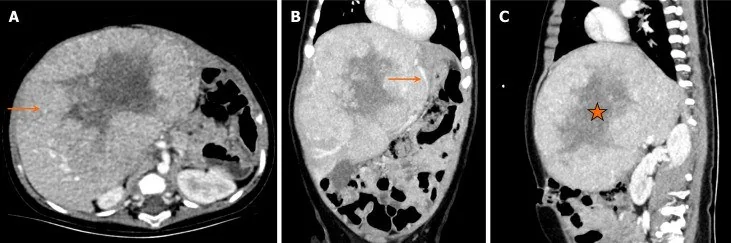
- BT'de hepatoblastom genellikle iyi sınırlı, heterojen bir lezyon olarak görülür ve kalsifikasyonlar olguların yaklaşık %40-50'sinde izlenir.
- Arteriyel tanısal
- BT'de hepatoblastom genellikle iyi sınırlı, heterojen bir lezyon olarak görülür; içinde nekroz veya kanamaya ait alanlar bulunabilir. Tümörün hepatik damarlarla ilişkisi ve damar invazyonu olasılığı, damar-tümör arayüzü değerlendirmesinde incelenir.
- Portal tanısal
- Hepatoblastom BT'de iyi sınırlı, solid ve heterojen bir lezyon olarak görülür; içinde kalsifikasyon odakları ile kistik nekroz alanları bulunabilir. Portal venöz fazda hepatoblastom, içinde nekroz veya kanamaya ait alanlar ile kalsifikasyon odakları bulunabilen solid bir kitle olarak değerlendirilir.
Önerilen pencereler G genişlik, M merkez; değerler Hounsfield birimi (HU)
- BatınG 400 / M +50
- KaraciğerG 150 / M +30
- AkciğerG 1500 / M −600
- AnjiyoG 600 / M +150
BT bulguları
- Lobüle solid kitle — çoğunlukla tek odaklı, karaciğer konturunu büyüten ve normal parankimi iten heterojen kitle.
- İç kalsifikasyon olguların yaklaşık %40-50'sinde görülür.
- Tümör içinde nekroz veya kanamaya ait alanlar bulunabilir.
- Portal ven tutulumu, PRETEXT değerlendirmesinde P ek faktörü olarak kaydedilir.
- PRETEXT V ek faktörü, hepatik ven veya inferior vena kava tutulumunu belirtir.
- Multifokalite — aynı karaciğer lobunda veya karşı lobda ayrı tümör nodülleri; tüm odakların haritalanması gerekir.
- Akciğerler hepatoblastomda uzak metastaz alanları arasındadır; bu tutulum PRETEXT M ek faktörüyle kaydedilir.
- Tümör rüptürü PRETEXT değerlendirmesinde R ek faktörü olarak kaydedilir.
- Akciğerler hepatoblastomda uzak metastazın en sık yerleri arasındadır ve akciğer metastazı PRETEXT M ek faktörüyle kaydedilir.
Ölçütler ve sınıflamalar
- PRETEXT
- Tedavi öncesi tümör yayılımı karaciğerin dört bölümüne (sol medial, sol lateral, sağ ön, sağ arka) göre PRETEXT I-IV olarak sınıflanır: I'de tümörsüz üç komşu bölüm vardır, II'de bir veya iki bölüm tutulurken tümörsüz iki komşu bölüm kalır, III sağ ve sol lobu birlikte tutan iki veya üç bölüm hastalığıdır ve yalnızca bir komşu bölüm tümörsüzdür, IV'te dört bölümün tamamı tutulur. V/P/E/F/R/C/N/M ek faktörleri sırasıyla hepatik ven/vena kava, portal ven, ekstrahepatik uzanım, multifokalite, rüptür, kaudat lob, bölgesel lenf düğümü ve uzak metastazı belirtir.
Normalde
Normal karaciğer parankimi homojen görünür; sağ ve sol portal dallar ile hepatik venler kesintisiz izlenir, konturda fokal bombeleşme veya damarların itilmesi beklenmez. Kitleyi karşı lobdaki parankim ve aynı düzeydeki damar dallarıyla kıyaslayın; kitlenin komşu yapıları itmesi ile portal ven trombozu ve hepatik ven tutulumunun varlığı evreleme açısından önemlidir.
Normal BT ile kıyasla
Aynı bölgenin, kaynak veri setinde patoloji içermediği belirtilen bir BT incelemesini kesit kesit kaydırın; organ sınırlarını açarak anatomiyi hasta görüntüsüyle karşılaştırın. Küçük rastlantısal bulgular tümüyle dışlanmamıştır.
Kaynak: TotalSegmentator v2.01 veri seti (Wasserthal ve ark., Radiology: Artificial Intelligence 2023), CC BY 4.0, vaka s0541; organ sınırları veri setinin otomatik segmentasyonundan, birleştirilerek sadeleştirildi. Görüntüler 2,5 mm kesit aralığına yeniden örneklendi.
Ayırıcı tanı
- Hepatik hemanjiyom
- periferik nodüler arteriyel kontrastlanma ve fazlar ilerledikçe merkeze dolum gösterir; hepatoblastomdaki heterojen solid doku ve kalsifikasyon farklıdır.
- Mezenkimal hamartom
- genellikle büyük, multiseptalı kistik kitle olup solid bileşenler içerebilir; bu görünüm, çoğunlukla solid ve heterojen olan hepatoblastomdan ayrımda yardımcı olur.
- Fokal nodüler hiperplazi
- arteriyel fazda belirgin ve daha homojen kontrastlanır; santral skar bulunabilir, çevre damarları yıkıcı biçimde tutması beklenmez.
- Hepatoselüler karsinom
- özellikle kronik karaciğer hastalığı veya daha büyük çocukta düşünülür; arteriyel hiperkontrastlanma ve portal fazda washout paterni olabilir.
- Nöroblastom genellikle adrenal medulla veya paraspinal sempatik zincirden kaynaklanan büyük, heterojen solid kitle oluşturur.
Tuzaklar
- Tek fazlı incelemede tümörün heterojen kontrastlanması canlı tümör ile nekrozu ayırmayı güçleştirir; eldeki tüm fazları birlikte okuyun ve fazı raporda belirtin.
- Büyük kitle komşu yapıları itip yer değiştirebildiğinden PRETEXT belirlerken hangi hepatik bölümün gerçekten tümörlü olduğunu ve damarsal tutulum ek faktörlerini ayrı ayrı kontrol edin.
- Akciğerler metastaz alanı olduğundan ve evrelemede toraks BT yapıldığından akciğer tutulumunu toraks evreleme görüntülemesinde ayrıca değerlendirin.
- Tümörün damara dıştan basısını damar tutulumu saymayın; yer değiştirme ile portal ven trombozu ve hepatik ven tutulumunu BT'de ayrı ayrı değerlendirin.
Kendini dene
BT'de hepatoblastomun kontrastlanma ve iç yapısı için hangisi tanımlanan görünüme uygundur?
Cevabı göster
Genellikle karaciğer parankiminden daha az kontrastlanan, heterojen ve nekroz veya kanama alanları içerebilen lezyon. Hepatoblastom BT'de genellikle normal karaciğer parankiminden daha az kontrastlanır; iyi sınırlı ve heterojen olabilir, nekroz veya kanama alanları içerebilir. Kalsifikasyonlar olguların yaklaşık %40–50'sinde görülür.
Tümör yalnız sol lateral anatomik hepatik bölümle sınırlı, diğer üç komşu bölüm tümörsüz. PRETEXT grubu hangisidir?
Cevabı göster
PRETEXT I. Tek bölüm tutulmuş ve diğer üç komşu bölüm tümörsüz olduğunda PRETEXT I tanımlanır. Gruplar radyolojik kesit sayısına değil dört hepatik bölümün tümör tutulumuna göre verilir.
İlgili konular
Kaynaklar
Bu sayfadaki 44 cümle ve 2 quiz sorusu aşağıdaki kaynaklardan alıntılarla otomatik olarak karşılaştırıldı; 14 cümle bu karşılaştırmada düzeltildi (2026-10-12).
- Pulmonary Metastasectomy After Liver Transplantation: Indications, Timing, and Surgical Decision-Making Across Primary Tumor Histologiespmc.ncbi.nlm.nih.gov
- Pathology reporting of hepatoblastoma resections: recommendations from the international collaboration on cancer reportingpmc.ncbi.nlm.nih.gov
- Progress in the study of therapeutic strategies for hepatoblastoma in childrenpmc.ncbi.nlm.nih.gov
- Imaging insights into pediatric liver masses: A comprehensive minireview for hepatology practicepmc.ncbi.nlm.nih.gov
- Hepatoblastoma: From Molecular Mechanisms to Therapeutic Strategiespmc.ncbi.nlm.nih.gov
- Fetal and neonatal liver tumours.pubmed.ncbi.nlm.nih.gov
- Molecular imaging and photodynamic therapy in hepatoblastoma.pubmed.ncbi.nlm.nih.gov
- 2017 PRETEXT: radiologic staging system for primary hepatic malignancies of childhood revised for the Paediatric Hepatic International Tumour Trial (PHITT).pubmed.ncbi.nlm.nih.gov
- Space Occupying Lesions in the Liver.pubmed.ncbi.nlm.nih.gov
- [Innovations in surgical treatment of pediatric solid tumors].pubmed.ncbi.nlm.nih.gov
- Magnetic resonance imaging of pediatric liver tumors.pubmed.ncbi.nlm.nih.gov
- Hepatocellular carcinoma and other hepatic malignancies: MR imaging.pubmed.ncbi.nlm.nih.gov
- Surgical treatment of hepatoblastoma.pubmed.ncbi.nlm.nih.gov
- MRI of paediatric liver tumours: How we review and report.pubmed.ncbi.nlm.nih.gov
- Pediatric Abdominal Malignancies and Intravascular Extension: Contemporary Single-Center Experience.pubmed.ncbi.nlm.nih.gov
- FDG-PET/CT in pediatric solid tumors.pubmed.ncbi.nlm.nih.gov
- Problematic lesions in cirrhotic liver mimicking hepatocellular carcinoma.pubmed.ncbi.nlm.nih.gov
- Clinicopathological features of primary hepatic diffuse large B-cell lymphoma: a report of seven cases and a literature review.pubmed.ncbi.nlm.nih.gov
- Staging and following common pediatric malignancies: MRI versus CT versus functional imaging.pubmed.ncbi.nlm.nih.gov
- Definitive surgical outcomes in children with advanced hepatoblastoma (PRETEXT III-IV): A retrospective single-center canadian experience.pubmed.ncbi.nlm.nih.gov
- Bibliometric and clinical trial landscape of hepatoblastoma (2000-2024): a multi-database analysis of global research.pubmed.ncbi.nlm.nih.gov
- FOXM1 knockdown suppresses hepatoblastoma progression and glycolysis by inhibiting the Wnt/β-catenin pathway.pubmed.ncbi.nlm.nih.gov
- Treatment and outcomes of hepatoblastoma in a tertiary care pediatric institution: a single-center experience.pubmed.ncbi.nlm.nih.gov
- Multimodality imaging in the diagnosis of biliary rhabdomyosarcoma in a young child: a case report.pubmed.ncbi.nlm.nih.gov
- Pediatric Personalized Deep Learning Models for Segmentation of Hepatoblastoma at CT and MRI.pubmed.ncbi.nlm.nih.gov
- Pediatric Hepatoblastoma: From Developmental Molecular Mechanisms to Innovative Therapeutic Strategies.pubmed.ncbi.nlm.nih.gov
- Hepatoblastoma: From Molecular Mechanisms to Therapeutic Strategies.pubmed.ncbi.nlm.nih.gov
- Review on Pediatric Malignant Focal Liver Lesions with Imaging Evaluation: Part I.pubmed.ncbi.nlm.nih.gov
- Undifferentiated embryonal sarcoma of the liver presenting as a complex mixed solid-cystic hepatic lesion in a young adult: A case report.pubmed.ncbi.nlm.nih.gov
- Rare pancreatic ductal adenocarcinoma variants and other malignant epithelial tumors: a comprehensive clinical and radiologic review.pubmed.ncbi.nlm.nih.gov
- Pancreatoblastoma with Portal Venous Invasion: A Case Series.pubmed.ncbi.nlm.nih.gov
- A pretreatment multiphasic CT-based decision-support model for differentiating pediatric hepatoblastoma from focal nodular hyperplasia.pubmed.ncbi.nlm.nih.gov
- Liver transplantation for pediatric liver tumors: a case report of hepatic angiosarcoma with literature review.pubmed.ncbi.nlm.nih.gov
- Calcified nest in the liver: Case report of CNSET.pubmed.ncbi.nlm.nih.gov
- Liver Ewing sarcoma: A case report.pubmed.ncbi.nlm.nih.gov
- Salvage resection for FGFR2 fusion-positive intrahepatic cholangiocarcinoma after pemigatinib therapy: a case report and literature review.pubmed.ncbi.nlm.nih.gov
- Hepatic Alveolar Echinococcosis Mimicking Perihilar Cholangiocarcinoma: A Case Report.pubmed.ncbi.nlm.nih.gov
- Improving image quality and diagnostic confidence for PRETEXT staging in pediatric hepatoblastoma using thin-slice and low-energy virtual monochromatic images in dual-energy CT with deep learning image reconstruction algorithm.pubmed.ncbi.nlm.nih.gov
- Clinicopathological Characteristics of Acute Antibody-Mediated Rejection in Pediatric Liver Transplantation-A Single-Center Study.pubmed.ncbi.nlm.nih.gov
- EACR 2025 Congress: Innovative Cancer Science, 16-19 June 2025.pubmed.ncbi.nlm.nih.gov
- Patterns of injury and violence in Yaoundé Cameroon: an analysis of hospital data.pubmed.ncbi.nlm.nih.gov
- Spectral CT and Photon-counting Detector CT: Principles and Applications in Neuroradiology.pubmed.ncbi.nlm.nih.gov
- Imaging insights into pediatric liver masses: A comprehensive minireview for hepatology practice.pubmed.ncbi.nlm.nih.gov
- CT scan diagnosis of hepatic adenoma in a case of von Gierke disease.pubmed.ncbi.nlm.nih.gov
- Associating Liver Partition and Portal Vein Ligation for Staged Hepatectomy (ALPPS) in Children with Advanced Hepatoblastoma-Lessons from a Case Series and Literature Review.pubmed.ncbi.nlm.nih.gov
- Clinical Risk Factors and Outcomes of Spontaneous Hepatoblastoma Rupture in Children: A 10-Year Propensity Score-Matched Study.pubmed.ncbi.nlm.nih.gov
- <i>In Situ</i> Hypothermic Perfusion in Hepatectomy for Advanced Hepatoblastoma: A Case Report and Literature Review.pubmed.ncbi.nlm.nih.gov
- Outcome of Liver Resection for Hepatoblastoma in Children from a General Pediatric Surgery Referral Center.pubmed.ncbi.nlm.nih.gov
- A Rare Case of Non-cirrhotic Hepatocellular Carcinoma in a Female Adolescent: Diagnostic and Multimodal Treatment Challenges in a Low-Resource Setting.pubmed.ncbi.nlm.nih.gov
- Pulmonary Metastasectomy After Liver Transplantation: Indications, Timing, and Surgical Decision-Making Across Primary Tumor Histologies.pubmed.ncbi.nlm.nih.gov
- Evaluation of hepatic infantile hemangiomas: the potential of contrast-enhanced ultrasound.pubmed.ncbi.nlm.nih.gov
- Advances in Fluorescent Adjuncts in Pediatric Surgery: A Comprehensive Review of Applications of Indocyanine Green Across Surgical Specialties.pubmed.ncbi.nlm.nih.gov
- Primary non-hepatoblastoma liver tumors in children-Defining the profile of a very rare subset of childhood tumors.pubmed.ncbi.nlm.nih.gov
- Whole-body magnetic resonance imaging vs. positron emission tomography-computed tomography in pediatric oncology: enhancing diagnostic precision for solid tumors.pubmed.ncbi.nlm.nih.gov
- International Society of Paediatric Surgical Oncology (IPSO) Minimally Invasive Surgery (MIS) Guidelines.pubmed.ncbi.nlm.nih.gov
- Unusual liver tumors: spectrum of imaging findings with pathologic correlationpubmed.ncbi.nlm.nih.gov
- Computed Tomographic Findings of Primary Hepatic Extraskeletal Osteosarcoma With Peritoneal Metastasis via Periportal Space in a Dog.pubmed.ncbi.nlm.nih.gov
- Alveolar echinococcosis.pubmed.ncbi.nlm.nih.gov
- Imaging features, diagnosis, and clinical management of hepatic involvement in hereditary hemorrhagic telangiectasia: a case series report and literature review.pubmed.ncbi.nlm.nih.gov
- Impact of preoperative chemotherapy cycles on tumor resectability and surgical timing in hepatoblastoma: a retrospective analysis.pubmed.ncbi.nlm.nih.gov
- Preoperative Triple-Phase Three-Dimensional-Multi-Detector Computed Tomography Imaging of the Hepatic Vascular Tree: An Accurate Road Map Prior to Tumor Resection in Hepatoblastoma.pubmed.ncbi.nlm.nih.gov
- Progress in the study of therapeutic strategies for hepatoblastoma in children.pubmed.ncbi.nlm.nih.gov
- Outcomes of children with well-differentiated fetal hepatoblastoma treated with surgery only: Report from Children's Oncology Group Trial, AHEP0731.pubmed.ncbi.nlm.nih.gov
- Spontaneous regression of a giant hepatic hemangioma on serial MRI: A case report with 3-year follow-up.pubmed.ncbi.nlm.nih.gov
- Bubbles in the barely born-contrast-enhanced ultrasound in neonates: a single-center experience.pubmed.ncbi.nlm.nih.gov
- Primary hepatic angiosarcoma misdiagnosed as hemangioma despite repeated negative biopsies and sclerotherapy: A diagnostic pitfall.pubmed.ncbi.nlm.nih.gov
- Complete surgical resection of a giant hepatic mesenchymal hamartoma in an infant: a multidisciplinary approach and confirmed disease-free outcome.pubmed.ncbi.nlm.nih.gov
- A case series of radiologically misdiagnosed visceral lymphatic malformations.pubmed.ncbi.nlm.nih.gov
- Large Mesenchymal Hepatic Hamartoma in Pediatric Age: A Case Report.pubmed.ncbi.nlm.nih.gov
- Focal nodular hyperplasia: a rare benign liver tumour in early childhood without predisposing factors.pubmed.ncbi.nlm.nih.gov
- Case Report: Focal nodular hyperplasia of the liver in an adolescent-a case report and literature review.pubmed.ncbi.nlm.nih.gov
- Hepatocellular Carcinoma Arising From Well-Differentiated Hepatocellular Neoplasm of Uncertain Malignant Potential in a Patient With Abernethy Malformation.pubmed.ncbi.nlm.nih.gov
- Liver Imaging Reporting and Data System (LI-RADS): A Comprehensive Review.pubmed.ncbi.nlm.nih.gov
- Rare Extrahepatic Metastasis of Hepatocellular Carcinoma to the Left Triangular Ligament: A Case Report.pubmed.ncbi.nlm.nih.gov
- An Unusual Cause of Persistent Wheeze in Infancy: Intrathoracic Neuroblastoma of the Lower Thoracic Sympathetic Chain.pubmed.ncbi.nlm.nih.gov
- Adult-onset neuroblastic tumor: An extremely rare entity in the adult population.pubmed.ncbi.nlm.nih.gov
- Neuroblastoma Presenting as a Congenital Renal Mass in a Neonate: A Diagnostic Pitfall.pubmed.ncbi.nlm.nih.gov
- Incidental/Misdiagnosed Intrahepatic Cholangiocarcinoma and Combined Hepatocellular-Cholangiocarcinoma in Patients Undergoing Living Donor Liver Transplantation.pubmed.ncbi.nlm.nih.gov
- Foundation Models Meet Medical Image Interpretation.pubmed.ncbi.nlm.nih.gov
- Ferumoxytol-Enhanced MRI in Children and Young Adults: State of the Art.pubmed.ncbi.nlm.nih.gov
- Pediatric pulmonary nodules: current state of knowledge, AI applications, and future directions.pubmed.ncbi.nlm.nih.gov
- Venous Thromboembolism in Neonates, Children, and Adolescents: A Comprehensive Narrative Review of Risk Factors, Diagnosis, Treatment, and Prevention.pubmed.ncbi.nlm.nih.gov
- International Society of Paediatric Surgical Oncology (IPSO) Surgical Practice Guidelines.pubmed.ncbi.nlm.nih.gov
- Yttrium-90 Transarterial Radioembolization as a Bridging Therapy to Liver Transplant in a Toddler With Pretreatment Extent (PRETEXT) IV Hepatoblastoma.pubmed.ncbi.nlm.nih.gov
- Quantitative ctDNA Detection in Hepatoblastoma: Implications for Precision Medicine.pubmed.ncbi.nlm.nih.gov
- Copy Number Alterations in Hepatoblastoma: Literature Review and a Brazilian Cohort Analysis Highlight New Biological Pathways.pubmed.ncbi.nlm.nih.gov
- Does laparoscopic surgery decrease the risk of atrial fibrillation after foregut surgery?pubmed.ncbi.nlm.nih.gov
- Hepatic mesenchymal hamartoma showing hepatobiliary-phase signal increase on gadoxetate disodium-enhanced magnetic resonance imaging: A case report.pubmed.ncbi.nlm.nih.gov
- Giant Mature Cystic Perihepatic Teratoma in an Adult Woman.pubmed.ncbi.nlm.nih.gov
- Predictors for Recurrence in Hepatoblastoma: Single-center Study.pubmed.ncbi.nlm.nih.gov
- Survival analysis of laparoscopic and laparotomy hepatectomy for pediatric liver neoplasm: a single-center retrospective cohort study.pubmed.ncbi.nlm.nih.gov
- Insight into congenital absence of the portal vein: is it rare?pubmed.ncbi.nlm.nih.gov
- Large Undifferentiated Sarcoma of the Liver: A Rare Case Report and Literature Review.pubmed.ncbi.nlm.nih.gov
- Rare mandibular metastasis of neuroblastoma in a child: a case report.pubmed.ncbi.nlm.nih.gov
- hNET-targeted [<sup>18</sup>F]MFBG PET as baseline functional imaging in newly diagnosed neuroblastoma.pubmed.ncbi.nlm.nih.gov
- Whole-Body MRI Versus <sup>18</sup>F-FDG-PET/CT for the Detection of Nodal and Distant Metastases in Pediatric Patients with Solid Tumors.pubmed.ncbi.nlm.nih.gov
- Treatment of Undifferentiated Embryonal Sarcoma of the Liver in Children.pubmed.ncbi.nlm.nih.gov
- Multiparametric cardiovascular magnetic resonance for differentiating cardiac masses: clinical impact from a case series.pubmed.ncbi.nlm.nih.gov
- Pediatric Focal Nodular Hyperplasia Mimicking Hepatic Metastasis from Wilms Tumor: A Case Report.pubmed.ncbi.nlm.nih.gov
- Massive undifferentiated embryonal sarcoma: An unusual primary hepatic malignancy.pubmed.ncbi.nlm.nih.gov
- Comparison of ultrasonographic features between two types of hepatic echinococcosis and hepatoblastoma in children.pubmed.ncbi.nlm.nih.gov
- A rare case report of hepatoblastoma in a child with ectopic adrenocorticotropic hormone syndrome.pubmed.ncbi.nlm.nih.gov
- Current approach to diagnosis and treatment of focal nodular hyperplasia in children with a management algorithm.pubmed.ncbi.nlm.nih.gov
- Fibrolamellar hepatocellular carcinoma: Advances, challenges and opportunities in a rare malignancy.pubmed.ncbi.nlm.nih.gov
- 2005 PRETEXT: a revised staging system for primary malignant liver tumours of childhood developed by the SIOPEL group.pubmed.ncbi.nlm.nih.gov
- Abdominal pain and distension in a 4-years-old child revealing an hepatoblastoma.pubmed.ncbi.nlm.nih.gov
- Surgical management of biliary fistula following associating liver partition and portal vein ligation for staged hepatectomy in pediatric hepatoblastoma: a case report and literature review.pubmed.ncbi.nlm.nih.gov
- Cancer predisposition syndromes: an imaging review.pubmed.ncbi.nlm.nih.gov
- Minimal adjuvant chemotherapy for children with hepatoblastoma resected at diagnosis (AHEP0731): a Children's Oncology Group, multicentre, phase 3 trial.pubmed.ncbi.nlm.nih.gov
- Kasai-Like Hepaticojejunostomy As Salvage Reconstruction for Bile Duct Injury in an Infant: A Case Report and Technical Consideration.pubmed.ncbi.nlm.nih.gov
- Undifferentiated embryonal sarcoma of the liver in an 11-year-old boy: a case report and clinical insights.pubmed.ncbi.nlm.nih.gov
- Treatment Adaptation to Surgical Timing in Pediatric Hepatoblastoma: A 19-Year Single-Center Experience With Resection and Liver Transplantation.pubmed.ncbi.nlm.nih.gov
- Pathology reporting of hepatoblastoma resections: recommendations from the international collaboration on cancer reporting.pubmed.ncbi.nlm.nih.gov
- Prenatal diagnosis and postnatal management of perinatal thoracoabdominopelvic tumors: multicenter experience.pubmed.ncbi.nlm.nih.gov
- Case Report: Complete remission in a neonate with high-risk neuroblastoma harboring MYCN amplification and 1p deletion: a case for aggressive early intervention, and literature review.pubmed.ncbi.nlm.nih.gov
Eğitim amaçlıdır; hasta başında tanı ve tedavi kararının yerine geçmez, tıbbi tavsiye değildir. Metinler yapay zekâ desteğiyle yazıldı ve otomatik bir adımda kaynak alıntılarıyla karşılaştırıldı; bu bir tıbbi doğrulama değildir ve içerik uzman radyolog incelemesinden geçmedi. Klinik kararlarda güncel kılavuzları, kurum protokollerini ve radyoloji raporunu esas alın.