Özet
BT protokolü, klinik soruyu yanıtlayacak anatomik alanı ve görüntü kalitesini hasta için gerekçeli radyasyon maruziyetiyle dengelemelidir. BT görüntü kalitesi; tüp gerilimi gibi edinim parametreleri, hasta özellikleri ve rekonstrüksiyon algoritmalarından etkilenir; gürültü ve yapı keskinliği bu etkenlerle değişebilir. BT protokol parametrelerinin uygunluğu klinik göreve göre değişir; tek bir ayar her klinik görev için en uygun görüntü kalitesini sağlamayabilir. Amaçlanan anatomik sınırların ötesine uzanan tarama gereksiz radyasyon maruziyetine yol açabilir; protokol optimizasyonu görüntü kalitesini tanısal görevle dengelemelidir.
Okuma sırası
- Toraks topogramı. Topogramda üst ve alt tarama sınırlarını belirleyin; seçilen toraks sorusu için planlanan aralığın ilgili anatomiyi kapsadığını doğrulayın.
- Bazal akciğer ve kostofrenik sinüsler. Topogramın kaudal ucuna gidin ve kostofrenik sinüslerin aksiyel seride gerçekten bulunduğunu eşleştirin; plan çizgisinin ötesinde kalan anatomi görüntü verisinde yer almaz.
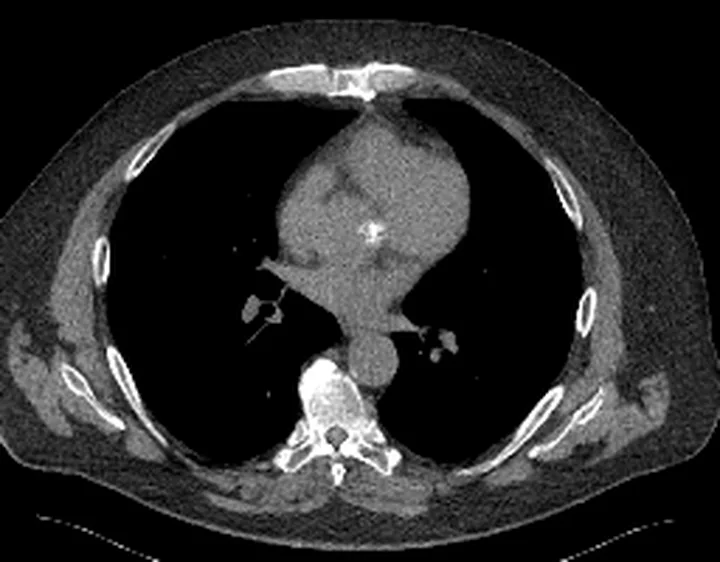
- Karina ve pulmoner damar dalı. Karina kesitinde pulmoner damarların akciğer parankimine uzanan dalını seçin; damar sınırının gürültü tarafından örtülüp örtülmediğini işaretleyin.
- Akciğer parankimi. Damarlar arasındaki parankim alanında gürültünün ince ayrıntıları örtecek düzeyde olup olmadığını gözlemleyin.
- Diyafram ve kostofrenik sinüsler. Bazal plevra ve diyafram konturunu inceleyin; kostofrenik sinüslerin görüntü alanında yer alıp almadığını ve ince ayrıntıların gürültü nedeniyle örtülüp örtülmediğini değerlendirin.
Faz ve pencere
- Kontrastsız tanısal
- Kontrastsız toraks BT örneğinde topogramla planlanan tarama aralığı ilgili anatomiyi kapsamalıdır; kuantum gürültüsü, dedektöre ulaşan foton sayısındaki istatistiksel değişkenlikten kaynaklanır.
Önerilen pencereler: Akciğer (G 1500 / M -600), Mediasten (G 350 / M 50), Kemik (G 1800 / M 400).
BT bulguları
- Topogramda planlanan tarama aralığı, istenen klinik soruyla ilgili anatomiyi kapsamalıdır; aralık anatomik sınırlara göre planlanmalıdır.
- Hasta zayıflaması ve tüp akımı, dedektöre ulaşan foton sayısını etkiler; foton sayısındaki istatistiksel değişkenlik kuantum gürültüsüne, düşük foton sayısı ise ince ayrıntıların görünürlüğünde azalmaya yol açabilir.
- Tüp gerilimi X ışını spektrumunu ve iyot kontrastının görünürlüğünü etkiler; düşük gerilim küçük veya uygun boyutlu hastalarda iyot kontrastını artırabilir, ancak vücut kalınlığına göre foton yetersizliği doğurabilir.
- Helikal pitch masa ilerlemesinin toplam ışın kolimasyonuna oranıdır; masa hızı ve örnekleme düzeniyle birlikte değerlendirilir, görüntü kalitesi ve doz etkisi tarayıcı uygulamasına bağlıdır.
- Dedektör kolimasyonu ile yeniden oluşturulan kesit kalınlığı farklı kavramlardır; ince rekonstrüksiyon küçük yapıları ve çok düzlemli reformasyonları destekler, görüntü gürültüsünü daha görünür kılabilir.
- Gantri dönüş süresi bir BT edinim parametresidir; kaynakta karşılaştırılan EID-CT ve PCD-CT taramalarında 0,5 saniye olarak kullanılmıştır.
- Rekonstrüksiyon algoritması görüntü gürültüsü ve yapı keskinliğini etkileyebilir.
Normalde
Normal erişkin toraks incelemesinde seçilen soru için gereken akciğer apeksleri, hiler yapılar ve bazal plevral sinüsler görüntü alanında yer alır; parankim dokusu ve damar kenarları tanısal ayrıntıyı örten yaygın gürültü olmadan seçilir. Topogram ile aksiyel serinin kapsamını birlikte eşleştirin; karina kesitinde damar sınırlarının ve parankim dokusunun protokol amacına yetecek görünürlükte olup olmadığını kıyaslayın.
Normal BT ile kıyasla
Aynı bölgenin, kaynak veri setinde patoloji içermediği belirtilen bir BT incelemesini kesit kesit kaydırın; organ sınırlarını açarak anatomiyi hasta görüntüsüyle karşılaştırın. Küçük rastlantısal bulgular tümüyle dışlanmamıştır.
Kaynak: TotalSegmentator v2.01 veri seti (Wasserthal ve ark., Radiology: Artificial Intelligence 2023), CC BY 4.0, vaka s1278; organ sınırları veri setinin otomatik segmentasyonundan, birleştirilerek sadeleştirildi. Görüntüler 2,5 mm kesit aralığına yeniden örneklendi.
Ayırıcı tanı
- Yetersiz foton istatistiği
- kuantum gürültüsü görüntüdeki ince ayrıntıları örtebilir; düşük foton sayısı yüksek zayıflama veya düşük tüp akımıyla ilişkili olabilir.
- Hareket artefaktı
- göğüs BT'de aort kökü hareketine bağlı artefaktlar görüntü kalitesi değerlendirmesini etkileyebilir; incelenen protokollerde ultrahızlı tarama modu daha yüksek hareket ilişkili öznel görüntü kalitesi sağlamıştır.
- Eksik tarama kapsamı
- topogramda apeks, bazal akciğer veya istenen başka anatomik sınırın çekim alanı dışında kaldığı görülür.
- Parsiyel hacim etkisi küçük yapıların komşu dokularla karışmasına neden olabilir.
Tuzaklar
- Düşük doz yaklaşımını yalnızca tüp akımını azaltmak olarak anlatmayın; hasta boyutu, otomatik pozlama kontrolü, klinik görev ve rekonstrüksiyon birlikte görüntü kalitesini belirler.
- Bir tarayıcıdaki kVp, pitch veya akım değerini farklı üreticiye ya da farklı vücut yapısına doğrudan taşımayın; doz kontrolü ve dedektör performansı değişebilir.
- Sadece doz göstergesini düşürmeyi optimizasyon saymayın; klinik görev için gerekli anatomik görünürlük ve kapsama da korunmalıdır.
Kendini dene
Topogramda akciğer apeksi üst sınırın dışında kalıyor. Hangi protokol sorunu doğrudan görülüyor?
Cevabı göster
Eksik anatomik kapsam. Tarama sınırının dışında kalan apeks edinim verisinde bulunmaz ve sonradan rekonstrüksiyonla eklenemez. Pencere, HU kalibrasyonu ve kontrast zamanlaması anatomik kapsamın dışarıda bırakılmasını açıklamaz.
Büyük yapılı bir hastanın BT görüntüsünde yaygın kuantum gürültüsü görülüyor. Bu gürültünün temel nedeni nedir?
Cevabı göster
Dedektöre ulaşan foton sayısındaki istatistiksel değişkenlik. Kuantum gürültüsü, dedektöre ulaşan foton sayısındaki istatistiksel değişkenlikten kaynaklanır; yüksek zayıflama foton sayısını azaltabilir.
İlgili konular
- BT görüntüsünün oluşumu
- Kontrast fazları ve zamanlama
- Pencere seviyesi ve genişliği
- BT doz göstergeleri ve efektif doz
- Hareket artefaktı
Kaynaklar
Bu sayfadaki 34 cümle ve 2 quiz sorusu aşağıdaki kaynaklardan alıntılarla otomatik olarak karşılaştırıldı; 14 cümle bu karşılaştırmada düzeltildi (2026-10-09).
- Artificial intelligence in personalized computed tomography dose optimization: a systematic review of techniques and clinical outcomespmc.ncbi.nlm.nih.gov
- Comments on the Letter: Strengthening the Evidence Base for Pediatric Cardiac Computed Tomography: Statistical and Technological Considerationspmc.ncbi.nlm.nih.gov
- Size-specific dose estimation in pediatric computed tomography: From dose characterization to individualized optimizationpmc.ncbi.nlm.nih.gov
- It Is All About Energy-the Changing Role of X-ray Photons in Photon-counting Detector Computed Tomographypmc.ncbi.nlm.nih.gov
- Performance of Commercial Deep Learning-Based Radiation Dose Optimization Software in Pediatric Radiology: A Systematic Reviewpmc.ncbi.nlm.nih.gov
- Relationships of pediatric anthropometrics for CT protocol selection.pubmed.ncbi.nlm.nih.gov
- New advances in CT imaging of pancreas diseases: a narrative review.pubmed.ncbi.nlm.nih.gov
- Fully automated image quality evaluation on patient CT: Multi-vendor and multi-reconstruction study.pubmed.ncbi.nlm.nih.gov
- Transition to Fast Whole-Body SPECT/CT Bone Imaging: An Assessment of Image Quality.pubmed.ncbi.nlm.nih.gov
- Optimization of CT protocol in polytrauma patients: an update.pubmed.ncbi.nlm.nih.gov
- Image quality of mean temporal arterial and mean temporal portal venous phase images calculated from low dose dynamic volume perfusion CT datasets in patients with hepatocellular carcinoma and pancreatic cancer.pubmed.ncbi.nlm.nih.gov
- The effect of head size∕shape, miscentering, and bowtie filter on peak patient tissue doses from modern brain perfusion 256-slice CT: how can we minimize the risk for deterministic effects?pubmed.ncbi.nlm.nih.gov
- Diagnostic protocols in oncology: workup and treatment planning. Part 1: the optimitation of CT protocol.pubmed.ncbi.nlm.nih.gov
- Exposing exposure: automated anatomy-specific CT radiation exposure extraction for quality assurance and radiation monitoring.pubmed.ncbi.nlm.nih.gov
- Optimization of low-dose CT protocol in pediatric nuclear medicine imaging.pubmed.ncbi.nlm.nih.gov
- Optimization of CT protocols using cause-and-effect analysis of outliers.pubmed.ncbi.nlm.nih.gov
- An optimized protocol for multislice computed tomography of the canine brain.pubmed.ncbi.nlm.nih.gov
- Radiation dosimetry changes in radiotherapy treatment plans for adult patients arising from the selection of the CT image reconstruction kernel.pubmed.ncbi.nlm.nih.gov
- Technical Note: Increased photon starvation artifacts at low helical pitch in ultra-low-dose CT.pubmed.ncbi.nlm.nih.gov
- Artificial intelligence in personalized computed tomography dose optimization: a systematic review of techniques and clinical outcomes.pubmed.ncbi.nlm.nih.gov
- Deep Learning Reconstruction Enables Substantial Radiation Dose Reduction in Ultra-High-Resolution Temporal Bone CT: a Body Donor Study.pubmed.ncbi.nlm.nih.gov
- Size-specific dose estimation in pediatric computed tomography: From dose characterization to individualized optimization.pubmed.ncbi.nlm.nih.gov
- Optimizing shielding protocols in tube current modulation chest computed tomography: a phantom study.pubmed.ncbi.nlm.nih.gov
- Reduced environmental impact in body CT imaging with deep learning reconstruction: experience of a high-volume tertiary referral center.pubmed.ncbi.nlm.nih.gov
- Aortic root motion artifacts on non-electrocardiographic-gated chest CT: A comparison of five CT scanner protocols including an ultrafast wide-detector CT system.pubmed.ncbi.nlm.nih.gov
- Stereotactic body radiation therapy for hepatocellular carcinoma: 2026 expert consensus-based practical recommendation of the Korean Liver Cancer Association.pubmed.ncbi.nlm.nih.gov
- Klippel-Trénaunay Syndrome With Pelvic/Rectal and Urinary Bladder Involvement: A Rare Case Report.pubmed.ncbi.nlm.nih.gov
- Preoperative planning for endovascular aortic arch repair.pubmed.ncbi.nlm.nih.gov
- The Diagnostic and Prognostic Impact of Cardiovascular Magnetic Resonance in Ischemic Heart Disease: A Systematic Review.pubmed.ncbi.nlm.nih.gov
- General-Purpose B-Mode Intraoperative Ultrasonography in Perirolandic Brain Metastasis Surgery: Practical Value and Limitations.pubmed.ncbi.nlm.nih.gov
- Magnetic resonance imaging thoracic organ-at-risk atlas for radiation oncology.pubmed.ncbi.nlm.nih.gov
- Cardiovascular Computed Tomography Angiographic Assessment of Simple Cardiac Shunts in Adults.pubmed.ncbi.nlm.nih.gov
- Chest wall lift for thoracoscopic lung lobectomy: Technique and results in two cats.pubmed.ncbi.nlm.nih.gov
- Scan Range and Radiation Dose of the Ultra-High-Resolution Series in Pancreatic Photon-Counting Detector CT: A Prospective Two-Group Comparison of an Ultra-Low-Dose Planning Series.pubmed.ncbi.nlm.nih.gov
- Mapping the Landscape of Over-Scanning in CT Imaging: A Scoping Review.pubmed.ncbi.nlm.nih.gov
- Personalized eye protection for head CT organ-based tube current modulation: A deep learning approach to derive 3D eyeball models from a single-view topogram.pubmed.ncbi.nlm.nih.gov
- Next-gen paediatric imaging: ultra-low dose chest photon-counting CT approaching chest radiograph doses.pubmed.ncbi.nlm.nih.gov
- Dual-scan conformal cone-beam CT for targeted image-quality improvement using dynamic collimation.pubmed.ncbi.nlm.nih.gov
- Size-specific weighted detectability index for computed tomography image characterization.pubmed.ncbi.nlm.nih.gov
- Efficiency and Optimization of Iodinated Contrast Agents in Cerebral Aneurysm CT Angiography: A Systematic Review.pubmed.ncbi.nlm.nih.gov
- Diagnostic Value and Operational Recommendations for Late Iodine Enhancement and ECV Quantification in Single-Energy Computed Tomography: A Narrative Review.pubmed.ncbi.nlm.nih.gov
- The impact of a novel deep learning reconstruction algorithm on image quality in ultralow-dose CT: a quantitative phantom study.pubmed.ncbi.nlm.nih.gov
- A wide-detector CT protocol for one-stop cardio-cerebrovascular angiography: a technical feasibility study comparing an integrated protocol with conventional two-scan approach.pubmed.ncbi.nlm.nih.gov
- A Practical Rule-of-Thumb to Adapt Contrast Media Dose in Photon-counting Detector CT: The 10-to-5 Rule.pubmed.ncbi.nlm.nih.gov
- Comparative Analysis of Middle Ear Prostheses Using Photon-Counting Detector CT versus Conventional CT.pubmed.ncbi.nlm.nih.gov
- Understanding Photon-Counting CT: Physics, Detector Technology, and Image Reconstructions.pubmed.ncbi.nlm.nih.gov
- Radiation exposure for planning deformity corrections with hexapods: comparison of conventional X-ray, standard CT, and ultra-low-dose CT.pubmed.ncbi.nlm.nih.gov
- Nonstop gated cone-beam computed tomography for respiratory gating pancreatic cancer radiotherapy using dual-domain deep learning reconstruction.pubmed.ncbi.nlm.nih.gov
- Single-Bolus Sequential Triple-Rule-Out CT Angiography: Image Quality and Radiation Dose on Wide-Area Detector and Dual-Source CT.pubmed.ncbi.nlm.nih.gov
- Ring Artifact Reduction in Photon Counting CT Using Redundant Sampling and Autocalibration.pubmed.ncbi.nlm.nih.gov
- Evaluation of deep-learning iterative reconstruction combined with high-frequency kernels in CT: a task-based image quality study.pubmed.ncbi.nlm.nih.gov
- Optimization of spectral photon-counting CT reconstruction parameters for improved detection of peritoneal metastases compared with energy-integrating detector dual-energy CT: a phantom study.pubmed.ncbi.nlm.nih.gov
- Perioperative POCUS: Technical Considerations and Applications for the Pediatric Anesthesiologist.pubmed.ncbi.nlm.nih.gov
- Feasibility of AI-Denoised Ultra-Low-Dose CT for Detection of Acute Pelvic and Hip Fractures: A Pilot Multi-Reader Study.pubmed.ncbi.nlm.nih.gov
- Quantitative estimation of pleural effusion volume on chest radiography: comparison of radiologists and a general-purpose multimodal AI model using CT as the reference standard.pubmed.ncbi.nlm.nih.gov
- Impact of an ultra-low dose unenhanced planning scan on CT coronary angiography scan length and effective radiation dose.pubmed.ncbi.nlm.nih.gov
- A comparison of breast and lung doses from chest CT scans using organ-based tube current modulation (OBTCM) vs. Automatic tube current modulation (ATCM).pubmed.ncbi.nlm.nih.gov
- Impact of Different Energy Levels of Virtual Monoenergetic Reconstructions on Radiomic Features Stability in Organic Phantom Imaging Using Photon-Counting CT.pubmed.ncbi.nlm.nih.gov
- Quantitative Evaluation of Low-Dose CT Image Quality Using Deep Learning Reconstruction: A Comparative Study of Philips Precise Image and GE TrueFidelity.pubmed.ncbi.nlm.nih.gov
- Acute Traumatic Aortic Injury: What the Radiologist Needs to Know.pubmed.ncbi.nlm.nih.gov
- A respiratory motion analysis for guiding stereotactic arrhythmia radiotherapy motion management.pubmed.ncbi.nlm.nih.gov
- Unlocking the Potential of Chest MRI: Strategies for Establishing a Successful Practice.pubmed.ncbi.nlm.nih.gov
- TOPOS: target organ prediction on scout views for automated CT scan planning.pubmed.ncbi.nlm.nih.gov
- Artificial intelligence-driven preoperative CT 3D planning: a narrative review on improving the accuracy of acetabular cup angle and size in total hip arthroplasty.pubmed.ncbi.nlm.nih.gov
- Region-specific QCT thresholds for osteoporosis assessment in the thoracic spine: why lumbar cut-offs fail.pubmed.ncbi.nlm.nih.gov
- Quantifying the impact of slice thickness on cardiovascular risk stratification in lung cancer screening: a multi-center "RESCUE" study.pubmed.ncbi.nlm.nih.gov
- Evaluation of a dual-energy computed tomography parameter -radiomics combined model for solitary pulmonary nodules.pubmed.ncbi.nlm.nih.gov
- Quantifying the Resolution Ceiling of Prototype-Based Few-Shot Segmentation on Sub-Centimetre Pulmonary Nodules: A Training-Free Geometric Analysis.pubmed.ncbi.nlm.nih.gov
- Application of Deep Learning Algorithm-Based Image Reconstruction in Improving Abdominal CT Image Quality in Adrenal and Renal Lesions Detection.pubmed.ncbi.nlm.nih.gov
- Low-kVp techniques for radiation dose optimization in abdominopelvic contrast-enhanced CT: a scoping review.pubmed.ncbi.nlm.nih.gov
- Performance of Commercial Deep Learning-Based Radiation Dose Optimization Software in Pediatric Radiology: A Systematic Review.pubmed.ncbi.nlm.nih.gov
- MIRD Pamphlet No. 34, Part 2: Benchmarking of MIRDct Software for CT Organ Dose Estimation.pubmed.ncbi.nlm.nih.gov
- Fetal organ dose calculator for maternal CT.pubmed.ncbi.nlm.nih.gov
- Artificial Intelligence in Chest Computed Tomography Optimization: A Task-based Framework for Balancing Detectability and Radiation Dose.pubmed.ncbi.nlm.nih.gov
- Self-Supervised Joint Reconstruction and Denoising of T2-Weighted PROPELLER MRI of the Lung at 0.55T.pubmed.ncbi.nlm.nih.gov
- Radon-Guided Wavelet-Domain Attention U-Net for Periodic Artifact Suppression in Brain MRI.pubmed.ncbi.nlm.nih.gov
- Phantom-based assessment of a modified 4D-MRI protocol for abdominal tumor motion tracking: Effects of sequence parameters and modality comparison.pubmed.ncbi.nlm.nih.gov
- Optimization of image quality and radiation dose in low-dose pediatric chest CT Using 80 kVp acquisition and variable ASiR-V reconstruction: A retrospective comparative study.pubmed.ncbi.nlm.nih.gov
- Optimization of Posterior Fossa Image Quality Using Virtual Monoenergetic Reconstructions from Dual-Layer Spectral CT.pubmed.ncbi.nlm.nih.gov
- AI-driven assessment of over-scanning in chest CT: A systematic review and meta-analysis.pubmed.ncbi.nlm.nih.gov
- COVID-19 Chest CT Quantification: Triage and Prognostic Value in Different Ages.pubmed.ncbi.nlm.nih.gov
- Pulmonary glue embolism mimicking thrombotic pulmonary embolism after varicocele embolization: a case report.pubmed.ncbi.nlm.nih.gov
- Ambiguity of Primary Patellar Tuberculous Osteomyelitis as a Pre-Patellar Bursitis: A Case Report.pubmed.ncbi.nlm.nih.gov
- Long-term safety and effectiveness of the "OptEase" vena cava filter.pubmed.ncbi.nlm.nih.gov
- Canine lung carcinoma-A descriptive review.pubmed.ncbi.nlm.nih.gov
- Brain herniation into arachnoid granulations: an underrecognized posterior fossa finding.pubmed.ncbi.nlm.nih.gov
- Artificial Intelligence in Pulmonary Endoscopy: Current Evidence, Limitations, and Future Directions.pubmed.ncbi.nlm.nih.gov
- Chinese expert consensus on imaging examination and diagnosis of nasal cavity and paranasal sinus tumors.pubmed.ncbi.nlm.nih.gov
- SPOT THE BOT: A comparative quality assessment of AI-generated written instructions for lung ultrasound training.pubmed.ncbi.nlm.nih.gov
- Pediatric lung ultrasound: Tips and tricks for better scanning and interpretation.pubmed.ncbi.nlm.nih.gov
- Pneumothorax and Hemothorax: Practical Approaches for Radiologists.pubmed.ncbi.nlm.nih.gov
- Long-term ipsilateral recurrence and contralateral risk following surgery for primary spontaneous pneumothorax in young patients: age-related differences.pubmed.ncbi.nlm.nih.gov
- Volume ratio factor: a novel CT-derived biomarker for pre-planning ipsilateral lung dose risk stratification in breast cancer radiotherapy.pubmed.ncbi.nlm.nih.gov
- A technology-specific risk analysis of surface guided radiation therapy.pubmed.ncbi.nlm.nih.gov
- Where Does the Signal Go? Technical Challenges of CT Perfusion in Lacunar and Infratentorial Stroke.pubmed.ncbi.nlm.nih.gov
- Failure modes and effects analysis for clinical implementation of online adaptive radiotherapy: A systematic review.pubmed.ncbi.nlm.nih.gov
- Prevention, Recognition, and Management of Anastomotic Leakage and Pelvic Sepsis After Rectal Cancer Surgery: A Structured Narrative Review.pubmed.ncbi.nlm.nih.gov
- Robot-assisted closed reduction and navigated fixation for pelvic ring injuries: a focused narrative review of a reduction-fixation-audit framework.pubmed.ncbi.nlm.nih.gov
- Intrathoracic Vertebral Allograft Migration After Surgery for Pediatric Pott Disease: A Case Report With Radiologic-Pathologic Correlation and a Critical Diagnostic Review.pubmed.ncbi.nlm.nih.gov
- Blood test trend versus single threshold abnormality to discriminate cancer from non-cancer in patients with unexpected weight loss: A retrospective cohort study.pubmed.ncbi.nlm.nih.gov
- Markerless On-Device Detection of Compensatory Movement Patterns in Upper-Limb Rehabilitation Exercises from Monocular RGB Video: A Validation Study in Healthy Adults.pubmed.ncbi.nlm.nih.gov
- It Is All About Energy-the Changing Role of X-ray Photons in Photon-counting Detector Computed Tomography: What the Radiologist Needs to Know About kV and keV.pubmed.ncbi.nlm.nih.gov
- Spectral CT and Photon-counting Detector CT: Principles and Applications in Neuroradiology.pubmed.ncbi.nlm.nih.gov
- From Materials to Medical Images: Translating Perovskite-Based X-Ray Detectors Toward Clinical Imaging.pubmed.ncbi.nlm.nih.gov
- Considerations for transoral robotic surgery with fluorescence imaging: a narrative review.pubmed.ncbi.nlm.nih.gov
- Epigenetic Gene Networks Governing Immune State Transitions Across the Lifespan.pubmed.ncbi.nlm.nih.gov
- β-cell-targeted RNA activation of vascular endothelial growth factor-A improves islet transplantation.pubmed.ncbi.nlm.nih.gov
- A CONSORT-compliant prospective randomized controlled trial: radiation dose reducing in computed tomography using an additional lateral scout view combined with automatic tube current modulation: Phantom and patient study.pubmed.ncbi.nlm.nih.gov
- Dual-source computed tomography in patients with acute chest pain: feasibility and image quality.pubmed.ncbi.nlm.nih.gov
- Size-based optimization of pediatric CT protocols: balancing radiation dose and image quality.pubmed.ncbi.nlm.nih.gov
- Quantitative comparison of 68-keV monoenergetic, routine-dose, and low-dose 120-kVp CT for calcium-mimicking inserts in thoracic phantoms: effects of phantom size and reconstruction method.pubmed.ncbi.nlm.nih.gov
- Methodological quality of dental cone-beam CT diagnostic reference levels: a systematic review.pubmed.ncbi.nlm.nih.gov
- Clinical Determinants of Dose-Length Product in Pediatric Brain CT: Implications for Age-Specific Imaging Protocols.pubmed.ncbi.nlm.nih.gov
- Workflow and dosimetric results for direct-to-unit single-fraction adaptive lung SBRT delivered on the ONE-STOP prospective pilot clinical trial.pubmed.ncbi.nlm.nih.gov
- Establishing Local Diagnostic Reference Levels (DRLs) for Adult Computed Tomography in Emirates Health Services Hospitals: A Multicenter Dose Survey.pubmed.ncbi.nlm.nih.gov
Eğitim amaçlıdır; hasta başında tanı ve tedavi kararının yerine geçmez, tıbbi tavsiye değildir. Metinler yapay zekâ desteğiyle yazıldı ve otomatik bir adımda kaynak alıntılarıyla karşılaştırıldı; bu bir tıbbi doğrulama değildir ve içerik uzman radyolog incelemesinden geçmedi. Klinik kararlarda güncel kılavuzları, kurum protokollerini ve radyoloji raporunu esas alın.