Özet
Sistematik BT okuma, belirgin klinik soruyu yanıtlarken görüntüye giren diğer anatomik bölgeleri de sıralı biçimde tarama yöntemidir. Acil hekimi ve radyoloji asistanı için bu yaklaşım, ilk bulunan anormalliğin dikkati daraltıp ikinci bir yaralanmayı veya görüntü kenarındaki kritik bulguyu gizlemesini azaltır. Kapsanmayan veya artefaktla seçilemeyen alanı normal saymak, raporda yanlış güven yaratabilir.
Okuma sırası
- Akciğer apeksleri ve tarama üst sınırı. Toraks girişindeki ilk aksiyel kesitlerden başla ve akciğer apekslerinin iki taraflı kapsandığını scout görüntüyle eşleştir.
- Akciğer parankimi. Apekslerden bazallere doğru her iki akciğer parankimini akciğer penceresinde ilerlet; küçük nodül ve plevral çizgileri ana mediastinal bulgudan bağımsız ara.
- Mediasten ve büyük damarlar. Aynı kesit düzeyinde mediastinal pencerede trakea, büyük damarlar ve özofagus çevresini sırala; damar lümeninin faza uygun opaklaşmasını izle.
- Servikotorasik kemikler. Servikotorasik bileşkedeki vertebra, klavikula ve ilk kaburgaları kemik penceresinde gözden geçir; ana bulgunun dışında kalan kemik alanını atlama.
- Görüntüye giren alanlar ve cihaz uçları. Son turda görüntü kenarındaki boyun tabanı, aksilla ve görülen tüp-kateter uçlarında beklenmeyen bulgu veya malpozisyon olup olmadığını kontrol et.
Faz ve pencere
- Kontrastsız tanısal
- Kontrastsız kafa BT'sinde gri-beyaz cevher sınırı, ekstraaksiyel kan, kafatası ve kafa tabanı aynı seri boyunca taranır; yumuşak doku penceresiyle birlikte kemik penceresinin gözden geçirilmesi gerekir.
- Portal tanısal
- Abdomen-pelvis BT'sinde organ parankimi, retroperitoneum ve pelvis yapıları sistematik olarak incelenmeli; faz seçimi ve çoklu seri gereksinimi klinik soruya göre belirlenir.
Önerilen pencereler: Beyin (G 80 / M 40), Subdural (G 200 / M 75), Kemik (G 1800 / M 400), Akciğer (G 1500 / M -600), Mediasten (G 350 / M 50), Batın (G 400 / M 50), Yumuşak doku (G 400 / M 40).
BT bulguları
- Başlangıç ve bitiş kesitleri klinik sorudaki anatomiyi içermiyorsa o segment için inceleme kapsamı eksiktir.
- Metal çizgilenmesi implanttan geçen bant boyunca beyin, boyun ya da komşu yumuşak doku kontrastını bozabilir.
- Kafa travması taramasında ilk görülen kanama odağı, karşı hemisferdeki kontüzyon veya kafa tabanı kırığını dışlamaz.
- Travma sonrası PMCT'de kemik penceresi kullanılmış ve pelvis ile omurga kırıkları gösterilmiştir.
- Kateter ve tüplerin ucu ile görüntü alanına giren boyun, aksilla, alt toraks veya kalça çevresi hedef organdan bağımsız bulgu barındırabilir.
Normalde
Normal referans incelemede kafa BT'sinde iki hemisferin gri-beyaz cevher ayrımı, ventrikül biçimi ve kafatası konturu simetrik; portal abdomen-pelvis BT'sinde karaciğer, dalak, böbrekler, bağırsak duvarı ve kemik korteksleri beklenen sürekliliktedir. Beyin görüntülemesinde posterior fossa, serebral sulkuslar ve kafa tabanı gözden kaçabilen kör noktalar arasındadır.
Normal BT ile kıyasla
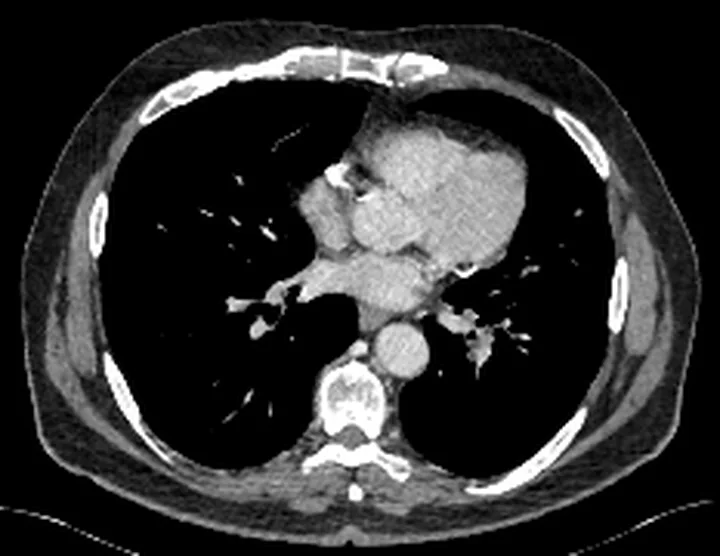
Aynı bölgenin, kaynak veri setinde patoloji içermediği belirtilen bir BT incelemesini kesit kesit kaydırın; organ sınırlarını açarak anatomiyi hasta görüntüsüyle karşılaştırın. Küçük rastlantısal bulgular tümüyle dışlanmamıştır.
Kaynak: TotalSegmentator v2.01 veri seti (Wasserthal ve ark., Radiology: Artificial Intelligence 2023), CC BY 4.0, vaka s0975; organ sınırları veri setinin otomatik segmentasyonundan, birleştirilerek sadeleştirildi. Görüntüler 2,5 mm kesit aralığına yeniden örneklendi.
Ayırıcı tanı
- Gerçek kortikal kontüzyon
- fokal parankim hiperdensitesi veya ödemli hipodensite komşu kesitlerde sürer; hareket artefaktı gibi tüm kenarı çiftlemez.
- Metal kaynaklı çizgilenme
- yüksek yoğunluklu protez ya da klipten yayılan doğrusal bantlar, ışın yolu üzerindeki farklı dokuları da etkiler.
- Kısmi hacim etkisi
- küçük yapı sınır vokselinde komşu yoğunluklarla ortalanır ve ardışık ince kesitlerde biçimi değişebilir.
- Kapsama dışı anatomi
- yapının görüntüde olmaması patolojik yokluk değil, tarama sınırının dışında kalması olabilir; scout ve uç kesitlerle anlaşılır.
Tuzaklar
- Belirgin bir lezyon bulduktan sonra incelemeyi bırakmak ikinci odağı kaçırabilir; ana soruyu yanıtladıktan sonra sıralı anatomik taramayı tamamla.
- Sadece aksiyel seri üzerinden ilerlemek oblik kırık hattını veya damar boyunca uzanan bulguyu saklayabilir; oluşturulmuş koronal ve sagittal serileri de gözden geçir.
- Görüntüye kısmen giren organı tam değerlendirilmiş gibi raporlamak kapsamı abartır; sınırlı alanı anatomik olarak belirt.
Kendini dene
Beyin görüntüleme körlük noktaları (blind spots) arasında aşağıdakilerden hangisi yer alır?
Cevabı göster
Posterior fossa. S98'e göre beyin görüntülemede sık görülen körlük noktaları arasında posterior fossa, serebral sulkuslar, kafa tabanı ve orbital yapılar bulunur.
BT incelemesinde yalnızca ilgili organ penceresi kullanıldığında ve sistemik tarama yapılmadığında en sık rastlanan hata türü hangisidir?
Cevabı göster
Satisfaction of search (arama tatmini). Öne çıkan bir bulgu dikkati çekerken, incelemenin geri kalan anatomik bölümlerinin eksik taranmasına satisfaction of search denir ve radyolojik tanı hatalarının önemli bir nedenidir.
Bu konunun yer aldığı turlar
İlgili konular
Kaynaklar
Bu sayfadaki 29 cümle ve 2 quiz sorusu aşağıdaki kaynaklardan alıntılarla tek tek karşılaştırıldı; 3 cümle bu karşılaştırmada düzeltildi (2026-10-08).
- Prognostic Value of Initial CT Imaging for Surgical Planning and Outcomes in Panfacial Fractures: A Systematic Review and Meta‐Analysispmc.ncbi.nlm.nih.gov
- COVID-19 Vaccination and Pulmonary Nodules: A Narrative Review of Causality, Detection Bias and Thoracic Imaging Pitfallspmc.ncbi.nlm.nih.gov
- CT-derived myocardial extracellular volume: current evidence, clinical utility, and the emerging role of photon-counting CT—a systematic reviewpmc.ncbi.nlm.nih.gov
- Radiation safety and cancer risks in pediatric computed tomography: a systematic review of large-scale cohort studiespmc.ncbi.nlm.nih.gov
- Artificial intelligence in computed tomography imaging for pulmonary embolism: a narrative review from computed tomography pulmonary angiography to non-contrast computed tomographypmc.ncbi.nlm.nih.gov
- Fleischner Society: Glossary of Terms for Thoracic Imaging.pubmed.ncbi.nlm.nih.gov
- Diagnostic criteria for idiopathic pulmonary fibrosis: a Fleischner Society White Paper.pubmed.ncbi.nlm.nih.gov
- The cognitive effect of non-invasive brain stimulation combined with cognitive training in Alzheimer's disease and mild cognitive impairment: a systematic review and meta-analysis.pubmed.ncbi.nlm.nih.gov
- Detection of thyroiditis on PET/CT imaging: a systematic review.pubmed.ncbi.nlm.nih.gov
- Magnetic resonance cholangiography: Current and future perspectives.pubmed.ncbi.nlm.nih.gov
- Mania and stroke: a systematic review.pubmed.ncbi.nlm.nih.gov
- Reversible cerebral vasoconstriction syndrome: a comprehensive systematic review.pubmed.ncbi.nlm.nih.gov
- Prostate Cancer Screening Patient Decision Aids: A Systematic Review and Meta-analysis.pubmed.ncbi.nlm.nih.gov
- SARS-COV-2 infection in children and newborns: a systematic review.pubmed.ncbi.nlm.nih.gov
- Effect of alcohol on blood pressure.pubmed.ncbi.nlm.nih.gov
- Adipokines in anorexia nervosa: A systematic review and meta-analysis.pubmed.ncbi.nlm.nih.gov
- Psychological treatments for adults with posttraumatic stress disorder: A systematic review and meta-analysis.pubmed.ncbi.nlm.nih.gov
- Mechanical Properties of Additive-Manufactured Composite-Based Resins for Permanent Indirect Restorations: A Scoping Review.pubmed.ncbi.nlm.nih.gov
- Impact of low-dose computed tomography (LDCT) screening on lung cancer-related mortality.pubmed.ncbi.nlm.nih.gov
- Diagnosis and Evaluation of Hypersensitivity Pneumonitis: CHEST Guideline and Expert Panel Report.pubmed.ncbi.nlm.nih.gov
- Effectiveness, Safety, and Workflow Burden of Large Language Model-Based Medical Report Generation: Systematic Review.pubmed.ncbi.nlm.nih.gov
- A foundation model for acute abdomen diagnosis stratification and triage on noncontrast computed tomography.pubmed.ncbi.nlm.nih.gov
- How do non-radiologist physicians read and use the radiology report? A French national survey.pubmed.ncbi.nlm.nih.gov
- Advances in Artificial Intelligence for Wrist Joint Injury Diagnosis.pubmed.ncbi.nlm.nih.gov
- Missed Opportunities in Orthopaedics for Intimate Partner Violence Identification: A Retrospective Review Over 24 years.pubmed.ncbi.nlm.nih.gov
- Cervical Spine Pathology in the Context of Intimate Partner and Interpersonal Violence: A Case Series and Focused Narrative Review.pubmed.ncbi.nlm.nih.gov
- Beyond the limits of space and time: Can 4D imaging enhance postmortem investigation?pubmed.ncbi.nlm.nih.gov
- Equivocal Dopamine Transporter Imaging: Integrating Visual Assessment, Quantification, and Clinical Follow-Up.pubmed.ncbi.nlm.nih.gov
- Low- versus high-concentration iodine contrast media for coronary computed tomography angiography and dynamic stress computed tomography perfusion: a study protocol for a prospective randomized trial.pubmed.ncbi.nlm.nih.gov
- Computed tomography-guided precision biopsy combined with metagenomic next-generation sequencing for etiological diagnosis in patients with blood culture-negative systemic infections.pubmed.ncbi.nlm.nih.gov
- Prolonged complete metabolic response to chemotherapy combined with amivantamab with high grade cutaneous toxicity after osimertinib resistance in an uncommon <i>T751_I759delinsAsp</i> <i>EGFR</i>-mutant lung adenocarcinoma: a case report.pubmed.ncbi.nlm.nih.gov
- Functional Neural Architecture of Working Memory in Musicians: An ALE Meta-Analysis and Review.pubmed.ncbi.nlm.nih.gov
- Computed tomography of pediatric abdominal trauma: optimizing utilization and enhancing diagnostic interpretation.pubmed.ncbi.nlm.nih.gov
- Emphysematous conditions of the abdomen and pelvis: pearls and pitfalls.pubmed.ncbi.nlm.nih.gov
- Unusual Configuration of a Giant Trans-Spatial Pancreatic Pseudocyst with Spontaneous Shrinkage: A Rare Case Report.pubmed.ncbi.nlm.nih.gov
- Mapping the Landscape of Over-Scanning in CT Imaging: A Scoping Review.pubmed.ncbi.nlm.nih.gov
- Dual-view scout scans with deep learning for ultra-low dose attenuation correction in PET.pubmed.ncbi.nlm.nih.gov
- Novel lateral fiducial marker positioning technique eliminates registration failures in high-body mass index patients during robot-assisted spine surgery.pubmed.ncbi.nlm.nih.gov
- Advances in multimodal data fusion in neuroimaging: Overview, challenges, and novel orientation.pubmed.ncbi.nlm.nih.gov
- Understanding Photon-Counting CT: Physics, Detector Technology, and Image Reconstructions.pubmed.ncbi.nlm.nih.gov
- Cone Beam Computed Tomography (CBCT)-Based Online Adaptive Radiotherapy for Patients With Metal Implants: An Institutional Experience.pubmed.ncbi.nlm.nih.gov
- AAPM CT metal artifact reduction grand challenge.pubmed.ncbi.nlm.nih.gov
- Neurotrauma: 2024 update.pubmed.ncbi.nlm.nih.gov
- iTRAQ-Based Quantitative Proteomics Reveals the New Evidence Base for Traumatic Brain Injury Treated with Targeted Temperature Management.pubmed.ncbi.nlm.nih.gov
- Imaging Evaluation of Acute Traumatic Brain Injury.pubmed.ncbi.nlm.nih.gov
- COVID-19 Vaccination and Pulmonary Nodules: A Narrative Review of Causality, Detection Bias and Thoracic Imaging Pitfalls.pubmed.ncbi.nlm.nih.gov
- Incidentally Detected Congenital Bronchial Atresia in Late Adulthood: A Case Report and Imaging Review.pubmed.ncbi.nlm.nih.gov
- Lung Parenchymal and Airway Injuries: Differential Diagnosis and Severity Grading.pubmed.ncbi.nlm.nih.gov
- Fatal Injuries Caused by Falling Trees: Correlation Between Postmortem Computed Tomography and Forensic Autopsy Findings in Eight Cases.pubmed.ncbi.nlm.nih.gov
- Traumatic Spinal Cord Injury: A Contemporary Review of Classification, Evaluation, and Acute Management.pubmed.ncbi.nlm.nih.gov
- Open reduction and internal fixation versus percutaneous multiple-trajectory screw fixation for unstable pelvic fractures with severe polytrauma: a prospective study.pubmed.ncbi.nlm.nih.gov
- Taxonomy of Acute Stroke: Imaging, Processing, and Treatment.pubmed.ncbi.nlm.nih.gov
- Bilateral lesions of the basal ganglia and thalami (central grey matter)-pictorial review.pubmed.ncbi.nlm.nih.gov
- Automated Segmentation of Tissues Using CT and MRI: A Systematic Review.pubmed.ncbi.nlm.nih.gov
- Development and validation of a machine learning-based radiomics model using 45-keV virtual monoenergetic images for differentiating fat-poor angiomyolipoma from clear cell renal cell carcinoma.pubmed.ncbi.nlm.nih.gov
- Arbitrary thickness profile metrology of low-Z and monolithic material components with a single X-ray projection.pubmed.ncbi.nlm.nih.gov
- MRI-Based Radiomics Reveals Cannabinoid-Associated Tumor Phenotypes in a Murine Breast Cancer Model.pubmed.ncbi.nlm.nih.gov
- Comparative evaluation of 4DCT and 4DCBCT for motion and volume measurement accuracy in a dynamic phantom.pubmed.ncbi.nlm.nih.gov
- Comparative evaluation of volume and helical four-dimensional computed tomography using canon system.pubmed.ncbi.nlm.nih.gov
- Feasibility and reproducibility of semi-automated magnetic resonance angiography measurements of the thoracic aorta using commercial software.pubmed.ncbi.nlm.nih.gov
- High-affinity alphavbeta3 integrin targeted optical probe as a new imaging biomarker for early atherosclerosis: initial studies in Watanabe rabbits.pubmed.ncbi.nlm.nih.gov
- Where Does the Signal Go? Technical Challenges of CT Perfusion in Lacunar and Infratentorial Stroke.pubmed.ncbi.nlm.nih.gov
- Quantitative comparison of enamel-dentin and dentin-pulp distances between cone-beam computed tomography and histological sections: An ex vivo study.pubmed.ncbi.nlm.nih.gov
- Quantifying the impact of slice thickness on cardiovascular risk stratification in lung cancer screening: a multi-center "RESCUE" study.pubmed.ncbi.nlm.nih.gov
- Interior soft x-ray tomography with sparse global sampling.pubmed.ncbi.nlm.nih.gov
- TomoRay cranial: synthesis of cranial CT imaging from biplanar radiographs using a generative adversarial network.pubmed.ncbi.nlm.nih.gov
- Bolus tracking from pulsed x-ray projections: A feasibility study using a five-dimensional cardiac CT contrast dynamics model.pubmed.ncbi.nlm.nih.gov
- Why we still miss breast cancers: strategies for improving mammography interpretation.pubmed.ncbi.nlm.nih.gov
- Diagnostic error and bias in the department of radiology: a pictorial essay.pubmed.ncbi.nlm.nih.gov
- Treatment Limitations and Missing Information in Peritoneal Metastatic Gastric Cancer.pubmed.ncbi.nlm.nih.gov
- Accessory Articulation of Elongated Anterior Tubercles of the Transverse Processes at C5-C6 in a Young Adult Female Patient: A Case Report.pubmed.ncbi.nlm.nih.gov
- Multilevel Lumbar CT Attenuation Beyond L1: Comparison with QCT-Derived Volumetric Bone Mineral Density and Prevalent Fragility Fracture Status in a Diagnostic Referral Cohort.pubmed.ncbi.nlm.nih.gov
- High Sinus, Lower Risk: A Paradigm Shift in Frontal Fracture Patterns.pubmed.ncbi.nlm.nih.gov
- Spontaneous Pneumothorax: A Review of Underlying Etiologies and Diagnostic Imaging Modalities.pubmed.ncbi.nlm.nih.gov
- Imaging appearances, CT evolution patterns, and surgical prognosis of stage I lung squamous cell carcinoma.pubmed.ncbi.nlm.nih.gov
- Diagnosis of Mucormycosis: Current Situation, Challenges and Future Prospects.pubmed.ncbi.nlm.nih.gov
- Interferon-induced transmembrane (IFITM) proteins at the tumour-immune interface: A four-axis framework for their context-dependent roles.pubmed.ncbi.nlm.nih.gov
- Deep learning-based fully automated Z-axis coverage range definition from scout scans to eliminate overscanning in chest CT imaging.pubmed.ncbi.nlm.nih.gov
- Deep Learning Body Region Classification of MRI and CT Examinations.pubmed.ncbi.nlm.nih.gov
- Society for Cardiovascular Magnetic Resonance/European Society of Cardiovascular Imaging/American Society of Echocardiography/Society for Pediatric Radiology/North American Society for Cardiovascular Imaging Guidelines for the use of cardiovascular magnetic resonance in pediatric congenital and acquired heart disease : Endorsed by The American Heart Association.pubmed.ncbi.nlm.nih.gov
- Robotic-assisted transbronchial biopsy versus computed tomography-guided transthoracic needle biopsy for peripheral pulmonary lesions: a systematic review and meta-analysis of direct comparative studies.pubmed.ncbi.nlm.nih.gov
- Analysis of pleural reaction following CT-guided hookwire localization for pulmonary nodules.pubmed.ncbi.nlm.nih.gov
- Retrospective Review Is the Best View: A Primer for Residents and Radiologists on Missed Findings in Chest Radiography.pubmed.ncbi.nlm.nih.gov
- Too Young, Too Silent: Painless Stanford Type A Aortic Dissection in a Young Adult.pubmed.ncbi.nlm.nih.gov
- Postoperative Pulmonary Complications: Clinical and Imaging Insightspubmed.ncbi.nlm.nih.gov
- Stereotactic radiotherapy for lung oligometastases.pubmed.ncbi.nlm.nih.gov
- Mini Transsternal Approach to the Anterior High Thoracic Spine (T1-T4 Vertebrae).pubmed.ncbi.nlm.nih.gov
- The Transmanubrial Approach for Cervicothoracic Junction Lesions : Feasibility, Limitations, and Advantages.pubmed.ncbi.nlm.nih.gov
- International Society of Paediatric Surgical Oncology (IPSO) Surgical Practice Guidelines.pubmed.ncbi.nlm.nih.gov
- Results of thoracic drainages placed in air rescue.pubmed.ncbi.nlm.nih.gov
- Alectinib shows promise for the treatment of refractory ALK-positive large B-cell lymphoma: a case report.pubmed.ncbi.nlm.nih.gov
- Immunoglobulin-G4 Related Disease: A Rare Entity with Many Clinical Faces - Literature Review and Case Illustration.pubmed.ncbi.nlm.nih.gov
- Dose-painting after multi-block endoscopic endonasal surgery in sinonasal tumours: protocol for the SinocaRT randomised phase II trial.pubmed.ncbi.nlm.nih.gov
- Spontaneous pneumothorax-associated with genetic disorders.pubmed.ncbi.nlm.nih.gov
- Comprehensive review of post-treatment imaging in head and neck cancers: from expected to unexpected and beyond.pubmed.ncbi.nlm.nih.gov
- Prognostic Value of Initial CT Imaging for Surgical Planning and Outcomes in Panfacial Fractures: A Systematic Review and Meta-Analysis.pubmed.ncbi.nlm.nih.gov
- CT-derived myocardial extracellular volume: current evidence, clinical utility, and the emerging role of photon-counting CT-a systematic review.pubmed.ncbi.nlm.nih.gov
- Blind spots in brain imaging: a pictorial essay.pubmed.ncbi.nlm.nih.gov
- Point-of-care ultrasound (POCUS) diagnosis of rib fractures.pubmed.ncbi.nlm.nih.gov
- Effect of tirzepatide-induced weight loss on adipose tissue in obesity: rationale and design of the randomized placebo-controlled Tirzepatide Brown and Beige Adipose Tissue Activation (TABFAT) trial.pubmed.ncbi.nlm.nih.gov
- Artificial Intelligence in Oral and Maxillofacial Surgery-A Narrative Review.pubmed.ncbi.nlm.nih.gov
- Artificial Intelligence in Orthopedic Trauma: A Narrative Review.pubmed.ncbi.nlm.nih.gov
- Electric Scooter and Electric Bicycle Injuries in Children and Adolescents: A Narrative Review of Epidemiology, Injury Patterns, Clinical Outcomes, and Prevention.pubmed.ncbi.nlm.nih.gov
- Large language models and large concept models in radiology: Present challenges, future directions, and critical perspectives.pubmed.ncbi.nlm.nih.gov
- The 2023 WSES guidelines on the management of trauma in elderly and frail patients.pubmed.ncbi.nlm.nih.gov
- A robust and reproducible automated MRI pipeline for quantifying tissue outcomes after experimental stroke in multi-center preclinical networks.pubmed.ncbi.nlm.nih.gov
- Radiomics differences between GOLD I-II and GOLD III-IV in patients with chronic obstructive pulmonary disease.pubmed.ncbi.nlm.nih.gov
- Tomographic 3D Ultrasound for Thyroid Volumetry-A Comparison Between Multiplanar 2D and 3D Imaging Methods.pubmed.ncbi.nlm.nih.gov
- AI-Based Approaches for the Identification and Quantification of Traumatic Brain Injury in Computed Tomography Imaging: Systematic Review.pubmed.ncbi.nlm.nih.gov
- Balancing Radiation Dose and Image Quality: Protocol Optimization for Mobile Head CT in Neurointensive Care Unit Patients.pubmed.ncbi.nlm.nih.gov
- Inferring neural sources from electroencephalography: foundations and frontiers.pubmed.ncbi.nlm.nih.gov
- Dual-Layer Spectral CT for Locoregional Assessment of Rectal Cancer: A Comparison with MRI in a Pilot Study.pubmed.ncbi.nlm.nih.gov
- Imaging of Pheochromocytomas and Paragangliomas.pubmed.ncbi.nlm.nih.gov
- Differentiating uterine sarcoma from leiomyoma: BET 1 T 2 ER Check!pubmed.ncbi.nlm.nih.gov
- A Review and Perspective of Techniques for Autonomous Robotic Ultrasound Acquisitions.pubmed.ncbi.nlm.nih.gov
Eğitim amaçlıdır; hasta başında tanı ve tedavi kararının yerine geçmez. İçerik yapay zekâ destekli bir süreçle güncel literatüre göre cümle cümle kaynaklarla karşılaştırıldı, ancak uzman radyolog incelemesinden geçmedi. Klinik kararlarda güncel kılavuzları, kurum protokollerini ve radyoloji raporunu esas alın.