Özet
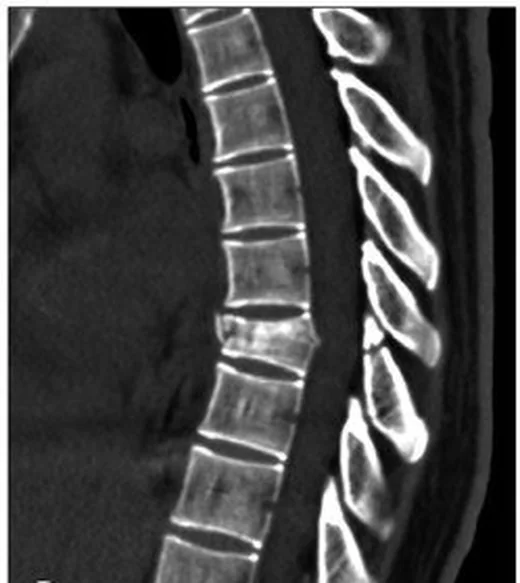
Yüksek enerjili künt travma veya düşme sonrası torasik, torakolomber bileşke ve lomber vertebra kırıkları araştırılır. Kontrastsız BT'nin ince kesitleri ve sagittal-koronal kemik rekonstrüksiyonları korpus, son plak, posterior eleman ve faset yaralanmalarını tek taramada birlikte değerlendirir. BT kemik morfolojisini gösterir; posterior ligamentöz kompleks ve omurilik yumuşak doku yaralanmalarını değerlendirmede sınırlıdır, şüphede MR ek bilgi sağlar; nörolojik durum klinik muayeneyle belirlenir. Retropulsiyon yapan fragmanla spinal kanal daralması, posterior gerilim bandı bozulması veya çoklu travmada ikinci bir seviyedeki kırığın atlanması, instabilite ve nörolojik hasar riskinin yanlış sınıflandırılmasına yol açabilir.
Faz ve pencere
- Kontrastsız tanısal
- Korpus ön ve arka duvarındaki kortikal kesinti, endplate çökmesi, kama biçimli yükseklik kaybı, pedikül-lamina kırıkları, faset ayrışması ve kanal içine retropulsiyon kemik algoritmasında görülür; ölçümler sagittal ve aksiyel rekonstrüksiyonlarda yapılır. Kemik kırığının değerlendirilmesi için intravenöz kontrast gerekmez.
Önerilen pencereler G genişlik, M merkez; değerler Hounsfield birimi (HU)
- KemikG 1800 / M +400
- Yumuşak dokuG 400 / M +40
BT bulguları
- Üst endplate çökmesi ve ön korpus yüksekliğinde kayıp; arka korteks korunuyorsa kompresyon tipi kırık lehinedir.
- Korpus arka duvarının kırılıp kanala doğru yer değiştirmesi burst morfolojisidir: tek endplate tutulumunda AO A3 (tamamlanmamış), iki endplate tutulumunda AO A4 (tam burst).
- Pedikül, lamina, transvers veya spinöz çıkıntıda kırık; korpus paternine ek posterior eleman hasarını tanımlar.
- Spinöz çıkıntılar arasında açılma, faset eklem aralığında genişleme veya ayrışma posterior gerilim bandı yaralanmasını düşündürür.
- Posterior korpus hizasındaki basamak ve faset eklemlerindeki hizalanma bozukluğu translasyon/rotasyon yaralanmasını düşündürür.
- Kanala retropulse olan kemik parçası spinal kanalda daralmaya yol açabilir; BT'de fragmanın kanal lümenine uzanımı ve kanal darlığının derecesi tarif edilir.
- İnterspinöz aralıkta genişleme gibi bulgular fleksiyon-distraksiyon paternini düşündürebilir.
- Korpus çevresindeki prevertebral yumuşak doku kalınlaşması veya hematom akut yaralanmayı destekleyebilir; bu bulgu tek başına akut-kronik ayrımını kesinleştirmez.
Ölçütler ve sınıflamalar
- AO Spine torakolomber yaralanma sınıflaması
- AO Spine sınıflamasında tip A kompresyon/burst yaralanmaları A1 (arka duvar tutulumu olmadan tek endplate kama kırığı), A2 (iki endplate’i tutan split/pincer kırığı), A3 (tek endplate ve posterior duvar tutulumu olan tamamlanmamış burst) ve A4 (iki endplate’i tutan tam burst) olarak; tip B gerilim bandı yaralanmaları kemik ve/veya ligamentöz bileşenli, tip C yaralanmalar ise translasyon/deplasman paterninde sınıflanır. BT kemik morfolojisini gösterir; ligamentöz bileşen gerektiğinde MR ile, nörolojik durum klinik muayeneyle değerlendirilir.
- TLICS (Thoracolumbar Injury Classification and Severity Score)
- Sınıflama üç bileşeni birlikte ele alır: kırık morfolojisi, posterior ligamentöz kompleksin sağlam/şüpheli/yaralı oluşu ve nörolojik durum. BT’de faset diastazı, interspinöz genişleme, spinöz çıkıntı avulsiyonu veya subluksasyon PLC yaralanmasını düşündürebilir; bağların doğrudan değerlendirilmesi için MR gerekir. Nörolojik durum klinik muayeneyle belirlenir.
Normalde
Yaralanan seviyeyi bitişik seviyelerle karşılaştırırken vertebral kamalaşma derecesi ve yükseklik kaybı yüzdesi ölçülür. Yaralanan seviyeyi bitişik sağlam korpuslarla karşılaştır; posterior korpus çizgisini, pedikülleri, faset eklemlerini ve interspinöz aralığı aynı planda incele; retropulsiyon varsa kanal konturundaki daralmayı ayrıca ölçerek raporla.
Normal BT ile kıyasla
Aynı bölgenin, kaynak veri setinde patoloji içermediği belirtilen bir BT incelemesini kesit kesit kaydırın; organ sınırlarını açarak anatomiyi hasta görüntüsüyle karşılaştırın. Küçük rastlantısal bulgular tümüyle dışlanmamıştır.
Kaynak: TotalSegmentator v2.01 veri seti (Wasserthal ve ark., Radiology: Artificial Intelligence 2023), CC BY 4.0, vaka s1338; organ sınırları veri setinin otomatik segmentasyonundan, birleştirilerek sadeleştirildi. Görüntüler 2,5 mm kesit aralığına yeniden örneklendi.
Ayırıcı tanı
- Akut kompresyon kırığı
- keskin son plak/korteks kesintisi ve komşu paravertebral yumuşak doku değişikliği.
- Kronik osteoporotik kama deformitesi
- önceki incelemelerde değişmeden kalması ve MR’da kemik iliği ödemi bulunmaması kronikliği destekler; yalnız BT ile akut-kronik ayrımı her zaman yapılamaz.
- Schmorl nodülü
- nucleus pulposus'un kıkırdak ve kemik endplate'i geçerek komşu vertebra korpusuna herniasyonudur.
- Vertebral hemanjiyom
- kaba dikey trabeküler kalınlaşma ve tipik benekli (polka-dot) görünümü tanıyı destekler; atipik lezyonlarda bu işaretler görülmeyebilir. Korpus çökmesi gelişebileceğinden yeni şekil değişikliği ayrıca değerlendirilmelidir.
- Malign patolojik kırık
- MR'da kemik iliği tutulumu ve yumuşak doku uzanımı saptanması ileri değerlendirme gerektirir.
Tuzaklar
- Kronik ön kama deformitesi akut çökme kırığı ile karışabilir; MR'da kemik iliği ödemi akut-subakut kırığı destekler, bu nedenle BT'de tek başına akut-kronik ayrımı her zaman yapılamaz.
- Burst kırığında korpus arka duvarı fragmanını atlamak, basit kompresyon olarak eksik tanımlamaya yol açar; sagittal planda posterior korteks çizgisini baştan sona izleyin.
- Kemik Chance kırığında posterior elemanlardan geçen yatay transosseöz hat sagittal ve koronal rekonstrüksiyonlarda izlenip aksiyel kesitlerde düzey düzey doğrulanmalıdır.
- Bir seviyedeki belirgin kırık tüm omurganın tarandığı anlamına gelmez; nonkontigu çoklu yaralanmaların sıklığı nedeniyle çoklu travmada tüm omurga değerlendirilmelidir.
Kendini dene
Düşme sonrası L1'de üst endplate kırığı ve posterior korpus duvarından kanala uzanan fragman var. Bu morfoloji en çok hangisine uyar?
Cevabı göster
Burst kırığı. Arka korpus duvarının kırılıp kanala retropulse olması burst morfolojisinin ayırt edici özelliğidir. Diğer seçenekler korpus arka duvarı ve kanal ilişkisini açıklamaz; Schmorl nodülü endplate içine sınırlıdır.
Emniyet kemeri izi olan hastada T12'de yatay kırık çizgisi korpus ve posterior elemanlara uzanıyor, fasetler aralanmış. En olası patern hangisidir?
Cevabı göster
Chance tipi fleksiyon-distraksiyon. Yatay, birden çok kolonu geçen kırık ve posterior ayrışma fleksiyon-distraksiyon/Chance paternini destekler. Kama kompresyonu ön korpusta sınırlıdır; hemanjiyom travmatik bir hat değildir; pars defekti tek posterior elemandadır.
Bu konunun yer aldığı turlar
Kaynaklar
Bu sayfadaki 47 cümle ve 2 quiz sorusu aşağıdaki kaynaklardan alıntılarla otomatik olarak karşılaştırıldı; 11 cümle bu karşılaştırmada düzeltildi (2026-10-12).
- ACR Appropriateness Criteria® Acute Spinal Trauma: 2024 Updatepubmed.ncbi.nlm.nih.gov
- Thoracolumbar Spine Trauma: WFNS Spine Committee Recommendationswfns-spine.org
- AO Spine Thoracolumbar Injury Classification Systemmedia.aofoundation.org
- Role of magnetic resonance imaging in acute spinal trauma: a pictorial reviewlink.springer.com
- Classifying thoracolumbar fractures: role of quantitative imagingpubmed.ncbi.nlm.nih.gov
- Imaging evaluation of traumatic thoracolumbar spine injuries: Radiological reviewpubmed.ncbi.nlm.nih.gov
- Vertebral hemangiomas: a review on diagnosis and managementlink.springer.com
- Schmorl's nodes: demystification road of endplate defects-a critical reviewpubmed.ncbi.nlm.nih.gov
- Schmorl's nodes: current pathophysiological, diagnostic, and therapeutic paradigmspubmed.ncbi.nlm.nih.gov
- Chance-type flexion-distraction injuries in the thoracolumbar spine: MR imaging characteristicspubmed.ncbi.nlm.nih.gov
- Appropriateness criteria: Suspected Spine Traumaradiologyinfo.org
- Primary Imaging Test for Suspected Traumatic Thoracolumbar Spine Injury: 2017 Guidelines by the Korean Society of Radiology and National Evidence-Based Healthcare Collaborating Agencypmc.ncbi.nlm.nih.gov
- Management and Outcome Analysis of Pediatric Unstable Thoracolumbar Spine Injury: Large Surgical Series with Literature Reviewpmc.ncbi.nlm.nih.gov
- Agreement and discordance between the modified thoracolumbar injury classification and severity score and the thoracolumbar AOSpine injury score in guiding surgical decision-making for thoracolumbar fractures: a comparative studypmc.ncbi.nlm.nih.gov
- Thoracolumbar spine injury in Cameroon: etiology, management, and outcomepmc.ncbi.nlm.nih.gov
- Predicting neurological recovery after thoracolumbar spine trauma: The role of injury morphology and admission American Spinal Injury Association Impairment Scale gradepmc.ncbi.nlm.nih.gov
- Imaging of Spine Trauma.pubmed.ncbi.nlm.nih.gov
- ACR Appropriateness Criteria ® Suspected Spine Trauma.pubmed.ncbi.nlm.nih.gov
- Primary Imaging Test for Suspected Traumatic Thoracolumbar Spine Injury: 2017 Guidelines by the Korean Society of Radiology and National Evidence-Based Healthcare Collaborating Agency.pubmed.ncbi.nlm.nih.gov
- Does Surgical Intervention or Timing of Surgery Have an Effect on Neurological Recovery in the Setting of a Thoracolumbar Burst Fracture?pubmed.ncbi.nlm.nih.gov
- Congress of Neurological Surgeons Systematic Review and Evidence-Based Guidelines on the Evaluation and Treatment of Patients With Thoracolumbar Spine Trauma: Classification of Injury.pubmed.ncbi.nlm.nih.gov
- Optimization of Spondylosynthesis for Certain Thoracolumbar Burst Fractures.pubmed.ncbi.nlm.nih.gov
- Intraoperative finding and management of complete spinal cord transection after thoracolumbar traumatic fracture-dislocation: A case report.pubmed.ncbi.nlm.nih.gov
- Clinical importance of posterior vertebral height loss on plain radiography when conservatively treating osteoporotic vertebral fractures.pubmed.ncbi.nlm.nih.gov
- The AOSpine thoracolumbar spine injury classification system: A reliability and agreement study.pubmed.ncbi.nlm.nih.gov
- Patients Immobilized with a Long Spine Board Rarely Have Unstable Thoracolumbar Injuries.pubmed.ncbi.nlm.nih.gov
- Treatment of thoracolumbar trauma by short-segment percutaneous transpedicular screw instrumentation: prospective comparative study with a minimum 2-year follow-up.pubmed.ncbi.nlm.nih.gov
- Vertebral Bone Marrow Edema (VBME) in Conservatively Treated Acute Vertebral Compression Fractures (VCFs): Evolution and Clinical Correlations.pubmed.ncbi.nlm.nih.gov
- Clinical relevance and validity of TLICS system for thoracolumbar spine injury.pubmed.ncbi.nlm.nih.gov
- Non-osteoporotic L4 vertebral compression fracture after low-voltage electrical injury without secondary trauma: A rare case report.pubmed.ncbi.nlm.nih.gov
- Compression fracture of the T12 vertebra combined with diaphragmatic hernia after low-energy trauma: a case report and literature review.pubmed.ncbi.nlm.nih.gov
- Emergency radiology of severe acute injury in extreme alpine summer sports: a pictorial essay.pubmed.ncbi.nlm.nih.gov
- Pseudomyogenic hemangioendothelioma of the thoracolumbar spine: A case-based review of a rare cause of vertebral collapse and neurological deficit.pubmed.ncbi.nlm.nih.gov
- Surgical Management of Progressive Scoliosis in Crisponi Syndrome: Multidisciplinary Perioperative Strategy and Technical Considerations.pubmed.ncbi.nlm.nih.gov
- Impact of MRI on the management of CT-defined AO spine A/B thoracolumbar fractures.pubmed.ncbi.nlm.nih.gov
- Comparative analysis of two modified TLICS systems in guiding surgical decision-making for thoracolumbar fractures.pubmed.ncbi.nlm.nih.gov
- Reliability and reproducibility of the modified thoracolumbar injury classification and severity score and the thoracolumbar AO spine injury score for guiding surgical decision-making in thoracolumbar fractures.pubmed.ncbi.nlm.nih.gov
- Dural tears from traumatic spinal fractures: an illustrative case and systematic review of its incidence, diagnosis, risk factors, and management.pubmed.ncbi.nlm.nih.gov
- Minimally Invasive Short-Segment Anteroposterior Surgery for Thoracolumbar Osteoporotic Fractures with Canal Compromise: A Prospective Study with a Minimum 2-Year Follow-up.pubmed.ncbi.nlm.nih.gov
- Intraoperative three-dimensional imaging-guided vertebral body stenting for cleft-associated very severe osteoporotic vertebral compression fractures: a surgical technique case series.pubmed.ncbi.nlm.nih.gov
- Anatomical and biological reconstruction of traumatic complete burst fractures of the thoracolumbar vertebrae using pedicle fixation combined with stent-armed kyphoplasty and intracorporeal bone grafting: technique rationale, 7-year experience and clinical, imaging, and histological outcomes.pubmed.ncbi.nlm.nih.gov
- Extrapedicular approach for basivertebral nerve radiofrequency ablation: a conceptual review.pubmed.ncbi.nlm.nih.gov
- Abnormal Cervical Facet Orientation and Congenital Stenosis: Case Reports and Biomechanical Implications-Illustrative Cases.pubmed.ncbi.nlm.nih.gov
- Subaxial cervical spine fractures with facet joint dislocation: Surgical management, technique, and results in a retrospective series of 36 patients.pubmed.ncbi.nlm.nih.gov
- Does pre-operative psoas muscle cross-sectional area predict post-operative outcomes following lumbar spine fusion surgery?-a systematic review and narrative synthesis.pubmed.ncbi.nlm.nih.gov
- Anatomy of the intraosseous arterial microvasculature of the adult lumbar vertebral body and its role in fracture healing: a literature review and historical perspective.pubmed.ncbi.nlm.nih.gov
- Diagnostic accuracy of deep learning vs. human raters for detecting osteoporotic vertebral compression fractures in routine CT scans.pubmed.ncbi.nlm.nih.gov
- Efficacy and safety of vertebral augmentation techniques in patients with osteoporotic vertebral compression fractures: A single center, retrospective, observational study.pubmed.ncbi.nlm.nih.gov
- Agreement and discordance between the modified thoracolumbar injury classification and severity score and the thoracolumbar AOSpine injury score in guiding surgical decision-making for thoracolumbar fractures: a comparative study.pubmed.ncbi.nlm.nih.gov
- Efficacy and Safety of Percutaneous Pedicle Screw Fixation for Neurologically Intact Thoracolumbar Burst Fractures: A Prospective Interventional Study.pubmed.ncbi.nlm.nih.gov
- Optimizing correction and restoring alignment: Outcomes of bone-substitute augmented short-segment fixation in thoracolumbar burst fractures, a descriptive series from Pakistan.pubmed.ncbi.nlm.nih.gov
- The AO Spine TL Injury Classification System Drives Clinical Decision Making in Acute Thoracolumbar Fractures: A Retrospective Evaluation of Clinical Implementation.pubmed.ncbi.nlm.nih.gov
- Machine Learning Algorithm to Predict Change in the Decision-Making for Thoracolumbar Fractures Without Neurological Deficit After MRI: A Multicenter Study.pubmed.ncbi.nlm.nih.gov
- Diagnostic accuracy of various methods for measuring interspinous widening in thoracolumbar posterior ligamentous complex injury shown on MRI.pubmed.ncbi.nlm.nih.gov
- Combine Short-Segment Fixation and Leverage Reduction Technique to Correct Kyphotic Angle in Kümmell's Disease.pubmed.ncbi.nlm.nih.gov
- Biomaterials for vertebral body repair: interior augmentation and total replacement-a literature review of bone fusion outcomes in clinical studies.pubmed.ncbi.nlm.nih.gov
- C-Arm Oblique View-Assisted Screw Placement Method for Extremely Small Lumbar Pedicles in Thoracolumbar Vertebral Body Fractures.pubmed.ncbi.nlm.nih.gov
- Inducing thoracolumbar burst fractures in human cadaveric specimens using a combined axial-flexion loading: a fracture simulation.pubmed.ncbi.nlm.nih.gov
- Beyond Cement: A Case Report of Cadaveric Allograft and Vertebral Body Stenting for a Traumatic Thoracolumbar Burst Fracture.pubmed.ncbi.nlm.nih.gov
- Application of AUSS-TLIF for the treatment of a lumbar burst fracture: A case report.pubmed.ncbi.nlm.nih.gov
- Paper template-based intraoperative rod bending for percutaneous stabilization of thoracic extension-distraction fracture: illustrative case.pubmed.ncbi.nlm.nih.gov
- Transpedicular lower vertebral space osteotomy for thoracolumbar kyphosis secondary to old osteoporotic vertebral compression fractures.pubmed.ncbi.nlm.nih.gov
- The evolution of cervical spine trauma classification: a paradigm shift from morphological description to clinical decision-making.pubmed.ncbi.nlm.nih.gov
- Intact Posterior Tension Band in Spinal Fractures in Patients With Spinal Ankylosing Disorders - Is it a Myth or a Reality? A Systematic Review.pubmed.ncbi.nlm.nih.gov
- Multilevel spinal fractures in ankylosing spondylitis: illustrative case.pubmed.ncbi.nlm.nih.gov
- Pathological Fracture of Thoracic Spine Aneurysmal Bone Cyst: A Case With Successful Outcome Following Debulking, Posterior Instrumentation, and Allogenic Bone Impaction Grafting.pubmed.ncbi.nlm.nih.gov
- How I Do It: MRI of the Bone with Marrow-specific Sequences.pubmed.ncbi.nlm.nih.gov
- Radiomics in spinal research: a narrative review.pubmed.ncbi.nlm.nih.gov
- Diagnostic decision-making, vertebral augmentation, and osteoporosis therapy in vertebral compression fractures: a narrative review.pubmed.ncbi.nlm.nih.gov
- An exploratory multimodal imaging and clinicopathological strategy for suspected Kümmell's disease in the absence of MRI.pubmed.ncbi.nlm.nih.gov
- Thoracic Fracture Adjacent to Spinal Fusion Following Cardiopulmonary Resuscitation: A Case Report.pubmed.ncbi.nlm.nih.gov
- Risk-stratified management of ankylosing spondylitis-related spinal fractures-a meta-synthesis of contemporary surgical and nonsurgical strategies: a narrative review.pubmed.ncbi.nlm.nih.gov
- Bechterew's Disease and the Risk of Spinal Fractures: Clinical Patterns, Imaging Correlation, and Outcomes.pubmed.ncbi.nlm.nih.gov
- Acute management of spinal fractures: What you need to know.pubmed.ncbi.nlm.nih.gov
- Evaluating Artificial Intelligence in Spinal Cord Injury Management: A Comparative Analysis of ChatGPT-4o and Google Gemini Against American College of Surgeons Best Practices Guidelines for Spine Injury.pubmed.ncbi.nlm.nih.gov
- Beyond Chordoma: A Comprehensive Review of Sacral Lesions.pubmed.ncbi.nlm.nih.gov
- Unveiling Primary Bone Tumors of the Spine: A Review of Essential Imaging Clues.pubmed.ncbi.nlm.nih.gov
- Integration of Stent Screw-Assisted Internal Fixation Into Posterior Fixations for High-Grade Thoracolumbar Spine Compression Fractures (SAIF-Rod).pubmed.ncbi.nlm.nih.gov
- Functional and Radiological Outcome of Osteoporotic Vertebral Fracture Managed with Balloon Kyphoplasty - A Prospective Study.pubmed.ncbi.nlm.nih.gov
- Traumatic Durotomy with Entrapment of Nerve Roots in a Lumbar Burst Fracture Diagnosed Intraoperatively: A Case Report.pubmed.ncbi.nlm.nih.gov
- Anatomical validation of ultrasound-guided retrolaminar block for the treatment of symptomatic vertebral fragility fractures.pubmed.ncbi.nlm.nih.gov
- Conservative Treatment of Pediatric Fractures-Narrative Review of Acceptable Deformity and Remodeling Potential.pubmed.ncbi.nlm.nih.gov
- Modified Spinous Process-Splitting Approach for Thoracolumbar Burst Fractures With Neurological Deficits: Technical Description and Preliminary Clinical Outcomes.pubmed.ncbi.nlm.nih.gov
- The clinical and radiological outcomes of a transfacet pedicle-sparing approach for directly addressing the compression of unstable thoracolumbar burst fractures with retropulsion.pubmed.ncbi.nlm.nih.gov
- Indirect Spinal Decompression in Thoracolumbar Burst Fractures: Efficacy of Combined Modified Percutaneous Posterior Short-segment Fixation and Intraoperative CT Assistance.pubmed.ncbi.nlm.nih.gov
- Spine Trauma Classifications: Historical, Current, and Emerging Perspectives for Radiologists.pubmed.ncbi.nlm.nih.gov
- Non-Infectious Spinal Diseases Mimicking Infection: A Pictorial Essay.pubmed.ncbi.nlm.nih.gov
- Post-traumatic lumbar discal fracture: A case report.pubmed.ncbi.nlm.nih.gov
- Spinal lesions: a comprehensive radiologic overview.pubmed.ncbi.nlm.nih.gov
- Pregnancy and lactation-associated osteoporosis in a postpartum woman with twin pregnancy: a 5-year follow-up case report.pubmed.ncbi.nlm.nih.gov
- Traumatic retropharyngeal hematoma successfully treated with n-butyl cyanoacrylate transarterial embolization: A case report and literature review.pubmed.ncbi.nlm.nih.gov
- Occipitocervical dissociation: A narrative review and case series with a novel management algorithm proposal.pubmed.ncbi.nlm.nih.gov
- Surgical management and outcomes analysis of lower lumbar (L3-L5) burst fractures: A single-center experience and meta-analysis.pubmed.ncbi.nlm.nih.gov
- Timing of surgery and predictors of canal reduction after short-segment fixation for thoracolumbar burst fractures.pubmed.ncbi.nlm.nih.gov
- Modified bone-disc-bone osteotomy (MBDBO) for the treatment of spinal kyphotic deformity secondary to old thoracolumbar vertebral fracture: a retrospective study with 2-year follow-up.pubmed.ncbi.nlm.nih.gov
- Deep learning and hybrid architectures for atypical and complex bone fracture diagnosis: a systematic review of performance and clinical validity.pubmed.ncbi.nlm.nih.gov
- Diagnostic value of an S1-normalized CT hounsfield unit ratio for identifying acute fractures in complex thoracolumbar osteoporotic deformities.pubmed.ncbi.nlm.nih.gov
- Diagnostic yield and number needed to screen for cervical and concomitant spinal injuries in geriatric head trauma.pubmed.ncbi.nlm.nih.gov
- Evolutionary Specializations of the Human Vertebral Body and Intervertebral Disc in Relation to Bipedalism.pubmed.ncbi.nlm.nih.gov
- The Anterolateral Transpedicular Transverse Process Screw Technique: Surgical Techniques, Biomechanical study and Preliminary Outcomes.pubmed.ncbi.nlm.nih.gov
- Development and Validation of a Computer-Assisted Screw Trajectory Planning Model Based on Iterative Closest Point Registration and Weighted K-Nearest Neighbors Algorithms for Cortical Bone and Pedicle Screw Techniques.pubmed.ncbi.nlm.nih.gov
- Recognizing Sacral Insufficiency Fractures Hidden in Plain Sight: An Illustrative Case Report.pubmed.ncbi.nlm.nih.gov
Eğitim amaçlıdır; hasta başında tanı ve tedavi kararının yerine geçmez, tıbbi tavsiye değildir. Metinler yapay zekâ desteğiyle yazıldı ve otomatik bir adımda kaynak alıntılarıyla karşılaştırıldı; bu bir tıbbi doğrulama değildir ve içerik uzman radyolog incelemesinden geçmedi. Klinik kararlarda güncel kılavuzları, kurum protokollerini ve radyoloji raporunu esas alın.