Özet
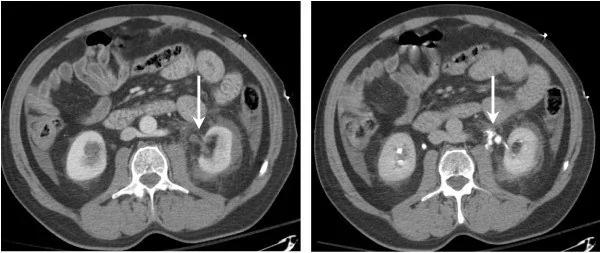
Üreter travması seyrektir; özellikle penetran abdominal yaralanmalarda ve künt deselerasyon travmasında şüphe edilmelidir; eşlik eden yaralanmalar sık görülür. İntravenöz kontrastlı BT ürografide gecikmiş ekskretuar görüntüler üreter yaralanmasından kaynaklanan kontrast ekstravazasyonunu gösterebilir. BT’de üreterin tüm seyrinin izlenememesi veya gecikmiş görüntülerde urinoma ve kontrast ekstravazasyonu saptanması yaralanmayı düşündürür. Tanı gecikmesi idrar kaçağı, urinoma, periüreterik apse, fistül ve üreter darlığı gibi komplikasyonlara yol açabilir.
Faz ve pencere
- Portal
- İntravenöz kontrastlı portal venöz fazda böbrek parankimi, retroperitoneal hematom ve üreter hattındaki dolaylı yumuşak doku bulguları görülür; üreter henüz opaklaşmamışsa bu fazda negatif görünüm üreter bütünlüğünü dışlamaz.
- Gecikmiş tanısal
- Ekskretuar gecikmiş BT ürografide opak idrarın üreter boyunca ilerleyişi izlenir; lümen dışına kontrast ekstravazasyonu, keskin opaklaşma sonlanması, segmental opaklaşmama veya kontrastla büyüyen periüreterik sıvı koleksiyonu yaralanmayı düşündürür. Hayatı tehdit eden yaralanmaların yönetimi öncelik taşıdığından, üreter değerlendirmesi hastanın hemodinamik durumuna göre planlanır.
Önerilen pencereler G genişlik, M merkez; değerler Hounsfield birimi (HU)
- BatınG 400 / M +50
- Yumuşak dokuG 400 / M +40
BT bulguları
- Üreteral kontrast ekstravazasyonu — opak idrar lümen dışına çıkar ve retroperitoneal fasiyal planlarda izlenir.
- Üreter opaklaşma kesintisi — kontrastla dolu proksimal segment, yaralanma düzeyinde aniden sonlanır ve distal devamlılık seçilemez.
- Üreterin tüm seyrinin görüntülenememesi yaralanma şüphesini artırır; gecikmiş ekskretuar görüntülerde kontrast ekstravazasyonu ve eşlik eden üriner bulgular araştırılmalıdır.
- Periüreterik sıvı — üreter çevresindeki sıvı, gecikmiş kesitlerde kontrastla yoğunlaşırsa urinoma lehinedir.
- Üreter çevresi hematomu — retroperitoneal kanama üreter hattını sarar veya yer değiştirir; kontrast ekstravazasyonu eşlik etmeyebilir.
- Hidronefroz ya da hafif üreter dilatasyonu — distal akım bozukluğu veya yaralanmanın dolaylı işareti olabilir.
- Eşlik eden retroperitoneal travma — vertebra, bağırsak, damar veya pelvis yaralanması üreterin yakın komşuluğunda saptanır.
Ölçütler ve sınıflamalar
- AAST üreter organ yaralanma ölçeği
- Derece I: devaskülarizasyon olmaksızın hematom. Derece II: üreter çevresinin %50'sinden azını içeren kısmi kesilme. Derece III: çevrenin %50'sinden fazlasını içeren kesilme. Derece IV: tam kesilme ve 2 cm'den az devaskülarizasyon. Derece V: 2 cm'den uzun devaskülarizasyonla birlikte tam yırtık. AAST sınıflamasında derece II ve III, üreter çevresinin sırasıyla %50'sinden azını ve fazlasını içeren laserasyonla; derece IV ve V ise tam yırtık ve devaskülarizasyon uzunluğuna göre tanımlanır.
Normalde
BT ürografide üreterlerin distansiyonu ve opaklaşması, kullanılan protokole ve görüntüleme zamanlamasına göre değişebilir. BT ürografide üreter distansiyonu ve opaklaşması, protokol ve görüntüleme zamanlamasına göre değişebilir.
Normal BT ile kıyasla
Aynı bölgenin, kaynak veri setinde patoloji içermediği belirtilen bir BT incelemesini kesit kesit kaydırın; organ sınırlarını açarak anatomiyi hasta görüntüsüyle karşılaştırın. Küçük rastlantısal bulgular tümüyle dışlanmamıştır.
Kaynak: TotalSegmentator v2.01 veri seti (Wasserthal ve ark., Radiology: Artificial Intelligence 2023), CC BY 4.0, vaka s0119; organ sınırları veri setinin otomatik segmentasyonundan, birleştirilerek sadeleştirildi. Görüntüler 2,5 mm kesit aralığına yeniden örneklendi.
Ayırıcı tanı
- Üreter dıştan basısı
- hematom veya kitle üreter lümenini itip daraltır, ancak lümen dışına kontrast sızıntısı göstermez.
- Üreter taşı şüphesinde kontrastsız BT, renal kolik hastalarının erken değerlendirilmesinde tercih edilen görüntüleme yöntemidir.
- Üreter peristaltizmi, üreteropelvik bileşkeden üreter-mesane ağzına doğru ilerleyen eşzamanlı ve ilerleyici kasılma hareketidir.
- Retroperitoneal hematom
- kanama üreterin çevresinde veya komşuluğundadır; gecikmiş görüntüde kontrastla dolan urinomadan ayrılır.
- Urinoma olmaksızın basit retroperitoneal sıvı
- sıvı koleksiyonu ekskretuar fazda idrar kontrastı ile yoğunlaşmaz.
Tuzaklar
- Portal venöz faz BT’de üreter yaralanması gözden kaçabileceğinden, travma şüphesi varsa gecikmiş/ürografik faz görüntüleri tanıyı doğrulamak için gereklidir.
- Hemodinamik anormallikler tanıyı geciktirebilir; idrar ekskresyonu yoksa retrograd veya antegrad piyelografi üreter lümenini doğrudan değerlendirebilir.
- Periüreterik hematom ve basit sıvı urinoma taklidi yapabilir; gecikmiş fazda koleksiyonun kontrastla opaklaşıp opaklaşmadığını kontrol et.
- Küçük veya kısmi yırtıkta belirgin ekstravazasyon görülmeyebilir; distal üreter opaklaşma kesintisi ile komşu travmatik sıvıyı birlikte ara.
- Mekanizma üreter yaralanmasını düşündürüyorsa hematürinin olmaması yaralanmayı dışlamaz.
Kendini dene
Gecikmiş BT ürografide üreterden retroperitoneuma kontrast ekstravazasyonu görülüyor. Bu bulguyla ilişkili koleksiyon hangisidir?
Cevabı göster
Urinoma. Gecikmiş ekskretuar görüntüler üreter yaralanmasından kontrast ekstravazasyonunu ve eşlik eden urinomayı gösterebilir.
Hemodinamik olarak stabil ve üreter yaralanmasından şüphelenilen hastada, üreterden kontrast ekstravazasyonunu göstermeye yardımcı olan BT yaklaşımı hangisidir?
Cevabı göster
İV kontrastlı abdomen-pelvis BT ve gecikmiş ekskretuar görüntüler. Gecikmiş ekskretuar BT görüntüleri üreter yaralanmasına bağlı kontrast ekstravazasyonunu gösterebilir.
İlgili konular
Kaynaklar
Bu sayfadaki 43 cümle ve 2 quiz sorusu aşağıdaki kaynaklardan alıntılarla otomatik olarak karşılaştırıldı; 18 cümle bu karşılaştırmada düzeltildi (2026-10-09).
- A review of ureteral injuries after external traumapmc.ncbi.nlm.nih.gov
- Prevention and management of difficult ureteroscope withdrawal caused by ureteroscopic impaction: a narrative reviewpmc.ncbi.nlm.nih.gov
- Feasibility of flexible and navigable suction ureteral access sheath in pediatric ureteroscopy: A systematic review from the European Association of Urology Section of Endourologypmc.ncbi.nlm.nih.gov
- Diagnosis and treatment of left ureteral injury as a rare complication of oblique lumbar interbody fusion surgery: a case report and literature reviewpmc.ncbi.nlm.nih.gov
- Delayed Diagnosis of Ureteral Injury Following Penetrating Abdominal Trauma: A Case Report and Review of the Literaturepmc.ncbi.nlm.nih.gov
- A review of ureteral injuries after external trauma.pubmed.ncbi.nlm.nih.gov
- [Diagnosis and Therapeutic Management in Kidney, Ureter and Bladder Trauma].pubmed.ncbi.nlm.nih.gov
- Hydronephrosis Presenting 6 Months After Sacral Colpopexy: Case Report and Literature Review.pubmed.ncbi.nlm.nih.gov
- Immediate ureterovaginal fistula following oocyte retrieval: A case and systematic review of the literature.pubmed.ncbi.nlm.nih.gov
- Computed tomography (CT) in the evaluation of bladder and ureteral trauma: indications, technique, and diagnosis.pubmed.ncbi.nlm.nih.gov
- Multi-modality imaging of the leaking ureter: why does detection of traumatic and iatrogenic ureteral injuries remain a challenge?pubmed.ncbi.nlm.nih.gov
- Delayed Diagnosis of Ureteral Injury Following Penetrating Abdominal Trauma: A Case Report and Review of the Literature.pubmed.ncbi.nlm.nih.gov
- Late diagnosis of ureteral injury from anterior lumbar spine interbody fusion surgery: Case report and literature review.pubmed.ncbi.nlm.nih.gov
- When TIME is kidney: an imaging-based diagnostic algorithm for iatrogenic ureteral injuries.pubmed.ncbi.nlm.nih.gov
- Ureteral injury after percutaneous iliosacral fixation: a case report and literature review.pubmed.ncbi.nlm.nih.gov
- Present status of sentinel lymph node biopsy in cervical cancer.pubmed.ncbi.nlm.nih.gov
- Ureteral Injury.pubmed.ncbi.nlm.nih.gov
- A sign on CT that predicts a hazardous ureteral anomaly.pubmed.ncbi.nlm.nih.gov
- Highly Stable and Bright NIR-II AIE Dots for Intraoperative Identification of Ureter.pubmed.ncbi.nlm.nih.gov
- Computed tomography of renal emergencies: A comprehensive diagnostic guide for radiology residents.pubmed.ncbi.nlm.nih.gov
- Management and Outcomes of Blunt Renal Trauma: A Retrospective Analysis from a High-Volume Urban Emergency Department.pubmed.ncbi.nlm.nih.gov
- How to manage delayed high-grade kidney trauma on pediatric and its complications: A case report.pubmed.ncbi.nlm.nih.gov
- Endoscopic management of ureteral injuries arising from gynecologic procedures.pubmed.ncbi.nlm.nih.gov
- Role of postoperative renal ultrasound in identifying ureteral injury despite normal intraoperative jet flow.pubmed.ncbi.nlm.nih.gov
- Ureteral Occlusion: Device Strategies, Approaches, and Results.pubmed.ncbi.nlm.nih.gov
- The Role of Interventional Radiology in Renal Trauma: A Narrative Review.pubmed.ncbi.nlm.nih.gov
- Imaging and clinical features of intra-abdominal injuries in children with suspected physical abuse.pubmed.ncbi.nlm.nih.gov
- RADIOLOGICAL IMAGING IN RENAL TRANSPLANTATION.pubmed.ncbi.nlm.nih.gov
- Congenital renal arteriovenous malformation presenting with gross hematuria after a routine jog: a case report.pubmed.ncbi.nlm.nih.gov
- Epidemiology, pathophysiology, and management of uric acid urolithiasis: A narrative review.pubmed.ncbi.nlm.nih.gov
- A Leak Beneath the Graft: Description of a Rare Ureteral Injury Following Aortobifemoral Bypass.pubmed.ncbi.nlm.nih.gov
- When Stones Escape: A Rare Radiologic Finding of Retroperitoneal Stone Extrusion Following American Association for the Surgery of Trauma (AAST) Grade IV Blunt Renal Trauma in a Chronically Hydronephrotic Kidney.pubmed.ncbi.nlm.nih.gov
- Dual Challenges: Addressing Post-Traumatic Retroperitoneal Urinoma in the Context of Pyeloureteral Duplication.pubmed.ncbi.nlm.nih.gov
- Explosive Weapons Trauma Care Collective (EXTRACCT) Blast Injury Clinical Practice Guideline: Genito-Urinary Trauma.pubmed.ncbi.nlm.nih.gov
- ESR Essentials: renal imaging in children-practice recommendations by the European Society of Paediatric Radiology.pubmed.ncbi.nlm.nih.gov
- Acute kidney injury in urological conditions.pubmed.ncbi.nlm.nih.gov
- Best Practice Recommendations for Infertility Management.pubmed.ncbi.nlm.nih.gov
- Abdominal Pain in the Emergency Department: How to Select the Correct Imaging for Diagnosis.pubmed.ncbi.nlm.nih.gov
- International Society of Paediatric Surgical Oncology (IPSO) Surgical Practice Guidelines.pubmed.ncbi.nlm.nih.gov
- 2012 CUA Abstracts.pubmed.ncbi.nlm.nih.gov
- The Japanese Clinical Practice Guidelines for Management of Sepsis and Septic Shock 2020 (J-SSCG 2020).pubmed.ncbi.nlm.nih.gov
- The Japanese Clinical Practice Guidelines for Management of Sepsis and Septic Shock 2020 (J-SSCG 2020).pubmed.ncbi.nlm.nih.gov
- Fluorescence-guided laparoscopic repair of ureterosciatic hernia using a self-gripping mesh: a case report.pubmed.ncbi.nlm.nih.gov
- Laparoscopic ureteral anastomosis to a bladder diverticulum for the treatment of postoperative ureteral fistula: a case report.pubmed.ncbi.nlm.nih.gov
- Pr-AKI: Acute Kidney Injury in Pregnancy - Etiology, Diagnostic Workup, Management.pubmed.ncbi.nlm.nih.gov
- Long-term safety and effectiveness of the "OptEase" vena cava filter.pubmed.ncbi.nlm.nih.gov
- Evaluation of Serum and Urine GDF-15 Levels in Patients with Ureteral Stones.pubmed.ncbi.nlm.nih.gov
- Challenges and outcomes in pediatric and adult kidney transplantation.pubmed.ncbi.nlm.nih.gov
- A Case of Pancreatic Fistula Following Left Nephrectomy: A Rare Complication.pubmed.ncbi.nlm.nih.gov
- Nephroptosis and ureteroinguinal incarcerated hernia mimicking acute appendicitis.pubmed.ncbi.nlm.nih.gov
- Distinguishing Physiological Ureter Uptake From an Involved Lymph Node in Staging Prostate-Specific Membrane Antigen (PSMA) Scans: Implications for Radiation Planning.pubmed.ncbi.nlm.nih.gov
- Management of Ureteric Small Bowel Fistula: A Case Report and Review of the Current Literature.pubmed.ncbi.nlm.nih.gov
- Interdisciplinary Management of Traumatic Injuries to the Kidneys and Urinary Tract Caused by Blunt Abdominopelvic Trauma.pubmed.ncbi.nlm.nih.gov
- Clinical success and safety of N-butyl cyanoacrylate in emergency embolization: is operator experience a key factor?pubmed.ncbi.nlm.nih.gov
- Adolescent dysmenorrhea revealing Herlyn-Werner-Wunderlich syndrome with endometriosis: A radiologic case report.pubmed.ncbi.nlm.nih.gov
- Ectopic ureter opening into the vagina in an adult with duplex kidney: a case report and literature review.pubmed.ncbi.nlm.nih.gov
- Primary Renal Ewing Sarcoma Presenting With Divergent Radiological Phenotypes: A Radiology-Focused Case Series Featuring the Mimicking of Renal Cell Carcinoma and Urinary Tract Urothelial Carcinoma.pubmed.ncbi.nlm.nih.gov
- Smart Lithotripsy: Lasers, Energy Sources and Efficiency.pubmed.ncbi.nlm.nih.gov
- Evaluation of Multimodal MRI Diffusion and Multiphase CT Parameters for Estimating Glomerular Filtration Rate in Patients with Acute Renal Obstruction.pubmed.ncbi.nlm.nih.gov
- Efficacy of preoperative electroacupuncture for ureteral access sheath placement during first-stage flexible ureteroscopy in urolithiasis: a multicenter, randomized, single-blind, sham-controlled trial protocol.pubmed.ncbi.nlm.nih.gov
- Comparison of the effects of commonly used double-J stents on stone-free rates and ureteral stent-related symptoms after lithotripsy for upper urinary tract stones.pubmed.ncbi.nlm.nih.gov
- Complications following repeated ureteroscopy for UTUC: The price to pay for nephron-sparing surgery.pubmed.ncbi.nlm.nih.gov
- Computed Tomography Urography: State of the Art and Beyond.pubmed.ncbi.nlm.nih.gov
- Urinary Tract Trauma in Cats: Stabilisation, Diagnosis and Management.pubmed.ncbi.nlm.nih.gov
- Percutaneous nephrostomy: technical aspects and indications.pubmed.ncbi.nlm.nih.gov
- CIRSE Standards of Practice on Nephrostomy and Ureteric Stent Placement and Exchange.pubmed.ncbi.nlm.nih.gov
- Clinical Significance, Differential Diagnosis and Initial Management of Hematuria in Emergency and Outpatient Settings.pubmed.ncbi.nlm.nih.gov
- Imaging of Acute Abdominopelvic Pain in Pregnancy and Puerperium-Part II: Non-Obstetric Complications.pubmed.ncbi.nlm.nih.gov
- Renal relevant radiology: imaging in kidney transplantation.pubmed.ncbi.nlm.nih.gov
- Iatrogenic urinary tract injuries: etiology, diagnosis, and management.pubmed.ncbi.nlm.nih.gov
- Approach to urinary tract infections.pubmed.ncbi.nlm.nih.gov
- Vascular and lymphatic complications after renal transplant.pubmed.ncbi.nlm.nih.gov
- Divergent outcomes of delayed ureteropelvic junction stenosis after renal cyst sclerotherapy: two case reports.pubmed.ncbi.nlm.nih.gov
- A Presumed Acquired Ureteral Diverticulum Presenting With Hematuria, Urosepsis, and Periureteral Contrast Leak: A Rare Case Report.pubmed.ncbi.nlm.nih.gov
- Ureteric Recovery Without Stenting After Intraoperative De-ligation During Cesarean Section: A Case Report.pubmed.ncbi.nlm.nih.gov
- A novel 'wrap-and-patch' omental flap technique for the repair of uretero-uterine fistula: A case report.pubmed.ncbi.nlm.nih.gov
- A retroperitoneal urinoma secondary to metastatic urothelial carcinoma mimicking psoas muscle malignancy: Case Report and literature review.pubmed.ncbi.nlm.nih.gov
- Patterns of injury and violence in Yaoundé Cameroon: an analysis of hospital data.pubmed.ncbi.nlm.nih.gov
- Total laparoscopic radical hysterectomy for cervical cancer in prolapsed uterus.pubmed.ncbi.nlm.nih.gov
- Flexible and Navigable Suction Ureteral Access Sheath (FANS) versus conventional stone-pushing technique for impacted upper ureteral stones: a retrospective cohort study.pubmed.ncbi.nlm.nih.gov
- Advancing urological practice: the value of combined antegrade and retrograde ureterography for the management of complex ureteral strictures.pubmed.ncbi.nlm.nih.gov
- Modern Imaging Guidelines for 3-D Modeling of Pediatric Solid Tumors: A New Era of Surgical Oncology Operative Planning.pubmed.ncbi.nlm.nih.gov
- Intestinal Vicarious Contrast Medium Excretion on Delayed Computed Tomography in Dogs with Protein-Losing Enteropathy.pubmed.ncbi.nlm.nih.gov
- Robot-Assisted Anderson-Hynes Pyeloplasty for Lower-Moiety Ureteropelvic Junction Obstruction in an Incomplete Duplex Collecting System Presenting as Dietl's Crisis: A Case Report.pubmed.ncbi.nlm.nih.gov
- Pediatric ureteropelvic junction disruption with renal laceration: organ-saving management through delayed diagnosis and surgical repair.pubmed.ncbi.nlm.nih.gov
- The Role of Imaging in Cervical Cancer Staging: ESGO/ESTRO/ESP Guidelines (Update 2023).pubmed.ncbi.nlm.nih.gov
- Endoscopic management of upper urinary tract urothelial carcinoma.pubmed.ncbi.nlm.nih.gov
- Clinical applications of vascular and non-vascular interventional procedures for various urologic diseases: a pictorial essay.pubmed.ncbi.nlm.nih.gov
- From scar to stone: Enterolith formation in an ileal stricture post-appendectomy - A case report and literature review.pubmed.ncbi.nlm.nih.gov
- Point-of-care ultrasound by emergency physicians for direct ureteral stone detection: a case series and review of the literature.pubmed.ncbi.nlm.nih.gov
- Quantitative renal magnetic resonance imaging: magnetic resonance urography.pubmed.ncbi.nlm.nih.gov
- Percutaneous nephrolithotomy versus retrograde intrarenal surgery for treatment of renal stones in adults.pubmed.ncbi.nlm.nih.gov
- Alpha-blockers as medical expulsive therapy for ureteral stones.pubmed.ncbi.nlm.nih.gov
- Evaluating the Effectiveness of Yttrium-90 Glass Microspheres in the Treatment of Hepatocellular Carcinoma, Intrahepatic Cholangiocarcinoma, and Metastatic Colorectal Cancer in Practice: Protocol for the Prospective PROACTIF Phase IV Registry Study in France.pubmed.ncbi.nlm.nih.gov
- Delayed diagnosis of proximal ureter injury after a blunt abdominal trauma in Korea: a case report.pubmed.ncbi.nlm.nih.gov
- Case Report: Iatrogenic intraperitoneal hematoma compresses the ureters leading to urogenic sepsis.pubmed.ncbi.nlm.nih.gov
- Application and value of CT-based 3D surgical modeling in the robotic management of grade V pancreatic trauma and grade III duodenal injury: a case report and literature review.pubmed.ncbi.nlm.nih.gov
- The Diagnosis and Management of Pediatric Blunt Abdominal Trauma-A Comprehensive Review.pubmed.ncbi.nlm.nih.gov
- The Rendezvous Technique: A Minimally Invasive Non-Surgical Approach for the Management of Iatrogenic Ureteral Injuries.pubmed.ncbi.nlm.nih.gov
- Solid Organ Injuries: To Irradiate or Operate?pubmed.ncbi.nlm.nih.gov
- Computed tomography of pediatric abdominal trauma: optimizing utilization and enhancing diagnostic interpretation.pubmed.ncbi.nlm.nih.gov
- Diagnosis by Resolution: Ultrasound Follow-Up of Neonatal Polypoid Cystitis Mimicking Botryoid Rhabdomyosarcoma.pubmed.ncbi.nlm.nih.gov
- Pembrolizumab-Associated Immune-Related Cystitis Mimicking Urothelial Malignancy as Part of a Multi-organ Immune-Related Adverse Event (irAE) Phenotype in a Patient With Metastatic Squamous Cell Lung Cancer: A Case Report and Literature Review.pubmed.ncbi.nlm.nih.gov
- Association of Postoperative Drainage Strategy with Persistent Urinary Leakage and Clinical Outcomes Following Percutaneous Nephrolithotomy.pubmed.ncbi.nlm.nih.gov
- Urinoma: A Rare but Potential Differential of Acute Abdomen.pubmed.ncbi.nlm.nih.gov
- 2023 WSES guidelines for the prevention, detection, and management of iatrogenic urinary tract injuries (IUTIs) during emergency digestive surgery.pubmed.ncbi.nlm.nih.gov
- Spontaneous Rectus Sheath Hematoma Mimicking Bladder Tamponade: A Case Report.pubmed.ncbi.nlm.nih.gov
- Intermittent Arterial Hemorrhage From Ureteral-Arterial Fistula After Long-Term Ureteral Stenting.pubmed.ncbi.nlm.nih.gov
- Radiologic evaluation of the kidney transplant donor and recipient.pubmed.ncbi.nlm.nih.gov
- Initial surgical management of injuries to the urogenital tract in patients with polytrauma and/or severe injuries: a systematic review and clinical practice guideline update.pubmed.ncbi.nlm.nih.gov
- Expanding the Armamentarium: Perspectives on Buccal Mucosal Grafts and Appendiceal Flaps in Ureteral Reconstructive Surgery.pubmed.ncbi.nlm.nih.gov
- Two-step postoperative ultrasound for early detection of ureteral obstruction after benign hysterectomy.pubmed.ncbi.nlm.nih.gov
Eğitim amaçlıdır; hasta başında tanı ve tedavi kararının yerine geçmez, tıbbi tavsiye değildir. Metinler yapay zekâ desteğiyle yazıldı ve otomatik bir adımda kaynak alıntılarıyla karşılaştırıldı; bu bir tıbbi doğrulama değildir ve içerik uzman radyolog incelemesinden geçmedi. Klinik kararlarda güncel kılavuzları, kurum protokollerini ve radyoloji raporunu esas alın.