Özet
Yüksek hızlı metal, cam veya taş parçaları kornea/sklerayı geçerek gözün ön ya da arka segmentine girebilir; küçük giriş yarası muayenede gözden kaçabilir. Kontrastsız orbital BT, yabancı cismin yerini, sayısını ve atenüasyonunu, ayrıca glob duvarı/lens hasarını değerlendirmek için ilk kesitsel yöntemdir. Demir içeren göz içi yabancı cisimler siderozis bulbi, bakır içerenler kalkozis nedeniyle acil girişim gerektirir. BT’de yabancı cisim gözden kaçabilir; bu nedenle negatif BT göz içi yabancı cismi dışlamaz.
Faz ve pencere
- Kontrastsız tanısal
- İnce kesit kontrastsız orbital BT'de glob içindeki yüksek atenüasyonlu odak, özellikle metal veya cam yabancı cisim açısından değerlendirilir; metalik cisim ışın sertleşmesi/çizgilenme artefaktı oluşturabilir. IV kontrast yabancı cismi saptamak için gerekmez.
- Kemik algoritması
- Kemik rekonstrüksiyonları ve kemik penceresi, yüksek yoğunluklu parçanın kenarlarını netleştirerek lokalizasyona yardımcı olur; ancak göz küresi duvarı ve yumuşak doku hasarının değerlendirmesi için standart yumuşak doku görüntüleri de ayrı olarak incelenmelidir.
Önerilen pencereler G genişlik, M merkez; değerler Hounsfield birimi (HU)
- Yumuşak dokuG 400 / M +40
- KemikG 1800 / M +400
BT bulguları
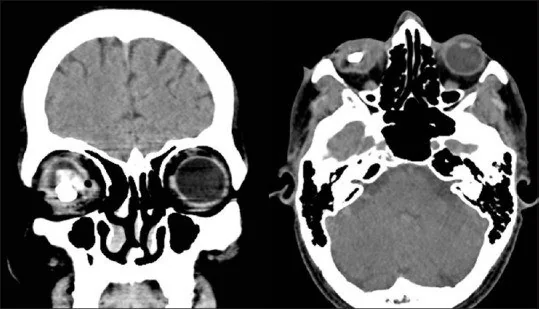
- Vitreus, ön kamara veya lens komşuluğunda keskin sınırlı hiperdens nokta ya da parça intraoküler yabancı cismi düşündürür.
- Metalik parçanın çevresindeki çizgilenme artefaktı, cismin metalik yapısı lehine bir ipucudur.
- Giriş yarası kornea veya korneoskleral bileşkede bulunabilir; bazı olgularda saptanamayabilir.
- BT, yabancı cismin göz içindeki yerini lokalize etmeye yardımcı olur.
- Vitreus içi hiperdens kanama, travmaya eşlik eden hemorajiyi düşündürür.
- Yer değiştirmiş lens zonül hasarını düşündürür; BT'de lens anormallığı açık glob yaralanmasıyla ilişkili bulgular arasında değerlendirilir.
- Retina ve koroid dekolmanları travma sonrası BT’de değerlendirilebilen oküler bulgular arasındadır; bu dekolmanların BT’deki özgül şekilleri ve BT’nin duyarlılığı iyi tanımlanmamıştır.
- Açık glob yaralanmasında BT’de glob kontur değişikliği, skleral ve korneal yaralanma, sığ ön kamara, lens dislokasyonu veya yıkımı ve vitreus hemorajisi görülebilir; BT’nin genel duyarlılığı sınırlıdır.
Normalde
Orbital BT'de yabancı cismin intraoküler, ekstraoküler veya retrooküler yerleşimi değerlendirilir. Karşı globun aynı seviyesindeki doğal kalsifikasyonları, lensi ve vitreusu referans al; şüpheli cismin glob içinde mi yoksa orbital yağda mı olduğunu kornea-sklera sınırına göre belirle. Kalsifiye skleral plak, BT’de hiperdens görünümüyle intraoküler yabancı cismi taklit edebilir; bu nedenle odağın skleral duvarla ilişkisi dikkatle değerlendirilmelidir.
Ayırıcı tanı
- Orbital yabancı cisim glob dışında, orbitada yerleşir.
- Skleral plak kalsifikasyonları duvar boyunca küçük veya plak biçimli hiperdens odaklar olarak yabancı cismi taklit edebilir; duvarla ilişkisi ve morfolojisi birlikte değerlendirilir.
Tuzaklar
- Tahta gibi organik cisimler düşük atenüasyonlu ve çizgisel biçimde görünüp havayla karışabilir; delici mekanizma varsa BT negatifliğini kesin dışlama olarak kabul etme.
- Düşük atenüasyonlu organik cisimler BT'de silik kalabilir; non-kontrast helikal BT'de ince kesitleri değerlendir.
- Metal çevresindeki ışın sertleşmesi artefaktı komşu dokuların görüntüsünü bozabilir; cismin merkezini ve glob içi-dışı konumunu ardışık kesitlerde izle.
- Glob içindeki hava açık glob yaralanmasının işareti olabilir; retina cerrahisi sonrası gazı ve düşük atenüasyonlu odunsu organik cismi ayırıcı tanıda değerlendir.
- Metalik yabancı cisim şüphesinde MR kontrendikedir; negatif BT ise göz içi yabancı cismi dışlamaz.
- Tahta yabancı cisimler düşük yoğunlukları nedeniyle BT’de travmatik orbital amfizemle karışabilir; kemik penceresinde pencere genişliğini artırmak ayırıcı değerlendirmeye yardımcı olabilir.
Kendini dene
Yüksek hızlı metalik göz travması olan hastanın kontrastsız orbital BT'sinde glob içinde hiperdens bir odak ve çevresinde çizgilenme artefaktı görülüyor. En olası açıklama nedir?
Cevabı göster
Metal intraoküler parça. Metalik intraoküler yabancı cisimler hiperdens görünür ve çevrelerinde çizgilenme artefaktı oluşturabilir.
Göze delici cisim battığı bilinen hastanın kontrastsız BT’sinde intraoküler yabancı cisim görülmüyor. Hangi yorum doğrudur?
Cevabı göster
Negatif BT intraoküler yabancı cismi kesin olarak dışlamaz. Negatif BT intraoküler yabancı cismi dışlamaz.
İlgili konular
Kaynaklar
Bu sayfadaki 37 cümle ve 2 quiz sorusu aşağıdaki kaynaklardan alıntılarla otomatik olarak karşılaştırıldı; 25 cümle bu karşılaştırmada düzeltildi (2026-10-12).
- Intraocular foreign bodiespubmed.ncbi.nlm.nih.gov
- Multimodal imaging features of intraocular foreign bodiespubmed.ncbi.nlm.nih.gov
- Computed tomography in traumatic orbital emergencies: a pictorial essay—imaging findings, tips, and report flowchartinsightsimaging.springeropen.com
- Advances in the management of intraocular foreign bodiesfrontiersin.org
- Intraocular Foreign Bodyncbi.nlm.nih.gov
- Ocular Trauma: Anatomy, Pitfalls, and Systematic Approach to Imaging Interpretationpubs.rsna.org
- Intravitreal injection of vancomycin leading to cilioretinal artery occlusion: A case report and literature reviewpmc.ncbi.nlm.nih.gov
- Ocular siderosis: a misdiagnosed cause of visual loss due to ferrous intraocular foreign bodies—epidemiology, pathogenesis, clinical signs, imaging and available treatment optionspmc.ncbi.nlm.nih.gov
- Ocular Point-of-Care Ultrasonography to Diagnose Posterior Chamber Abnormalitiespmc.ncbi.nlm.nih.gov
- Senile Scleral Plaque Mimicking an Intraocular Foreign Bodypmc.ncbi.nlm.nih.gov
- An evaluation of approaches to imaging for the pre-surgical assessment of intraocular foreign body sizepmc.ncbi.nlm.nih.gov
- Imaging of Orbital Trauma and Emergent Non-traumatic Conditions.pubmed.ncbi.nlm.nih.gov
- [Open-globe injuries and intraocular foreign bodies involving the posterior segment].pubmed.ncbi.nlm.nih.gov
- The epidemiology of Open Globe Injuries presenting to a tertiary referral eye hospital in Australia.pubmed.ncbi.nlm.nih.gov
- Diagnostic assessment of computed tomography (CT) in open globe injuries: a systematic review and meta-analysis.pubmed.ncbi.nlm.nih.gov
- Clinical outcomes and epidemiology of intraocular foreign body injuries in Cork University Hospital, Ireland: an 11-year review.pubmed.ncbi.nlm.nih.gov
- Updates on the clinical management of intraocular foreign body (IOFB).pubmed.ncbi.nlm.nih.gov
- High risk and low prevalence diseases: Open globe injury.pubmed.ncbi.nlm.nih.gov
- Ocular siderosis: a misdiagnosed cause of visual loss due to ferrous intraocular foreign bodies-epidemiology, pathogenesis, clinical signs, imaging and available treatment options.pubmed.ncbi.nlm.nih.gov
- Use of preoperative imaging in open globe injury management: a systematic review.pubmed.ncbi.nlm.nih.gov
- Acute ocular pain during magnetic resonance imaging due to retained intraocular metallic foreign body: the role of ultrasonography and ultrasound biomicroscopy in diagnosis and management of this condition.pubmed.ncbi.nlm.nih.gov
- The role of various imaging techniques in identifying and locating intraocular foreign bodies related to open-globe injury: three case reports and literature review.pubmed.ncbi.nlm.nih.gov
- Clinical outcomes and characterization of intraocular foreign body injuries from a Canadian centre: a 20-year retrospective study and literature review.pubmed.ncbi.nlm.nih.gov
- Intraocular foreign bodies: A review.pubmed.ncbi.nlm.nih.gov
- Injuries Associated with Recreational and Sport Angling: A Case Series of Mechanisms, Diagnosis, Treatment, and Rehabilitation.pubmed.ncbi.nlm.nih.gov
- Artificial Intelligence for In-Flight Detection of Space-Related Ocular Trauma: Bridging Diagnostic Gaps in Microgravity.pubmed.ncbi.nlm.nih.gov
- Intraocular foreign body in the anterior chamber angle of the eye-a 30-year-old 'emergency'.pubmed.ncbi.nlm.nih.gov
- Advancements in Wearable and Implantable BioMEMS Devices: Transforming Healthcare Through Technology.pubmed.ncbi.nlm.nih.gov
- Medical hyperspectral imaging: an updated review of technology advancements and biomedical applications.pubmed.ncbi.nlm.nih.gov
- Collaborative Diagnostic Pathways for Unilateral Orbital Disease: A Clinicopathological Series.pubmed.ncbi.nlm.nih.gov
- Multimodal imaging in neuro-ophthalmology.pubmed.ncbi.nlm.nih.gov
- Penetrating Orbital Injury: A Narrative Review for Emergency Clinicians.pubmed.ncbi.nlm.nih.gov
- Computed tomography in traumatic orbital emergencies: a pictorial essay-imaging findings, tips, and report flowchart.pubmed.ncbi.nlm.nih.gov
- Eye Globe Abnormalities on MR and CT in Adults: An Anatomical Approach.pubmed.ncbi.nlm.nih.gov
- Intracranial Migration of Silicone Delaying Life Saving Surgical Management: A Mimicker of Hemorrhage.pubmed.ncbi.nlm.nih.gov
- Spring Door Closer Entrapment of the Upper Eyelid: A Pediatric Periocular Foreign-Body Injury With a Favorable Functional Outcome-A Case Report.pubmed.ncbi.nlm.nih.gov
- Novel Technique in Performing Ocular Ultrasound in Trauma: A Case Series.pubmed.ncbi.nlm.nih.gov
- Pediatric intraorbital wooden foreign body mimicking an orbital mass: Delayed diagnosis and imaging considerations on MRI.pubmed.ncbi.nlm.nih.gov
- International Harmonization of Nomenclature and Diagnostic Criteria (INHAND): Nonproliferative and Proliferative Lesions of Nonrodent Ocular Tissues.pubmed.ncbi.nlm.nih.gov
- Congenital Malformations of the Eye: A Pictorial Review and Clinico-Radiological Correlations.pubmed.ncbi.nlm.nih.gov
- Principles of Ophthalmic Ultrasound.pubmed.ncbi.nlm.nih.gov
- Utility of CT in detecting and monitoring subphrenic jujube pits: a retrospective cross-sectional study of clinical cases and ex vivo experiments.pubmed.ncbi.nlm.nih.gov
- Clinical Presentation and Management Strategies in Intraorbital Foreign Bodies.pubmed.ncbi.nlm.nih.gov
- Novel Clinical Observations after Photodynamic Therapy in Choroidal Osteoma: A Three-Case Series.pubmed.ncbi.nlm.nih.gov
- Utility of artificial intelligence for the diagnosis, prognosis, and management of central serous chorioretinopathy: a narrative review.pubmed.ncbi.nlm.nih.gov
- Advancing Non-Invasive Ophthalmic Imaging in Sturge-Weber Syndrome: Clinical Guidelines Towards Early Choroidal Hemangioma Detection.pubmed.ncbi.nlm.nih.gov
- Intraocular and Ocular Adnexal Metastases: A Comprehensive Review.pubmed.ncbi.nlm.nih.gov
- Modified cyclodialysis suturing with sodium hyaluronate for traumatic choroidal avulsion and cyclodialysis: a retrospective study.pubmed.ncbi.nlm.nih.gov
- Optical Coherence Tomography in Retinal Detachment: Prognostic Biomarkers, Surgical Planning, and Postoperative Monitoring.pubmed.ncbi.nlm.nih.gov
- A Novel Conservative Approach for Managing the Phthisical Silicone Oil-Filled Eye: Conjunctival Flap Coverage and Prosthetic Fitting.pubmed.ncbi.nlm.nih.gov
- Endoscopy-assisted vitrectomy for severe ocular penetrating trauma with corneal opacity.pubmed.ncbi.nlm.nih.gov
- Assessment of intraocular foreign body using high resolution 3D ultrasound imaging.pubmed.ncbi.nlm.nih.gov
- Guidelines for preoperative visual function and imaging examination standards in vitreoretinal surgery (2025).pubmed.ncbi.nlm.nih.gov
- Foreign body removal from nasal cavity in transorbital injury of long bamboo stick penetrating nasopharyngeal region: a case report.pubmed.ncbi.nlm.nih.gov
- Clinical Analysis of Perforating Globe Injuries with Intraorbital Foreign Bodies: An 18-Year Retrospective Study.pubmed.ncbi.nlm.nih.gov
- Clinical findings and management of intraocular foreign bodies (IOFB) in third-world country eye hospital.pubmed.ncbi.nlm.nih.gov
- Fishing Hook Globe Injury Diagnosed with Point-of-care Ultrasound: A Case Report.pubmed.ncbi.nlm.nih.gov
- Zygomatic Sialadenitis as a Rare Cause of Exophthalmos in a Dog.pubmed.ncbi.nlm.nih.gov
- Hunting Firearm Induced Optic Nerve Transection.pubmed.ncbi.nlm.nih.gov
- International Harmonization of Nomenclature and Diagnostic Criteria (INHAND): Nonproliferative and Proliferative Lesions of the Rabbit.pubmed.ncbi.nlm.nih.gov
- Proceedings of the 15th International Congress on Circumpolar Health.pubmed.ncbi.nlm.nih.gov
- Case Report: Intraocular foreign body coexisting for 30 years.pubmed.ncbi.nlm.nih.gov
- Comparison of Ultrasonography, Magnetic Resonance Imaging and Cone Beam Computed Tomography for Detection of Foreign Bodies in Maxillofacial Region.pubmed.ncbi.nlm.nih.gov
- Ammonium ion binding to DNA G-quadruplexes: do electrospray mass spectra faithfully reflect the solution-phase species?pubmed.ncbi.nlm.nih.gov
- Diagnostic methods and therapeutic options of uveal melanoma with emphasis on MR imaging-Part I: MR imaging with pathologic correlation and technical considerations.pubmed.ncbi.nlm.nih.gov
- A case report: exudative retinal detachment secondary to combined infection of H1N1 influenza and Mycoplasma.pubmed.ncbi.nlm.nih.gov
- A Novel Surgical Strategy for Choroidal Avulsion in Complex Ocular Trauma: Choroidal Suturing Technique Using 9-0 Double-Armed Polypropylene Sutures.pubmed.ncbi.nlm.nih.gov
- International Olympic Committee (IOC) consensus paper on sports-related ophthalmology issues in elite sports.pubmed.ncbi.nlm.nih.gov
- Advances and Challenges in Wearable Sensors for Health Monitoring.pubmed.ncbi.nlm.nih.gov
- Consensus disease definitions for ophthalmic immune-related adverse events of immune checkpoint inhibitors.pubmed.ncbi.nlm.nih.gov
- Commentary: an eye on PET quantification.pubmed.ncbi.nlm.nih.gov
- A Rare Case of Orbitocranial Penetrating Injury with Intracranial Wooden Foreign Body Residue.pubmed.ncbi.nlm.nih.gov
- Magnetic resonance imaging of the orbit, Part 2: Characterization of orbital pathologies.pubmed.ncbi.nlm.nih.gov
- Radiological characteristics of mixed composition intraorbital foreign body.pubmed.ncbi.nlm.nih.gov
- LAWN TRIMMER-RELATED OPEN-GLOBE INJURIES IN TAIWAN.pubmed.ncbi.nlm.nih.gov
- Clinical Characteristics and Prognostic Factors of Patients with Intraocular Foreign Bodies from a Tertiary Eye Center in North China.pubmed.ncbi.nlm.nih.gov
- Relationship Between Ocular Trauma Score and Computed Tomography Findings in Eyes with Penetrating Globe Injuries: A Preliminary Study.pubmed.ncbi.nlm.nih.gov
- Demographic characteristics and visual prognosis of open globe ınjuries in an ındustrialized region of Turkey, east Thrace.pubmed.ncbi.nlm.nih.gov
- Accidental intravitreal injection of a veterinary inactivated FMD vaccine resulting in noninfectious intraocular inflammation: a case report.pubmed.ncbi.nlm.nih.gov
- Retrospective analysis of the clinical characteristics of childhood ocular trauma, 2020-2024.pubmed.ncbi.nlm.nih.gov
- A Standardized Classification of Uveal Injury.pubmed.ncbi.nlm.nih.gov
- Intraventricular silicone oil migration post-retinal detachment surgery: diagnostic features and classification - a case study with literature review.pubmed.ncbi.nlm.nih.gov
- Silicone oil tamponade in vitreoretinal surgery and future perspective: a narrative review.pubmed.ncbi.nlm.nih.gov
- More Than Meets the Eye: A Case of Endogenous Panophthalmitis.pubmed.ncbi.nlm.nih.gov
- Diagnostic test accuracy of CT for open globe injury: A systematic review and meta-analysis of overall impression and individual imaging signs.pubmed.ncbi.nlm.nih.gov
- Diagnostic value of computed tomography in predicting open globe injury.pubmed.ncbi.nlm.nih.gov
- Case Report of Ultrasonographic and Computed Tomography Findings of Presumed Traumatic Ocular Globe and Lens Rupture in a Cat.pubmed.ncbi.nlm.nih.gov
- A 43-Year-Old Man with a 30-Year History of a Retained Glass Intraocular Foreign Body Presenting with Retinal Detachment.pubmed.ncbi.nlm.nih.gov
- Clinical characteristics of 59 orbital space-occupying lesions: A retrospective case series.pubmed.ncbi.nlm.nih.gov
- Malpositioned orbital implants: indications for implant removal and secondary reconstructive techniques.pubmed.ncbi.nlm.nih.gov
- An Unusual Case of Low Vision and Anisocoria Considered a Neurological Finding in the Emergency Department: Ocular Siderosis.pubmed.ncbi.nlm.nih.gov
- Foreign Body Presenting as Golden Hypopyon.pubmed.ncbi.nlm.nih.gov
- Infectious scleritis: a review of etiologies, clinical features, and management strategies.pubmed.ncbi.nlm.nih.gov
- Scleritis: Differentiating infectious from non-infectious entities.pubmed.ncbi.nlm.nih.gov
- Extraction of Magnetic Intraocular Foreign Bodies Using a Novel Magnetic Foreign Body Extractor: 2 Cases.pubmed.ncbi.nlm.nih.gov
- Posterior migration of an Ahmed glaucoma valve: A case report of a rare postoperative complication.pubmed.ncbi.nlm.nih.gov
- Challenges in Diagnosing Extruded Hydrogel Scleral Buckle Mimicking an Orbital Abscess: A Case Report.pubmed.ncbi.nlm.nih.gov
- Clinical Characteristics and Prognostic Factors for Visual Outcome in Intraocular Foreign Body Cases Treated at a Tertiary Eye Hospital in Indonesia.pubmed.ncbi.nlm.nih.gov
- Clinical Characteristics, Outcomes, and Complications Associated With Delayed Diagnosis of Intraocular Foreign Body.pubmed.ncbi.nlm.nih.gov
- The Prevalence of Ophthalmic Diagnoses and Exam Findings in Emergency Department Consults at Two Academic Hospitals.pubmed.ncbi.nlm.nih.gov
- The Eye That Hid Its Wound: A Case Report of Corneal Perforation Despite a Negative Seidel Test.pubmed.ncbi.nlm.nih.gov
- Systematic Review of Bilateral Ocular Trauma: Considerations for Future Whole-eye Transplantation.pubmed.ncbi.nlm.nih.gov
- Ultrasound biomicroscopy and anterior segment OCT in ocular surface squamous neoplasia: complementary roles, case series, and targeted literature review.pubmed.ncbi.nlm.nih.gov
- The Rusty Eye: Ocular Siderosis Masquerading as Chronic Anterior Uveitis.pubmed.ncbi.nlm.nih.gov
- Senile Scleral Plaque Mimicking an Intraocular Foreign Body.pubmed.ncbi.nlm.nih.gov
- Transformative biomechanics and mechanobiology breakthroughs shaping the future of health and medicine.pubmed.ncbi.nlm.nih.gov
- Diagnosis and Management Strategies in Sclerochoroidal Calcification: A Systematic Review.pubmed.ncbi.nlm.nih.gov
- A Computed Tomography Scan Near Miss of an Intraorbital Wooden Foreign Body.pubmed.ncbi.nlm.nih.gov
- pubmed.ncbi.nlm.nih.govpubmed.ncbi.nlm.nih.gov
- pmc.ncbi.nlm.nih.govpmc.ncbi.nlm.nih.gov
Eğitim amaçlıdır; hasta başında tanı ve tedavi kararının yerine geçmez, tıbbi tavsiye değildir. Metinler yapay zekâ desteğiyle yazıldı ve otomatik bir adımda kaynak alıntılarıyla karşılaştırıldı; bu bir tıbbi doğrulama değildir ve içerik uzman radyolog incelemesinden geçmedi. Klinik kararlarda güncel kılavuzları, kurum protokollerini ve radyoloji raporunu esas alın.