Özet
Zigomatik ark, zigomatik kemiğin temporal çıkıntısı ile temporal kemiğin zigomatik çıkıntısından oluşur. Arkın çökmesi yüz konturunu düzleştirebilir; medial fragmanın koronoide dayanması ağız açılmasını mekanik olarak kısıtlayabilir. Kırığı izole olarak adlandırmadan daha geniş zigomatikomaksiller kompleks yaralanmasını dışlamak, eşlik eden orbital ve maksiller hasarı atlamamak açısından önemlidir.
Faz ve pencere
- Kontrastsız tanısal
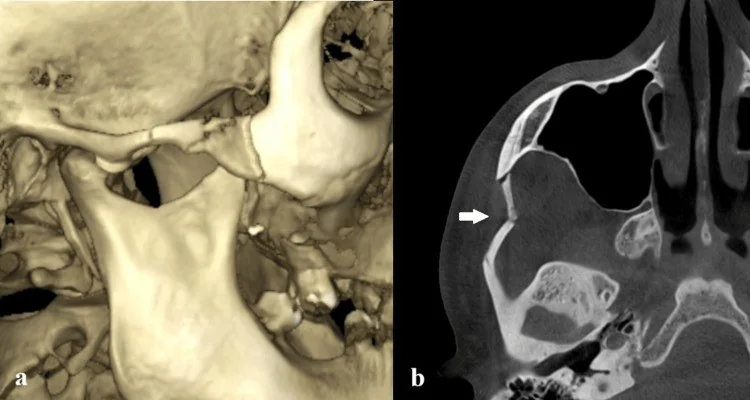
- Yüz kemik BT'sinde ark boyunca kırık hattı, kemik deplasmanı veya anterior, posterior ve orta bölge çökmesi izlenebilir.
- Kemik algoritması tanısal
- Yüz kemik BT'sinin aksiyel görüntülerinde zigomatik ark kırıkları değerlendirilebilir.
Önerilen pencereler G genişlik, M merkez; değerler Hounsfield birimi (HU)
- KemikG 1800 / M +400
- Yumuşak dokuG 400 / M +40
BT bulguları
- Kontur çökmesi — normalde dışa konveks olan arkın temporal fossaya doğru düzleşmesi veya basamaklı girinti oluşturması.
- Ark kırığında kırık çizgileri ve kemik deplasmanı görülebilir.
- V biçimli orta çökme — orta ark bölümünde birbirine yaklaşan kırık kolları arasında içe deplase kama biçimli segment.
- Parçalanma — arkın tek bir çökme segmenti yerine çok sayıda küçük fragmana ayrılması.
- Koronoid-ark ilişkisi — kırık konumuna bağlı olarak ark fragmanı ile mandibulanın koronoid çıkıntısı arasında doğrudan kemik teması oluşabilir.
- İzole ark kırığı demeden önce zigomatikofrontal sütür, zigomatikomaksiller buttress ve orbital duvarlarda eşlik eden kırık olup olmadığını değerlendirin.
Ölçütler ve sınıflamalar
- Nam–Jung izole zigomatik ark sınıflaması
- Nam ve Jung tarafından önerilen (izole ark kırıkları için evrensel uzlaşı sağlamayan) sınıflamada Tip I deplase olmayan kırık çizgisi veya yeşil ağaç kırığıdır. Tip II, III ve IV sırasıyla ön, arka ve orta bölüm çökmesini; Tip V orta bölümde V biçimli çökme/kırığı; Tip VI parçalı kırığı tanımlar. Tip II–V’de deplasman ve travma vektörü de dikkate alınır. Koronoid impingement her tipte bulunabilir veya bulunmayabilir.
Normalde
Normal zigomatik ark, zigomatik kemiğin temporal çıkıntısı ile temporal kemiğin zigomatik çıkıntısı arasında kesintisiz, dışa konveks bir köprü görünümündedir. İzole ark kırığı değerlendirilirken eşlik eden başka yüz kırığı olup olmadığı dikkate alınır.
Normal BT ile kıyasla
Aynı bölgenin, kaynak veri setinde patoloji içermediği belirtilen bir BT incelemesini kesit kesit kaydırın; organ sınırlarını açarak anatomiyi hasta görüntüsüyle karşılaştırın. Küçük rastlantısal bulgular tümüyle dışlanmamıştır.
Kaynak: TotalSegmentator v2.01 veri seti (Wasserthal ve ark., Radiology: Artificial Intelligence 2023), CC BY 4.0, vaka s0849; organ sınırları veri setinin otomatik segmentasyonundan, birleştirilerek sadeleştirildi. Görüntüler 2,5 mm kesit aralığına yeniden örneklendi.
Ayırıcı tanı
- Zigomatikomaksiller kompleks yaralanması
- ark hasarına orbital rim/duvar, zigomatikofrontal eklem veya maksiller buttress boyunca ek kırıklar katılır.
- Deplasmansız veya yeşil ağaç tipi ark kırığı
- yalnızca kırık çizgisi görülen deplasmansız kırıklar ve yeşil ağaç kırıkları da izole ark kırığı alt tipleri arasında değerlendirilmelidir; belirgin çökme olmaması bu kırıkları dışlamaz.
Tuzaklar
- Aksiyel kesitlerde tek başına arkı görmek, yaralanmanın izole olduğunu kanıtlamaz; zigomatikofrontal eklemden orbital duvarlara ve zigomatikomaksiller buttress'e kesintisiz geçiş yapın.
- Koronoid impingement'i, kırık konumuna bağlı olarak ark fragmanı ile koronoid çıkıntı arasındaki doğrudan kemik temasıyla değerlendirin.
- Zigomatik ark kırıklarının saptanması, 2D ve 3D BT görüntülerinde benzer bulunmuştur.
Kendini dene
Yüz kemik BT'sinde zigomatik ark kırığı saptanıyor. Başka yüz kırığı yok. Bu yaralanma nasıl adlandırılır?
Cevabı göster
İzole zigomatik ark kırığı. Başka yüz kırığı eşlik etmediğinde ark kırığı izole zigomatik ark kırığı olarak adlandırılır; ark kırıkları çoklu yüz kırıklarının bir parçası olarak da görülebilir.
Zigomatik ark kırığında koronoid impingement gelişmesi ağız açılmasını nasıl etkileyebilir?
Cevabı göster
Ağız açılmasını kısıtlayabilir. Koronoid impingement, ağız açılmasında belirgin kısıtlılıkla ilişkili olabilir.
İlgili konular
Kaynaklar
Bu sayfadaki 35 cümle ve 2 quiz sorusu aşağıdaki kaynaklardan alıntılarla otomatik olarak karşılaştırıldı; 9 cümle bu karşılaştırmada düzeltildi (2026-10-12).
- Proposal for a modified classification of isolated zygomatic arch fracturespmc.ncbi.nlm.nih.gov
- Closed Isolated Zygomatic Arch Fracture Management Made Easy.pubmed.ncbi.nlm.nih.gov
- Intra-operative application of ultrasonography (USG) for reduction of zygomatic arch fracture.pubmed.ncbi.nlm.nih.gov
- Discrepancy of the location of depression on the soft tissue and the bone in isolated zygomatic arch fracture.pubmed.ncbi.nlm.nih.gov
- Proposal for a modified classification of isolated zygomatic arch fractures.pubmed.ncbi.nlm.nih.gov
- Feasibility of 4-point fixation using the preauricular approach in a zygomaticomaxillary complex fracture.pubmed.ncbi.nlm.nih.gov
- Is Gillies Temporal Incision Necessary to Successfully Reduce Zygomaticomaxillary Fracture Combined With Orbital Wall Fracture?pubmed.ncbi.nlm.nih.gov
- Evaluation of Treatment of Zygomaticomaxillary Complex Fractures and Isolated Zygomatic Arch Fractures Using Intraoperative Ultrasonography.pubmed.ncbi.nlm.nih.gov
- Defining the Zygomaticosphenoidal Angle as a Guide to Anatomic Zygomaticomaxillary Complex Fracture Reduction.pubmed.ncbi.nlm.nih.gov
- Does Intraoperative Computed Tomography Improve the Outcome in Zygomatico-Orbital Complex Fracture Reduction?pubmed.ncbi.nlm.nih.gov
- Patterns of facial fractures in children.pubmed.ncbi.nlm.nih.gov
- Comparisons among four types of absorbable plates used for internal fixation of zygomaticomaxillary complex fractures.pubmed.ncbi.nlm.nih.gov
- Rare case of isolated osteochondroma of the zygomatic bone: an endoscopic-assisted approach.pubmed.ncbi.nlm.nih.gov
- Accuracy of three-dimensional facial soft tissue simulation in post-traumatic zygoma reconstruction.pubmed.ncbi.nlm.nih.gov
- Fractures of the posterolateral maxillary sinus: a masticator space blowout injury?pubmed.ncbi.nlm.nih.gov
- V-shaped outward displacement: a proposed new subtype of isolated zygomatic arch fracture.pubmed.ncbi.nlm.nih.gov
- Injury Patterns in Soccer-Induced Maxillofacial Fractures and Ocular Trauma: A Narrative Review.pubmed.ncbi.nlm.nih.gov
- The Ocular Signature of TBI: A Narrative Review of Structural Changes and Potential Candidate Biomarkers.pubmed.ncbi.nlm.nih.gov
- The use of mandibular nerve block in unilateral mandibular fracture to evaluate the mouth opening for assessment of airway.pubmed.ncbi.nlm.nih.gov
- MANAGING TEMPOROMANDIBULAR JOINT DISLOCATION IN IBADAN: A REVIEW OF 11 CASES.pubmed.ncbi.nlm.nih.gov
- A review of the oral health of individuals with disabilities in Puerto Rico and among U.S. Hispanics.pubmed.ncbi.nlm.nih.gov
- Evaluation of treatment outcomes of zygomaticomaxillary complex (ZMC) fractures using Foley catheter ballooning technique.pubmed.ncbi.nlm.nih.gov
- Non-Scar Fixation Technique for Zygomaticomaxillary Complex Tripod Fracture Using Upper Lid Transconjunctival Incision.pubmed.ncbi.nlm.nih.gov
- Patterns of Surgically Managed Maxillofacial Injuries in a Tertiary Care Hospital in North India.pubmed.ncbi.nlm.nih.gov
- Uncommon Presentation of a Symphyseal and Bilateral Mandibular Body Fracture From a Gunshot Injury: A Case Report and Literature Review.pubmed.ncbi.nlm.nih.gov
- Osteotomies: Indications, Imaging Appearance, Surgical Techniques, and Complications.pubmed.ncbi.nlm.nih.gov
- Evidence for deliberate burial of the dead by <i>Homo naledi</i>.pubmed.ncbi.nlm.nih.gov
- Surgical Measures Improving Functional Limitations of the Masticatory System, Aesthetic Deficits, and Skeletal Malformations in Neurofibromatosis Type 1-associated Hemifacial Diffuse Plexiform Neurofibroma Complicated by Rapidly Growing Midfacial Peripheral Nerve Sheath Tumor.pubmed.ncbi.nlm.nih.gov
- Histological Diversity, Diagnostic Challenges, and Surgical Treatment Strategies of Fibrous Dysplasia of Upper and Mid-Thirds of the Craniomaxillofacial Complex.pubmed.ncbi.nlm.nih.gov
- Masses of developmental and genetic origin affecting the paediatric craniofacial skeleton.pubmed.ncbi.nlm.nih.gov
- Evidence of neolithic cannibalism among farming communities at El Mirador cave, Sierra de Atapuerca, Spain.pubmed.ncbi.nlm.nih.gov
- The Use of MMF Screws: Surgical Technique, Indications, Contraindications, and Common Problems in Review of the Literature.pubmed.ncbi.nlm.nih.gov
- Experimental butchering of a chimpanzee carcass for archaeological purposes.pubmed.ncbi.nlm.nih.gov
- Reconstructive Surgery for Head and Neck Cancer Patients.pubmed.ncbi.nlm.nih.gov
- Imaging-Guided Algorithmic Management of Mandibular Condylar Fractures: A 13-Year Institutional Analysis of 495 Joints.pubmed.ncbi.nlm.nih.gov
- Management Protocol for Ballistic and Other High-Energy Avulsive Facial Injuries-An Update for the 21st Century.pubmed.ncbi.nlm.nih.gov
- Ophthalmic Complications Following Sinus Lifting Surgery: Case Report and Review of Literature.pubmed.ncbi.nlm.nih.gov
- Anatomy-Driven Aesthetic Design for Facial Contouring in Northeast Asian Females: A Conceptual Framework and Case Report.pubmed.ncbi.nlm.nih.gov
- Surgical Correction of the Nasolabial Fold: A Critical Review of Rhytidectomy Techniques.pubmed.ncbi.nlm.nih.gov
- The osteology of Triisodon crassicuspis (Cope, 1882): New insights into the enigmatic "archaic" placental mammal group "Triisodontidae".pubmed.ncbi.nlm.nih.gov
- Temporalis muscle flap in craniofacial reconstruction: anatomy, techniques, outcomes, and innovations.pubmed.ncbi.nlm.nih.gov
- Unusual pattern of mandibular fracture displacement in a child: A case report.pubmed.ncbi.nlm.nih.gov
- A Core Head, Neck, and Neuroanatomy Syllabus for Physical Therapy Student Education.pubmed.ncbi.nlm.nih.gov
- Hominin Variability and Evolutionary Relationships at Guattari Cave During the Middle and Late Pleistocene (San Felice Circeo, Latina, Italy).pubmed.ncbi.nlm.nih.gov
- Task force of the Brazilian Society of Otology - evaluation and management of peripheral facial palsy.pubmed.ncbi.nlm.nih.gov
- Computer-Assisted Evaluation of Zygomatic Fracture Outcomes: Case Series and Proposal of a Reproducible Workflow.pubmed.ncbi.nlm.nih.gov
- Computed tomography in traumatic orbital emergencies: a pictorial essay-imaging findings, tips, and report flowchart.pubmed.ncbi.nlm.nih.gov
- Surgical Management of Isolated Zygomaticomaxillary Complex Fractures: Role of Objective Morphometric Analysis in Decision-Making.pubmed.ncbi.nlm.nih.gov
- Efficacy of a Y-modified Transconjunctival Approach for Open Reduction and Internal Fixation of Zygomaticomaxillary Complex Fractures: Functional Recovery and Cosmetic Outcomes.pubmed.ncbi.nlm.nih.gov
- Functional and Aesthetic Outcomes of the Subtarsal Approach in Zygomaticomaxillary Complex Fractures With Orbital Floor Involvement: A Prospective Cohort Study.pubmed.ncbi.nlm.nih.gov
- Effect of different palatal expanders with miniscrews in surgically assisted rapid palatal expansion: A non-linear finite element analysis.pubmed.ncbi.nlm.nih.gov
- Application of Finite Element Analysis in Oral and Maxillofacial Surgery-A Literature Review.pubmed.ncbi.nlm.nih.gov
- The Comprehensive AOCMF Classification System: Midface Fractures - Level 3 Tutorial.pubmed.ncbi.nlm.nih.gov
- Cone-Beam Computed Tomography (CBCT)-Based Diagnosis of Dental Bone Defects.pubmed.ncbi.nlm.nih.gov
- Diagnostic Utility of the "Air Sign" as a Radiological Indicator for Mandibular Body and Angle Fractures.pubmed.ncbi.nlm.nih.gov
- Contemporary Management of Zygomaticomaxillary Complex Fractures.pubmed.ncbi.nlm.nih.gov
- Anatomic, Radiographic, and Computed Tomographic Study of the Skull in the Persian Squirrel (Sciurus anomalus).pubmed.ncbi.nlm.nih.gov
- Minimally invasive resection of a spheno-orbital tumor: Review of surgical techniques and a case report.pubmed.ncbi.nlm.nih.gov
- An Eleven-Point Ultrasound-Guided Fascia Hydrorelease Protocol for Non-Odontogenic Toothache and Orofacial Pain: A Clinical Protocol.pubmed.ncbi.nlm.nih.gov
- A new balaenopterid whale from the late Miocene of the Southern North Sea Basin and the evolution of balaenopterid diversity (Cetacea, Mysticeti).pubmed.ncbi.nlm.nih.gov
- Intraoperative CT evaluation of repositioning accuracy in zygomaticomaxillary complex fractures: 1-point versus multiple-point fixation.pubmed.ncbi.nlm.nih.gov
- New Skull Material of Taeniolabis taoensis (Multituberculata, Taeniolabididae) from the Early Paleocene (Danian) of the Denver Basin, Colorado.pubmed.ncbi.nlm.nih.gov
- The current regenerative medicine approaches of craniofacial diseases: A narrative review.pubmed.ncbi.nlm.nih.gov
- Post-Traumatic Orbital Reconstruction Using Titanium Patient-Specific Implants: A Clinical and Radiological Cohort Study Focusing on Paranasal Sinuses Physiology.pubmed.ncbi.nlm.nih.gov
- Are Age and Trauma Mechanism Associated with Volume Change in the Fractures of the Bony Orbit?pubmed.ncbi.nlm.nih.gov
- Does More Invasive Surgery Result in Higher Patient Satisfaction? A Long-Term Follow-Up of 136 Zygomaticomaxillary Complex Fractures.pubmed.ncbi.nlm.nih.gov
- Suspected Posttraumatic Mandibular Coronoid Hyperplasia and Condylar Hypoplasia: Two Case Reports and Literature Review.pubmed.ncbi.nlm.nih.gov
- Evaluation of the mechanism and principles of management of temporomandibular joint dislocation. Systematic review of literature and a proposed new classification of temporomandibular joint dislocation.pubmed.ncbi.nlm.nih.gov
- An Exploratory Study on Injury Patterns and Clinical Characteristics of Sports-Related Oral and Maxillofacial Trauma: A Single-Center Retrospective Study.pubmed.ncbi.nlm.nih.gov
- Combined Treatment of Myofascial Pain Syndrome by Bilateral Coronoidectomy and Botulinum Toxin Injection.pubmed.ncbi.nlm.nih.gov
- Anterior dislocation of the coronoid process above a ZMC fracture: case report and a technical note.pubmed.ncbi.nlm.nih.gov
- Imaging Evaluation for Jaw Deformities: Diagnostic Workup and Pre-Treatment Imaging Checklist for Orthognathic Surgery.pubmed.ncbi.nlm.nih.gov
- Variations on a Theme: Morphological Variability and Insular Adaptations in the Pleistocene Hippopotamuses of the Siculo-Maltese Archipelago.pubmed.ncbi.nlm.nih.gov
- Traumatic oculomotor nerve palsy treated with transnasal endoscopic decompression through the optic strut.pubmed.ncbi.nlm.nih.gov
- Chronic Long-Standing Temporomandibular Joint Dislocation: Report of Three Cases and Review of Literature.pubmed.ncbi.nlm.nih.gov
- Method for accessing zygomatic-maxillary complex symmetry: Mirroring, transposing, and calculating Hausdorff distance.pubmed.ncbi.nlm.nih.gov
- Effectiveness of ultrasound-guided peripheral mandibular nerve block: A systematic review.pubmed.ncbi.nlm.nih.gov
- Comparative Study of Computerized Tomography Imaging of Facial Trauma Using 2D and 3D Reconstruction Scans.pubmed.ncbi.nlm.nih.gov
- Preliminary outcomes of the surgical navigation system combined with intraoperative three-dimensional C-arm computed tomography for zygomatico-orbital fracture reconstruction.pubmed.ncbi.nlm.nih.gov
- Evaluation of 3 and 2-point internal fixation in the management of zygomaticomaxillary complex fractures: Case report.pubmed.ncbi.nlm.nih.gov
- Automated 3D Analysis of Zygomaticomaxillary Fracture Rotation and Displacement.pubmed.ncbi.nlm.nih.gov
- Evaluation of Zygomaticomaxillary Complex Fractures with Gillies Approach in Al-Baha Region of Saudi Arabia: A Cohort Study.pubmed.ncbi.nlm.nih.gov
- Impact of zygomaticomaxillary complex fracture on masticatory muscle dysfunction and pain: systematic review and observational meta-analysis.pubmed.ncbi.nlm.nih.gov
- Frontal Bone Fractures and Frontal Sinus Injuries: Treatment Paradigms.pubmed.ncbi.nlm.nih.gov
- Midface Fractures I.pubmed.ncbi.nlm.nih.gov
- Open reduction and internal fixation of zygomatic arch fracture by transbuccal instrumentation - A prospective clinical trial.pubmed.ncbi.nlm.nih.gov
- Critical Degree of Orbital Floor Displacement Drives Operative Repair of Zygomaticomaxillary Complex Fractures: Findings from a 10-Year Retrospective Study.pubmed.ncbi.nlm.nih.gov
- A modified approach for treating zygomatic arch fracture with plate fixation: a retrospective study.pubmed.ncbi.nlm.nih.gov
- Evaluation of the Relationship Between Zygomatic Arch Fracture Reduction and Mandibular Movements.pubmed.ncbi.nlm.nih.gov
- High-resolution imaging of an ancient Egyptian mummified head: new insights into the mummification process.pubmed.ncbi.nlm.nih.gov
- Facial Contouring in Orthognathic Surgery: The Role of Facial Implants.pubmed.ncbi.nlm.nih.gov
- Facial fractures: classification and highlights for a useful report.pubmed.ncbi.nlm.nih.gov
- Trauma of the midface.pubmed.ncbi.nlm.nih.gov
- Integrated management of mandibular fractures and traumatic dental injuries: a literature review and clinical algorithm proposal.pubmed.ncbi.nlm.nih.gov
- Temporomandibular Joint Defects: Etiology and Reconstruction Strategy: A Narrative Review.pubmed.ncbi.nlm.nih.gov
- Patient-Specific Subperiosteal Implants for Oral and Maxillofacial Rehabilitation: A Scoping Review Across Indications, from Established Full-Arch Use to Emerging Single-Tooth and Oncologic Applications.pubmed.ncbi.nlm.nih.gov
- Preliminary Evaluation of Static and Kinematic Magnetic Resonance Imaging (MRI) of the Feline Temporomandibular Joint (TMJ): A Comparative Analysis of Joint Inclination Angles in Intact and Dislocated Conditions.pubmed.ncbi.nlm.nih.gov
- Innovations in Implant Osseointegration: Biomaterials, Surface Engineering, and Translational Strategies.pubmed.ncbi.nlm.nih.gov
- Application of ultrasound guidance in the oral and maxillofacial nerve block.pubmed.ncbi.nlm.nih.gov
- Imaging of the temporomandibular joint: An update.pubmed.ncbi.nlm.nih.gov
- Minimally Invasive Single-Point Stabilization of Zygomaticomaxillary Complex Fractures.pubmed.ncbi.nlm.nih.gov
- Optimizing the surgical management of zygomaticomaxillary complex fractures.pubmed.ncbi.nlm.nih.gov
- Pediatric orbital fractures.pubmed.ncbi.nlm.nih.gov
- Retrospective Study of Orbital and Orbitozygomaticomaxillary Complex Fractures Treated at Aalesund Hospital Between 2002 and 2017.pubmed.ncbi.nlm.nih.gov
- Management of Traumatic Soft Tissue Injuries of the Face.pubmed.ncbi.nlm.nih.gov
- The Cat Mandible (II): Manipulation of the Jaw, with a New Prosthesis Proposal, to Avoid Iatrogenic Complications.pubmed.ncbi.nlm.nih.gov
- Myositis Ossificans of the Masseter Muscle: A Rare Post-traumatic Case.pubmed.ncbi.nlm.nih.gov
- Radiological investigation of acute mandibular injury.pubmed.ncbi.nlm.nih.gov
- Early presence of Homo sapiens in Southeast Asia by 86-68 kyr at Tam Pà Ling, Northern Laos.pubmed.ncbi.nlm.nih.gov
- Multidetector computed tomography of temporomandibular joint: A road less travelled.pubmed.ncbi.nlm.nih.gov
- LeFort Fractures.pubmed.ncbi.nlm.nih.gov
Eğitim amaçlıdır; hasta başında tanı ve tedavi kararının yerine geçmez, tıbbi tavsiye değildir. Metinler yapay zekâ desteğiyle yazıldı ve otomatik bir adımda kaynak alıntılarıyla karşılaştırıldı; bu bir tıbbi doğrulama değildir ve içerik uzman radyolog incelemesinden geçmedi. Klinik kararlarda güncel kılavuzları, kurum protokollerini ve radyoloji raporunu esas alın.