Özet
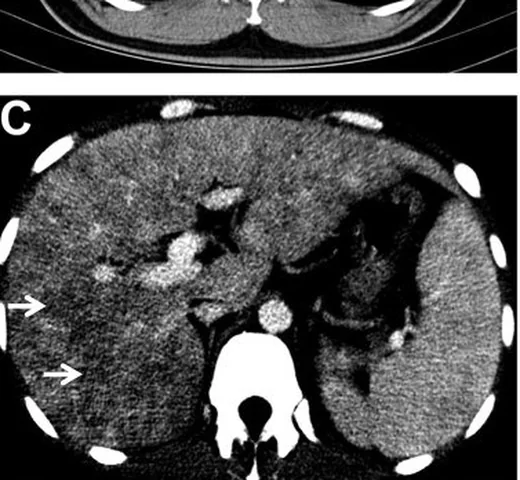
Sinüzoidal obstrüksiyon sendromu (SOS; eski adıyla veno-oklüzif hastalık), sinüzoidal endotel hasarı nedeniyle hepatik venül ve sinüzoidlerde kan akımının tıkanmasıyla oluşan, karaciğer konjesyonu ve portal hipertansiyonla karakterize bir tablodur; hematopoietik kök hücre nakli ve pirrolizidin alkaloit gibi toksik maruziyetler önemli nedenleridir. Kontrastlı BT hepatomegali, periportal ödem ve yamalı parankim kontrastlanmasını gösterebilir; ana hepatik venler açık kalabileceğinden normal büyük damar görünümü SOS'u dışlamaz. Görüntüleme klinik tanıya destek olur ve portal hipertansiyon bulgularını, ayrıca Budd–Chiari gibi makrovenöz tıkanmaları araştırır. Erken tanınmayan ağır SOS çoklu organ etkilenimi ve karaciğer yetmezliğiyle ilerleyebilir; yalnızca hepatik venlerin açık olmasına bakıp tanıyı dışlamak gecikmeye yol açar.
Faz ve pencere
- Arteriyel
- Arteriyel fazda karaciğer parankiminde yamalı ve düzensiz kontrastlanma görülebilir; bu erken perfüzyon değişikliği tek başına SOS'a özgü değildir ve portal faz bulgularıyla birlikte okunmalıdır.
- Portal tanısal
- Portal fazda parankimde yamalı düşük atenüasyon ve heterojen azalmış kontrastlanma, periportal ödem ve portal hipertansiyon işaretleri görülebilir. Küçük intrahepatik venler silik veya dar görünebilir; ana hepatik venler patent kalabilir.
Önerilen pencereler: Karaciğer (G 150 / M 30), Batın (G 400 / M 50).
BT bulguları
- Erken akut dönemde ağrılı hepatomegali, sıvı tutulumu ve asit sık görülür.
- Portal ven dalları çevresinde ödem ve parankim içinde yamalı düşük atenüasyon/azalmış portal faz kontrastlanması izlenebilir.
- Safra kesesi duvarında ödem, perihepatik sıvı ve asit portal hipertansiyon ile birlikte ortaya çıkabilir.
- Küçük intrahepatik hepatik venler dar, düzensiz ya da silik görünebilir; ana hepatik venlerin opasifikasyonu korunabilir.
- Asit ve safra kesesi duvarı ödemi sık görülürken, dalak büyümesi ve portosistemik kollateraller akut evrede nadirdir; kronik seyirte portal hipertansiyon bulguları gelişebilir.
- Hepatik venleri çevreleyen pençe biçimli kontrastlanma, venöz ve denge fazlarında yamalı parankim kontrastlanmasıyla birlikte görülebilir.
Normalde
Karşılaştırmada karaciğer parankimindeki yamalı düşük atenüasyon ve venöz-denge fazlarındaki heterojen kontrastlanma ile periportal ödemi, safra kesesi duvarı ödemini ve asiti değerlendir.
Normal BT ile kıyasla
Aynı bölgenin, kaynak veri setinde patoloji içermediği belirtilen bir BT incelemesini kesit kesit kaydırın; organ sınırlarını açarak anatomiyi hasta görüntüsüyle karşılaştırın. Küçük rastlantısal bulgular tümüyle dışlanmamıştır.
Kaynak: TotalSegmentator v2.01 veri seti (Wasserthal ve ark., Radiology: Artificial Intelligence 2023), CC BY 4.0, vaka s0541; organ sınırları veri setinin otomatik segmentasyonundan, birleştirilerek sadeleştirildi. Görüntüler 2,5 mm kesit aralığına yeniden örneklendi.
Ayırıcı tanı
- Budd–Chiari sendromu
- ana hepatik ven veya IVC'de trombüs, nonopasifikasyon ya da belirgin çıkış darlığı doğrudan makrovenöz tıkanmayı gösterir.
- Konjestif hepatopati
- sağ kalp büyümesi, geniş IVC/hepatik venler ve sağ atriyumdan venöz sisteme reflü kardiyak kaynaklı basınç artışını destekler.
- Akut hepatit
- periportal ödem ve safra kesesi duvar ödemi örtüşebilir, ancak venül daralması ve transplantasyon/toksik maruziyet öyküsü SOS yönünde ipucudur.
- Hipoksik hepatit
- şok bağlamında yaygın silik hipoenhansman ve başka organlarda düşük perfüzyon bulguları daha olasıdır.
Tuzaklar
- Ana hepatik venlerin açık olması SOS'u dışlamaz; hastalığın yerleşimi sinüzoidler ve küçük venüllerdedir.
- Asit, safra kesesi duvarı ödemi ve periportal halo özgül değildir; nakil/toksik maruziyet bağlamı ile parankim paternini beraber değerlendir.
- Budd–Chiari ve SOS benzer hepatomegali-perfüzyon bozukluğu yapabilir; büyük damar lümenini ve olası trombüsü doğrudan araştır.
Kendini dene
Nakil sonrası hastada hepatomegali, yamalı portal faz hipoenhansmanı ve periportal ödem var; ana hepatik venler açık. En olası tanı?
Cevabı göster
Sinüzoidal obstrüksiyon sendromu. Nakil bağlamı ve parankimal/portal ödem paterninin, ana venler açıkken görülmesi küçük venül-sinüzoid düzeyindeki SOS'u destekler. Budd–Chiari büyük venleri tıkar; kardiyak konjesyonda geniş IVC ve kalp bulguları beklenir; kolesistit karaciğer parankimini bu biçimde etkilemez.
Yamalı karaciğer kontrastlanmasına ek olarak sağ atriyum ve IVC geniş, hepatik venlere kontrast reflüsü mevcut. Hangi tanı daha uygundur?
Cevabı göster
Konjestif hepatopati. Venöz genişleme ve sağ kalpten geriye kontrast akımı kardiyak venöz konjesyonu gösterir. SOS mikrodolaşım hastalığıdır; viral hepatit bu reflüyü, steatoz ise bu venöz bulguları açıklamaz.
İlgili konular
Kaynaklar
Bu sayfadaki 34 cümle ve 2 quiz sorusu aşağıdaki kaynaklardan alıntılarla tek tek karşılaştırıldı; 5 cümle bu karşılaştırmada düzeltildi (2026-10-09).
- Hepatic sinusoidal obstruction syndrome caused by Gynura japonica once misdiagnosed as pancreatitis: a case report and review of literaturepmc.ncbi.nlm.nih.gov
- Hepatic Sinusoidal Obstruction Syndrome Induced by Pyrrolizidine Alkaloids from Gynura segetum : Mechanisms and Therapeutic Advancespmc.ncbi.nlm.nih.gov
- Atypical features of hepatic veno-occlusive disease/sinusoidal obstruction syndrome after inotuzumab ozogamicin in adult patients with acute lymphoblastic leukemiapmc.ncbi.nlm.nih.gov
- Burden of illness of non-hematopoietic stem cell transplant-related hepatic sinusoidal obstruction syndrome: A systematic reviewpmc.ncbi.nlm.nih.gov
- Key CT and MRI findings of drug-associated hepatobiliary and pancreatic disorderspmc.ncbi.nlm.nih.gov
- Hepatic sinusoidal dilatation.pubmed.ncbi.nlm.nih.gov
- CT and MR imaging of chemotherapy-induced hepatopathy.pubmed.ncbi.nlm.nih.gov
- Quantitative Imaging in Pediatric Hepatobiliary Disease.pubmed.ncbi.nlm.nih.gov
- Imaging of chemotherapy-induced liver toxicity: an illustrated overview.pubmed.ncbi.nlm.nih.gov
- Hepatobiliary phase liver MR imaging findings after Oxaliplatin-based chemotherapy in cancer patients.pubmed.ncbi.nlm.nih.gov
- Consequences of chemotherapy on resection of colorectal liver metastases.pubmed.ncbi.nlm.nih.gov
- Noninvasive imaging diagnosis of sinusoidal obstruction syndrome: a pictorial review.pubmed.ncbi.nlm.nih.gov
- Key CT and MRI findings of drug-associated hepatobiliary and pancreatic disorders.pubmed.ncbi.nlm.nih.gov
- Drug-induced hepatic sinusoidal obstruction syndrome: current advances and future perspectives.pubmed.ncbi.nlm.nih.gov
- Vascular disorders of the liver: recommendations from the Italian Association for the Study of the Liver (AISF) ad hoc committee.pubmed.ncbi.nlm.nih.gov
- Role of imaging techniques in liver veno-occlusive disease diagnosis: recent advances and literature review.pubmed.ncbi.nlm.nih.gov
- [Acute hepatic vascular complications].pubmed.ncbi.nlm.nih.gov
- Pyrrolizidine alkaloids-induced hepatic sinusoidal obstruction syndrome: Pathogenesis, clinical manifestations, diagnosis, treatment, and outcomes.pubmed.ncbi.nlm.nih.gov
- Expert consensus on the clinical management of pyrrolizidine alkaloid-induced hepatic sinusoidal obstruction syndrome.pubmed.ncbi.nlm.nih.gov
- Review of imaging findings in hepatic veno-occlusive disease.pubmed.ncbi.nlm.nih.gov
- Hepatic Sinusoidal Obstruction Syndrome Induced by Pyrrolizidine Alkaloids from <i>Gynura segetum</i>: Mechanisms and Therapeutic Advances.pubmed.ncbi.nlm.nih.gov
- Defibrotide for Protecting Against and Managing Endothelial Injury in Hematologic Malignancies and COVID-19.pubmed.ncbi.nlm.nih.gov
- A comprehensive review on the hepatotoxicity of herbs used in the Indian (Ayush) systems of alternative medicine.pubmed.ncbi.nlm.nih.gov
- Hepatic sarcoidosis presenting as Budd Chiari syndrome leading to cirrhosis.pubmed.ncbi.nlm.nih.gov
- Ultrasound Evaluation of Fontan-Associated Liver Disease: A State-of-the-Art Review.pubmed.ncbi.nlm.nih.gov
- Fontan-associated liver disease: Diagnosis, surveillance, and management.pubmed.ncbi.nlm.nih.gov
- Pathophysiology of Primary Budd-Chiari Syndrome: A Narrative Review.pubmed.ncbi.nlm.nih.gov
- Unusual Etiology of Budd-Chiari Syndrome in an Adolescent: A Case of Combined Thrombophilic Disorder.pubmed.ncbi.nlm.nih.gov
- Budd-Chiari Syndrome: Presentation, Management, and Prognosis.pubmed.ncbi.nlm.nih.gov
- Diagnostic delay of veno-occlusive disease in a myelofibrosis patient with pre-transplant transjugular intrahepatic portosystemic shunt: a case report.pubmed.ncbi.nlm.nih.gov
- Fontan Failure: Current State of the Art in Mechanical Circulatory Support and Transplantation.pubmed.ncbi.nlm.nih.gov
- The Liver as a Biomarker Organ in Heart Failure: Molecular Mechanisms, Hepatic Scores and Systemic Risk Stratification.pubmed.ncbi.nlm.nih.gov
- Case Report: Hepatic sinusoidal obstruction syndrome caused by <i>Gynura <b>s</b>egetum</i>.pubmed.ncbi.nlm.nih.gov
- Clinical and CT/MRI features of hepatic AL amyloidosis: preliminary experience in 10 cases.pubmed.ncbi.nlm.nih.gov
- Hepatic sinusoidal obstruction syndrome caused by Gynura japonica once misdiagnosed as pancreatitis: a case report and review of literature.pubmed.ncbi.nlm.nih.gov
- Imaging in scrub typhus - a pictorial review.pubmed.ncbi.nlm.nih.gov
- Fontan-Associated Liver Disease.pubmed.ncbi.nlm.nih.gov
- Multiparametric Ultrasound in Budd-Chiari Syndrome: From Venous Outflow Obstruction to Microcirculatory Dysfunction.pubmed.ncbi.nlm.nih.gov
- A Silent Mimic: Biopsy-Proven Focal Nodular Hyperplasia Masquerading as Chronic Intrahepatic Biliary Obstruction.pubmed.ncbi.nlm.nih.gov
- Metabolic dysfunction-associated steatotic liver disease with alcohol- and iron overload-related cholestatic liver injury: a case report.pubmed.ncbi.nlm.nih.gov
- Sinusoidal Obstruction Syndrome With Inotuzumab Ozogamicin Combined With Ponatinib for Philadelphia-Chromosome-Positive Lymphoblastic Malignancies.pubmed.ncbi.nlm.nih.gov
- Computed tomography manifestations of drug-induced liver injury according to type and severity of injury.pubmed.ncbi.nlm.nih.gov
- Spontaneous Hepatobiliary Disease in a Breeding Colony of Aotus spp.pubmed.ncbi.nlm.nih.gov
- Chinese Guidelines for Clinical Diagnosis, Treatment, and Management of Cirrhosis (2025).pubmed.ncbi.nlm.nih.gov
- Imaging in Vascular Liver Diseases.pubmed.ncbi.nlm.nih.gov
- Liver and Spleen Stiffness Measurements for Assessment of Portal Hypertension Severity in Patients with Budd Chiari Syndrome.pubmed.ncbi.nlm.nih.gov
- Imaging of complications from hematopoietic stem cell transplant.pubmed.ncbi.nlm.nih.gov
- Massive bleeding from a Bricker ileal conduit during FOLFIRINOX therapy in noncirrhotic portal hypertension: suspected oxaliplatin-associated sinusoidal injury and presumed irinotecan-associated conduit mucositis: a case report.pubmed.ncbi.nlm.nih.gov
- Long-term outcome of sinusoidal obstruction syndrome secondary to hematopoietic stem cell transplantation.pubmed.ncbi.nlm.nih.gov
- Role of Grey Scale and Color Doppler in the Diagnosis of Portal Hypertension: A Comprehensive Review.pubmed.ncbi.nlm.nih.gov
- Treatments and cancer: implications for radiologists.pubmed.ncbi.nlm.nih.gov
- Budd-Chiari syndrome: imaging review.pubmed.ncbi.nlm.nih.gov
- Contrast-Enhanced CT Finding of Hot Spot Sign Secondary to Supra Hilar Mass Causing Superior Vena Cava Syndrome: A Case Report.pubmed.ncbi.nlm.nih.gov
- Peribiliary Inflammatory Phlegmon Masquerading as Cholangiocarcinoma in Janus Kinase 2 V617F-positive Primary Myelofibrosis: A Multimodality Imaging Diagnosis.pubmed.ncbi.nlm.nih.gov
- Triple-Phase Computed Tomography for Differentiating Canine Cutaneous and Subcutaneous Mast Cell Tumors From Benign Lesions: A Size-Based Evaluation.pubmed.ncbi.nlm.nih.gov
- From guidelines to radiology practice: navigating the 2023 ASCO guidelines for advanced gastroesophageal cancer and beyond.pubmed.ncbi.nlm.nih.gov
- Immune-Related Adverse Events Induced by Immune Checkpoint Inhibitors and CAR-T Cell Therapy: A Comprehensive Imaging-Based Review.pubmed.ncbi.nlm.nih.gov
- Imaging features of toxicities associated with immune checkpoint inhibitors.pubmed.ncbi.nlm.nih.gov
- JAK2-Positive Myeloproliferative Neoplasm: Polycythaemia Vera Presenting As Budd-Chiari Syndrome.pubmed.ncbi.nlm.nih.gov
- Managing High-Risk Liver Transplantation: A Case of Budd-Chiari Syndrome With Preemptive Venovenous Extracorporeal Membrane Oxygenation (ECMO).pubmed.ncbi.nlm.nih.gov
- Tachycardia-Mediated Cardiomyopathy from Concealed Left-Sided AVRT with Complete Recovery Post-Ablation.pubmed.ncbi.nlm.nih.gov
- Long-Term Care in Fontan Circulation: Surveillance and Management of Fontan-Associated Liver Disease and Protein-Losing Enteropathy.pubmed.ncbi.nlm.nih.gov
- An Approach to Antibody-Mediated Rejection in Pediatric Liver Transplantation.pubmed.ncbi.nlm.nih.gov
- Adult Hepatic Infarction for Internists: A Practical Diagnostic and Management Pathway to Avoid Misdiagnosis, Unnecessary Drainage, and Delayed Vascular Recognition.pubmed.ncbi.nlm.nih.gov
- Multisystem Imaging Manifestations of COVID-19, Part 2: From Cardiac Complications to Pediatric Manifestations.pubmed.ncbi.nlm.nih.gov
- The AFSUMB Consensus Statements and Recommendations for the Clinical Practice of Contrast-Enhanced Ultrasound using Sonazoid.pubmed.ncbi.nlm.nih.gov
- Study of Morphological Changes in Rat Liver Caused by Occlusion of Inferior Vena Cava.pubmed.ncbi.nlm.nih.gov
- Establishment and validation of a prediction model for the first recurrence of Budd-Chiari syndrome after endovascular treatment: a large sample size, single-center retrospective study.pubmed.ncbi.nlm.nih.gov
- Successful defibrotide treatment of a patient with veno-occlusive disease after living-donor liver transplantation: A case report.pubmed.ncbi.nlm.nih.gov
- Noninvasive imaging of hepatic dysfunction: A state-of-the-art review.pubmed.ncbi.nlm.nih.gov
- Imaging of pathology involving the space around the hepatic veins: "perivenous pattern".pubmed.ncbi.nlm.nih.gov
- Imaging side effects and complications of chemotherapy and radiation therapy: a pictorial review from head to toe.pubmed.ncbi.nlm.nih.gov
- Liver and Spleen Stiffness as Non-Invasive Tools Assessing Liver Congestion in Patients With Budd-Chiari Syndrome.pubmed.ncbi.nlm.nih.gov
- Idiopathic portal hypertension with transfusion-associated hemolytic anemia: a case report.pubmed.ncbi.nlm.nih.gov
- Clinical applications of 4D flow magnetic resonance imaging in hepatic vascular disorders: practical biomarkers, protocol design, and translational implementation.pubmed.ncbi.nlm.nih.gov
- Computed tomography evaluation of periportal halo in healthy dogs under medetomidine-based sedation and alfaxalone-sevoflurane anesthesia.pubmed.ncbi.nlm.nih.gov
- Hypoattenuating periportal halo on CT in a patient population can occur in presence of a variety of diseases.pubmed.ncbi.nlm.nih.gov
- Update on the Complications and Management of Liver Cirrhosis.pubmed.ncbi.nlm.nih.gov
- Noncirrhotic portal hypertension.pubmed.ncbi.nlm.nih.gov
- Multimodal imaging features to diagnose abdominal complications of sickle cell disease.pubmed.ncbi.nlm.nih.gov
- The Role of Interventional Radiology for the Treatment of Liver CE and AE Lesions: Current Concepts.pubmed.ncbi.nlm.nih.gov
- Epstein-Barr Virus and Hepatitis E Virus in an Immunocompetent Adult: A Rare Case Report.pubmed.ncbi.nlm.nih.gov
- Percutaneous Transhepatic Stent Placement for Hepatic Venous Outflow Obstruction After Liver Transplantation: A Case Report.pubmed.ncbi.nlm.nih.gov
- Assessment of Congestion in Heart Failure Using VExUS: Current Evidence, Limitations and Clinical Perspectives.pubmed.ncbi.nlm.nih.gov
- Assessing Venous Congestion in Acute and Chronic Heart Failure: A Review of Splanchnic, Cardiac and Pulmonary Ultrasound: Part 1: Conventional B-Mode, Colordoppler, and Vexus Protocol.pubmed.ncbi.nlm.nih.gov
- FIB-4 Index as a Non-Invasive Biomarker of Congestion and Prognosis in Heart Failure.pubmed.ncbi.nlm.nih.gov
- Advances in the diagnosis and management of clinically significant portal hypertension in cirrhosis: A narrative review.pubmed.ncbi.nlm.nih.gov
- A Case of Recurrent Refractory Stomal Variceal Bleeding Associated with Oxaliplatin-Induced Portal Hypertension.pubmed.ncbi.nlm.nih.gov
- Hepatic Angiosarcoma Mimicking Sinusoidal Obstruction Syndrome: A Case Report.pubmed.ncbi.nlm.nih.gov
- Case Report: Multimodality imaging features and serial metabolic changes on <sup>18</sup> F-FDG PET/CT in a dog with granulomatous hepatitis.pubmed.ncbi.nlm.nih.gov
- Case Report: Mimicking benignity: hepatic sinusoidal metastasis masquerading as diffuse liver disease in small cell lung cancer.pubmed.ncbi.nlm.nih.gov
- Common features of Budd Chiari syndrome in Sudanese population: a computed tomography-based review and descriptive analysis.pubmed.ncbi.nlm.nih.gov
- Imaging features of porto-sinusoidal vascular disorder in a case-control study: diagnostic value for differentiation from liver cirrhosis.pubmed.ncbi.nlm.nih.gov
- Diagnostic imaging of canine hepatobiliary affections: a review.pubmed.ncbi.nlm.nih.gov
- Long-term safety and effectiveness of the "OptEase" vena cava filter.pubmed.ncbi.nlm.nih.gov
Eğitim amaçlıdır; hasta başında tanı ve tedavi kararının yerine geçmez. İçerik yapay zekâ destekli bir süreçle güncel literatüre göre cümle cümle kaynaklarla karşılaştırıldı, ancak uzman radyolog incelemesinden geçmedi. Klinik kararlarda güncel kılavuzları, kurum protokollerini ve radyoloji raporunu esas alın.