Özet
Karma tip intraduktal papiller müsinöz neoplazm, pankreas ana kanalını ve yan dal sistemini birlikte tutan, müsin üreten duktal bir neoplazmdır. Ana kanal tutulumu, yalnız yan dal tutulumuna göre ileri displazi veya invaziv tümör açısından daha dikkatli değerlendirme gerektirir. Pankreas protokollü kontrastlı BT, kanal çapı, kistik yan dal kümeleri, kontrastlanan mural nodül ve yayılımı gösterir; küçük kanal bağlantısı MRCP'de daha belirgin olabilir. IPMN'de görüntüleme hastalık yaygınlığını her zaman doğru haritalamayabilir; bu nedenle kanal içi yayılımın değerlendirilmesi önemlidir.
Faz ve pencere
- Arteriyel tanısal
- Pankreas parankim fazında ana kanal duvarındaki veya kistik yan dal içindeki yumuşak doku çıkıntısının kontrastlanması, mukus tıkacı ve basit sıvıdan ayrılmasına yardım eder.
- Portal tanısal
- Ana kanalın seyri ve kalibresi, yan dal kistlerinin çok odaklı dağılımı, pankreas atrofisi, karaciğer lezyonları ve peritoneal yayılım birlikte incelenir.
Önerilen pencereler G genişlik, M merkez; değerler Hounsfield birimi (HU)
- BatınG 400 / M +50
- KaraciğerG 150 / M +30
- Yumuşak dokuG 400 / M +40
BT bulguları
- Ana pankreatik kanal boyunca segmental ya da yaygın genişleme ve kanal konturunda düzensizlik
- Ana kanala uzanan veya onunla devamlılığı seçilen, birden fazla segmentte kümelenmiş yan dal kistleri.
- Kist duvarında ya da genişlemiş kanal içinde kontrastlanan papiller mural nodül
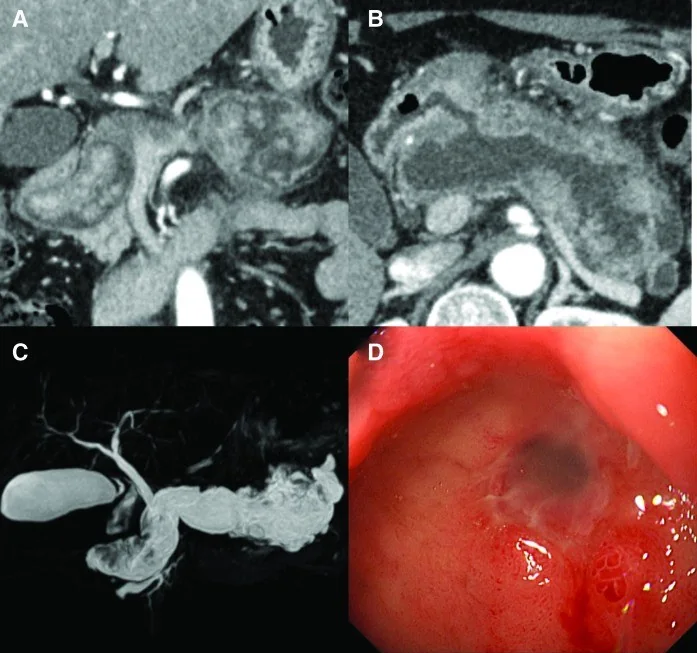
- IPMN’de aşırı müsin üretimi görülebilir; kontrastlı BT’de ana kanal içinde papiller kitleler ve kanal genişlemesi izlenebilir.
- Pankreas gövde-kuyruk kesiminde atrofi veya kanal kalibresinde ani değişim
- Birden fazla pankreas segmentinde eş zamanlı kistik odaklar ve ana kanal tutulumu
- İleri hastalıkta pankreas dışına uzanım, bölgesel lenf düğümü veya karaciğer metastazı
- Ana kanal tipi bileşen için, başka bir tıkayıcı neden yokken ana pankreatik kanalın >5 mm genişlemesi değerlendirilir; karma tip tanımı ana kanal ve yan dal tutulumunun birlikte bulunmasına dayanır.
Ölçütler ve sınıflamalar
- Kyoto 2024 yüksek risk stigması: kontrastlanan mural nodül
- ≥5 mm
- Kyoto 2024 yüksek risk stigması: ana pankreatik kanal çapı
- ≥10 mm
- Kyoto 2024 kaygı verici özellik: ana kanal çapı
- 5–<10 mm
- Duktal dağılıma göre IPMN
- Yan dal tipi yalnız yan dalları; ana kanal tipi ana pankreatik kanalı; karma tip ikisini birlikte tutar. Görüntülemede ana kanal ve yan dal tutulumunu ayrı ayrı tarif et.
- Kyoto 2024 risk özellikleri
- IAP 2017 ölçütlerinde yüksek risk stigmaları; sarılık, ≥5 mm kontrastlanan mural nodül, ≥10 mm ana pankreatik kanal çapı veya sitolojide yüksek dereceli displazi/kanserdir. Fukuoka 2017 ölçütlerinde kaygı verici özellikler arasında akut pankreatit, kist çapı ≥3 cm, kalınlaşmış ve kontrastlanan kist duvarı, ana kanal çapının 5–9 mm olması, distal atrofiyle birlikte ani kanal kalibre değişikliği, lenfadenopati, serum CA 19-9 yüksekliği ve kist büyüme hızının 2 yılda >5 mm olması yer alır. Tek başına BT görünümü histolojik dereceyi belirlemez.
Normalde
Normal pankreasta ana kanal ince, düzgün konturlu ve gövde boyunca izlenebilir; yan dallar belirgin kistik boşluklar oluşturmaz. Aynı anatomik düzeyde kanalın kalibresini, yan dal kistlerinin ana kanalla devamlılığını ve pankreas parankiminin gövde-kuyruk tarafında incelip incelmediğini karşılaştır.
Normal BT ile kıyasla
Aynı bölgenin, kaynak veri setinde patoloji içermediği belirtilen bir BT incelemesini kesit kesit kaydırın; organ sınırlarını açarak anatomiyi hasta görüntüsüyle karşılaştırın. Küçük rastlantısal bulgular tümüyle dışlanmamıştır.
Kaynak: TotalSegmentator v2.01 veri seti (Wasserthal ve ark., Radiology: Artificial Intelligence 2023), CC BY 4.0, vaka s0541; organ sınırları veri setinin otomatik segmentasyonundan, birleştirilerek sadeleştirildi. Görüntüler 2,5 mm kesit aralığına yeniden örneklendi.
Ayırıcı tanı
- Yan dal IPMN
- yan dal kistleri vardır, ancak ana kanalda neoplastik tutulum gösteren mural doku veya belirgin kanal değişikliği yoktur.
- Müsinöz kistik neoplazm
- çoğunlukla gövde-kuyrukta tek kitle oluşturur ve ana kanalla doğrudan bağlantı beklenmez.
- Seröz kistik neoplazm
- IPMN'den farklı olarak ana kanalla bağlantılı müsin üretimli papiller tutulum göstermez.
- Pankreatik psödokist
- pankreatit öyküsü ve çevresel inflamasyon eşlik edebilir; papiller kontrastlanan mural doku ve kanal kaynaklı çok odaklı patern beklenmez.
- Pankreatik duktal adenokarsinom
- fokal infiltratif hipoenhans kitle, ani kanal kesilmesi ve distal atrofi ön plandadır; yaygın kistik yan dal bağlantıları tipik değildir.
Tuzaklar
- IPMN’de ana kanal segmental veya yaygın genişleyebilir; karma tip dağılımı tarif ederken ana kanal ve yan dal tutulumunu birlikte değerlendir.
- İnce yan dal bağlantısı rutin aksiyel BT'de görünmeyebilir; negatif BT bağlantıyı dışlamaz, şüphede MRCP ile kanal ağacı daha iyi haritalanır.
- Bağımlı mukus veya debris mural nodülü taklit edebilir; kontrast sonrası gerçek nodülde iç kontrastlanma aranır, BT belirsizse MR ya da EUS korelasyonu gerekir.
- Ana pankreatik kanal genişlemesi kronik pankreatitte de görülebileceğinden, başka bir tıkayıcı neden dışlanmadan genişleme ana kanal tipi IPMN bileşeni olarak sınıflandırılmamalıdır.
Kendini dene
BT’de ana kanal içinde kontrastlanan papiller dokuya ek olarak ana kanalla iletişimli yan dal kistleri görülüyor. Hangi dağılım tipi vardır?
Cevabı göster
Karma tip IPMN. Ana kanal ve yan dal sisteminin birlikte tutulması karma tip IPMN tanımına uyar.
Pankreatit öyküsü olmayan hastada kanal boyunca kist kümeleri ve iç kontrastlanan odak görülüyor. Odak neyi düşündürür?
Cevabı göster
Mural neoplastik nodül. Kontrastlanan papiller yumuşak doku mural neoplastik nodül lehinedir. Mukus ve debris genellikle kontrastlanmaz; seröz kist septaları ise ana kanal içindeki papiller çıkıntı görünümünü açıklamaz.
İlgili konular
Kaynaklar
Bu sayfadaki 48 cümle ve 2 quiz sorusu aşağıdaki kaynaklardan alıntılarla otomatik olarak karşılaştırıldı; 8 cümle bu karşılaştırmada düzeltildi (2026-10-09).
- Fistula formation into other organs secondary to intraductal papillary mucinous neoplasm of the pancreas: A case report and literature reviewpmc.ncbi.nlm.nih.gov
- Pancreatic intraductal papillary mucinous neoplasms: Current diagnosis and managementpmc.ncbi.nlm.nih.gov
- Main- and Branch-Duct Intraductal Papillary Mucinous Neoplasms: Extent of Surgical Resectionpmc.ncbi.nlm.nih.gov
- Concomitant pancreatic endocrine neoplasm and intraductal papillary mucinous neoplasm: a case report and literature reviewpmc.ncbi.nlm.nih.gov
- Surgical Intervention and Prognosis of Intraductal Papillary Mucinous Adenoma in Elderly Patients: A Single Center Retrospective Studypmc.ncbi.nlm.nih.gov
- Main- and Branch-Duct Intraductal Papillary Mucinous Neoplasms: Extent of Surgical Resection.pubmed.ncbi.nlm.nih.gov
- [Resection of main duct and mixed type IPMN ≥5 mm].pubmed.ncbi.nlm.nih.gov
- [Cystic lesions of the pancreas : Differential diagnostics and treatment].pubmed.ncbi.nlm.nih.gov
- Concomitant pancreatic endocrine neoplasm and intraductal papillary mucinous neoplasm: a case report and literature review.pubmed.ncbi.nlm.nih.gov
- Pancreatic intraductal papillary mucinous neoplasms: Current diagnosis and management.pubmed.ncbi.nlm.nih.gov
- Is Biannual Surveillance for Pancreatic Cancer Sufficient in Individuals With Genetic Syndromes or Familial Pancreatic Cancer?pubmed.ncbi.nlm.nih.gov
- Middle-preserving pancreatectomy: an interesting procedure for pancreas-sparing resection.pubmed.ncbi.nlm.nih.gov
- Predicting dysplasia and invasive carcinoma in intraductal papillary mucinous neoplasms of the pancreas: development of a preoperative nomogram.pubmed.ncbi.nlm.nih.gov
- Results of First-Round of Surveillance in Individuals at High-Risk of Pancreatic Cancer from the AISP (Italian Association for the Study of the Pancreas) Registry.pubmed.ncbi.nlm.nih.gov
- Epidemiology, clinical features and diagnostic work-up of cystic neoplasms of the pancreas: Interim analysis of the prospective PANCY survey.pubmed.ncbi.nlm.nih.gov
- Pancreatic intraductal papillary mucinous neoplasm associated colloid carcinoma.pubmed.ncbi.nlm.nih.gov
- The natural history of main duct-involved, mixed-type intraductal papillary mucinous neoplasm: parameters predictive of progression.pubmed.ncbi.nlm.nih.gov
- Main-duct Intraductal Papillary Mucinous Neoplasm: High Cancer Risk in Duct Diameter of 5 to 9 mm.pubmed.ncbi.nlm.nih.gov
- Imaging considerations in intraductal papillary mucinous neoplasms of the pancreas.pubmed.ncbi.nlm.nih.gov
- Undifferentiated carcinoma of the pancreas arising from intraductal papillary mucinous neoplasm: a case report.pubmed.ncbi.nlm.nih.gov
- Risk Assessment of Malignancy in Pancreatic Intraductal Papillary Mucinous Neoplasm Harboring Multiple Worrisome Features and High-Risk Stigmata: A Single-Center Cohort Study.pubmed.ncbi.nlm.nih.gov
- Malignant potential of intraductal papillary mucinous neoplasm (IPMN) of the pancreas: imaging assessment of IPMN-derived cancer and concomitant pancreatic ductal adenocarcinoma.pubmed.ncbi.nlm.nih.gov
- Intraductal Papillary Mucinous Neoplasm (IPMN) of the Pancreas: History, Myths, and Realities Between Past and Future.pubmed.ncbi.nlm.nih.gov
- DIAGNOSIS AND MANAGEMENT OF INTRADUCTAL PAPILLARY MUCINOUS NEOPLASMS: A NARRATIVE REVIEW BASED ON INTERNATIONAL GUIDELINES.pubmed.ncbi.nlm.nih.gov
- Common cystic pancreatic neoplasms: A comprehensive magnetic resonance imaging-based review of typical and atypical imaging features.pubmed.ncbi.nlm.nih.gov
- Feasibility of Peroral Pancreatoscopy Using the 9-Fr eyeMAX for Surgical Planning in Main-Duct and Mixed-Type Intraductal Papillary Mucinous Neoplasms.pubmed.ncbi.nlm.nih.gov
- Postoperative Outcomes and Strategic Refinement in Intraductal Papillary Mucinous Neoplasm Management: A Single Academic Cancer Center Experience.pubmed.ncbi.nlm.nih.gov
- Comparison of risk of malignancy and predictive value of diagnostic categories defined by Papanicolaou Society of Cytopathology system and WHO reporting system for pancreaticobiliary cytopathology in solid pancreatic lesions.pubmed.ncbi.nlm.nih.gov
- Pancreatic Neuroendocrine Tumors: From Benchside to Surgical Treatment.pubmed.ncbi.nlm.nih.gov
- Oncocytic intraductal papillary neoplasm of the pancreas: Multimodality imaging and cytopathologic correlation.pubmed.ncbi.nlm.nih.gov
- Letter to the Editor: De-escalation of branch duct intraductal papillary mucinous neoplasms surveillance.pubmed.ncbi.nlm.nih.gov
- Differentiation of intraductal papillary mucinous neoplasms and pancreatic ductal adenocarcinoma using arterial-phase CT radiomics combined with clinical features.pubmed.ncbi.nlm.nih.gov
- Pancreatic intraductal papillary mucinous neoplasm with invasive carcinoma and uterine metastasis: a case report.pubmed.ncbi.nlm.nih.gov
- Role of Endoscopic Ultrasonography in Management of Pancreaticobiliary Cancers: Recent Trends and Advances.pubmed.ncbi.nlm.nih.gov
- Surgical Strategies for Tumors of the Pancreas and Duodenum.pubmed.ncbi.nlm.nih.gov
- Peroral Pancreatoscopy for Differentiating Main Duct IPMN from Chronic Pancreatitis: A Narrative Review and a Case Series.pubmed.ncbi.nlm.nih.gov
- Pancreatic Cystic Lesions: From Basic Knowledge to Recent Guidelines.pubmed.ncbi.nlm.nih.gov
- CT and MRI findings of intraductal tubulopapillary neoplasm of the pancreas.pubmed.ncbi.nlm.nih.gov
- Advances for Managing Pancreatic Cystic Lesions: Integrating Imaging and AI Innovations.pubmed.ncbi.nlm.nih.gov
- Risk Assessment and Radiomics Analysis in Magnetic Resonance Imaging of Pancreatic Intraductal Papillary Mucinous Neoplasms (IPMN).pubmed.ncbi.nlm.nih.gov
- Intraductal papillary neoplasm of the biliary tract with typical clinicopathological, endoscopic features: A case report.pubmed.ncbi.nlm.nih.gov
- Ectopic β-hCG-Expressing Hepatic Neoplasm with Cutaneous Metastasis in a Young Postpartum Woman: A Case Report and Literature Review.pubmed.ncbi.nlm.nih.gov
- Synchronous Multifocal Intraductal Tubulopapillary Neoplasm of the Pancreas Treated with Total Pancreatectomy: A Case Report.pubmed.ncbi.nlm.nih.gov
- Australian Pancreatic Cyst Registry: protocol for a prospective national clinical quality registry of intraductal papillary mucinous neoplasms.pubmed.ncbi.nlm.nih.gov
- Intraductal papillary mucinous neoplasm unveiling incidental multifocal pancreatic neuroendocrine tumors: a challenging case report.pubmed.ncbi.nlm.nih.gov
- Rapidly Progressive Neuroendocrine Carcinoma of the Ampulla of Vater Detected During Intraductal Papillary Mucinous Neoplasm Surveillance.pubmed.ncbi.nlm.nih.gov
- Implications and risk of new versus persisting intraductal papillary mucinous neoplasms after pancreatic surgery: meta-analysis.pubmed.ncbi.nlm.nih.gov
- Endoscopic-guided chemoablation of an inoperable main-duct intraductal papillary mucinous neoplasm.pubmed.ncbi.nlm.nih.gov
- Discordant pathology following pancreatoduodenectomy for suspected intraductal papillary mucinous neoplasm: reassessment of cyst fluid genetic analysis.pubmed.ncbi.nlm.nih.gov
- Recent Advances in Non-Invasive Blood Markers for Intraductal Papillary Mucinous Neoplasm Grading.pubmed.ncbi.nlm.nih.gov
- Pancreaticobiliary Fistula Caused by Intraductal Papillary Mucinous Adenoma Requiring Pancreaticoduodenectomy.pubmed.ncbi.nlm.nih.gov
- Videolaparoscopic pancreatojejunostomy using a hybrid technique in chronic pancreatitis without significant ductal dilatation.pubmed.ncbi.nlm.nih.gov
- Acute Emergent Biliary Pathologies Identified Using Point-of-Care Ultrasound.pubmed.ncbi.nlm.nih.gov
- Endoscopic Management of Obstructive Chronic Pancreatitis in a Dual Solid Organ Transplant Recipient: A Case Report.pubmed.ncbi.nlm.nih.gov
- Portuguese Pancreatic Club Perspective on Intraductal Papillary Mucinous Neoplasm Diagnosis, Characterization and Indications for Fine-Needle Aspiration/Biopsy, Advanced Endoscopic Ultrasound Imaging Techniques and Role of Pancreatoscopy.pubmed.ncbi.nlm.nih.gov
- Mixed exocrine-neuroendocrine intraductal papillary mucinous neoplasms of the pancreas: a case series.pubmed.ncbi.nlm.nih.gov
- Punctate Palmoplantar Keratoderma Type 1 (PPPK1) Associated with Pancreatic Intraductal Papillary Mucinous Neoplasm (IPMN): A Case Report.pubmed.ncbi.nlm.nih.gov
- Beware of Radiological Diagnosis of Pancreatic Pseudocyst: Lesson Learned From an Interesting Case.pubmed.ncbi.nlm.nih.gov
- Beyond the Expected: A Case-Based Exploration and Literature Review on the Rare Evolution of Pseudomyxoma Peritonei From a Side-Branch Intraductal Papillary Mucinous Neoplasm.pubmed.ncbi.nlm.nih.gov
- Incidental cystic pancreatic neuroendocrine neoplasm and differential diagnosis.pubmed.ncbi.nlm.nih.gov
- Beyond the Six-Week Rule: Contemporary Insights Into Pancreatic Pseudocyst.pubmed.ncbi.nlm.nih.gov
- Presumed Intraductal Papillary Mucinous Neoplasms in Individuals at High Risk for Pancreatic Cancer.pubmed.ncbi.nlm.nih.gov
- Real-time guidance of lauromacrogol ablation for pancreatic cystic lesions using confocal laser endomicroscopy.pubmed.ncbi.nlm.nih.gov
- From bench to bedside: pancreatic juice as a platform for biomarker discovery in pancreatic disease.pubmed.ncbi.nlm.nih.gov
- Fistulating Intraductal Papillary Mucinous Neoplasms (IPMNs): Case Series and Discussion of a Rare Complication.pubmed.ncbi.nlm.nih.gov
- Can abbreviated MRI replace standard protocols in IPMN surveillance? A retrospective comparative study.pubmed.ncbi.nlm.nih.gov
- Non-contrast MRI features of mucin plugs and mural nodules in pancreatic cystic lesions.pubmed.ncbi.nlm.nih.gov
- Correlation of pathological types and imaging features in pancreatic cancer.pubmed.ncbi.nlm.nih.gov
- Pancreatic Cyst Management: A Multimodal and Interdisciplinary Approach.pubmed.ncbi.nlm.nih.gov
- Feasibility of deep learning-accelerated HASTE-FS for pancreatic cystic lesion surveillance: comparison with conventional HASTE and MRCP.pubmed.ncbi.nlm.nih.gov
- Pancreatic ductal adenocarcinoma staging: a narrative review of radiologic techniques and advances.pubmed.ncbi.nlm.nih.gov
- Intraductal Papillary Neoplasm of Bile Duct: Updated Clinicopathological Characteristics and Molecular and Genetic Alterations.pubmed.ncbi.nlm.nih.gov
- Dilemmas for the pathologist in the oncologic assessment of pancreatoduodenectomy specimens : An overview of different grossing approaches and the relevance of the histopathological characteristics in the oncologic assessment of pancreatoduodenectomy specimens.pubmed.ncbi.nlm.nih.gov
- A Rare Pediatric Intraductal Papillary Mucinous Neoplasm Presenting as a Pancreatic Pseudocyst With Splenic Vein Thrombosis and Gastric Variceal Hemorrhage.pubmed.ncbi.nlm.nih.gov
- Rethinking imaging-based IPMN subtype classification: is mixed-type a necessary radiologic category?pubmed.ncbi.nlm.nih.gov
- Case Report: Metachronous oncocytic and colloid carcinoma arising from pancreatic intraductal neoplasms over four decades.pubmed.ncbi.nlm.nih.gov
- Positron Emission Tomography (PET) in Oncology.pubmed.ncbi.nlm.nih.gov
- Commentary: an eye on PET quantification.pubmed.ncbi.nlm.nih.gov
- Endoscopic ultrasound-guided radiofrequency ablation for pancreatic cystic neoplasms: a comprehensive review.pubmed.ncbi.nlm.nih.gov
- Spectral attenuation curves of photon-counting detector CT scans for the differentiation between mucinous and non-mucinous cyst fluids of pancreatic lesions - a proof-of-concept study.pubmed.ncbi.nlm.nih.gov
- CT-Derived Radiomic Signature of MUC6 Expression Improves Guideline-Based Risk Stratification in Intraductal Papillary Mucinous Neoplasms.pubmed.ncbi.nlm.nih.gov
- Endoscopic Ultrasound-Guided Radiofrequency Ablation (EUS-RFA): Are We Getting Evidence-Based Results? A Systematic Review According to the Levels of Evidence.pubmed.ncbi.nlm.nih.gov
- Role of pancreatoscopy in the management of suspected and confirmed intraductal papillary mucinous neoplasm of the pancreas.pubmed.ncbi.nlm.nih.gov
- Applications and Prospects of Artificial Intelligence-Assisted Endoscopic Ultrasound in Digestive System Diseases.pubmed.ncbi.nlm.nih.gov
- Special Issue: EACR 2026 Congress: Innovative Cancer Science, 8-11 June 2026.pubmed.ncbi.nlm.nih.gov
- EACR 2025 Congress: Innovative Cancer Science, 16-19 June 2025.pubmed.ncbi.nlm.nih.gov
- Solid Pseudopapillary Neoplasm With Extensive Intratumoral Hemorrhage.pubmed.ncbi.nlm.nih.gov
- Diagnostic Method Advancement to Improve the Prognosis of Pancreatic Ductal Adenocarcinoma.pubmed.ncbi.nlm.nih.gov
- A 30-year institutional experience of insulinoma management at a tertiary care center: a case series.pubmed.ncbi.nlm.nih.gov
- Schwannoma Likely Arising from the Pancreatic Head Nerve Plexus That Mimicked a Mucinous Cystic Neoplasm and Was Treated by Pancreaticoduodenectomy: A Case Report.pubmed.ncbi.nlm.nih.gov
- GerPaCyst - The trial protocol of the prospective, multicenter, interdisciplinary German Pancreas Club Cyst Registry.pubmed.ncbi.nlm.nih.gov
- 불분명한 소아 복부 종괴: 영상 기반 진단 접근법.pubmed.ncbi.nlm.nih.gov
- Pancreatic Cancer Detection in Intraductal Papillary Mucinous Neoplasm (IPMN)-New Insights.pubmed.ncbi.nlm.nih.gov
- Cancer Risk After Initial Surveillance of Intraductal Papillary Mucinous Neoplasms (IPMNs): Are We Missing the Window for Prevention?pubmed.ncbi.nlm.nih.gov
- Small and Stable Pancreatic Cysts Are Reassuring During Surveillance: Results From the PACYFIC Trial.pubmed.ncbi.nlm.nih.gov
- Interobserver agreement in dysplasia grading of intraductal papillary mucinous neoplasms: performance of Kyoto guidelines and optimization of endomicroscopy biomarkers through pathology reclassification.pubmed.ncbi.nlm.nih.gov
- A modified stent-free Chen's U-suture technique in pediatric pancreaticojejunostomy: safety and efficacy.pubmed.ncbi.nlm.nih.gov
- Pancreatic Atrophy: A Narrative Review and Surgical Interpretation.pubmed.ncbi.nlm.nih.gov
- A case of intraductal oncocytic papillary neoplasm treated with distal pancreatectomy.pubmed.ncbi.nlm.nih.gov
- Imaging for Early Detection of Pancreatic Ductal Adenocarcinoma: Updates and Challenges in the Implementation of Screening and Surveillance Programs.pubmed.ncbi.nlm.nih.gov
- Pancreatic tail cancer in the setting of pancreatitis with a review of the literature: A case report.pubmed.ncbi.nlm.nih.gov
- Pancreatic ductal adenocarcinoma: the latest on diagnosis, molecular profiling, and systemic treatments.pubmed.ncbi.nlm.nih.gov
- Endoscopic ultrasound for pancreatic cystic lesions: a narrative review.pubmed.ncbi.nlm.nih.gov
- Portuguese Pancreatic Club Perspective on Epidemiology, Classification, and Natural History of Pancreatic Intraductal Papillary Mucinous Neoplasms.pubmed.ncbi.nlm.nih.gov
- Contrast-Enhanced Harmonic Endoscopic Ultrasonography for Prediction of Aggressiveness and Treatment Response in Patients with Pancreatic Lesions.pubmed.ncbi.nlm.nih.gov
- Monitoring of low-risk pancreatic cystic lesions with targeted abdominal ultrasound: diagnostic yield, clinical utility, and acceptance.pubmed.ncbi.nlm.nih.gov
- Spatial Analysis of Intraductal Papillary Mucinous Neoplasms Defines a Paradoxical Keratin 17-Positive, Low-Grade Epithelial Population Harboring Malignant Features.pubmed.ncbi.nlm.nih.gov
- Current Considerations in Nonoperative Surveillance of Intraductal Papillary Mucinous Neoplasms.pubmed.ncbi.nlm.nih.gov
- How to distinguish pancreatic tumors and assess the necessity for biopsy.pubmed.ncbi.nlm.nih.gov
- Approach to Cystic Lesions of the Pancreas: Review of Literature.pubmed.ncbi.nlm.nih.gov
- Use of an Algo-Based Decision-Making Tool to Compare Real-Life Clinical Practice in a Single Tertiary Center with the Kyoto IPMN Surveillance Recommendations.pubmed.ncbi.nlm.nih.gov
- Sequential Pancreatic Ascites and Hemosuccus Pancreaticus from an Identical Rupture Site in Branch-Duct Intraductal Papillary Mucinous Neoplasm: A Case Report.pubmed.ncbi.nlm.nih.gov
- Endoscopic ultrasound-guided radiofrequency ablation for large branch-duct intraductal papillary mucinous neoplasms: Safety and efficacy trial.pubmed.ncbi.nlm.nih.gov
- Diagnostic and therapeutic guidelines for pancreatic cystic tumors: recommendations of Polish Pancreatic Club experts.pubmed.ncbi.nlm.nih.gov
- Pancreatic Cystic Lesions in the Older Patient: A Review of Clinical Guidelines and Management.pubmed.ncbi.nlm.nih.gov
Eğitim amaçlıdır; hasta başında tanı ve tedavi kararının yerine geçmez, tıbbi tavsiye değildir. Metinler yapay zekâ desteğiyle yazıldı ve otomatik bir adımda kaynak alıntılarıyla karşılaştırıldı; bu bir tıbbi doğrulama değildir ve içerik uzman radyolog incelemesinden geçmedi. Klinik kararlarda güncel kılavuzları, kurum protokollerini ve radyoloji raporunu esas alın.