
Özet
Sternumda görülen her çizgi, basamak veya kemik açıklığı travmatik kırık değildir; manubriosternal eklem, gelişimsel ossifikasyon merkezleri, sternal foramen ve cleft benzer görünüm oluşturabilir. BT, çoklu planar ve üç boyutlu reformasyonlarıyla sternal korteks bütünlüğünü ve eklem hizasını; yumuşak doku penceresi ise komşu retrosternal değişiklikleri değerlendirmek için kullanılır. Özellikle çocuklarda birleşmemiş ossifikasyon odakları, erişkinde eklem yüzü ve orta hat foramen yanlış pozitif kırık yorumuna yol açabilir. Sternal varyantların patolojiyle ayırımı gereksiz tanı ve tedaviyi önlerken; gerçek travmalarda eşlik eden ciddi toraks yaralanmalarının birlikte değerlendirilmesi gerekir.
Faz ve pencere
- Kontrastsız tanısal
- BT'nin çoklu planar reformasyonları, sternal korteks bütünlüğünü, eklem hizasını ve komşu yumuşak doku değişikliklerini değerlendirmek için kullanılır.
Önerilen pencereler G genişlik, M merkez; değerler Hounsfield birimi (HU)
- KemikG 1800 / M +400
- MediastenG 350 / M +50
BT bulguları
- Akut sternal kırık yer değiştirmiş olabilir; manubriosternal dislokasyon eşlik edebilir.
- Retrosternal hematom, özellikle kırıkla aynı seviyede anterior mediastinal yumuşak doku dansite artışı olarak izlenir ve travmatik yaralanma lehine bağlamsal bulgudur.
- Çocuklarda sternal ossifikasyon merkezleri birleşmemiş olabilir; sternumun birleşmemiş lateral ossifikasyon merkezleri, honeycomb sternum adı verilen normal anatomik varyantı oluşturur.
- Sternebra ossifikasyon merkezleri segment içinde düzenli konumlanır ve çevreleri düzgün/simetrik olabilir; birleşmemiş merkezler gelişim çağında fraktür fragmanını taklit eder.
- Sternal foramen gibi sternal varyasyonların tanınması, bunları patolojik durumlardan ayırmak açısından önemlidir.
- Sternal cleft, sternal barların embriyogenez sırasında birleşmemesine bağlı konjenital bir göğüs duvarı defektidir.
- Tek kesitte kırık benzeri düzensiz konturlar, multiplanar ve üç boyutlu reformasyonlarla eklem ve korteks bütünlüğü açısından patolojiden aydınlatılmalıdır.
Normalde
Sternumda farklı görünüm ve sıklıkta anatomik varyasyonlar görülebilir; bunların patolojik durumlardan ayırt edilmesi önemlidir. Sternal kırık, ağır travmanın dolaylı bir bulgusu olabilir ve vasküler yapıların dikkatle değerlendirilmesini gerektirir.
Normal BT ile kıyasla
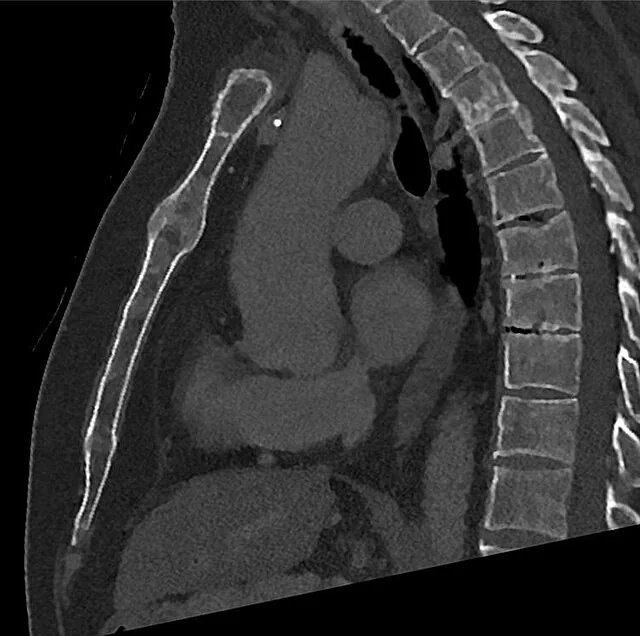
Aynı bölgenin, kaynak veri setinde patoloji içermediği belirtilen bir BT incelemesini kesit kesit kaydırın; organ sınırlarını açarak anatomiyi hasta görüntüsüyle karşılaştırın. Küçük rastlantısal bulgular tümüyle dışlanmamıştır.
Kaynak: TotalSegmentator v2.01 veri seti (Wasserthal ve ark., Radiology: Artificial Intelligence 2023), CC BY 4.0, vaka s1278; organ sınırları veri setinin otomatik segmentasyonundan, birleştirilerek sadeleştirildi. Görüntüler 2,5 mm kesit aralığına yeniden örneklendi.
Ayırıcı tanı
- Manubriosternal eklem
- beklenen birleşme düzeyinde çizgisel aralık ve düzgün eklem yüzleri; fragmanlaşma ya da çevresel hematom yokluğu varyant lehinedir.
- Gelişimsel ossifikasyon merkezi
- sternum segmenti içinde düzenli yerleşimli ve kortike kenarlı odak; çocuk veya ergende fizyolojik olabilir.
- Sternal foramen değerlendirilirken, sternal varyasyonların patolojik durumlardan ayırt edilmesi gerektiği göz önünde bulundurulmalıdır.
- Sternal cleft, sternal barların embriyogenez sırasında birleşmemesine bağlı konjenital bir defekttir.
- Gerçek akut sternal kırık
- kortikal basamak veya düzensiz kırık çizgisi; travma mekanizması, lokal hematom ya da eşlik eden toraks yaralanması tanıyı destekler.
- Sternal yarık, sternal barların embriyogenez sırasında birleşmemesine bağlı konjenital bir göğüs duvarı defektidir.
Tuzaklar
- Fizyolojik eklem boşluğu ve açılar, multiplanar reformasyonlarla eklem yüz uyumu ve korteks devamlılığı açısından travmatik dislokasyondan ayırt edilmelidir.
- Sternal foramen değerlendirilirken sternal varyasyonların patolojik durumlardan ayırt edilmesi önemlidir.
- Çocukta ayrık sternebra merkezlerini fragman sayma; sternum boyunca düzenli segment dizilimini ve çevre hematomun bulunup bulunmadığını ara.
- Kırık yokluğu toraks travmasını dışlamaz; aynı incelemede kaburga, sternoklaviküler eklem, akciğer ve mediastinal yaralanmaları gözden kaçırma.
Kendini dene
Çocuk travmasında sternumda gelişimsel varyant olan 'bal petisi sternum' (honeycomb sternum) saptanır. Bu bulgu neyi temsil eder?
Cevabı göster
Normal gelişimsel varyant. Birleşmemiş lateral sternal ossifikasyon merkezleri, honeycomb sternum olarak adlandırılan normal anatomik varyantı oluşturur; tanınması yanlış tanıyı önlemeye yardımcı olur.
Çocuk travmasında BT'de akut travma bulgusu yok ve sternumun lateral ossifikasyon merkezleri birleşmemiş. Bu bulgu en uygun nasıl tanımlanır?
Cevabı göster
Birleşmemiş sternal ossifikasyon merkezleri (honeycomb sternum). Sternumun birleşmemiş lateral ossifikasyon merkezleri honeycomb sternum adı verilen normal anatomik varyanttır; akut travma bulgusu yoksa bu gelişimsel varyant yanlışlıkla travmatik yaralanma olarak yorumlanmamalıdır.
İlgili konular
Kaynaklar
Bu sayfadaki 36 cümle ve 2 quiz sorusu aşağıdaki kaynaklardan alıntılarla otomatik olarak karşılaştırıldı; 24 cümle bu karşılaştırmada düzeltildi (2026-10-09).
- An integrated digital-to-surgical framework for patient-specific chest wall resection and reconstruction using 3D-printed titanium implants: proof-of-concept studypmc.ncbi.nlm.nih.gov
- Acute Traumatic Aortic Injury: What the Radiologist Needs to Knowpmc.ncbi.nlm.nih.gov
- Common Clinical Scenarios in Adult Congenital Heart Disease: A Practical Guide for General Cardiologistspmc.ncbi.nlm.nih.gov
- Development and biomechanical validation of a whole spine–thorax finite element model for quantitative biomechanical analysispmc.ncbi.nlm.nih.gov
- Shoulder joint angles in supine and upright imaging of the preoperative reverse total shoulder arthroplasty patientpmc.ncbi.nlm.nih.gov
- Keel bone damage assessment: consistency in enriched colony laying hens.pubmed.ncbi.nlm.nih.gov
- 3D Printing Technology for Chest Wall Reconstruction With a Sternum-Ribs-Cartilage Titanium Implant: From Ideation to Creation.pubmed.ncbi.nlm.nih.gov
- An integrated digital-to-surgical framework for patient-specific chest wall resection and reconstruction using 3D-printed titanium implants: proof-of-concept study.pubmed.ncbi.nlm.nih.gov
- Acute Traumatic Aortic Injury: What the Radiologist Needs to Know.pubmed.ncbi.nlm.nih.gov
- Minor Trauma, Major Discovery: The Ultrasound Identification of a Sternal Fracture Missed by Computed Tomography in an Older Patient Presenting With Acute Chest Pain.pubmed.ncbi.nlm.nih.gov
- Retrospective Review Is the Best View: A Primer for Residents and Radiologists on Missed Findings in Chest Radiography.pubmed.ncbi.nlm.nih.gov
- ARDS management in trauma patients.pubmed.ncbi.nlm.nih.gov
- Expected imaging findings and postoperative complications of median sternotomy.pubmed.ncbi.nlm.nih.gov
- gp130/STAT3 signaling is required for homeostatic proliferation and anabolism in postnatal growth plate and articular chondrocytes.pubmed.ncbi.nlm.nih.gov
- Prognostic Factors of Mortality and Clinical Characteristics of Patients Surgically Treated for Blunt Liver Injury-A Single-Center Experience.pubmed.ncbi.nlm.nih.gov
- A Plea for a Paradigm Shift from X-Ray to Ultrasound in Adults: An Update for Emergency Physicians, General Practitioners, Orthopedists and Sports Medicine Physicians.pubmed.ncbi.nlm.nih.gov
- Rigid anterior plating for open transverse sternal fracture traversing previous sternotomy: a case report.pubmed.ncbi.nlm.nih.gov
- Extrapericardial tamponade following blunt chest trauma treated with subxiphoid uniportal video-assisted thoracoscopic surgery: a case report.pubmed.ncbi.nlm.nih.gov
- Chest Wall and Diaphragmatic Injuries: Imaging Evaluation and Clinical Considerations.pubmed.ncbi.nlm.nih.gov
- Honeycomb Sternum Mimicking Manubriosternal Dislocation in a Pediatric Trauma Patient.pubmed.ncbi.nlm.nih.gov
- The sternum in detail: a review of the anatomy and pathologies of the sternum.pubmed.ncbi.nlm.nih.gov
- A pictorial essay of thoracic wall diseases: multiple pathologies in the same anatomical site.pubmed.ncbi.nlm.nih.gov
- Congenital Chest Wall Deformities in Children: A Narrative Review.pubmed.ncbi.nlm.nih.gov
- Imaging of pediatric musculoskeletal trauma: Age-specific considerations and challenges.pubmed.ncbi.nlm.nih.gov
- Single-stage repair of congenital complete sternal agenesis with PFO-type interatrial communication and aortic arch variant complicated by an unexpected ascending aortic pseudoaneurysm: a case report.pubmed.ncbi.nlm.nih.gov
- Lung hernia: an updated narrative review.pubmed.ncbi.nlm.nih.gov
- Society for Cardiovascular Magnetic Resonance 2024 Cases of SCMR case series.pubmed.ncbi.nlm.nih.gov
- Predictors of Blunt Thoracic Aortic Injury Requiring TEVAR in Patients with Left-Sided Hemothorax: Implications for Chest Drainage and Early CTA Assessment.pubmed.ncbi.nlm.nih.gov
- Novel Application of STRATOS for Restoration of Clavicular Stability After Oncologic Sternoclavicular Joint Resection: A Case Report and Review of the Literature.pubmed.ncbi.nlm.nih.gov
- Video-assisted thoracoscopic surgery surgical stabilization of rib fractures: surgical technique and case report.pubmed.ncbi.nlm.nih.gov
- Operative management of unstable sternal fracture in polytrauma: a case report and literature review.pubmed.ncbi.nlm.nih.gov
- Rib Cross-Sectional Mineralized Area in Early Pleistocene Hominins: Insights From the Homo antecessor and H. erectus s. l. Fossil Record.pubmed.ncbi.nlm.nih.gov
- Radiological age assessment based on clavicle ossification in CT: enhanced accuracy through deep learning.pubmed.ncbi.nlm.nih.gov
- Supraclavicular Foramina in Dry Clavicles: An Observational Study and Meta-Analysis of Prevalence and Laterality.pubmed.ncbi.nlm.nih.gov
- Multifocal tuberculosis revealed by a sternal swelling in an immunocompetent child.pubmed.ncbi.nlm.nih.gov
- MDCT evaluation of sternal variations: Pictorial essay.pubmed.ncbi.nlm.nih.gov
- Management of adults with coarctation of aorta.pubmed.ncbi.nlm.nih.gov
- Management of congenital chest wall deformities.pubmed.ncbi.nlm.nih.gov
- Epidemiology and outcomes of traumatic sternal fractures and associated blunt cardiac injury: a nationwide cohort study in the Netherlands.pubmed.ncbi.nlm.nih.gov
- Determination of cystathionine beta-synthase activity in human plasma by LC-MS/MS: potential use in diagnosis of CBS deficiency.pubmed.ncbi.nlm.nih.gov
- Long-term safety and effectiveness of the "OptEase" vena cava filter.pubmed.ncbi.nlm.nih.gov
- Balance-shaped sternal elevation-assisted uniportal subxiphoid video-assisted thoracoscopic surgery for thymoma with persistent left superior vena cava.pubmed.ncbi.nlm.nih.gov
- Aortic Injury and Hemopericardium: Key Findings and Evaluation.pubmed.ncbi.nlm.nih.gov
- MDCT Morphometry of the Thoracolumbar Junction in a Turkish Cohort: Surgical, Radiological, and Forensic Implications.pubmed.ncbi.nlm.nih.gov
- Musculoskeletal infections through direct inoculation.pubmed.ncbi.nlm.nih.gov
- Lung imaging methods: indications, strengths and limitations.pubmed.ncbi.nlm.nih.gov
- Patterns of injury and violence in Yaoundé Cameroon: an analysis of hospital data.pubmed.ncbi.nlm.nih.gov
- Surgical stabilization of rib fractures in patients with open flail chest results in improved clinical outcomes: a report of three cases.pubmed.ncbi.nlm.nih.gov
- Lung parenchymal trauma biomechanics, mechanisms, and classification: a narrative review of the current knowledge.pubmed.ncbi.nlm.nih.gov
- Musculoskeletal and overgrowth syndromes associated with cutaneous abnormalities.pubmed.ncbi.nlm.nih.gov
- Incidental Extracardiac Findings of Technetium-99m Pyrophosphate Scintigraphy: A Pictorial Review.pubmed.ncbi.nlm.nih.gov
- Complex anterior chest wall reconstruction after extensive oncologic resections: a narrative review.pubmed.ncbi.nlm.nih.gov
- Ultrasound and bone: a pictorial review.pubmed.ncbi.nlm.nih.gov
- Biomechanics of chest wall injury: implications for surgical stabilization and failure prevention.pubmed.ncbi.nlm.nih.gov
- Combined tonsillar reflex zone stimulation and four-step manipulative reduction for Grisel syndrome following pediatric adenotonsillectomy: a case report.pubmed.ncbi.nlm.nih.gov
- 3D printed patient-specific drill guide for percutaneous pedicle screw fixation in lumbosacral vertebrae in dogs: A cadaveric study and clinical case report.pubmed.ncbi.nlm.nih.gov
- Common Clinical Scenarios in Adult Congenital Heart Disease: A Practical Guide for General Cardiologists.pubmed.ncbi.nlm.nih.gov
- The Role of Thoracic Ultrasound for Diagnosis of Diseases of the Chest Wall, the Mediastinum, and the Diaphragm-Narrative Review and Pictorial Essay.pubmed.ncbi.nlm.nih.gov
- Multidetector computed tomography of chest trauma: indications, technique and interpretation.pubmed.ncbi.nlm.nih.gov
- International Society of Paediatric Surgical Oncology (IPSO) Surgical Practice Guidelines.pubmed.ncbi.nlm.nih.gov
- Beyond the definitions of the phenotypic complications of sickle cell disease: an update on management.pubmed.ncbi.nlm.nih.gov
- Chest wall - underappreciated structure in sonography. Part I: Examination methodology and ultrasound anatomy.pubmed.ncbi.nlm.nih.gov
- Imaging update on musculoskeletal infections.pubmed.ncbi.nlm.nih.gov
- Patient-specific 3D-printed scaffold for pediatric superior sternal cleft repair.pubmed.ncbi.nlm.nih.gov
- Extrahepatic Biliary Atresia With Situs Inversus and Ventricular Septal Defect: A Case Report.pubmed.ncbi.nlm.nih.gov
- Surgical stabilization of rib fractures (SSRF): the WSES and CWIS position paper.pubmed.ncbi.nlm.nih.gov
- Management Options for Traumatic Posterior Sternoclavicular Joint Dislocation: A Narrative Review with a Single Institution's Experience.pubmed.ncbi.nlm.nih.gov
- Scapulothoracic dissociation.pubmed.ncbi.nlm.nih.gov
- Pediatric emergency medicine point-of-care ultrasound: summary of the evidence.pubmed.ncbi.nlm.nih.gov
- Emerging and re-emerging infectious disease in otorhinolaryngology.pubmed.ncbi.nlm.nih.gov
- MRI Findings in Axial Psoriatic Spondylarthritis.pubmed.ncbi.nlm.nih.gov
- Taxonomic revision and phylogenetic analysis of the flightless Mancallinae (Aves, Pan-Alcidae).pubmed.ncbi.nlm.nih.gov
- Radiological findings of partial expression pentalogy of Cantrell and other multiple congenital anomalies: A rare case report.pubmed.ncbi.nlm.nih.gov
- Assessing Sternal Dimensions for Sex Classification: Insights from a Greek Computed Tomography-Based Study.pubmed.ncbi.nlm.nih.gov
- Sternal Abnormalities on Thoracic Radiographs of Dogs and Cats.pubmed.ncbi.nlm.nih.gov
- Hoxa5 Activity Across the Lateral Somitic Frontier Regulates Development of the Mouse Sternum.pubmed.ncbi.nlm.nih.gov
- Sternal resection and reconstruction: a review.pubmed.ncbi.nlm.nih.gov
- Imaging of pleural disease.pubmed.ncbi.nlm.nih.gov
- Primary and Secondary Sinonasal Aspergillosis in Dogs.pubmed.ncbi.nlm.nih.gov
- Osteopathia striata with cranial sclerosis, associated with juvenile idiopathic arthritis: A case report and review of literature.pubmed.ncbi.nlm.nih.gov
- Robot-assisted thoracoscopic resection of a costal cartilage chondrosarcoma mimicking anterior mediastinal teratoma: a case report.pubmed.ncbi.nlm.nih.gov
- Narrative review of chest wall ultrasound: a practical approach.pubmed.ncbi.nlm.nih.gov
- Postnatal imaging of conjoined twins: a customized multimodality approach.pubmed.ncbi.nlm.nih.gov
- 2.5-mm articulated endoluminal forceps using a compliant mechanism.pubmed.ncbi.nlm.nih.gov
- Coexistence of Autoantibodies against the Golgi Complex and Ro52 Antigen in a Patient with Nonspecific Interstitial Pneumonia.pubmed.ncbi.nlm.nih.gov
- Pediatric Manubriosternal Dislocation: A Case Report and Review of Literature.pubmed.ncbi.nlm.nih.gov
- How Do Drugs Affect the Skeleton? Implications for Forensic Anthropology.pubmed.ncbi.nlm.nih.gov
- Emergency Department Imaging of Pediatric Patients with Blunt Thoracic Trauma: A Systematic Review, Meta-Analysis, and Practice Management Guideline.pubmed.ncbi.nlm.nih.gov
- Primary B cell lymphoma of the patella presenting as anterior knee pain: A case report.pubmed.ncbi.nlm.nih.gov
- A mysterious clavicular swelling.pubmed.ncbi.nlm.nih.gov
- Safety and efficacy of the polymer enhanced AS-ELARIS<sup>®</sup> pedicle screw system using ultrasonically liquefied polylactide: a short-, mid-, and long-term posterolateral fusion study in sheep.pubmed.ncbi.nlm.nih.gov
- Three-Dimensional Printing of Medical Devices Used Directly to Treat Patients: A Systematic Review.pubmed.ncbi.nlm.nih.gov
- Fibulin-2: A potential regulator of immune dysfunction after bone trauma.pubmed.ncbi.nlm.nih.gov
- State of the art of 18 F-FDG PET/CT application in inflammation and infection: a guide for image acquisition and interpretation.pubmed.ncbi.nlm.nih.gov
- Childhood osteomyelitis: imaging characteristics.pubmed.ncbi.nlm.nih.gov
- Radiographic features of osteogenesis imperfecta.pubmed.ncbi.nlm.nih.gov
Eğitim amaçlıdır; hasta başında tanı ve tedavi kararının yerine geçmez, tıbbi tavsiye değildir. Metinler yapay zekâ desteğiyle yazıldı ve otomatik bir adımda kaynak alıntılarıyla karşılaştırıldı; bu bir tıbbi doğrulama değildir ve içerik uzman radyolog incelemesinden geçmedi. Klinik kararlarda güncel kılavuzları, kurum protokollerini ve radyoloji raporunu esas alın.