Özet
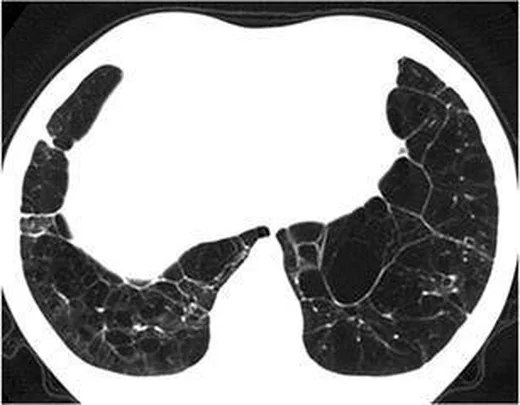
Panlobüler amfizem, sekonder pulmoner lobül boyunca yaygın alveoler yıkımla seyreder; lobülün normal yapıları silikleşebilir. Alt lob baskınlığı görülebilir ve alfa-1 antitripsin eksikliğiyle ilişkilidir, ancak BT dağılımı tek başına etiyolojiyi kanıtlamaz. İnce kesit inspiratuvar BT’de geniş veya yaygın düşük atenüasyon alanları ve damar dallarında seyrelme görülebilir. Hafif hastalıkta korunmuş parankimle yoğunluk farkı silik kalabileceğinden, bulgunun atlanması amfizem yaygınlığının olduğundan az değerlendirilmesine yol açabilir.
Faz ve pencere
- HRCT tanısal
- İnspirasyonda ince kesit akciğer görüntülerinde sekonder pulmoner lobül boyunca yaygın düşük atenüasyon ve o alanda seyrelmiş damar dalları aranır; alt loblarda belirgin olabilir. Panlobüler amfizem paterninin değerlendirilmesinde HRCT kullanılabilir.
Önerilen pencereler: Akciğer (G 1500 / M -600).
BT bulguları
- Panlobüler (panasiner) amfizemde asinüsün respiratuvar bronşiollerden alveollere uzanan bölümleri homojen biçimde genişler; HRCT’de sekonder pulmoner lobül boyunca panlobüler ya da belirsiz yaygın düşük atenüasyon görülebilir.
- Yaygın parankim yıkımında korunmuş akciğerle yoğunluk farkı sentrilobüler küçük odaklardakinden daha az çarpıcı olabilir.
- Alt lob ve bazal zonlarda belirginleşme klasik dağılımdır; tüm hastalarda bu dağılım görülmez.
- Yıkımın bulunduğu bölgelerde periferal pulmoner damarlar incelmiş ve seyrek görünür (pruning).
- İleri evrede küçük lobüler odaklar birleşerek geniş alanlı parankim lucensisine dönüşebilir.
- Panlobüler amfizemde HRCT’de lobüler düşük atenüasyon veya belirsiz yaygın düşük atenüasyon görülebilir.
Ölçütler ve sınıflamalar
- Sekonder lobüle göre anatomik amfizem alt tipi
- Panlobüler amfizem asinüs boyunca homojen hava boşluğu genişlemesiyle, sentrilobüler tip sekonder lobül merkezindeki genişlemeyle, paraseptal tip ise plevra komşuluğundaki pulmoner lobüllerin etkilenmesiyle tanımlanır. Panlobüler yıkım BT’de sekonder pulmoner lobül boyunca yaygın düşük atenüasyon şeklinde izlenebilir.
Normalde
Normal alt loblarda sekonder pulmoner lobüller arasında benzer parankim atenüasyonu ve düzenli dallanan pulmoner damar yapısı korunur. İki alt lobu ve şüpheli alanın merkez-perifer dağılımını karşılaştırın; panlobüler yıkımda düşük atenüasyon lobülün tamamına yayılabilir ve damar dalları seyrekleşebilir.
Normal BT ile kıyasla
Aynı bölgenin, kaynak veri setinde patoloji içermediği belirtilen bir BT incelemesini kesit kesit kaydırın; organ sınırlarını açarak anatomiyi hasta görüntüsüyle karşılaştırın. Küçük rastlantısal bulgular tümüyle dışlanmamıştır.
Kaynak: TotalSegmentator v2.01 veri seti (Wasserthal ve ark., Radiology: Artificial Intelligence 2023), CC BY 4.0, vaka s1278; organ sınırları veri setinin otomatik segmentasyonundan, birleştirilerek sadeleştirildi. Görüntüler 2,5 mm kesit aralığına yeniden örneklendi.
Ayırıcı tanı
- Sentrilobüler amfizem
- respiratuvar bronşiol çevresindeki merkezî lucensiler ve aralarda kalan korunmuş lobüler parankim ayırıcıdır.
- Paraseptal amfizem
- plevra veya interlobüler septa boyunca dizilen subplevral hava boşlukları ön plandadır.
- Obliteratif bronşiolit
- HRCT’de azalmış atenüasyon veya mozaik atenüasyon paterniyle görülebilir.
- Pulmoner Langerhans hücreli histiyositoz
- nodüler veya kistik lezyonlarla ve sigara öyküsüyle ilişkili olabilir.
- Obliteratif bronşiolitte mozaik atenüasyon görülebilir; panlobüler amfizem de azalmış atenüasyonla izlenebildiğinden, düşük atenüasyon tek başına bu iki durumu ayırt ettirmez.
Tuzaklar
- Alfa-1 antitripsin eksikliği bazal baskın panlobüler amfizemle ilişkilidir.
- BT'de teknik ve hasta etmenleri yalancı bulgulara yol açabileceğinden, akciğer yoğunluğunu teknik kaliteyi dikkate alarak değerlendirin.
- Ağır sentrilobüler yıkım birleşerek tüm lobüle yayılmış izlenimi verebilir; damar-bronşiol merkezindeki küçük korunmuş adacıkları ara.
- Hafif panlobüler değişiklikte lobüler sınır ve normal akciğerle kontrast silik olabilir; tek bir küçük alan yerine seri kesitlerdeki damar örüntüsünü izle.
Kendini dene
Sekonder pulmoner lobül boyunca homojen hava boşluğu genişlemesi hangi amfizem alt tipini tanımlar?
Cevabı göster
Panlobüler amfizem. Panlobüler amfizemde hava boşlukları sekonder pulmoner lobül boyunca homojen genişler; sentrilobüler tip lobül merkezinde, paraseptal tip plevra komşuluğundaki lobüllerde tanımlanır.
Alfa-1 antitripsin eksikliğiyle klasik olarak ilişkilendirilen amfizem paterni hangisidir?
Cevabı göster
Bazal baskın panlobüler amfizem. Kaynak, alfa-1 antitripsin eksikliğinde bazal baskın panlobüler amfizem paternini tanımlar. Sentrilobüler ve paraseptal paternler farklı anatomik dağılımlarla tanımlanır.
İlgili konular
Kaynaklar
Bu sayfadaki 36 cümle ve 2 quiz sorusu aşağıdaki kaynaklardan alıntılarla otomatik olarak karşılaştırıldı; 10 cümle bu karşılaştırmada düzeltildi (2026-10-09).
- Recent advances in airway imaging using micro-computed tomography and computed tomography for chronic obstructive pulmonary diseasepmc.ncbi.nlm.nih.gov
- Mimics in chest disease: interstitial opacitiespmc.ncbi.nlm.nih.gov
- A Single-Cell Transcriptional Landscape of Emphysema: Heterogeneous Cellular Dynamics in Centrilobular, Panlobular, and Paraseptal Subtypespmc.ncbi.nlm.nih.gov
- Delayed Diagnosis of Alpha-1 Antitrypsin Deficiency in an Elderly Patientpmc.ncbi.nlm.nih.gov
- Characterization of alpha-1 antitrypsin in a Pi∗ZZ patient with emphysema: a case reportpmc.ncbi.nlm.nih.gov
- Airway disease in alpha-1 antitrypsin deficiency.pubmed.ncbi.nlm.nih.gov
- Pulmonary talcosis: imaging findings.pubmed.ncbi.nlm.nih.gov
- Phenotype of Chronic Obstructive Pulmonary Disease Based on Computed Tomography-Defined Underlying Pathology.pubmed.ncbi.nlm.nih.gov
- Recent advances in airway imaging using micro-computed tomography and computed tomography for chronic obstructive pulmonary disease.pubmed.ncbi.nlm.nih.gov
- A vision transformer for emphysema classification using CT images.pubmed.ncbi.nlm.nih.gov
- Association Between Air Pollution and Lung Lobar Emphysema in COPD.pubmed.ncbi.nlm.nih.gov
- Classification and Quantification of Emphysema Using a Multi-Scale Residual Network.pubmed.ncbi.nlm.nih.gov
- Micro-Computed Tomography Comparison of Preterminal Bronchioles in Centrilobular and Panlobular Emphysema.pubmed.ncbi.nlm.nih.gov
- SERPINE2 haplotype as a risk factor for panlobular type of emphysema.pubmed.ncbi.nlm.nih.gov
- PHYSIOLOGIC AND QUANTITATIVE COMPUTED TOMOGRAPHY DIFFERENCES BETWEEN CENTRILOBULAR AND PANLOBULAR EMPHYSEMA IN COPD.pubmed.ncbi.nlm.nih.gov
- RANKING AND CLASSIFICATION OF MONOTONIC EMPHYSEMA PATTERNS WITH A MULTI-CLASS HIERARCHICAL APPROACH.pubmed.ncbi.nlm.nih.gov
- Panlobular Emphysema: Enhancing Visibility with Quantitative Computed Tomography.pubmed.ncbi.nlm.nih.gov
- Mimics in chest disease: interstitial opacities.pubmed.ncbi.nlm.nih.gov
- Abrupt withdrawal of inhaled corticosteroids does not result in spirometric deterioration in chronic obstructive pulmonary disease: Effect of phenotyping?pubmed.ncbi.nlm.nih.gov
- A Single-Cell Transcriptional Landscape of Emphysema: Heterogeneous Cellular Dynamics in Centrilobular, Panlobular, and Paraseptal Subtypes.pubmed.ncbi.nlm.nih.gov
- Precision treatment of COPD based on novel imaging phenotypes: a treatable traits approach.pubmed.ncbi.nlm.nih.gov
- Identification of imaging-based pulmonary and extrapulmonary treatable traits in COPD: a review.pubmed.ncbi.nlm.nih.gov
- Delayed Diagnosis of Alpha-1 Antitrypsin Deficiency in an Elderly Patient.pubmed.ncbi.nlm.nih.gov
- Quantitative analysis of chest computed tomography in alpha-1-antitrypsin deficiency.pubmed.ncbi.nlm.nih.gov
- Alpha-1 Antitrypsin Deficiency-Associated Chronic Obstructive Pulmonary Disease.pubmed.ncbi.nlm.nih.gov
- CT-Definable Subtypes of Chronic Obstructive Pulmonary Disease: A Statement of the Fleischner Society.pubmed.ncbi.nlm.nih.gov
- Incidental pulmonary findings on CT in daily practice: the nodule and the interstitial lung abnormalities - what's old, what's new.pubmed.ncbi.nlm.nih.gov
- The Impact of CT Reconstruction Parameters on Emphysema Index Quantification, HU-Based Measurements, and Goddard Score in COPD Assessment: A Prospective Study.pubmed.ncbi.nlm.nih.gov
- Clinical and Procedural Predictive Model for Pneumothorax Risk After CT-Guided Lung Biopsy.pubmed.ncbi.nlm.nih.gov
- Pediatric Diffuse Lung Disease in Infants: Imaging Findings and Histopathologic Correlation.pubmed.ncbi.nlm.nih.gov
- Fleischner Society: Glossary of Terms for Thoracic Imaging.pubmed.ncbi.nlm.nih.gov
- Predictive value of quantitative CT-derived emphysema heterogeneity for outcomes following bronchoscopic lung volume reduction.pubmed.ncbi.nlm.nih.gov
- Phenotyping preserved ratio impaired spirometry (PRISm) using quantitative high-resolution computed tomography imaging features.pubmed.ncbi.nlm.nih.gov
- Prevalence of SERPINA1 mutations in a bronchiectasis cohort: implications of extended screening for alpha-1 antitrypsin deficiency.pubmed.ncbi.nlm.nih.gov
- Chronic thromboembolic pulmonary hypertension: diagnosis, operability assessment and patient selection for pulmonary endarterectomy.pubmed.ncbi.nlm.nih.gov
- Experience of 500 cardiovascular magnetic resonance imaging and systematic analysis of cases.pubmed.ncbi.nlm.nih.gov
- International Harmonization of Nomenclature and Diagnostic Criteria (INHAND): Non-proliferative and Proliferative Lesions of the Non-human Primate ( M. fascicularis ).pubmed.ncbi.nlm.nih.gov
- Lung Imaging in COPD Part 1: Clinical Usefulness.pubmed.ncbi.nlm.nih.gov
- Reporting and management of incidental lung findings on computed tomography: beyond lung nodules.pubmed.ncbi.nlm.nih.gov
- Congenital pulmonary airway malformation mimicking lung cancer in adults: a pitfall in oncologic diagnosis.pubmed.ncbi.nlm.nih.gov
- The Diagnostic Value of Lung Ultrasound in Bronchopulmonary Dysplasia Among Preterm Infants with Gestational Age ≤ 28 Weeks.pubmed.ncbi.nlm.nih.gov
- Hybrid deep learning approach for early emphysema diagnosis combining fuzzy C-means, TransUNet, and faster mask R-CNN.pubmed.ncbi.nlm.nih.gov
- AWMF S2k Guideline: Diagnosis and Assessment of Lung Disease Caused by Occupational Silica Dust Exposure (Silicosis) - Disease No. 4101 as per Occupational Diseases Ordinance (BKV) Annex 1.pubmed.ncbi.nlm.nih.gov
- Management of pneumonia by the emergency radiologist.pubmed.ncbi.nlm.nih.gov
- Diffuse cystic lung diseases-a primer for radiologists.pubmed.ncbi.nlm.nih.gov
- Spontaneous Pneumothorax: A Review of Underlying Etiologies and Diagnostic Imaging Modalities.pubmed.ncbi.nlm.nih.gov
- Spatial transcriptomics reveals compartment-specific cytotoxic T cell crosstalk with AT2 and goblet cells in advanced COPD.pubmed.ncbi.nlm.nih.gov
- The Pneumoconiosis Renaissance: Revisiting the Pulmonary Pathology of Poorly Soluble Low Toxicity Particles: Insights from Rodent Inhalation Studies on Titanium Dioxide Nanoparticles.pubmed.ncbi.nlm.nih.gov
- Pathologic and Radiologic Correlation of Adult Cystic Lung Disease: A Comprehensive Review.pubmed.ncbi.nlm.nih.gov
- Imaging of pulmonary emphysema: a pictorial review.pubmed.ncbi.nlm.nih.gov
- Role of computed tomography in quantitative assessment of emphysema.pubmed.ncbi.nlm.nih.gov
- A retrospective analysis of the anatomic characteristics of pulmonary bullae based on chest CT classification and their association with pulmonary function.pubmed.ncbi.nlm.nih.gov
- Understanding cystic lung lesions in smokers with interstitial lung disease: radiologic-pathological correlation.pubmed.ncbi.nlm.nih.gov
- Non-Linear Dysanaptic Lung Growth in Patients With Post-Infectious Bronchiolitis Obliterans.pubmed.ncbi.nlm.nih.gov
- Bronchiolitis Obliterans Syndrome Following High-Dose Chemotherapy and Autologous Hematopoietic Stem Cell Transplantation in a Pediatric Patient With Neuroblastoma.pubmed.ncbi.nlm.nih.gov
- Sotatercept treatment in a patient with end-stage bronchiolitis obliterans syndrome after lung transplantation.pubmed.ncbi.nlm.nih.gov
- Not So Crystal Clear: Pulmonary Crystal-Storing Histiocytosis Without Haematological Disease: A Unique Radiological Manifestation and Review of the Literature.pubmed.ncbi.nlm.nih.gov
- Pulmonary langerhans cell histiocytosis following resection of lung adenocarcinoma: a case report and diagnostic challenges.pubmed.ncbi.nlm.nih.gov
- Symptomatic diffuse pulmonary meningotheliomatosis with persistent diffusing-capacity impairment.pubmed.ncbi.nlm.nih.gov
- Emphysema in an 11-month-old boy with alpha-1 antitrypsin deficiency.pubmed.ncbi.nlm.nih.gov
- Pulmonary function prediction in lung cancer resection candidates: the latest insights.pubmed.ncbi.nlm.nih.gov
- The effects of airway disease on the deposition of inhaled drugs.pubmed.ncbi.nlm.nih.gov
- Novel Subtypes of Pulmonary Emphysema Based on Spatially-Informed Lung Texture Learning: The Multi-Ethnic Study of Atherosclerosis (MESA) COPD Study.pubmed.ncbi.nlm.nih.gov
- The Contribution of Small Airway Obstruction to the Pathogenesis of Chronic Obstructive Pulmonary Disease.pubmed.ncbi.nlm.nih.gov
- Clinical-radiological-pathological correlation in chronic thromboembolic pulmonary hypertension.pubmed.ncbi.nlm.nih.gov
- Clinical Applications of Photon-counting CT: A Review of Pioneer Studies and a Glimpse into the Future.pubmed.ncbi.nlm.nih.gov
- Pitfalls in diagnosis of infiltrative lung disease by CT.pubmed.ncbi.nlm.nih.gov
- Lung imaging methods: indications, strengths and limitations.pubmed.ncbi.nlm.nih.gov
- Multidisciplinary Approach to the Diagnosis of Idiopathic Interstitial Pneumonias: Focus on the Pathologist's Key Role.pubmed.ncbi.nlm.nih.gov
- Imaging Markers of Chronic Obstructive Pulmonary Disease on Computed Tomography of the Lungs: a Narrative Review.pubmed.ncbi.nlm.nih.gov
- Seeing is believing-on the utility of CT in phenotyping chronic obstructive pulmonary disease.pubmed.ncbi.nlm.nih.gov
- Management of Massive Post-Tracheostomy Subcutaneous Emphysema With an Adjustable-Length, Wire-Reinforced Tracheostomy Tube: A Case Report.pubmed.ncbi.nlm.nih.gov
- Spontaneous pneumothorax-associated with genetic disorders.pubmed.ncbi.nlm.nih.gov
- Dexmedetomidine-esketamine combination for anesthesia in a patient with severe Swyer-James-Macleod syndrome: a case report.pubmed.ncbi.nlm.nih.gov
- The abstracts of VIII National Congress AdET (Accademia di Ecografia Toracica).pubmed.ncbi.nlm.nih.gov
- Deep Learning Image Reconstruction Algorithm for Quantitative Assessment of Low-Dose Biphasic Chest CT in Chronic Obstructive Pulmonary Disease.pubmed.ncbi.nlm.nih.gov
- Quantitative HRCT-Derived Fibrosis Burden as an Independent Predictor of Mortality in Patients with Idiopathic Pulmonary Fibrosis: A Retrospective Observational Study.pubmed.ncbi.nlm.nih.gov
- Clinical and Radiological Outcomes of Organising Pneumonia Secondary to COVID-19: A 2-Year Longitudinal Cohort Study.pubmed.ncbi.nlm.nih.gov
- Characterizing chronic obstructive pulmonary disease using quantitative MRI biomarkers.pubmed.ncbi.nlm.nih.gov
- Pulmonary hypertension associated with lung diseases.pubmed.ncbi.nlm.nih.gov
- Radiographic Phenotypes Affect the Risk of Inhaled Corticosteroid-Associated Pneumonia in Patients with COPD.pubmed.ncbi.nlm.nih.gov
- Altitude hypoxia and hypoxemia: pathogenesis and management.pubmed.ncbi.nlm.nih.gov
- Biphasic quantitative CT to classify a residual volume-defined subclinical gas-trapping phenotype: development and internal validation of a multivariable model.pubmed.ncbi.nlm.nih.gov
- Pulmonary Biomechanics in COPD: Imaging Techniques and Clinical Applications.pubmed.ncbi.nlm.nih.gov
- Imaging in chronic thromboembolic pulmonary hypertension: review of the current literature.pubmed.ncbi.nlm.nih.gov
- Pulmonary CT and MRI phenotypes that help explain chronic pulmonary obstruction disease pathophysiology and outcomes.pubmed.ncbi.nlm.nih.gov
- Not All Gastric Air Is Equal: A Case Report Highlighting the Difficulty in Distinguishing Between Benign and Lethal Gastric Pneumatosis.pubmed.ncbi.nlm.nih.gov
- Swallowing‑induced spontaneous pneumomediastinum after ingestion of a large, unchewed food bolus in a young adult: a case report.pubmed.ncbi.nlm.nih.gov
- Extensive cervicofacial-to-scrotal subcutaneous emphysema without pneumothorax following pediatric blunt thoracic trauma: a case report.pubmed.ncbi.nlm.nih.gov
- Cardiothoracic Imaging Findings in Obesity Hypoventilation Syndrome (Pickwickian Syndrome): A Case Series.pubmed.ncbi.nlm.nih.gov
- Pulmonary vascular features on chest computed tomography differentially associate with adverse outcomes in smokers in COPDGene.pubmed.ncbi.nlm.nih.gov
- Small Airway Disease in Pre-COPD and Early COPD: Insights Into the Pulmonary "Silent Zone".pubmed.ncbi.nlm.nih.gov
- Analysis of factors influencing hookwire dislodgement in CT-guided hookwire localization: a retrospective study using variable importance analysis with a random forest model.pubmed.ncbi.nlm.nih.gov
- Differential diagnosis of pneumoconiosis mass shadows and peripheral lung cancer using CT radiomics and the AdaBoost machine learning model.pubmed.ncbi.nlm.nih.gov
- Imaging biomarkers of post-COVID dyspnea: insights from machine learning CT patterns and parametric response mapping.pubmed.ncbi.nlm.nih.gov
- Deformable image registration of dark-field chest radiographs for functional lung assessment.pubmed.ncbi.nlm.nih.gov
- Assessment of Comorbidities in Chronic Obstructive Pulmonary Disease Patients by Chest High Resolution Computed Tomography (HRCT).pubmed.ncbi.nlm.nih.gov
- Quantitative assessment of thoracic morphometry in interstitial lung diseases: a CT-based comparison of nonspecific interstitial pneumonia, usual interstitial pneumonia, and healthy control.pubmed.ncbi.nlm.nih.gov
- Radiological Insights into UIP Pattern: A Comparison Between IPF and Non-IPF Patients.pubmed.ncbi.nlm.nih.gov
- Diagnosis and Treatment of Hypersensitivity Pneumonitis: S2k Guideline of the German Respiratory Society and the German Society for Allergology and Clinical Immunology.pubmed.ncbi.nlm.nih.gov
- Subtyping preserved ratio impaired spirometry (PRISm) by using quantitative HRCT imaging characteristics.pubmed.ncbi.nlm.nih.gov
- Chest CT in the evaluation of chronic obstructive pulmonary disease: recommendations of Asian Society of Thoracic Radiology.pubmed.ncbi.nlm.nih.gov
- Paraseptal Lucencies Mimicking Emphysema in a Non-smoker With Acute Lung Injury in COVID-19.pubmed.ncbi.nlm.nih.gov
- Diagnosis and Management of Small Airways Disease.pubmed.ncbi.nlm.nih.gov
- High-Resolution CT Findings in Interstitial Lung Disease Associated with Connective Tissue Diseases: Differentiating Patterns for Clinical Practice-A Systematic Review with Meta-Analysis.pubmed.ncbi.nlm.nih.gov
- Pulmonary plasma cell disorders: histopathology, diagnosis, and clinical perspectives.pubmed.ncbi.nlm.nih.gov
- Pulmonary Langerhans cell histiocytosis: A case series and literature review.pubmed.ncbi.nlm.nih.gov
- Lymphangioleiomyomatosis with superimposed organizing pneumonia diagnosed by transbronchial lung cryobiopsy: A case report.pubmed.ncbi.nlm.nih.gov
- Alpha-1 antitrypsin deficiency: genetics, clinical manifestations, AI prognostics, and advanced imaging in liver disease.pubmed.ncbi.nlm.nih.gov
- A novel percutaneous aspiration sclerotherapy for staged volume reduction of giant single bulla in the treatment of COPD combined with pulmonary bullae.pubmed.ncbi.nlm.nih.gov
- The efficacy-invasiveness trade-off: a retrospective cohort comparison of surgical operation and endobronchial valves for refractory lung bullae disease.pubmed.ncbi.nlm.nih.gov
- Clinical implications of a novel SERPINA1 variant c.236 T > A: Challenges in characterizing new rare alpha-1 antitrypsin mutations.pubmed.ncbi.nlm.nih.gov
- Association Between Emphysema and Coronary Artery Calcium on Low-Dose CT in Urban Chinese Adults: Does Lifestyle Matter?pubmed.ncbi.nlm.nih.gov
- Prevalence, Detection, and Trajectory of Combined Pulmonary Fibrosis and Emphysema.pubmed.ncbi.nlm.nih.gov
- Emphysema and lung cancer risk.pubmed.ncbi.nlm.nih.gov
Eğitim amaçlıdır; hasta başında tanı ve tedavi kararının yerine geçmez, tıbbi tavsiye değildir. Metinler yapay zekâ desteğiyle yazıldı ve otomatik bir adımda kaynak alıntılarıyla karşılaştırıldı; bu bir tıbbi doğrulama değildir ve içerik uzman radyolog incelemesinden geçmedi. Klinik kararlarda güncel kılavuzları, kurum protokollerini ve radyoloji raporunu esas alın.