Özet
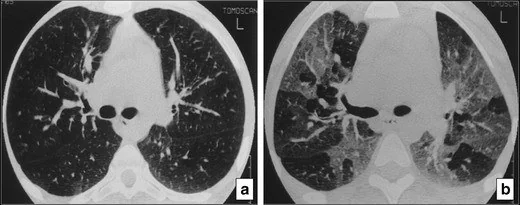
Mozaik atenüasyon küçük hava yolları, damarlar, alveoller veya interstisyumla ilişkili hastalıklarda görülebilir. Ekspiratuvar görüntülerde inspiratuvar mozaik atenüasyonun belirginleşmesi, coğrafi hava hapsiyle uyumludur. Ayırıcı tanıda eşlik eden BT bulgularını ve klinik öyküyü, inspirasyon-ekspirasyon görüntülerindeki mozaik atenüasyon değişimiyle birlikte değerlendirin.
Faz ve pencere
- HRCT tanısal
- Eşleştirilmiş inspirasyon-ekspirasyon HRCT görüntülerinde inspiratuvar mozaik atenüasyonun ekspirasyonda belirginleşmesi coğrafi hava hapsiyle uyumludur. Ekspiratuvar görüntülerde belirginleşen inspiratuvar mozaik atenüasyon coğrafi hava hapsiyle uyumludur.
Önerilen pencereler G genişlik, M merkez; değerler Hounsfield birimi (HU)
- AkciğerG 1500 / M −600
BT bulguları
- Ekspirasyon görüntülerinde mozaik atenüasyon belirginleşebilir ve coğrafi hava hapsiyle uyumludur.
- Hava hapsi, inspiratuvar mozaik atenüasyonun ekspiratuvar görüntülerde belirginleşmesiyle izlenebilir.
- Pulmoner vasküler hastalıkta periferik pulmoner arter dallarında göreli seyrelme ve mozaik atenüasyon birlikte görülebilir.
- Mozaik atenüasyon küçük hava yolları, damarlar, alveoller veya interstisyumla ilişkili hastalıklarda görülebilir; tek başına mekanizmayı belirlemez.
- Nonfibrotik hipersensitivite pnömonisinde HRCT’de buzlu cam opasiteleri, sentrilobüler nodüller ve mozaik atenüasyon; fibrotik formda ise retikülasyon, traksiyon bronşektazisi ve bal peteği görülebilir.
- Bronş duvar kalınlaşması, astımda mozaik atenüasyon ve hava hapsiyle birlikte görülebilir.
- İnspiratuvar mozaik atenüasyonun ekspiratuvar BT’de belirginleşmesi coğrafi hava hapsiyle uyumludur.
Ölçütler ve sınıflamalar
- Mozaik atenüasyon mekanizmasına göre yaklaşım
- İnspiratuvar mozaik atenüasyon küçük hava yolları, damarlar, alveoller veya interstisyumla ilişkili hastalıklarda görülebilir; eşlik eden BT bulguları ve klinik öykü ayırıcı tanıyı daraltmaya yardımcı olur.
- Hipersensitivite pnömonisinde fibrotik ve nonfibrotik HRCT paterni
- Hipersensitivite pnömonisinin fibröz olmayan formunda HRCT’de tipik olarak buzlu cam opasiteleri, sentrilobüler nodüller ve mozaik atenüasyon; fibröz formunda ise sıklıkla retikülasyon, traksiyon bronşiektazisi ve bal peteği görülür.
Normalde
Eşleşen inspirasyon-ekspirasyon HRCT görüntülerinde mozaik atenüasyonun ekspirasyonda belirginleşmesi coğrafi hava hapsiyle uyumludur. Eşleşen inspirasyon-ekspirasyon BT kesitlerini karşılaştır.
Normal BT ile kıyasla
Aynı bölgenin, kaynak veri setinde patoloji içermediği belirtilen bir BT incelemesini kesit kesit kaydırın; organ sınırlarını açarak anatomiyi hasta görüntüsüyle karşılaştırın. Küçük rastlantısal bulgular tümüyle dışlanmamıştır.
Kaynak: TotalSegmentator v2.01 veri seti (Wasserthal ve ark., Radiology: Artificial Intelligence 2023), CC BY 4.0, vaka s1278; organ sınırları veri setinin otomatik segmentasyonundan, birleştirilerek sadeleştirildi. Görüntüler 2,5 mm kesit aralığına yeniden örneklendi.
Ayırıcı tanı
- Kronik tromboembolik pulmoner hipertansiyon, mozaik atenüasyonun vasküler nedenleri arasında yer alır; eşlik eden BT bulguları ve klinik öykü ayırıcı tanıyı daraltmaya yardımcı olur.
- Yamalı buzlu cam opasiteleri mozaik paterne neden olabilir. Mozaik atenüasyon ekspiratuvar görüntülerde belirginleştiğinde bronşiolitis obliterans ya da konstriktif bronşiolitin hava hapsiyle uyumludur.
- Amfizem değerlendirmesinde BT’de düşük atenüasyon alanları ve amfizem indeksi, amfizemin nicel değerlendirilmesinde kullanılan ölçütlerdir.
- Hipersensitivite pnömonisinde HRCT’de mozaik atenüasyona sentrilobüler nodüller ve buzlu cam opasiteleri eşlik edebilir.
- Eşleştirilmiş inspirasyon-ekspirasyon BT’de PRM gibi nicel ölçümler fonksiyonel küçük hava yolu hastalığını değerlendirmek için kullanılabilir.
Tuzaklar
- Eşleşen inspirasyon ve ekspirasyon HRCT görüntülerinde mozaik atenüasyonun ekspirasyonda belirginleşmesi coğrafi hava hapsiyle uyumludur.
- Mozaik atenüasyon ile hava hapsini eş anlamlı kullanma; inspiratuvar mozaik atenüasyon ekspirasyon görüntülerinde belirginleştiğinde coğrafi hava hapsiyle uyumludur.
- Düşük atenüasyonlu alanlardaki ekspiratuvar görünüm, eşlik eden BT bulguları ve klinik öyküyle birlikte değerlendirilmelidir.
- Hipersensitivite pnömonisinde buzlu cam opasiteleri, sentrilobüler nodüller ve mozaik atenüasyon görülebilir; bu BT bulguları maruziyet öyküsü ve diğer klinik verilerle birlikte değerlendirilmelidir.
Kendini dene
Ekspiratuvar HRCT’de inspiratuvar mozaik atenüasyonun belirginleşmesi hangi görünümle uyumludur?
Cevabı göster
Coğrafi hava hapsi. İnspiratuvar mozaik atenüasyonun ekspiratuvar görüntülerde belirginleşmesi coğrafi hava hapsiyle uyumludur.
İnspiratuvar BT’de mozaik atenüasyonun ekspirasyon görüntülerinde belirginleşmesi neyle uyumludur?
Cevabı göster
Coğrafi hava hapsiyle. Küçük hava yolu hastalıklarında inspiratuvar görüntülerdeki mozaik atenüasyon ekspirasyon görüntülerinde belirginleşebilir ve coğrafi hava hapsiyle uyumludur.
İlgili konular
Kaynaklar
Bu sayfadaki 37 cümle ve 2 quiz sorusu aşağıdaki kaynaklardan alıntılarla otomatik olarak karşılaştırıldı; 21 cümle bu karşılaştırmada düzeltildi (2026-10-12).
- Overview and Challenges of Bronchiolar Disorders.pubmed.ncbi.nlm.nih.gov
- Imaging of Small Airways Disease.pubmed.ncbi.nlm.nih.gov
- Constrictive (Obliterative) Bronchiolitis as Presenting Manifestation of Connective Tissue Diseases.pubmed.ncbi.nlm.nih.gov
- Bronchiolar disorders: a clinical-radiological diagnostic algorithm.pubmed.ncbi.nlm.nih.gov
- Clinical characteristics associated with small airways disease in systemic sclerosis.pubmed.ncbi.nlm.nih.gov
- Mosaic Attenuation Pattern: A Guide to Analysis with HRCT.pubmed.ncbi.nlm.nih.gov
- Multivariate modeling using quantitative CT metrics may improve accuracy of diagnosis of bronchiolitis obliterans syndrome after lung transplantation.pubmed.ncbi.nlm.nih.gov
- Mycoplasma pneumoniae-Associated Bronchiolitis Obliterans Following Acute Bronchiolitis.pubmed.ncbi.nlm.nih.gov
- Analysis of perfusion defects by causes other than acute pulmonary thromboembolism on contrast-enhanced dual-energy CT in consecutive 537 patients.pubmed.ncbi.nlm.nih.gov
- Pulmonary multislice computed tomography findings in acute aortic dissection.pubmed.ncbi.nlm.nih.gov
- Computed tomography in hypersensitivity pneumonitis: main findings, differential diagnosis and pitfalls.pubmed.ncbi.nlm.nih.gov
- Forced Oscillation Technique and Small Airway Involvement in Chronic Hypersensitivity Pneumonitis.pubmed.ncbi.nlm.nih.gov
- High resolution computed tomography in asthma.pubmed.ncbi.nlm.nih.gov
- Parametric Response Mapping of Bronchiolitis Obliterans Syndrome Progression After Lung Transplantation.pubmed.ncbi.nlm.nih.gov
- Imaging Markers of Chronic Obstructive Pulmonary Disease on Computed Tomography of the Lungs: a Narrative Review.pubmed.ncbi.nlm.nih.gov
- The silent zone of paediatric asthma: integrating small airway dysfunction assessment into clinical practice.pubmed.ncbi.nlm.nih.gov
- CT Findings of Asthma and Asthma-Mimicking Conditions.pubmed.ncbi.nlm.nih.gov
- Chest CT in the evaluation of chronic obstructive pulmonary disease: recommendations of Asian Society of Thoracic Radiology.pubmed.ncbi.nlm.nih.gov
- Identification of imaging-based pulmonary and extrapulmonary treatable traits in COPD: a review.pubmed.ncbi.nlm.nih.gov
- Precision treatment of COPD based on novel imaging phenotypes: a treatable traits approach.pubmed.ncbi.nlm.nih.gov
- A case of breathlessness and unexpected antibodies: stating the obvious.pubmed.ncbi.nlm.nih.gov
- Cardiothoracic Imaging Findings in Obesity Hypoventilation Syndrome (Pickwickian Syndrome): A Case Series.pubmed.ncbi.nlm.nih.gov
- Small vessel disease in chronic thromboembolic pulmonary hypertension: a comprehensive narrative review of multimodality imaging evaluation.pubmed.ncbi.nlm.nih.gov
- Assessing Lung Involvement in Paediatric Rheumatic Diseases: A Retrospective Evaluation of the Limitations of Spirometry.pubmed.ncbi.nlm.nih.gov
- Physiological characteristics and temporal transitions of preserved ratio impaired spirometry.pubmed.ncbi.nlm.nih.gov
- CT strain metrics allow for earlier diagnosis of bronchiolitis obliterans syndrome after hematopoietic cell transplant.pubmed.ncbi.nlm.nih.gov
- Clinical features of canine pulmonary veno-occlusive disease and pulmonary capillary hemangiomatosis.pubmed.ncbi.nlm.nih.gov
- Deep Learning Image Reconstruction Algorithm for Quantitative Assessment of Low-Dose Biphasic Chest CT in Chronic Obstructive Pulmonary Disease.pubmed.ncbi.nlm.nih.gov
- Hypersensitivity Pneumonitis: A Pictorial Review Based on the New ATS/JRS/ALAT Clinical Practice Guideline for Radiologists and Pulmonologists.pubmed.ncbi.nlm.nih.gov
- Pulmonary Adverse Events in Cancer Immunotherapy: Case Studies of CT Patterns.pubmed.ncbi.nlm.nih.gov
- Imaging in the diagnosis and management of fibrosing interstitial lung diseases.pubmed.ncbi.nlm.nih.gov
- Predictive value of quantitative CT-derived emphysema heterogeneity for outcomes following bronchoscopic lung volume reduction.pubmed.ncbi.nlm.nih.gov
- Preserved ratio impaired spirometry: clinical, imaging and artificial intelligence perspective.pubmed.ncbi.nlm.nih.gov
- Characteristics of irreversibility in high-resolution computed tomography in chronic hypersensitivity pneumonitis.pubmed.ncbi.nlm.nih.gov
- Imaging in chronic thromboembolic pulmonary hypertension: review of the current literature.pubmed.ncbi.nlm.nih.gov
- The Unveiled Triad: Clinical, Radiological and Pathological Insights into Hypersensitivity Pneumonitis.pubmed.ncbi.nlm.nih.gov
- ESR Essentials: imaging in fibrotic lung diseases-practice recommendations by the European Society of Thoracic Imaging.pubmed.ncbi.nlm.nih.gov
- Diagnostic, prognostic, and therapeutic challenges in patients with hypersensitivity pneumonitis.pubmed.ncbi.nlm.nih.gov
- Acute respiratory failure as a rare presentation of non-fibrotic hypersensitivity pneumonitis: Case series.pubmed.ncbi.nlm.nih.gov
- Current concepts in the diagnosis and treatment of hypersensitivity pneumonitis: a narrative review.pubmed.ncbi.nlm.nih.gov
- Multidisciplinary Recommendations for the Use of Chest CT and Bronchial Biopsy in Severe Asthma: An Expert Consensus Based on Real-World Experience.pubmed.ncbi.nlm.nih.gov
- Seeing is believing-on the utility of CT in phenotyping chronic obstructive pulmonary disease.pubmed.ncbi.nlm.nih.gov
- Trying to disentangle the causes of dyspnea and exercise limitation in a subject with GATA2 deficiency and normal spirometry: a case report.pubmed.ncbi.nlm.nih.gov
- Origins of and lessons from quantitative functional X-ray computed tomography of the lung.pubmed.ncbi.nlm.nih.gov
- Interstitial Lung Disease in Children: Rare Genetic Variants Beyond Surfactant Dysfunction.pubmed.ncbi.nlm.nih.gov
- Defining endotypes of bronchopulmonary dysplasia in preterm infants to improve precision-based therapies.pubmed.ncbi.nlm.nih.gov
- Postoperative Pulmonary Complications: Clinical and Imaging Insightspubmed.ncbi.nlm.nih.gov
- May Small Airways Dysfunction (SAD) Play a Role in the Idiopathic Pulmonary Fibrosis (IPF) and May SAD Be a Therapeutic Target?pubmed.ncbi.nlm.nih.gov
- Frequency of Radiologic Bronchiolocentric Interstitial Pneumonia Patterns and Associated Factors in Welders.pubmed.ncbi.nlm.nih.gov
- Pseudo-obstruction on single-phase CTPA: unilateral pulmonary vein atresia as the cause of 50 years of hemoptysis.pubmed.ncbi.nlm.nih.gov
- Agenesis of the left pulmonary artery and cardiac hydatid cysts: A dual rarity.pubmed.ncbi.nlm.nih.gov
- New CT-Detected Pulmonary Abnormalities During Breast Cancer Chemotherapy: Frequency, Imaging Features, and Cumulative-Exposure Associations.pubmed.ncbi.nlm.nih.gov
- Management of pneumonia by the emergency radiologist.pubmed.ncbi.nlm.nih.gov
- Assessment of CT quantitative characteristics derived from CT in connective tissue disease-associated interstitial lung disease.pubmed.ncbi.nlm.nih.gov
- Usual Interstitial Pneumonia in a Patient With Celiac Disease: Expanding the Spectrum of Pulmonary Manifestations.pubmed.ncbi.nlm.nih.gov
- Diffuse cystic lung diseases-a primer for radiologists.pubmed.ncbi.nlm.nih.gov
- Fleischner Society: Glossary of Terms for Thoracic Imaging.pubmed.ncbi.nlm.nih.gov
- Lung imaging methods: indications, strengths and limitations.pubmed.ncbi.nlm.nih.gov
- Hot Tub Lung: Misdiagnosed Hypersensitivity Pneumonitis Revealing a Mycobacterial Aetiology-A Case Report and Literature Review.pubmed.ncbi.nlm.nih.gov
- Liver Imaging Reporting and Data System (LI-RADS): A Comprehensive Review.pubmed.ncbi.nlm.nih.gov
- Computer-assisted evaluation of small airway disease in CT scans of Iran-Iraq war victims of chemical warfare by a locally developed software: comparison between different quantitative methods.pubmed.ncbi.nlm.nih.gov
- Guidance for clinical practice using emergency and point-of-care ultrasonography.pubmed.ncbi.nlm.nih.gov
- CPAP improves regional lung strain rate and diaphragm velocity of relaxation in experimental self-inflicted lung injury.pubmed.ncbi.nlm.nih.gov
- A Review of Electrical Impedance Tomography in Lung Applications: Theory and Algorithms for Absolute Images.pubmed.ncbi.nlm.nih.gov
- The physical basis of ventilator-induced lung injury.pubmed.ncbi.nlm.nih.gov
- Emphysema in an 11-month-old boy with alpha-1 antitrypsin deficiency.pubmed.ncbi.nlm.nih.gov
- Case Report: High-altitude exposure and severe respiratory infection precipitating diabetic ketoacidosis: new-onset ketosis-prone diabetes unmasked by physiological stress.pubmed.ncbi.nlm.nih.gov
- Diagnosis and Treatment of Hypersensitivity Pneumonitis: S2k Guideline of the German Respiratory Society and the German Society for Allergology and Clinical Immunology.pubmed.ncbi.nlm.nih.gov
- From COPD to Smoke-Related Arteriopathy: The Mechanical and Immune-Inflammatory Landscape Underlying Lung Cancer Distant Spreading-A Narrative Review.pubmed.ncbi.nlm.nih.gov
- Transformative biomechanics and mechanobiology breakthroughs shaping the future of health and medicine.pubmed.ncbi.nlm.nih.gov
- Recent publications from the Alzheimer's Disease Neuroimaging Initiative: Reviewing progress toward improved AD clinical trials.pubmed.ncbi.nlm.nih.gov
- Radiologic patterns of interstitial lung disease: a pictorial review based on the 2025 European Respiratory Society/American Thoracic Society Classification.pubmed.ncbi.nlm.nih.gov
- Quantitative CT assessment of structural and functional response to omalizumab in severe allergic asthma: a prospective real-world study.pubmed.ncbi.nlm.nih.gov
- Lipoid Pneumonia: HRCT and MRI Spectrum, Diagnostic Pitfalls, and Imaging-Based Diagnostic Workflow.pubmed.ncbi.nlm.nih.gov
- Rituximab for the treatment of acute exacerbation of interstitial lung disease associated with connective tissue disease.pubmed.ncbi.nlm.nih.gov
- Imaging of Childhood Interstitial Lung Disease.pubmed.ncbi.nlm.nih.gov
- Early chest CT abnormalities to predict the subsequent occurrence of chronic lung allograft dysfunction.pubmed.ncbi.nlm.nih.gov
- Pitfalls in diagnosis of infiltrative lung disease by CT.pubmed.ncbi.nlm.nih.gov
- CT findings of lung injury during breast cancer treatment.pubmed.ncbi.nlm.nih.gov
- Post-Tuberculosis Lung Disease: Clinicopathologic Insights, Diagnosis, Prevention, and Management.pubmed.ncbi.nlm.nih.gov
- Chronic respiratory morbidity and wheeze after preterm birth: a narrative review.pubmed.ncbi.nlm.nih.gov
- Toward precision medicine in COPD: phenotypes, endotypes, biomarkers, and treatable traits.pubmed.ncbi.nlm.nih.gov
- Multiple cystic lung disease.pubmed.ncbi.nlm.nih.gov
- Drug-Induced Interstitial Lung Disease in Lung Cancer Patients.pubmed.ncbi.nlm.nih.gov
- Uncommon Causes of Interlobular Septal Thickening on CT Images and Their Distinguishing Features.pubmed.ncbi.nlm.nih.gov
- Diagnosis of Hypersensitivity Pneumonitis in Adults. An Official ATS/JRS/ALAT Clinical Practice Guideline.pubmed.ncbi.nlm.nih.gov
- The Dual Threat Combined Pulmonary Fibrosis and Emphysema (CPFE): Two Cases.pubmed.ncbi.nlm.nih.gov
- Emergence of Incidentalomas Following Chest CT Screening for COVID-19 Infection: A Multicenter Cross-Sectional Study.pubmed.ncbi.nlm.nih.gov
- Assessing the Safety of Carbon Dioxide Extracts of <i>Acorus calamus</i> Rhizomes and <i>Calendula officinalis</i> Flowers and the Antitussive Activity of the Tablet Dosage Form 'Exkair' and Granules 'Zerp-Ak-Broncho' Developed on Their Basis.pubmed.ncbi.nlm.nih.gov
- Quality of AI chatbot-generated information on hypersensitivity pneumonitis for clinical and patient use.pubmed.ncbi.nlm.nih.gov
- Toward precision imaging in interstitial lung disease: advances in quantitative imaging and artificial intelligence.pubmed.ncbi.nlm.nih.gov
- Imaging of pulmonary hypertension: an update.pubmed.ncbi.nlm.nih.gov
- Pathophysiological Insights and Clinical Management Strategies for Interstitial Lung Diseases.pubmed.ncbi.nlm.nih.gov
- Hypersensitivity Pneumonitis: An Interesting Case of Acute Shortness of Breath in a Young Patient.pubmed.ncbi.nlm.nih.gov
- Clinical and radiological pattern of olaparib-induced interstitial lung disease.pubmed.ncbi.nlm.nih.gov
- Long-term safety and effectiveness of the "OptEase" vena cava filter.pubmed.ncbi.nlm.nih.gov
- Korean Guidelines for the Diagnosis and Management of Interstitial Lung Diseases: Hypersensitivity Pneumonitis.pubmed.ncbi.nlm.nih.gov
- Segmentation-based deep learning emphysema quantification using chest CT: improved accuracy and robustness vs LAA-950.pubmed.ncbi.nlm.nih.gov
- The Role of High-Resolution Lung Computed Tomography to Distinguish Between Fibrosing Hypersensitivity Pneumonitis and Usual Interstitial Pneumonia.pubmed.ncbi.nlm.nih.gov
- High-affinity alphavbeta3 integrin targeted optical probe as a new imaging biomarker for early atherosclerosis: initial studies in Watanabe rabbits.pubmed.ncbi.nlm.nih.gov
- CT Features of Granulomatous-Lymphocytic Interstitial Lung Disease (GLILD): The "Kebab Sign" as a Marker to Support Differential Diagnosis.pubmed.ncbi.nlm.nih.gov
- Practical Imaging Interpretation in Patients Suspected of Having Idiopathic Pulmonary Fibrosis: Official Recommendations from the Radiology Working Group of the Pulmonary Fibrosis Foundation.pubmed.ncbi.nlm.nih.gov
- Differences in radiological/HRCT findings in eosinophilic bronchitis and asthma: implication for bronchial responsiveness.pubmed.ncbi.nlm.nih.gov
- CFD Modeling of Airflow and Aerosol Transport in the Human Respiratory System: A Comprehensive Review.pubmed.ncbi.nlm.nih.gov
- Pathogenesis, Diagnostic Advances, and Therapeutic Management of Chronic Obstructive Pulmonary Disease: A Narrative Review.pubmed.ncbi.nlm.nih.gov
- Small airway dysfunction: a shared, early, measurable, and potentially treatable trait across COPD, asthma, and fibrotic lung disease.pubmed.ncbi.nlm.nih.gov
- From FEV<sub>1</sub> to Small Airways: AMethodological Review of Lung Function Assessment in Biologic-Treated Asthma.pubmed.ncbi.nlm.nih.gov
- Clinical significance of a flattening index derived from the flow-volume loop.pubmed.ncbi.nlm.nih.gov
- Chronic phase ventilation strategy in established severe bronchopulmonary dysplasia: A critical evaluation of the evidence.pubmed.ncbi.nlm.nih.gov
- Surgically Diagnosed Diffuse Idiopathic Pulmonary Neuroendocrine Cell Hyperplasia in Asymptomatic Patients.pubmed.ncbi.nlm.nih.gov
Eğitim amaçlıdır; hasta başında tanı ve tedavi kararının yerine geçmez, tıbbi tavsiye değildir. Metinler yapay zekâ desteğiyle yazıldı ve otomatik bir adımda kaynak alıntılarıyla karşılaştırıldı; bu bir tıbbi doğrulama değildir ve içerik uzman radyolog incelemesinden geçmedi. Klinik kararlarda güncel kılavuzları, kurum protokollerini ve radyoloji raporunu esas alın.