Özet
Üreter hasarı yüksek enerjili künt veya penetran travmada, ayrıca pelvik ve abdominal cerrahi sonrasında görülebilir; hematüri olmaması yaralanmayı dışlamaz. Hemodinamik olarak stabil hastada intravenöz kontrastlı BT'nin ekskretuar gecikmiş görüntüleri, kaçak yerini ve üreter devamlılığını ortaya koyar; rutin tek fazlı travma BT'si küçük bir yaralanmayı kaçırabilir. Tanı gecikirse idrar koleksiyonu büyüyerek urinoma, enfeksiyon veya fistüle dönüşebilir ve üreterde sonradan darlık gelişebilir.
Faz ve pencere
- Ekskretuar tanısal
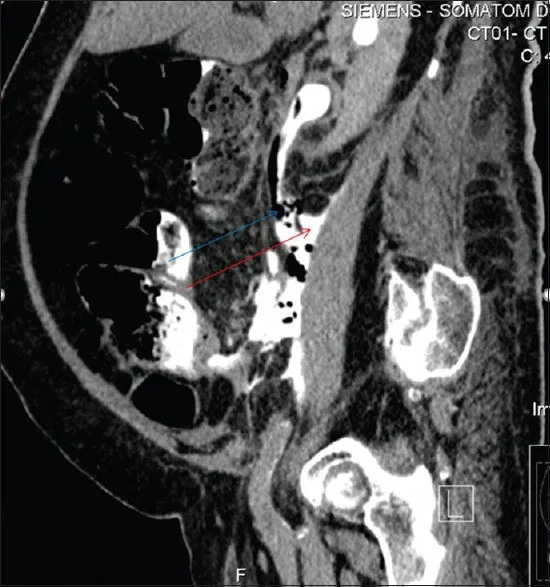
- Ekskretuar gecikmiş görüntülerde böbrekten atılan iyotlu kontrast üreter dışındaki retroperitoneal odağa geçebilir; fokal ekstravazasyon, lümen devamlılığındaki kesinti, distal segmentin opaklaşmaması ve ipsilateral gecikmiş piyelogram birlikte aranır. İlk görüntüde üreter yeterince dolmamışsa daha geç ekskretuar görüntü alınması opaklaşmayı ve olası kaçağı değerlendirmeye yardım eder.
- Portal
- Kontrastlı portal venöz seri periüreteral hematomu, çevre sıvıyı ve eşlik eden bağırsak, damar veya solid organ yaralanmasını gösterir. İdrarın damar içi kontrasttan ayırt edilmesini ve kaçağın doğrulanmasını tek başına sağlamadığı için üreter hasarının dışlanmasında tanısal değildir.
Önerilen pencereler: Batın (G 400 / M 50), Yumuşak doku (G 400 / M 40).
BT bulguları
- Üreter lümeninden dışarı uzanan ekskretuar kontrast — retroperitoneumda çizgisel veya düzensiz opaklaşma, aktif üriner kaçağı gösterir.
- Yaralanma hizasında üreter konturunda kesilme veya ani kalibrasyon değişikliği — travma hattıyla aynı düzeyde lümen hasarını düşündürür.
- Distal üreterde kontrast sütununun görülmemesi, ancak yeterli böbrek ekskresyonu ve proksimal üreter opaklaşması varsa kesinti şüphesini artırır; tek başına tam transeksiyonu kanıtlamaz.
- İpsilateral gecikmiş nefrogram veya piyelogram — karşı böbreğe kıyasla ekskresyonun gecikmesi, obstrüksiyon ya da ciddi yaralanma eşlik edebileceğini gösterir.
- Üreter çevresinde hematom ve retroperitoneal yağ dokuda çizgilenme — özellikle penetran yaralanma hattı veya deselerasyon travması boyunca dolaylı ipucudur.
- Periüreteral sıvı koleksiyonu — ekskretuar fazda kontrastla opaklaşması urinoma lehinedir; erken dönemde koleksiyon henüz belirgin olmayabilir.
- Eşlik eden retroperitoneal, bağırsak, damar veya pelvik yaralanma — üreter hasarı olasılığını artıran travma dağılımı ve ilişkili bulgulardır.
Ölçütler ve sınıflamalar
- AAST Üreter Yaralanma Ölçeği
Normalde
Normal gecikmiş BT ürogramında renal pelvislerden çıkan iki üreter, mesaneye kadar kesintisiz ve lümen dışına kontrast vermeden izlenir; üreter çevresinde yeni sıvı veya hematom bulunmaz. Yaralı tarafı aynı seviyedeki karşı taraf üreterle karşılaştırırken opaklaşma sürekliliğine, kalibreye ve çevre yağ planına bakın; tek taraflı ekskresyon gecikmesi karşılaştırmayı etkileyebilir.
Normal BT ile kıyasla
Aynı bölgenin, kaynak veri setinde patoloji içermediği belirtilen bir BT incelemesini kesit kesit kaydırın; organ sınırlarını açarak anatomiyi hasta görüntüsüyle karşılaştırın. Küçük rastlantısal bulgular tümüyle dışlanmamıştır.
Kaynak: TotalSegmentator v2.01 veri seti (Wasserthal ve ark., Radiology: Artificial Intelligence 2023), CC BY 4.0, vaka s0119; organ sınırları veri setinin otomatik segmentasyonundan, birleştirilerek sadeleştirildi. Görüntüler 2,5 mm kesit aralığına yeniden örneklendi.
Ayırıcı tanı
- Retroperitoneal sıvı koleksiyonları, gecikmiş fazda kontrastlı idrarla opaklaşarak idrar kaçağından ayrılır; tek fazlı incelemelerde hematom veya apseden ayırt edilmeleri zor olabilir.
- Lenfosel
- cerrahi yatakta görülen sıvı koleksiyonudur; idrar kaçağından farklı olarak ekskretuar faza kontrast vermez.
- Apse
- kalın duvar kontrastlanması, çevre inflamasyon veya gaz destekler; üreter lümeninden koleksiyona uzanan kontrast beklenmez.
- Mesane rüptürü
- idrar kaçağı perivezikal bölgede yoğunlaşır; üreter seyrinden bağımsızdır.
- Üreter obstrüksiyonu proksimalde hidronefroz ve üreter dilatasyonu yapar; idrar kaçağı ise gecikmiş faza üreter dışına kontrast sızması (ekstravazasyon) ile ayrılır.
Tuzaklar
- Gecikmiş ekskretuar seri alınmamış rutin portal faz BT'de idrar kaçağı görünmeyebilir; klinik şüphe sürüyorsa tek fazlı incelemeyi dışlayıcı kabul etmeyin.
- Hipovolemi veya böbrek işlev bozukluğunda kontrast atılımı gecikebilir; yaralanma distalinde opaklaşmama bulgusunu, yeterli ekskresyon oluşup oluşmadığına bakmadan tam kopma saymayın.
- Erken incelemede periüreteral sıvı hematomla karışabilir; daha geç ekskretuar görüntülerde koleksiyonun idrar kontrastıyla dolması kaçağı destekler.
- Komşu yapıların kontrastlanması yanlış pozitif verebilir; fazlar arası karşılaştırma gereklidir.
Kendini dene
Künt travma sonrası gecikmiş BT'de proksimal üreter çevresinde kontrastlı idrar izleniyor; distal üreter lümeni seçilemiyor. En olası tanı nedir?
Cevabı göster
Üreter yaralanması ve idrar ekstravazasyonu. Üreter dışına sızan kontrastlı idrar üreter yaralanmasını ve kaçağı gösterir. Gecikmiş fazda üreter lümeni dışına uzanan kontrastlı idrar, üreteral yaralanma ve idrar kaçağını doğrudan gösterir.
Pelvik cerrahi sonrası üreter boyunca sıvı koleksiyonu görülüyor; gecikmiş görüntüde kontrast koleksiyona karışıyor. En uygun adlandırma hangisidir?
Cevabı göster
Urinoma. Ekskretuar kontrastın üreter dışındaki koleksiyona ulaşması idrar kaçağını ve urinoma oluşumunu gösterir. Lenfosel ve seroma idrar kontrastıyla dolmaz; apsede duvar kontrastlanması ve inflamasyon baskındır.
İlgili konular
Kaynaklar
Bu sayfadaki 40 cümle ve 2 quiz sorusu aşağıdaki kaynaklardan alıntılarla tek tek karşılaştırıldı; 7 cümle bu karşılaştırmada düzeltildi (2026-10-08).
- A Presumed Acquired Ureteral Diverticulum Presenting With Hematuria, Urosepsis, and Periureteral Contrast Leak: A Rare Case Reportpmc.ncbi.nlm.nih.gov
- A Leak Beneath the Graft: Description of a Rare Ureteral Injury Following Aortobifemoral Bypasspmc.ncbi.nlm.nih.gov
- Embolization of post-partial nephrectomy upper calyceal-perirenal urinary fistula using onyx-34: A novel application of a (pseudo-) liquid embolic agentpmc.ncbi.nlm.nih.gov
- Septic Shock After Suprapubic Catheter Placement in a Patient With Advanced Multiple System Atrophypmc.ncbi.nlm.nih.gov
- Pyelo‐Hepatic Fistula Resulting From a Perinephric Abscess: A Case Report and Literature Reviewpmc.ncbi.nlm.nih.gov
- Imaging of Small Renal Masses before and after Thermal Ablation.pubmed.ncbi.nlm.nih.gov
- The effects of recreational ketamine cystitis on urinary tract reconstruction - a surgical challenge.pubmed.ncbi.nlm.nih.gov
- Diagnostic and Interventional Radiology Management of Ureteral Iatrogenic Leakage after Gynecologic Surgery.pubmed.ncbi.nlm.nih.gov
- Application of the "Yang-Monti principle" in children with iatrogenic ureteral injuries.pubmed.ncbi.nlm.nih.gov
- Urine leaks in children sustaining blunt renal trauma.pubmed.ncbi.nlm.nih.gov
- Urine leak after robotic radical prostatectomy: not all urine leaks come from the anastomosis.pubmed.ncbi.nlm.nih.gov
- Ureterocalyceal Fistula: A Rare Complication of Laparoscopic Partial Nephrectomy.pubmed.ncbi.nlm.nih.gov
- Tension haemothorax from a bleeding branch of the renal artery following isolated penetrating thoracic trauma: a rare presentation.pubmed.ncbi.nlm.nih.gov
- A Leak Beneath the Graft: Description of a Rare Ureteral Injury Following Aortobifemoral Bypass.pubmed.ncbi.nlm.nih.gov
- Mid-ureteric injury resulting from malposition of an indwelling urethral catheter.pubmed.ncbi.nlm.nih.gov
- Ureteric Recovery Without Stenting After Intraoperative De-ligation During Cesarean Section: A Case Report.pubmed.ncbi.nlm.nih.gov
- Spontaneous Bilateral Renal Forniceal Rupture Secondary to Acute Urinary Retention in a Patient with Prior Prostate Radiotherapy: A Case Report.pubmed.ncbi.nlm.nih.gov
- Urinary Biomarkers in Urological Oncology: From Biological Origin to Clinical Decision-Making-A Narrative Review.pubmed.ncbi.nlm.nih.gov
- Rare Case of Delayed Bleeding Occurring 8 Years After Percutaneous Nephrolithotomy and Angioembolization: A Case Report and Current Literature Review.pubmed.ncbi.nlm.nih.gov
- Diagnostic Accuracy of Magnetic Resonance Urography Compared With Computed Tomography Urography in Patients With Hematuria.pubmed.ncbi.nlm.nih.gov
- Radiologic evaluation of the kidney transplant donor and recipient.pubmed.ncbi.nlm.nih.gov
- Interdisciplinary Management of Traumatic Injuries to the Kidneys and Urinary Tract Caused by Blunt Abdominopelvic Trauma.pubmed.ncbi.nlm.nih.gov
- Post-Surgical Imaging Assessment in Rectal Cancer: Normal Findings and Complications.pubmed.ncbi.nlm.nih.gov
- Percutaneous antegrade-retrograde recanalization (rendezvous technique) of a complete ureteropelvic junction disruption after robotic-assisted partial nephrectomy: A case report.pubmed.ncbi.nlm.nih.gov
- Endoscopic management of ureteral injuries arising from gynecologic procedures.pubmed.ncbi.nlm.nih.gov
- Role of postoperative renal ultrasound in identifying ureteral injury despite normal intraoperative jet flow.pubmed.ncbi.nlm.nih.gov
- Percutaneous nephrostomy: technical aspects and indications.pubmed.ncbi.nlm.nih.gov
- Long-term safety and effectiveness of the "OptEase" vena cava filter.pubmed.ncbi.nlm.nih.gov
- Computed tomography of renal emergencies: A comprehensive diagnostic guide for radiology residents.pubmed.ncbi.nlm.nih.gov
- Contrast-enhanced ultrasound (CEUS) in pediatric blunt abdominal trauma.pubmed.ncbi.nlm.nih.gov
- Superior Detection without Clinical Benefit: A Prospective Comparison of CT and Ultrasonography After Stone Surgery.pubmed.ncbi.nlm.nih.gov
- Validation of the diagnostic accuracy of a urine-based DNA methylation marker test in patients with upper urinary tract lesions.pubmed.ncbi.nlm.nih.gov
- Dual Challenges: Addressing Post-Traumatic Retroperitoneal Urinoma in the Context of Pyeloureteral Duplication.pubmed.ncbi.nlm.nih.gov
- Pediatric ureteropelvic junction disruption with renal laceration: organ-saving management through delayed diagnosis and surgical repair.pubmed.ncbi.nlm.nih.gov
- Navigating pelvic anatomy for exenteration: a clinical guide for radiologists.pubmed.ncbi.nlm.nih.gov
- Urogenital surgery in foals.pubmed.ncbi.nlm.nih.gov
- Endoscopic repair of Strasberg type D bile duct injury following laparoscopic cholecystectomy: an unconventional approach.pubmed.ncbi.nlm.nih.gov
- Transrenal Ureter Embolization for Refractory Urine Leaks from Iatrogenic Ureteric Injury Following Colorectal Surgery.pubmed.ncbi.nlm.nih.gov
- Managing Ureteropelvic Junction Obstruction in the Young Infant.pubmed.ncbi.nlm.nih.gov
- Severe Hydronephrosis and Perinephric Urinoma with Rupture of Renal Fornix Secondary to Postoperative Urinary Retention following Laparoscopic Umbilical Hernia Repair.pubmed.ncbi.nlm.nih.gov
- Complications after Nephron-sparing Interventions for Renal Tumors: Imaging Findings and Management.pubmed.ncbi.nlm.nih.gov
- Large minimally symptomatic iatrogenic urinoma presenting three years after abdominal aortic aneurysm repair.pubmed.ncbi.nlm.nih.gov
- Robot-assisted reconstruction of posterior urethral stenosis: surgical techniques, graft use, and clinical outcomes.pubmed.ncbi.nlm.nih.gov
- 2023 WSES guidelines for the prevention, detection, and management of iatrogenic urinary tract injuries (IUTIs) during emergency digestive surgery.pubmed.ncbi.nlm.nih.gov
- Renal venous flow in different regions of the kidney are different and reflecting different etiologies of venous reflux disorders in septic acute kidney injury: a prospective cohort study.pubmed.ncbi.nlm.nih.gov
- Creation of a neoinfundibulum and serial balloon dilations for the treatment of the excluded calyx: Two cases describing a novel technique.pubmed.ncbi.nlm.nih.gov
- Management and Outcomes of Blunt Renal Trauma: A Retrospective Analysis from a High-Volume Urban Emergency Department.pubmed.ncbi.nlm.nih.gov
- Initial surgical management of injuries to the urogenital tract in patients with polytrauma and/or severe injuries: a systematic review and clinical practice guideline update.pubmed.ncbi.nlm.nih.gov
- Computed tomography of pediatric abdominal trauma: optimizing utilization and enhancing diagnostic interpretation.pubmed.ncbi.nlm.nih.gov
- The Role of Interventional Radiology in Renal Trauma: A Narrative Review.pubmed.ncbi.nlm.nih.gov
- Challenges and outcomes in pediatric and adult kidney transplantation.pubmed.ncbi.nlm.nih.gov
- Vascular and lymphatic complications after renal transplant.pubmed.ncbi.nlm.nih.gov
- Iatrogenic-related transplant injuries: the role of the interventional radiologist.pubmed.ncbi.nlm.nih.gov
- 2012 CUA Abstracts.pubmed.ncbi.nlm.nih.gov
- Protecting organs-at-risk in cancer therapies through temporary organ displacement: a comprehensive review.pubmed.ncbi.nlm.nih.gov
- Acute kidney injury in urological conditions.pubmed.ncbi.nlm.nih.gov
- Clinical Approaches and Emerging Therapeutic Horizons in Primary Hyperoxaluria.pubmed.ncbi.nlm.nih.gov
- Three-Dimensional Printing and Bioprinting in Renal Transplantation and Regenerative Medicine: Current Perspectives.pubmed.ncbi.nlm.nih.gov
- Indications for abdominal imaging: When and what to choose?pubmed.ncbi.nlm.nih.gov
- PET-CT in Clinical Adult Oncology-IV. Gynecologic and Genitourinary Malignancies.pubmed.ncbi.nlm.nih.gov
- Case Report: Spontaneous dissection of the renal pelvis and ureter.pubmed.ncbi.nlm.nih.gov
- Robot-Assisted Anderson-Hynes Pyeloplasty for Lower-Moiety Ureteropelvic Junction Obstruction in an Incomplete Duplex Collecting System Presenting as Dietl's Crisis: A Case Report.pubmed.ncbi.nlm.nih.gov
- Patterns of injury and violence in Yaoundé Cameroon: an analysis of hospital data.pubmed.ncbi.nlm.nih.gov
- The Hidden Hitchhiker: Retrocaval Ureter Masquerading as Isolated Pelviureteric Junction Obstruction.pubmed.ncbi.nlm.nih.gov
- Infected stent graft and severe aortitis after transcaval glue embolization of type II endoleak: a case report.pubmed.ncbi.nlm.nih.gov
- Imaging of renal emergencies: Review of infectious, hemorrhagic, vascular, and traumatic etiologies.pubmed.ncbi.nlm.nih.gov
- Advances in Imaging for Assessing Pelvic Endometriosis.pubmed.ncbi.nlm.nih.gov
- Role of Ultrasound in the Assessment and Differential Diagnosis of Pelvic Pain in Pregnancy.pubmed.ncbi.nlm.nih.gov
- Contrast-sparing CT using renal-clearable gold nanoclusters for early spatial mapping of renal dysfunction.pubmed.ncbi.nlm.nih.gov
- Renal transplantation and variations in blood supply: a narrative review.pubmed.ncbi.nlm.nih.gov
- Total laparoscopic radical hysterectomy for cervical cancer in prolapsed uterus.pubmed.ncbi.nlm.nih.gov
- A Presumed Acquired Ureteral Diverticulum Presenting With Hematuria, Urosepsis, and Periureteral Contrast Leak: A Rare Case Report.pubmed.ncbi.nlm.nih.gov
- The impact of intraoperative ureteral stent omission on postoperative complications during radical cystectomy.pubmed.ncbi.nlm.nih.gov
- Explosive Weapons Trauma Care Collective (EXTRACCT) Blast Injury Clinical Practice Guideline: Genito-Urinary Trauma.pubmed.ncbi.nlm.nih.gov
- Conservatively Managed Grade V Blunt Renal Injury.pubmed.ncbi.nlm.nih.gov
- Two Cases of Isolated Ureteral Injury Secondary to Blunt Force Trauma.pubmed.ncbi.nlm.nih.gov
- Interventional Radiology in Renal Trauma.pubmed.ncbi.nlm.nih.gov
- Case report: traumatic avulsion of the left kidney and spleen with diaphragmatic rupture in a young worker.pubmed.ncbi.nlm.nih.gov
- Comprehensive 90-Day Morbidity Assessment Following Robot-Assisted Radical Cystectomy With Intracorporeal Diversion.pubmed.ncbi.nlm.nih.gov
- Myosteatosis as a New Risk Factor of Surgical Complications in Kidney Transplant Recipients: A Retrospective Study.pubmed.ncbi.nlm.nih.gov
- Pediatric Genitourinary Trauma.pubmed.ncbi.nlm.nih.gov
- Dynamic contrast-enhanced computed tomography for small bowel bleeding: Two cases of arteriovenous malformation and gastrointestinal stromal tumor.pubmed.ncbi.nlm.nih.gov
- Pneumothorax and Hemothorax: Practical Approaches for Radiologists.pubmed.ncbi.nlm.nih.gov
- Imaging in the postpartum period.pubmed.ncbi.nlm.nih.gov
- Ureteral contrast findings as a potential predictor for invasive intervention in high-grade pediatric renal trauma: A retrospective analysis.pubmed.ncbi.nlm.nih.gov
- Interventional Radiology Management of Genitourinary Trauma: Literature, Current Practice, and Strategies for the Future.pubmed.ncbi.nlm.nih.gov
- Efficacy and Safety of Tip-Flexible Suctioning Ureteral Access in Renal Stone Treatment.pubmed.ncbi.nlm.nih.gov
- The surgical technique and efficacy of a novel pure retroperitoneoscopic extravesical bladder cuff excision without intraoperative repositioning for upper tract urothelial carcinoma.pubmed.ncbi.nlm.nih.gov
- Imaging of Acute Abdominopelvic Pain in Pregnancy and Puerperium-Part II: Non-Obstetric Complications.pubmed.ncbi.nlm.nih.gov
- Contrast Enhanced Ultrasound Compared with MRI and CT in the Evaluation of Post-Renal Transplant Complications.pubmed.ncbi.nlm.nih.gov
- Renal relevant radiology: imaging in kidney transplantation.pubmed.ncbi.nlm.nih.gov
- Advances in Fluorescent Adjuncts in Pediatric Surgery: A Comprehensive Review of Applications of Indocyanine Green Across Surgical Specialties.pubmed.ncbi.nlm.nih.gov
- When Stones Escape: A Rare Radiologic Finding of Retroperitoneal Stone Extrusion Following American Association for the Surgery of Trauma (AAST) Grade IV Blunt Renal Trauma in a Chronically Hydronephrotic Kidney.pubmed.ncbi.nlm.nih.gov
- Urotrauma: AUA guideline.pubmed.ncbi.nlm.nih.gov
- Imaging in renal trauma.pubmed.ncbi.nlm.nih.gov
- Robotic reconstruction for benign upper urinary tract obstruction: a review of the current literature.pubmed.ncbi.nlm.nih.gov
- Comparison of traditional and novel tip-flexible suctioning ureteral access sheath combined with flexible ureteroscope to treat unilateral renal calculi.pubmed.ncbi.nlm.nih.gov
- Contrast-enhanced ultrasound-guided biopsy and perfusion monitoring for bladder involvement in relapsed multiple myeloma: a case report.pubmed.ncbi.nlm.nih.gov
- Best Practice Imaging in the Initial Investigation of Paediatric Blunt Abdominal Trauma: A Narrative Review.pubmed.ncbi.nlm.nih.gov
- Imaging in scrub typhus - a pictorial review.pubmed.ncbi.nlm.nih.gov
- RADIOLOGICAL IMAGING IN RENAL TRANSPLANTATION.pubmed.ncbi.nlm.nih.gov
- Multidetector CT of expected findings and complications after hysterectomy.pubmed.ncbi.nlm.nih.gov
- Clinical efficacy of the Galdakao-modified supine Valdivia position vs. the lithotomy position in FANS-UAS-assisted IPC-RIRS for renal calculi.pubmed.ncbi.nlm.nih.gov
- Laparoscopic repair of a proximal ureteral injury during transperitoneal para-aortic lymphadenectomy: a video article.pubmed.ncbi.nlm.nih.gov
- Prevalence and Factors Associated With Urologic Injury in Patients With Placenta Accreta Spectrum Undergoing Cesarean Hysterectomy Over a 10-Year Retrospective Cohort at a Tertiary Referral Center in Shiraz, Iran.pubmed.ncbi.nlm.nih.gov
- A novel 'wrap-and-patch' omental flap technique for the repair of uretero-uterine fistula: A case report.pubmed.ncbi.nlm.nih.gov
- Predictive value of ultrasound findings for high-grade vesicoureteral reflux in children: a retrospective cross-sectional study in Saudi Arabia.pubmed.ncbi.nlm.nih.gov
- Bilateral forgotten double-j stents with high-grade encrustation (fecal grade 4-5): renal loss and staged multimodal management - a case report.pubmed.ncbi.nlm.nih.gov
- AI-Supported Prediction of Vesicoureteral Reflux in Children Based on Cystoscopic Configuration of the Ureteric Orifice.pubmed.ncbi.nlm.nih.gov
- A foundation model for acute abdomen diagnosis stratification and triage on noncontrast computed tomography.pubmed.ncbi.nlm.nih.gov
- Solid Organ Injuries: To Irradiate or Operate?pubmed.ncbi.nlm.nih.gov
- Application and value of CT-based 3D surgical modeling in the robotic management of grade V pancreatic trauma and grade III duodenal injury: a case report and literature review.pubmed.ncbi.nlm.nih.gov
- Traumatic Kidney Injury: A 6-Year Retrospective Study in Childhood and Adolescence.pubmed.ncbi.nlm.nih.gov
- Kidney and uro-trauma: WSES-AAST guidelines.pubmed.ncbi.nlm.nih.gov
- The Diagnosis and Management of Pediatric Blunt Abdominal Trauma-A Comprehensive Review.pubmed.ncbi.nlm.nih.gov
Eğitim amaçlıdır; hasta başında tanı ve tedavi kararının yerine geçmez. İçerik yapay zekâ destekli bir süreçle güncel literatüre göre cümle cümle kaynaklarla karşılaştırıldı, ancak uzman radyolog incelemesinden geçmedi. Klinik kararlarda güncel kılavuzları, kurum protokollerini ve radyoloji raporunu esas alın.