Özet
Pelvik kırık, perineye darbe veya üretral girişim sonrasında özellikle meatus kanaması ve işeyememe varsa üretra hasarı akla gelmelidir. Rutin travma BT'si pelvik hematomu ve eşlik eden kırıkları haritalar; erkek hastada erken lümen değerlendirmesinin standart yöntemi retrograd üretrografidir. BT'de ürogenital diyafram yağ planı veya prostat konturu bozulması ve iskiyokavernöz ya da obturator internus kaslarında hematom üretra yaralanmasıyla ilişkili olabilir; BT, şüpheli yaralanmanın değerlendirilmesinde retrograd üretrografinin yerini almamalıdır. Üretra yaralanmaları uzun dönemde darlık, impotans veya inkontinans gibi sonuçlara yol açabilir.
Okuma sırası
- Prostat apeksi ve membranöz üretra. Aksiyel kesitlerde mesane tabanından prostat apeksine inin; üretranın geçtiği orta hat çevresinde yeni yumuşak doku yoğunluğu arayın.
- Periprostatik hematom ve pubik halka. Aksiyel BT kesitlerinde obturator internus ve iskiyokavernöz kas yapılarını inceleyerek üretra hasarına eşlik edebilecek hematom odağı arayın.
- Prostat-mesane boynu ilişkisi. Ürogenital diyafram yağ planında veya prostat konturunda bozulma olup olmadığını BT'de değerlendirin; bu bulgular tek başına tanı koydurmaz.
- Üretra lümeni ve ekstraluminal kontrast. BT üretrografisi yapılmışsa üretranın tüm uzunluğunu BT'de izleyerek lümen devamsızlığı ve ekstraluminal kontrast kaçağı arayın.
- Mesane, rektum ve pelvik halka. Pelvik kanama yanında mesane duvarı, rektum ve pubik kemiklerde ek yaralanma olup olmadığını aynı travma hacminde arayın.
Faz ve pencere
- Portal
- Travma BT'sinde ürogenital diyafram yağ planı veya prostat konturu bozulması ve iskiyokavernöz ya da obturator internus kaslarında hematom üretra yaralanmasıyla ilişkili olabilir; BT şüpheli yaralanmada retrograd üretrografinin yerini almaz.
- Özel BT işeme üretrografisi tanısal
- BT, üretra yaralanmasının tipini belirlemeye yardımcı olabilir; ancak şüpheli yaralanmanın tanısında retrograd üretrografinin yerini almaz. Erkek hastada şüpheli üretra yaralanmasının erken standart incelemesi retrograd üretrografidir.
Önerilen pencereler G genişlik, M merkez; değerler Hounsfield birimi (HU)
- Yumuşak dokuG 400 / M +40
- KemikG 1800 / M +400
BT bulguları
- İskiyokavernöz ve/veya obturator internus kaslarında hematom BT'de üretra yaralanmasıyla ilişkili olabilir.
- Pelvik halka kırığıyla birliktelik — Pelvik kırıklar posterior üretra yaralanmasıyla ilişkili olabilir; pubis veya simfizis yaralanması görülebilir.
- Yüksek yerleşimli prostat posterior üretra yaralanmasında görülebilir; bu bulgunun tanısal duyarlılığı görece düşüktür.
- Ürogenital diyafram yağ planı veya prostat konturunda bozulma — BT'de üretra yaralanmasıyla ilişkili olabilir.
- BT, üretra yaralanmasının tipini belirlemeye yardımcı olabilir; ancak şüpheli yaralanmanın tanısında retrograd üretrografinin yerini almaz.
- Perineal yayılım — Üretra yaralanmasında BT'de iskiyokavernöz ve/veya obturator internus kaslarında hematom görülebilir.
- Eşlik eden mesane veya rektum hasarı — pelvik hematomun yanı sıra komşu organ duvarı ve çevre boşluklar gözden geçirilmelidir.
Ölçütler ve sınıflamalar
- Üretra yaralanma sınıflaması (Tip 1-5)
- RUG, üretra travmasının şiddetini skar dokusu yoğunluğu, prostat yer değiştirmesi, korpus kavernozum avülsiyonu ve çevre yumuşak doku hasarı bakımından doğru belirleyemez.
Normalde
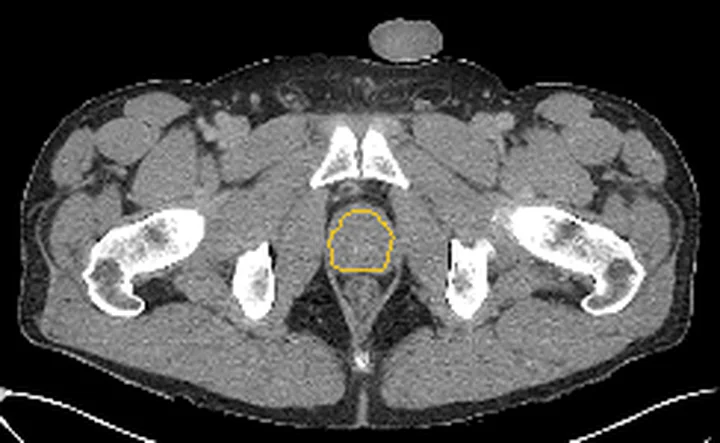
Normal erkekte posterior üretra proksimalden distale doğru mesane boynu, prostatik üretra ve membranöz üretradan oluşur; BT'de ürogenital diyafram yağ planının veya prostat konturunun silikleşmesi üretra yaralanmasıyla ilişkili bir bulgudur. BT'de ürogenital diyafram yağ planı ve prostat konturunu değerlendirin; BT bulguları üretra yaralanmasıyla ilişkili olabilir, ancak BT retrograd üretrografinin yerini almaz.
Normal BT ile kıyasla
Aynı bölgenin, kaynak veri setinde patoloji içermediği belirtilen bir BT incelemesini kesit kesit kaydırın; organ sınırlarını açarak anatomiyi hasta görüntüsüyle karşılaştırın. Küçük rastlantısal bulgular tümüyle dışlanmamıştır.
Kaynak: TotalSegmentator v2.01 veri seti (Wasserthal ve ark., Radiology: Artificial Intelligence 2023), CC BY 4.0, vaka s0119; organ sınırları veri setinin otomatik segmentasyonundan, birleştirilerek sadeleştirildi. Görüntüler 2,5 mm kesit aralığına yeniden örneklendi.
Ayırıcı tanı
- Ekstraperitoneal mesane yırtığı
- kontrastlı sistografide kaçak mesane duvarından çıkar ve perivezikal alanı doldurur.
- Perineal yumuşak doku kontüzyonu
- yüzeyel ödem veya kanama yapabilir; üretra opaklaştırılmadıysa lümen bütünlüğü hakkında karar verdirmez.
- Prostat konturunda bozulma
- BT'de üretra yaralanmasıyla ilişkili olabilir; şüpheli yaralanmanın ilk değerlendirmesinde retrograd üretrografi tercih edilir.
Tuzaklar
- Rutin travma BT'sinde belirgin ekstravazasyon olmamasını üretranın sağlamlığı sayma; standart incelemede üretra çoğunlukla opak değildir.
- Pelvik hematom çevresindeki BT bulguları üretra yaralanmasıyla ilişkili olabilir; BT, tanısal değerlendirmede RUG'nin yerini almamalıdır.
- Yüksek yerleşimli prostatı tek başına kopma kanıtı saymayın; bu bulgunun posterior üretra yaralanmasını saptamadaki duyarlılığı görece düşüktür.
- Üretra yaralanma sınıflamasını yalnız BT'deki hematom boyutundan çıkarmayın; yaralanmalar yerleşim ve kapsamlarına göre sınıflandırılır, RUG ise çevre yumuşak doku hasarı ve prostat yer değiştirmesi gibi özelliklerin şiddetini doğru belirleyemeyebilir.
- Meatus kanaması posterior üretra yaralanmalarının tümünde görülmez; erkeklerde şüpheli yaralanmanın doğrudan değerlendirilmesinde RUG altın standarttır.
Kendini dene
Pelvik halka kırığı ve periprostatik hematom var; rutin BT'de üretra opak değil. Erkekte doğrudan erken değerlendirme hangisidir?
Cevabı göster
Retrograd üretrografi. Retrograd üretrografi erkek üretra yaralanmasının erken değerlendirmesinde standart testtir. BT sistografi mesane kaçağını araştırır; intravenöz piyelografi üst üriner sistemi gösterir; skrotal ultrason farklı anatomiyi değerlendirir.
BT'de üretra yaralanmasıyla ilişkili olduğu bildirilen bulgu hangisidir?
Cevabı göster
İskiyokavernöz-obturator hematom. İskiyokavernöz ve/veya obturator internus hematomu BT'de üretra yaralanmasıyla ilişkili bildirilmiştir.
İlgili konular
Kaynaklar
Bu sayfadaki 38 cümle ve 2 quiz sorusu aşağıdaki kaynaklardan alıntılarla otomatik olarak karşılaştırıldı; 18 cümle bu karşılaştırmada düzeltildi (2026-10-10).
- Urethral Injuries: Diagnostic and Management Strategies for Critical Care and Trauma Clinicianspmc.ncbi.nlm.nih.gov
- Transperineal drainage of prostate abscesses: A minimally invasive, low‐risk management strategy that yields satisfactory resultspmc.ncbi.nlm.nih.gov
- Treatment and prognosis of pelvic-related urethral injuries in children: a 20-year single-center study and systematic reviewpmc.ncbi.nlm.nih.gov
- Tailor-made natural and synthetic grafts for precise urethral reconstructionpmc.ncbi.nlm.nih.gov
- Management of male stress urinary incontinence in high-risk patients: a narrative reviewpmc.ncbi.nlm.nih.gov
- The spectrum of injuries in buttock stab wounds.pubmed.ncbi.nlm.nih.gov
- Imaging of Acute Conditions of the Perineum.pubmed.ncbi.nlm.nih.gov
- Imaging of male pelvic trauma.pubmed.ncbi.nlm.nih.gov
- SIU/ICUD Consultation on Urethral Strictures: Evaluation and follow-up.pubmed.ncbi.nlm.nih.gov
- Diagnosis and management of pediatric urethral injuries.pubmed.ncbi.nlm.nih.gov
- [A Case of Traumatic Dislocation of the Penis].pubmed.ncbi.nlm.nih.gov
- Imaging techniques for the diagnosis of male traumatic urethral strictures.pubmed.ncbi.nlm.nih.gov
- Role of magnetic resonance imaging in the management of male pelvic fracture urethral injury.pubmed.ncbi.nlm.nih.gov
- Management of long-term functional sequelae of pelvic fracture urethral injury.pubmed.ncbi.nlm.nih.gov
- Preoperative Factors Associated With Surgical Complexity in Pelvic Fracture Urethral Injury: Systematic Review.pubmed.ncbi.nlm.nih.gov
- [Not Available].pubmed.ncbi.nlm.nih.gov
- Multiple impacted urethral metallic needles and screws (foreign bodies) associated with polyembolokoilamania.pubmed.ncbi.nlm.nih.gov
- Penile Evaluation: An Illustrated Review.pubmed.ncbi.nlm.nih.gov
- Near infrared fluorescence imaging of the urethra: a systematic review of the literature.pubmed.ncbi.nlm.nih.gov
- [Contemporary management of pelvic fracture urethral injuries].pubmed.ncbi.nlm.nih.gov
- Management of male pelvic fracture urethral injuries: Review and current topics.pubmed.ncbi.nlm.nih.gov
- Pubic fractures secondary to extended transpelvic urethrostomy in a cat.pubmed.ncbi.nlm.nih.gov
- High rising flames: a sign of complex extraperitoneal bladder rupture.pubmed.ncbi.nlm.nih.gov
- Imaging Findings Associated With Failure of Conservative Management After Blunt Extraperitoneal Bladder Injury.pubmed.ncbi.nlm.nih.gov
- High rising flames: a sign of complex extraperitoneal bladder rupture.pubmed.ncbi.nlm.nih.gov
- Traumatic lesions of the posterior urethra.pubmed.ncbi.nlm.nih.gov
- SIU/ICUD Consultation on Urethral Strictures: Pelvic fracture urethral injuries.pubmed.ncbi.nlm.nih.gov
- Epidemiology of posterior urethral injury among adults with traumatic pelvic ring disruptions: a 10-year retrospective review from a trauma care centre in Southeast Nigeria.pubmed.ncbi.nlm.nih.gov
- Traumatic Posterior Urethral Strictures in Children and Adolescents.pubmed.ncbi.nlm.nih.gov
- Histotopographic study of the rectourethralis muscle.pubmed.ncbi.nlm.nih.gov
- Imaging Genitourinary Trauma.pubmed.ncbi.nlm.nih.gov
- [Radiological diagnosis of pelvic ring fractures].pubmed.ncbi.nlm.nih.gov
- Operative management of penile strangulation caused by a rigid metallic ring: a case report.pubmed.ncbi.nlm.nih.gov
- Flexible cystoscopy-guided realignment of traumatic urethral disruption in pelvic fracture: A case report.pubmed.ncbi.nlm.nih.gov
- Added Clinical Benefit of Voiding Cystourethrography Combined With Standard-of-Care Retrograde Urethrography for Adult Male Urethral Strictures and Urethral Injuries: A Pictorial Review.pubmed.ncbi.nlm.nih.gov
- Surgical Management of Extensive Urine Extravasation Resulting in Urethrocutaneous Fistulation and Soft Tissue Necrosis of the Femoral Region Secondary to Pelvic Urethral Rupture in Two Cats.pubmed.ncbi.nlm.nih.gov
- The space of Retzius: anatomy, imaging features, and patterns of disease spread.pubmed.ncbi.nlm.nih.gov
- Pediatric Genitourinary Trauma.pubmed.ncbi.nlm.nih.gov
- Immediate repair in complete anterior urethral injury caused by blunt trauma: a case report and literature review.pubmed.ncbi.nlm.nih.gov
- Optimised Protocol for Managing Failed Catheterisation: Leveraging Bedside Retrograde Urethrography and Cystourethroscopy.pubmed.ncbi.nlm.nih.gov
- Retrograde urethrography in children: a decade of experience at a children's hospital.pubmed.ncbi.nlm.nih.gov
- Managing urethral injuries in suburban India-general surgeon's perspective.pubmed.ncbi.nlm.nih.gov
- Long-term safety and effectiveness of the "OptEase" vena cava filter.pubmed.ncbi.nlm.nih.gov
- Posterior urethroplasty for pelvic fracture urethral injuries: risk factors for recurrence and complications.pubmed.ncbi.nlm.nih.gov
- Noniatrogenic Urethral Trauma in Children: A Narrative Review.pubmed.ncbi.nlm.nih.gov
- Summary of emergency treatment experience of acute severe urethral trauma in pre-pubertal girls.pubmed.ncbi.nlm.nih.gov
- 2012 CUA Abstracts.pubmed.ncbi.nlm.nih.gov
- Interdisciplinary Management of Traumatic Injuries to the Kidneys and Urinary Tract Caused by Blunt Abdominopelvic Trauma.pubmed.ncbi.nlm.nih.gov
- Urethrocystography: a guide for urological surgery?pubmed.ncbi.nlm.nih.gov
- A multimodality review of male urethral imaging: pearls and pitfalls with an update on urethral stricture treatment.pubmed.ncbi.nlm.nih.gov
- Clinical applications of vascular and non-vascular interventional procedures for various urologic diseases: a pictorial essay.pubmed.ncbi.nlm.nih.gov
- Occult bladder injury in low displacement anterior-posterior compression pelvic fractures type I: a retrospective analysis of incidence and predictors.pubmed.ncbi.nlm.nih.gov
- Giant anterior urethral diverticulum with posterior urethral false passage masquerading as incontinence after pelvic fracture urethral injury: a case report.pubmed.ncbi.nlm.nih.gov
- Explosive Weapons Trauma Care Collective (EXTRACCT) Blast Injury Clinical Practice Guideline: Genito-Urinary Trauma.pubmed.ncbi.nlm.nih.gov
- Penetrating Trauma to the Ureter, Bladder, and Urethra.pubmed.ncbi.nlm.nih.gov
- Irreducible Locked Symphysis Pubis Disruption Caused by Incarcerated Urinary Bladder in a 14-year-Old Boy, a Case Report and Review of the Literature.pubmed.ncbi.nlm.nih.gov
- Urethral Injuries: Diagnostic and Management Strategies for Critical Care and Trauma Clinicians.pubmed.ncbi.nlm.nih.gov
- 2025 iCatCare consensus guidelines on the diagnosis and management of lower urinary tract diseases in cats.pubmed.ncbi.nlm.nih.gov
- Intermittent urethral obstruction secondary to caudal sliding of a pelvic bladder in 3 dogs.pubmed.ncbi.nlm.nih.gov
- A kaleidoscopic view of male urethral pathologies on 64-slice multidetector computed tomographic urethrography: A novel technique.pubmed.ncbi.nlm.nih.gov
- Interventional Radiology Management of Genitourinary Trauma: Literature, Current Practice, and Strategies for the Future.pubmed.ncbi.nlm.nih.gov
- The Role of Interventional Radiology in Treatment of Patients with Acute Trauma: A Pictorial Essay.pubmed.ncbi.nlm.nih.gov
- Standardization of pediatric uroradiological terms: a multidisciplinary European glossary.pubmed.ncbi.nlm.nih.gov
- Urotrauma: AUA guideline.pubmed.ncbi.nlm.nih.gov
- Imaging Approach and Diagnosis in a Case of Combined Intraperitoneal: Extraperitoneal Urinary Bladder Injuries in a Child.pubmed.ncbi.nlm.nih.gov
- Computed tomography of pediatric abdominal trauma: optimizing utilization and enhancing diagnostic interpretation.pubmed.ncbi.nlm.nih.gov
- Surgical multidisciplinary approach to a complex war case with urological, colorectal and orthopaedics lesions.pubmed.ncbi.nlm.nih.gov
- When the bowel meets the bladder: Optimal management of colorectal pathology with urological involvement.pubmed.ncbi.nlm.nih.gov
- Early versus delayed urethroplasty for pediatric pelvic fracture-related urethral injury in boys: a retrospective comparative cohort study of complications and surgical success rates from a single center.pubmed.ncbi.nlm.nih.gov
- Indirect evidence for the volume-outcome relationship for corrective surgery for anorectal malformations using the IQWIG V24-07 rapid report methodology.pubmed.ncbi.nlm.nih.gov
- Paclitaxel-Coated Balloon Dilation for Adults With Recurrent Bulbar Urethral Stricture: A Health Technology Assessment.pubmed.ncbi.nlm.nih.gov
- An updated narrative review on revolutionizing erectile dysfunction treatment: the crucial role of trophic factors in Adipose-Derived stem cell therapy.pubmed.ncbi.nlm.nih.gov
- Anatomy and techniques in posterior urethroplasty.pubmed.ncbi.nlm.nih.gov
- Total laparoscopic radical hysterectomy for cervical cancer in prolapsed uterus.pubmed.ncbi.nlm.nih.gov
- Management of Pelvic Fractures With Urogenital Injuries.pubmed.ncbi.nlm.nih.gov
- Emergency treatment of pelvic ring injuries: state of the art.pubmed.ncbi.nlm.nih.gov
- Posterior urethral stenosis: a comparative review of the guidelines.pubmed.ncbi.nlm.nih.gov
- Intravesical gas explosion after sequential greenlight laser prostate vaporization and plasma electrocoagulation: a case report and literature review.pubmed.ncbi.nlm.nih.gov
- Salvage Surgery Including Rectal Wall Vas Deferens Pexy for Recurrent Bilateral Perineal Hernia with Bladder Retroflexion in a Dog: A Case Report.pubmed.ncbi.nlm.nih.gov
- Unique presentation of urosymphyseal fistula and conservative management.pubmed.ncbi.nlm.nih.gov
- Comparison of Open Versus Minimally Invasive Repair of Colovesical Fistula: A Case Report and Propensity-Matched National Database Analysis.pubmed.ncbi.nlm.nih.gov
- Scrotal Hirudiniasis: The Mysterious Migration of a Leech Into the Scrotum: A Case Report.pubmed.ncbi.nlm.nih.gov
- Protocol for necropsy and tissue processing of the common marmoset, Callithrix jacchus, for histopathological analysis.pubmed.ncbi.nlm.nih.gov
- Immediate Repair for Laceration of the Tunica Albuginea of the Corpora Cavernosa and Penile Urethral Injury Caused by Blunt Trauma to the Flaccid Penis: A Case Report.pubmed.ncbi.nlm.nih.gov
- Management of pelvic fracture urethral injury.pubmed.ncbi.nlm.nih.gov
- An Unexpected Cause of De Novo Urge Incontinence Following Artificial Urinary Sphincter Placement: A Case Report.pubmed.ncbi.nlm.nih.gov
- Managing severe (and open) pelvic disruption.pubmed.ncbi.nlm.nih.gov
- Penetrating Posterior Urethral Injuries: Case Report and Management Strategies.pubmed.ncbi.nlm.nih.gov
- CT of Penetrating Abdominopelvic Trauma.pubmed.ncbi.nlm.nih.gov
- Patterns of injury and violence in Yaoundé Cameroon: an analysis of hospital data.pubmed.ncbi.nlm.nih.gov
- A Comprehensive Review Emphasizing Anatomy, Etiology, Diagnosis, and Treatment of Male Urethral Stricture Disease.pubmed.ncbi.nlm.nih.gov
- Endoscopic urethral realignment of traumatic urethral disruption: A monocentric experience.pubmed.ncbi.nlm.nih.gov
- Current trends in urethral stricture management.pubmed.ncbi.nlm.nih.gov
- Evaluation and Management of Urological Complications Following Pediatric Kidney Transplantation: Experience from a Single Tertiary Center.pubmed.ncbi.nlm.nih.gov
- Primary management of pelvic fracture urethral injury in a woman: challenges and outcome.pubmed.ncbi.nlm.nih.gov
- Management of a traumatic anorectal full-thickness laceration: a case report.pubmed.ncbi.nlm.nih.gov
- Endoscopic marsupialization of a prostatic utricle cyst: A case report and literature review of an unusual clinical condition.pubmed.ncbi.nlm.nih.gov
- Bleeding without fracture: Unmasking a penile arterial leak as a cause of urethrorrhagia.pubmed.ncbi.nlm.nih.gov
- Successful treatment by gasless single-port robot-assisted perineal secondary urethrectomy combined with adjuvant therapy for urethral recurrence after radical cystectomy: a case report of an elderly male patient with 16-month follow-up.pubmed.ncbi.nlm.nih.gov
- Imaging of the adult male urethra, penile prostheses and artificial urinary sphincters.pubmed.ncbi.nlm.nih.gov
- International Harmonization of Nomenclature and Diagnostic Criteria (INHAND): Nonproliferative and Proliferative Lesions of the Rabbit.pubmed.ncbi.nlm.nih.gov
- Imaging Review of Pelvic Ring Fractures and Its Complications in High-Energy Trauma.pubmed.ncbi.nlm.nih.gov
- Know your way around acute unenhanced CT during global iodinated contrast crisis: a refresher to ED radiologists.pubmed.ncbi.nlm.nih.gov
- Management of Pelvic Ring Injury Patients With Hemodynamic Instability.pubmed.ncbi.nlm.nih.gov
- Role of MR Imaging and FDG PET/CT in Selection and Follow-up of Patients Treated with Pelvic Exenteration for Gynecologic Malignancies.pubmed.ncbi.nlm.nih.gov
- Posterior urethra rupture: contrast-enhanced computed tomography scan and urethrocystography demonstrations.pubmed.ncbi.nlm.nih.gov
- Case Report: Transanal extraction combined with wound management for a broken glass foreign body and associated rectal injuries.pubmed.ncbi.nlm.nih.gov
- Initial surgical management of injuries to the urogenital tract in patients with polytrauma and/or severe injuries: a systematic review and clinical practice guideline update.pubmed.ncbi.nlm.nih.gov
- Khat-induced intravesical coiling of a self-inserted urethral serum set: a rare cause of acute urinary retention requiring open bladder surgery.pubmed.ncbi.nlm.nih.gov
- PURE-MRI: An international study assessing physician accuracy in delineating the prostate and urethra on prostate MRI.pubmed.ncbi.nlm.nih.gov
- MRI of the Scrotum and Penis: Current Applications and Clinical Relevance.pubmed.ncbi.nlm.nih.gov
- Evaluation of animal models for urethral stricture: a systematic review.pubmed.ncbi.nlm.nih.gov
- Congenital hypospadias complicated with pelvic cystic lesions and accessory urethra:A case report.pubmed.ncbi.nlm.nih.gov
- Combined Anterior Transmembranous Posterior Urethral Bulbar (CATPUB) cuff placement: A novel surgical technique for AUS implantation after severe pelvic trauma - a retrospective cohort study.pubmed.ncbi.nlm.nih.gov
- Diagnostic challenges in blunt pelvic fracture-related lower urinary tract injuries: a 13-year retrospective study.pubmed.ncbi.nlm.nih.gov
Eğitim amaçlıdır; hasta başında tanı ve tedavi kararının yerine geçmez, tıbbi tavsiye değildir. Metinler yapay zekâ desteğiyle yazıldı ve otomatik bir adımda kaynak alıntılarıyla karşılaştırıldı; bu bir tıbbi doğrulama değildir ve içerik uzman radyolog incelemesinden geçmedi. Klinik kararlarda güncel kılavuzları, kurum protokollerini ve radyoloji raporunu esas alın.