Özet
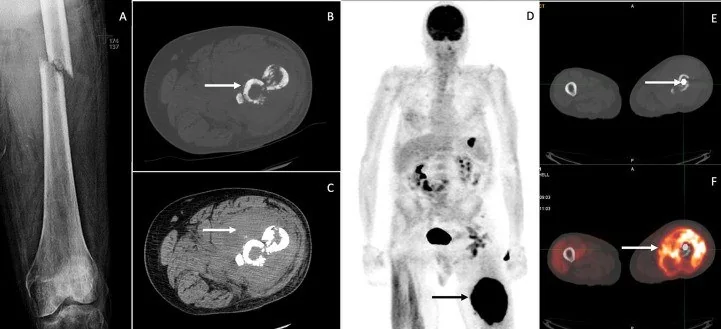
Femur patolojik kırığı, tümör, enfeksiyon veya metabolik kemik hastalığıyla zayıflamış kemikte düşük enerjili travma ya da olağan yüklenme sonrasında gelişebilir; metastatik odaklar önemli nedenler arasındadır. İnce kesit BT kırık hattının yönünü, deplasmanı, kortikal kaybı ve lezyonun medüller/ekstraosseöz yayılımını üç düzlemde gösterir. Önceki inceleme ile karşılaştırma, kırık öncesi kemik lezyonunu belirginleştirir; kontrastsız kemik algoritması çoğu kırık değerlendirmesi için yeterlidir. Femur patolojik kırığında BT'de kırık ve korteks dışındaki yumuşak doku bileşeni değerlendirilebilir.
Faz ve pencere
- Kontrastsız tanısal
- İnce kesit kemik algoritmasında medüller litik/sklerotik lezyon içinden geçen kortikal kırık hattı, parçalanma, angulasyon ve yer değiştirme; korteksin kırık öncesi incelme/yıkımı aranır.
Önerilen pencereler G genişlik, M merkez; değerler Hounsfield birimi (HU)
- KemikG 1800 / M +400
- Yumuşak dokuG 400 / M +40
BT bulguları
- Lezyon içinden geçen kırık — ince radyolusent hat litik veya sklerotik medüller odağı keser; koronal/sagittal planda uzanımı şaft boyunca izlenir.
- Kortikal kesinti — kırık hattının bir veya iki korteksi bozduğu yer, çevresindeki tümör kaynaklı incelme ve destrüksiyondan ayrıştırılır.
- Parçalanma ve deplasman — kırık parçalarının translasyonu, angulasyonu, kısalması ve rotasyonel uyumsuzluğu kemik penceresinde tarif edilir.
- Medüller lezyon — kırık çevresinde litik, sklerotik veya mikst odak; endosteal oyulma ve lezyonun kemik çapına oranı gösterilir.
- Periostal yanıt — periostal reaksiyon kemik enfarktüsüyle ilişkili sarkomlarda ve femur osteomiyelitinde görülebilir; örüntüsü ve lezyonla ilişkisi değerlendirilir.
- Ekstraosseöz kitle — femur korteksini aşarak kemik dışına uzanan solid kitle, kemik tümörünün ekstraosseöz uzanımıyla ilişkili olabilir.
- Komşu bölge uzanımı — femur boynu kırığına eşlik eden ipsilateral şaft ve peritrokanterik bölge kemik lezyonları ayrıca değerlendirilir.
- Çoklu iskelet odağı — kapsanan pelvis/femur kesimlerinde başka medüller odakların varlığı patolojik zeminin yaygınlığını destekler.
Ölçütler ve sınıflamalar
- Metastatik femur lezyonunda aksiyel kortikal tutulum ile artmış kırık riski
- >30 mm
- Mirels skoru: metastatik uzun kemik lezyonunda yüksek risk eşiği
- ≥9/12
Normalde
Brown tümör olgusunda proksimal femur korteksi kemiğin diğer bölümlerine göre yaklaşık üçte bir kalınlıktaydı ve kistik değişiklik gösteriyordu.
Normal BT ile kıyasla
Aynı bölgenin, kaynak veri setinde patoloji içermediği belirtilen bir BT incelemesini kesit kesit kaydırın; organ sınırlarını açarak anatomiyi hasta görüntüsüyle karşılaştırın. Küçük rastlantısal bulgular tümüyle dışlanmamıştır.
Kaynak: TotalSegmentator v2.01 veri seti (Wasserthal ve ark., Radiology: Artificial Intelligence 2023), CC BY 4.0, vaka s0685; organ sınırları veri setinin otomatik segmentasyonundan, birleştirilerek sadeleştirildi. Görüntüler 2,5 mm kesit aralığına yeniden örneklendi.
Ayırıcı tanı
- Travmatik kırık
- enerji ve travma mekanizmasıyla uyumlu hat görülebilir; önceden var olan fokal medüller lezyon veya kortikal oyulma patolojik zemini düşündürür.
- Stres/insufficiency kırığı
- kortekste ince radyolusent hat veya endosteal kalınlaşma görülebilir; primer malignite, destrüktif medüller kitle veya tümör kaynaklı ekstraosseöz komponent yokluğu tanısal olarak önemlidir.
- Osteomiyelit
- destrüksiyon, periostal yeni kemik ve yumuşak doku inflamasyonu yapabilir; sekestrum, kloaka veya apse kavitesi enfeksiyonu destekler.
- Primer kemik sarkomu
- kırıkla birlikte agresif permeatif kemik yıkımı, tümör matriksi ve yumuşak doku kitlesi gösterebilir; metastaz öyküsü olmayan hastada değerlendirilmelidir.
- Metastatik kemik lezyonunda BT'de kırık varlığı ve kortikal bütünlük ayrı görüntüleme özellikleri olarak değerlendirilir.
Tuzaklar
- Tümör içi kırık hattını lezyonun kenarındaki endosteal oyukla karıştırma; kesintiyi ardışık ince kesitlerde ve iki ortogonal planda doğrula.
- Kırık çevresindeki hematomu otomatik olarak ekstraosseöz tümör kitlesi sayma; solid nodüler komponent, kortikal geçiş ve varsa kontrast davranışını ayrı değerlendir.
- Düşük enerjili düşme öyküsü patolojik nedeni dışlamaz; kırık hattının geçtiği kemikte önceden mevcut litik/sklerotik odağı ve önceki görüntüleri araştır.
- Mirels veya aksiyel kortikal tutulum ölçüsünü oluşmuş kırığın sınıflaması gibi sunma; bunlar metastatik odakta kırık risk tahminine yöneliktir.
Kendini dene
Düşük enerjili düşme sonrası femur şaftında kırık; hattın çevresinde litik medüller odak ve kortikal oyulma izleniyor. Bu kırık nasıl adlandırılır?
Cevabı göster
Patolojik kırık. Kırığın önceden zayıflamış litik kemik odağından geçmesi patolojik kırığı destekler. Stres ve subkondral kırıkta belirgin destrüktif tümör odağı beklenmez; avulsiyon kırığı tendon/ligament yapışma yerinde küçük kemik fragmanıdır.
Metastatik femur lezyonunda aksiyel kortikal tutulum 36 mm ölçülüyor. Bu bulgu neyi düşündürür?
Cevabı göster
Kırık riski artmıştır. Aksiyel kortikal tutulumun ≥30 mm olması femoral metastazlarda yüksek kırık riskiyle ilişkilidir. Aksiyel kortikal tutulum ölçümü kırık riskini değerlendirmeye yardımcıdır; Mirels skorunu tek başına vermez, çünkü skor ağrı, yerleşim, lezyon tipi ve boyutuna dayanır.
İlgili konular
Kaynaklar
Bu sayfadaki 38 cümle ve 2 quiz sorusu aşağıdaki kaynaklardan alıntılarla otomatik olarak karşılaştırıldı; 6 cümle bu karşılaştırmada düzeltildi (2026-10-09).
- Rare Case of BCOR::CCNB3 Sarcoma of Bonepmc.ncbi.nlm.nih.gov
- Total Hip Arthroplasty With Prophylactic Fixation of Greater Trochanter and Distal Femur in a Patient With a History of Multiple Myeloma and Breast Cancerpmc.ncbi.nlm.nih.gov
- Orthopedic telemedicine encounter during the COVID-19 pandemic: A cautionary talepmc.ncbi.nlm.nih.gov
- A Case Report of Aneurysmal Bone Cyst with Pathologic Fracture of Proximal Femur Managed with EnblocExcision and Autologous Non-vascularized Fibular Graftpmc.ncbi.nlm.nih.gov
- Pathologic Fracture of the Femur in Brown Tumor Induced in Parathyroid Carcinoma: A Case Reportpmc.ncbi.nlm.nih.gov
- [Differentiated treatment strategies for bone metastases of the extremities].pubmed.ncbi.nlm.nih.gov
- Infection of the hip joint by Serratia marcescens .pubmed.ncbi.nlm.nih.gov
- Atypical bisphosphonate-associated subtrochanteric and femoral shaft stress fractures: diagnostic features on bone scan.pubmed.ncbi.nlm.nih.gov
- Infarct-Associated Bone Sarcomas: Multimodality Imaging Findings.pubmed.ncbi.nlm.nih.gov
- Langerhans cell histiocytosis of the atlas in an adult.pubmed.ncbi.nlm.nih.gov
- When and where do patients with bone metastases actually break their femurs?pubmed.ncbi.nlm.nih.gov
- Percutaneous osteosynthesis in the pelvis in cancer patients.pubmed.ncbi.nlm.nih.gov
- Development of Distal Femoral Metastasis is Rare in Cases of Isolated Proximal Femoral Metastases.pubmed.ncbi.nlm.nih.gov
- A fundamental study of cryoablation on normal bone: diagnostic imaging and histopathology.pubmed.ncbi.nlm.nih.gov
- Predicting Pathologic Bone Lesions Using Scout Computed Tomography (CT) Imaging.pubmed.ncbi.nlm.nih.gov
- Does CT-based Rigidity Analysis Influence Clinical Decision-making in Simulations of Metastatic Bone Disease?pubmed.ncbi.nlm.nih.gov
- Distribution of Femoral Metastases; Potential Role for Extended FDG PET/CT Scanning.pubmed.ncbi.nlm.nih.gov
- Morphological and mechanical characterization of bone phenotypes in the Amish G610C murine model of osteogenesis imperfecta.pubmed.ncbi.nlm.nih.gov
- Magnetic resonance imaging guided biopsy of musculoskeletal lesions.pubmed.ncbi.nlm.nih.gov
- Isolated Lesser Trochanter Fractures in Adults: A Systematic Review of Malignant, Infectious, and Benign Etiologies.pubmed.ncbi.nlm.nih.gov
- Risk Factors for Pathologic Fracture in Dogs With Confirmed or Suspected Appendicular Osteosarcoma Treated With Low- or Standard-Dose-Rate Palliative External Beam Radiation Therapy.pubmed.ncbi.nlm.nih.gov
- Extra-axial chordoma of the distal tibia incidentally discovered during fixation of a presumed pathologic fracture.pubmed.ncbi.nlm.nih.gov
- Transphyseal Proximal Humeral Aneurysmal Bone Cyst with Pathologic Fracture in a Child: A Case Report.pubmed.ncbi.nlm.nih.gov
- Deep Learning-Assisted Radiomics for Predicting Thoracolumbar Osteoporotic Vertebral Fractures.pubmed.ncbi.nlm.nih.gov
- Deep learning and hybrid architectures for atypical and complex bone fracture diagnosis: a systematic review of performance and clinical validity.pubmed.ncbi.nlm.nih.gov
- Unnoticed Giant Cell Tumor of the Left Distal Tibia in a 52-Year-Old Male: A Rare Case Report.pubmed.ncbi.nlm.nih.gov
- Orthopedic preoperative evaluation and surgical strategies of hereditary multiple osteochondromas involving the spinal region.pubmed.ncbi.nlm.nih.gov
- Imaging characteristics and clinical management of intraosseous hemangioma in tubular bones: a retrospective case series.pubmed.ncbi.nlm.nih.gov
- Intraosseous tumours of the knee.pubmed.ncbi.nlm.nih.gov
- Candida Femoral Osteomyelitis in a Young Adult Without Known Risk Factors for Immunosuppression: A Case Report.pubmed.ncbi.nlm.nih.gov
- Extra-abdominal Desmoid Tumor in a 23-Year-Old Male: A Case Report.pubmed.ncbi.nlm.nih.gov
- Chronic Expanding Hematoma Presenting 15 Years After Metal-on-Metal Total Hip Arthroplasty With Multiple Recurrences: A Case Report.pubmed.ncbi.nlm.nih.gov
- Pathological fracture of the femur without surgical fixation in primary bone diffuse large B-cell lymphoma (DLBCL): A rare case with full recovery.pubmed.ncbi.nlm.nih.gov
- Use of the IlluminOss Photodynamic Bone Stabilisation System Following Stereotactic Body Radiation Therapy for Limb-Sparing in Six Dogs With Presumptive Appendicular Osteosarcoma.pubmed.ncbi.nlm.nih.gov
- Surgically Treated Benign Bone Tumors and Tumor-like Conditions in the Pediatric Population-A 10-Year Institutional Experience.pubmed.ncbi.nlm.nih.gov
- Paget's disease of bone with superimposed osseous metastasis from lung carcinoma: A case report.pubmed.ncbi.nlm.nih.gov
- Vanishing Osteochondromas of the Distal Femur and Proximal Humerus: A Two-Case Report.pubmed.ncbi.nlm.nih.gov
- Clinical efficacy of the lateral decubitus position in the treatment of irreducible trochanteric fractures with bisection of the lesser trochanter.pubmed.ncbi.nlm.nih.gov
- Reduction of complications in femoral neck fracture fixation using femoral neck system: the importance of pre-compression technique and power bar position.pubmed.ncbi.nlm.nih.gov
- Fractures around the shoulder in the skeletally immature: A scoping review.pubmed.ncbi.nlm.nih.gov
- Malignant Transformation of Musculoskeletal Lesions with Imaging-Pathology Correlation-Part 1: Bone Lesions.pubmed.ncbi.nlm.nih.gov
- Pathological Fracture in the Metatarsal Bone Due to an Intraosseous Schwannoma: A Case Report.pubmed.ncbi.nlm.nih.gov
- The Resolution of a Biopsy-Proven Enchondroma in the Proximal Humerus Over a 14-Year Interval.pubmed.ncbi.nlm.nih.gov
- Xanthogranulomatous Osteomyelitis as a Bone Tumor Mimic: A Systematic Review of Pre-biopsy Diagnostic Clues and Management Decision Points.pubmed.ncbi.nlm.nih.gov
- Paget's Disease of the Spine as a Catalyst for Osteosarcoma: A Narrative Review.pubmed.ncbi.nlm.nih.gov
- Long-term oncological and functional outcomes in patients with bone sarcomas in the proximal femur undergoing unplanned surgery: A single-center retrospective cohort study.pubmed.ncbi.nlm.nih.gov
- Comparison of FRACTURE MRI, Conventional Radiography, and CT in the Evaluation of Bone Tumors.pubmed.ncbi.nlm.nih.gov
- Beyond Pipkin IV: Management of Femoral Head-neck Fracture-dislocation with Posterior Acetabular Wall and Peritrochanteric Fracture in an Adolescent Using a Modified Kocher-Langenbeck Approach.pubmed.ncbi.nlm.nih.gov
- Total Femoral Replacement as a Salvage Procedure for a Periprosthetic Fracture After Multiple Previous Femoral Reconstructions: A Case Report.pubmed.ncbi.nlm.nih.gov
- Insufficiency Fracture of the Neck of the Talus After Total Knee Arthroplasty.pubmed.ncbi.nlm.nih.gov
- Primary splenic angiosarcoma presenting with multiple bone destruction as the initial manifestation: a case report and narrative review.pubmed.ncbi.nlm.nih.gov
- hNET-targeted [<sup>18</sup>F]MFBG PET as baseline functional imaging in newly diagnosed neuroblastoma.pubmed.ncbi.nlm.nih.gov
- The Paradox of Prevention: How Prophylactic Surgery Accelerated Decline in Metastatic Cancer.pubmed.ncbi.nlm.nih.gov
- Discrepancy between X-ray and CT assessment in the Mirels score for long bone metastasis.pubmed.ncbi.nlm.nih.gov
- Predictive Factors for Failed Nonsurgical Management of Long Bone Metastasis and Myeloma.pubmed.ncbi.nlm.nih.gov
- High Fracture Risk of Femoral Bone Metastasis Treated with Palliative Radiotherapy in Recent Years.pubmed.ncbi.nlm.nih.gov
- Diagnostic accuracy of Mirels score, CT-based Structural Rigidity Analysis, and Finite Element Analysis for predicting impending femoral pathologic fractures in metastatic bone disease: a systematic review.pubmed.ncbi.nlm.nih.gov
- Advancements in Assessing Pathological Fracture Risk: News on Mirels' Score.pubmed.ncbi.nlm.nih.gov
- Internal validation of modified Mirels' scoring system for pathologic femur fractures.pubmed.ncbi.nlm.nih.gov
- Clinical features and sequelae of pediatric osteomyelitis following surgical treatment: a 10-year retrospective study.pubmed.ncbi.nlm.nih.gov
- Limb-Salvage Reconstruction of the Proximal Humerus Using Patient-Specific 3D-Printed PEEK Implants: A Midterm Clinical Study.pubmed.ncbi.nlm.nih.gov
- How to choose treatment for patients who are eligible for both unicompartmental knee arthroplasty and high tibial osteotomy?pubmed.ncbi.nlm.nih.gov
- Salmonella Typhi Osteomyelitis of the Ulnar Diaphysis in an Immunocompetent Adult: A Case Report.pubmed.ncbi.nlm.nih.gov
- Chronic Osteomyelitis or Squamous Cell Carcinoma of the Mandible: A Case Report With Diagnostic Challenges.pubmed.ncbi.nlm.nih.gov
- Endoprosthetic reconstruction versus osteosynthesis for metastatic disease of the proximal femur: a population-based cohort study.pubmed.ncbi.nlm.nih.gov
- Outcomes of Megaprosthetic Reconstruction After Tumor Resection of the Distal Femur and Proximal Tibia: A Single-Center Retrospective Study of 241 Cases.pubmed.ncbi.nlm.nih.gov
- Giant expansile humeral lesion with soap-bubble appearance mimicking a primary bone tumor: Multiple myeloma as the final diagnosis.pubmed.ncbi.nlm.nih.gov
- Low-grade osteogenic tumor with secondary aneurysmal bone cyst: Distinguishing osteoblastoma from low-grade osteosarcoma in the setting of noncanonical molecular findings.pubmed.ncbi.nlm.nih.gov
- Pathophysiology of Femoral Fractures in Hypophosphatasia.pubmed.ncbi.nlm.nih.gov
- Clinicopathologic and Molecular Analysis of Primary Angiosarcoma of Bone-A Single Institution Experience.pubmed.ncbi.nlm.nih.gov
- Imaging for Plasma Cell Dyscrasias: What, When, and How?pubmed.ncbi.nlm.nih.gov
- Pathological fracture due to primary bone lymphoma in a patient with a history of prostate cancer: A case report and review of literature.pubmed.ncbi.nlm.nih.gov
- Pathologic Fracture as Presentation of Generalized Lymphangiomatosis in an Eight-Year-Old: A Case Report and Literature Review.pubmed.ncbi.nlm.nih.gov
- Society of Skeletal Radiology- white paper. Guidelines for the diagnostic management of incidental solitary bone lesions on CT and MRI in adults: bone reporting and data system (Bone-RADS).pubmed.ncbi.nlm.nih.gov
- Femoral Osteomyelitis Presenting as a Pathologic Fracture in a 53 Year Old Male: A Rare Case Report.pubmed.ncbi.nlm.nih.gov
- Exercise for myeloma patients with bone disease: a scoping review.pubmed.ncbi.nlm.nih.gov
- Customized 3D-printed component-preserving reconstruction for femoral neck fracture revision in a long-term survivor of pediatric osteosarcoma: a case report.pubmed.ncbi.nlm.nih.gov
- Femoral stem alignment and post-operative patient satisfaction: a retrospective analysis of total hip arthroplasty using computer-assisted equipment for placing cups.pubmed.ncbi.nlm.nih.gov
- Targeting AHNAK ameliorates osteonecrosis of the femoral head and affects adipogenic pathways involving Smad/PPARγ.pubmed.ncbi.nlm.nih.gov
- Utilization of the posterior iliac line for visualizing posterior column screws in obturator oblique view.pubmed.ncbi.nlm.nih.gov
- Preoperative 3D-Planned S1 Corridors Transferred into 2D Fluoroscopy Allow for Safe Intraoperative Large-Diameter Implant Placement: Description of a Novel Sacroiliac Fixation Technique and Proof of Concept in 137 Implantations.pubmed.ncbi.nlm.nih.gov
- The implementation of the femoral neck surgical central axis guide pins to establish the stable implanting-screws spatial coordinate system.pubmed.ncbi.nlm.nih.gov
- Isolated Ipsilateral Hemiparesis From a Pyramidal Decussation Infarct: A Rare Case Confirmed by Magnetic Resonance Imaging.pubmed.ncbi.nlm.nih.gov
- Association between anatomical subtypes of medullary infarction and clinical outcome: a multicenter cohort study.pubmed.ncbi.nlm.nih.gov
- Stabilization of distal humerus pathologic fracture with IlluminOss®: A case series.pubmed.ncbi.nlm.nih.gov
- Mechanical effects of valgus osteotomy angle and re-fixation strategies on re-fixation of the femoral neck fracture: a finite element analysis.pubmed.ncbi.nlm.nih.gov
- Spinal granulocytic sarcoma with both extradural and intradural involvement: a case report.pubmed.ncbi.nlm.nih.gov
- Bone health in patients with cancer: a SEOM-SEIOMM consensus review of risk factors, assessment strategies, and management approaches.pubmed.ncbi.nlm.nih.gov
- Approach to the Patient: From Endocrinopathy to the Diagnosis of a Histiocytic Disorder.pubmed.ncbi.nlm.nih.gov
- Imaging of pediatric musculoskeletal trauma: Age-specific considerations and challenges.pubmed.ncbi.nlm.nih.gov
- Case Report: Total hip arthroplasty via the direct anterior approach using a cementless revision stem without corrective osteotomy for fibrous dysplasia.pubmed.ncbi.nlm.nih.gov
- Proximal Tibial Giant Cell Tumor in a Skeletally Immature Child: A Diagnostic Dilemma and Review of the Literature.pubmed.ncbi.nlm.nih.gov
- Anterolateral approach for benign proximal femoral lesions among Indian children.pubmed.ncbi.nlm.nih.gov
- Initiation of Collapse in Osteonecrosis of the Femoral Head: A Patient-Specific Finite Element Simulation Study.pubmed.ncbi.nlm.nih.gov
- Diagnostic Imaging Analysis of Humerus Bone Structure in Long-Legged Buzzard (Buteo rufinus): Radiology and CT-Scan Insights.pubmed.ncbi.nlm.nih.gov
- Anatomy-driven automated subsegmentation of pelvic and proximal femoral CT into clinically relevant subregions and landmarks.pubmed.ncbi.nlm.nih.gov
- Recurrent Giant Cell Tumor of the Lateral Condyle of the Distal Femur Managed by Repeated Extended Curettage and Bone Cementing: A Case Report.pubmed.ncbi.nlm.nih.gov
- Computed Tomography in Craniofacial Fibrous Dysplasia: A Case Series with Review of Literature and Classification Update.pubmed.ncbi.nlm.nih.gov
- Fibrous dysplasia: an overview of disease process, indications for surgical management, and a case report.pubmed.ncbi.nlm.nih.gov
- Stress fracture of the pelvis and lower limbs including atypical femoral fractures-a review.pubmed.ncbi.nlm.nih.gov
- Femoral diaphyseal fatigue stress fracture in an older adult male with normal bone mineral density.pubmed.ncbi.nlm.nih.gov
- Bone lesions of the tibia: Multimodal iconographic review and diagnostic algorithms, Part 1: Diagnostic algorithms, dysplasia and diaphyseal lesions.pubmed.ncbi.nlm.nih.gov
- Twenty Years of Continuous Bisphosphonate Use Leading to Atypical Bilateral Femoral Fractures: A Case Report.pubmed.ncbi.nlm.nih.gov
- Bone health in advanced prostate cancer: pathophysiology and management strategies.pubmed.ncbi.nlm.nih.gov
- An analysis of different reconstruction techniques for the radius: a finite element analysis.pubmed.ncbi.nlm.nih.gov
- SHIELD: An AI Framework for Skeletal Health Intelligence and Early Lesion Detection to Improve Orthopedic Referrals.pubmed.ncbi.nlm.nih.gov
- Twenty-Four-Year Follow-up of Successful Total Hip Arthroplasty for Recurrent Proximal Femoral Aneurysmal Bone Cyst with a Pathologic Fracture Following Extended Curettage and Bone Grafting: A Case Report.pubmed.ncbi.nlm.nih.gov
- Limb Salvage in Myxoid Liposarcoma With Tumor Prosthetic Reconstruction: A Case Report and Literature Review.pubmed.ncbi.nlm.nih.gov
- Surgical limb-sparing in veterinary medicine: A review of existing techniques in dogs.pubmed.ncbi.nlm.nih.gov
- Musculoskeletal tumors and tumor-like lesions with "dark" signal intensity on T2-weighted MR images: A pictorial review.pubmed.ncbi.nlm.nih.gov
- Predictive value of a prediction system based on bone mineral density and proximal femoral imaging indexes for hip fracture risk in osteoporotic patients.pubmed.ncbi.nlm.nih.gov
- Piezo1 in hypertrophic chondrocytes regulates osteoclastogenesis in endochondral ossification.pubmed.ncbi.nlm.nih.gov
- International Society of Paediatric Surgical Oncology (IPSO) Surgical Practice Guidelines.pubmed.ncbi.nlm.nih.gov
- Commentary: an eye on PET quantification.pubmed.ncbi.nlm.nih.gov
- Photon-counting detector CT in oncology: a new era of cancer imaging.pubmed.ncbi.nlm.nih.gov
Eğitim amaçlıdır; hasta başında tanı ve tedavi kararının yerine geçmez, tıbbi tavsiye değildir. Metinler yapay zekâ desteğiyle yazıldı ve otomatik bir adımda kaynak alıntılarıyla karşılaştırıldı; bu bir tıbbi doğrulama değildir ve içerik uzman radyolog incelemesinden geçmedi. Klinik kararlarda güncel kılavuzları, kurum protokollerini ve radyoloji raporunu esas alın.