Özet
Doğrudan veya omuza iletilen dolaylı kuvvetler sonucu klavikula medial ucunda kırık ya da iskelet gelişimi tamamlanmamış hastalarda fizis yaralanması gelişebilir. BT incelemesi yaralanmanın yönünü ve ilişkili medial klavikula kırığını değerlendirmede gereklidir; olası vasküler etkilenmeyi değerlendirmede ise BT anjiyografi ek avantaj sağlar. Medial klavikula fizisi 25 yaşına kadar tam kaynaşmadığından, genç hastalardaki deplase fizis kırıkları sternoklaviküler çıkığı taklit edebilir ve psödoçıkık olarak adlandırılır. Posterior yer değiştiren yaralanmalarda büyük damar hasarı, trakeal hasar veya özofagus basısı gibi mediastinal komplikasyon riskleri nedeniyle fragmanın komşu yapılarla ilişkisi değerlendirilmelidir.
Faz ve pencere
- Kontrastsız tanısal
- BT incelemesinde medial klavikula kemik kırığı veya eklem deplasmanı, fragmanın yönü ve klavikula çevresindeki hematom değerlendirilir. Kemik kırığını göstermek için kontrast gerekmez.
- Arteriyel
- Damarsal etkilenme şüphesinde yapılan BT anjiyografide subklavyen ve brakiyosefalik damarlarda bası, psödoanevrizma, lümen açıklığı veya kanama değerlendirilir.
- Kemik algoritması tanısal
- Çok düzlemli ve üç boyutlu kemik BT rekonstrüksiyonları, kemik yaralanma paternini, tutulan segmentleri ve fragmanın yer değiştirme yönünü net olarak ortaya koyar.
Önerilen pencereler G genişlik, M merkez; değerler Hounsfield birimi (HU)
- KemikG 1800 / M +400
- MediastenG 350 / M +50
- Yumuşak dokuG 400 / M +40
- AnjiyoG 600 / M +150
BT bulguları
- Medial klavikula kırığı — BT'de medial uç veya metafiz düzeyinde deplase, çok parçalı keskin kenarlı kemik fragmanı şeklinde izlenir.
- Fizis ayrışması — iskelet gelişimi tamamlanmamış hastalarda yer değiştiren metafiz fragmanıyla karakterizedir ve BT'de gerçek eklem çıkığını taklit eden psödoçıkık görünümüne yol açabilir.
- Eklem ilişkisi — BT incelemesinde sternoklaviküler eklemin korunduğu mu yoksa kırığa eşlik eden eklem çıkığı veya uyumsuzluğunun mu olduğu değerlendirilir.
- Posterior deplasman — medial fragmanın manubrium arkasına ve retrosternal aralığa yönelmesi aksiyel kesitlerde doğrulanır.
- Retrosternal hematom — posteriora yer değiştiren yaralanmalarda kapsüler hasarla ilişkili hematom görülebilir ve sol brakiyosefalik ven gibi mediastinal damarlarda basıya yol açabilir.
- Mediastinal komşuluk — BT'de yer değiştiren fragmanın brakiyosefalik ven ve büyük damarlar ile trakea ve özofagus gibi mediastinal yapılarla yakınlığı ve bası bulguları değerlendirilir.
- Plevral eşlikçi — yüksek enerjili travmalarda eşlik eden pnömotoraks ya da hemotoraks varlığı BT kesitlerinde taranmalıdır.
- Medial klavikula fizis yaralanması gerçek sternoklaviküler çıkığı taklit edebilir ve BT'de ayrım zor olabilir.
Normalde
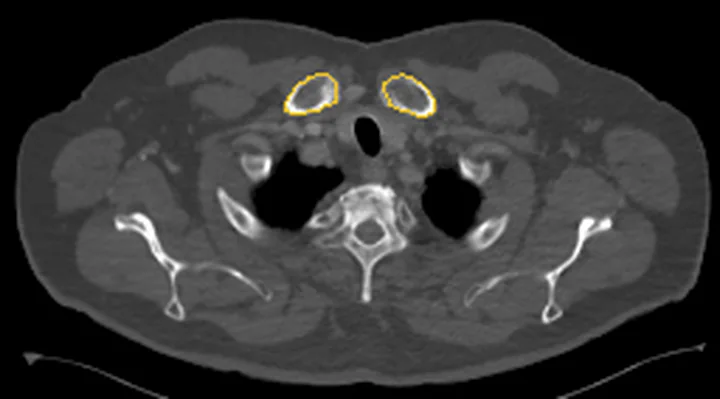
Normal sternoklaviküler eklemde kemik korteksi kesintisizdir, eklem uyumu korunmuştur ve medial klavikula manubriumla normal anatomik dizilimdedir. Sternoklaviküler yaralanmanın yer değiştirme yönünü BT ile değerlendirin; damar etkilenmesini değerlendirmede BT anjiyografi ek katkı sağlar.
Normal BT ile kıyasla
Aynı bölgenin, kaynak veri setinde patoloji içermediği belirtilen bir BT incelemesini kesit kesit kaydırın; organ sınırlarını açarak anatomiyi hasta görüntüsüyle karşılaştırın. Küçük rastlantısal bulgular tümüyle dışlanmamıştır.
Kaynak: TotalSegmentator v2.01 veri seti (Wasserthal ve ark., Radiology: Artificial Intelligence 2023), CC BY 4.0, vaka s0975; organ sınırları veri setinin otomatik segmentasyonundan, birleştirilerek sadeleştirildi. Görüntüler 2,5 mm kesit aralığına yeniden örneklendi.
Ayırıcı tanı
- Posterior sternoklaviküler çıkık
- medial klavikula manubrium arkasına yer değiştirir, ancak fragmanlı kortikal kırık olmayabilir.
- Medial klavikula fizis ayrışması
- iskelet gelişimi tamamlanmamış genç hastalarda metafizin posteriora yer değiştirmesi gerçek sternoklaviküler çıkığı taklit edebilir (psödoçıkık); BT'de ayrım zor olabilir.
- Manubrium kırığı
- kırık hattı sternum manubriumunda sınırlıdır; BT incelemesinde manubriumdaki kırık hattı ve deplasman gösterilerek klavikula ve torasik yapılar değerlendirilir.
- Kostoklaviküler bağ klavikulayı birinci kostal kıkırdağa ve ilk kaburga ucuna bağlar; bu bağlantı medial klavikula yaralanmalarında anatomik komşuluk olarak değerlendirilir.
- Sternoklaviküler eklem varyantları
- bölge geniş anatomik varyasyonlar sergileyebilir; bu varyantların görüntülemede doğru tanınması travmatik patolojilerle karışmasını ve yanlış tanıları önler.
Tuzaklar
- Posterior deplasmanı SC çıkık diye etiketlemeden önce medial fizis ve metafizi incele; çocuk ve genç erişkinde fizis ayrışması aynı görünümü oluşturabilir.
- Posterior yer değiştirmeyi sternoklaviküler çıkık olarak etiketlemeden önce özellikle genç hastada medial fizis yaralanmasını düşün; bu yaralanma çıkığı taklit edebilir.
- Kırık hattına odaklanıp retrosternal yumuşak dokuyu atlama; hematom ve damar konturu bulgusu tanının aciliyetini değiştirir.
Kendini dene
Genç hastada medial klavikula metafizi manubrium arkasına kaymış, medial epifiz seçilemiyor. En olası tanı nedir?
Cevabı göster
Medial fizis ayrisma (psodocikik). Genç hastada medial fizis açıktır ve posterior metafiz deplasmanı SC çıkığı taklit edebilir.
Posterior sternoklaviküler yaralanmada damar etkilenmesini değerlendirmek için hangi görüntüleme yöntemi ek avantaj sağlar?
Cevabı göster
BT anjiyografi. BT anjiyografi, sternoklaviküler yaralanmaya eşlik edebilecek vasküler etkilenmenin değerlendirilmesine ek avantaj sağlar.
İlgili konular
Kaynaklar
Bu sayfadaki 36 cümle ve 2 quiz sorusu aşağıdaki kaynaklardan alıntılarla otomatik olarak karşılaştırıldı; 19 cümle bu karşılaştırmada düzeltildi (2026-10-11).
- Medial Clavicle Fracture with Posterior Dislocation of the Ipsilateral Acromioclavicular Joint Following Skiing Traumapmc.ncbi.nlm.nih.gov
- Anterior sternoclavicular joint disruption with ipsilateral medial clavicle fracture in an adolescent: case report and literature reviewpmc.ncbi.nlm.nih.gov
- From pitch to palsy: A rare case of acute brachial plexopathy following medial clavicle fracture in women's rugby ☆pmc.ncbi.nlm.nih.gov
- Triple segment injury of the clavicular axis: Medial clavicle fracture with simultaneous sternoclavicular and acromioclavicular dislocations in an elderly patient – A case reportpmc.ncbi.nlm.nih.gov
- Rapid Return to Sport Following Focused Electrohydraulic Shockwave Therapy for a Medial Clavicle Fracture in a 14‐Year‐Old Female Soccer Player: A Case Reportpmc.ncbi.nlm.nih.gov
- Bipolar Injury of the Clavicle.pubmed.ncbi.nlm.nih.gov
- The operative outcomes of displaced medial-end clavicle fractures.pubmed.ncbi.nlm.nih.gov
- Medial Clavicle Osseous Dimensions with Implication on Plate Fixation.pubmed.ncbi.nlm.nih.gov
- Traumatic Floating Clavicle- A case report.pubmed.ncbi.nlm.nih.gov
- Operative Management of Periarticular Medial Clavicle Fractures-Report of 10 Cases.pubmed.ncbi.nlm.nih.gov
- Posterior sternoclavicular disruption with ipsilateral clavicle fracture in a nine-year-old hockey player.pubmed.ncbi.nlm.nih.gov
- Efficacy analysis of a novel sternoclavicular hook plate for treatment of unstable sternoclavicular joint dislocation or fracture.pubmed.ncbi.nlm.nih.gov
- What Are the Functional Outcomes and Pain Scores after Medial Clavicle Fracture Treatment?pubmed.ncbi.nlm.nih.gov
- Case report-Vascular injury in association with posteriorly displaced medial clavicle fracture.pubmed.ncbi.nlm.nih.gov
- Traumatic medial clavicle fracture induced by chin bar of a full-face helmet following a downhill mountainbike accident.pubmed.ncbi.nlm.nih.gov
- Medial clavicle fracture with bone destruction after radical neck dissection combined with postoperative chemotherapy for secondary cervical lymph node metastasis of tongue cancer: a case report.pubmed.ncbi.nlm.nih.gov
- Mini Fragment Locking Compression Plate Fixation of a Rare Case of Displaced Medial End Clavicle Fracture.pubmed.ncbi.nlm.nih.gov
- Medial Clavicle Fracture with Posterior Dislocation of the Ipsilateral Acromioclavicular Joint Following Skiing Trauma.pubmed.ncbi.nlm.nih.gov
- Triple segment injury of the clavicular axis: Medial clavicle fracture with simultaneous sternoclavicular and acromioclavicular dislocations in an elderly patient - A case report.pubmed.ncbi.nlm.nih.gov
- Three-year emergency department analysis of clavicle fractures: Age- and sex-dependent patterns and associated injuries.pubmed.ncbi.nlm.nih.gov
- Bipolar Clavicle Fracture: A Rare Entity of the Commonest Fracture - A Case Report.pubmed.ncbi.nlm.nih.gov
- From pitch to palsy: A rare case of acute brachial plexopathy following medial clavicle fracture in women's rugby.pubmed.ncbi.nlm.nih.gov
- The incidence of retrosternal vascular injuries following acute traumatic posterior sternoclavicular joint injuries is less than had previously been considered.pubmed.ncbi.nlm.nih.gov
- Posterior Sternoclavicular Dislocation in Children: A Case Report.pubmed.ncbi.nlm.nih.gov
- Balser Plate Stabilization for Traumatic Sternoclavicular Instabilities or Medial Clavicle Fractures: A Case Series and Literature Review.pubmed.ncbi.nlm.nih.gov
- Imaging of pediatric musculoskeletal trauma: Age-specific considerations and challenges.pubmed.ncbi.nlm.nih.gov
- All-Suture Repair of a Posterior Sternoclavicular Fracture Dislocation in an Adolescent Athlete.pubmed.ncbi.nlm.nih.gov
- Spontaneous Remodeling of Posterior Sternoclavicular Joint Dislocations in Skeletally Immature Patients: A Case Report.pubmed.ncbi.nlm.nih.gov
- Medial Clavicle Physeal Fracture in a 15-Year-Old Male: A Case Report.pubmed.ncbi.nlm.nih.gov
- Primary hyperparathyroidism due to ectopic parathyroid adenoma with bone lesions mimicking skeletal neoplasm: a case report.pubmed.ncbi.nlm.nih.gov
- The sternum in detail: a review of the anatomy and pathologies of the sternum.pubmed.ncbi.nlm.nih.gov
- Accuracy of clinical and radiographic measurements for detecting significant shortening in acute midshaft clavicle fractures: a cross-sectional study with computed tomography scan as the reference standard.pubmed.ncbi.nlm.nih.gov
- Refracture after implant removal of the clavicle: a retrospective cohort analysis.pubmed.ncbi.nlm.nih.gov
- Neglected acromioclavicular joint injury in coracoid process fractures: a retrospective cohort study.pubmed.ncbi.nlm.nih.gov
- Axillary Artery Injury in Proximal Humeral Fractures: Displacement Medial to the Coracoid on X-ray as a Risk Sign of Vascular Injury.pubmed.ncbi.nlm.nih.gov
- Asymptomatic migration of Kirschner wire into the cervical spine: a rare case report complication 32 months post-clavicle fracture fixation.pubmed.ncbi.nlm.nih.gov
- Surgical treatment of complex scapular fractures: a single centre prospective observational study.pubmed.ncbi.nlm.nih.gov
- Three-Dimensional Mapping of Distal Clavicle Fractures: Displacement Patterns and Clinical Implications for Surgical Management.pubmed.ncbi.nlm.nih.gov
- Traumatic Floating Clavicle: A Case Report and Updated Literature Review.pubmed.ncbi.nlm.nih.gov
- Top 15 musculoskeletal lesions in the aging recreational sporter: a pictorial review.pubmed.ncbi.nlm.nih.gov
- Efficacy of the MIPO approach combined with inverted Philos plate fixation in the treatment of AO/OTA type 12B distal humeral shaft fractures.pubmed.ncbi.nlm.nih.gov
- Safe Reconstruction of Posterior Sternoclavicular Dislocation Using a Palmaris Longus Autograft and ACL Tibial Guide Assistance: A Case Report.pubmed.ncbi.nlm.nih.gov
- Novel Application of STRATOS for Restoration of Clavicular Stability After Oncologic Sternoclavicular Joint Resection: A Case Report and Review of the Literature.pubmed.ncbi.nlm.nih.gov
- Assessment of a new technique for biological augmentation in sternoclavicular joint dislocations: a cadaveric feasibility and biomechanical evaluation.pubmed.ncbi.nlm.nih.gov
- Sternoclavicular Joint Reconstruction Using a Hamstring and Cadaveric Fibular Cortical Allograft: A Case Report.pubmed.ncbi.nlm.nih.gov
- Sternoclavicular Joint Reconstruction Using the Sternal Docking Technique.pubmed.ncbi.nlm.nih.gov
- Surgical stabilization of rib fractures in patients with open flail chest results in improved clinical outcomes: a report of three cases.pubmed.ncbi.nlm.nih.gov
- Prospective Evaluation of Clavicle Fracture Osteosynthesis: Patient Satisfaction, Clinical, and Radiological Outcomes with Clavipectoral Fascial Plane Block.pubmed.ncbi.nlm.nih.gov
- Major Vessels of the Interclavicular Suprasternal Space: A Suprasternal Notch-Referenced Topographic Classification with Potential Procedural Relevance.pubmed.ncbi.nlm.nih.gov
- Analysis of hardware complications and functional outcomes following sternoclavicular hook plate fixation for traumatic dislocations.pubmed.ncbi.nlm.nih.gov
- Medial clavicle resection for acute traumatic posterior sternoclavicular dislocation: Experience from Grenoble Alpes University Hospital.pubmed.ncbi.nlm.nih.gov
- Posterior Sternoclavicular Joint Dislocation Presenting as Acute Torticollis in a Kabaddi Player: A Case Report.pubmed.ncbi.nlm.nih.gov
- Osteoarthritis of the sternoclavicular joint: is clavicular length a risk factor?pubmed.ncbi.nlm.nih.gov
- Atypical fractures at non-classical sites associated with anti-resorptive therapy: a systematic review.pubmed.ncbi.nlm.nih.gov
- Normative Values for Sternoclavicular Joint and Clavicle Anatomy Based on MR Imaging: A Comprehensive Analysis of 1591 Healthy Participants.pubmed.ncbi.nlm.nih.gov
- Ultrasound-guided hydrodissection of the subclavius muscle region in neurogenic thoracic outlet syndrome: a case report.pubmed.ncbi.nlm.nih.gov
- Magnetic resonance imaging imaging in the diagnosis of sternoclavicular joint injuries.pubmed.ncbi.nlm.nih.gov
- Superior shoulder suspensory complex disruptions: from injury pattern recognition to treatment decision-making-a narrative review with institutional case illustrations.pubmed.ncbi.nlm.nih.gov
- A Rare Pediatric Cause of Lateral Foot Pain: Symptomatic Os Vesalianum Pedis Requiring Excision and Peroneus Brevis Repair.pubmed.ncbi.nlm.nih.gov
- Shoulder Anatomy and Normal Variants.pubmed.ncbi.nlm.nih.gov
- Ultrasound and bone: a pictorial review.pubmed.ncbi.nlm.nih.gov
- When Muscle Lines Blur: An Unusual Fusion of Trapezius and Sternocleidomastoid With Surgical Relevance.pubmed.ncbi.nlm.nih.gov
- Anatomical Reasons for an Impaired Internal Jugular Flow.pubmed.ncbi.nlm.nih.gov
- Functional impact of osteosuture in medial bilateral clavicular physeal fracture in teenagers.pubmed.ncbi.nlm.nih.gov
- Superior sternoclavicular joint dislocation presented with shoulder motion limitation: A case report and literature review.pubmed.ncbi.nlm.nih.gov
- Management of a Complex Medial-End Clavicle Fracture With Hook Plate Fixation After Failed Prior Surgeries: A Case Report and Narrative Review of Surgical Options.pubmed.ncbi.nlm.nih.gov
- Osteosynthesis of an acromion fracture using a proximal clavicle plate: a case report.pubmed.ncbi.nlm.nih.gov
- Magnetic Resonance Neurography of Sports-Related Peripheral Nerve Injuries of the Shoulder Region.pubmed.ncbi.nlm.nih.gov
- Dislocations of the acromioclavicular and sternoclavicular joint in children and adolescents: A retrospective clinical study and big data analysis of routine data.pubmed.ncbi.nlm.nih.gov
- Glossary of terms for musculoskeletal radiology.pubmed.ncbi.nlm.nih.gov
- Aortic arch impingement with Salter Harris II epiphyseal fracture of the medial clavicle: A novel use of video assisted thoracoscopy.pubmed.ncbi.nlm.nih.gov
- Ultrasound imaging in musculoskeletal injuries-What the Orthopaedic surgeon needs to know.pubmed.ncbi.nlm.nih.gov
- Association of Chiropractic Colleges Educational Conference and Research Agenda Conference 2023: Leadership in Education.pubmed.ncbi.nlm.nih.gov
- Posterior Sternoclavicular Joint Dislocation in a Pediatric Wrestler: Delayed Diagnosis After Initially Benign Radiographs.pubmed.ncbi.nlm.nih.gov
- Current clinical and translational challenges in temporomandibular joint reconstruction.pubmed.ncbi.nlm.nih.gov
- Narrative review of chest wall ultrasound: a practical approach.pubmed.ncbi.nlm.nih.gov
- A Case of an Extensive Keratocystic Odontogenic Tumor in the Mandible Reconstructed with a Custom-Made Total Joint Prosthesis.pubmed.ncbi.nlm.nih.gov
- Axial Spondyloarthritis: Mimics and Pitfalls of Imaging Assessment.pubmed.ncbi.nlm.nih.gov
- The state of trial registrations in the field of Orthopaedics in years 2015-2020. A meta-epidemiological study.pubmed.ncbi.nlm.nih.gov
- Accuracy and Feasibility of Intraoperative Computed Tomography Navigation with a Clavicular Reference Frame in Anterior Cervical Spine Surgery: A Preliminary Report.pubmed.ncbi.nlm.nih.gov
- Research progress and narrative review of totally implantable venous access ports.pubmed.ncbi.nlm.nih.gov
- Scapulothoracic Dissociation Following a Fall From Standing Height: A Rare and Atypical Presentation of Severe Shoulder Girdle Injury.pubmed.ncbi.nlm.nih.gov
- Neonatal Birth Fractures.pubmed.ncbi.nlm.nih.gov
- Management Options for Traumatic Posterior Sternoclavicular Joint Dislocation: A Narrative Review with a Single Institution's Experience.pubmed.ncbi.nlm.nih.gov
- Posterior sternoclavicular dislocation in childhood - a case report about a rare injury.pubmed.ncbi.nlm.nih.gov
- Case Report: Medial Clavicle Physeal Injury Mimicking a Posterior Clavicular Dislocation in a Young Adult.pubmed.ncbi.nlm.nih.gov
- Clinical application of Grunenwald incision in cervicothoracic junction surgery.pubmed.ncbi.nlm.nih.gov
- In Trauma Expect the Unexpected - A Case Report on Post-Traumatic Pancreatitis Associated with Superior Mesenteric Artery Pseudoaneurysm in Spinopelvic Fracture.pubmed.ncbi.nlm.nih.gov
- An Unusual Pattern of Acromioclavicular Joint Instability With Coracoid Base Fracture.pubmed.ncbi.nlm.nih.gov
- The most common bone tumors of the upper extremity in childhood and adolescence and their treatment: a review of the current literature.pubmed.ncbi.nlm.nih.gov
- Minimally invasive repair of pectus excavatum in adults: a review article of presentation, workup, and surgical treatment.pubmed.ncbi.nlm.nih.gov
- Successful repair of thoracic outlet syndrome in a growing young patient due to posterior sternoclavicular joint dislocation.pubmed.ncbi.nlm.nih.gov
- Multidisciplinary Team-Assisted Rescue of Innominate Artery Hemorrhage During Tracheotomy for Bilateral Vocal Cord Paralysis Post-Thyroidectomy for Thyroid Cancer: A Case Report and Scoping Literature Review.pubmed.ncbi.nlm.nih.gov
- Venous valves of the head and neck: a narrative review.pubmed.ncbi.nlm.nih.gov
- Subclavian vessels injury: An underestimated complication of clavicular fractures.pubmed.ncbi.nlm.nih.gov
- Navigating Complications in Cardiac Pacemakers: A Comprehensive Review and Management Strategies.pubmed.ncbi.nlm.nih.gov
- Upper Extremity Blocks for Hand Surgeons: A Literature Review of Regional Anaesthesia Techniques, Efficacy, and Safety.pubmed.ncbi.nlm.nih.gov
- Surgical approaches to the management of the intrathoracic goiter - A systematic review.pubmed.ncbi.nlm.nih.gov
- Managing complications I: leaks, strictures, emptying, reflux, chylothorax.pubmed.ncbi.nlm.nih.gov
- Case Report: Reconstruction of the chest wall with titanium alloy plates after resection of a rare malignant spindle cell tumor of the sternum complicated by ankylosing spondylitis.pubmed.ncbi.nlm.nih.gov
- An Isolated Manubrium Fracture in a Young Football Player: A Case Report.pubmed.ncbi.nlm.nih.gov
- Defining the imaging diagnostic criteria for adult chronic non-bacterial osteitis.pubmed.ncbi.nlm.nih.gov
- Internal-locking intramedullary nails (talons, claws, wings, wedge-locks, endopins): a mechanics-guided scoping review of designs, failure signatures, and technique imperatives.pubmed.ncbi.nlm.nih.gov
- Paediatric Calcaneal Osteochondroma: A Case Report and a Literature Review.pubmed.ncbi.nlm.nih.gov
- A Race Against Time: Endovascular Removal of an Intracardiac Foreign Body.pubmed.ncbi.nlm.nih.gov
- Sun Tzu Art of War-Inspired Technique for the Elusive Sternoclavicular Joint (SCJ) Arthritis: The Badortho Procedure.pubmed.ncbi.nlm.nih.gov
- First rib resection and corrective clavicle osteotomy using the infraclavicular approach for thoracic outlet syndrome due to clavicle malunion: A case report.pubmed.ncbi.nlm.nih.gov
- Operative Fixation of a Lateral Acromion Fracture in a Native Shoulder Using Nice Knot Suture Cerclage.pubmed.ncbi.nlm.nih.gov
- The management of Salter-Harris type II fracture with associated posterior sternoclavicular joint displacement using a locking compression plate: A 14-year-old adolescent's case report.pubmed.ncbi.nlm.nih.gov
- Posterior sternoclavicular Salter-Harris fracture-dislocation in a patient with unossified medial clavicle epiphysis.pubmed.ncbi.nlm.nih.gov
Eğitim amaçlıdır; hasta başında tanı ve tedavi kararının yerine geçmez, tıbbi tavsiye değildir. Metinler yapay zekâ desteğiyle yazıldı ve otomatik bir adımda kaynak alıntılarıyla karşılaştırıldı; bu bir tıbbi doğrulama değildir ve içerik uzman radyolog incelemesinden geçmedi. Klinik kararlarda güncel kılavuzları, kurum protokollerini ve radyoloji raporunu esas alın.