Özet
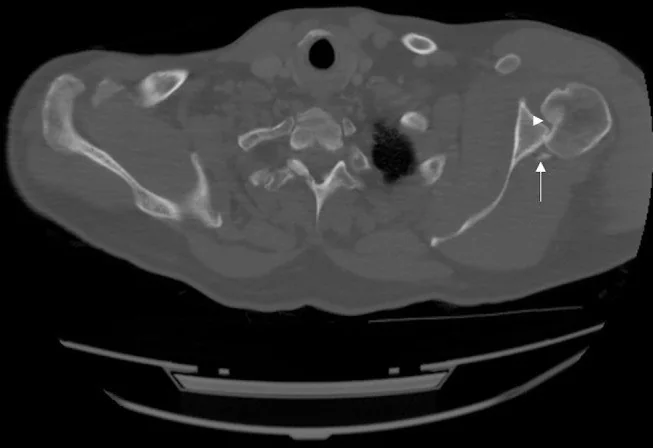
Posterior glenohumeral çıkıkta humerus başı glenoidin arkasına yer değiştirir; nöbet, elektrik çarpması ve travma sonrası gelişebilir. Tanı başlangıç grafilerinde gözden kaçabildiğinden, BT özellikle aksiyel planda eklem hizasını ve eşlik eden anteromedial impaksiyon kırığını doğrudan ortaya koyar. Posterior glenoid kenarı ve küçük tüberkül de yaralanma alanına dahil olabilir. Çıkığın atlanması kilitli eklem ve tedavi gecikmesiyle sonuçlanabilir.
Faz ve pencere
- Kontrastsız tanısal
- Aksiyel kemik algoritmalı BT'de humerus başının glenoid arkasına ve korakoid çıkıntının posterioruna geçişi, eklem aralığının asimetrik genişlemesi, anteromedial baş impaksiyonu ve posterior glenoid fragmanı izlenir; rutin kemik değerlendirmesinde kontrast gerekmez.
Önerilen pencereler: Kemik (G 1800 / M 400), Yumuşak doku (G 400 / M 40).
BT bulguları
- Posterior migrasyon — humerus başı glenoid eklem yüzünün arkasında yer alır; aksiyel BT'de en doğrudan hizalanma bulgusudur.
- Aksiyel düzlemde humerus başının glenoidin arkasına kayması ve korakoid çıkıntıya göre konumunun değişmesi.
- İç rotasyonda sabit kalan baş — proksimal humerus tipik olarak iç rotasyonda sabitlenmiştir ve başın yuvarlak konturu glenoide göre bozulabilir.
- Reverse Hill-Sachs — humerus başı anteromedialinde, posterior glenoid kenarıyla temas alanında çökme defekti.
- Kemikli Bankart lezyonu — posterior glenoid kenarında kortikal kopma veya kırık fragmanı.
- Küçük tüberkül kırığı — avulsiyon fragmanı ya da kortikal kırık hattı posterior çıkığa eşlik edebilir.
- Redüksiyon sonrası kalıcı çentiklenme — eklem yeniden hizalansa bile baştaki anteromedial impaksiyon defekti ve serbest fragmanlar görünürlüğünü koruyabilir.
- Posterior çıkıkta reverse bony Bankart lezyonu posterior glenoid kenarında aranır; BT, glenoid kemik kaybının değerlendirilmesine yardımcı olur.
Ölçütler ve sınıflamalar
- Glenohumeral çıkık yönü
- Humerus başının glenoidin önünde, arkasında, üstünde veya altında konumlanmasına göre anterior, posterior, superior veya inferior olarak sınıflandırılır.
Normalde
Normal aksiyel BT'de humerus başı glenoidin karşısında ortalanır ve korakoid çıkıntının lateralinde yer alır; eklem aralığı her iki tarafta uyumludur. Başın posteriora taşmasını, anteromedial korteks oluğunu ve posterior glenoid kenarındaki kopmayı karşılaştırın; normal baş konturu düzgün ve glenoid kenarı süreklidir.
Ayırıcı tanı
- Anterior glenohumeral çıkık
- baş glenoidin önüne geçer ve posterolateral humerus başı impaksiyonu eşlik edebilir.
- İnferior glenohumeral çıkık
- humerus başı glenoid seviyesinin altında görünür; koronal düzlem konumu ayırt eder.
- Glenohumeral subluksasyon
- baş glenoidle kısmi temasını korur ve posterior tam ayrışma oluşmaz.
- Humerus başı psödosubluksasyonu
- eklem sıvısı veya deltoid tonus kaybıyla aşağı kayma olur, ancak posterior migrasyon ve reverse Hill-Sachs paterni yoktur.
Tuzaklar
- Ön-arka grafide baş glenoidle üst üste düşüp normalmiş gibi görünebilir; aksiyel BT'de glenoidin arkasında kalan başı doğrudan doğrulayın.
- Proksimal humerus genellikle patolojik olarak iç rotasyonda sabittir; bu durum yalnızca pozisyondan ziyade kas spazmı ve mekanizmaya bağlıdır, bu nedenle glenoid-humerus ilişkisini ve impaksiyon defektini doğrudan değerlendirmek gerekir.
- Küçük anteromedial baş oluğu eski impaksiyon veya dejeneratif kontur değişikliği olabilir; akut çıkık tanısı için mevcut eklem konumunu ve kortikal kenarları değerlendirin.
- Akut durumlarda ön-arka grafilerde posterior glenoid kenar kırıkları kolayca gözden kaçabilir; eklem uyumu ve eşlik eden fragmanları değerlendirmek için aksiyel BT görüntüleme tercih edilmelidir.
Kendini dene
Nöbet sonrası omuz BT'sinde humerus başı glenoid arkasında ve anteromedial başta çökme var. Tanı nedir?
Cevabı göster
Posterior çıkık. Posterior migrasyon ve anteromedial impaksiyon reverse Hill-Sachs ile uyumludur. Anterior çıkıkta baş öne gider, inferior çıkıkta aşağı yerleşir; subluksasyonda eklem teması kısmen sürer.
Epileptik nöbet sonrası gelen hastada omuzda ağrı ve ekstern rotasyon kısıtlılığı var. Posterior çıkık ön-arka grafide kolayca gözden kaçabilir. Posterior çıkığı aksiyel BT’de destekleyen bulgu hangisidir?
Cevabı göster
Humerus başının korakoid çıkıntıya göre posteriora yer değiştirmesi. Aksiyel BT’de humerus başının korakoid çıkıntıya göre posterior migrasyonu posterior çıkıkla uyumludur. Kaynak, bu migrasyonu kontrastsız aksiyel BT’de tarif eder.
İlgili konular
Kaynaklar
Bu sayfadaki 39 cümle ve 2 quiz sorusu aşağıdaki kaynaklardan alıntılarla otomatik olarak karşılaştırıldı; 9 cümle bu karşılaştırmada düzeltildi (2026-10-09).
- Imaging of traumatic shoulder injuries – Understanding the surgeon’s perspective ☆pmc.ncbi.nlm.nih.gov
- Dislocation of the Shoulder Joint – Radiographic Analysis of Osseous Abnormalitiespmc.ncbi.nlm.nih.gov
- Massive rotator cuff tear associated with acute traumatic posterior shoulder dislocation: report of two cases and literature review.pubmed.ncbi.nlm.nih.gov
- Chronic posterior shoulder dislocation: Current evidence, treatment options, and a decision-making algorithm.pubmed.ncbi.nlm.nih.gov
- [Treatment of acute, first-time posterior shoulder instability].pubmed.ncbi.nlm.nih.gov
- Acute traumatic posterior shoulder dislocation.pubmed.ncbi.nlm.nih.gov
- Risk of Engagement of Bipolar Bone Defects in Posterior Shoulder Instability.pubmed.ncbi.nlm.nih.gov
- Missed posterior shoulder fracture dislocations: a new protocol from a London major trauma centre.pubmed.ncbi.nlm.nih.gov
- [Posterior shoulder dislocation; an often-missed diagnosis].pubmed.ncbi.nlm.nih.gov
- Chronic posterior dislocation of shoulder.pubmed.ncbi.nlm.nih.gov
- Influence of defect size and localization on the engagement of reverse Hill-Sachs lesions.pubmed.ncbi.nlm.nih.gov
- Spontaneous posterior shoulder dislocation as the first symptom of a Charcot arthropathy.pubmed.ncbi.nlm.nih.gov
- Management of Locked Posterior Shoulder Dislocation with Reverse Hill-Sachs Lesions via Anatomical Reconstructions.pubmed.ncbi.nlm.nih.gov
- Arthroscopic Repair of a Posterior Midcapsular Rupture Causing Posterior Shoulder Instability.pubmed.ncbi.nlm.nih.gov
- Treatment of reverse Hill-Sachs lesion by autograft reconstruction.pubmed.ncbi.nlm.nih.gov
- Traumatic Posterior Shoulder Dislocation during Judo in a Child and Literature Review.pubmed.ncbi.nlm.nih.gov
- Treatment of Chronic Locked Posterior Dislocation of the Shoulder: Is There a Time Limit to Try a Closed Reduction?: A Report of 3 Cases.pubmed.ncbi.nlm.nih.gov
- The duration of dislocation is the most important prognostic factor in chronic locked posterior shoulder dislocations treated with the modified McLaughlin surgical procedure: a multicentre study.pubmed.ncbi.nlm.nih.gov
- Bilateral anterior shoulder dislocation: A case report.pubmed.ncbi.nlm.nih.gov
- Outcomes of Internal Fixation in Proximal Humerus Head Split Fractures in Young Adults - How Often Is It Missed and Can We Really Afford to Do So.pubmed.ncbi.nlm.nih.gov
- Case Report: Revision surgery for a missed posterior dislocation of the humeral head in a shoulder fracture-dislocation and literature review.pubmed.ncbi.nlm.nih.gov
- A Systematic Approach to the Evaluation of Acute Musculoskeletal Injuries in the Emergency Department.pubmed.ncbi.nlm.nih.gov
- Surgical treatment of locked posterior shoulder dislocations with modified McLaughlin procedure: Case series and review of treatment possibilities of reverse Hill-Sachs defect.pubmed.ncbi.nlm.nih.gov
- Proximal humerus fractures in the elderly work up, classifications and fracture biomechanics.pubmed.ncbi.nlm.nih.gov
- Irreducible Anterior Shoulder Dislocation Caused by Soft Tissue Interposition: A Comprehensive Review.pubmed.ncbi.nlm.nih.gov
- Delayed Diagnosis of Bilateral Posterior Shoulder Fracture-Dislocation Following a Seizure: A Case Report.pubmed.ncbi.nlm.nih.gov
- Modified McLaughlin procedure combined with proximal humeral locking plate for proximal humeral fractures with posterior shoulder dislocation and reverse Hill-Sachs lesion: a retrospective case series.pubmed.ncbi.nlm.nih.gov
- Management of proximal humerus fractures: a review of contemporary treatment options.pubmed.ncbi.nlm.nih.gov
- Acute massive rotator cuff tear and biceps tendon dislocation following posterior shoulder dislocation: A case report.pubmed.ncbi.nlm.nih.gov
- Arthroscopic Autologous Iliac Crest Bone Augmentation for Restoring Engaging Reverse Hill-Sachs Lesion With Anterior Capsular Tightening in Posterior Shoulder Dislocation.pubmed.ncbi.nlm.nih.gov
- Arthroscopic Fixation of Acute Reverse Bony Bankart Lesion using Cancellous Cannulated Screws: A Rare Case Report.pubmed.ncbi.nlm.nih.gov
- Shifting paradigms: how the glenoid track changed the concept of shoulder instability.pubmed.ncbi.nlm.nih.gov
- Arthroscopic Bone Graft Remplissage Using Flexible Bone Allograft for Treatment of Hill-Sachs Lesions in Anterior Shoulder Instability.pubmed.ncbi.nlm.nih.gov
- Arthroscopic Repair of a Neglected Subscapularis Avulsion of the Lesser Tuberosity of the Humerus in the Adolescent Population.pubmed.ncbi.nlm.nih.gov
- Imaging of pediatric musculoskeletal trauma: Age-specific considerations and challenges.pubmed.ncbi.nlm.nih.gov
- Fractures of the coronoid process: state of the art.pubmed.ncbi.nlm.nih.gov
- The Radiologic Evaluation and Clinical Significance of Glenohumeral Bone Loss in Anterior Shoulder Instability.pubmed.ncbi.nlm.nih.gov
- The Use of Glenoid Structural Allografts for Glenoid Bone Defects in Reverse Shoulder Arthroplasty.pubmed.ncbi.nlm.nih.gov
- Preoperative and operative risk factors for failed lateral collateral ligament reconstruction.pubmed.ncbi.nlm.nih.gov
- Prediction of humeral torsion from proximal humerus computed tomography is enabled by three-dimensional estimation of the transepicondylar axis using deep learning.pubmed.ncbi.nlm.nih.gov
- Scapular Morphology and Posterior Shoulder Stability: Biomechanical Evidence From an Advanced Cadaveric Shoulder Simulator.pubmed.ncbi.nlm.nih.gov
- The role of glenoid version in arthroplasty.pubmed.ncbi.nlm.nih.gov
- Arthroscopic stabilization for atraumatic shoulder instability: minimum two-year outcomes.pubmed.ncbi.nlm.nih.gov
- Analysis of the curative effect of arthroscopic coracoid process drill-free U-shaped suspension fixation in the treatment of acute acromioclavicular joint dislocation.pubmed.ncbi.nlm.nih.gov
- Rare Presentation of Chronic Anterior Instability with Concomitant Triad of Anterior Labral Periosteal Sleeve Avulsion, Hill-Sachs, and Humeral Avulsion of the Glenohumeral Ligament Lesions: A Case Report.pubmed.ncbi.nlm.nih.gov
- Antero-inferior glenohumeral instability is associated with an abnormal position of the coracoid process.pubmed.ncbi.nlm.nih.gov
- Arthroscopic Iliac Crest Bone Grafting for Shoulder Glenoid Defect Augmentation Using a "Three-Pulley Four-Point Antirotation" Suture Anchor Technique.pubmed.ncbi.nlm.nih.gov
- Management of Labral Tears Associated with Glenohumeral Instability in Athletes.pubmed.ncbi.nlm.nih.gov
- Diagnostic Pitfalls and Management of Transphyseal Fractures of the Distal Humerus: A Retrospective Review of 25 Cases.pubmed.ncbi.nlm.nih.gov
- Midshaft clavicle fractures with associated ipsilateral acromioclavicular joint injuries: a systematic review.pubmed.ncbi.nlm.nih.gov
- Computed tomography Osteoabsorptiometry: Review of bone density, mechanical strength of material and clinical application.pubmed.ncbi.nlm.nih.gov
- Glossary of terms for musculoskeletal radiology.pubmed.ncbi.nlm.nih.gov
- Up-to-date concepts and procedures in shoulder instability: a comprehensive review.pubmed.ncbi.nlm.nih.gov
- Comparative Analysis of 3D MRI and CT in Assessing Static Bone Loss and Dynamic Bipolar Interaction in Glenohumeral Instability.pubmed.ncbi.nlm.nih.gov
- Evaluation of the Baseplate Position and Screws in Reverse Total Shoulder Arthroplasty Using 3D Printed Patient-Specific Instrumentation.pubmed.ncbi.nlm.nih.gov
- Shoulder instability and associated shoulder injuries in patients with epilepsy.pubmed.ncbi.nlm.nih.gov
- Clinical and Functional Outcomes of Posterior Shoulder Fracture-Dislocation: A Retrospective Case Series.pubmed.ncbi.nlm.nih.gov
- Traumatic Asymmetric Bilateral Shoulder Dislocation: The First Case Report in Mexico.pubmed.ncbi.nlm.nih.gov
- Is three-dimensional reconstruction really necessary for glenoid version measurement on magnetic resonance imaging in patients with glenohumeral instability?pubmed.ncbi.nlm.nih.gov
- Clinical Outcomes of an Improved Arthroscopic Suture-Bridge Technique Assisted by a "5 O'clock" Portal for Acute Bony Bankart Lesions.pubmed.ncbi.nlm.nih.gov
- Arthroscopy-Assisted Fixation of Combined Coracoid Fracture and Acromioclavicular Dislocation: A Minimalist Approach.pubmed.ncbi.nlm.nih.gov
- The natural history of traumatic posterior glenohumeral dislocations in a high-risk population.pubmed.ncbi.nlm.nih.gov
- Cranial anatomy, palaeoneurology, palaeobiology and stratigraphic age of the large-bodied ornithopod, <i>Muttaburrasaurus langdoni</i> Bartholomai and Molnar, 1981, from the mid-Cretaceous of Australia.pubmed.ncbi.nlm.nih.gov
- Redescription of the soft-shell turtle Rafetus bohemicus (Testudines, Trionychidae) from the Early Miocene of Czechia.pubmed.ncbi.nlm.nih.gov
- Anatomy and relationships of the early diverging Crocodylomorphs Junggarsuchus sloani and Dibothrosuchus elaphros.pubmed.ncbi.nlm.nih.gov
- Pseudodislocation of the Shoulder After a Pathologic Scapula Fracture: A Rare Case Report.pubmed.ncbi.nlm.nih.gov
- Inlay Dynamic Anterior Stabilization of the Shoulder With Long Head Biceps Tendon Using All-Suture Anchor.pubmed.ncbi.nlm.nih.gov
- Arthroscopic biceps superior capsular reconstruction for irreparable massive rotator cuff tear with posterior dislocation of the long head of the biceps tendon and irreducible anterior glenohumeral subluxation: A case report and literature review.pubmed.ncbi.nlm.nih.gov
- Progressive Soft Tissue Release and Latarjet Procedure in the Treatment of Neglected Anterior Shoulder Dislocation After Failed ORIF in a Young Active Patient: A Case Report.pubmed.ncbi.nlm.nih.gov
- FUNCTIONAL OUTCOME OF WEBER OSTEOTOMY IN CHRONIC ANTERIOR GLENOHUMERAL DISLOCATION IN YOUNG PATIENTS.pubmed.ncbi.nlm.nih.gov
- Radiographic and Advanced Imaging Evaluation of Posterior Shoulder Instability.pubmed.ncbi.nlm.nih.gov
- The role of minimally invasive plate osteosynthesis (MIPO) technique for treating 3- and 4-part proximal humerus fractures in the elderly - a case study.pubmed.ncbi.nlm.nih.gov
- Posterior shoulder fracture-dislocation: A systematic review of the literature and current aspects of management.pubmed.ncbi.nlm.nih.gov
- Bilateral posterior shoulder dislocations with reverse Hill-Sachs lesions: a report of two cases and a literature review.pubmed.ncbi.nlm.nih.gov
- Neurologic Complications in Shoulder Surgery: Anatomy, Mechanisms, and Surgical Recommendations.pubmed.ncbi.nlm.nih.gov
- Biomechanics of custom glenoid components in reverse total shoulder arthroplasty-a narrative review of concepts for surgeons.pubmed.ncbi.nlm.nih.gov
- Neurovascular injuries associated with proximal humerus fractures: a review of the current literature.pubmed.ncbi.nlm.nih.gov
- Arthroscopic Latarjet using double suture-button fixation: learning curve, graft positioning, and complications - A two-center study of 80 patients.pubmed.ncbi.nlm.nih.gov
- Pediatric shoulder instability: epidemiology, etiology, diagnosis and treatment.pubmed.ncbi.nlm.nih.gov
- Single-Screw versus Two-Screw Fixation in the Latarjet Procedure: A Prospective Comparative Study.pubmed.ncbi.nlm.nih.gov
Eğitim amaçlıdır; hasta başında tanı ve tedavi kararının yerine geçmez, tıbbi tavsiye değildir. Metinler yapay zekâ desteğiyle yazıldı ve otomatik bir adımda kaynak alıntılarıyla karşılaştırıldı; bu bir tıbbi doğrulama değildir ve içerik uzman radyolog incelemesinden geçmedi. Klinik kararlarda güncel kılavuzları, kurum protokollerini ve radyoloji raporunu esas alın.