Özet
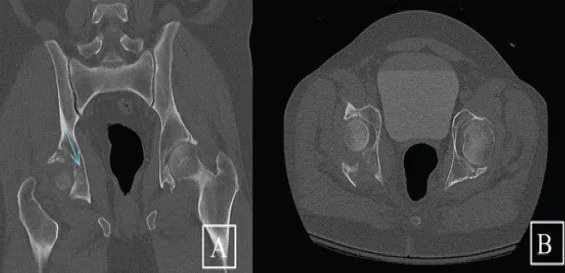
Kalçaya iletilen aksiyel yük sonrasında özellikle posterior kalça çıkığıyla birlikte görülen arka duvar kırığı, eklem yüzünün taşıyıcı kenarını ve kalça stabilitesini etkileyebilir. İnce kesit kontrastsız BT, posterior rimdeki fragmanları, eklem yüzüne uzanımı, marjinal impaksiyonu ve eklem içinde kalmış kemik parçalarını doğrudan gösterir. Bilgisayarlı tomografi ile kolon tutulumunun, eklem içi parçaların ve kırık morfolozisinin değerlendirilmesi, Judet-Letournel sınıflamasına göre elementary ve ilişkili örüntüleri ayırt ederek uygun cerrahi yaklaşımın seçilmesine yardımcı olur. Fragman, impaksiyon veya çıkıkla ilişkili uyumsuzluk atlanırsa eklem hasarının kapsamı ve olası instabilite eksik raporlanabilir.
Faz ve pencere
- Kontrastsız tanısal
- Asetabulum posterior riminde kortikal ayrılma ve eklem yüzüne uzanan kemik fragmanları yüksek dansiteli korteks ve trabeküler kemik olarak seçilir; aksiyel kesitlerde fragman sayısı, yer değiştirme, femur başı ilişkisi, marjinal impaksiyon ve eklem içi serbest kemik araştırılır. İnce kesit kemik algoritmalı koronal ve sagittal rekonstrüksiyonlar çatıya ve arka kolona uzanımı tamamlar; damar yaralanması ayrıca şüphe edilmiyorsa kontrast fazı kırık morfolojisinin tanısı için gerekli değildir.
Önerilen pencereler: Kemik (G 1800 / M 400), Yumuşak doku (G 400 / M 40).
BT bulguları
- Posterior rim kesintisi — asetabulumun arka eklem kenarında basamaklanma ve ana kemikten ayrılmış kortikal-trabeküler fragman görülür.
- Duvar fragmanı morfolojisi — tek büyük parça, çok parçalı kırılma veya posterior-superior çatıya uzanan fragman olarak tarif edilir.
- Marjinal impaksiyon — posterior eklem yüzünün subkondral bölümü femur başı tarafından içe çökmüş ve eklem konturu çukurlaşmıştır.
- Eklem içi kemik parçası — asetabular kırık yatağından ayrılmış küçük yoğun fragman femur başı ile yuva arasında veya eklem boşluğunda yer alır.
- Femur başı uyumu — başın asetabulum içinde merkezlenmesi, posteriora çıkması ya da medial subluksasyonu belirtilir.
- Arka kolon bütünlüğü — büyük siyatik çentikten asetabular çatıya ve obturator halkaya uzanan ikinci bir çizginin olup olmadığı araştırılır.
- Femur başı eşlikçi hasarı — impaksiyon çukuru veya femur başı kırık fragmanı aynı eklem seviyesinde aranır.
- Kalça çevresinde yumuşak doku şişliği travmaya eşlik edebilir.
Ölçütler ve sınıflamalar
- Judet–Letournel temel kırık örüntüleri
- Arka duvar, beş temel (elementary) asetabulum örüntüsünden biridir. Judet-Letournel sınıflamasında posterior duvar fragmanının varlığı, kırık örüntüsünün değerlendirilmesinde kullanılan unsurlardan biridir.
- Judet–Letournel ilişkili örüntüler
- Arka duvar fragmanı arka kolon kırığıyla veya transvers asetabulum kırığıyla birlikte görülebilir. BT'de eşlik eden kolon hattı aranarak izole duvar kırığından ayrılır.
Normalde
Normal BT'de posterior asetabular rim ince, kesintisiz kortikal yay oluşturur; arka duvarın eklem yüzü femur başını düzgün örter ve baş eklem içinde merkezlidir. Aynı seviyedeki karşı kalçayla posterior rimin konturunu, subkondral plağın sürekliliğini ve eklem aralığındaki kemik yoğunluklarını karşılaştırın; normalde arka kolon boyunca uzanan kesintisiz kemik köprü kırık hattıyla ayrılmaz.
Normal BT ile kıyasla
Aynı bölgenin, kaynak veri setinde patoloji içermediği belirtilen bir BT incelemesini kesit kesit kaydırın; organ sınırlarını açarak anatomiyi hasta görüntüsüyle karşılaştırın. Küçük rastlantısal bulgular tümüyle dışlanmamıştır.
Kaynak: TotalSegmentator v2.01 veri seti (Wasserthal ve ark., Radiology: Artificial Intelligence 2023), CC BY 4.0, vaka s1256; organ sınırları veri setinin otomatik segmentasyonundan, birleştirilerek sadeleştirildi. Görüntüler 2,5 mm kesit aralığına yeniden örneklendi.
Ayırıcı tanı
- Arka kolon kırığı
- çizgi büyük siyatik çentikten yük taşıyan çatı boyunca ilerleyip obturator halkaya çıkar; yalnız rim fragmanı biçiminde kalmaz.
- Transvers asetabulum kırığı posterior duvar kırığıyla birlikte bulunabilir.
- Femur başı kırığı
- yoğun fragman asetabulumdan değil femur başı konturundan kopar; başın kendi subkondral yüzeyinde çentik veya basamak vardır.
- Kalça osteoartritinde asetabular labrumda kalsifikasyon görülebilir.
- Eski posterior duvar kırığı iyileşmiş kırık sekeli olarak görülebilir.
Tuzaklar
- Yalnız en belirgin posterior duvar fragmanını izleyip arka kolon hattını atlamak birleşik kırığın izole duvar kırığı olduğu yanılgısına düşmeye yol açar; büyük siyatik çentikten obturator halkaya kadar kemik sürekliliğini takip edin.
- Posterior çıkık redükte edilmiş olsa bile eklem içinde sıkışmış kemik parçası kalabilir; femur başı ile asetabular yüz arasındaki eklem aralığını ardışık ince kesitlerde tarayın.
- Marjinal impaksiyon bazen ayrı bir fragman gibi görünmez; posterior eklem yüzündeki basık subkondral konturu ve femur başındaki karşılık gelen temas alanını birlikte inceleyin.
- Sadece aksiyel görüntüyle çatıya uzanım eksik değerlendirilebilir; kemik algoritmalı koronal ve sagittal rekonstrüksiyonlarla fragmanın superior sınırını doğrulayın.
Kendini dene
Asetabulum posterior riminde fragman görüldüğünde, arka kolon tutulumunu değerlendirmek amacıyla hangi çizgi izlenmelidir?
Cevabı göster
İlioiskial çizgi. Belirli radyografik çizgilerdeki kesintiler, Judet-Letournel sınıflamasında temel ve ilişkili kırık tiplerinin doğru ayırt edilmesine olanak tanır; bu algoritmik yaklaşım deneyimsiz cerrahlar için de geçerlidir.
Kalça çıkığı redükte edilmiş hastada hangi BT bulgusu eklem içinde kalmış kemik parçasını en doğrudan gösterir?
Cevabı göster
Baş ile yuva arasında yoğun kemik odağı. Femur başı ile asetabulum arasındaki eklem aralığında yoğun kemik odağı, sıkışmış fragman için doğrudan bulgudur. Diğer seçenekler ön kolon, posterior pelvik halka veya eski iskiyal değişikliği tarif eder.
İlgili konular
Kaynaklar
Bu sayfadaki 42 cümle ve 2 quiz sorusu aşağıdaki kaynaklardan alıntılarla tek tek karşılaştırıldı; 9 cümle bu karşılaştırmada düzeltildi (2026-10-08).
- Gunshot Wound to the Hip Resulting in a Femoral Head and Acetabulum Fracture Treated With Open Reduction and Internal Fixation and Bipolar Hemiarthroplastypmc.ncbi.nlm.nih.gov
- Morphology-Guided Surgical Management of Complex Traumatic Hip Fracture-Dislocations and Acetabular Fractures: A Six-Case Series Illustrating Morphology-Based Surgical Approachespmc.ncbi.nlm.nih.gov
- A Case Report on Unclassified Anatomical Sciatic Nerve Variant in Acetabulum Fracturepmc.ncbi.nlm.nih.gov
- Combined irreducible femoral head fracture-dislocation (Pipkin Ⅳ) and ipsilateral irreducible intertrochanteric fracture: A case reportpmc.ncbi.nlm.nih.gov
- Traumatic Bilateral Asymmetrical Hip Dislocation with Acetabular Fracture: A Case Report and Review of Current Evidencepmc.ncbi.nlm.nih.gov
- Femoroacetabular impingement as a complication of acetabular fracture fixation.pubmed.ncbi.nlm.nih.gov
- Cortical Impaction in Posterior Wall Acetabular Fractures.pubmed.ncbi.nlm.nih.gov
- Posterior Wall Acetabulum Fracture with a Persistent Sciatic Artery: A Case Report.pubmed.ncbi.nlm.nih.gov
- Intraoperative CT in the assessment of posterior wall acetabular fracture stability.pubmed.ncbi.nlm.nih.gov
- Morphological abnormalities of the hip in acetabular fractures.pubmed.ncbi.nlm.nih.gov
- Femoral head reduction osteoplasty for fracture dislocation: A surgical technique.pubmed.ncbi.nlm.nih.gov
- Radiographic Determinants of Early Failure After Posterior Wall Acetabular Fracture Fixation.pubmed.ncbi.nlm.nih.gov
- Acetabular Fracture Resulting from a Basketball Cutting Movement in a Young Adult Male: A Case Report.pubmed.ncbi.nlm.nih.gov
- Examination Under Anesthesia for Posterior Wall Acetabular Fracture A Survey of the OTA Membership.pubmed.ncbi.nlm.nih.gov
- Midterm results of digastric trochanteric flip osteotomy for high acetabular posterior wall fracture.pubmed.ncbi.nlm.nih.gov
- Repeat posterior wall acetabular fracture-dislocation: High-energy trauma as a 'second hit phenomenon'.pubmed.ncbi.nlm.nih.gov
- The added value of intraoperative CT scanner and screw navigation in displaced posterior wall acetabular fracture with articular impaction.pubmed.ncbi.nlm.nih.gov
- Posterior Wall Acetabular Fracture After Low-Energy Trauma Masquerading as Infection: A Case Report.pubmed.ncbi.nlm.nih.gov
- Can experts in acetabular fracture care determine hip stability after posterior wall fractures using plain radiographs and computed tomography?pubmed.ncbi.nlm.nih.gov
- Accuracy of Posterior Wall Acetabular Fracture Lag Screw Placement: Correlation Between Intraoperative Fluoroscopy and Postoperative Computer Tomography.pubmed.ncbi.nlm.nih.gov
- Acetabular superior wall fractures: a distinct acetabular fracture entity.pubmed.ncbi.nlm.nih.gov
- Super-acute massive osteolysis of the femoral head after acetabular fracture fixation : a comparative study with conventional post-traumatic osteonecrosis requiring total hip arthroplasty.pubmed.ncbi.nlm.nih.gov
- Femoral head fractures systematic review and meta-analysis.pubmed.ncbi.nlm.nih.gov
- Efficiency and Temporal Reasoning in Transformer-Based Video Object Detection: A Systematic Review.pubmed.ncbi.nlm.nih.gov
- ConFormer-Net: Spatiotemporal Modeling for Landslide Detection Using Multi-Temporal SAR Data.pubmed.ncbi.nlm.nih.gov
- The Evolving Security of the Internet of Vehicles: A Survey from Classical Machine Learning to Large Language Models, Adversarial Robustness, and Explainable AI.pubmed.ncbi.nlm.nih.gov
- Advances in FAI Imaging: a Focused Review.pubmed.ncbi.nlm.nih.gov
- 2.5-mm articulated endoluminal forceps using a compliant mechanism.pubmed.ncbi.nlm.nih.gov
- Implant utilization for posterior wall fractures of the pelvis: a narrative review.pubmed.ncbi.nlm.nih.gov
- Acetabular posterior column screws via an anterior approach.pubmed.ncbi.nlm.nih.gov
- Tips and tricks for the treatment of marginal impaction in acetabular fractures.pubmed.ncbi.nlm.nih.gov
- Anatomical reduction of marginal impaction in posterior wall acetabular fractures ensures mid-term satisfactory outcomes.pubmed.ncbi.nlm.nih.gov
- Articular impactions in acetabular fractures.pubmed.ncbi.nlm.nih.gov
- Efficient hip joint distraction using the AO large femoral distractor in treating acetabular fractures associated with marginal impaction and intraarticular incarcerated fragments.pubmed.ncbi.nlm.nih.gov
- Intra-articular anterior inferior iliac spine avulsion with hip instability: A retrospective study.pubmed.ncbi.nlm.nih.gov
- Current understanding of articular cartilage lesions in femoroacetabular impingement syndrome.pubmed.ncbi.nlm.nih.gov
- Single-baseline virtual progression modeling of Crowe type I-III developmental dysplasia of the hip: a finite element study of stress-location migration.pubmed.ncbi.nlm.nih.gov
- Anterior Hip Dislocation with Cranial Femoral Head Osteochondral Lesion and Isolated Quadrilateral Plate Fracture: A Case Report.pubmed.ncbi.nlm.nih.gov
- Surgical Management of Pediatric Acetabular Fractures: A Retrospective Study of 14 Rare Cases.pubmed.ncbi.nlm.nih.gov
- Lateral rectus abdominis approach fixation of a high-energy both-column acetabular fracture after total hip arthroplasty with retention of a stable acetabular cup: a case report.pubmed.ncbi.nlm.nih.gov
- Staged management of a Tile C3 pelvic ring injury with bilateral sacroiliac disruption and T-shaped sacral fracture.pubmed.ncbi.nlm.nih.gov
- Letournel-Judet Classification of Acetabular Fractures: A Systematic Review of Reliability and Association With Post-traumatic Arthritis.pubmed.ncbi.nlm.nih.gov
- Impaction Injury of the Femoral Head After Traumatic Posterior Hip Dislocation: A Literature Review and Case Study.pubmed.ncbi.nlm.nih.gov
- Femoral head impaction fracture: a new technique for closed reduction and biological stabilisation.pubmed.ncbi.nlm.nih.gov
- Aetiology of pelvic neuropathies in women: a narrative review.pubmed.ncbi.nlm.nih.gov
- Differential Diagnosis of Posterior Buttock Pain: A Conceptual Review Based on Topographic Localization of Pain, Is It Really the Sacroiliac Joint?pubmed.ncbi.nlm.nih.gov
- MRI in Chronic Pudendal Neuralgia: Diagnostic Criteria and Associated Pathologies.pubmed.ncbi.nlm.nih.gov
- Fascia Lata and Tensor Fasciae Latae in Lower-Limb Reconstruction.pubmed.ncbi.nlm.nih.gov
- Current Position of Nuclear Medicine Imaging in Primary Bone Tumors.pubmed.ncbi.nlm.nih.gov
- The state of trial registrations in the field of Orthopaedics in years 2015-2020. A meta-epidemiological study.pubmed.ncbi.nlm.nih.gov
- Sonography of sports injuries of the hip.pubmed.ncbi.nlm.nih.gov
- The Predictive Factors for Post-Traumatic Hip Osteoarthritis After Surgical Treatment of Acetabular Fractures: A Retrospective Cohort of 130 Patients.pubmed.ncbi.nlm.nih.gov
- Functional Outcomes of Surgical Management of Posterior Wall Acetabular Fractures: A Prospective Study.pubmed.ncbi.nlm.nih.gov
- Management and outcome of displaced acetabular fractures in the oldest-old: a retrospective analysis of orif and acute total hip arthroplasty.pubmed.ncbi.nlm.nih.gov
- Epidemiological profile and factors associated with length of stay in patients with acetabular fractures at a level 1 trauma center in Nepal: a retrospective analytical study.pubmed.ncbi.nlm.nih.gov
- A Comparative Study of Functional Outcomes in Anterior and Posterior Wall Acetabular Fractures Managed Using Modified Stoppa and Kocher-Langenbeck Approaches at a Tertiary Hospital in India.pubmed.ncbi.nlm.nih.gov
- Team Approach: Hip Preservation Surgery.pubmed.ncbi.nlm.nih.gov
- Association of prophylactic transcatheter arterial embolization with perioperative blood loss and operative time in complex acetabular fractures: a propensity score-matched retrospective study.pubmed.ncbi.nlm.nih.gov
- Comparing outcomes of acetabular fracture fixation in early career versus experienced orthopaedic trauma surgeons.pubmed.ncbi.nlm.nih.gov
- Long-Term Outcome of Patients with a Floating Hip Injury of Müller Type A: An Analysis of Prognostic Factors Linked to Functional Outcomes.pubmed.ncbi.nlm.nih.gov
- The role of applying radiological modifiers to the Letournel classification and its clinical implications.pubmed.ncbi.nlm.nih.gov
- Association of knee ligament injury with pelvic and acetabular fractures: a retrospective cohort study.pubmed.ncbi.nlm.nih.gov
- Morphology-Guided Surgical Management of Complex Traumatic Hip Fracture-Dislocations and Acetabular Fractures: A Six-Case Series Illustrating Morphology-Based Surgical Approaches.pubmed.ncbi.nlm.nih.gov
- Open reduction and internal fixation versus percutaneous multiple-trajectory screw fixation for unstable pelvic fractures with severe polytrauma: a prospective study.pubmed.ncbi.nlm.nih.gov
- Biomechanical comparison of two fixation constructs for displaced quadrilateral surface acetabular fractures: a finite elements analysis.pubmed.ncbi.nlm.nih.gov
- Management of Acetabular Fractures with Total Hip Replacement: A Narrative Literature Review.pubmed.ncbi.nlm.nih.gov
- Corticosteroid-associated osteonecrosis in paediatric compared with adult patients: are they the same disease?pubmed.ncbi.nlm.nih.gov
- Porous Ti-6Al-4V Architectures in Load-Bearing Orthopedic Reconstruction: A Critical Narrative Review of the Translational Gap Across Microstructure, Fatigue, Surface Function, and Clinical Failure Modes.pubmed.ncbi.nlm.nih.gov
- Differential impact of hemiplegia severity stratification on post-hemiarthroplasty dislocation in elderly intertrochanteric fracture patients.pubmed.ncbi.nlm.nih.gov
- Dual-Energy CT Arthrography: Advanced Muscolo-Skelatal Applications in Clinical Practice.pubmed.ncbi.nlm.nih.gov
- Magnetic resonance imaging of the hip: anatomy and pathology.pubmed.ncbi.nlm.nih.gov
- MRI of the hip for the evaluation of femoroacetabular impingement; past, present, and future.pubmed.ncbi.nlm.nih.gov
- Treatment Outcomes of Total Hip Arthroplasty Following Hip Joint Gunshot and Shell Fragment Injuries: Insights From a Single-Center Retrospective Study in Yemen.pubmed.ncbi.nlm.nih.gov
- Asymmetric Bilateral Hip Dislocations With an Associated Unstable Pelvic Ring Injury: A Case Report.pubmed.ncbi.nlm.nih.gov
- Glossary of terms for musculoskeletal radiology.pubmed.ncbi.nlm.nih.gov
- A Guide to Improving the Care of Patients with Fragility Fractures, Edition 2.pubmed.ncbi.nlm.nih.gov
- A novel screw-and-cement pile technique for Harrington II/III periacetabular lesions: technical note and short-term outcomes.pubmed.ncbi.nlm.nih.gov
- AI-assisted direct anterior approach <i>versus</i> posterolateral approach in total hip arthroplasty: a retrospective cohort study based on artifact-reduced CT 3D reconstruction.pubmed.ncbi.nlm.nih.gov
- Differentiating Lumbar Spinal Etiology from Peripheral Plexopathies.pubmed.ncbi.nlm.nih.gov
- Utilization of the posterior iliac line for visualizing posterior column screws in obturator oblique view.pubmed.ncbi.nlm.nih.gov
- A Pilot Three-Dimensional Evaluation of Acetabular Bony Coverage After Modified Spitzy Shelf Acetabuloplasty.pubmed.ncbi.nlm.nih.gov
- Obesity-associated Morphological Changes in Acetabular Growth and Development: Potential Implications for Slipped Capital Femoral Epiphysis.pubmed.ncbi.nlm.nih.gov
- Intraoperative Fluoroscopy for Minimally Invasive Periacetabular Osteotomy: A Standardized Step-By-Step Operative Technique.pubmed.ncbi.nlm.nih.gov
- Anatomy-driven automated subsegmentation of pelvic and proximal femoral CT into clinically relevant subregions and landmarks.pubmed.ncbi.nlm.nih.gov
- Acute Osteochondral Fractures in the Lower Extremities - Approach to Identification and Treatment.pubmed.ncbi.nlm.nih.gov
- Patterns of injury and violence in Yaoundé Cameroon: an analysis of hospital data.pubmed.ncbi.nlm.nih.gov
- Fractures Around the Knee-Significant Achievements During the Past 25 Years and Major Questions to Be Solved.pubmed.ncbi.nlm.nih.gov
- Bernese periacetabular osteotomy (PAO): from its local inception to its worldwide adoption.pubmed.ncbi.nlm.nih.gov
- Clinical outcomes of internal iliosciatic fixation using a conventional reconstruction plate via an anterior approach for acetabular fractures involving the posterior column.pubmed.ncbi.nlm.nih.gov
- Student perceptions of a three-minute thesis presentation activity in undergraduate pharmacology education: a post-intervention evaluation.pubmed.ncbi.nlm.nih.gov
- Assessing the Impact of a Longitudinal Student-Run Medical Spanish Course in a California Doctor of Medicine (MD) Program.pubmed.ncbi.nlm.nih.gov
- Physical Activity Determinants Among Adolescents With Mild Intellectual Disability in Dutch Practical Education: Exploratory Sequential Mixed Methods Study.pubmed.ncbi.nlm.nih.gov
- Clinical impact of early postoperative routine radiology in isolated pelvic injuries: a retrospective study.pubmed.ncbi.nlm.nih.gov
- Total Hip Replacement Following Unsuccessful Acetabular Repair: A Case Report.pubmed.ncbi.nlm.nih.gov
- Acute Total Hip Arthroplasty with or Without Internal Fixation for Acetabular Fractures in the Elderly: A Case Series.pubmed.ncbi.nlm.nih.gov
- Retrograde posterior column acetabular screw: robotically assisted and CT-guided minimally invasive procedure.pubmed.ncbi.nlm.nih.gov
- Clinical efficacy and biomechanical analysis of 3D-printed guide plate-assisted cannulated screw fixation compared with conventional fixation in complex acetabular fractures.pubmed.ncbi.nlm.nih.gov
- Labral repair restoring stability in a mildly dysplastic hip with concomitant femoral head and neck fracture-dislocation: a case report.pubmed.ncbi.nlm.nih.gov
- Femoroacetabular stabilization using a suspensory fixation device in post-traumatic hip instability after hip fracture-dislocation: technique and report of 6 cases.pubmed.ncbi.nlm.nih.gov
- High-resolution ultrasound in the evaluation of the adult hip.pubmed.ncbi.nlm.nih.gov
- Clinical results of endoscopic sciatic nerve decompression for deep gluteal syndrome: mean 2-year follow-up.pubmed.ncbi.nlm.nih.gov
- The trifecta approach: a staged alternative to the extended iliofemoral approach for complex acetabular fractures-technique and case report.pubmed.ncbi.nlm.nih.gov
- Pre-Reduction Position of Posterior Wall Fragment is Associated with Intra-Articular Displacement.pubmed.ncbi.nlm.nih.gov
- Elevated secretion of pro-collagen I-alpha and vascular endothelial growth factor as biomarkers of acetabular labrum degeneration and calcification in hip osteoarthritis: An explant study.pubmed.ncbi.nlm.nih.gov
- Legg-Calvé-Perthes disease- surgical treatment options.pubmed.ncbi.nlm.nih.gov
- The Role of Ultrasonography in Hip Impingement Syndromes: A Narrative Review.pubmed.ncbi.nlm.nih.gov
- Case Report: Total hip arthroplasty via the direct anterior approach using a cementless revision stem without corrective osteotomy for fibrous dysplasia.pubmed.ncbi.nlm.nih.gov
- Spinal manifestations of Paget's disease: Case presentation and systematic review.pubmed.ncbi.nlm.nih.gov
- Nonunion in Long Bone Fractures: A Comprehensive Review of Current Treatment Strategies.pubmed.ncbi.nlm.nih.gov
- Complex Reconstruction of Post-traumatic Fracture Dislocation Hip: The Anchor Total Hip Arthroplasty Following Failed Index Surgery.pubmed.ncbi.nlm.nih.gov
- Posterior Acetabular Wall Fracture Mimicking a Subcapital Femoral Neck Fracture on Plain Radiographs: A Diagnostic Pitfall and the Role of Intraoperative Fluoroscopy: A Case Report.pubmed.ncbi.nlm.nih.gov
- An algorithmic approach to mechanical hip pain.pubmed.ncbi.nlm.nih.gov
- Algorithms in acetabular fracture classifications.pubmed.ncbi.nlm.nih.gov
- Quantitative 3D assessment of marginal impaction volume in posterior wall acetabular fractures: a pilot study.pubmed.ncbi.nlm.nih.gov
- Asymmetric Bilateral Hip Dislocations: A Case Report and Historical Review of the Literature.pubmed.ncbi.nlm.nih.gov
Eğitim amaçlıdır; hasta başında tanı ve tedavi kararının yerine geçmez. İçerik yapay zekâ destekli bir süreçle güncel literatüre göre cümle cümle kaynaklarla karşılaştırıldı, ancak uzman radyolog incelemesinden geçmedi. Klinik kararlarda güncel kılavuzları, kurum protokollerini ve radyoloji raporunu esas alın.