Özet
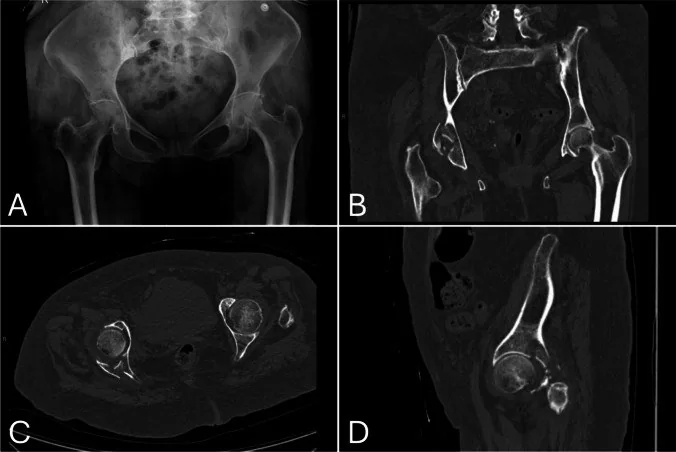
Arka kolon kırığı asetabulumun posterior kolonunu tutar; ilioiskial çizgi posterior kolon tutulumunu değerlendirmede kullanılan anatomik işaretlerden biridir. Travmalı hastada BT, kırık morfolojisini tanımlayarak kolon tutulumunu ve eklem içi fragmanları değerlendirmeye ve cerrahi planlamaya yardımcı olur. İlioiskial çizgi posterior kolon tutulumunu, posterior duvar fragmanının varlığı ise eşlik eden duvar bileşenini değerlendirmede kullanılan anatomik ipuçlarıdır. Asetabular kırıkların sınıflandırılmasında çok düzlemli ve üç boyutlu BT rekonstrüksiyonları ek olarak önerilir.
Faz ve pencere
- Kontrastsız tanısal
- Aksiyel ince kesitlerde posterior kolondan medial-lateral yönde geçen kortikal kırık hattı ve fragman yer değiştirmesi seçilir; koronal-sagittal kemik rekonstrüksiyonları hattın büyük siyatik çentikten çatıya, quadrilateral yüz ve obturator halkaya devamını gösterir. BT'de kırık morfolojisi, kolon tutulumu ve eklem içi fragmanlar değerlendirilir.
Önerilen pencereler G genişlik, M merkez; değerler Hounsfield birimi (HU)
- KemikG 1800 / M +400
- Yumuşak dokuG 400 / M +40
BT bulguları
- Çatı ilişkisi — posterior kolon tutulumunu ilioiskial çizgiyle değerlendirin; asetabular kırıkların sınıflandırılması için çok düzlemli BT ve 3B rekonstrüksiyonları inceleyin.
- İlioiskial çizgi karşılığı — ilioiskial çizginin değerlendirilmesi posterior kolon tutulumunu belirlemeye yardımcı olur.
- Kolon fragmanı — eşlik eden kırıklara rağmen posterior kolon kırığı yer değiştirmemiş olabilir.
- Arka duvar bileşeni — eklem seviyesinde ayrı posterior rim fragmanları aranır; kolon hattı ile duvar kırığı birlikteyse ilişkili örüntüdür.
- Femur başı subluksasyonu veya çıkığı — femur başının asetabuluma göre konumu ve olası yer değiştirmesi değerlendirilir.
- Pelvik yumuşak dokular — travma BT'sinde nadir de olsa gluteal kompartman hematomu görülebilir.
- Judet–Letournel sınıflamasında posterior kolon ve posterior duvar bileşenleri değerlendirilir; ikisi birlikte de bulunabilir.
Ölçütler ve sınıflamalar
- Judet–Letournel temel kırık örüntüleri
- Judet–Letournel sınıflamasında posterior kolon tutulumu ve posterior duvar fragmanının varlığı ayrı bileşenler olarak değerlendirilir. Arka duvar kırığı eklenirse posterior column–posterior wall ilişkili örüntüsü olarak tanımlanır.
- AO/OTA asetabulum 62A2
- AO sınıflamasında posterior kolon asetabulum kırığı 62A2.2 olarak kodlanır.
Normalde
İlioiskial çizgi, radyografik çizgi analizinde posterior kolon tutulumunu değerlendirmeye yardımcı olur. Karşılaştırmada yalnız arka eklem kenarını değil, çentik-çatı-obturator halka doğrultusundaki kemik köprüsünü ve femur başının merkezlenmesini izleyin.
Normal BT ile kıyasla
Aynı bölgenin, kaynak veri setinde patoloji içermediği belirtilen bir BT incelemesini kesit kesit kaydırın; organ sınırlarını açarak anatomiyi hasta görüntüsüyle karşılaştırın. Küçük rastlantısal bulgular tümüyle dışlanmamıştır.
Kaynak: TotalSegmentator v2.01 veri seti (Wasserthal ve ark., Radiology: Artificial Intelligence 2023), CC BY 4.0, vaka s1256; organ sınırları veri setinin otomatik segmentasyonundan, birleştirilerek sadeleştirildi. Görüntüler 2,5 mm kesit aralığına yeniden örneklendi.
Ayırıcı tanı
- Posterior duvar kırığında arka duvar fragmanı bulunur; posterior kolon kırığının eşlik edip etmediği ayrıca değerlendirilmelidir.
- Transvers asetabulum kırığı, Judet–Letournel sınıflamasında yer alan kırık örüntülerindendir.
- Posterior kolon kırığına posterior duvar kırığı eşlik edebilir; bu iki bileşen birlikte değerlendirilmelidir.
- Posterior kolon kırıklarında BT, kırık morfolojisini tanımlamaya yardımcı olur.
Tuzaklar
- Posterior kolon kırıklarının sınıflandırılmasında BT'de çok düzlemli ve 3B rekonstrüksiyonlar ek olarak önerilir.
- Başka kırık bileşenleri eşlik etse de posterior kolon kırığı yer değiştirmemiş olabilir; BT morfolojiyi tanımlamaya yardımcı olur.
- Obturator halka kırığı tek başına kolon kırığı demek değildir; tanı için kırık hattının posterior asetabular çatı ve büyük siyatik çentikle bağlantısını gösterin.
- Femur başının medial yer değiştirmesi BT'de saptanabilir ve kırık morfolojisiyle birlikte değerlendirilebilir.
Kendini dene
Standart pelvis grafilerinde ilioiskial çizgi hangi kolon tutulumunu değerlendirmede kullanılır?
Cevabı göster
Arka kolon. İlioiskial çizgi posterior kolon tutulumunu değerlendirmede kullanılan radyografik çizgilerden biridir. Posterior kolon tutulumu ilioiskial çizgiyle ilişkilendirilir.
Asetabular kırık örüntülerinin sınıflandırılmasında hangi ileri görüntüleme yaklaşımı önerilir?
Cevabı göster
MPR ve 3B BT. Asetabular kırık sınıflandırmasında çok düzlemli BT ve 3B rekonstrüksiyonlar ek olarak önerilir.
İlgili konular
Kaynaklar
Bu sayfadaki 38 cümle ve 2 quiz sorusu aşağıdaki kaynaklardan alıntılarla otomatik olarak karşılaştırıldı; 30 cümle bu karşılaştırmada düzeltildi (2026-10-09).
- Morphology-Guided Surgical Management of Complex Traumatic Hip Fracture-Dislocations and Acetabular Fractures: A Six-Case Series Illustrating Morphology-Based Surgical Approachespmc.ncbi.nlm.nih.gov
- Early post-traumatic avascular necrosis with secondary osteoarthritis following an acetabular fracture in a 19-year-old patient treated with total hip arthroplasty: a case reportpmc.ncbi.nlm.nih.gov
- Case Report: Osteosynthesis-associated infection with Ochrobactrum intermedium after acetabular fracturepmc.ncbi.nlm.nih.gov
- Favorable Outcome Twenty-Two Months after Delbet Type Ib Capital Femoral Transepiphyseal Fracture and Posterior Column Acetabular Fracture in a Fifteen-Year-Old Malepmc.ncbi.nlm.nih.gov
- A new navigational apparatus for fixation of acetabular posterior column fractures with percutaneous retrograde lagscrewpmc.ncbi.nlm.nih.gov
- Core curriculum illustration: posterior column acetabular fracture.pubmed.ncbi.nlm.nih.gov
- A new navigational apparatus for fixation of acetabular posterior column fractures with percutaneous retrograde lagscrew: Design and application.pubmed.ncbi.nlm.nih.gov
- Morphology-Guided Surgical Management of Complex Traumatic Hip Fracture-Dislocations and Acetabular Fractures: A Six-Case Series Illustrating Morphology-Based Surgical Approaches.pubmed.ncbi.nlm.nih.gov
- Early post-traumatic avascular necrosis with secondary osteoarthritis following an acetabular fracture in a 19-year-old patient treated with total hip arthroplasty: a case report.pubmed.ncbi.nlm.nih.gov
- Acetabular fractures in elderly.pubmed.ncbi.nlm.nih.gov
- Intraoperative Imaging in Pelvic Surgery.pubmed.ncbi.nlm.nih.gov
- Surgical Treatment of Displaced Acetabular Fractures Using a Modified Stoppa Approach.pubmed.ncbi.nlm.nih.gov
- A novel electromagnetic navigation tool for acetabular surgery.pubmed.ncbi.nlm.nih.gov
- Periacetabular osteotomy using three-dimensional cutting and reposition guides: a cadaveric study.pubmed.ncbi.nlm.nih.gov
- The ongoing relevance of acetabular fracture classification.pubmed.ncbi.nlm.nih.gov
- Designation and Validation of a Posterior Anatomical Plate for the Anterior Column of the Acetabulum.pubmed.ncbi.nlm.nih.gov
- Algorithms in acetabular fracture classifications.pubmed.ncbi.nlm.nih.gov
- 3D printing in designing of anatomical posterior column plate.pubmed.ncbi.nlm.nih.gov
- [Mid-term results of total hip arthroplasty for treatment of ankylosing spondylitis].pubmed.ncbi.nlm.nih.gov
- Analysis of computed tomography-based infra-acetabular morphometry to assess the feasibility of infra-acetabular screws.pubmed.ncbi.nlm.nih.gov
- The Reconstructive Pelvic Anatomy classification system : a valid and reliable classification system for pelvic reconstruction.pubmed.ncbi.nlm.nih.gov
- Feasibility study of a robot-assisted endoscopic technique for plate osteosyntheses of the acetabulum and anterior pelvic ring.pubmed.ncbi.nlm.nih.gov
- A novel plate design for anatomic reduction of posterior acetabular column and wall fractures: A retrospective comparative study of the Paseos plate versus the pelvic reconstruction plate.pubmed.ncbi.nlm.nih.gov
- Glossary of terms for musculoskeletal radiology.pubmed.ncbi.nlm.nih.gov
- Acetabular superior wall fractures: a distinct acetabular fracture entity.pubmed.ncbi.nlm.nih.gov
- The Predictive Factors for Post-Traumatic Hip Osteoarthritis After Surgical Treatment of Acetabular Fractures: A Retrospective Cohort of 130 Patients.pubmed.ncbi.nlm.nih.gov
- Management of Acetabular Fractures with Total Hip Replacement: A Narrative Literature Review.pubmed.ncbi.nlm.nih.gov
- The role of applying radiological modifiers to the Letournel classification and its clinical implications.pubmed.ncbi.nlm.nih.gov
- Quantitative three-dimensional fracture mapping reveals subtype-specific morphology of acetabular roof column and wall fractures.pubmed.ncbi.nlm.nih.gov
- Anatomy-driven automated subsegmentation of pelvic and proximal femoral CT into clinically relevant subregions and landmarks.pubmed.ncbi.nlm.nih.gov
- A case of nontraumatic acetabular fracture during epileptic seizure in an elderly patient: Imaging diagnosis and endovascular treatment.pubmed.ncbi.nlm.nih.gov
- Ipsilateral femoral neck and trochanter fracture.pubmed.ncbi.nlm.nih.gov
- Intraoperative Fluoroscopy for Minimally Invasive Periacetabular Osteotomy: A Standardized Step-By-Step Operative Technique.pubmed.ncbi.nlm.nih.gov
- Special screw corridors and imaging in pelvic ring trauma.pubmed.ncbi.nlm.nih.gov
- Fluoroscopy-assisted identification of the individual optimal antegrade entry point of the anterior column fixation corridor in pelvic and acetabular surgery: a novel perspective.pubmed.ncbi.nlm.nih.gov
- Clinico-radiological outcomes of surgical fixation for posterior column acetabular fractures, with or without posterior wall involvement.pubmed.ncbi.nlm.nih.gov
- Comparison of the Biomechanical Stability of Two Fix-and-Replace Techniques in an Acetabular Fracture Model with Pelvic Discontinuity.pubmed.ncbi.nlm.nih.gov
- Acetabular Bone Defect Classifications in Revision Total Hip Arthroplasty: A Systematic Review of the Literature.pubmed.ncbi.nlm.nih.gov
- Management of Intraoperative Acetabular Fractures in Total Hip Arthroplasty: A Current Concept Review.pubmed.ncbi.nlm.nih.gov
- The Impact of Pelvic Osteotomies on Birth Canal Anatomy and Cesarean Section Rates: A Systematic Review.pubmed.ncbi.nlm.nih.gov
- Safe surgical technique for associated acetabular fractures.pubmed.ncbi.nlm.nih.gov
- Isolated screw fixation of posterior wall fractures.pubmed.ncbi.nlm.nih.gov
- Labral repair restoring stability in a mildly dysplastic hip with concomitant femoral head and neck fracture-dislocation: a case report.pubmed.ncbi.nlm.nih.gov
- Femoroacetabular stabilization using a suspensory fixation device in post-traumatic hip instability after hip fracture-dislocation: technique and report of 6 cases.pubmed.ncbi.nlm.nih.gov
- Deep Gluteal syndrome: An underestimated cause of posterior hip pain.pubmed.ncbi.nlm.nih.gov
- Clinical results of endoscopic sciatic nerve decompression for deep gluteal syndrome: mean 2-year follow-up.pubmed.ncbi.nlm.nih.gov
- Posterior, Lateral, and Anterior Hip Pain Due to Musculoskeletal Origin: A Narrative Literature Review of History, Physical Examination, and Diagnostic Imaging.pubmed.ncbi.nlm.nih.gov
- Functional Outcomes of Surgical Management of Posterior Wall Acetabular Fractures: A Prospective Study.pubmed.ncbi.nlm.nih.gov
- Association of prophylactic transcatheter arterial embolization with perioperative blood loss and operative time in complex acetabular fractures: a propensity score-matched retrospective study.pubmed.ncbi.nlm.nih.gov
- Comparing outcomes of acetabular fracture fixation in early career versus experienced orthopaedic trauma surgeons.pubmed.ncbi.nlm.nih.gov
- Super-acute massive osteolysis of the femoral head after acetabular fracture fixation : a comparative study with conventional post-traumatic osteonecrosis requiring total hip arthroplasty.pubmed.ncbi.nlm.nih.gov
- Systematic Review of Combined Pelvic Ring and Acetabular Injuries: What Do We Know From the Literature?pubmed.ncbi.nlm.nih.gov
- Erectile dysfunction after acetabular fracture.pubmed.ncbi.nlm.nih.gov
- Three-Dimensional Printing and Fracture Mapping in Pelvic and Acetabular Fractures: A Systematic Review and Meta-Analysis.pubmed.ncbi.nlm.nih.gov
- Prognostic factors and quality of life after pelvic fractures. The Brabant Injury Outcome Surveillance (BIOS) study.pubmed.ncbi.nlm.nih.gov
- Treatment of Geriatric Acetabular Fractures Using the Modified Stoppa Approach: A Review Article of Technique, Tips, and Pitfalls.pubmed.ncbi.nlm.nih.gov
- Rugby Injury Imaging.pubmed.ncbi.nlm.nih.gov
- Management of Complex Acetabular Fractures by Using 3D Printed Models.pubmed.ncbi.nlm.nih.gov
- Sacroiliac Joint Ankylosis in Pelvic Ring Injuries with Posterior Ilium Fractures.pubmed.ncbi.nlm.nih.gov
- Association of knee ligament injury with pelvic and acetabular fractures: a retrospective cohort study.pubmed.ncbi.nlm.nih.gov
- A new rhynchocephalian (Reptilia: Lepidosauria) from the Late Jurassic of Solnhofen (Germany) and the origin of the marine Pleurosauridae.pubmed.ncbi.nlm.nih.gov
- Asymmetric Bilateral Hip Dislocations: A Case Report and Historical Review of the Literature.pubmed.ncbi.nlm.nih.gov
- Anatomy and systematics of the diplodocoid Amphicoelias altus supports high sauropod dinosaur diversity in the Upper Jurassic Morrison Formation of the USA.pubmed.ncbi.nlm.nih.gov
- Management of skeletal metastases: An orthopaedic surgeon's guide.pubmed.ncbi.nlm.nih.gov
- Acetabular fractures in the elderly: treatment recommendations.pubmed.ncbi.nlm.nih.gov
- Patterns of injury and violence in Yaoundé Cameroon: an analysis of hospital data.pubmed.ncbi.nlm.nih.gov
- Osteotomies: Indications, Imaging Appearance, Surgical Techniques, and Complications.pubmed.ncbi.nlm.nih.gov
- Artificial intelligence assisted preoperative planning and 3D-printing guiding frame for percutaneous screw reconstruction in periacetabular metastatic cancer patients.pubmed.ncbi.nlm.nih.gov
- Is percutaneous fixation of the superior pubic ramus possible in all types of pelvis?pubmed.ncbi.nlm.nih.gov
- Diagnostic value of multiple projection angle X-ray and CT 3D reconstruction for long-term unreduced posterior hip dislocation.pubmed.ncbi.nlm.nih.gov
- Is Hip Center Elevation an Acceptable Choice for Total Hip Arthroplasty for Legg-Calvé-Perthes Disease? Perioperative Complications and Patient-Reported Outcomes.pubmed.ncbi.nlm.nih.gov
- Hybrid plate-and-UHMWPE fixation for step-cut subtrochanteric osteotomy in crowe IV hip dysplasia: a finite element-supported case report.pubmed.ncbi.nlm.nih.gov
- Pelvic-girdle reconstruction with three-dimensional-printed endoprostheses after limb-salvage surgery for pelvic sarcomas: current landscape.pubmed.ncbi.nlm.nih.gov
- Comparative analysis of posterior column screw trajectories: pararectus vs. lateral window of the pelvis.pubmed.ncbi.nlm.nih.gov
- Lateral rectus abdominis approach fixation of a high-energy both-column acetabular fracture after total hip arthroplasty with retention of a stable acetabular cup: a case report.pubmed.ncbi.nlm.nih.gov
- Custom Triflange Acetabular and Femoral Components for Primary Hip Arthroplasty in a Patient With Severe Bone Defect: A Case Report.pubmed.ncbi.nlm.nih.gov
- An unprecedented pan-brachial injury: A case report of ipsilateral floating shoulder, floating elbow, and acetabular fracture following a psychosis-induced fall.pubmed.ncbi.nlm.nih.gov
- Minimally invasive stabilisation of anterior pelvic ring injuries through anterior infix versus percutaneous anterior retrograde pubic screw: a prospective comparative cohort study.pubmed.ncbi.nlm.nih.gov
- Long-term results of a vitamin E-blended polyethylene liner in total hip arthroplasty: a minimum ten year computer aided design based evaluation of wear and component positioning.pubmed.ncbi.nlm.nih.gov
- Acetabular Morphotype Is Associated with Change in Acetabular Orientation Between Supine and Standing.pubmed.ncbi.nlm.nih.gov
- Modern Dual Mobility Implants in Total Hip Arthroplasty: Stability, Survival, and Ion Safety Evaluation: The Comprehensive Review.pubmed.ncbi.nlm.nih.gov
- Quadrilateral plate fractures.pubmed.ncbi.nlm.nih.gov
- Bone metastases from hepatocellular carcinoma: Guidance on the management of spinal and long bone lesions.pubmed.ncbi.nlm.nih.gov
- Experimental Biomechanical study on the consequences of dashboard injury of the pelvis after total hip replacement.pubmed.ncbi.nlm.nih.gov
- Staged management of a Tile C3 pelvic ring injury with bilateral sacroiliac disruption and T-shaped sacral fracture.pubmed.ncbi.nlm.nih.gov
- Long-Term Outcome of Patients with a Floating Hip Injury of Müller Type A: An Analysis of Prognostic Factors Linked to Functional Outcomes.pubmed.ncbi.nlm.nih.gov
- Rehabilitation Protocols for Surgically Treated Acetabular Fractures in Older Adults: Current Practices and Outcomes.pubmed.ncbi.nlm.nih.gov
- Biomechanical and Computational Modeling of Metastatic Acetabular Defects: Influence of Tumor Location on the Risk of Fracture.pubmed.ncbi.nlm.nih.gov
- Letournel-Judet Classification of Acetabular Fractures: A Systematic Review of Reliability and Association With Post-traumatic Arthritis.pubmed.ncbi.nlm.nih.gov
- The Diagnosis and Treatment of Acetabular Bone Loss in Revision Hip Arthroplasty: An International Consensus Symposium.pubmed.ncbi.nlm.nih.gov
- The use of an algorithm for classifying acetabular fractures: a role for resident education?pubmed.ncbi.nlm.nih.gov
- Delayed fixation of neglected acetabular fractures: clinical challenges and mid-term outcomes of a prospective case series.pubmed.ncbi.nlm.nih.gov
- Acetabulum fractures in elderly patients: A review.pubmed.ncbi.nlm.nih.gov
- Safe passage analysis for both column screw fixation technique in posterior column acetabular fractures.pubmed.ncbi.nlm.nih.gov
- The anatomical bone corridor study of schanz screw placement in adolescent pelvic ring fractures via three-dimensional CT.pubmed.ncbi.nlm.nih.gov
- Is the both column fixation corridor a universally valid and consistent fixation pathway in pelvic and acetabular surgery?pubmed.ncbi.nlm.nih.gov
- Clinical impact of early postoperative routine radiology in isolated pelvic injuries: a retrospective study.pubmed.ncbi.nlm.nih.gov
- Reconstruction with 3D-printed prostheses after type I + II + III internal hemipelvectomy: Finite element analysis and preliminary outcomes.pubmed.ncbi.nlm.nih.gov
- Cementless acetabular revision: past, present, and future. Revision total hip arthroplasty: the acetabular side using cementless implants.pubmed.ncbi.nlm.nih.gov
- Open reduction and internal fixation versus percutaneous multiple-trajectory screw fixation for unstable pelvic fractures with severe polytrauma: a prospective study.pubmed.ncbi.nlm.nih.gov
- Outcomes after surgical treatment of acetabular fractures: a review.pubmed.ncbi.nlm.nih.gov
- Results after surgical treatment of transtectal transverse acetabular fractures.pubmed.ncbi.nlm.nih.gov
- A novel internal fixation system for sacral fractures: a finite element biomechanical study.pubmed.ncbi.nlm.nih.gov
- A novel technique for posterior internal fixation of acetabular fractures.pubmed.ncbi.nlm.nih.gov
- Progress of fracture mapping technology based on CT three-dimensional reconstruction.pubmed.ncbi.nlm.nih.gov
- Pre-Reduction Position of Posterior Wall Fragment is Associated with Intra-Articular Displacement.pubmed.ncbi.nlm.nih.gov
- Metallosis and pseudotumor following total hip arthroplasty: a case report of two patients.pubmed.ncbi.nlm.nih.gov
- Gluteal compartment syndrome and superior gluteal artery injury as a result of simple hip dislocation: a case report.pubmed.ncbi.nlm.nih.gov
- Posterior hip pain in an athletic population: differential diagnosis and treatment options.pubmed.ncbi.nlm.nih.gov
- Sciatic nerve injury associated with acetabular fractures.pubmed.ncbi.nlm.nih.gov
- Imaging of Hip Pain: From Radiography to Cross-Sectional Imaging Techniques.pubmed.ncbi.nlm.nih.gov
- Utilization of the posterior iliac line for visualizing posterior column screws in obturator oblique view.pubmed.ncbi.nlm.nih.gov
- A study on the feasibility and initial outcomes of artificial intelligence-assisted preoperative planning for hip revision surgery.pubmed.ncbi.nlm.nih.gov
- Management and outcome of displaced acetabular fractures in the oldest-old: a retrospective analysis of orif and acute total hip arthroplasty.pubmed.ncbi.nlm.nih.gov
- Catastrophic Failure of a Prosthetic Femoral Stem due to Component Malposition: A Case Report.pubmed.ncbi.nlm.nih.gov
Eğitim amaçlıdır; hasta başında tanı ve tedavi kararının yerine geçmez, tıbbi tavsiye değildir. Metinler yapay zekâ desteğiyle yazıldı ve otomatik bir adımda kaynak alıntılarıyla karşılaştırıldı; bu bir tıbbi doğrulama değildir ve içerik uzman radyolog incelemesinden geçmedi. Klinik kararlarda güncel kılavuzları, kurum protokollerini ve radyoloji raporunu esas alın.