Özet
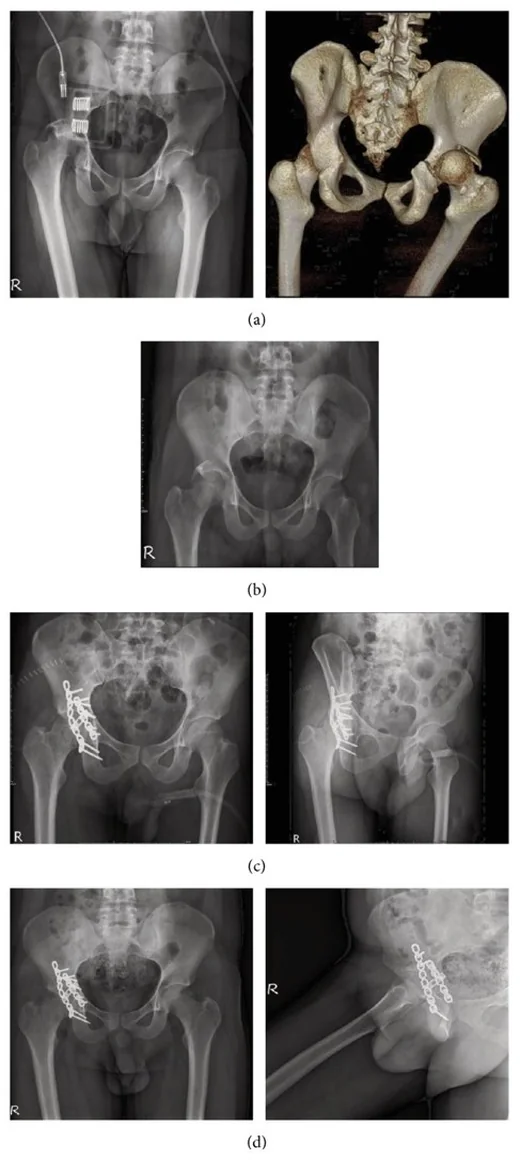
Kalça çıkığına eşlik eden asetabulum kırıkları genellikle yüksek enerjili travma sonucu gelişir ve asetabulum duvar kırığı, femur başı yaralanması veya eklem içi kemik parçası bulgularıyla birlikte seyreder. İnce kesit kontrastsız BT, femur başının asetabulumla ilişkisini, kırık parçalarını ve eşlik eden eklem içi cisimleri gösterir; redüksiyon sonrası BT'de eklem içindeki sıkışmış parça ve kalan uyumsuzluk özellikle görünür hale gelir. Tek grafi kırık örüntüsünün ve küçük fragmanların kapsamını eksik gösterebilir. Çıkıkla ilişkili kırık, femur başı impaksiyonu veya eklemde hapsolmuş parçanın atlanması eklem bütünlüğüne dair kritik bilginin kaybolmasına neden olur.
Faz ve pencere
- Kontrastsız tanısal
- Redüksiyon sonrası BT, femur başı ve asetabular duvar fragmanlarının konumunu ve eklem içi yabancı cisimleri değerlendirmeye yardımcı olur. Redüksiyon sonrası BT ve üç boyutlu rekonstrüksiyonlar, fragmanların ekleme gömülme durumunu, boyutunu ve asetabulum-femur başı uyumunu detaylandırmak için kullanılır.
Önerilen pencereler: Kemik (G 1800 / M 400), Yumuşak doku (G 400 / M 40).
BT bulguları
- Femur başı asetabular merkez dışı — baş asetabular eklem yüzünden ayrılmış ve çıkık yönüne göre posterior, anterior veya inferior yerleşmiştir.
- Posterior duvar kırığı — arka asetabular korteks ayrılmış, parçalı veya femur başı tarafından itilmiş olabilir.
- Asetabular kolon kırığı — kırık çizgisi ön/arka kolondan ilerler; transvers veya birleşik örüntü eşlik edebilir.
- Femur başı impaksiyonu — baş yüzünde fokal düzleşme, çökme ya da osteokondral defekt görülebilir.
- Femur başı osteokondral kırığı — BT, femur başı kırık fragmanlarının boyutunu ve eşlik eden asetabular duvar kırığını tanımlamaya yardımcı olur.
- Eklem içi hapsolmuş fragman — redükte kalçanın eklem aralığında yer alan kemik parçası eklem yüzlerinin tam oturmasını engelleyebilir.
- Eklem aralığı asimetrisi — redüksiyon sonrasında baş ile asetabulum arasında fokal genişleme veya uyumsuzluk, araya giren fragmanla ilişkili olabilir.
- Eşlik eden pelvik halka yaralanması — sakrum, pubik ramuslar veya sakroiliak eklemde ek kırık/ayrışma bulunabilir.
Ölçütler ve sınıflamalar
- Letournel-Judet asetabulum sınıflaması
- Asetabular eşlikçi kırığı beş temel tipten (ön duvar, ön kolon, arka duvar, arka kolon, transvers) veya beş birleşik tipten biri olarak tanımlar; kalça çıkığının yönü ayrıca belirtilir.
- Pipkin femur başı kırığı sınıflaması
- Pipkin (yaygın, anatomik sınıflama): Tip I femur başı kırığı fovea capitis’in inferiorunda; Tip II superiorundadır. Tip III, Tip I/II femur başı kırığına femur boyun kırığının; Tip IV ise asetabular kırığın eşlik ettiği örüntüdür. Sınıflama fragman boyutu, deplasman, eklem kongruitesi ve eşlik eden asetabular kırığın ayrıntılarını tek başına kodlamaz; bunları ayrıca tarif edin.
Normalde
Redüksiyon sonrası BT, fragmanların eklem içindeki konumunu ve eklemde yabancı cisim bulunup bulunmadığını değerlendirmeye yardımcı olur; 3B BT rekonstrüksiyonları izlemde kullanılabilir.
Normal BT ile kıyasla
Aynı bölgenin, kaynak veri setinde patoloji içermediği belirtilen bir BT incelemesini kesit kesit kaydırın; organ sınırlarını açarak anatomiyi hasta görüntüsüyle karşılaştırın. Küçük rastlantısal bulgular tümüyle dışlanmamıştır.
Kaynak: TotalSegmentator v2.01 veri seti (Wasserthal ve ark., Radiology: Artificial Intelligence 2023), CC BY 4.0, vaka s1256; organ sınırları veri setinin otomatik segmentasyonundan, birleştirilerek sadeleştirildi. Görüntüler 2,5 mm kesit aralığına yeniden örneklendi.
Ayırıcı tanı
- Femur başı kırığı olmadan saf kalça çıkığı
- baş asetabulum dışındadır ancak asetabular duvar ve baş korteksinde belirgin kırık görülmeyebilir.
- Femur başı osteokondral kırığı
- baş konturundan kopan fragman ön plandadır; asetabular duvar kırığı eşlik etmeyebilir.
- Asetabular arka duvar kırığı ve subluksasyon
- baş eklem içinde kısmen örtülü kalır; tam çıkıkta olduğu gibi asetabulum dışına taşınmaz.
- Gelişimsel displaziye bağlı kalça subluksasyonu, asetabular kemik yetersizliği ve anormal eklem yüklenmesiyle birlikte görülebilir.
- Kalça protezi çıkığı
- femur başı protez bileşeni içindedir; asetabulum bileşeni ve linerı değerlendirilir, doğal asetabulum yüzeyi yerine protez yapıları izlenir.
Tuzaklar
- Çıkık yönünü yalnız pelvis grafisindeki projeksiyona göre varsaymayın; BT'de femur başının asetabulum ve posterior duvarla gerçek ilişkisini belirleyin.
- Redüksiyon sonrası düzgün görünen eklemde küçük eklem içi fragmanı dışlamayın; eklem aralığını ardışık ince kesitlerde ve karşı tarafla kıyaslayın.
- Femur başındaki impaksiyon defekti yalnızca asetabular kırık olarak yorumlanmamalıdır; başın tüm artiküler konturunu ayrıca tarayın.
- Posterior duvar fragman boyutu tek başına dinamik kalça stabilitesini belirlemez; BT morfolojisini stabilite muayenesinin yerine koymayın.
- Redüksiyon sonrası eklem konsantrik değilse, BT’de eklem içi patoloji ile eşlik eden femur başı veya asetabulum kırığı araştırılmalıdır.
Kendini dene
Redüksiyon sonrası femur başı yuvada ancak posterior eklem aralığında küçük kemik parçası ve asimetri sürüyor. En olası açıklama nedir?
Cevabı göster
Eklem içi hapsolmuş fragman. Eklem aralığında kemik parçası ve kalan asimetri, tam kongruiteyi engelleyen hapsolmuş fragmanı düşündürür. Avasküler nekroz erken travma sonrası küçük serbest parça biçiminde görünmez; displazi kronik örtünme azlığı, hematom ise yumuşak doku bulgusudur.
Kalça çıkığına femur başında subkondral çökme ve asetabulumda posterior duvar kırığı eşlik ediyor. Hangi ek yaralanma bölgesi ayrıca taranmalıdır?
Cevabı göster
Pelvik halka. Yüksek enerjili kalça çıkığı eşlik eden sakrum, pubik ramus veya sakroiliak yaralanmalarla birlikte olabilir; pelvis BT'sinde halka devamlılığı gözden geçirilir. Diğer seçenekler bu bölgesel travma örüntüsünün dışında kalır.
İlgili konular
Kaynaklar
Bu sayfadaki 44 cümle ve 2 quiz sorusu aşağıdaki kaynaklardan alıntılarla otomatik olarak karşılaştırıldı; 9 cümle bu karşılaştırmada düzeltildi (2026-10-09).
- Classifications in Brief: The Pipkin Classification of Femoral Head Fracturespmc.ncbi.nlm.nih.gov
- Hip dislocations--epidemiology, treatment, and outcomes.pubmed.ncbi.nlm.nih.gov
- Management of neglected acetabular fractures.pubmed.ncbi.nlm.nih.gov
- Relative position of the supra-acetabular bone to the crestal plane: a radiological analysis.pubmed.ncbi.nlm.nih.gov
- Hip dislocation: evaluation and management.pubmed.ncbi.nlm.nih.gov
- Middle-term follow-up results of Pipkin type IV femoral head fracture patients treated by reconstruction plate and bioabsorbable screws.pubmed.ncbi.nlm.nih.gov
- Mid term results of total hip arthroplasty using polyethylene-ceramic composite (Sandwich) liner.pubmed.ncbi.nlm.nih.gov
- Assessment of acetabular version in total hip arthroplasty: an application of Widmer's technique in a regional setting.pubmed.ncbi.nlm.nih.gov
- Supine versus lateral position for accurate positioning of acetabular cup in total hip arthroplasty using the modified Watson-Jones approach: A randomized single-blind controlled trial.pubmed.ncbi.nlm.nih.gov
- Does intraoperative periprosthetic occult fracture of the acetabulum affect clinical outcomes after primary total hip arthroplasty?pubmed.ncbi.nlm.nih.gov
- Fracture-dislocations of the femoral head.pubmed.ncbi.nlm.nih.gov
- Fractures of the acetabulum in elderly patients: an update.pubmed.ncbi.nlm.nih.gov
- Morphological abnormalities of the hip in acetabular fractures.pubmed.ncbi.nlm.nih.gov
- Size and location of posterior wall fragment on CT can predict hip instability in a cadaveric model.pubmed.ncbi.nlm.nih.gov
- Italian Consensus Conference on Guidelines for preoperative treatment in acetabular fractures.pubmed.ncbi.nlm.nih.gov
- Association of knee ligament injury with pelvic and acetabular fractures: a retrospective cohort study.pubmed.ncbi.nlm.nih.gov
- Labral repair restoring stability in a mildly dysplastic hip with concomitant femoral head and neck fracture-dislocation: a case report.pubmed.ncbi.nlm.nih.gov
- Functional Outcomes of Surgical Management of Posterior Wall Acetabular Fractures: A Prospective Study.pubmed.ncbi.nlm.nih.gov
- Pre-Reduction Position of Posterior Wall Fragment is Associated with Intra-Articular Displacement.pubmed.ncbi.nlm.nih.gov
- Morphology-Guided Surgical Management of Complex Traumatic Hip Fracture-Dislocations and Acetabular Fractures: A Six-Case Series Illustrating Morphology-Based Surgical Approaches.pubmed.ncbi.nlm.nih.gov
- Acetabular superior wall fractures: a distinct acetabular fracture entity.pubmed.ncbi.nlm.nih.gov
- Short-term clinical and radiographic outcomes of a 3D-printed trabecular titanium acetabular cup in primary total hip arthroplasty for Crowe type I-III developmental dysplasia of the hip with limited acetabular bone defects: a retrospective comparative study.pubmed.ncbi.nlm.nih.gov
- The Unique Features of Pediatric Sports Injuries: The Hip.pubmed.ncbi.nlm.nih.gov
- Clinical impact of early postoperative routine radiology in isolated pelvic injuries: a retrospective study.pubmed.ncbi.nlm.nih.gov
- Impaction Injury of the Femoral Head After Traumatic Posterior Hip Dislocation: A Literature Review and Case Study.pubmed.ncbi.nlm.nih.gov
- A Systematic Approach to the Evaluation of Acute Musculoskeletal Injuries in the Emergency Department.pubmed.ncbi.nlm.nih.gov
- Management of Geriatric Acetabulum Fracture - A Case Report.pubmed.ncbi.nlm.nih.gov
- Femoroacetabular stabilization using a suspensory fixation device in post-traumatic hip instability after hip fracture-dislocation: technique and report of 6 cases.pubmed.ncbi.nlm.nih.gov
- Risk factors for bipolar hemiarthroplasty dislocation: a retrospective cohort study.pubmed.ncbi.nlm.nih.gov
- Rabbit models of hip dysplasia: a narrative review.pubmed.ncbi.nlm.nih.gov
- Artificial Intelligence-Based Automatic Screening System for Hip Dysplasia.pubmed.ncbi.nlm.nih.gov
- Management and outcome of displaced acetabular fractures in the oldest-old: a retrospective analysis of orif and acute total hip arthroplasty.pubmed.ncbi.nlm.nih.gov
- Comparing outcomes of acetabular fracture fixation in early career versus experienced orthopaedic trauma surgeons.pubmed.ncbi.nlm.nih.gov
- The Predictive Factors for Post-Traumatic Hip Osteoarthritis After Surgical Treatment of Acetabular Fractures: A Retrospective Cohort of 130 Patients.pubmed.ncbi.nlm.nih.gov
- Favorable 17-Year Outcome of a Bulk Femoral Head Allograft Combined With a Burch-Schneider Antiprotrusio Cage in Revision Total Hip Arthroplasty for Severe Acetabular Osteolysis and Pelvic Discontinuity: A Case Report.pubmed.ncbi.nlm.nih.gov
- Super-acute massive osteolysis of the femoral head after acetabular fracture fixation : a comparative study with conventional post-traumatic osteonecrosis requiring total hip arthroplasty.pubmed.ncbi.nlm.nih.gov
- Hip Arthroscopy-Assisted Management of Pipkin Types I and II Femoral Head Fracture-Dislocations: Mid-Term Clinical and Radiographic Outcomes.pubmed.ncbi.nlm.nih.gov
- Osteochondral Autograft Options for Reconstruction of Intra-articular Distal Humerus and Proximal Ulna Injuries in Physiologically Young Patients.pubmed.ncbi.nlm.nih.gov
- Ligamentum teres tear with hyaline body formation: A rare cause of mechanical hip pain.pubmed.ncbi.nlm.nih.gov
- Hip Arthroscopy After Total Hip Arthroplasty: A Current Review of Indications, Techniques, and Outcomes.pubmed.ncbi.nlm.nih.gov
- Lateral rectus abdominis approach fixation of a high-energy both-column acetabular fracture after total hip arthroplasty with retention of a stable acetabular cup: a case report.pubmed.ncbi.nlm.nih.gov
- Post-traumatic End-Stage Hip Osteoarthritis Decades After an Adolescent Gunshot Wound Treated With Direct Anterior Total Hip Arthroplasty: A Case Report.pubmed.ncbi.nlm.nih.gov
- Staged management of a compound combined pelvi-acetabular injury with perineal degloving in a young female: a case report and literature review.pubmed.ncbi.nlm.nih.gov
- Modified Pemberton osteotomy for developmental dysplasia of the hip in children: a mid- to long-term follow-up study.pubmed.ncbi.nlm.nih.gov
- Single-baseline virtual progression modeling of Crowe type I-III developmental dysplasia of the hip: a finite element study of stress-location migration.pubmed.ncbi.nlm.nih.gov
- Individualized 3D Planning for Hip Reconstruction in Cerebral Palsy: Study Protocol.pubmed.ncbi.nlm.nih.gov
- Combined Patellofemoral Arthroplasty With Patellar Realignment: Surgical Technique and Clinical Outcomes in a Retrospective Case Series.pubmed.ncbi.nlm.nih.gov
- Mid-term outcomes of modified colonna capsular arthroplasty in adolescent and young adult patient with unilateral hip dysplasia dislocation.pubmed.ncbi.nlm.nih.gov
- MRI-based parameters to assess the quality and prognosis of closed reduction in toddlers with developmental dysplasia of the hip.pubmed.ncbi.nlm.nih.gov
- Association of prophylactic transcatheter arterial embolization with perioperative blood loss and operative time in complex acetabular fractures: a propensity score-matched retrospective study.pubmed.ncbi.nlm.nih.gov
- Treatment of posterior wall acetabular fractures via the direct posterior approach using a seagull-shaped plate: A retrospective cohort study.pubmed.ncbi.nlm.nih.gov
- Long-Term Outcome of Patients with a Floating Hip Injury of Müller Type A: An Analysis of Prognostic Factors Linked to Functional Outcomes.pubmed.ncbi.nlm.nih.gov
- CT/MRI-based finite element model construction and biomechanical analysis of acetabular quadrilateral fractures.pubmed.ncbi.nlm.nih.gov
- Beyond Pipkin IV: Management of Femoral Head-neck Fracture-dislocation with Posterior Acetabular Wall and Peritrochanteric Fracture in an Adolescent Using a Modified Kocher-Langenbeck Approach.pubmed.ncbi.nlm.nih.gov
- Femoral head fractures systematic review and meta-analysis.pubmed.ncbi.nlm.nih.gov
- A Case Report of Pipkin Type II Femoral Head Fracture Managed by Ganz Safe Surgical Dislocation and Headless Compression Screw (Herbert Screw) Fixation: A Stepwise Technical Description and Clinical Outcome.pubmed.ncbi.nlm.nih.gov
- Femoral head fractures: anatomy, diagnosis and management.pubmed.ncbi.nlm.nih.gov
- Staged Emergency Caesarean Section and Cementless Total Hip Arthroplasty Within a Single Anaesthetic Episode for Pipkin Type III Femoral Head Fracture-Dislocation in a Gravid Patient: A Case Report.pubmed.ncbi.nlm.nih.gov
- Management of Femoral Head Fractures: A Systematic Review.pubmed.ncbi.nlm.nih.gov
- Mix and match strategies in revision total hip arthroplasty: a review of techniques and outcomes.pubmed.ncbi.nlm.nih.gov
- Isolated fracture of the anterior wall of the acetabulum: A rare fracture, even rarer in the skeletally immature patient. Report of two cases and literature review.pubmed.ncbi.nlm.nih.gov
- Delayed fixation of neglected acetabular fractures: clinical challenges and mid-term outcomes of a prospective case series.pubmed.ncbi.nlm.nih.gov
- Modified triple pelvic osteotomy for residual acetabular dysplasia through double incisions: Technical note and review of short-term results.pubmed.ncbi.nlm.nih.gov
- Avascular femoral head necrosis in young gymnasts: a pursuit of aetiology and management.pubmed.ncbi.nlm.nih.gov
- A Rare Presentation of Idiopathic Medial Patellar Instability: Case Report and Review of the Literature.pubmed.ncbi.nlm.nih.gov
- Obturator Dislocation During Pavlik Harness Treatment for Developmental Dysplasia of the Hip: A Rare Complication and Its Clinical Course.pubmed.ncbi.nlm.nih.gov
- Total Hip Arthroplasty for Post-Traumatic Hip Arthritis in Chronic Pubic Diastasis: A Case Report.pubmed.ncbi.nlm.nih.gov
- Impact of Chronic Opioid Use in Recurrent Dislocations following Revision Total Hip Arthroplasty: An Iatrogenic Charcot-Like Arthropathy Case Report.pubmed.ncbi.nlm.nih.gov
- Risk Factors and Preventive Strategies for Dislocation Following Primary Total Hip Arthroplasty: A Large Single-Surgeon Cohort Study.pubmed.ncbi.nlm.nih.gov
- A Narrative Review of Spinopelvic Alignment Changes After Total Hip Arthroplasty.pubmed.ncbi.nlm.nih.gov
- Indications for Acetabular and Femoral Osteotomies for the Non-Arthritic Hip.pubmed.ncbi.nlm.nih.gov
- Ballistic injuries of the pelvis and acetabulum: a narrative review.pubmed.ncbi.nlm.nih.gov
- Conservative Treatment of Pediatric Fractures-Narrative Review of Acceptable Deformity and Remodeling Potential.pubmed.ncbi.nlm.nih.gov
- Femoral head impaction fracture: a new technique for closed reduction and biological stabilisation.pubmed.ncbi.nlm.nih.gov
- Both Acetabular and Femoral Reconstructions With Impaction Bone Grafting in Revision Total Hip Arthroplasty: Case Series and Literature Review.pubmed.ncbi.nlm.nih.gov
- Etiology, pathology, and treatment of osteonecrosis of the femoral head in adolescents: A comprehensive review.pubmed.ncbi.nlm.nih.gov
- Functional and Vascular Outcomes of Posterior Acetabular Wall Osteosynthesis via the Kocher-Langenbeck Approach: A Dynamic Analysis.pubmed.ncbi.nlm.nih.gov
- A Pilot Three-Dimensional Evaluation of Acetabular Bony Coverage After Modified Spitzy Shelf Acetabuloplasty.pubmed.ncbi.nlm.nih.gov
- Three-Dimensional Estimation of the Femoral Head Center From Trochanteric Landmarks in Japanese Female Patients With Developmental Dysplasia of the Hip.pubmed.ncbi.nlm.nih.gov
- Bone Shape Feature Differences in Single and Recurrent Patellar Dislocations via Statistical Shape Modeling.pubmed.ncbi.nlm.nih.gov
- Chronic posterior shoulder dislocation: Current evidence, treatment options, and a decision-making algorithm.pubmed.ncbi.nlm.nih.gov
- Quantitative three-dimensional fracture mapping reveals subtype-specific morphology of acetabular roof column and wall fractures.pubmed.ncbi.nlm.nih.gov
- Case Report: Combined posterolateral and direct anterior approaches for total hip arthroplasty in osteonecrosis of the femoral head with a rare massive osteophyte with literature review.pubmed.ncbi.nlm.nih.gov
- Residual articular incongruity is not a predictor of poor functional outcomes in operatively treated intra-articular elbow fractures.pubmed.ncbi.nlm.nih.gov
- Surgical Treatment of Acetabular Posterior Wall Fracture with Hip Arthroscopy: A Case Report.pubmed.ncbi.nlm.nih.gov
- Acceptable outcomes after anterior subcutaneous pelvic Internal Fixation (INFIX) for Fragility Fractures of the Pelvis (FFP) type III in elderly patients: a retrospective study.pubmed.ncbi.nlm.nih.gov
- Case Report of Overlapping Pubic Symphysis Dislocation Managed Nonoperatively.pubmed.ncbi.nlm.nih.gov
- Clinical Outcomes of Straddle Fracture Patterns: A Retrospective Multicenter Analysis Based on a New Descriptive Classification Framework.pubmed.ncbi.nlm.nih.gov
- Surgical management of traumatic posterior hip dislocation associated with ipsilateral femoral shaft fracture in a child via the anterior approach: a case report and literature review.pubmed.ncbi.nlm.nih.gov
- Isolated screw fixation of posterior wall fractures.pubmed.ncbi.nlm.nih.gov
- The role of applying radiological modifiers to the Letournel classification and its clinical implications.pubmed.ncbi.nlm.nih.gov
- Accuracy analysis of the new artificial anatomical marker positioning method (shoulder-to-shoulder) in preventing leg length discrepancy in total hip arthroplasty.pubmed.ncbi.nlm.nih.gov
- Imaging in Hip Arthroplasty Management Part 2: Postoperative Diagnostic Imaging Strategy.pubmed.ncbi.nlm.nih.gov
- Advances in FAI Imaging: a Focused Review.pubmed.ncbi.nlm.nih.gov
- Arthroscopic-Assisted Removal of Incarcerated Fragment following Manual Reduction of Posterior Hip Dislocation in Acute Polytrauma Patient: A Case Report.pubmed.ncbi.nlm.nih.gov
- Efficient hip joint distraction using the AO large femoral distractor in treating acetabular fractures associated with marginal impaction and intraarticular incarcerated fragments.pubmed.ncbi.nlm.nih.gov
- Anatomical landmarks and intraoperative "safe zone" for precise acetabular prosthesis placement in total hip arthroplasty for developmental dysplasia of the hip.pubmed.ncbi.nlm.nih.gov
- Accuracy of Acetabular Cup Position Using CT Navigation During Total Hip Arthroplasty in Patients With Developmental Dysplasia of the Hip.pubmed.ncbi.nlm.nih.gov
- Optimizing Acetabular Positioning: A Comprehensive Review of Contemporary Strategies in Total Hip Arthroplasty.pubmed.ncbi.nlm.nih.gov
- Radiographic assessment of femoral, acetabular and global offset following hip spacer implantation in staged total hip arthroplasty".pubmed.ncbi.nlm.nih.gov
- Femoral head fracture management: outcomes of surgical hip dislocation with bioabsorbable screw fixation.pubmed.ncbi.nlm.nih.gov
- Recurrent Ceramic Femoral Head Fracture in Dual Mobility Total Hip Arthroplasty: A Case Report.pubmed.ncbi.nlm.nih.gov
- Musculoskeletal changes and treatments in paediatric spinal cord disorders: A scoping review.pubmed.ncbi.nlm.nih.gov
- Ipsilateral Knee Pain After Total Hip Arthroplasty: Pathogenesis and Intervention Strategies-A Narrative Review.pubmed.ncbi.nlm.nih.gov
- Glenohumeral cartilage lesions: reviewing diagnostic imaging strategies and preoperative evaluation.pubmed.ncbi.nlm.nih.gov
- Unexpected Metal Ion Elevation and Adverse Tissue Reactions in Trident II Dual Mobility Constructs With Ceramic Heads.pubmed.ncbi.nlm.nih.gov
- Citation landscape and research themes of robotic-assisted total hip arthroplasty: a bibliometric analysis of the 100 most-cited English-language publications in the Web of Science Core Collection.pubmed.ncbi.nlm.nih.gov
- Early Intraprosthetic Dislocation After Closed Reduction of Dual-Mobility Total Hip Arthroplasty: A Case Report.pubmed.ncbi.nlm.nih.gov
- Traumatic Bilateral Asymmetrical Hip Dislocation with Acetabular Fracture: A Case Report and Review of Current Evidence.pubmed.ncbi.nlm.nih.gov
- Traumatic lumbosacral instability: part 2-indications and techniques for surgical management.pubmed.ncbi.nlm.nih.gov
- Outcomes after surgical treatment of acetabular fractures: a review.pubmed.ncbi.nlm.nih.gov
Eğitim amaçlıdır; hasta başında tanı ve tedavi kararının yerine geçmez, tıbbi tavsiye değildir. Metinler yapay zekâ desteğiyle yazıldı ve otomatik bir adımda kaynak alıntılarıyla karşılaştırıldı; bu bir tıbbi doğrulama değildir ve içerik uzman radyolog incelemesinden geçmedi. Klinik kararlarda güncel kılavuzları, kurum protokollerini ve radyoloji raporunu esas alın.