Özet
Atlantoaksiyel subluksasyon, C1 atlasın C2 aksis üzerindeki öne-arkaya veya rotasyonel uyumunun bozulmasıdır; travma, inflamasyon ve üst solunum yolu enfeksiyonu sonrası gelişebilir. İzotropik çözünürlüklü çok kesitli BT ve çok düzlemli rekonstrüksiyonlar kompleks kemik anomalilerini daha iyi gösterir; rotasyonel fiksasyon tanısını desteklemek için baş sağa ve sola döndürülürken atlasın aksise göre sabit kaldığı gösterilmelidir. Artmış atlantodental aralık atlantoaksiyel dislokasyonu düşündürür; BT kemik hizalanmasını değerlendirirken transvers bağ bütünlüğü ve omurilik etkilenmesi için MR daha uygundur. Rotasyonel fiksasyon tanısında, baş sola ve sağa olabildiğince döndürülürken C1’in C2’ye göre sabit kaldığı ve normal C1-C2 rotasyonunun kaybolduğu gösterilmeli; bulgu, rotasyonel atlantoaksiyel yer değiştirmede klasik başvuru bulgusu olan tortikollis bağlamında değerlendirilmelidir.
Faz ve pencere
- Kontrastsız tanısal
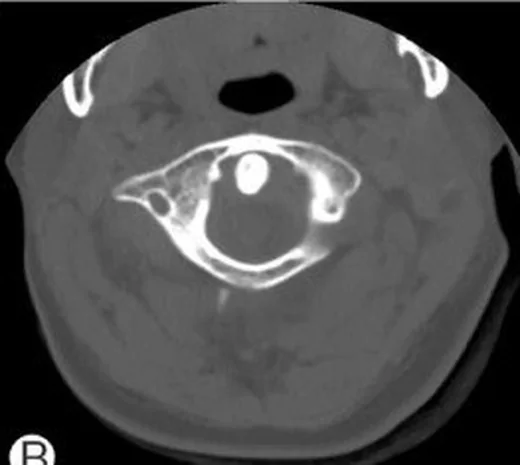
- Aksiyel BT görüntülerinde densin C1 halkası içindeki konumu ve C1’in C2’ye göre rotasyonel hizalanması değerlendirilir.
- Kemik algoritması tanısal
- Sagittal ve koronal BT rekonstrüksiyonları kırık hattının düzlemini ve parçalanma derecesini göstermeye yardımcıdır.
Önerilen pencereler G genişlik, M merkez; değerler Hounsfield birimi (HU)
- KemikG 1800 / M +400
BT bulguları
- C1 ön arkusu ile dens arasındaki atlantodental aralıkta artış izlenebilir.
- C1 lateral kitlelerinin C2'ye göre rotasyonel yer değiştirmesi değerlendirilir.
- Dinamik BT'de baş döndürülürken C1'in C2'ye göre sabit kalması ve normal rotasyon kaybı gösterilir.
- Densin C1 halkasına göre konumu ve transvers bağ bütünlüğünü düşündüren indirekt kemik hizalanma bulguları.
- Tam atlas halka kırığında transvers bağ bütünlüğü için MR değerlendirmesi gerekebilir.
- Baş sola ve sağa döndürülürken C1'in C2'ye göre sabit kalıp kalmadığı değerlendirilir.
- Kanal çapında kemik daralma veya belirgin translasyon varsa omurilik etkisi için MR gereksinimi klinik bağlamda ayrıca değerlendirilir.
Ölçütler ve sınıflamalar
- Fielding–Hawkins Tip II anterior translasyon
- 3–5 mm
- Fielding–Hawkins Tip III anterior translasyon
- >5 mm
- Erişkinde anterior atlanto-dental aralık (ADI)
- Erişkinde <3 mm normal kabul edilir; erişkinde >3 mm genişleme olarak değerlendirilir.
- Çocukta anterior atlanto-dental aralık (ADI; ≤8 yaş radyografi referansı)
- Lateral radyografide ≤8 yaşta <5 mm, >8 yaşta <3 mm normal kabul edilir. BT için eşikler ölçüm yöntemi/modaliteye göre değişebilir; bu radyografi sınırı evrensel bir BT kesim değeri olarak kullanılmamalıdır.
- Fielding–Hawkins rotasyonel sınıflaması
- Tip I: rotasyon vardır, anterior translasyon yoktur; tip II: anterior translasyon 3–5 mm; tip III: >5 mm anterior translasyon; tip IV: C1’in C2’ye göre posterior yer değiştirmesi. Sınır ölçümleri tek başına tanı koydurmaz; statik incelemede baş pozisyonu da değerlendirilir.
Normalde
Nötral baş pozisyonunda normal C1 ve C2 anteroposterior eksenleri paraleldir ve MDCT'de atlantodental aralık <2.6 mm, AA aralığı <3.9 mm olarak ölçülür. Kıyaslamada dens-C1 ön arkusu mesafesini, sağ-sol faset örtüşmesini ve başın/omuzların tarama içindeki rotasyonunu birlikte inceleyin; uç fizyolojik rotasyonda faset temasının azalabileceğini unutmayın.
Normal BT ile kıyasla
Aynı bölgenin, kaynak veri setinde patoloji içermediği belirtilen bir BT incelemesini kesit kesit kaydırın; organ sınırlarını açarak anatomiyi hasta görüntüsüyle karşılaştırın. Küçük rastlantısal bulgular tümüyle dışlanmamıştır.
Kaynak: TotalSegmentator v2.01 veri seti (Wasserthal ve ark., Radiology: Artificial Intelligence 2023), CC BY 4.0, vaka s1338; organ sınırları veri setinin otomatik segmentasyonundan, birleştirilerek sadeleştirildi. Görüntüler 2,5 mm kesit aralığına yeniden örneklendi.
Ayırıcı tanı
- Fizyolojik pozisyonel C1-C2 rotasyonunu rotasyonel fiksasyondan ayırmak için, baş sola ve sağa olabildiğince döndürülürken C1’in C2’ye göre sabit kaldığı ve normal rotasyonun kaybolduğu gösterilmelidir.
- Rotasyonel fiksasyon genellikle ağrılı tortikollis ve karakteristik cock-robin pozisyonuyla başvurur.
- Os odontoideum
- dens tabanından ayrı kortike kemikçik ve kısa dens gövdesi, atlantoaksiyel instabiliteye eşlik edebilir.
- Travmatik kaynamamada fragman aralığı dar ve düzensiz olabilir; kırık hattı aksis gövdesine uzanabilir.
- Grisel sendromu
- travma olmadan üst solunum yolu/baş-boyun enfeksiyonu sonrası rotasyonel malalignment görülebilir.
Tuzaklar
- Tek pozisyon BT hareketle redükte olan subluksasyonu gösteremeyebilir; dinamik BT yalnız klinik olarak uygun seçilmiş durumda ek bilgi sağlar.
- Atlantodental aralık normal görünse bile rotasyonel faset anormalliği bulunabilir; dens ön arkus ölçümünü tek başına dışlama ölçütü yapmayın.
- Artmış ADI transvers bağ yaralanması olasılığını düşündürür ancak tek başına kanıtlamaz; bağ bütünlüğü kuşkusunda MR değerlendirmeye yardımcı olur.
Kendini dene
Çocuğun BT'sinde baş belirgin sağa dönük; C1-C2 faset teması azalmış, dens-C1 aralığı artmamış. En doğru yaklaşım hangisidir?
Cevabı göster
Pozisyonel rotasyonu sorgula. Başın dönük olduğu statik incelemede faset temasının azalması fizyolojik olabilir; patolojik fiksasyonu kanıtlamak için dinamik BT (baş her iki yönde döndürülerek) veya klinik takip gereklidir. Tip III için belirgin anterior translasyon gerekir; ölçüm olmadan bağ kopması veya dens kırığı çıkarımı yapılamaz.
C1'in C2'ye göre öne translasyonu 6 mm ve rotasyonel kilitlenme var. Fielding–Hawkins sınıfı hangisidir?
Cevabı göster
Tip III. 5 mm üzerindeki anterior translasyon Tip III ile uyumludur. Tip I'de öne translasyon minimaldir; Tip II 3–5 mm aralığındadır; Tip IV posterior yer değiştirmeyi tanımlar.
İlgili konular
Kaynaklar
Bu sayfadaki 44 cümle ve 2 quiz sorusu aşağıdaki kaynaklardan alıntılarla otomatik olarak karşılaştırıldı; 11 cümle bu karşılaştırmada düzeltildi (2026-10-12).
- CT and MR imaging of odontoid abnormalities: A pictorial reviewpmc.ncbi.nlm.nih.gov
- Cervical Spine Evaluation in Pediatric Trauma: A Review and an Update of Current Conceptspmc.ncbi.nlm.nih.gov
- Atlantoaxial dislocation.pubmed.ncbi.nlm.nih.gov
- Injuries of the upper cervical spine-how can instability be identified?pubmed.ncbi.nlm.nih.gov
- Spine challenges in mucopolysaccharidosis.pubmed.ncbi.nlm.nih.gov
- Recommendations for the Diagnostic Testing and Therapy of Atlas Fractures.pubmed.ncbi.nlm.nih.gov
- Cervical spine involvement early in the course of rheumatoid arthritis.pubmed.ncbi.nlm.nih.gov
- Endoscopic transoral excision of odontoid process in irreducible atlantoaxial dislocation: our experience of 34 patients.pubmed.ncbi.nlm.nih.gov
- Atlanto-Axial Subluxation After Adenoidectomy.pubmed.ncbi.nlm.nih.gov
- 'Pseudofacets' or 'supernumerary facets' in congenital atlanto-axial dislocation: boon or bane?pubmed.ncbi.nlm.nih.gov
- New Classification and Its Value Evaluation for Atlantoaxial Dislocation.pubmed.ncbi.nlm.nih.gov
- Thinking beyond pannus: a review of retro-odontoid pseudotumor due to rheumatoid and non-rheumatoid etiologies.pubmed.ncbi.nlm.nih.gov
- Atlantoaxial rotatory subluxation in children.pubmed.ncbi.nlm.nih.gov
- Rotational vertebral artery occlusion ("bow hunter syndrome").pubmed.ncbi.nlm.nih.gov
- Management of Unusual Atlantoaxial Dislocation.pubmed.ncbi.nlm.nih.gov
- Anxiety- and depression-related somatic symptoms and atlantoaxial disorders: potential mechanistic links and clinical implications.pubmed.ncbi.nlm.nih.gov
- Combined tonsillar reflex zone stimulation and four-step manipulative reduction for Grisel syndrome following pediatric adenotonsillectomy: a case report.pubmed.ncbi.nlm.nih.gov
- Imaging and classifications of atlantoaxial dislocation: a narrative review.pubmed.ncbi.nlm.nih.gov
- Case Report: Multimodal imaging, custom 3D-printed reconstruction and surgical stabilization of severe congenital occipitoatlantoaxial malformation in an adult dog.pubmed.ncbi.nlm.nih.gov
- Rheumatoid Arthritis in the Cervical Spine: An Updated Review of Epidemiology, Imaging, and Surgical Indications.pubmed.ncbi.nlm.nih.gov
- Surgical management strategies for atlantoaxial instability/dislocation in down syndrome.pubmed.ncbi.nlm.nih.gov
- CT evaluation of pediatric craniocervical distraction injuries: a comprehensive review of morphometric parameters and practical applications.pubmed.ncbi.nlm.nih.gov
- Mild Grisel Syndrome: Expanding the Differential for Posttonsillectomy Adenoidectomy Symptoms.pubmed.ncbi.nlm.nih.gov
- Does alar ligament injury predict conservative treatment failure of atlantoaxial rotatory subluxation in adults: Case report and review of the literature.pubmed.ncbi.nlm.nih.gov
- Atlanto-axial morphometric measurements for age and sex estimation: a retrospective cone beam computed tomography study.pubmed.ncbi.nlm.nih.gov
- Life-size 3D modeling for C1-C2 fixation planning: A preoperative tool for atlantoaxial stabilization techniques.pubmed.ncbi.nlm.nih.gov
- Clinical characteristics of postoperative anterior arch fracture of the atlas following C1 laminectomy: 14-year experience of a single neurosurgical center.pubmed.ncbi.nlm.nih.gov
- Atlantoaxial Rotatory Fixation: Current Challenges and Advances in Diagnosis and Management.pubmed.ncbi.nlm.nih.gov
- Correlation Between Outcomes of Surgical Correction of Atlantoaxial Instability in Small Dogs and Magnetic Resonance Imaging Abnormalities.pubmed.ncbi.nlm.nih.gov
- Chronic Irreducible C1-C2 Rotatory Subluxation Presenting as Painful Torticollis in a Child Managed with Posterior Lateral Mass Fixation: A Case Report.pubmed.ncbi.nlm.nih.gov
- 3D printing enabled biomechanical evaluation of a novel expandable wedge spacer for atlantoaxial reduction.pubmed.ncbi.nlm.nih.gov
- Staged Management of Adult Traumatic Atlantoaxial Rotatory Fixation With C2 Superior Facet Fracture: A Case Report.pubmed.ncbi.nlm.nih.gov
- Treatment of Canine Atlantoaxial Subluxation with a Modified Cervical Distraction-Stabilization Technique and Clinical Outcomes.pubmed.ncbi.nlm.nih.gov
- Occipitocervical dissociation: A narrative review and case series with a novel management algorithm proposal.pubmed.ncbi.nlm.nih.gov
- Differentiating the Structural and Functional Instability of the Craniocervical Junction.pubmed.ncbi.nlm.nih.gov
- Traumatic posterior dislocation of atlanto-axial joint with anterior arch fracture in the patient of atlanto-occipital assimilation: A case report.pubmed.ncbi.nlm.nih.gov
- Congenital and Breed-Associated Vertebral Anomalies in Dogs and Cats: Developmental Anatomy, Genetic Determinants, and Biological Significance.pubmed.ncbi.nlm.nih.gov
- Challenges and solutions in the treatment of spinal disorders in patients with skeletal dysplasia: A comprehensive review.pubmed.ncbi.nlm.nih.gov
- Comparison of the diagnostic performance of the Swischuk line method and the anterior atlantodental interval method in atlantodental subluxation.pubmed.ncbi.nlm.nih.gov
- Occipital plate-assisted posterior reduction for tumor-related severe atlantoaxial dislocation: a single-case surgical technique.pubmed.ncbi.nlm.nih.gov
- Endoscopic-Assisted Posterior Atlantoaxial Fusion: Technical Innovation and Clinical Experience.pubmed.ncbi.nlm.nih.gov
- Posterior C1-C2 screw-rod salvage for Chiari I malformation with atlantoaxial instability after failed foramen magnum decompression.pubmed.ncbi.nlm.nih.gov
- Mobility Assessment Using Multi-Positional MRI in Children with Cranio-Vertebral Junction Anomalies.pubmed.ncbi.nlm.nih.gov
- Consensus practice guidelines on interventions for cervical spine (facet) joint pain from a multispecialty international working group.pubmed.ncbi.nlm.nih.gov
- Consensus practice guidelines on interventions for cervical spine (facet) joint pain from a multispecialty international working group.pubmed.ncbi.nlm.nih.gov
- Inflammatory Pediatric Grisel Syndrome Secondary to Acute Adenoiditis: A Rare Case Report and Review of Literature.pubmed.ncbi.nlm.nih.gov
- Grisel's syndrome as an early manifestation of Kawasaki disease preceding Kawasaki disease shock syndrome: a case report.pubmed.ncbi.nlm.nih.gov
- Long-Term Outcomes of Prolonged Atlantoaxial Rotatory Fixation Managed Without Halo Vest Immobilization in a Child.pubmed.ncbi.nlm.nih.gov
- Atlantoaxial rotatory fixation.pubmed.ncbi.nlm.nih.gov
- Dorsal C1-2 Spinal Cord Compression After Reduction of Atlantoaxial Posterior Dislocation Associated With Os Odontoideum: A Case Report and Literature Review.pubmed.ncbi.nlm.nih.gov
- OS odontoideum in an achondroplastic adult - A case report and review.pubmed.ncbi.nlm.nih.gov
- A Case of Occipitocervical Fixation for Orthotopic Os Odontoideum in a 2-year-old Child with Progressive Floppy Infant.pubmed.ncbi.nlm.nih.gov
- The mutational burden in os odontoideum patients.pubmed.ncbi.nlm.nih.gov
- CerviHFENet: hybrid feature extraction-based deep learning for multi-label classification of upper cervical spine abnormalities in X-ray imaging.pubmed.ncbi.nlm.nih.gov
- Isolated Idiopathic Cervical Dystonia with a Rare Type of Atlantoaxial Dislocation. A Case Report and a Short Literature Review.pubmed.ncbi.nlm.nih.gov
- A case report of postoperative atlantoaxial rotatory subluxation following craniotomy for pilocytic astrocytoma in a pediatric patient.pubmed.ncbi.nlm.nih.gov
- The Grisel Syndrome: early interdisciplinary treatment needed to prevent severe upper cervical deformity - Experience from a high-volume spine center and systematic review of existing literature.pubmed.ncbi.nlm.nih.gov
- Clinical significance of measuring the lateral atlantodental interval in children with tic disorders.pubmed.ncbi.nlm.nih.gov
- Association of Chiropractic Colleges Educational Conference and Research Agenda Conference 2025: Transformative Trends in Healthcare.pubmed.ncbi.nlm.nih.gov
- Pediatric cervical spine instability.pubmed.ncbi.nlm.nih.gov
- Atlantoaxial Subluxation Related to Axial Spondylarthritis: A Case-Based Systematic Review.pubmed.ncbi.nlm.nih.gov
- Grisel's Syndrome After COVID-19 in a Pediatric Patient: A Case Report.pubmed.ncbi.nlm.nih.gov
- Diagnosis and Prevalence (1975-2010) of Sudden Death due to Atlantoaxial Subluxation in Cervical Rheumatoid Arthritis: A Literature Review.pubmed.ncbi.nlm.nih.gov
- Intraoperative computed tomography guided navigation for atlantoaxial screw placement: Accuracy and safety analysis.pubmed.ncbi.nlm.nih.gov
- An Observational Retrospective and Prospective Study to Evaluate the Treatment Outcomes of Atlantoaxial Osteoarthritis.pubmed.ncbi.nlm.nih.gov
- Imaging Findings of Pediatric Rheumatic Disorders: JIA in the PRINTO Era and Autoimmune Interferonopathies.pubmed.ncbi.nlm.nih.gov
- Cervical spine trauma.pubmed.ncbi.nlm.nih.gov
- Plough Fracture (Anterior Arch Fracture Type Traumatic Posterior Atlantoaxial Dislocation, TPAD-AOT Type III): A Retrospective Study of Nine Clinical Cases With Complete Imaging Data.pubmed.ncbi.nlm.nih.gov
- Management of neurologically intact traumatic posterior atlantoaxial dislocation with odontoid fracture and bilateral locked facets: a case report and literature review.pubmed.ncbi.nlm.nih.gov
- Navigation-assisted C1-ring osteosynthesis for an unstable atlas fracture: a case report.pubmed.ncbi.nlm.nih.gov
- Atlantoaxial rotatory subluxation in a pediatric patient with osteopetrosis following minor trauma: illustrative case.pubmed.ncbi.nlm.nih.gov
- Atlantoaxial subluxation treated with exercise therapy combined with occipito-maxillary band traction: a case report.pubmed.ncbi.nlm.nih.gov
- Atlantoaxial Dislocation Presenting with Dizziness.pubmed.ncbi.nlm.nih.gov
- Biomechanical effects of the prone stretching and adjusting cervical manipulation : a three-dimensional finite element analysis study.pubmed.ncbi.nlm.nih.gov
- Neural Basis of Etiopathogenesis and Treatment of Cervicogenic Orofacial Pain.pubmed.ncbi.nlm.nih.gov
- Therapeutic options and results following fixed atlantoaxial rotatory dislocations.pubmed.ncbi.nlm.nih.gov
- Non-instrumented management of traumatic atlanto-axial rotatory subluxation: surgical technique.pubmed.ncbi.nlm.nih.gov
- Craniovertebral Junction Instability after Oncological Resection: A Narrative Review.pubmed.ncbi.nlm.nih.gov
- Bow Hunter's syndrome surgical approach and outcome: Two new cases and literature review.pubmed.ncbi.nlm.nih.gov
- CT and MR imaging of odontoid abnormalities: A pictorial review.pubmed.ncbi.nlm.nih.gov
- Magnetic Resonance Imaging of the Craniovertebral Junction Ligaments: Normal Anatomy and Traumatic Injury.pubmed.ncbi.nlm.nih.gov
- Novel artificial transverse atlantal ligament reconstruction for atlantoaxial instability: a finite element analysis.pubmed.ncbi.nlm.nih.gov
- Scintigraphic Characteristics of the Occipitoatlantoaxial Region in Clinically Sound Horses.pubmed.ncbi.nlm.nih.gov
- Atlantoaxial rotatory dislocation: Surgical treatment in a pediatric patient cohort.pubmed.ncbi.nlm.nih.gov
- Surgical Management of Adult Traumatic Atlantoaxial Rotatory Subluxation with Unilateral Locked Facet; Case Report and Literature Review.pubmed.ncbi.nlm.nih.gov
- Case Report of a Traumatic Atlantoaxial Rotatory Subluxation with Bilateral Locked Cervical Facets: Management, Treatment, and Outcome.pubmed.ncbi.nlm.nih.gov
- Vertebral Artery Dissection and PICA-Territory Stroke Associated with Chronic Atlantoaxial Structural Abnormality: A Case Report.pubmed.ncbi.nlm.nih.gov
- C1-ring osteosynthesis for Jefferson fracture: a multi-institutional retrospective case series.pubmed.ncbi.nlm.nih.gov
- Imaging of cervical spine involvement in inflammatory arthropathies: a review.pubmed.ncbi.nlm.nih.gov
- Comparison between Bilateral C2 Pedicle Screwing and Unilateral C2 Pedicle Screwing, Combined with Contralateral C2 Laminar Screwing, for Atlantoaxial Posterior Fixation.pubmed.ncbi.nlm.nih.gov
- Pediatric Craniovertebral Junction Surgery.pubmed.ncbi.nlm.nih.gov
- Finite Element Analysis of Anterior Odontoid Screw Fixation for Type II Odontoid Fractures.pubmed.ncbi.nlm.nih.gov
- Stress-guided determination of screw trajectory for C1 lateral mass fixation: A finite element approach.pubmed.ncbi.nlm.nih.gov
- C1-C2 subluxation in enthesitis-related arthritis: two case reports and literature review of ten cases.pubmed.ncbi.nlm.nih.gov
- Cervical Myelopathy Caused by Non-Rheumatic Retro-Odontoid Pseudotumor: An Investigation of Underlying Mechanisms and Optimal Surgical Strategy.pubmed.ncbi.nlm.nih.gov
- Atlantoaxial Spondyloptosis: Report of a Case and Review of the Literature.pubmed.ncbi.nlm.nih.gov
- Ununited Mobile Odontoid Fracture: Clinical and Imaging Findings With Subsequent Management: A Case Report.pubmed.ncbi.nlm.nih.gov
- Two-screw osteosynthesis is biomechanically superior to single-screw osteosynthesis for type II odontoid fractures.pubmed.ncbi.nlm.nih.gov
- Atlantoaxial rotatory displacement in children.pubmed.ncbi.nlm.nih.gov
- Pathoanatomy, biomechanics, and treatment of upper cervical ligamentous instability: A literature review.pubmed.ncbi.nlm.nih.gov
- Pediatric Spine Trauma.pubmed.ncbi.nlm.nih.gov
- A review of the diagnosis and treatment of atlantoaxial dislocations.pubmed.ncbi.nlm.nih.gov
- Atlanto-axial rotary instability (Fielding type 1): characteristic clinical and radiological findings, and treatment outcomes following alignment, fusion, and stabilization.pubmed.ncbi.nlm.nih.gov
- Novelties for increased safety in cranio-vertebral surgery: a review.pubmed.ncbi.nlm.nih.gov
- Association of Chiropractic Colleges Educational Conference and Research Agenda Conference 2026: Connected Care.pubmed.ncbi.nlm.nih.gov
- Post-Traumatic Atlanto-Axial Instability: A Combined Clinical and Radiological Approach for the Diagnosis of Pathological Rotational Movement in the Upper Cervical Spine.pubmed.ncbi.nlm.nih.gov
- Addressing the challenges of complex type III odontoid fractures: Clinical and radiological outcomes of various treatment modalities.pubmed.ncbi.nlm.nih.gov
- Clinical and Radiographic Outcomes of Modified Posterior Atlantoaxial Temporary Fixation with Preservation of Semispinalis Cervicis: A Comparative Study.pubmed.ncbi.nlm.nih.gov
- Anatomical Variants of the Cervical Spine and Sports-Related Injury in Athletes: A Narrative Review.pubmed.ncbi.nlm.nih.gov
- Clinical study of three internal fixation systems via transoral approach for motor function preservation in atlas fractures.pubmed.ncbi.nlm.nih.gov
- Morphometric Evaluation of the Craniovertebral Junction Using Computed Tomography: A Sex-Based Analysis of 500 Adults.pubmed.ncbi.nlm.nih.gov
- Cervical Spine Evaluation in Pediatric Trauma: A Review and an Update of Current Concepts.pubmed.ncbi.nlm.nih.gov
Eğitim amaçlıdır; hasta başında tanı ve tedavi kararının yerine geçmez, tıbbi tavsiye değildir. Metinler yapay zekâ desteğiyle yazıldı ve otomatik bir adımda kaynak alıntılarıyla karşılaştırıldı; bu bir tıbbi doğrulama değildir ve içerik uzman radyolog incelemesinden geçmedi. Klinik kararlarda güncel kılavuzları, kurum protokollerini ve radyoloji raporunu esas alın.