Özet
Tip II odontoid kırığı, dens ile C2 korpusunun bileşkesinden geçer ve özellikle düşük enerjili düşme sonrası ileri yaşta görülebilir. BT odontoid kırıklarının tanımlanmasında temel yöntemdir; MPR’de kırık hattı, fragman konumu, angulasyon ve parçalanma değerlendirilir. Kırık hattının C2 korpusuna uzanıp uzanmadığı tip II/III ayrımında değerlendirilir; C1–C2 dizilimi yaralanmanın kapsamını değerlendirmede kullanılır. Akut kırık ile os odontoideum veya eski kaynamamış kırık ayrımında kortikal kenarlar, fragman morfolojisi ve C1–C2 ilişkisi birlikte değerlendirilmelidir.
Faz ve pencere
- Kontrastsız tanısal
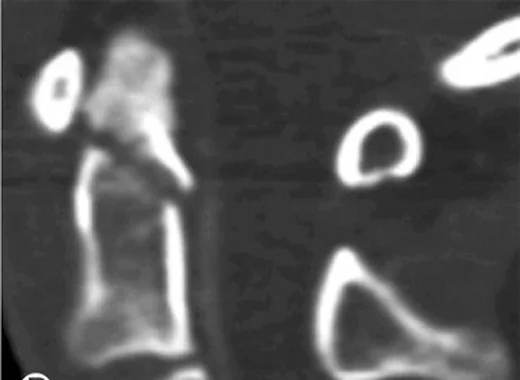
- Sagittal BT rekonstrüksiyonunda dens tabanındaki transvers tip II kırık, koronal rekonstrüksiyonda ise atlantoaksiyal dislokasyon gösterilebilir.
Önerilen pencereler G genişlik, M merkez; değerler Hounsfield birimi (HU)
- KemikG 1800 / M +400
BT bulguları
- Dens-korpus bileşkesinden geçen transvers ya da oblik kırık hattı.
- Dens fragmanı posteriora deplase olabilir.
- Dens fragmanında anterior ya da posterior translasyon ve angulasyon.
- Kırık hattında parçalanma veya küçük ara fragman.
- Anderson–D’Alonzo tip II odontoid kırığı dens tabanında yer alır. Grauer sınıflaması, odontoid kırıklarını sınıflandırmak için kullanılan sistemlerden biridir.
- Dens kırığına atlantoaksiyal dislokasyon eşlik edebilir.
- Akut servikal travma BT’sinde daha önceden oluşmuş, nonakut veya kaynamamış odontoid kırığı bulguları da eşlik edebilir.
- Kronik kaynamama veya nonakut odontoid kırığında BT’de kırık rezorpsiyonu, skleroz ve kist oluşumu görülebilir.
Ölçütler ve sınıflamalar
- Anderson–D’Alonzo odontoid sınıflaması
- Tip II kırık dens tabanı ile C2 korpusu arasındaki bileşkeden geçer. Tip I dens apeksini tutar; tip III dens tabanının altından başlayıp C2 korpusuna uzanır.
- Grauer tip II alt grupları
- Grauer tip II alt grupları: IIA deplase olmayan kırık; IIB anterosüperior–posteroinferior yönde oblik kırık veya deplase transvers kırık; IIC anteroinferior–posterosüperior yönde oblik ya da parçalı kırık. Bu alt tipler kırık hattının yönünü, deplasmanını ve parçalanmasını betimler.
Normalde
Normal dens tabanı, C2 korpusuna kesintisiz kortikal geçiş yapar; odontoid çevresinde kırık aralığı veya fragman basamağı yoktur. Aynı sagittal düzeyde dens-korpus birleşimini, aksiyelde korteks devamlılığını ve C1 lateral kitlelerinin C2 üst artiküler fasetleriyle ilişkisini MPR'de değerlendirin.
Normal BT ile kıyasla
Aynı bölgenin, kaynak veri setinde patoloji içermediği belirtilen bir BT incelemesini kesit kesit kaydırın; organ sınırlarını açarak anatomiyi hasta görüntüsüyle karşılaştırın. Küçük rastlantısal bulgular tümüyle dışlanmamıştır.
Kaynak: TotalSegmentator v2.01 veri seti (Wasserthal ve ark., Radiology: Artificial Intelligence 2023), CC BY 4.0, vaka s1338; organ sınırları veri setinin otomatik segmentasyonundan, birleştirilerek sadeleştirildi. Görüntüler 2,5 mm kesit aralığına yeniden örneklendi.
Ayırıcı tanı
- Odontoid tip I kırığı
- kırık hattı dens apeksini tutar.
- Os odontoideum, kraniyoservikal bileşke patolojisidir; etiyolojisi tartışmalı olup travmatik ve konjenital mekanizmalar öne sürülmüştür.
- Travmatik eski kaynamama
- yeni travma sonrası BT’de daha önceden oluşmuş ve kaynamamış odontoid kırığı bulunabilir.
- Subdental sinkondroz
- dens tabanı ile C2 korpusu arasındaki gelişimsel sinkondroz 3–6 yaşta kaynaşır; iz 11–12 yaşına kadar görülebilir.
Tuzaklar
- Dens tabanına sınırlı sığ kırıklarda tip II ile sığ tip III ayrımı güç olabilir; korpus uzanımını çok kesitli izleyin.
- Os odontoideum–kırık ayrımında ossikülün çevresel kortikasyonu ve C1 anterior arkındaki eşlik eden hipertrofi yararlı morfolojik ipuçlarıdır.
- Başın aksiyel rotasyonu C1 lateral kitlelerinin C2 ile ilişkisini değiştirebilir; C1–C2 hizalanmasını MPR’de birden fazla düzlemde birlikte değerlendirin.
- Kronik kaynamamış tip II odontoid kırığında BT’de fraktür rezorpsiyonu, skleroz ve kist oluşumu görülebilir.
Kendini dene
BT'de kırık hattı dens ile C2 gövdesinin birleşiminde sonlanıyor; apeks sağlam ve gövdeye belirgin uzanım yok. Sınıfı nedir?
Cevabı göster
Anderson–D’Alonzo tip II. Tip II, dens tabanı ile C2 korpusu arasındaki bileşke kırığıdır. Tip I dens apeksini, tip III ise dens tabanının altından C2 korpusuna uzanan hattı tanımlar; os odontoideum çevresel kortikasyonla sınırlı ayrı bir ossiküldür. Verilen akut taban kırığı bu nedenle tip II’dir.
Tip II odontoid kırığında BT'de kronik kaynamama bulguları hangileridir?
Cevabı göster
Rezorpsiyon, skleroz, kist. Kronik kaynamamada BT'de kırık rezorpsiyonu, skleroz ve kist oluşumu görülür.
İlgili konular
Kaynaklar
Bu sayfadaki 42 cümle ve 2 quiz sorusu aşağıdaki kaynaklardan alıntılarla otomatik olarak karşılaştırıldı; 21 cümle bu karşılaştırmada düzeltildi (2026-10-12).
- Odontoid Fractures: A Review of the Current State of the Artapi.repository.cam.ac.uk
- Classifications of Odontoid Process Fractures: A Systematic Review and Proposal of a New Simplified Classification System Based on Embryologyassets.cureus.com
- A review and commentary on congenital anomalies of the craniocervical junctionlink.springer.com
- Imaging Assessment of Nontraumatic Pathologic Conditions at the Craniovertebral Junction: A Comprehensive Reviewpubs.rsna.org
- Systematic Review on Surgical and Nonsurgical Treatment of Type II Odontoid Fractures in the Elderlypmc.ncbi.nlm.nih.gov
- Type II odontoid fracture with complete posterior dens displacement: Manual reduction and anterior screw fixationpmc.ncbi.nlm.nih.gov
- Case of posterior atlantoaxial dislocation with backward displacement of type II odontoid fracturepmc.ncbi.nlm.nih.gov
- C1 translaminar screw as a salvage technique for a failed lateral mass screw: A case report and literature reviewpmc.ncbi.nlm.nih.gov
- Operative video of Goel-Harms C1-C2 fusion for atlanto-axial instability secondary to odontoid fracture (Anderson-D’ Alonzo II)pmc.ncbi.nlm.nih.gov
- Odontoid fractures: update on management.pubmed.ncbi.nlm.nih.gov
- A major pitfall to avoid: retroclival hematoma due to odontoid fracture.pubmed.ncbi.nlm.nih.gov
- Symptomatic vertebral artery compression by the rod of a C1-C2 posterior fusion construct: case report and review of the literature.pubmed.ncbi.nlm.nih.gov
- Posterior C1-C2 Fixation Using Absorbable Suture for Type II Odontoid Fracture in 2-Year-Old Child: Description of a New Technique and Literature Review.pubmed.ncbi.nlm.nih.gov
- Healing of type II odontoid fracture without surgery in an octogenarian - Case report and literature review.pubmed.ncbi.nlm.nih.gov
- Traumatic Posterior Atlantoaxial Dislocation With an Associated Fracture: A Systematic Review.pubmed.ncbi.nlm.nih.gov
- Temporary fusionless posterior occipitocervical fixation for a proximal junctional type II odontoid fracture after previous C2-pelvis fusion: case report, description of a new surgical technique, and review of the literature.pubmed.ncbi.nlm.nih.gov
- Occipital bone erosion induced by C1 pedicle screw as a late complication of atlantoaxial fixation: a case report and literature review.pubmed.ncbi.nlm.nih.gov
- The Feasibility of C1-C2 Screw-rod Fixation in the Children 5 Years of Age and Younger.pubmed.ncbi.nlm.nih.gov
- Gallie technique versus atlantoaxial screw-rod constructs in the treatment of atlantoaxial sagittal instability: a retrospective study of 49 patients.pubmed.ncbi.nlm.nih.gov
- Image measurements of os odontoideum in children.pubmed.ncbi.nlm.nih.gov
- CT based evaluation of odontoid morphology in the Indian population.pubmed.ncbi.nlm.nih.gov
- Neurologic injury because of trauma after type II odontoid nonunion.pubmed.ncbi.nlm.nih.gov
- Management of Type II Odontoid Fractures: Experience from Latin American Spine Centers.pubmed.ncbi.nlm.nih.gov
- Intraoperative Navigation in Cervical Spine Surgery.pubmed.ncbi.nlm.nih.gov
- CT and MR imaging of odontoid abnormalities: A pictorial review.pubmed.ncbi.nlm.nih.gov
- Classifications of Odontoid Process Fractures: A Systematic Review and Proposal of a New Simplified Classification System Based on Embryology.pubmed.ncbi.nlm.nih.gov
- Risk Factors of Nonunion After Anterior Screw Fixation of Anderson and D'Alonzo Type II Odontoid Fractures.pubmed.ncbi.nlm.nih.gov
- Applications of Computer-Assisted and Robotic Navigation in Anterior Cervical Spine Surgery: A Scoping Review.pubmed.ncbi.nlm.nih.gov
- Does Radiographic Union Matter? Clinical Outcomes After Anterior Odontoid Screw Fixation in Elderly Patients.pubmed.ncbi.nlm.nih.gov
- Anatomical variability, morphofunctional characteristics, and clinical relevance of accessory ossicles of the back: implications for spinal pathophysiology and differential diagnosis.pubmed.ncbi.nlm.nih.gov
- A review and commentary on congenital anomalies of the craniocervical junction.pubmed.ncbi.nlm.nih.gov
- Prevalence of os odontoideum: a systematic review, meta-analysis and meta-regression with implications for vertebral artery and osseous anomalies.pubmed.ncbi.nlm.nih.gov
- Expansion of the phenotype of lateral meningocele syndrome.pubmed.ncbi.nlm.nih.gov
- "Two-step" technique with OsiriX™ to evaluate feasibility of C2 pedicle for surgical fixation.pubmed.ncbi.nlm.nih.gov
- C1 translaminar screw as a salvage technique for a failed lateral mass screw: A case report and literature review.pubmed.ncbi.nlm.nih.gov
- Anterior Odontoid Screw Fixation: Current Advances in Indications and Techniques.pubmed.ncbi.nlm.nih.gov
- Plough Fracture (Anterior Arch Fracture Type Traumatic Posterior Atlantoaxial Dislocation, TPAD-AOT Type III): A Retrospective Study of Nine Clinical Cases With Complete Imaging Data.pubmed.ncbi.nlm.nih.gov
- Fusion strategy after odontoid fracture and three-column atlantoaxial displacement in a patient with prior C2-pelvis fusion: a case report.pubmed.ncbi.nlm.nih.gov
- Atlantoaxial Spondyloptosis: Report of a Case and Review of the Literature.pubmed.ncbi.nlm.nih.gov
- Endoscopic-assisted anterior transarticular screw fixation and arthrodesis for atlantoaxial instability via a retropharyngeal approach: technical note and preliminary clinical outcomes.pubmed.ncbi.nlm.nih.gov
- Endoscopic-Assisted Posterior Atlantoaxial Fusion: Technical Innovation and Clinical Experience.pubmed.ncbi.nlm.nih.gov
- Ununited Mobile Odontoid Fracture: Clinical and Imaging Findings With Subsequent Management: A Case Report.pubmed.ncbi.nlm.nih.gov
- Safety and Stability of a Combined C2 Screw Placement Strategy With Vertebral Artery Mobilization.pubmed.ncbi.nlm.nih.gov
- Atlantoaxial Instability due to Os Odontoideum in a Child with Christianson Syndrome.pubmed.ncbi.nlm.nih.gov
- Atlantoaxial Subluxation Secondary to Unstable Os Odontoideum in a Patient With Arrested Hydrocephalus Due to Congenital Aqueductal Stenosis: A Case Report.pubmed.ncbi.nlm.nih.gov
- The management of odontoid fractures through the lens of evolution in classification schemes: A systematic review with illustrative case examples.pubmed.ncbi.nlm.nih.gov
- Impact of Fracture Deficit Volume on Fusion Success in Anterior Odontoid Screw Fixation.pubmed.ncbi.nlm.nih.gov
- Atlantoaxial Stabilization by Posterior C1 and C2 Screw-Rod Fixation for Various Pathologies: Case Series and Comprehensive Review of Literature.pubmed.ncbi.nlm.nih.gov
- Magnetic resonance imaging of the spine.pubmed.ncbi.nlm.nih.gov
- Management of C2 fractures following multiple classifications, a narrative review.pubmed.ncbi.nlm.nih.gov
- Posterior wiring with sublaminar polyester bands, titanium-peek fixation system for C2 fracture management: a 4-patient case series with a maximum of 18 months' follow-up.pubmed.ncbi.nlm.nih.gov
- Safe management of acute cervical spine injuries.pubmed.ncbi.nlm.nih.gov
- Pathoanatomy, biomechanics, and treatment of upper cervical ligamentous instability: A literature review.pubmed.ncbi.nlm.nih.gov
- Anterior Odontoid Screw Fixation for Trauma: Case Series and Technical Considerations.pubmed.ncbi.nlm.nih.gov
- MDCT and MRI evaluation of cervical spine trauma.pubmed.ncbi.nlm.nih.gov
- Determining the optimal management of geriatric type II odontoid fractures: a comparative network meta-analysis.pubmed.ncbi.nlm.nih.gov
- Type II odontoid fracture with complete posterior dens displacement: Manual reduction and anterior screw fixation.pubmed.ncbi.nlm.nih.gov
- Occipitocervical dissociation: A narrative review and case series with a novel management algorithm proposal.pubmed.ncbi.nlm.nih.gov
- Novelties for increased safety in cranio-vertebral surgery: a review.pubmed.ncbi.nlm.nih.gov
- Management of Massively Displaced Type II Odontoid Fracture in an Obese Patient in a Resource-Challenged Facility: A Case Report of an Anterior Screw Osteosynthesis Technique.pubmed.ncbi.nlm.nih.gov
- Craniocervical traumatic ligamentous injuries - AO spine type B injuries - Anatomy, biomechanics and clinical perspectives.pubmed.ncbi.nlm.nih.gov
- Odontoid Fractures: A Review of the Current State of the Art.pubmed.ncbi.nlm.nih.gov
- The AO Spine Upper Cervical Injury Classification System (AO UCIC) - An Umbrella Review of Traumatic Axis Injuries Factors that May Affect Treatment Decision.pubmed.ncbi.nlm.nih.gov
- The craniocervical junction: embryology, anatomy, biomechanics and imaging in blunt trauma.pubmed.ncbi.nlm.nih.gov
- Cervical Collar in Adult Trauma: Evidence, Controversies, and Clinical Decision-Making.pubmed.ncbi.nlm.nih.gov
- Odontoid Fracture Nonunion with Atlantoaxial Instability, Myelopathy, High-Riding Vertebral Artery, and Narrow Pars Treated with C1-C2-C3 Posterior-Only Fixation: First Case Report.pubmed.ncbi.nlm.nih.gov
- Current Concepts in the Treatment of Traumatic C2 Vertebral Fracture : A Literature Review.pubmed.ncbi.nlm.nih.gov
- Retroodontoid Pseudotumor Related to Development of Myelopathy Secondary to Atlantoaxial Instability on Os Odontoideum.pubmed.ncbi.nlm.nih.gov
- Incidence and risk factors for cardiac arrest following upper cervical spine fractures in the elderly after minor trauma.pubmed.ncbi.nlm.nih.gov
- Occipital plate-assisted posterior reduction for tumor-related severe atlantoaxial dislocation: a single-case surgical technique.pubmed.ncbi.nlm.nih.gov
- Comparison of Two Posterior Minimally Invasive Approaches for Odontoid Fractures: Midline Nuchal Ligament Approach vs. Paramedian Muscle-Splitting Approach.pubmed.ncbi.nlm.nih.gov
- Treatment of Odontoid Fractures: Recommendations of the Spine Section of the German Society for Orthopaedics and Trauma (DGOU).pubmed.ncbi.nlm.nih.gov
- The mutational burden in os odontoideum patients.pubmed.ncbi.nlm.nih.gov
- Pseudarthrosis in modern instrumented pediatric cervical spine fusion.pubmed.ncbi.nlm.nih.gov
- Restoring stability at the craniovertebral junction using the Goel technique: Outcomes of posterior C1-C2 fixation in 216 patients.pubmed.ncbi.nlm.nih.gov
- Chronic type 2 odontoid fracture with atlantoaxial spondyloptosis in an adult: a case report and literature review.pubmed.ncbi.nlm.nih.gov
- Reducibility-Based Posterior Reduction and Fusion Strategies for Atlantoaxial Dislocation: A Clinical and Radiological Study.pubmed.ncbi.nlm.nih.gov
- Surgical Outcomes of Craniocervical Junction Fractures in Elderly Patients: A Retrospective Single-Center Series.pubmed.ncbi.nlm.nih.gov
- Os odontoideum: A comprehensive review.pubmed.ncbi.nlm.nih.gov
- Cervical sarcopenia and frailty as complementary predictors of postoperative outcomes after odontoid fracture fixation: a retrospective cohort study in the United States.pubmed.ncbi.nlm.nih.gov
- Salvage Posterior C1-C2 Fusion for Odontoid Nonunion After Failed Nonoperative Management: A Propensity Score-Matched Comparison with Primary Fusion.pubmed.ncbi.nlm.nih.gov
- pubmed.ncbi.nlm.nih.govpubmed.ncbi.nlm.nih.gov
Eğitim amaçlıdır; hasta başında tanı ve tedavi kararının yerine geçmez, tıbbi tavsiye değildir. Metinler yapay zekâ desteğiyle yazıldı ve otomatik bir adımda kaynak alıntılarıyla karşılaştırıldı; bu bir tıbbi doğrulama değildir ve içerik uzman radyolog incelemesinden geçmedi. Klinik kararlarda güncel kılavuzları, kurum protokollerini ve radyoloji raporunu esas alın.