Özet
Transforaminal kırık, yüksek enerjili pelvik travmada sakral nöral foramenlerden geçen dikey bir çizgiyle tanınır; osteoporotik hastada da foramen komşuluğuna uzanan yetersizlik kırığı görülebilir. İnce kesit kontrastsız BT ve çok düzlemli rekonstrüksiyon, hangi foramenlerin etkilendiğini, kanal ya da ala uzanımını ve kemik fragmanlarının sinir kökü çıkışına etkisini ortaya koyar. Kırığın nörolojik yaralanma riski taşıyan bölgeyi ve etkilenen foramenleri belirlemek için ince kesit kontrastsız BT ile çok düzlemli rekonstrüksiyon yapılmalı, nöral yapılar üzerindeki kompresyon veya traksiyon etkisi değerlendirilmelidir. Kontrastsız BT ve çok düzlemli rekonstrüksiyon, sakral kırıklarda nöral kompresyon veya traksiyon yaratan bulguları saptamak için değerlidir.
Okuma sırası
- Sakral nöral foramenler. Sakrumda S1–S4 köklerinin çıktığı dört sakral forameni belirle; kırık hattının foramenlerle ilişkisini değerlendir.
- Transforaminal kırık çizgisi. BT’de sakral kırık hattını ve sakral foramenlerle ilişkisini değerlendir.
- Karşı ve etkilenen foramen. BT’de etkilenen foramenleri ve kırık morfolojisini kaydet; muayene edilemiyorsa sinir basısı veya traksiyonu için dolaylı bulguları değerlendir.
- Sakral kanal ve karşı sakrum. Kırıkla ilişkili yumuşak doku yaralanmalarının türünü ve uzanımını BT’de değerlendir.
Faz ve pencere
- Kontrastsız tanısal
- Denis zon 2 kırığında dikey kırık hattı sakral foramen içinden geçer; BT, muayene edilemeyen hastada sinir basısı veya gerilme yaralanması için dolaylı bulgu sağlayabilir. BT, sakral kırıkların tanı ve morfolojik özelliklerini değerlendirmede standart yöntemdir; çok düzlemli rekonstrüksiyonlar kırığın erken tanınmasına yardımcı olur.
Önerilen pencereler G genişlik, M merkez; değerler Hounsfield birimi (HU)
- KemikG 1800 / M +400
- Yumuşak dokuG 400 / M +40
BT bulguları
- Transforaminal çizgi — aksiyel görüntüde sakral foramen boyunca uzanır; koronal planda dikey devamlılık gösterir.
- Etkilenen foramen düzeyi — Kırık hattı birden fazla sakral forameni etkileyebileceğinden her foramenin düzeyini ayrı ayrı belirt.
- Foraminal daralma — BT’de sakral foramenlerin ve nöral elemanların ilişkisi değerlendirilir; muayene edilemeyen hastada BT, sinir basısı veya traksiyon yaralanması için dolaylı belirteç olabilir.
- Kırık hattı foramenlerin medialinde sakral kanala uzanıyorsa zon 3 yerleşimi olarak tanımlanır.
- Sakroiliak eklem ve ala uzanımı — Sakral kanatlar iliyumla eklemleşerek sakroiliak eklemleri oluşturur; kırık hattının bu yapılarla ilişkisini tarif et.
- Bilateral dikey sakral kırık bileşenlerine transvers kırık eşlik ediyorsa U/H biçimli spinopelvik ayrışma örüntüsü araştırılır.
Ölçütler ve sınıflamalar
- Denis sakral zonları
- Zon 1 kırık foraminaların lateralinde, zon 2 bir veya daha fazla foramen içinden, zon 3 ise foraminaların medialinde sakral kanal boyunca uzanır. Zon 2'nin belirleyici anatomik ölçütü transforaminal seyirdir.
- AO Spine sakral kırık sınıflaması
- A tipi alt sakrum yaralanmalarını; B tipi posterior halka içinde spinopelvik bağlantısı korunan yaralanmaları; C tipi spinopelvik ayrışmayı ifade eder. Foramen içinden geçen dikey hat, eşlik eden instabilite bileşeniyle birlikte sınıflandırılmalıdır.
Normalde
Sakral nöral foramenler, S1-S4 sakral köklerinin çıkış yoludur. Kırık hattının sakral foramenlerle ilişkisini ve Denis zonunu, çok düzlemli BT rekonstrüksiyonlarında değerlendirin.
Normal BT ile kıyasla
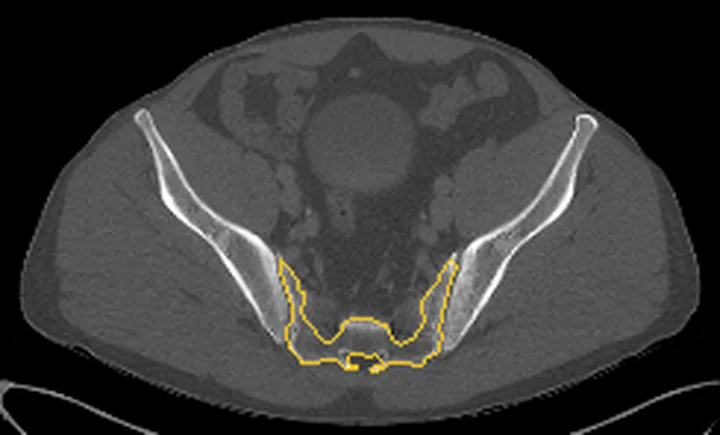
Aynı bölgenin, kaynak veri setinde patoloji içermediği belirtilen bir BT incelemesini kesit kesit kaydırın; organ sınırlarını açarak anatomiyi hasta görüntüsüyle karşılaştırın. Küçük rastlantısal bulgular tümüyle dışlanmamıştır.
Kaynak: TotalSegmentator v2.01 veri seti (Wasserthal ve ark., Radiology: Artificial Intelligence 2023), CC BY 4.0, vaka s0119; organ sınırları veri setinin otomatik segmentasyonundan, birleştirilerek sadeleştirildi. Görüntüler 2,5 mm kesit aralığına yeniden örneklendi.
Ayırıcı tanı
- Denis zon 1 ala kırığı
- çizgi sakral ala üzerinden uzanır ve foramenleri kesmez.
- Denis zon 3 kanal kırığı
- çizgi sakral kanal boyunca uzanır.
- Sakral yetersizlik kırıkları, zayıflamış kemikte normal biyomekanik kuvvetlerle gelişen stres kırıklarıdır; osteoporoz bu kemik zayıflığının nedenlerinden biridir.
Tuzaklar
- Sakral kırıkların tanı ve sınıflandırılmasında standart yöntem BT’dir; çok düzlemli rekonstrüksiyonlar erken tanıya yardımcı olur.
- Foraminal daralmayı değerlendirirken kırık fragmanlarının konumunu ve eşlik eden yumuşak doku yaralanmalarının uzanımını BT’de incele.
Kendini dene
Sakral kırık hattı bir sakral foramenden geçiyor. Denis sınıflamasına göre kırık hangi zondadır?
Cevabı göster
Zon 2. Foramen içinden geçen kırık Denis zon 2'dir. Zon 1 transalar, zon 2 transforaminal, zon 3 ise santral yerleşimlidir.
Muayene edilemeyen sakral kırıklı hastada BT, sinir basısı veya traksiyon yaralanması açısından nasıl katkı sağlar?
Cevabı göster
Sinir basısı veya traksiyon yaralanması için dolaylı bulgu sağlayabilir. Muayene edilemeyen hastada BT, sinir basısı veya traksiyon yaralanması için dolaylı bulgu sağlayabilir.
İlgili konular
- Sakral ala kırığı (Denis zon 1)
- Sakral kanal kırığı (Denis zon 3)
- Sakral U/H tipi kırık ve spinopelvik ayrışma
Kaynaklar
Bu sayfadaki 36 cümle ve 2 quiz sorusu aşağıdaki kaynaklardan alıntılarla otomatik olarak karşılaştırıldı; 25 cümle bu karşılaştırmada düzeltildi (2026-10-09).
- Staged management of a Tile C3 pelvic ring injury with bilateral sacroiliac disruption and T-shaped sacral fracturepmc.ncbi.nlm.nih.gov
- Neuronavigated placement of iliosacral screws in sacral fractures: an additional tool in the spine surgeon’s arsenalpmc.ncbi.nlm.nih.gov
- Percutaneous fixation of posterior pelvic ring lesions in the elderly: current evidence and recent advancespmc.ncbi.nlm.nih.gov
- Traumatic lumbosacral instability: part 1 – proposing a definition and identifying underlying injury patternspmc.ncbi.nlm.nih.gov
- E-Posterspmc.ncbi.nlm.nih.gov
- Preoperative 3D-Planned S1 Corridors Transferred into 2D Fluoroscopy Allow for Safe Intraoperative Large-Diameter Implant Placement: Description of a Novel Sacroiliac Fixation Technique and Proof of Concept in 137 Implantations.pubmed.ncbi.nlm.nih.gov
- Knowledge gaps in high-energy sacral fracture treatment and management.pubmed.ncbi.nlm.nih.gov
- Sacral and Pelvic Fractures: Historical Systems and Advancements with the AO Spine Classification.pubmed.ncbi.nlm.nih.gov
- Consensus practice guidelines on sacroiliac joint complex pain from a multispecialty, international working group.pubmed.ncbi.nlm.nih.gov
- Imaging of Sacroiliac Pain: The Current State-of-the-Art.pubmed.ncbi.nlm.nih.gov
- Imaging Features of Intraosseous Schwannoma: A Case Series and Review of the Literature.pubmed.ncbi.nlm.nih.gov
- The value of magnetic resonance imaging and computed tomography in the study of spinal disorders.pubmed.ncbi.nlm.nih.gov
- The American Society of Pain and Neuroscience (ASPN) Evidence-Based Clinical Guideline of Interventional Treatments for Low Back Pain.pubmed.ncbi.nlm.nih.gov
- A Guide to Improving the Care of Patients with Fragility Fractures, Edition 2.pubmed.ncbi.nlm.nih.gov
- Artificial intelligence in spine care: A scoping review of diagnostic applications.pubmed.ncbi.nlm.nih.gov
- Machine Learning in Spine Oncology: A Narrative Review.pubmed.ncbi.nlm.nih.gov
- Anatomical Ignorance Resulting in Iatrogenic Causes of Human Morbidity.pubmed.ncbi.nlm.nih.gov
- Radiomics in spinal research: a narrative review.pubmed.ncbi.nlm.nih.gov
- Feasibility of AI-Denoised Ultra-Low-Dose CT for Detection of Acute Pelvic and Hip Fractures: A Pilot Multi-Reader Study.pubmed.ncbi.nlm.nih.gov
- Multilevel Lumbar CT Attenuation Beyond L1: Comparison with QCT-Derived Volumetric Bone Mineral Density and Prevalent Fragility Fracture Status in a Diagnostic Referral Cohort.pubmed.ncbi.nlm.nih.gov
- Long-term safety and effectiveness of the "OptEase" vena cava filter.pubmed.ncbi.nlm.nih.gov
- Recognizing Sacral Insufficiency Fractures Hidden in Plain Sight: An Illustrative Case Report.pubmed.ncbi.nlm.nih.gov
- Traumatic lumbosacral instability: part 1 - proposing a definition and identifying underlying injury patterns.pubmed.ncbi.nlm.nih.gov
- CT of Sacral Fractures: Classification Systems and Management.pubmed.ncbi.nlm.nih.gov
- Glossary of terms for musculoskeletal radiology.pubmed.ncbi.nlm.nih.gov
- Investigating sacroplasty: technical considerations and finite element analysis of polymethylmethacrylate infusion into cadaveric sacrum.pubmed.ncbi.nlm.nih.gov
- Sacral U-Type Fractures: A Comparative Study of Treatment Approaches.pubmed.ncbi.nlm.nih.gov
- Comparative biomechanical evaluation of the U-shaped lumbopelvic stabilization technique in treating unstable sacral fractures.pubmed.ncbi.nlm.nih.gov
- Treatment Strategies for Isolated LC-1 Pelvic Injuries: A Comparative Cohort Study of Percutaneous Posterior-Only vs. Combined Anterior-Posterior Fixation.pubmed.ncbi.nlm.nih.gov
- Surgical Stabilization of the Spine: A Clinical Review of Spinal Fractures, Spondylolisthesis, and Instrumentation Methods.pubmed.ncbi.nlm.nih.gov
- Scoliosis and Lower Limb Inequality: To Lift or Not to Lift, That Is the Question.pubmed.ncbi.nlm.nih.gov
- Minimally Invasive and Conservative Interventions for the Treatment of Sacroiliac Joint Pain: A Review of Recent Literature.pubmed.ncbi.nlm.nih.gov
- International Society of Paediatric Surgical Oncology (IPSO) Surgical Practice Guidelines.pubmed.ncbi.nlm.nih.gov
- Bilateral abducens nerve palsy following ligamentous C1-C2 distraction.pubmed.ncbi.nlm.nih.gov
- A novel internal fixation system for sacral fractures: a finite element biomechanical study.pubmed.ncbi.nlm.nih.gov
- Staged management of a Tile C3 pelvic ring injury with bilateral sacroiliac disruption and T-shaped sacral fracture.pubmed.ncbi.nlm.nih.gov
- Iliosacral Screw Fixation for Treating Sacral Fractures: A Modified Pedicle-Guided Fixation Technique in Prone Position.pubmed.ncbi.nlm.nih.gov
- Anatomy-driven automated subsegmentation of pelvic and proximal femoral CT into clinically relevant subregions and landmarks.pubmed.ncbi.nlm.nih.gov
- Clinical Outcomes of Sacral Alar-Iliac Screw Fixation for Pelvic Ring Fractures: A Retrospective Case Series.pubmed.ncbi.nlm.nih.gov
- Evaluating the necessity of edema-sensitive imaging in assessing fragility fractures of the pelvis: a retrospective cohort study utilizing the OF Pelvis Classification and Score.pubmed.ncbi.nlm.nih.gov
- Open and Percutaneous Fixation of Traumatic Sacral Fracture-Dislocation with Spinopelvic Dissociation: Two Adolescent Cases and a Systematic Literature Review.pubmed.ncbi.nlm.nih.gov
- Interlaminar Contralateral Endoscopic Foraminotomy Reduces Postoperative Dysesthesia in Patients With Degenerative Lumbar Deformity: A Multicenter Comparative Cohort Study.pubmed.ncbi.nlm.nih.gov
- Beyond Chordoma: A Comprehensive Review of Sacral Lesions.pubmed.ncbi.nlm.nih.gov
- Fragility Fractures of the Pelvis-Current Understanding and Open Questions.pubmed.ncbi.nlm.nih.gov
- Unveiling Primary Bone Tumors of the Spine: A Review of Essential Imaging Clues.pubmed.ncbi.nlm.nih.gov
- Spinal granulocytic sarcoma with both extradural and intradural involvement: a case report.pubmed.ncbi.nlm.nih.gov
- A Didactic Ultrasound Manual for identifying lumbar Plexus Peripheral Nerves in the lower limb: Lower Abdominal Wall, Groin and Thigh.pubmed.ncbi.nlm.nih.gov
- Traumatic Spinal Cord Injury: A Contemporary Review of Classification, Evaluation, and Acute Management.pubmed.ncbi.nlm.nih.gov
- Atypical fractures at non-classical sites associated with anti-resorptive therapy: a systematic review.pubmed.ncbi.nlm.nih.gov
- Axial Spondyloarthritis: Mimics and Pitfalls of Imaging Assessment.pubmed.ncbi.nlm.nih.gov
- Management strategies of pediatric coccydynia: a narrative review.pubmed.ncbi.nlm.nih.gov
- Lumbar spinal stenosis exacerbated by spinal epidural lipomatosis: a case report.pubmed.ncbi.nlm.nih.gov
- Specimen-level phylogenetic analysis and taxonomic revision of North American metoposaurids: a case for monospecific genera in vertebrate paleontology.pubmed.ncbi.nlm.nih.gov
- Musculoskeletal infections through direct inoculation.pubmed.ncbi.nlm.nih.gov
- Unusual Presentation of Thoracic Chordoma with Spinal Epidural Hematoma: A Rare Case Report and PRISMA-Driven Systematic Review.pubmed.ncbi.nlm.nih.gov
- Congenital and Breed-Associated Vertebral Anomalies in Dogs and Cats: Developmental Anatomy, Genetic Determinants, and Biological Significance.pubmed.ncbi.nlm.nih.gov
- Neurolymphomatosis: A Comprehensive Review of Clinical and Imaging Features.pubmed.ncbi.nlm.nih.gov
- Subacute and Chronic Low-Back Pain: From MRI Phenotype to Imaging-Guided Interventions.pubmed.ncbi.nlm.nih.gov
- Total laparoscopic radical hysterectomy for cervical cancer in prolapsed uterus.pubmed.ncbi.nlm.nih.gov
- Surgical and Oncologic Outcome following Sacrectomy for Primary Malignant Bone Tumors and Locally Recurrent Rectal Cancer.pubmed.ncbi.nlm.nih.gov
- Conservative Management of Low Back Pain Related to an Unresectable Aggressive Sacral Hemangioma: A Case Report.pubmed.ncbi.nlm.nih.gov
- A positioning method for the transiliac-transsacral screw bone channel based on a manual tracing of a transparent overlay of preoperative computed tomography images in patients with pelvic fracture and a unilateral trans-sacroiliac corridor.pubmed.ncbi.nlm.nih.gov
- Functional Outcomes and Quality of Life After Sacrum Fractures Managed by Either Operative or Conservative Approaches: A Case Series With One-Year Follow-Up.pubmed.ncbi.nlm.nih.gov
- Chronic pelvic insufficiency fractures and their treatment.pubmed.ncbi.nlm.nih.gov
- Imaging Review of Pelvic Ring Fractures and Its Complications in High-Energy Trauma.pubmed.ncbi.nlm.nih.gov
- Diagnosis and management of traumatic cervical central spinal cord injury: A review.pubmed.ncbi.nlm.nih.gov
- Lumbar degenerative spondylolisthesis epidemiology: A systematic review with a focus on gender-specific and age-specific prevalence.pubmed.ncbi.nlm.nih.gov
- Common differential diagnosis of low back pain in contemporary medical practice: a narrative review.pubmed.ncbi.nlm.nih.gov
- Diagnostics of Sacroiliac Joint Differentials to Axial Spondyloarthritis Changes by Magnetic Resonance Imaging.pubmed.ncbi.nlm.nih.gov
- Minimally invasive stabilisation of anterior pelvic ring injuries through anterior infix versus percutaneous anterior retrograde pubic screw: a prospective comparative cohort study.pubmed.ncbi.nlm.nih.gov
- Spinal lesions: a comprehensive radiologic overview.pubmed.ncbi.nlm.nih.gov
- Neuronavigated placement of iliosacral screws in sacral fractures: an additional tool in the spine surgeon's arsenal.pubmed.ncbi.nlm.nih.gov
- Traumatic lumbosacral instability: part 2-indications and techniques for surgical management.pubmed.ncbi.nlm.nih.gov
- Navigating pelvic anatomy for exenteration: a clinical guide for radiologists.pubmed.ncbi.nlm.nih.gov
- Hemipelvis malrotation deformity leading to instability: The need for careful preoperative radiographic evaluation in total hip arthroplasty.pubmed.ncbi.nlm.nih.gov
- Sacral Ewing Sarcoma Presenting With Cauda Equina Syndrome: A Case Report and Radiological Review.pubmed.ncbi.nlm.nih.gov
- Total Hip Arthroplasty for Post-Traumatic Hip Arthritis in Chronic Pubic Diastasis: A Case Report.pubmed.ncbi.nlm.nih.gov
- Utilization of the posterior iliac line for visualizing posterior column screws in obturator oblique view.pubmed.ncbi.nlm.nih.gov
- The Unique Features of Pediatric Sports Injuries: The Hip.pubmed.ncbi.nlm.nih.gov
- Spinal lymphangiomas: Case-based review of a chameleonic disease entity.pubmed.ncbi.nlm.nih.gov
- A Primer on Anatomy, Biophysics, Pathology, Imaging and Treatment of the Intervertebral Disc and the Anterior Spinal Column: The Discogenic, Intervertebral, Spinal Column (DISC) ASPN Workgroup.pubmed.ncbi.nlm.nih.gov
- Association of Chiropractic Colleges Educational Conference and Research Agenda Conference 2025: Transformative Trends in Healthcare.pubmed.ncbi.nlm.nih.gov
- The evolution of cervical spine trauma classification: a paradigm shift from morphological description to clinical decision-making.pubmed.ncbi.nlm.nih.gov
- Outcomes of Lumbosacral Fixation in Patients with Suicidal Jumper's Fractures: A Retrospective Study from a Single Center in Turkey.pubmed.ncbi.nlm.nih.gov
- Sacral Dysmorphism as an Independent Risk Factor for Cortical Breach During Percutaneous S1 Iliosacral Screw Fixation.pubmed.ncbi.nlm.nih.gov
- Differentiating Lumbar Spinal Etiology from Peripheral Plexopathies.pubmed.ncbi.nlm.nih.gov
- Off the scale: a new species of fish-scale gecko (Squamata: Gekkonidae: Geckolepis ) with exceptionally large scales.pubmed.ncbi.nlm.nih.gov
- Pedicle paradox: Duplicate vertebral pedicles creating a rare "pseudo foramen" with symptomatic foraminal stenosis.pubmed.ncbi.nlm.nih.gov
- Fluid transport in the brain.pubmed.ncbi.nlm.nih.gov
- Clinical diagnostic utility of transcranial magnetic stimulation in neurological disorders. Updated report of an IFCN committee.pubmed.ncbi.nlm.nih.gov
- Recent Progress in the Classification and Operation of Sacral Fractures.pubmed.ncbi.nlm.nih.gov
- What Are the Key Factors of Functional Outcomes in Patients with Spinopelvic Dissociation Treated with Triangular Osteosynthesis?pubmed.ncbi.nlm.nih.gov
- Biomechanical stability evaluation of isolated straddle fracture using finite element analysis.pubmed.ncbi.nlm.nih.gov
- Comparative study of modified vs. traditional sacroiliac screw techniques in day type II crescent fracture dislocation of the pelvis.pubmed.ncbi.nlm.nih.gov
- Biomechanical analysis of iliosacral and transiliac-transsacral screw combinations for fixation of undisplaced Denis II vertical shear fractures in dysmorphic sacrum.pubmed.ncbi.nlm.nih.gov
- High performance of low-dose ultrahigh-resolution photon-counting detector CT for sacroiliac joint assessment in axial spondyloarthritis.pubmed.ncbi.nlm.nih.gov
- Percutaneous spinopelvic fixation technique using external fixation for focal kyphosis reduction in U-type sacral fractures: a case report.pubmed.ncbi.nlm.nih.gov
- Longitudinal Midline Sacral Split Fracture - A Rare Entity.pubmed.ncbi.nlm.nih.gov
- Consensus for management of sacral fractures: from the diagnosis to the treatment, with a focus on the role of decompression in sacral fractures.pubmed.ncbi.nlm.nih.gov
- Treatment of Displaced Sacroiliac Fracture Using the Lateral Window for Short Plate Buttress Reduction and Percutaneous Sacroiliac Screw Fixation.pubmed.ncbi.nlm.nih.gov
- Modified spinopelvic crab-shaped fixation using offset connectors for a H-shaped sacral fracture with a floating Roy-Camille type 3 transverse component: a case report.pubmed.ncbi.nlm.nih.gov
- Preferential sacral fracture sites in fragility fractures of the pelvis type IVb and comparison of internal fixation methods: CT-based morphological mapping and finite element analysis.pubmed.ncbi.nlm.nih.gov
- Magnetic resonance imaging of the spine.pubmed.ncbi.nlm.nih.gov
- Denis pattern-dependent biomechanical behavior of posterior trans-iliac plate fixation compared with bilateral triangular osteosynthesis in unilateral sacral fractures: a finite element study.pubmed.ncbi.nlm.nih.gov
- Traditional versus Minimally Invasive Spinopelvic Fixation for Sacral Fracture Treatment in Vertically Unstable Pelvic Fractures.pubmed.ncbi.nlm.nih.gov
- Postpartum pelvic stress fractures with subsequent forefoot overload injury: A case report.pubmed.ncbi.nlm.nih.gov
- Comparative Radiologic and Morphologic Analysis of Posterolateral Fusion and Percutaneous Pedicle Screw Fixation for Thoracolumbar Junction Burst Fractures.pubmed.ncbi.nlm.nih.gov
- A Case of U-shaped Sacral Fracture After Longstanding Spinopelvic Fixation Treated With Percutaneous Sacroiliac Joint Fusion and Iliosacral Osteosynthesis.pubmed.ncbi.nlm.nih.gov
- Role of 3D Printing in Preoperative Planning for Spine Surgery: A Scoping Review.pubmed.ncbi.nlm.nih.gov
- The Transiliac Approach: A Forgotten Alternative for Transforaminal Endoscopic Decompression at the L5-S1 Level in Patients With High Iliac Crests.pubmed.ncbi.nlm.nih.gov
- American Society of Pain and Neuroscience Best Practice (ASPN) Guideline for the Treatment of Sacroiliac Disorders.pubmed.ncbi.nlm.nih.gov
- A Comprehensive Review of the Role of the Latest Minimally Invasive Neurosurgery Techniques and Outcomes for Brain and Spinal Surgeries.pubmed.ncbi.nlm.nih.gov
- Treatment for sacral insufficiency fractures: A systematic review.pubmed.ncbi.nlm.nih.gov
- Sacroiliac Joint Anatomical Variants and Their Association with Spinopelvic Alignment: A Whole-Spine CT Study.pubmed.ncbi.nlm.nih.gov
- Uncommon Sacroiliac and Presacral Tuberculosis Mimicking Chronic Low Back Pain in a Young Female.pubmed.ncbi.nlm.nih.gov
Eğitim amaçlıdır; hasta başında tanı ve tedavi kararının yerine geçmez, tıbbi tavsiye değildir. Metinler yapay zekâ desteğiyle yazıldı ve otomatik bir adımda kaynak alıntılarıyla karşılaştırıldı; bu bir tıbbi doğrulama değildir ve içerik uzman radyolog incelemesinden geçmedi. Klinik kararlarda güncel kılavuzları, kurum protokollerini ve radyoloji raporunu esas alın.