
Özet
Kapsüler kontraktür, implant çevresindeki fibröz dokunun kasılıp protezi sıkıştırdığı klinik bir komplikasyondur; hasta sertlik, ağrı veya meme biçiminde değişiklik fark edebilir. Toraks BT'de küreselleşmiş ya da düzensiz implant konturu ve kaba kapsüler kalsifikasyon görülebilir, ancak bu bulgular klinik sertlik derecesini tek başına belirlemez. Toraks BT'de implantlara ilişkin bulgular çoğunlukla tesadüfen saptanır; rüptür, seroma, enfeksiyon veya kitle gibi komplikasyonlar da görülebilir. Kapsüler kalsifikasyon veya implant içi debris gerçek komplikasyonları taklit edebilir ya da gizleyebilir.
Faz ve pencere
- Kontrastsız
- İmplant konturundaki morfolojik değişiklikler ve kapsüler kalsifikasyon toraks BT'de görülebilir; BT yumuşak doku karakterizasyonunda sınırlı olduğundan bu bulgular tek başına kesin tanı sağlamaz.
Önerilen pencereler G genişlik, M merkez; değerler Hounsfield birimi (HU)
- Yumuşak dokuG 400 / M +40
- MediastenG 350 / M +50
BT bulguları
- Projeksiyon/taban oranında artış kapsüler kontraktürle ilişkili olabilir; tek başına tanı koydurmaz.
- İmplant konturunda deformasyon — kapsüler kontraktürde implantın projeksiyon/taban oranı artabilir.
- Fibröz kapsül kalınlığı kontraktür şiddetiyle ilişkili olabilir; Baker sınıflaması ise klinik değerlendirmeye dayanır ve gözlemciler arası uyumu sınırlıdır.
- Histolojik olarak kontrakte kapsül daha kalın olabilir; BT'de izlenen kapsüler kalsifikasyon ve implant içi debris ise gerçek komplikasyonları taklit edebilir veya gizleyebilir.
- Radial kıvrımlar — implantın konturu boyunca görülebilen, genellikle kontraktür olmadan da izlenen normal postoperatif değişimlerdir.
- Tek taraflı şişlik, geç peri-implant sıvı veya kapsüler kitle BIA-ALCL dâhil implant ilişkili malignitelerle ilişkili olabilir; BT bulguları tek başına tanı koydurmaz ve hedefli değerlendirme gerekebilir.
- BT’de şüpheli veya belirsiz implant bulguları saptandığında, hedefli meme ultrasonografisi veya MRG ile ileri değerlendirme önerilebilir.
Ölçütler ve sınıflamalar
- Baker sınıflaması
- Baker sınıflaması kliniktir: I yumuşak ve doğal; II bir miktar sert; III sertlik ve deformite; IV sert, ağrılı ve belirgin deformite ile tanımlanır. Rekonstrüksiyon sonrası sınıf I, IA ve IB olarak ayrılabilir. Baker sınıflaması öznel ve gözlemciler arası uyumu sınırlı bir klinik derecelendirmedir; BT’de ölçülen implant morfolojisi klinik sınıflamanın yerini almaz.
Normalde
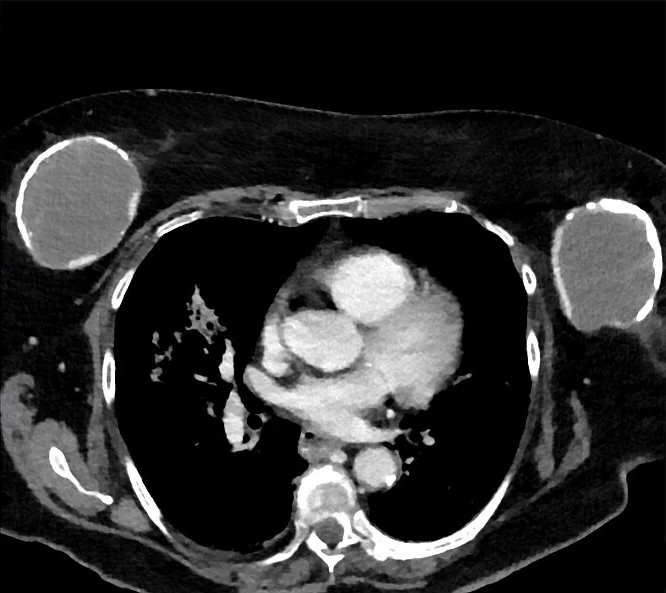
Toraks BT’de implantın konumu, konturu ve kabuk özellikleri ile radial kıvrımlar ve minimal peri-implant sıvı gibi beklenen postoperatif görünümler seçilebilir. İmplant konturunu ve deformitesini değerlendirirken önceki incelemelerle karşılaştırın; BT bulgularını tek başına Baker derecesi olarak yorumlamayın.
Normal BT ile kıyasla
Aynı bölgenin, kaynak veri setinde patoloji içermediği belirtilen bir BT incelemesini kesit kesit kaydırın; organ sınırlarını açarak anatomiyi hasta görüntüsüyle karşılaştırın. Küçük rastlantısal bulgular tümüyle dışlanmamıştır.
Kaynak: TotalSegmentator v2.01 veri seti (Wasserthal ve ark., Radiology: Artificial Intelligence 2023), CC BY 4.0, vaka s1278; organ sınırları veri setinin otomatik segmentasyonundan, birleştirilerek sadeleştirildi. Görüntüler 2,5 mm kesit aralığına yeniden örneklendi.
Ayırıcı tanı
- İntrakapsüler rüptür
- koheşiv silikon implantların rüptüründe implantın şekli korunmaya devam edebilir ve intrakapsüler kalabilir; tespit için görüntüleme gereklidir.
- Ekstrakapsüler rüptür
- fibröz kapsül dışına uzanan silikon veya silikon içeren lenf nodları eşlik edebilir.
- Normal radial kıvrım
- düzgün, sınırlı kabuk katlantısıdır ve çevresel küreselleşme ya da kaba kapsüler kalsifikasyon olmadan da görülebilir.
- İmplant çevresinde minimal sıvı birikimi veya radial kıvrımlar beklenen postoperatif görünümler olabilir; kaba kapsüler kalsifikasyon veya implant içi debris gerçek komplikasyonları taklit edebilir veya gizleyebilir.
- Geç peri-implant seromaların çoğu benign nedenlidir; ancak BIA-ALCL dâhil implant ilişkili maligniteler benzer bulgularla ortaya çıkabileceğinden uygun inceleme gerekir. BT'de saptanan geç peri-implant sıvı veya şüpheli kitle için hedefli ultrasonografi, sıvı örneklemesi ya da biyopsiyle ileri değerlendirme gerekebilir.
- Peri-implant geç seroma veya kapsüler kitle kontraktürden ayrı değerlendirilmesi gereken bulgulardır; BIA-ALCL olasılığı klinik ve uygun görüntüleme bulgularıyla birlikte ele alınır.
Tuzaklar
- Ultrasonografide kapsül kalınlığı ve implant deformitesi kontraktür şiddetiyle ilişkili olabilir; bu bir ultrason bulgusudur ve BT özel meme görüntülemesinin yerine kullanılmamalıdır.
- Uzun süreli implantlarda görülen kapsüler kalsifikasyon ve içsel debris, gerçek komplikasyonları taklit edebilir veya gizleyebilir.
- İmplant rüptürleri çoğunlukla asemptomatiktir; semptomatik olgularda meme şekli, sertliği veya boyutu değişebilir. Ekstrakapsüler silikon rüptüründe silikon fibröz kapsül dışına, meme veya göğüs duvarı yumuşak dokularına yayılabilir.
- Bu başlıkta BT’de implant biçimini, kapsül kalsifikasyonunu ve implant içi debris’i betimleyin; bu bulguları klinik Baker derecesi olarak yorumlamayın.
Kendini dene
İmplantı çevreleyen fibröz kapsülde kalınlaşma var; hasta meme sertliği ve ağrı tarif ediyor. En olası komplikasyon hangisidir?
Cevabı göster
Kapsüler kontraktür. Kapsüler kontraktür kapsülün aşırı sıkılaşmasıyla meme sertliği, ağrı ve şekil bozukluğuna yol açabilir; Baker derecelendirmesi klinik değerlendirmeye dayanır.
BT’de implantın projeksiyon/taban oranı artmış; hasta öyküsü bilinmiyor. Hangi sonuç çıkarılabilir?
Cevabı göster
Morfoloji kontraktürü düşündürür. Projeksiyon/taban oranındaki artış kontraktürle ilişkili olabilir; BT çalışmasında projeksiyon/taban oranı Baker III/IV grubunda kontraktür sonrasında artmıştır; bu morfolojik bulgu tek başına klinik Baker derecesini belirlemez.
İlgili konular
- Rastlantısal meme kitlesi
- Primer meme kanserinin BT görünümü
- Silikon implant intrakapsüler rüptürü
- Peri-implant sıvı koleksiyonu
Kaynaklar
Bu sayfadaki 41 cümle ve 2 quiz sorusu aşağıdaki kaynaklardan alıntılarla otomatik olarak karşılaştırıldı; 27 cümle bu karşılaştırmada düzeltildi (2026-10-12).
- Capsular Contracture in Implant-Based Breast Reconstruction: A Comprehensive Narrative Review of Pathophysiology, Risk Factors, and Contemporary Controversiespmc.ncbi.nlm.nih.gov
- Recognizing and Managing Breast Implant Complications: A Review for Healthcare Providers Who Treat Women Who Underwent Breast Implant–Based Surgerypmc.ncbi.nlm.nih.gov
- Timing of postmastectomy radiation therapy in two-stage expander/implant-based breast reconstruction: a systematic review and meta-analysis for the 2022 Japanese breast cancer society clinical practice guidelinepmc.ncbi.nlm.nih.gov
- The evaluation of the delayed swollen breast in patients with a history of breast implantspmc.ncbi.nlm.nih.gov
- Overview of Risk Factors and Prevention of Capsular Contracture Following Implant-Based Breast Reconstruction and Cosmetic Surgery: A Systematic Reviewpmc.ncbi.nlm.nih.gov
- [Microsurgical techniques for breast reconstruction].pubmed.ncbi.nlm.nih.gov
- Nonarthroplasty Treatment Options for Management of Primary Elbow Osteoarthritis.pubmed.ncbi.nlm.nih.gov
- Acellular Dermal Matrix: Imaging Features With Histopathology Correlation.pubmed.ncbi.nlm.nih.gov
- A Spectrum of Disease: Breast Implant-Associated Anaplastic Large Cell Lymphoma, Atypicals, and Other Implant Associations.pubmed.ncbi.nlm.nih.gov
- Breast Implants: Common Questions and Answers.pubmed.ncbi.nlm.nih.gov
- [The throwing shoulder].pubmed.ncbi.nlm.nih.gov
- Current Trends and Controversies in Breast Augmentation.pubmed.ncbi.nlm.nih.gov
- The Use of Multispectral Imaging in DIEP Free Flap Perforator Selection: A Case Study.pubmed.ncbi.nlm.nih.gov
- Silicone breast implant rupture: a review.pubmed.ncbi.nlm.nih.gov
- Evaluation and treatment of internal impingement of the shoulder in overhead athletes.pubmed.ncbi.nlm.nih.gov
- IDEAL IMPLANT Structured Breast Implants: Core Study Results at 6 Years.pubmed.ncbi.nlm.nih.gov
- Imaging of the Reconstructed Breast.pubmed.ncbi.nlm.nih.gov
- Safety and Efficacy of Stabilized Hyaluronic Acid Gel for Breast Enhancement.pubmed.ncbi.nlm.nih.gov
- Return to play after treatment of superior labral tears in professional baseball players.pubmed.ncbi.nlm.nih.gov
- Ten-year results from the Natrelle 410 anatomical form-stable silicone breast implant core study.pubmed.ncbi.nlm.nih.gov
- Breast Implants: Biomaterials, Surfaces, Biocompatibility-A Biomedical Engineering Perspective.pubmed.ncbi.nlm.nih.gov
- Shear-Wave Elastography as an Objective Diagnostic Tool for Capsular Contracture After Breast Implant Surgery: A Comparative Study.pubmed.ncbi.nlm.nih.gov
- Outcome Analysis of 852 Breast Implant Check Assessments: The Added Value of Clinician-operated Ultrasound.pubmed.ncbi.nlm.nih.gov
- Beyond the lung: recognizing incidental breast lesions on chest computed tomography.pubmed.ncbi.nlm.nih.gov
- Assessment of Acellular Dermal Matrix-Associated Complications With Silicone Implants.pubmed.ncbi.nlm.nih.gov
- Capsular Contracture in Implant-Based Breast Reconstruction: A Comprehensive Narrative Review of Pathophysiology, Risk Factors, and Contemporary Controversies.pubmed.ncbi.nlm.nih.gov
- Breast Implant Illness and Autoimmune/Inflammatory Syndrome Induced by Adjuvants: Mechanistic Rationale and a Practical Multidisciplinary Diagnostic Algorithm.pubmed.ncbi.nlm.nih.gov
- Breast implant-associated diffuse large cell B-cell lymphoma (BIA-DLBCL) - a case report and a treatment algorithm.pubmed.ncbi.nlm.nih.gov
- Porous silicon nanoparticles in drug delivery, regenerative medicine, and biosensing: a translational review.pubmed.ncbi.nlm.nih.gov
- A morphological analysis of calcium hydroxylapatite and poly-l-lactic acid biostimulator particles.pubmed.ncbi.nlm.nih.gov
- Recent Advancements of Nanomedicine in Breast Cancer Surgery.pubmed.ncbi.nlm.nih.gov
- Augmentation Mastopexy With Polyurethane-Coated Implants in the Prepectoral Plane: A 24-Month Follow-Up Study.pubmed.ncbi.nlm.nih.gov
- Assessment of Capsular Contracture Based on Morphological Change of Breast Implant Using Computed Tomography.pubmed.ncbi.nlm.nih.gov
- Understanding Capsular Contracture: Mechanisms, Management, and Patient Outcomes in Implant-based Breast Augmentation and Reconstruction.pubmed.ncbi.nlm.nih.gov
- Galactocele Rupture Causing Milk Contamination of a Prepectoral Implant Pocket: Diagnostic Pitfall and Implant Salvage.pubmed.ncbi.nlm.nih.gov
- A Rare Case of Breast Implant-Associated Anaplastic Large Cell Lymphoma (BIA-ALCL) in a Transgender Patient With Exclusive Smooth Implant Exposure.pubmed.ncbi.nlm.nih.gov
- Patient-Reported Symptom Changes Following Breast Implant Explantation with Total Capsulectomy: A Prospective Case Series of 50 Patients.pubmed.ncbi.nlm.nih.gov
- A review of radiological characteristics and patterns of fat necrosis after different autologous breast surgery techniques.pubmed.ncbi.nlm.nih.gov
- A compendium of male breast imaging: The road less traveled.pubmed.ncbi.nlm.nih.gov
- Capsular Contracture Rates in Subfascial and Subglandular Breast Augmentation With Smooth vs Textured Implants.pubmed.ncbi.nlm.nih.gov
- Extracapsular breast implant rupture with silicone migration and lymphadenopathy following a breast augmentation - A case report.pubmed.ncbi.nlm.nih.gov
- Silicone granuloma with intact breast implants: A case report.pubmed.ncbi.nlm.nih.gov
- Personalized Models of Biological Barriers and Their Diseases: Recent Progress with Organs-On-Chips.pubmed.ncbi.nlm.nih.gov
- Glossary of terms for musculoskeletal radiology.pubmed.ncbi.nlm.nih.gov
- Patterns of injury and violence in Yaoundé Cameroon: an analysis of hospital data.pubmed.ncbi.nlm.nih.gov
- Technique-Driven and Patient-Specific Variations in Complications of Mastectomy with Immediate Breast Reconstruction: An Evidence-Based Review.pubmed.ncbi.nlm.nih.gov
- Hot Topics in Implant-Based Breast Reconstruction.pubmed.ncbi.nlm.nih.gov
- Breast Reconstruction following Mastectomy for Breast Cancer or Prophylactic Mastectomy: Therapeutic Options and Results.pubmed.ncbi.nlm.nih.gov
- Asymptomatic breast implant rupture detected in pregnancy: a case report and a management pathway.pubmed.ncbi.nlm.nih.gov
- Preliminary clinical and structural outcomes of a standardized ultrasound-guided diagnostic and interventional protocol for refractory adhesive capsulitis.pubmed.ncbi.nlm.nih.gov
- Evaluation of the efficacy and safety of breast augmentation using implants combined with autologous fat grafting: a retrospective study of 219 cases.pubmed.ncbi.nlm.nih.gov
- Do Textured Breast Implants Mitigate Malposition? A Systematic Review and Meta-Analysis.pubmed.ncbi.nlm.nih.gov
- Ultrasound Elastography and Tonometry as Predictive Tools for Capsular Contracture After Breast Implant Surgery: Over a 12-Month Prospective Study.pubmed.ncbi.nlm.nih.gov
- The Inflammatory Reaction to Silicone Implants: Polyurethane Foam Versus Nanotextured Surface-An Experimental Study in Rats.pubmed.ncbi.nlm.nih.gov
- High-affinity alphavbeta3 integrin targeted optical probe as a new imaging biomarker for early atherosclerosis: initial studies in Watanabe rabbits.pubmed.ncbi.nlm.nih.gov
- Late breast cancer recurrence concurrent with silicone breast implant rupture 17 years after mastectomy and immediate implant-based reconstruction in a 53-year-old woman: a case report.pubmed.ncbi.nlm.nih.gov
- Ultrasound Criteria and Baker Scale for Breast Implant Capsular Contracture Diagnosis.pubmed.ncbi.nlm.nih.gov
- Normal and Pathological Incidental Breast Implant Findings on Chest Computed Tomography: What the Radiologist Needs to Know.pubmed.ncbi.nlm.nih.gov
- Internal Brace Augmentation Following Ulnar Collateral Ligament Release for Elbow Stiffness: A Case Series.pubmed.ncbi.nlm.nih.gov
- The Stiff Elbow Revisited: How Much Motion Can Surgery Really Restore?pubmed.ncbi.nlm.nih.gov
- The state of trial registrations in the field of Orthopaedics in years 2015-2020. A meta-epidemiological study.pubmed.ncbi.nlm.nih.gov
- Long-term safety and effectiveness of the "OptEase" vena cava filter.pubmed.ncbi.nlm.nih.gov
- Migration of Silicone Particles Into the Liver Following Rupture of Silicone Breast Implant: A Case Report and Literature Review.pubmed.ncbi.nlm.nih.gov
- Beyond the Surface: Deciphering the Role of Genetic Susceptibility in BIA-ALCL Pathogenesis.pubmed.ncbi.nlm.nih.gov
- Can a Breast Augmentation Procedure Improve the Appearance of Pectus Excavatum Deformity in Female Patients? A Prospective Study.pubmed.ncbi.nlm.nih.gov
- Medical Imaging of Inflammations and Infections of Breast Implants.pubmed.ncbi.nlm.nih.gov
- The evaluation of the delayed swollen breast in patients with a history of breast implants.pubmed.ncbi.nlm.nih.gov
- Breast cystic echinococcosis with ultrasonographic "cerebral gyrus sign": a case report.pubmed.ncbi.nlm.nih.gov
- Complicated calcified alloplastic implants in the nasal dorsum: A clinical analysis.pubmed.ncbi.nlm.nih.gov
- A Systematic Review of Breast Implant-Associated Squamous Cell Carcinoma.pubmed.ncbi.nlm.nih.gov
- A review of bioengineering techniques applied to breast tissue: Mechanical properties, tissue engineering and finite element analysis.pubmed.ncbi.nlm.nih.gov
- A national curriculum for ophthalmology residency training.pubmed.ncbi.nlm.nih.gov
- Periostin mediates collagen production, ECM remodeling and myofibroblast differentiation in breast prosthesis capsule formation.pubmed.ncbi.nlm.nih.gov
- Beyond the Beam: Multimodal Imaging and Surveillance of Post-Radiotherapy Changes in the Breast.pubmed.ncbi.nlm.nih.gov
- Imaging of common breast implants and implant-related complications: A pictorial essay.pubmed.ncbi.nlm.nih.gov
- Extended applications of chest wall perforator flaps in breast surgery: case series and systematic literature review.pubmed.ncbi.nlm.nih.gov
- Radiological Insights into Acellular Dermal Matrix Integration in Post-Mastectomy Breast Reconstruction: Implications for Cancer Patient Management.pubmed.ncbi.nlm.nih.gov
- The anterior intercostal artery perforator flap in immediate oncoplastic breast reconstruction: current applications and future perspectives.pubmed.ncbi.nlm.nih.gov
- Immediate Breast Reconstruction Outcomes in Patients with Prior Mantle and Whole Breast Irradiation.pubmed.ncbi.nlm.nih.gov
- Structured Mammoplasty (Breast Reduction and Mastopexy with Silicone Implants): Standardization of Technique for Predictable Results.pubmed.ncbi.nlm.nih.gov
- Simultaneous Salvage Auto-augmentation: Contemporary Strategy for Management of the Breast Explantation Patient.pubmed.ncbi.nlm.nih.gov
- Non-linear optical microscopy and histological analysis of collagen, elastin and lysyl oxidase expression in breast capsular contracture.pubmed.ncbi.nlm.nih.gov
- Absorbable Synthetic Meshes in Implant-Based Breast Reconstruction After Subcutaneous Mastectomy: A Systematic Review with Clinical and Economic Considerations.pubmed.ncbi.nlm.nih.gov
- Capsule histology in breast reconstruction: different materials lead to different tissue responses - a case series.pubmed.ncbi.nlm.nih.gov
- ADM-Assisted Breast Reconstruction vs Micro-Polyurethane Foam-Covered Implants in the Prepectoral Space: A Monocentric Study.pubmed.ncbi.nlm.nih.gov
- Poly-4-hydroxybutyrate mesh (GalaFlex®) in aesthetic breast surgery: A comprehensive systematic review.pubmed.ncbi.nlm.nih.gov
- Versatile Usability of Lateral Crural Strut Graft for Correction of Various Nasal Tip Deformities in Secondary Rhinoplasty in Asians.pubmed.ncbi.nlm.nih.gov
- From Bench to Bedside: Clinical Implications of a 4-Micron Surface-Modulated Immune Response in the Era of Breast Tissue Preservation.pubmed.ncbi.nlm.nih.gov
- Changing Paradigms in Polyurethane-coated Breast Implant Surgery: A Bibliometric Analysis of 4 Decades of Clinical Practice.pubmed.ncbi.nlm.nih.gov
- Breast Reconstruction After Cancer: Historical Development, Modern Techniques, and Psychological Impact.pubmed.ncbi.nlm.nih.gov
- Diagnostic and management challenges of late chest wall mass following implant-based breast reconstruction: a case report.pubmed.ncbi.nlm.nih.gov
- Comparison of Secondary Procedures and Complications Between Subpectoral and Prepectoral Direct-to-implant-based Breast Reconstruction: 5-year Retrospective Analysis.pubmed.ncbi.nlm.nih.gov
- The use of porcine acellular dermal matrices in implant-based breast reconstruction: A systematic literature review.pubmed.ncbi.nlm.nih.gov
- Incidence and Risk Assessment of Capsular Contracture in Breast Cancer Patients following Post-Mastectomy Radiotherapy and Implant-Based Reconstruction.pubmed.ncbi.nlm.nih.gov
- Current Challenges in Breast Implantation.pubmed.ncbi.nlm.nih.gov
- Optimizing design parameters of 3D-printed poly-4-hydroxybutyrate nipple scaffolds for nipple reconstruction.pubmed.ncbi.nlm.nih.gov
- Personalized Breast Reconstruction After Breast-Conserving Therapy: Risk-Informed Approaches to Technique Selection and Timing.pubmed.ncbi.nlm.nih.gov
- Prepectoral Breast Reconstruction: Early and Long-Term Complications and Outcomes of Total Coverage Acellular Dermal Matrix and Implants Vs Polyurethane-Coated Implants Without Use of Acellular Dermal Matrix.pubmed.ncbi.nlm.nih.gov
- Transaxillary Breast Augmentation: A Randomized Controlled Trial Comparing a New Semiendoscopic Video-Assisted Technique versus the Blind Technique.pubmed.ncbi.nlm.nih.gov
- Implant Survival and Autologous Breast Augmentation in Rupture Management.pubmed.ncbi.nlm.nih.gov
- The Role of Montelukast in the Prevention and Treatment of Capsular Contracture (Baker Grade III-IV) - A Systematic Review and Case Analysis.pubmed.ncbi.nlm.nih.gov
- A proposal of a new periimplant breast pathology classification into 3 types.pubmed.ncbi.nlm.nih.gov
- The comparison outcome of implant-based breast reconstruction with acellular dermal matrix, non-acellular dermal matrix and TiLOOP<sup>®</sup> reconstruction in breast cancer patients.pubmed.ncbi.nlm.nih.gov
- Comparing Latissimus Dorsi Flap to Implant in Breast Reconstruction Following Mastectomy in Breast Cancer Patients: A Systematic Review.pubmed.ncbi.nlm.nih.gov
- Pilot Study: Vancomycin Calcium Sulfate Beads in the Prevention of Recurrent Capsular Contracture of Breast Implants.pubmed.ncbi.nlm.nih.gov
- The endoscopic-assisted triple-plane technique: a technical refinement for complete autologous prosthesis coverage in subpectoral implant-based breast reconstruction.pubmed.ncbi.nlm.nih.gov
- A Comparative Analysis of Local and Systemic Immunological Biomarkers in Females With Breast Implants and Capsular Contracture.pubmed.ncbi.nlm.nih.gov
- Clinical Management After Rupture of Silicone Gel-Filled Breast Implants in a Surgically Treated Cohort: A Retrospective Study.pubmed.ncbi.nlm.nih.gov
- Management of Asymptomatic Breast Implant Rupture in Older Adult Patients: A Scoping Review, Discussion, and Recommendations.pubmed.ncbi.nlm.nih.gov
- Why Is the Baker Classification Inadequate for Classifying Silicone Implant Fibrous Capsules?pubmed.ncbi.nlm.nih.gov
- Imaging Spectrum of Augmented Breast and Post-Mastectomy Reconstructed Breast with Common Complications: A Pictorial Essay.pubmed.ncbi.nlm.nih.gov
- Current Progress in Breast Implant-Associated Anaplastic Large Cell Lymphoma.pubmed.ncbi.nlm.nih.gov
- A Forgotten Entity following Breast Implant Contracture: Does Baker Need a Change?pubmed.ncbi.nlm.nih.gov
- The Recent Surgical Treatment of Elbow Pain.pubmed.ncbi.nlm.nih.gov
- Anaplastic Large Cell Lymphoma Related to Breast Implant Presenting as a Solid mass: A Case Report.pubmed.ncbi.nlm.nih.gov
Eğitim amaçlıdır; hasta başında tanı ve tedavi kararının yerine geçmez, tıbbi tavsiye değildir. Metinler yapay zekâ desteğiyle yazıldı ve otomatik bir adımda kaynak alıntılarıyla karşılaştırıldı; bu bir tıbbi doğrulama değildir ve içerik uzman radyolog incelemesinden geçmedi. Klinik kararlarda güncel kılavuzları, kurum protokollerini ve radyoloji raporunu esas alın.