Özet
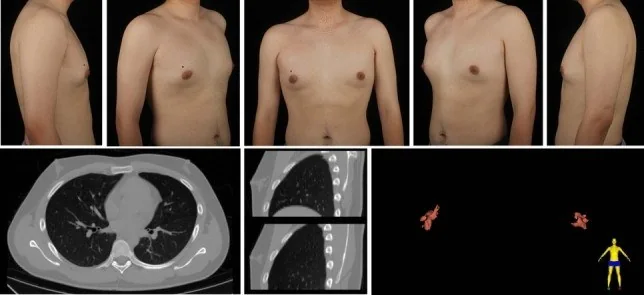
Jinekomasti, erkek memesinde retroareolar glandüler dokunun çoğalmasıdır ve toraks BT'sinde çoğu kez başka nedenle çekilmiş incelemede fark edilir. Tek taraflı veya iki taraflı olabilir; BT'de nodüler, alevsi uzanımlı dendritik ya da yaygın glandüler görünüm alabilir. Toraks BT aksiyel görüntülerinde jinekomasti değerlendirilebilir; ancak klinik tanıda mamografi ve ultrasonografinin yerini almamalıdır. Palpabl meme kitlesine meme başı çekintisi veya cilt kalınlaşması eşlik ediyorsa erkek meme kanseri ayırıcı tanıda düşünülmelidir.
Faz ve pencere
- Kontrastsız tanısal
- Retroareolar alanda meme başı merkezli glandüler doku toraks BT aksiyel görüntülerinde izlenebilir ve nodüler, dendritik veya diffüz paternde sınıflandırılabilir. Jinekomasti, aksiyel toraks BT görüntülerinde değerlendirilebilir.
Önerilen pencereler G genişlik, M merkez; değerler Hounsfield birimi (HU)
- Yumuşak dokuG 400 / M +40
- MediastenG 350 / M +50
BT bulguları
- Nodüler patern — meme başının hemen arkasında, çevre yağa belirsiz geçiş gösteren yuvarlak veya yelpaze biçimli yumuşak doku.
- Dendritik patern, toraks BT çalışmalarında sınıflandırılan jinekomasti tiplerinden biridir.
- Diffüz jinekomasti, nodüler ve dendritik formların özelliklerini birlikte gösterebilir veya kadın memesinin mimarisine benzeyebilir.
- Santral yerleşim — glandüler yoğunluğun meme başı-areola kompleksinin altında merkezlenmesi.
- Jinekomasti tek taraflı veya iki taraflı olabilir.
- Yağ-glandüler ayrımı — gerçek jinekomasti fibroglandüler doku içerirken, yalancı jinekomasti saf yağ dokusundan oluşur ve fibroglandüler bileşen yoktur.
- Jinekomastiden ayrı palpabl retroareolar kitle, meme başı çekintisi veya cilt kalınlaşması saptanırsa erkek meme kanseri ayrıca değerlendirilmelidir.
Ölçütler ve sınıflamalar
- Radyolojik patern
- Mamografide tanımlanan üç patern nodüler, dendritik ve diffüzdür; nodüler retroareolar yelpaze biçiminde, dendritik alev biçiminde parmaksı uzanımlarla görülür.
Normalde
Normal erişkin erkek memesinin büyük bölümü subkutan yağdır; yalnız meme başının altında ince, sınırlı duktal-yumuşak doku görülebilir. Erişkin erkek memesi esas olarak deri, subkutan yağ ve stromal elemanlardan oluşur; duktuslar seyrek ve atrofiktir.
Normal BT ile kıyasla
Aynı bölgenin, kaynak veri setinde patoloji içermediği belirtilen bir BT incelemesini kesit kesit kaydırın; organ sınırlarını açarak anatomiyi hasta görüntüsüyle karşılaştırın. Küçük rastlantısal bulgular tümüyle dışlanmamıştır.
Kaynak: TotalSegmentator v2.01 veri seti (Wasserthal ve ark., Radiology: Artificial Intelligence 2023), CC BY 4.0, vaka s1278; organ sınırları veri setinin otomatik segmentasyonundan, birleştirilerek sadeleştirildi. Görüntüler 2,5 mm kesit aralığına yeniden örneklendi.
Ayırıcı tanı
- Yalancı jinekomasti
- meme hacmi artışı yağ atenüasyonludur; meme başı altında ayrı glandüler disk seçilmez.
- Erkek meme kanseri
- mamografide retroareolar düzensiz, spiküle veya mikrolobüle kenarlı kitle görülebilir; klinikte meme başı çekintisi veya cilt kalınlaşması eşlik edebilir.
- Lipom
- mamografide düzgün sınırlı, radyolüsent oval kitle olarak görülür.
- Meme metastazı
- bilinen sistemik malignitesi olan hastada çoklu veya iki taraflı meme kitleleri metastatik tutulumu düşündürebilir; en sık primerler arasında melanom, akciğer ve prostat kanseri metastazları ile lenfoma tutulumu bildirilmiştir.
Tuzaklar
- Jinekomasti tek taraflı da görülebilir; toraks BT çalışmalarında sağ veya sol memede tek taraflı tutulum bildirilmiştir.
- Glandüler doku ile eşzamanlı eksantrik kitle bulunabilir; jinekomasti paterni ayrı lezyonun değerlendirilmesini sonlandırmaz.
- BT'de jinekomastinin saptanması gereksiz ileri meme görüntülemelerini önleyebilir; ancak BT klinik tanıda mamografi ve ultrasonografinin yerini almamalıdır.
Kendini dene
Toraks BT'de jinekomasti için tanımlanan morfolojik paternler hangileridir?
Cevabı göster
Nodüler, dendritik ve diffüz. Toraks BT çalışmasında jinekomasti nodüler, dendritik ve diffüz tipler olarak değerlendirilmiştir.
Tek taraflı retroareolar palpabl kitleye meme başı çekintisi eşlik ediyor. En olası tanı hangisidir?
Cevabı göster
Erkek meme kanseri. Tek taraflı retroareolar kitleye meme başı çekintisi eşlik etmesi erkek meme kanserini düşündürür; yalancı jinekomasti yağ dokusundan oluşur ve fibroglandüler bileşen içermez.
İlgili konular
Kaynaklar
Bu sayfadaki 34 cümle ve 2 quiz sorusu aşağıdaki kaynaklardan alıntılarla otomatik olarak karşılaştırıldı; 12 cümle bu karşılaştırmada düzeltildi (2026-10-12).
- Male Breast: A Review of the Literature and Current State of the Art of Diagnostic Imaging Work-Uppmc.ncbi.nlm.nih.gov
- Gaps or links between hormonal therapy and schizophrenia? (Review).pubmed.ncbi.nlm.nih.gov
- [Primary mediastinal choriocarcinoma: A case report and literature review].pubmed.ncbi.nlm.nih.gov
- Treatment of gynecomastia with prednisone: case report and literature review.pubmed.ncbi.nlm.nih.gov
- Thoracic perspective revisited in chronic liver disease.pubmed.ncbi.nlm.nih.gov
- Pleomorphic lobular carcinoma in a male breast: a case report with review of the literature.pubmed.ncbi.nlm.nih.gov
- Male breast MRI: a review of different pathological conditions.pubmed.ncbi.nlm.nih.gov
- Gynecomastia with rare granulomatous lobular mastitis: a case report and literature review.pubmed.ncbi.nlm.nih.gov
- Breast imaging in Turner syndrome - ultrasonographic assessment of breast development and screening.pubmed.ncbi.nlm.nih.gov
- A male patient from the West Indies with invasive ductal carcinoma in the right breast: a case report and literature review.pubmed.ncbi.nlm.nih.gov
- Imaging in gynecomastia.pubmed.ncbi.nlm.nih.gov
- EAA clinical practice guidelines-gynecomastia evaluation and management.pubmed.ncbi.nlm.nih.gov
- CHARGE Association.pubmed.ncbi.nlm.nih.gov
- Beyond the lung: recognizing incidental breast lesions on chest computed tomography.pubmed.ncbi.nlm.nih.gov
- Identification and management of incidental findings in a Veteran's lung cancer screening program.pubmed.ncbi.nlm.nih.gov
- A compendium of male breast imaging: The road less traveled.pubmed.ncbi.nlm.nih.gov
- Male Breast Cancer in a Bronx Urban Population: A Single-Institution Retrospective Observational Study.pubmed.ncbi.nlm.nih.gov
- Male accessory breast carcinoma: a rare case report and literature review.pubmed.ncbi.nlm.nih.gov
- The Role and Feasibility of Automated Breast Ultrasound in the Evaluation of Male Breast Disease: Workflow Efficiency and Imaging Spectrum.pubmed.ncbi.nlm.nih.gov
- Glioblastoma mimicking autoimmune meningitis in an adult: A complex diagnostic challenge.pubmed.ncbi.nlm.nih.gov
- Fibrolamellar Hepatocellular Carcinoma (FLHCC) in a Young Patient Presenting With Nausea and Vomiting After a Greasy Meal.pubmed.ncbi.nlm.nih.gov
- American Association of Clinical Endocrinology Consensus Statement on Management of Multiple Endocrine Neoplasia Type 1.pubmed.ncbi.nlm.nih.gov
- Imaging findings and classification of the common and uncommon male breast diseases.pubmed.ncbi.nlm.nih.gov
- Gynecomastia on Thoracic Computed Tomography.pubmed.ncbi.nlm.nih.gov
- Imaging Evaluation and Management of Breast Symptoms in the Pediatric Population.pubmed.ncbi.nlm.nih.gov
- Unusual Presentations of Cancer in the Male Breast.pubmed.ncbi.nlm.nih.gov
- The inframammary fold: Structure, clinical considerations, and reconstructive techniques.pubmed.ncbi.nlm.nih.gov
- Paediatric and Adolescent Breast Cancer: A Narrative Review.pubmed.ncbi.nlm.nih.gov
- Bone Loss, Osteoporosis, and Skeletal Fragility: Hidden Consequences of Cancer Cachexia.pubmed.ncbi.nlm.nih.gov
- US-Guided percutaneous core needle biopsy via the complete transhepatic approach: a reliable option for deep abdominal lesions.pubmed.ncbi.nlm.nih.gov
- IgG4-Related Disease: Endocrine Involvement, Clinical Implications, and Management Strategies.pubmed.ncbi.nlm.nih.gov
- Prevalence of Incidental Gynecomastia by Chest Computed Tomography in Patients with a Prediagnosis of COVID-19 Pneumonia.pubmed.ncbi.nlm.nih.gov
- Benign breast cyst without associated gynecomastia in a male patient: a case report.pubmed.ncbi.nlm.nih.gov
- A retrospective analysis of initial ultrasonographic misdiagnosis of fibrous hamartoma of infancy at the ultrasound center of a tertiary hospital in China.pubmed.ncbi.nlm.nih.gov
- Submucosal laryngeal lesions: A puzzling diagnostic conundrum.pubmed.ncbi.nlm.nih.gov
- Plan of Management of Adrenal Incidentaloma Diagnosed with Carcinoma Colon: A Case Report and Review of Literature.pubmed.ncbi.nlm.nih.gov
- Metastases to the Male Breast: A Systematic Review.pubmed.ncbi.nlm.nih.gov
- Common and Uncommon Splenic Lesions: A Review.pubmed.ncbi.nlm.nih.gov
- Splenic pathologies: A pictorial review of common, wandering, twisting and rare presentations.pubmed.ncbi.nlm.nih.gov
- Is primary breast melanoma a true pathological entity? The argument against it.pubmed.ncbi.nlm.nih.gov
- International Harmonization of Nomenclature and Diagnostic Criteria (INHAND): Non-proliferative and Proliferative Lesions of the Non-human Primate ( M. fascicularis ).pubmed.ncbi.nlm.nih.gov
- International Harmonization of Nomenclature and Diagnostic Criteria (INHAND): Nonproliferative and Proliferative Lesions of the Rabbit.pubmed.ncbi.nlm.nih.gov
- A Rare Case of Remittent Male Invasive Ductal Carcinoma With New Metastasis After Incomplete Adjuvant Therapy.pubmed.ncbi.nlm.nih.gov
- Effectiveness and safety of periareolar micro-excision combined with liposuction for gynecomastia: a retrospective cohort of 177 patients.pubmed.ncbi.nlm.nih.gov
- Male breast carcinoma in a 45-year-old without known risk factors: case report and literature review.pubmed.ncbi.nlm.nih.gov
- A Rare Normal Variant with an Unusual Presentation on a Male Mammogram: A Case Report.pubmed.ncbi.nlm.nih.gov
- A rare presentation of male breast schwannoma.pubmed.ncbi.nlm.nih.gov
- Rare β-human chorionic gonadotrophin-secreting urothelial carcinoma initially presenting as gynecomastia.pubmed.ncbi.nlm.nih.gov
- Is gynecomastia related to the disease characteristics and prognosis in testicular germ cell tumor patients?pubmed.ncbi.nlm.nih.gov
- Frequency and spectrum of incidental findings when using chest CT as a primary triage tool for COVID-19.pubmed.ncbi.nlm.nih.gov
- Best Practice Recommendations for Infertility Management.pubmed.ncbi.nlm.nih.gov
- Non-retroareolar male mucinous breast cancer without gynecomastia development in an elderly man: A case report.pubmed.ncbi.nlm.nih.gov
- A New Clinical Classification Method for Gynecomastia Based on Chest Appearance and MR/CT Images.pubmed.ncbi.nlm.nih.gov
- Dendritic fibromyxolipoma of the male breast: case report and literary review.pubmed.ncbi.nlm.nih.gov
- Key Points of Endoscopic Minimally Invasive Surgery for Gynecomastia Based on Refined Anatomy: A Case Series.pubmed.ncbi.nlm.nih.gov
- Early Diagnosis of Male Breast Cancer: A Case Report and Literature Review.pubmed.ncbi.nlm.nih.gov
- Case report: Renal clear cell carcinoma presenting with metastatic nodules in the male breast: a case and literature review.pubmed.ncbi.nlm.nih.gov
- Adenoid Cystic Carcinoma of the Male Breast: An Exceptionally Rare Presentation.pubmed.ncbi.nlm.nih.gov
- Paraneoplastic Endocrine Changes in Gastrointestinal Tumors: A Clinical and Mechanistic Review.pubmed.ncbi.nlm.nih.gov
- Incidental Gynecomastia on Thoracic Computed Tomography in Clinical Practice: Characteristics, Radiologic Features, and Correlation With Possible Causes in South Korean Men.pubmed.ncbi.nlm.nih.gov
- Unilateral breast enlargement in males during adolescence (10-19 years): Review of current literature and personal experience.pubmed.ncbi.nlm.nih.gov
- Epidermoid Cyst in Male Patient Mimicking a Suspicious Breast Mass and Consequences of Biopsy.pubmed.ncbi.nlm.nih.gov
- Male Breast Cancer in the Age of Genetic Testing: An Opportunity for Early Detection, Tailored Therapy, and Surveillance.pubmed.ncbi.nlm.nih.gov
- Sonographic Features of Palpable Breast and Axillary Lesions in Adult Male Patients: A Pictorial Essay.pubmed.ncbi.nlm.nih.gov
- Clinical Management of Testicular Tumors in Dogs.pubmed.ncbi.nlm.nih.gov
- Benign and malignant breast lesions in children and adolescents - diagnostic and therapeutic approach.pubmed.ncbi.nlm.nih.gov
- Optimizing Care for Veterans at Risk of Cancer From Camp Lejeune Water Exposure.pubmed.ncbi.nlm.nih.gov
- Azoospermia, Atrophy, and Asymmetry: Unilateral Sertoli Cell Tumor as a Rare and Overlooked Cause of Male Infertility: A Case Report and Literature Review.pubmed.ncbi.nlm.nih.gov
- Primary aldosteronism: pharmacotherapy <i>vs</i> surgery <i>vs</i> embolization efficacy - systematic review and network meta-analysis of studies predominantly conducted in China.pubmed.ncbi.nlm.nih.gov
- Incidental Breast Findings on Chest CT: Rates of Report and Follow-Up.pubmed.ncbi.nlm.nih.gov
- Subareolar breast abscess in males.pubmed.ncbi.nlm.nih.gov
- Management of gynecomastia in adolescence and adults: the clinical practice guidelines from the Italian Society of Andrology and Sexual Medicine (SIAMS).pubmed.ncbi.nlm.nih.gov
- Comprehensive use of combined surgical techniques performing liposuction, round-block periareolar de-epithelialization, and complete subcutaneous breast tissue resection approach in grade III gynecomastia: a review of 82 patients.pubmed.ncbi.nlm.nih.gov
- Laterality and Breed Distribution of Cryptorchidism in 251 Dogs: A Retrospective Clinical Study.pubmed.ncbi.nlm.nih.gov
- Gynecomastia Outpatient Surgical Treatment in Children Without Closed-Suction Drain Placement: Is It Safe and Effective?pubmed.ncbi.nlm.nih.gov
- Metastatic Prostate Cancer Masquerading as Locally Advanced Breast Cancer.pubmed.ncbi.nlm.nih.gov
- FDG-PET findings associated with various medical procedures and treatments.pubmed.ncbi.nlm.nih.gov
- Desmoid-Type Fibromatosis of the Male Breast Associated with Bilateral Gynecomastia: Diagnostic Challenges and Surgical Management.pubmed.ncbi.nlm.nih.gov
- Automated Breast Ultrasound (ABUS): A Pictorial Essay of Common Artifacts and Benign and Malignant Pathology.pubmed.ncbi.nlm.nih.gov
- Mammary and extramammary myofibroblastoma: multimodality imaging features with clinicopathologic correlation, management and outcomes in a series of 23 patients.pubmed.ncbi.nlm.nih.gov
- A Breast Mass That Was Not Breast Cancer: Chest Wall-Invading Non-small Cell Lung Carcinoma Presenting as a Retroareolar Tumor in a Male Patient.pubmed.ncbi.nlm.nih.gov
- The unexpected finding of breast and axillary metastases in a patient with prostate carcinoma.pubmed.ncbi.nlm.nih.gov
- Spironolactone-Induced Bilateral Gynecomastia in a Patient With Comorbid Conditions.pubmed.ncbi.nlm.nih.gov
- [A Review on Gynecomastia and Male Breast Cancer for Radiologists].pubmed.ncbi.nlm.nih.gov
- Breast Hamartoma in the Male Sex: Case Report.pubmed.ncbi.nlm.nih.gov
- Male Breast: A Review of the Literature and Current State of the Art of Diagnostic Imaging Work-Up.pubmed.ncbi.nlm.nih.gov
- Isolated metastasis of renal clear-cell carcinoma to the male breast following nephrectomy: A rare case report.pubmed.ncbi.nlm.nih.gov
- Bloody nipple discharge in young children: mammary duct ectasia as a benign, self-limiting condition.pubmed.ncbi.nlm.nih.gov
- A rare presentation of male breast atypical papillary lesion.pubmed.ncbi.nlm.nih.gov
- Proactive fat grafting from the breast area in gynecomastia surgery: Impact on the prevention of contour irregularities and patient satisfaction.pubmed.ncbi.nlm.nih.gov
Eğitim amaçlıdır; hasta başında tanı ve tedavi kararının yerine geçmez, tıbbi tavsiye değildir. Metinler yapay zekâ desteğiyle yazıldı ve otomatik bir adımda kaynak alıntılarıyla karşılaştırıldı; bu bir tıbbi doğrulama değildir ve içerik uzman radyolog incelemesinden geçmedi. Klinik kararlarda güncel kılavuzları, kurum protokollerini ve radyoloji raporunu esas alın.