Özet
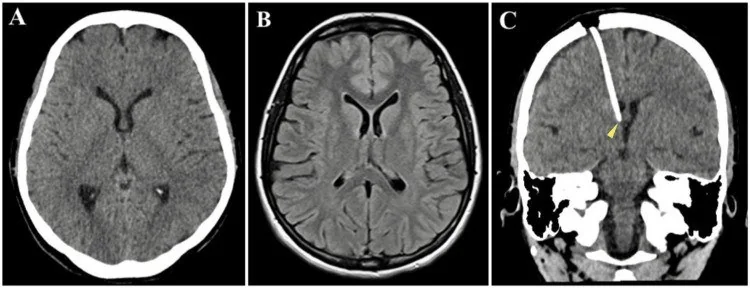
Uzun süreli BOS şantı bulunan hastada lateral ventriküllerin yarık gibi küçülmesi, şant aşırı drenajı ile ilişkili olabilir; ancak klinik sendrom yalnız bu görüntüye indirgenemez. Kontrastsız BT ventrikül boyutunu değerlendirir; şant aşırı drenajında kronik subdural koleksiyonlar eşlik edebilir. Önceki görüntülerle karşılaştırma yapılmalıdır; küçük ventriküller sebat ederken aralıklı işlev bozukluğu veya yüksek basınç görülebilir. Küçük ventriküller yüksek intrakraniyal basıncı dışlamaz.
Faz ve pencere
- Kontrastsız tanısal
- Lateral ventriküller ince yarık şeklinde izlenebilir; şant aşırı drenajına kronik subdural koleksiyonlar eşlik edebilir. Ventrikül boyutu kontrastsız BT ile değerlendirilir.
Önerilen pencereler G genişlik, M merkez; değerler Hounsfield birimi (HU)
- BeyinG 80 / M +40
- SubduralG 200 / M +75
BT bulguları
- Lateral ventrikül gövdeleri ve frontal boynuzlarda belirgin daralma/kollaps görülür; üçüncü ventrikül de kollabe olabilir.
- Şant kateter ucunun ventrikül duvarına dayanması veya ventrikül kollabe olduğunda komşu parankimle yakın teması.
- Şant aşırı drenajına kronik subdural koleksiyonlar eşlik edebilir.
- Ventrikül boyutunun önceki incelemeye göre değişimi; yeni genişleme, küçük ventrikül kalıbı içinde bile tıkanma olasılığını gündeme getirir.
- Eşlik eden intrakraniyal hipertansiyon ve foramen magnum altına tonsiller herniasyon bulguları değerlendirilir.
- Kateterin yanlış yerleşim veya migrasyon açısından konumu BT'de değerlendirilir.
- Küçük ventriküller klinik slit ventrikül sendromuyla aynı şey değildir; sendrom değerlendirmesinde belirtiler ve şant işlevi de dikkate alınır.
Ölçütler ve sınıflamalar
- Slit ventrikül ile ilişkilendirilen klinik örüntüler
- Literatürde radyolojik olarak yarık ventriküllerle ilişkilendirilen başlıca klinik örüntüler; negatif basınçlı gerçek aşırı drenaj, on-off semptom kompleksi, tekrarlayan proksimal kateter işlev bozukluğu, şant aşırı drenajına bağlı kronik subdural koleksiyonlar ve şant işlevinden bağımsız baş ağrısı olarak tanımlanır; BT tek başına bu klinik alt tipleri ayıramaz.
Normalde
Ventrikül boyutu BT ile değerlendirilir ve önceki görüntülerle karşılaştırılır. Aynı aksiyel seviyedeki eski BT ile lümen genişliği, kateter-ependim ilişkisi ve ekstraaksiyel boşluklar kıyaslanır.
Normal BT ile kıyasla
Aynı bölgenin, kaynak veri setinde patoloji içermediği belirtilen bir BT incelemesini kesit kesit kaydırın; organ sınırlarını açarak anatomiyi hasta görüntüsüyle karşılaştırın. Küçük rastlantısal bulgular tümüyle dışlanmamıştır.
Kaynak: TotalSegmentator v2.01 veri seti (Wasserthal ve ark., Radiology: Artificial Intelligence 2023), CC BY 4.0, vaka s0103; organ sınırları veri setinin otomatik segmentasyonundan, birleştirilerek sadeleştirildi. Görüntüler 2,5 mm kesit aralığına yeniden örneklendi.
Ayırıcı tanı
- Şant aşırı drenajı postürle ilişkili baş ağrısı ve kronik subdural koleksiyonlarla ilişkili olabilir.
- Ventrikül içi kateter tıkanması
- klinik bozulma ve önceki BT’ye göre ventrikül genişlemesi görülebilir; küçük ventriküller de şant işlev bozukluğunu dışlamaz.
- Ventrikül genişlemesi saptanmazsa şant işlev bozukluğu dışındaki tanılar da düşünülebilir; ancak slit ventrikül sendromu da akılda tutulmalıdır.
Tuzaklar
- Slit ventrikül görünümü işlevsel tanı değildir; küçük ventrikülle intrakraniyal basınç artışı ve aralıklı tıkanma da görülebilir.
- Şant ucunun parankime yakın görünmesi, kateterin kesin olarak tıkalı olduğu anlamına gelmez; önceki konum ve klinik korelasyon gerekir.
- Yarık ventriküllü hastalarda ventrikül kateteri yerleştirilmesi teknik olarak zor olabilir; bu hastalarda görüntüleme rehberliği serbest el tekniğine kıyasla tercih edilen yaklaşımlardan biridir.
Kendini dene
Uzun süredir BOS şantı bulunan bir hastada BT'de lateral ventriküller ince yarık gibi küçülmüş ve bilateral kronik subdural koleksiyonlar saptanıyor. Yarık ventrikül örüntüsüyle ilişkili en olası süreç hangisidir?
Cevabı göster
Şantın aşırı BOS drenajı. Yarık ventriküller, şant aşırı drenajıyla ilişkili klinik örüntülerden biridir; aşırı drenaja kronik subdural koleksiyonlar eşlik edebilir. Akut tıkanmada genellikle ventrikül genişlemesi beklenir.
Küçük ventriküllü şant hastasında baş ağrısı ve kusma sürüyor; yeni görüntüde ventriküller yine küçük. Hangi çıkarım doğrudur?
Cevabı göster
Basınç sorunu dışlanmaz. Slit ventriküller aralıklı şant tıkanmasıyla birlikte görülebilir; ventrikül boyutu tek başına şant işlevini kanıtlamaz.
İlgili konular
- Şant aşırı drenajı ve intrakraniyal hipotansiyon bulguları
- Şant yetersiz drenajı ve yeniden hidrosefali
- Şant ilişkili subdural higroma veya hematom
Kaynaklar
Bu sayfadaki 35 cümle ve 2 quiz sorusu aşağıdaki kaynaklardan alıntılarla otomatik olarak karşılaştırıldı; 18 cümle bu karşılaştırmada düzeltildi (2026-10-12).
- Slit ventricle syndrome: Historical considerations, diagnosis, pathophysiology, and treatment reviewpmc.ncbi.nlm.nih.gov
- A US-based survey on ventriculostomy practices.pubmed.ncbi.nlm.nih.gov
- Isolated Post-Shunt Metopic Synostosis and Neural Tube Defects.pubmed.ncbi.nlm.nih.gov
- Neuroimaging of ventriculoperitoneal shunt complications in children.pubmed.ncbi.nlm.nih.gov
- Shunt-related cerebrospinal fluid overdrainage - a multicentre consensus definition.pubmed.ncbi.nlm.nih.gov
- Diagnostic Challenges and Surgical Outcomes of Miyazaki Syndrome: A Report of Two Cases and a Systematic Review.pubmed.ncbi.nlm.nih.gov
- Incidence and management of overdrainage in pediatric hydrocephalus patients exclusively treated with modern gravitational VP shunt valves.pubmed.ncbi.nlm.nih.gov
- Ultrasound-guided needle technique as a relaxation strategy for early cranioplasty: illustrative case.pubmed.ncbi.nlm.nih.gov
- Pseudocyst in Neck: A Case Report on Rare Complication of Ventriculoperitoneal Shunt.pubmed.ncbi.nlm.nih.gov
- Armored Brain Associated with Secondary Craniostenosis Development at 7-year following Ventriculoperitoneal Shunt Surgery during Infancy: Extremely Unusual Association and Review.pubmed.ncbi.nlm.nih.gov
- Coronary Arterial Anomalies in Adults with Congenital Heart Disease: From Detection to Management Strategies.pubmed.ncbi.nlm.nih.gov
- Lumbar puncture-induced negative-pressure hydrocephalus in a child with a ventriculoperitoneal shunt and ventricular obstruction: illustrative case.pubmed.ncbi.nlm.nih.gov
- Obstructive Hypertrophic Cardiomyopathy and Interarterial Anomalous Aortic Origin of the Right Coronary Artery (AAORCA) Presenting With Syncope: Multimodal Diagnostic Assessment and Individualized Management.pubmed.ncbi.nlm.nih.gov
- Atrial volume reduction correlates with early improvement in hemorrhage-associated normal pressure hydrocephalus-a 3D computed tomography volumetric study.pubmed.ncbi.nlm.nih.gov
- Anatomical Approaches for Insertion Sites of External Ventricular Drainage Catheters.pubmed.ncbi.nlm.nih.gov
- Cerebrospinal Fluid Shunts: An Updated Radiologic Review of Devices, Malfunctions, and Complications.pubmed.ncbi.nlm.nih.gov
- Ventriculo gallbladder shunt as an alternative cerebrospinal fluid diversionary procedure.pubmed.ncbi.nlm.nih.gov
- Navigation-Assisted Ventriculoperitoneal Shunt Placement in Pediatric Hydrocephalus: Improved Catheter Positioning and Reduced Revision Rates.pubmed.ncbi.nlm.nih.gov
- Trapped Fourth Ventricle in a Pediatric Patient With a History of Post-Traumatic Hydrocephalus and Ventriculoperitoneal Shunt: A Case Report and Literature Review.pubmed.ncbi.nlm.nih.gov
- Spontaneous Vertebral Artery Dissection as the Heralding Manifestation of Previously Undiagnosed Marfan Syndrome in a Young Adult with Posterior Circulation Stroke: A Case Report.pubmed.ncbi.nlm.nih.gov
- Giant Right Sphenoid Wing Meningioma as a Reversible Frontal Network Lesion: A Pseudo-bvFTD Case with Venous-Sparing Skull-Base Resection.pubmed.ncbi.nlm.nih.gov
- Urgent and emergent pediatric cardiovascular imaging.pubmed.ncbi.nlm.nih.gov
- Catheter architecture as a determinant of cerebrospinal fluid flow in pediatric hydrocephalus.pubmed.ncbi.nlm.nih.gov
- Role of cerebroventricular size and surgical placement in modulating catheter flow distribution.pubmed.ncbi.nlm.nih.gov
- Optimal timing of ventriculoperitoneal shunt insertion relative to cranioplasty post-decompressive craniectomy: a frequentist network meta-analysis.pubmed.ncbi.nlm.nih.gov
- Pediatric Trapped Fourth Ventricle: The Need for Objective Surgical-Selection Criteria and Long-Term Surveillance After Open Fenestration.pubmed.ncbi.nlm.nih.gov
- Successfully treated delayed upward trans-tentorial herniation (UTTH) following ventriculoperitoneal shunt placement for an acute obstructive hydrocephalus secondary to midline posterior fossa mass in a low-resource setting: case report.pubmed.ncbi.nlm.nih.gov
- Management of a congenital arachnoid cyst in a newborn with obstructive hydrocephalus: A multistage surgical approach and neurodevelopmental outcome.pubmed.ncbi.nlm.nih.gov
- Advances in temporizing treatment strategies and associated complications for posthemorrhagic hydrocephalus in preterm infants.pubmed.ncbi.nlm.nih.gov
- Individualized treatment for pediatric intracranial aneurysms in China: case series and literature review.pubmed.ncbi.nlm.nih.gov
- Analysis of risk factors for delayed intracranial hemorrhage following ventriculoperitoneal shunt surgery and construction of a nomogram model.pubmed.ncbi.nlm.nih.gov
- Electrophysiology Laboratory Survival Guide Part 1: Electrogram Basics, Catheters, and Basic Intervals.pubmed.ncbi.nlm.nih.gov
- Predominance of ventricular catheter misplacement with anterior approach in neonates and infants.pubmed.ncbi.nlm.nih.gov
- Ebstein Anomaly: Imaging, Pathophysiology, and Therapeutics.pubmed.ncbi.nlm.nih.gov
- A novel ventricular septal reconstruction device for post-myocardial infarction ventricular septal rupture: preclinical and first-in-human study results.pubmed.ncbi.nlm.nih.gov
- Occipital shuntalgia: Rethinking post-shunt occipital headache etiology and care.pubmed.ncbi.nlm.nih.gov
- Endothelial Slit2 guides the Robo1-positive sympathetic innervation during heart development.pubmed.ncbi.nlm.nih.gov
- Lipomatous Dural Metaplasia Associated With Chronic Ventricular Shunting: A Report of Two Cases.pubmed.ncbi.nlm.nih.gov
- Paediatric cranial ultrasound: abnormalities of the brain in term neonates and young infants.pubmed.ncbi.nlm.nih.gov
- Fetal Brain Development: Regulating Processes and Related Malformations.pubmed.ncbi.nlm.nih.gov
- Comparative accuracy evaluation of patient-specific 3D-printed guide and neuronavigation for ventriculoperitoneal shunt in dogs: a dual-phase <i>ex vivo</i> and <i>in vivo</i> study.pubmed.ncbi.nlm.nih.gov
- The Feasibility, Accuracy and Safety of Robot-Assisted Ventriculoperitoneal Shunt.pubmed.ncbi.nlm.nih.gov
- Chudley-McCullough syndrome: A report of a rare syndromic sensorineural hearing loss.pubmed.ncbi.nlm.nih.gov
- Case Report: Ventriculoperitoneal Shunt Catheter Migration into the Gluteal Muscle.pubmed.ncbi.nlm.nih.gov
- Radiologic Assessment of Malpositioned Indwelling Catheters and Medical Devices: A Retrospective Case Series With Pictorial Review.pubmed.ncbi.nlm.nih.gov
- Automated ventricular segmentation and shunt failure detection using convolutional neural networks.pubmed.ncbi.nlm.nih.gov
- Pediatric endocrine disorders: a review of intracranial findings and appropriate imaging.pubmed.ncbi.nlm.nih.gov
- Telemetric intracranial pressure monitoring in patients with hydrocephalus: a systematic literature review.pubmed.ncbi.nlm.nih.gov
- Dural sac shrinkage signs on spinal magnetic resonance imaging indicate overdrainage after lumboperitoneal shunt for idiopathic normal pressure hydrocephalus.pubmed.ncbi.nlm.nih.gov
- Shunt Overdrainage: Reappraisal of the Syndrome and Proposal for an Integrative Model.pubmed.ncbi.nlm.nih.gov
- How to Evaluate and Adjust the Recommended Level of Physical Activity in Patients with Congenital Heart Diseases? A Practical Approach.pubmed.ncbi.nlm.nih.gov
- Long intramural left coronary artery confined to the left sinus of Valsalva with diastolic deformation: a case report.pubmed.ncbi.nlm.nih.gov
- Diagnostic value of machine-learning using conventional magnetic resonance imaging markers for pediatric idiopathic intracranial hypertension: a retrospective study.pubmed.ncbi.nlm.nih.gov
- Combined podocyte, fibrotic and echocardiographic correlates of an operationally defined subclinical cardiorenal phenotype in chronic kidney disease: an exploratory study.pubmed.ncbi.nlm.nih.gov
- A modified surgical technique for ventriculoperitoneal shunt placement using a non-burr hole valve in a pediatric population.pubmed.ncbi.nlm.nih.gov
- Ultrasonic typing and diagnostic value of intravenous leiomyomatosis: a single-center retrospective study.pubmed.ncbi.nlm.nih.gov
- A 7-Point Risk Stratification Tool for EVD Placement in Acute Intracerebral Hemorrhage: A Multivariable Analysis and the Development of Novel Predictive Score (EVD-ICH Score).pubmed.ncbi.nlm.nih.gov
- Early prediction of ventricular peritoneal shunt dependency in aneurysmal subarachnoid haemorrhage patients by recurrent neural network-based machine learning using routine intensive care unit data.pubmed.ncbi.nlm.nih.gov
- Point-of-Care Ultrasound Assessment of Ventriculoperitoneal Shunt Patency: A Case Report.pubmed.ncbi.nlm.nih.gov
- Ventriculoperitoneal Shunt-Associated Cerebrospinal Fluid Pseudocyst Presenting as Abdominal Distension and Pain in an Adult Female Patient: A Case Report.pubmed.ncbi.nlm.nih.gov
- Plasma metagenomic cfDNA sequencing identifies pathogens in culture-negative sepsis following urinary pouch rupture.pubmed.ncbi.nlm.nih.gov
- Minimally invasive interventions for intracranial pathologies using tubular retractors in the pediatric population: Safety, efficacy, technical aspects and outcomes.pubmed.ncbi.nlm.nih.gov
- Continuum of Irreversible and Potentially Reversible Traumatic Brain Injury Sequelae: Axonal Injury and Hydrocephalus.pubmed.ncbi.nlm.nih.gov
- Hydrocephalus: Molecular and Neuroimaging Biomarkers in Diagnosis and Management.pubmed.ncbi.nlm.nih.gov
- Neuroimaging in normal pressure hydrocephalus.pubmed.ncbi.nlm.nih.gov
- 2025 Heart Disease and Stroke Statistics: A Report of US and Global Data From the American Heart Association.pubmed.ncbi.nlm.nih.gov
- Intraoperative cone-beam CT for real-time quality control in CSF shunt surgery: a prospective workflow study.pubmed.ncbi.nlm.nih.gov
- Guidelines for the use of flow cytometry and cell sorting in immunological studies (second edition).pubmed.ncbi.nlm.nih.gov
- Determination of cystathionine beta-synthase activity in human plasma by LC-MS/MS: potential use in diagnosis of CBS deficiency.pubmed.ncbi.nlm.nih.gov
- Delayed presentation of syringomyelia after retrosigmoid craniectomy and resection of vestibular schwannoma: discussion of mechanisms.pubmed.ncbi.nlm.nih.gov
- Cranial ultrasound for beginners.pubmed.ncbi.nlm.nih.gov
- Cranial morphology of the orectolobiform shark, <i>Chiloscyllium punctatum</i> Müller & Henle, 1838.pubmed.ncbi.nlm.nih.gov
- Radiation Safety in Children With Congenital and Acquired Heart Disease: A Scientific Position Statement on Multimodality Dose Optimization From the Image Gently Alliance.pubmed.ncbi.nlm.nih.gov
- Theophylline can resolve refractory acute negative-pressure hydrocephalus: illustrative case.pubmed.ncbi.nlm.nih.gov
- Recapitulation of physiologic and pathophysiologic pulsatile CSF flow in purpose-built high-throughput hydrocephalus bioreactors.pubmed.ncbi.nlm.nih.gov
- Microcephaly, seizures and developmental delay caused by two novel mutations in the <i>PNKP</i> gene: a case report.pubmed.ncbi.nlm.nih.gov
- Dyke-Davidoff-Masson Syndrome Underlying Hemiplegic Cerebral Palsy in an Adolescent: A Case Report.pubmed.ncbi.nlm.nih.gov
- Alzheimer's disease and related dementia: evaluation, diagnosis and acute care management.pubmed.ncbi.nlm.nih.gov
- Comparative CT Ventricular Morphometrics in Hydrocephalus, Stroke, and Traumatic Brain Injury: A Distortion-Controlled Analysis.pubmed.ncbi.nlm.nih.gov
- Characteristics of brain computed tomography in dementia with cardiovascular disease and psychological and behavioral symptoms.pubmed.ncbi.nlm.nih.gov
- Technical nuances of endoscopic transcortical transventricular fenestration for management of giant suprasellar arachnoid cysts in adults: illustrative cases.pubmed.ncbi.nlm.nih.gov
- Primary pineal alveolar rhabdomyosarcoma in an adult patient: a case report and literature review.pubmed.ncbi.nlm.nih.gov
- CT ventriculographic identification and neuroendoscopic treatment of acquired hydrocephalus due to cerebral aqueduct lesions: a two-case report.pubmed.ncbi.nlm.nih.gov
- Atypical Presentations of Ventriculoperitoneal Shunt Malfunction: A Case Series.pubmed.ncbi.nlm.nih.gov
- Right atrial rupture caused by primary cardiac angiosarcoma: A case report.pubmed.ncbi.nlm.nih.gov
- Programmable gravitational valves in idiopathic normal pressure hydrocephalus: long-term outcomes after a 3-year follow-up.pubmed.ncbi.nlm.nih.gov
- Observation of the progression of tension in intracranial arachnoid cyst: a case report and review of literature.pubmed.ncbi.nlm.nih.gov
- Primary intracranial myxopapillary ependymoma: two case reports and literature review.pubmed.ncbi.nlm.nih.gov
- Two cases of syringomyelia after ventriculosubgaleal shunt.pubmed.ncbi.nlm.nih.gov
- Accuracy, Hemorrhagic Complications and CT Radiation Dose of Emergency External Ventricular Drain (EVD) Placement in Pediatric Patients: A 15-Year Retrospective Analysis.pubmed.ncbi.nlm.nih.gov
- First-in-human endovascular treatment of hydrocephalus with a miniature biomimetic transdural shunt.pubmed.ncbi.nlm.nih.gov
- Utility of intracranial pressure monitoring in idiopathic intracranial hypertension patients with refractory headaches: an 8-year, single-surgeon, specialized-center retrospective study.pubmed.ncbi.nlm.nih.gov
- Trans-sylvian hematoma evacuation combined with lamina terminalis ventriculostomy for hypertensive basal ganglia hemorrhage: a retrospective cohort study.pubmed.ncbi.nlm.nih.gov
- Changes in serum sodium during an external ventricular drain weaning in patients with subarachnoid hemorrhage.pubmed.ncbi.nlm.nih.gov
- Comparison of Free-Hand Technique and Neuronavigation in Intraventricular Shunt Catheter Placement.pubmed.ncbi.nlm.nih.gov
- Sympathetic hyperactivation following endoscopic third ventriculostomy: a rare and underrecognized postoperative complication. Illustrative case.pubmed.ncbi.nlm.nih.gov
- Endoscopic third ventriculostomy for diencephalosynapsis-related hydrocephalus in MPDZ gene syndrome: a case report and review of the literature.pubmed.ncbi.nlm.nih.gov
- PHACE syndrome: a systematic literature review and illustrative case report of a patient with severe cerebrovascular and neurodevelopmental sequelae.pubmed.ncbi.nlm.nih.gov
- Coronary-Bronchial Artery Fistulas: Pathophysiology, Multimodality Imaging, and Contemporary Management.pubmed.ncbi.nlm.nih.gov
- When Cancer Clots: An Extensive Radiologic Analysis of Cancer-Associated Thromboembolism.pubmed.ncbi.nlm.nih.gov
- Utility of a freehand frameless navigation system in computed tomography-assisted ventral bulla osteotomy for otitis media in calves.pubmed.ncbi.nlm.nih.gov
- Mechanical-Chemical Combined Atherectomy in a Topologically Isolated Arterial Segment.pubmed.ncbi.nlm.nih.gov
- Post-traumatic hydrocephalus in adults: the mechanisms of development, predictors of progression and management strategies. A narrative review and case series analysis.pubmed.ncbi.nlm.nih.gov
- Endoscopic transclival decompression for ventral brainstem tuberculous abscess: illustrative case.pubmed.ncbi.nlm.nih.gov
- Etiology and Risk Factors for Shunt Revision in Adult Hydrocephalus: A Single-Center Retrospective Cohort Study.pubmed.ncbi.nlm.nih.gov
- Ventriculoperitoneal shunt failures at Red Cross War Memorial Children's Hospital.pubmed.ncbi.nlm.nih.gov
- Progressive ataxia, cognitive decline, urinary incontinence, and unexplained hydrocephalus: a rare case of idiopathic normal pressure hydrocephalus in epileptic patient.pubmed.ncbi.nlm.nih.gov
- A Case of Aqueductal Stenosis with Bilateral Papilledema and Abducens Nerve Palsies without Headache.pubmed.ncbi.nlm.nih.gov
- A Comprehensive Review of Arachnoid Cysts.pubmed.ncbi.nlm.nih.gov
- Analysis of Lateral Ventricular Volume Changes in Patients With Nonsyndromic Sagittal Craniosynostosis and Slit Ventricle Syndrome Following Posterior Vault Distraction.pubmed.ncbi.nlm.nih.gov
- Slit ventricle syndrome: Historical considerations, diagnosis, pathophysiology, and treatment review.pubmed.ncbi.nlm.nih.gov
- pubmed.ncbi.nlm.nih.govpubmed.ncbi.nlm.nih.gov
Eğitim amaçlıdır; hasta başında tanı ve tedavi kararının yerine geçmez, tıbbi tavsiye değildir. Metinler yapay zekâ desteğiyle yazıldı ve otomatik bir adımda kaynak alıntılarıyla karşılaştırıldı; bu bir tıbbi doğrulama değildir ve içerik uzman radyolog incelemesinden geçmedi. Klinik kararlarda güncel kılavuzları, kurum protokollerini ve radyoloji raporunu esas alın.