Özet
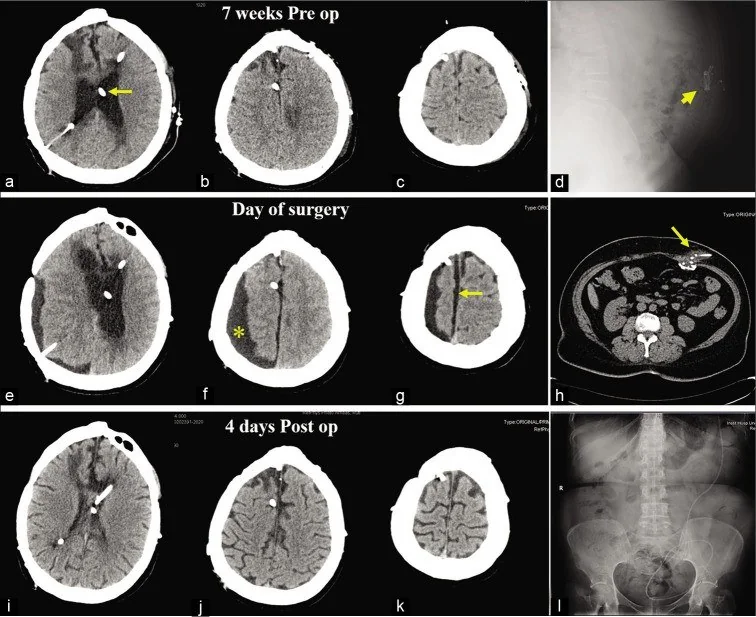
Şantla ilişkili sorunlarda klinik bulgular özgül olmayabilir ve ilk görüntüleme değişiklik göstermeyebilir; klinik kötüleşme sürerse seri değerlendirme gerekebilir. Şant yetersiz drenajında progresif ventrikülomegali görülebilir; hidrosefaliye periventriküler transependimal ödem eşlik edebilir. Şant kateteri ucu görüntülemede değerlendirilebilir; ancak başlangıç BT’sinin kronik hidrosefalide değişmemesi, klinik kötüleşme sırasında şant ilişkili patolojiyi dışlamaz. Şant yetmezliğinde ventriküler genişleme gelişmeyebileceğinden değişmemiş ventrikül boyutları klinik şüpheyi tek başına sonlandırmaz.
Faz ve pencere
- Kontrastsız tanısal
- BT’de hidrosefali değerlendirilirken temporal boynuz genişlemesi ve periventriküler ödem bulguları incelenebilir.
Önerilen pencereler G genişlik, M merkez; değerler Hounsfield birimi (HU)
- BeyinG 80 / M +40
- Yumuşak dokuG 400 / M +40
BT bulguları
- BT’de hidrosefali değerlendirilirken lateral ventriküller ve temporal boynuz genişlemesi incelenebilir.
- Üçüncü ventrikülde bombeleşme görülebilir; obstrüktif patern akuaduktal stenoz bağlamında değerlendirilir.
- Periventriküler beyaz cevherde ventrikül kenarına komşu düşük atenüasyon: transependimal BOS geçişi lehine, ancak özgül olmayan bulgu.
- Basınç etkisi olan hidrosefalide BT'de ventrikülomegaliye periventriküler transependimal ödem eşlik edebilir.
- Kateterin intraventriküler ucunun konumu ve ventrikül duvarıyla teması görüntülemede değerlendirilir.
- Şant sistemi ventriküler kateter, rezervuar, valf ve distal kateter içerir; yerleşim ve işlevin radyografik değerlendirilmesi klinik bakımda önemlidir.
Normalde
Şantlı hastada ventrikül boyutları önceki BT’ye göre değişmemiş olabilir; bu bulgu klinik kötüleşmeyi tek başına dışlamaz. Ventrikül boyutları, önceki BT incelemeleriyle karşılaştırılarak değerlendirilir.
Normal BT ile kıyasla
Aynı bölgenin, kaynak veri setinde patoloji içermediği belirtilen bir BT incelemesini kesit kesit kaydırın; organ sınırlarını açarak anatomiyi hasta görüntüsüyle karşılaştırın. Küçük rastlantısal bulgular tümüyle dışlanmamıştır.
Kaynak: TotalSegmentator v2.01 veri seti (Wasserthal ve ark., Radiology: Artificial Intelligence 2023), CC BY 4.0, vaka s0103; organ sınırları veri setinin otomatik segmentasyonundan, birleştirilerek sadeleştirildi. Görüntüler 2,5 mm kesit aralığına yeniden örneklendi.
Ayırıcı tanı
- Travma sonrası kalıcı ventrikülomegali serebral atrofiyle karıştırılabilir; tedavi edilebilir hidrosefali dışlanmalıdır.
- Vertebrobaziler dolikoektaziye bağlı obstrüktif hidrosefali normal basınçlı hidrosefaliyi taklit edebilir; dikkatli radyolojik değerlendirme gerekir.
- Periakuaduktal lezyona bağlı obstrüktif hidrosefalide lateral ve üçüncü ventriküllerde genişleme görülebilir.
Tuzaklar
- Şantı olan hastada ventrikül boyutu başlangıçta küçük olabilir; aralıklı tıkanma klinik kötüleşmeye rağmen belirgin genişleme yapmayabilir.
- Periventriküler lezyonlar laküner enfarkt, neoplazi ve enfeksiyonlarla karışabilir; ayrımda MR rolü önemlidir.
- Ventrikül boyutlarının değişmemesi, klinik kötüleşen şantlı hastada şantla ilişkili bir sorunu dışlamaz.
- Şantlı hastalarda ventriküller küçük kalabilir veya BT başlangıçta değişmemiş görünebilir; bu görünüm klinik kötüleşme sırasında şantla ilişkili patolojiyi dışlamaz.
Kendini dene
Şantlı hastada baş ağrısı/kusma ile başvuruda önceki BT'ye göre ventriküllerde belirgin genişleme ve periventriküler düşük atenüasyon varsa en olası BT yorumu nedir?
Cevabı göster
Yetersiz drenaja bağlı rekürren hidrosefali. Önceki BT'ye göre ventrikül genişlemesi ve transependimal ödem yetersiz drenaja bağlı yeniden hidrosefali lehinedir; slit ventrikülde ventriküller küçük kalır, ex vacuo genişleme şant işleviyle kötüleşme açıklamaz, NPH'ye özgü tek başına tanısal BT görünümü yoktur.
Şant kateteri ventrikül içinde görülüyor; ventriküller önceki BT'ye göre değişmemiş, fakat hasta klinik olarak kötüleşiyor. Bu BT bulgusu neyi dışlamaz?
Cevabı göster
Şant işlev bozukluğunu. Kateterin ventrikülde görünmesi işlevsel yeterliliği kanıtlamaz; özellikle periventriküler gliozis ('stiff ventricle') nedeniyle şant yetmezliğinde ventrikül genişlemesi gelişmeyebilir, değişmemiş BT şantla ilişkili sorunu dışlamaz.
İlgili konular
- Şant aşırı drenajı ve intrakraniyal hipotansiyon bulguları
- Slit ventrikül örüntüsü ve şant komplikasyonu
- Şant ilişkili subdural higroma veya hematom
Kaynaklar
Bu sayfadaki 30 cümle ve 2 quiz sorusu aşağıdaki kaynaklardan alıntılarla otomatik olarak karşılaştırıldı; 14 cümle bu karşılaştırmada düzeltildi (2026-10-10).
- Slit ventricle syndrome: Historical considerations, diagnosis, pathophysiology, and treatment reviewpmc.ncbi.nlm.nih.gov
- A hybrid omental-parietal peritoneal fibrous sheath: a case report of an unreported cause of recurrent ventriculoperitoneal shunt failure.pubmed.ncbi.nlm.nih.gov
- Acute Neurological Deterioration in a Child with Shunt-Dependent Post-Hemorrhagic Hydrocephalus: A Case Report.pubmed.ncbi.nlm.nih.gov
- Sixteen-Year Interval CT Comparison in Chiari II Malformation After Early Ventriculoperitoneal Shunting: Marked Ventricular Improvement and a Prolonged Seizure-Free Interval.pubmed.ncbi.nlm.nih.gov
- Basilar artery dolichoectasia presenting as obstructive hydrocephalus mimicking normal pressure hydrocephalus.pubmed.ncbi.nlm.nih.gov
- Point-of-Care Ultrasound Assessment of Ventriculoperitoneal Shunt Patency: A Case Report.pubmed.ncbi.nlm.nih.gov
- Continuum of Irreversible and Potentially Reversible Traumatic Brain Injury Sequelae: Axonal Injury and Hydrocephalus.pubmed.ncbi.nlm.nih.gov
- From shunt dependency to shunt freedom: Endoscopic third ventriculostomy in ventriculoperitoneal shunt-dependent communicating tetraventricular hydrocephalus: A case report.pubmed.ncbi.nlm.nih.gov
- Neuroendoscopic-assisted abdominal wall puncture technique in ventriculoperitoneal shunt surgery: implication for clinical treatment.pubmed.ncbi.nlm.nih.gov
- Case Report: Primary Fourth Ventricle Outlet Obstruction in Childhood - New Clinical Insights and Long-Term Outcome.pubmed.ncbi.nlm.nih.gov
- A combined valve-sparing aortic root replacement and primary tetralogy of Fallot repair in an unoperated adult: a case report.pubmed.ncbi.nlm.nih.gov
- Endoscopic third ventriculostomy for diencephalosynapsis-related hydrocephalus in MPDZ gene syndrome: a case report and review of the literature.pubmed.ncbi.nlm.nih.gov
- Isolated Aphasia as an Epileptic Manifestation of Neurosarcoidosis: A Case Report.pubmed.ncbi.nlm.nih.gov
- Malignant Posterior Reversible Encephalopathy Syndrome (PRES) After Allogeneic Hematopoietic Stem Cell Transplantation Requiring Emergency Decompressive Craniectomy: A Case Report.pubmed.ncbi.nlm.nih.gov
- Anatomically Precise Microsurgical Resection of a Posterior Fossa Cerebellar Metastasis in an Elderly Patient with Preservation of Venous Outflow, Dentate Nucleus, and Cerebrospinal Fluid Pathways.pubmed.ncbi.nlm.nih.gov
- Fetal intracranial hemorrhage and infarct: Main sonographic and MRI characteristics: A review article.pubmed.ncbi.nlm.nih.gov
- Navigation-Assisted Ventriculoperitoneal Shunt Placement in Pediatric Hydrocephalus: Improved Catheter Positioning and Reduced Revision Rates.pubmed.ncbi.nlm.nih.gov
- Impact of posthemorrhagic ventricular dilatation on cerebral oxygenation in preterm infants with intraventricular hemorrhage.pubmed.ncbi.nlm.nih.gov
- Venous Thromboembolism in Neonates, Children, and Adolescents: A Comprehensive Narrative Review of Risk Factors, Diagnosis, Treatment, and Prevention.pubmed.ncbi.nlm.nih.gov
- <i>Streptococcus suis</i> meningitis complicated with communicating hydrocephalus: complete clinical and radiological resolution with non-neurosurgical management-A case report.pubmed.ncbi.nlm.nih.gov
- Atrial volume reduction correlates with early improvement in hemorrhage-associated normal pressure hydrocephalus-a 3D computed tomography volumetric study.pubmed.ncbi.nlm.nih.gov
- Advances in temporizing treatment strategies and associated complications for posthemorrhagic hydrocephalus in preterm infants.pubmed.ncbi.nlm.nih.gov
- A Coronal Hydrocephalic Index (Eo Index) for Predicting Shunt Responsiveness in Idiopathic Normal Pressure Hydrocephalus.pubmed.ncbi.nlm.nih.gov
- Comparative CT Ventricular Morphometrics in Hydrocephalus, Stroke, and Traumatic Brain Injury: A Distortion-Controlled Analysis.pubmed.ncbi.nlm.nih.gov
- Cribriform Brain Unraveling Virchow-Robin Space Dilation.pubmed.ncbi.nlm.nih.gov
- Revisiting the Intracranial Neurological Imaging Manifestations of Human Immunodeficiency Virus: Pictorial Review with a Pattern-Based Approach.pubmed.ncbi.nlm.nih.gov
- Predictors for the Differentiation between Glioblastoma, Primary Central Nervous System Lymphoma, and Metastasis in Patients with a Solitary Enhancing Intracranial Mass.pubmed.ncbi.nlm.nih.gov
- The effectiveness of various CSF diversion surgeries in idiopathic normal pressure hydrocephalus: a systematic review and meta-analysis.pubmed.ncbi.nlm.nih.gov
- Overshunting-Related Cervical Myelopathy Causing Progressive Gait Disturbance: A Case Report.pubmed.ncbi.nlm.nih.gov
- Shunt Overdrainage: Reappraisal of the Syndrome and Proposal for an Integrative Model.pubmed.ncbi.nlm.nih.gov
- Shunt Dysfunction Assessment in Shunted Patients via Multiparametric Non-Invasive ICP Waveform Monitoring.pubmed.ncbi.nlm.nih.gov
- Diagnostic Challenges and Surgical Outcomes of Miyazaki Syndrome: A Report of Two Cases and a Systematic Review.pubmed.ncbi.nlm.nih.gov
- Endoscopic third ventriculostomy in hydrocephalus patients with functioning ventriculoperitoneal shunts: challenging the dictum that shunts treat all types of hydrocephalus. Patient series.pubmed.ncbi.nlm.nih.gov
- VP Shunt Malfunction Simulation Case for Emergency Medicine Residents.pubmed.ncbi.nlm.nih.gov
- <i>Cryptococcus gattii</i> CNS infection presenting as a periaqueductal "soap-bubble" lesion causing obstructive hydrocephalus with refractory CSF diversion.pubmed.ncbi.nlm.nih.gov
- PDA in Prematurity: Rethinking a Decades-Old Debate in 2026.pubmed.ncbi.nlm.nih.gov
- MR Lymphangiography in Pediatrics: Indications, Technique, Findings, and Management.pubmed.ncbi.nlm.nih.gov
- Congenital heart disease: types, pathophysiology, diagnosis, and treatment options.pubmed.ncbi.nlm.nih.gov
- Acute fulminant cerebellitis in children: a case series and literature review on diagnostic challenges and management strategies.pubmed.ncbi.nlm.nih.gov
- Automated Evans index measurement using deep learning in acute subarachnoid hemorrhage: reliability, agreement with experts, and association with external ventricular drainage.pubmed.ncbi.nlm.nih.gov
- TachoSil<sup>®</sup> as a ventricular sealant after glioma resection: A single-center retrospective cohort study.pubmed.ncbi.nlm.nih.gov
- A case of idiopathic normal pressure hydrocephalus without enlarged ventricle and with negative tap test.pubmed.ncbi.nlm.nih.gov
- Baseline radiological parameters associated with good neurological outcome following ventriculoperitoneal shunt in normal pressure hydrocephalus: A single-center study on 82 patients.pubmed.ncbi.nlm.nih.gov
- Cerebral blood flow, autoregulation and vascular reactivity in normal pressure hydrocephalus: a systematic review.pubmed.ncbi.nlm.nih.gov
- Loss of PHF6 causes spontaneous seizures, enlarged brain ventricles and altered transcription in the cortex of a mouse model of the Börjeson-Forssman-Lehmann intellectual disability syndrome.pubmed.ncbi.nlm.nih.gov
- Imaging of cerebral complications of extracorporeal membrane oxygenation in infants with congenital heart disease - ultrasound with multimodality correlation.pubmed.ncbi.nlm.nih.gov
- Advanced Ultrasound Techniques for Pediatric Imaging.pubmed.ncbi.nlm.nih.gov
- Achondroplasia: a comprehensive clinical review.pubmed.ncbi.nlm.nih.gov
- A review of the oral health of individuals with disabilities in Puerto Rico and among U.S. Hispanics.pubmed.ncbi.nlm.nih.gov
- Hypertrophic cardiomyopathy: state of the art on diagnosis and current therapeutic approach.pubmed.ncbi.nlm.nih.gov
- Society for Cardiovascular Magnetic Resonance 2024 Cases of SCMR case series.pubmed.ncbi.nlm.nih.gov
- Trans-catheter aortic valve implantation in a patient with membranous ventricular septal defect, sub-aortic band, and double-chambered right ventricle: a case report.pubmed.ncbi.nlm.nih.gov
- Analysis of the effect of laparoscopic temporary long-tunneled external ventricular drainage in patients with post-traumatic brain injury hydrocephalus.pubmed.ncbi.nlm.nih.gov
- Ventriculoperitoneal Shunts in the Emergency Department: A Review.pubmed.ncbi.nlm.nih.gov
- Telemetric intracranial pressure monitoring in patients with hydrocephalus: a systematic literature review.pubmed.ncbi.nlm.nih.gov
- The role of shuntography in diagnosis of mechanic complications after implantation of ventriculoperitoneal shunts in patients with idiopathic normal pressure hydrocephalus: a retrospective clinical evaluation.pubmed.ncbi.nlm.nih.gov
- Anatomical Approaches for Insertion Sites of External Ventricular Drainage Catheters.pubmed.ncbi.nlm.nih.gov
- Ventriculosagittal sinus shunt for treating hydrocephalus with elevated cerebrospinal fluid protein.pubmed.ncbi.nlm.nih.gov
- Stretching the Limits: A Rare Case Report of Perimesencephalic Subarachnoid Hemorrhage During Yoga.pubmed.ncbi.nlm.nih.gov
- Paediatric cranial ultrasound: abnormalities of the brain in term neonates and young infants.pubmed.ncbi.nlm.nih.gov
- Persistent neurological symptoms and elevated intracranial pressures in a previously healthy host with cryptococcal meningitis.pubmed.ncbi.nlm.nih.gov
- Jugular Venous Compression via Soft Cervical Collar in Shunt-Refractory Low-Pressure Hydrocephalus: A Report of Two Cases.pubmed.ncbi.nlm.nih.gov
- Flexible endoscopy for removal of a migrated fractured ventricular catheter in an adult: A case report and technical note.pubmed.ncbi.nlm.nih.gov
- Treatment strategies and prognostic outcomes in craniosynostosis with concurrent hydrocephalus: a case series.pubmed.ncbi.nlm.nih.gov
- Inflammation Meets Ventricular Dynamics: Combined Hematologic and Radiologic Predictors of Shunt-Dependent Hydrocephalus in Endovascularly Treated Patients with Aneurysmal Subarachnoid Hemorrhage.pubmed.ncbi.nlm.nih.gov
- The Role of Antisiphon Devices in the Prevention of Central Ventricular Catheter Obliteration for Hydrocephalus: A 15-Years Institution's Experience Retrospective Analysis.pubmed.ncbi.nlm.nih.gov
- Surgical Management of Breast Cancer Adjacent to a Calcified Ventriculoperitoneal Shunt: A Case Report.pubmed.ncbi.nlm.nih.gov
- Occipital shuntalgia: Rethinking post-shunt occipital headache etiology and care.pubmed.ncbi.nlm.nih.gov
- Clinical manifestations, progression and treatment of post-traumatic hydrocephalus accompanied by contralateral subdural effusion after decompressive craniectomy: a single-center retrospective study.pubmed.ncbi.nlm.nih.gov
- Imaging biomarkers for detection and longitudinal monitoring of ventricular abnormalities from birth to childhood.pubmed.ncbi.nlm.nih.gov
- Bedside Ultrasound for Ventricular Size Monitoring in Patients with PEEK Cranioplasty: A Preliminary Experience of Technical Feasibility in Neurotrauma Setting.pubmed.ncbi.nlm.nih.gov
- Advanced Ultrasound Techniques for Neuroimaging in Pediatric Critical Care: A Review.pubmed.ncbi.nlm.nih.gov
- Clinically relevant imaging in tuberous sclerosis.pubmed.ncbi.nlm.nih.gov
- Post-traumatic hydrocephalus in adults: the mechanisms of development, predictors of progression and management strategies. A narrative review and case series analysis.pubmed.ncbi.nlm.nih.gov
- 2025 Heart Disease and Stroke Statistics: A Report of US and Global Data From the American Heart Association.pubmed.ncbi.nlm.nih.gov
- Long-term safety and effectiveness of the "OptEase" vena cava filter.pubmed.ncbi.nlm.nih.gov
- Pediatric Ventriculoperitoneal (VP) Shunt Catheter Migration Into the Pulmonary Trunk: A Case Report and Literature Review.pubmed.ncbi.nlm.nih.gov
- Cerebrospinal Fluid Shunts: An Updated Radiologic Review of Devices, Malfunctions, and Complications.pubmed.ncbi.nlm.nih.gov
- Subdural fluid accumulation caused by ventriculoperitoneal shunt underdrainage: A rare and paradoxical complication.pubmed.ncbi.nlm.nih.gov
- Palliative stereotactic-endoscopic third ventriculostomy for the treatment of obstructive hydrocephalus from cerebral metastasis.pubmed.ncbi.nlm.nih.gov
- A Prospective Comparative Study of Optic Nerve Sheath Diameter Measurement by Ultrasonography vs Computed Tomography Scan for the Detection of Elevated Intracranial Pressure in Patients with Acute Neurological Emergencies.pubmed.ncbi.nlm.nih.gov
- Intraparenchymal cyst formation after invasive intracranial pressure monitoring: a rare complication. Illustrative case.pubmed.ncbi.nlm.nih.gov
- Navigating the Complexity of Thalamic Abscess: A Systematic Review of Case Studies and Evidence-Based Management.pubmed.ncbi.nlm.nih.gov
- A modified surgical technique for ventriculoperitoneal shunt placement using a non-burr hole valve in a pediatric population.pubmed.ncbi.nlm.nih.gov
- Ventriculo-gallbladder shunt reflux: A case study and review of the literature.pubmed.ncbi.nlm.nih.gov
- Ventricular Anatomy Across CT and MRI in Hydrocephalus: A Retrospective Study.pubmed.ncbi.nlm.nih.gov
- Hydrocephalus: Molecular and Neuroimaging Biomarkers in Diagnosis and Management.pubmed.ncbi.nlm.nih.gov
- Pediatric Meningeal Diseases: What Radiologists Need to Know.pubmed.ncbi.nlm.nih.gov
- Giant Posterior Fossa Tuberculoma Mimicking Atypical Teratoid/Rhabdoid Tumor in a Child: Illustrative Case.pubmed.ncbi.nlm.nih.gov
- Sympathetic hyperactivation following endoscopic third ventriculostomy: a rare and underrecognized postoperative complication. Illustrative case.pubmed.ncbi.nlm.nih.gov
- Surgery for post-traumatic hydrocephalus: lessons, challenges and future directions.pubmed.ncbi.nlm.nih.gov
- Bilateral Lateral Ventricle Cerebrospinal Fluid Diversion in a Rare Case of Foramen of Monro Occlusion: A Case Report.pubmed.ncbi.nlm.nih.gov
- Clinical Subgroups and Treatment Outcomes in Idiopathic Normal Pressure Hydrocephalus: Application of Machine Learning-Based Clustering.pubmed.ncbi.nlm.nih.gov
- Progress in the diagnosis and treatment of post-traumatic hydrocephalus.pubmed.ncbi.nlm.nih.gov
- Cytotoxic Lesions of the Corpus Callosum after Aneurysmal Subarachnoid Hemorrhage and Risk of Shunt-Dependent Chronic Hydrocephalus.pubmed.ncbi.nlm.nih.gov
- Moving on in hydrocephalus imaging: from 2D to 3D biomarkers.pubmed.ncbi.nlm.nih.gov
- Subarachnoid Hemorrhage Causing Hydrocephalus: Narrative Review of a Neurosurgical Emergency.pubmed.ncbi.nlm.nih.gov
- Role of cerebroventricular size and surgical placement in modulating catheter flow distribution.pubmed.ncbi.nlm.nih.gov
- Comparative accuracy evaluation of patient-specific 3D-printed guide and neuronavigation for ventriculoperitoneal shunt in dogs: a dual-phase <i>ex vivo</i> and <i>in vivo</i> study.pubmed.ncbi.nlm.nih.gov
- Perioperative real-life mobility assessment using wearable step counts in idiopathic normal pressure hydrocephalus after ventriculoperitoneal shunt surgery: a prospective pilot study.pubmed.ncbi.nlm.nih.gov
- Dolichoectasia of Anterior and Posterior Circulation With Thrombosed Saccular Aneurysm of Vertebral Artery Presenting as Obstructive Hydrocephalus: A Case Report.pubmed.ncbi.nlm.nih.gov
- Vascular Anomaly Presenting as Neurological Crisis: A Case Report of Dolichoectasia-Induced Seizures.pubmed.ncbi.nlm.nih.gov
- Hydrocephalus as a rare compilation of vertebrobasilar dolichoectasia: A case report and review of the literature.pubmed.ncbi.nlm.nih.gov
- Catheter architecture as a determinant of cerebrospinal fluid flow in pediatric hydrocephalus.pubmed.ncbi.nlm.nih.gov
- Multifocal intracranial hemorrhage on emergency brain CT in a child with end-stage nephrotic syndrome.pubmed.ncbi.nlm.nih.gov
- Successfully treated delayed upward trans-tentorial herniation (UTTH) following ventriculoperitoneal shunt placement for an acute obstructive hydrocephalus secondary to midline posterior fossa mass in a low-resource setting: case report.pubmed.ncbi.nlm.nih.gov
- Autopsy Confirmed Normal Pressure Hydrocephalus (NPH) Presenting With Corticobasal Syndrome.pubmed.ncbi.nlm.nih.gov
- Cerebrospinal fluid dysregulation and post-traumatic hydrocephalus after paediatric traumatic brain injury.pubmed.ncbi.nlm.nih.gov
- Endovascular thrombectomy in a patient with ischemic stroke and vertebrobasilar dolichoectasia: A case report.pubmed.ncbi.nlm.nih.gov
- CT ventriculographic identification and neuroendoscopic treatment of acquired hydrocephalus due to cerebral aqueduct lesions: a two-case report.pubmed.ncbi.nlm.nih.gov
- Acute decompensation of chronic hydrocephalus following elective abdominal surgery presenting as paroxysmal sympathetic hyperactivity: illustrative case.pubmed.ncbi.nlm.nih.gov
Eğitim amaçlıdır; hasta başında tanı ve tedavi kararının yerine geçmez, tıbbi tavsiye değildir. Metinler yapay zekâ desteğiyle yazıldı ve otomatik bir adımda kaynak alıntılarıyla karşılaştırıldı; bu bir tıbbi doğrulama değildir ve içerik uzman radyolog incelemesinden geçmedi. Klinik kararlarda güncel kılavuzları, kurum protokollerini ve radyoloji raporunu esas alın.