Özet
Ventrikülomegali, ventriküllerin geniş görünmesini tanımlar; bu görünüm tek başına aktif hidrosefali demek değildir. Ex-vacuo genişleme, beyin hacim kaybına bağlı ventrikül genişlemesidir. BT'de ventrikül boyutu temporal boynuzlar, üçüncü ventrikül, kortikal sulkuslar ve periventriküler atenüasyonla birlikte değerlendirilmelidir. Ventriküler genişlemenin atrofiye veya hidrosefaliye yanlış bağlanması gereksiz şant cerrahisine ya da tedavinin gecikmesine yol açabilir.
Faz ve pencere
- Kontrastsız tanısal
- Ventrikül ve sulkus genişliği, temporal boynuz konturu, üçüncü ventrikül ve periventriküler atenüasyon aynı incelemede karşılaştırılarak değerlendirilir.
Önerilen pencereler G genişlik, M merkez; değerler Hounsfield birimi (HU)
- BeyinG 80 / M +40
BT bulguları
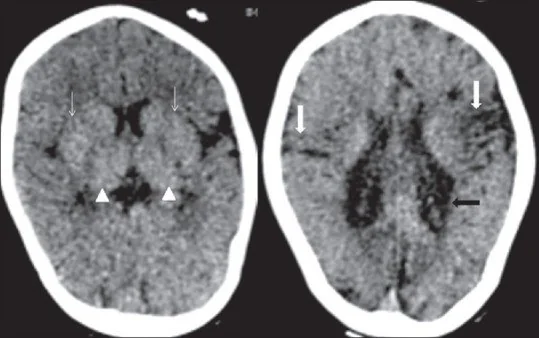
- Ex vacuo lehine: ventrikül genişlemesine beyin hacim kaybının ve yaygın kortikal sulkus genişliğinin eşlik etmesi; sulkusların daralma göstermemesi hidrosefaliden ayrımı destekler.
- Aktif hidrosefali lehine: kortikal sulkuslarda basıya bağlı daralma/silinme izlenmesi ve ventrikül genişliğinin dış BOS alanlarına göre görece belirgin olması.
- Temporal boynuzlar ve üçüncü ventrikül, ventrikül sisteminin geri kalanıyla uyumlu biçimde genişlemişse hidrosefali lehinedir; ex-vacuo genişleme beyin hacim kaybına bağlıdır.
- Üçüncü ventrikül genişliği genel ventrikül örüntüsüyle karşılaştırılır; tek başına tanısal eşik değildir.
- Periventriküler düşük atenüasyon transependimal BOS geçişini düşündürebilir; hidrosefali diğer görüntüleme ve klinik bulgularla birlikte değerlendirilir.
- Temporal boynuzların ve üçüncü ventrikülün genişlemesi, ventrikül sisteminin geri kalanındaki genişlemeyle uyumluysa hidrosefali lehinedir; sulkusların silinmesi ve periventriküler düşük atenüasyon da tanıyı destekler.
- İdiyopatik normal basınçlı hidrosefali kuşkusunda Evans indeksi, kallozal açı ve DESH örüntüsü MR ile birlikte değerlendirilebilir; ventrikül genişliğine dayalı ölçümler tek başına şant seçimi için yeterli değildir.
Ölçütler ve sınıflamalar
- Morfolojik ayrım
- Ex vacuo: beyin hacim kaybına bağlı ventrikül genişlemesine yaygın dış BOS alanı ve sulkus genişliğinin eşlik etmesi. Hidrosefali: ventrikül genişliğinin dış BOS alanlarına göre görece belirgin olması; temporal boynuz ve üçüncü ventrikül genişlemesi ile sulkal silinme veya transependimal geçiş tanıyı destekleyebilir.
Normalde
Yaşa uygun normal beyin BT'sinde ventrikül boyutu yaşla değişir ve tek bir mutlak ölçüyle yorumlanmaz; ventrikül, sulkus ve parankim uyumu klinik bağlamla değerlendirilir. Kıyaslamada ventrikül genişlemesinin kortikal hacim kaybı ve sulkal açıklıkla paralel olup olmadığını, periventriküler ödem veya sisternal bası bulunup bulunmadığını izleyin.
Normal BT ile kıyasla
Aynı bölgenin, kaynak veri setinde patoloji içermediği belirtilen bir BT incelemesini kesit kesit kaydırın; organ sınırlarını açarak anatomiyi hasta görüntüsüyle karşılaştırın. Küçük rastlantısal bulgular tümüyle dışlanmamıştır.
Kaynak: TotalSegmentator v2.01 veri seti (Wasserthal ve ark., Radiology: Artificial Intelligence 2023), CC BY 4.0, vaka s0103; organ sınırları veri setinin otomatik segmentasyonundan, birleştirilerek sadeleştirildi. Görüntüler 2,5 mm kesit aralığına yeniden örneklendi.
Ayırıcı tanı
- İdiyopatik normal basınçlı hidrosefali
- Sylvian fissürler genişken yüksek konveksite sulkusları dar kalabilir.
- Komünikan hidrosefali BOS dolaşım/emilim bozukluğuyla ilişkilidir; temporal boynuz genişlemesi ve periventriküler transependimal geçiş basınç bileşenini destekleyebilir.
- Obstrüktif hidrosefali BOS akım yolundaki tıkanıklıkla ilişkilidir; genişleme dağılımı tıkanıklığın seviyesine göre değerlendirilir.
- İleri nörodejeneratif atrofide ventrikül genişlemesi serebral atrofiye bağlı görülebilir.
Tuzaklar
- Yaşlı hastada geniş ventrikülleri otomatik olarak atrofiye bağlamayın; temporal boynuz, sulkal dağılım ve seri değişim birlikte incelenmelidir.
- Periventriküler düşük atenüasyon, transependimal BOS geçişini düşündüren bir bulgudur ancak tanı yalnızca bu bulguyla konulmaz; hidrosefali tanısı diğer radyolojik ve klinik bulgularla birlikte değerlendirilmelidir.
- Tek bir aksiyel kesitte sulkus genişliği yanıltıcı olabilir; yüksek konveksite ve Sylvian fissürler dahil tüm dış BOS alanlarını izleyin.
Kendini dene
Ventriküller geniş; sulkuslar geniş ve silinme yok, beyin hacim kaybı var. En olası yorum nedir?
Cevabı göster
Ex-vacuo genişleme. Dış BOS alanları da geniş ve sulkal silinme yoksa tablo beyin hacim kaybına bağlı ex-vacuo genişleme lehinedir; bazal sisternlerde obliterasyon ve kortikal sulkuslarda silinme hidrosefali tanısını destekler.
Ventriküller ve temporal boynuzlar geniş; kortikal sulkuslar silinmiş ve periventriküler beyaz cevherde BT'de düşük atenüasyon var. Bu bulgular en çok hangi tanıyı destekler?
Cevabı göster
Hidrosefali. Temporal boynuz genişlemesi ve kortikal sulkusların silinmesi hidrosefaliyi destekler; basınç altındaki ventriküllerden periventriküler parankime transependimal BOS geçişi BT'de düşük atenüasyon olarak görülebilir.
İlgili konular
Kaynaklar
Bu sayfadaki 35 cümle ve 2 quiz sorusu aşağıdaki kaynaklardan alıntılarla otomatik olarak karşılaştırıldı; 16 cümle bu karşılaştırmada düzeltildi (2026-10-12).
- Hydrocephalus Indian scenario – A reviewpmc.ncbi.nlm.nih.gov
- Beyond Maximum Haemorrhage Grade: Serial Cranial Ultrasound Phenotyping Refines Developmental Risk Stratification After Intraventricular Haemorrhage in Very Preterm Infants.pubmed.ncbi.nlm.nih.gov
- Cerebrospinal fluid dysregulation and post-traumatic hydrocephalus after paediatric traumatic brain injury.pubmed.ncbi.nlm.nih.gov
- Distinctive hydrocephalus-like phenotype in NOTCH2NLC-related neuronal intranuclear inclusion disease: clinicopathological features and therapeutic implications.pubmed.ncbi.nlm.nih.gov
- Redefining Idiopathic Normal Pressure Hydrocephalus Using AI-Driven Brain Volumetry.pubmed.ncbi.nlm.nih.gov
- Dyke-Davidoff-Masson Syndrome: A Case of Unilateral Cerebral Atrophy and Seizure Disorder.pubmed.ncbi.nlm.nih.gov
- Baseline radiological parameters associated with good neurological outcome following ventriculoperitoneal shunt in normal pressure hydrocephalus: A single-center study on 82 patients.pubmed.ncbi.nlm.nih.gov
- Cerebral blood flow, autoregulation and vascular reactivity in normal pressure hydrocephalus: a systematic review.pubmed.ncbi.nlm.nih.gov
- Degenerative spinal stenosis may influence Normal Pressure Hydrocephalus (NPH)-related imaging characteristics.pubmed.ncbi.nlm.nih.gov
- Emerging cryptococcosis cases in Himalayan & sub-Himalayan regions of India.pubmed.ncbi.nlm.nih.gov
- An intracranial yolk sac tumor with initial symptom of hemorrhage in the basal ganglia: a case report.pubmed.ncbi.nlm.nih.gov
- Structural neuroimaging markers of normal pressure hydrocephalus versus Alzheimer's dementia and Parkinson's disease, and hydrocephalus versus atrophy in chronic TBI-a narrative review.pubmed.ncbi.nlm.nih.gov
- Brain CT can predict low lean mass in the elderly with cognitive impairment: a community-dwelling study.pubmed.ncbi.nlm.nih.gov
- Continuum of Irreversible and Potentially Reversible Traumatic Brain Injury Sequelae: Axonal Injury and Hydrocephalus.pubmed.ncbi.nlm.nih.gov
- Subcortical morphological alterations and volume loss in infantile hydrocephalus: A surface- and volume-based analysis.pubmed.ncbi.nlm.nih.gov
- Factors determining hydrocephalus after decompressive craniectomy: the role of interhemispheric hygroma.pubmed.ncbi.nlm.nih.gov
- A comparative assessment of age- and gender-related variations in brain morphometry using linear and volumetric MRI analysis.pubmed.ncbi.nlm.nih.gov
- Congenital Idiopathic Dilatation of the Right Atrium: Prenatal Diagnosis and 9-Year Follow-Up.pubmed.ncbi.nlm.nih.gov
- Isolated tricuspid regurgitation in structurally normal fetal hearts: a systematic review.pubmed.ncbi.nlm.nih.gov
- Beyond Ventricular Enlargement: Multimodal MRI Assessment Improves Surgical Decision-Making in Normal Pressure Hydrocephalus.pubmed.ncbi.nlm.nih.gov
- Fluid transport in the brain.pubmed.ncbi.nlm.nih.gov
- Clinicopathologic Features and Magnetic Resonance Imaging Findings in 24 Cats With Histopathologically Confirmed Neurologic Feline Infectious Peritonitis.pubmed.ncbi.nlm.nih.gov
- Digital Cognitive Phenotyping for Differential Diagnosis and Monitoring in Neurological Conditions.pubmed.ncbi.nlm.nih.gov
- Neuropsychiatric Systemic Lupus Erythematosus With Early-Onset Brain Atrophy: A Case Report and Literature Review.pubmed.ncbi.nlm.nih.gov
- Radiological Predictors of Cognitive Impairment in Paediatric Brain Tumours Using Multiparametric Magnetic Resonance Imaging: A Review of Current Practice, Challenges and Future Directions.pubmed.ncbi.nlm.nih.gov
- Chronic kidney disease and cognitive decline: choroid plexus remodeling, glymphatic dysfunction, and alzheimer biomarker interpretation.pubmed.ncbi.nlm.nih.gov
- Mapping neurodegeneration with diffusion MRI: biomarkers, mechanisms, and clinical translation.pubmed.ncbi.nlm.nih.gov
- Role of Ultrasound and Fetal MRI in the Prenatal Assessment of Congenital Cytomegalovirus Infection: A Systematic Review.pubmed.ncbi.nlm.nih.gov
- Assessing CT-based volumetric analysis via deep learning for idiopathic normal pressure hydrocephalus.pubmed.ncbi.nlm.nih.gov
- Artificial intelligence in paediatric neuroradiology: current landscape, challenges, and future directions.pubmed.ncbi.nlm.nih.gov
- Diagnostic performance of black tent sign on 3D T2 SPACE in the diagnosis of idiopathic normal-pressure hydrocephalus.pubmed.ncbi.nlm.nih.gov
- Surgery for post-traumatic hydrocephalus: lessons, challenges and future directions.pubmed.ncbi.nlm.nih.gov
- Canine Cognitive Dysfunction and Alzheimer's Disease: Pathophysiological Relationships and the Impact of Glymphatic System Impairment on Neurodegeneration.pubmed.ncbi.nlm.nih.gov
- Radiological predictors of shunt response in the diagnosis and treatment of idiopathic normal pressure hydrocephalus: a systematic review and meta-analysis.pubmed.ncbi.nlm.nih.gov
- Imaging features associated with idiopathic normal pressure hydrocephalus have high specificity even when comparing with vascular dementia and atypical parkinsonism.pubmed.ncbi.nlm.nih.gov
- Radiological assessment of dementia: the Italian inter-society consensus for a practical and clinically oriented guide to image acquisition, evaluation, and reporting.pubmed.ncbi.nlm.nih.gov
- Syncope in a Patient With an Extensive Thoracolumbosacral Myxopapillary Ependymoma.pubmed.ncbi.nlm.nih.gov
- Incidental Diagnosis of Normal Pressure Hydrocephalus in Elderly Patients Presenting With Acute Neurological Illnesses: A Report of Two Cases.pubmed.ncbi.nlm.nih.gov
- From Sound to Silence: Cerebellar Abscesses and Herniation Due to Cochlear Implant Infection With <i>Escherichia coli</i> and <i>Bacteroides fragilis</i>.pubmed.ncbi.nlm.nih.gov
- Advances in Fetal Surgery: A Narrative Review of Therapeutic Interventions and Future Directions.pubmed.ncbi.nlm.nih.gov
- Slit ventricle syndrome: Historical considerations, diagnosis, pathophysiology, and treatment review.pubmed.ncbi.nlm.nih.gov
- Functional loss of Ccdc1 51 leads to hydrocephalus in a mouse model of primary ciliary dyskinesia.pubmed.ncbi.nlm.nih.gov
- Identification of MRI-Derived Structural Biomarkers in Female Alzheimer's Disease Subjects Using CAT12 and Mimics: Effects of Voxel Geometry on Biomarker Estimation.pubmed.ncbi.nlm.nih.gov
- Neurological manifestations and neuroimaging findings in patients with SARS-CoV2-a systematic review.pubmed.ncbi.nlm.nih.gov
- Automated Evans index measurement using deep learning in acute subarachnoid hemorrhage: reliability, agreement with experts, and association with external ventricular drainage.pubmed.ncbi.nlm.nih.gov
- Imaging biomarkers for detection and longitudinal monitoring of ventricular abnormalities from birth to childhood.pubmed.ncbi.nlm.nih.gov
- <i>Wnt</i> and <i>Nodal</i> asymmetries stratify mouse laterality phenotypes in the absence of node flow.pubmed.ncbi.nlm.nih.gov
- A Coronal Hydrocephalic Index (Eo Index) for Predicting Shunt Responsiveness in Idiopathic Normal Pressure Hydrocephalus.pubmed.ncbi.nlm.nih.gov
- Deep learning-based automatic segmentation of brain structures on MRI: A test-retest reproducibility analysis.pubmed.ncbi.nlm.nih.gov
- AI-based differential diagnosis of dementia etiologies on multimodal data.pubmed.ncbi.nlm.nih.gov
- Sex difference in tDCS current mediated by changes in cortical anatomy: A study across young, middle and older adults.pubmed.ncbi.nlm.nih.gov
- The Role of the Craniocervical Junction in Craniospinal Hydrodynamics and Neurodegenerative Conditions.pubmed.ncbi.nlm.nih.gov
- Paediatric cranial ultrasound: abnormalities of the brain in term neonates and young infants.pubmed.ncbi.nlm.nih.gov
- Interpretable 2D Deep Learning for Alzheimer's Detection from sMRI: A Lightweight Residual CNN Approach with Comprehensive Preprocessing and Stratified Data Partitioning.pubmed.ncbi.nlm.nih.gov
- The role of magnetic resonance imaging in the diagnosis and prognosis of dementia.pubmed.ncbi.nlm.nih.gov
- Prenatal assessment of brain malformations on neuroimaging: an expert panel review.pubmed.ncbi.nlm.nih.gov
- Clinical Application of Brain MRI in the Diagnostic Work-up of Parkinsonism.pubmed.ncbi.nlm.nih.gov
- Imaging of Neuromodulation and Surgical Interventions for Epilepsy.pubmed.ncbi.nlm.nih.gov
- Neuropathology of the Alzheimer's continuum: an update.pubmed.ncbi.nlm.nih.gov
- Concordance between routine interictal magnetoencephalography and simultaneous scalp electroencephalography in a sample of patients with epilepsy.pubmed.ncbi.nlm.nih.gov
- Bridging the gap: Translating fetal, infant, and toddler neuroimaging insights into clinical practice.pubmed.ncbi.nlm.nih.gov
- Regulation of brain fluid volumes and pressures: basic principles, intracranial hypertension, ventriculomegaly and hydrocephalus.pubmed.ncbi.nlm.nih.gov
- From the past to the present: evolving theories in the pathophysiology of normal pressure hydrocephalus.pubmed.ncbi.nlm.nih.gov
- Fetal intracranial hemorrhage and infarct: Main sonographic and MRI characteristics: A review article.pubmed.ncbi.nlm.nih.gov
- Bacterial Meningoencephalitis in Newborns.pubmed.ncbi.nlm.nih.gov
- The value of CSF flow studies in the management of CSF disorders in children: a pictorial review.pubmed.ncbi.nlm.nih.gov
- Differences in Brain Morphology between Hydrocephalus Ex Vacuo and Idiopathic Normal Pressure Hydrocephalus.pubmed.ncbi.nlm.nih.gov
- Alzheimer's disease and related dementia: evaluation, diagnosis and acute care management.pubmed.ncbi.nlm.nih.gov
- Alzheimer's disease: A comprehensive review of epidemiology, pathophysiology, diagnosis, and treatment.pubmed.ncbi.nlm.nih.gov
- The Role of Magnetic Resonance Spectroscopy (MRS), Diffusion-Tensor-Imaging (DTI) and Structural MRI in the Alzheimer's Disease and Mild Cognitive Impairment Diagnosis: A Review.pubmed.ncbi.nlm.nih.gov
- Endoscopic third ventriculostomy for diencephalosynapsis-related hydrocephalus in MPDZ gene syndrome: a case report and review of the literature.pubmed.ncbi.nlm.nih.gov
- Surgical treatment of large vestibular schwannomas with hydrocephalus in octogenarians: Two cases with favorable functional outcomes.pubmed.ncbi.nlm.nih.gov
- Low-Pressure Hydrocephalus After Traumatic Brain Injury: A Case Series and Scoping Review.pubmed.ncbi.nlm.nih.gov
- Reversal of cerebral pseudoatrophy in normal pressure hydrocephalus after ventriculoatrial shunt placement.pubmed.ncbi.nlm.nih.gov
- Moving on in hydrocephalus imaging: from 2D to 3D biomarkers.pubmed.ncbi.nlm.nih.gov
- Post-Hemorrhagic Hydrocephalus with Secondary Cerebrospinal Fluid Pathway Obstruction in an Extremely Premature Infant: A Case Report.pubmed.ncbi.nlm.nih.gov
- Comparative CT Ventricular Morphometrics in Hydrocephalus, Stroke, and Traumatic Brain Injury: A Distortion-Controlled Analysis.pubmed.ncbi.nlm.nih.gov
- Neurogenic Paradoxical Vocal Fold Motion: A Systematic Review of Central and Pheripheral Nervous System Disorders.pubmed.ncbi.nlm.nih.gov
- Differential diagnosis of non-hydrocephalus ventricular dilation and hydrocephalus.pubmed.ncbi.nlm.nih.gov
- Imaging Markers for Normal Pressure Hydrocephalus: An Overview.pubmed.ncbi.nlm.nih.gov
- Pediatric Meningeal Diseases: What Radiologists Need to Know.pubmed.ncbi.nlm.nih.gov
- Evaluation of disproportionately enlarged subarachnoid-space hydrocephalus in progressive supranuclear palsy.pubmed.ncbi.nlm.nih.gov
- The parasagittal dural space of the human brain.pubmed.ncbi.nlm.nih.gov
- Neonatal cranial sonography: ultrasound findings in neonatal meningitis-a pictorial review.pubmed.ncbi.nlm.nih.gov
- Diagnosis and Treatment of Idiopathic Normal Pressure Hydrocephalus.pubmed.ncbi.nlm.nih.gov
- Neuroimaging biomarkers of preterm brain injury: toward developing the preterm connectome.pubmed.ncbi.nlm.nih.gov
- Navigating Diagnostic Ambiguity in Palliative Pediatric Neuro-Oncology: A Conceptual Framework for Suspected Shunt Malfunction and Refractory Hyponatremia.pubmed.ncbi.nlm.nih.gov
- Autopsy Confirmed Normal Pressure Hydrocephalus (NPH) Presenting With Corticobasal Syndrome.pubmed.ncbi.nlm.nih.gov
- An ABC for decision making.pubmed.ncbi.nlm.nih.gov
- High Evans Index in progressive supranuclear palsy may mimic normal pressure hydrocephalus: a retrospective cross-sectional study.pubmed.ncbi.nlm.nih.gov
- Cerebral and occipito-atlanto-axial involvement in mucopolysaccharidosis patients: clinical, radiological, and neurosurgical features.pubmed.ncbi.nlm.nih.gov
- Optimal timing of ventriculoperitoneal shunt insertion relative to cranioplasty post-decompressive craniectomy: a frequentist network meta-analysis.pubmed.ncbi.nlm.nih.gov
- Fetal mri of obstructive hydrocephalus: a review proposing a surgical etiology-based approach.pubmed.ncbi.nlm.nih.gov
- <i>Streptococcus suis</i> meningitis complicated with communicating hydrocephalus: complete clinical and radiological resolution with non-neurosurgical management-A case report.pubmed.ncbi.nlm.nih.gov
- Immunosuppressive Therapy in Takayasu Arteritis: A Tightrope Walk Between Inflammation and Infection.pubmed.ncbi.nlm.nih.gov
- Characteristics of brain computed tomography in dementia with cardiovascular disease and psychological and behavioral symptoms.pubmed.ncbi.nlm.nih.gov
- CT-based automatic segmentation of key CSF regions for detecting disproportionately enlarged subarachnoid space hydrocephalus.pubmed.ncbi.nlm.nih.gov
- Parasagittal subdural space: a novel quantitative marker of spontaneous intracranial hypotension syndrome-induced chronic subdural hematoma.pubmed.ncbi.nlm.nih.gov
- The differential diagnosis and treatment of normal-pressure hydrocephalus.pubmed.ncbi.nlm.nih.gov
- MRI Evaluation and Reporting in Suspected and Established Idiopathic Normal Pressure Hydrocephalus, <i>AJR</i> Expert Panel Review.pubmed.ncbi.nlm.nih.gov
- Disproportionately elevated sulcal index (DESI): An automatically driven index representing disproportionate subarachnoid space enlargement in brain MRI scans.pubmed.ncbi.nlm.nih.gov
- Idiopathic normal pressure hydrocephalus: validation of the DESH score in the Capital Region of Denmark.pubmed.ncbi.nlm.nih.gov
- Persistent Hypersomnolence Following Aneurysmal Subarachnoid Hemorrhage: A Case Report.pubmed.ncbi.nlm.nih.gov
- Basilar artery dolichoectasia presenting as obstructive hydrocephalus mimicking normal pressure hydrocephalus.pubmed.ncbi.nlm.nih.gov
- Bilateral Lateral Ventricle Cerebrospinal Fluid Diversion in a Rare Case of Foramen of Monro Occlusion: A Case Report.pubmed.ncbi.nlm.nih.gov
- PITCH (pediatric infratentorial tumors - hydrocephalus-related complications) registry study design: observational, prospective, multicenter study evaluating the number of surgeries associated with the treatment of hydrocephalus secondary to infratentorial tumors in childhood and adolescence.pubmed.ncbi.nlm.nih.gov
- Brain Morphological Alterations in Adults with Spinal Muscular Atrophy Types 2 and 3: A CAT12-Derived Region-Based and Surface-Based Morphometry Study.pubmed.ncbi.nlm.nih.gov
- Clinical and literature insights into the frontotemporal dementia and motor neuron disease spectrum.pubmed.ncbi.nlm.nih.gov
- Long-Standing Overt Ventriculomegaly in Adults (LOVA) With Absent Septum Pellucidum and Spontaneous Ventriculostomy: Report of a Rare Case.pubmed.ncbi.nlm.nih.gov
- Clinical Subgroups and Treatment Outcomes in Idiopathic Normal Pressure Hydrocephalus: Application of Machine Learning-Based Clustering.pubmed.ncbi.nlm.nih.gov
- Two-year outcomes following modified transsylvian peri-insular hemispherotomy.pubmed.ncbi.nlm.nih.gov
Eğitim amaçlıdır; hasta başında tanı ve tedavi kararının yerine geçmez, tıbbi tavsiye değildir. Metinler yapay zekâ desteğiyle yazıldı ve otomatik bir adımda kaynak alıntılarıyla karşılaştırıldı; bu bir tıbbi doğrulama değildir ve içerik uzman radyolog incelemesinden geçmedi. Klinik kararlarda güncel kılavuzları, kurum protokollerini ve radyoloji raporunu esas alın.