Özet
İdiyopatik normal basınçlı hidrosefali (iNPH), özellikle ileri yaşta yürüme bozukluğu, bilişsel yavaşlama ve üriner yakınmalarla ilişkilendirilen, tedavi edilebilir olabilen kronik bir klinik-radyolojik sendromdur. Kontrastsız BT ventrikül genişlemesini ve hastalığın diğer tipik bulgularını gösterebilir; iNPH tanısı klinik ve görüntüleme ölçütlerinin birlikte değerlendirilmesini gerektirir, MR ise daha doğru görüntüleme sağlar. Sylvian fissürlerin geniş, yüksek konveksite sulkuslarının dar olduğu orantısız BOS dağılımı, basit atrofiye bağlı ventrikül genişlemesinden ayrımda önemlidir. Örüntünün gözden kaçması uygun klinik değerlendirmeye yönlendirmeyi geciktirebilir; Evans indeksi ise özgül tanı ölçütü değildir.
Faz ve pencere
- Kontrastsız tanısal
- Kontrastsız BT'de ventrikül genişlemesi, geniş Sylvian fissürler ve dar yüksek konveksite sulkuları birlikte değerlendirilir; eşlik eden periventriküler hipodansite yaşlılarda sık görülebildiğinden iNPH'ye özgü değildir.
Önerilen pencereler G genişlik, M merkez; değerler Hounsfield birimi (HU)
- BeyinG 80 / M +40
BT bulguları
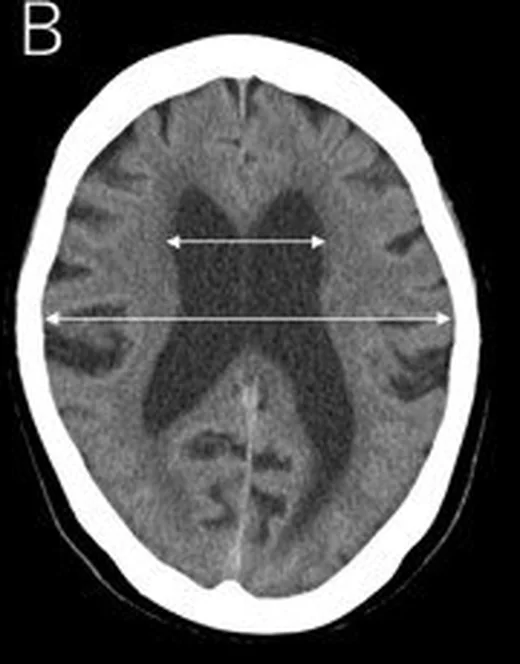
- Frontal boynuzların balonlaşması ve lateral ventriküllerin kortikal sulkus genişliğine göre orantısız büyümesi.
- Sylvian fissürler ve bazal subaraknoid alanlarda belirginleşme.
- Yüksek konveksite ile parasagittal sulkuslarda daralma veya silinme; DESH örüntüsünün dış BOS alanı bileşeni.
- Temporal boynuz genişlemesi hidrosefalinin erken bir görüntüleme belirteci olabilir; iNPH'de perihipokampal fissürlerin Alzheimer hastalığına göre daha küçük bulunabildiği bildirilmiştir.
- Kallosal açı, koronal BT reformasyonunda da değerlendirilebilen ve iNPH'de ex vacuo ventrikülomegalisine göre daha düşük bulunabilen destekleyici bir görüntüleme belirtecidir.
- Periventriküler beyaz cevher değişikliği eşlik edebilir ve iNPH'ye özgü değildir.
- Kallosal açı, ön-arka komissür düzlemine dik koronal görüntüde arka komissür düzeyinde ölçülür; 90°'den küçük olması iNPH ile Alzheimer tipi atrofi örüntüsünü ayırmada kullanılan kaba bir eşiktir.
Ölçütler ve sınıflamalar
- Evans indeksi
- ≥0,30
- DESH örüntüsü
- Ventrikülomegaliye eşlik eden geniş Sylvian fissürler ve dar yüksek konveksite/orta hat subaraknoid aralıkları; iNPH için destekleyici bir morfolojik örüntüdür, tek başına klinik tanı değildir.
Normalde
Normal BOS dağılımında Sylvian fissürler ile yüksek konveksite sulkusları arasında DESH'teki gibi orantısız genişleme-daralma birlikteliği beklenmez. Ventrikül genişlemesine ek olarak perihipokampal fissür genişliği ve hipokampal hacim kaybını iNPH ile Alzheimer ayrımı için değerlendirin.
Normal BT ile kıyasla
Aynı bölgenin, kaynak veri setinde patoloji içermediği belirtilen bir BT incelemesini kesit kesit kaydırın; organ sınırlarını açarak anatomiyi hasta görüntüsüyle karşılaştırın. Küçük rastlantısal bulgular tümüyle dışlanmamıştır.
Kaynak: TotalSegmentator v2.01 veri seti (Wasserthal ve ark., Radiology: Artificial Intelligence 2023), CC BY 4.0, vaka s0103; organ sınırları veri setinin otomatik segmentasyonundan, birleştirilerek sadeleştirildi. Görüntüler 2,5 mm kesit aralığına yeniden örneklendi.
Ayırıcı tanı
- Hidrosefali ex vacuo
- yüksek konveksite sulkuslarında daralma beklenmez; dar kallozal açı, Sylvian fissür genişlemesi ve superior parietal sulkus daralması iNPH lehinedir.
- Alzheimer tipi atrofi
- medial temporal lob ve hipokampal hacim kaybı ile perihipokampal fissür genişlemesi ön plandadır.
- Komünikan hidrosefali
- iNPH komünikan hidrosefalinin bir alt tipidir; akuadukt stenozu gibi BOS akım tıkanıklığı beklenmez.
- Obstrüktif hidrosefali
- ventrikül genişlemesi bir BOS geçiş noktasının proksimalinde yoğunlaşır ve distal ventrikül görece korunabilir.
Tuzaklar
- Evans indeksinin eşik üstünde olması yaşlı erişkinde iNPH tanısı koydurmaz; klinik ve sulkal dağılımla birlikte yorumlanır.
- Periventriküler beyaz cevher değişikliği iNPH'ye özgü değildir.
- Yüksek konveksite darlığının aksiyel ve koronal kesitlerde yeterli doğrulukla saptanabildiği beyin MRG'de gösterilmiştir; BT'de kuşku varsa koronal reformasyonları gözden geçirin.
- DESH bulgularının olmaması iNPH'yi bütünüyle dışlamaz; BT morfolojisi klinik değerlendirmeyi ikame etmez.
Kendini dene
İleri yaştaki hastada ventrikülomegaliye geniş Sylvian fissürler ve dar tepe sulkusları eşlik ediyor. Örüntü hangisidir?
Cevabı göster
DESH. Sylvian fissür genişlemesi ile yüksek konveksite sulkus daralmasının eşleşmesi DESH örüntüsünü tanımlar ve iNPH'yi destekler. Ex vacuo ayrımında yüksek konveksite daralmasının yokluğu yardımcıdır.
Ventrikül geniş, Evans indeksi eşik üstünde; ancak konveksite sulkusları da yaygın geniş ve hipokampuslar küçülmüş. En olası açıklama nedir?
Cevabı göster
Hacim kaybına bağlı genişleme. Ventriküllerle birlikte kortikal sulkusların yaygın genişlemesi ve hipokampal hacim kaybı ex vacuo genişlemeyi destekler. DESH'te tepe sulkusları dardır.
İlgili konular
Kaynaklar
Bu sayfadaki 38 cümle ve 2 quiz sorusu aşağıdaki kaynaklardan alıntılarla otomatik olarak karşılaştırıldı; 12 cümle bu karşılaştırmada düzeltildi (2026-10-12).
- Guidelines for Management of Idiopathic Normal Pressure Hydrocephalus (Third Edition): Endorsed by the Japanese Society of Normal Pressure Hydrocephaluspmc.ncbi.nlm.nih.gov
- Imaging Markers for Normal Pressure Hydrocephalus: An Overviewpmc.ncbi.nlm.nih.gov
- Normal pressure hydrocephalus: an updatepmc.ncbi.nlm.nih.gov
- 18 F-FDG PET-CT pattern in idiopathic normal pressure hydrocephalus.pubmed.ncbi.nlm.nih.gov
- Striatal Dopamine Deficit and Motor Impairment in Idiopathic Normal Pressure Hydrocephalus.pubmed.ncbi.nlm.nih.gov
- Psychotic symptoms in normal pressure hydrocephalus.pubmed.ncbi.nlm.nih.gov
- On the Utility of MIBG SPECT/CT in Evaluating Cardiac Sympathetic Dysfunction in Lewy Body Diseases.pubmed.ncbi.nlm.nih.gov
- Fluid Distribution Pattern in Adult-Onset Congenital, Idiopathic, and Secondary Normal-Pressure Hydrocephalus: Implications for Clinical Care.pubmed.ncbi.nlm.nih.gov
- Idiopathic Normal Pressure Hydrocephalus: The Real Social and Economic Burden of a Possibly Enormous Underdiagnosis Problem.pubmed.ncbi.nlm.nih.gov
- Cerebral blood flow and Alzheimer's disease-related biomarkers in cerebrospinal fluid in idiopathic normal pressure hydrocephalus.pubmed.ncbi.nlm.nih.gov
- Petrous apex's dural arteriovenous fistula (DAVF) mimicking a pineal region tumour: a rare cause of Hakim triad.pubmed.ncbi.nlm.nih.gov
- A multicenter brain perfusion SPECT study evaluating idiopathic normal-pressure hydrocephalus on neurological improvement.pubmed.ncbi.nlm.nih.gov
- Assessing CT-based Volumetric Analysis via Transfer Learning with MRI and Manual Labels for Idiopathic Normal Pressure Hydrocephalus.pubmed.ncbi.nlm.nih.gov
- Depressive symptoms, functional impairment, and health-related quality of life in idiopathic normal pressure hydrocephalus: A population-based study.pubmed.ncbi.nlm.nih.gov
- 11 C-PIB retention patterns in white and grey cerebral matter in idiopathic normal pressure hydrocephalus patients. A visual analysis.pubmed.ncbi.nlm.nih.gov
- Peripheral immunity patterns, imaging features, and clinical outcomes in patients with gait impairment and ventriculomegaly on brain MRI.pubmed.ncbi.nlm.nih.gov
- The metabolic spatial covariance pattern of definite idiopathic normal pressure hydrocephalus: an FDG PET study with principal components analysis.pubmed.ncbi.nlm.nih.gov
- α-Synuclein Pathology in Idiopathic Normal Pressure Hydrocephalus: Evidence for Concomitant Synucleinopathy and Clinical Implications.pubmed.ncbi.nlm.nih.gov
- Differential diagnosis of non-hydrocephalus ventricular dilation and hydrocephalus.pubmed.ncbi.nlm.nih.gov
- Autopsy Confirmed Normal Pressure Hydrocephalus (NPH) Presenting With Corticobasal Syndrome.pubmed.ncbi.nlm.nih.gov
- Variability in the circulation of cerebrospinal fluid: causes and clinical implications for intraventricular drug delivery.pubmed.ncbi.nlm.nih.gov
- Imaging Markers for Normal Pressure Hydrocephalus: An Overview.pubmed.ncbi.nlm.nih.gov
- A newly described imaging finding for idiopathic normal pressure hydrocephalus: Can hummingbird sign contribute to the diagnosis?pubmed.ncbi.nlm.nih.gov
- A Coronal Hydrocephalic Index (Eo Index) for Predicting Shunt Responsiveness in Idiopathic Normal Pressure Hydrocephalus.pubmed.ncbi.nlm.nih.gov
- Radiological Correlates of Headache and Papilledema in Patients Undergoing Cranial MRI: Clinical Relevance of the Evans Index and Fazekas Score.pubmed.ncbi.nlm.nih.gov
- Perioperative real-life mobility assessment using wearable step counts in idiopathic normal pressure hydrocephalus after ventriculoperitoneal shunt surgery: a prospective pilot study.pubmed.ncbi.nlm.nih.gov
- A case of idiopathic normal pressure hydrocephalus without enlarged ventricle and with negative tap test.pubmed.ncbi.nlm.nih.gov
- Prenatal Ultrasound and Magnetic Resonance Findings of Glutaric Acidemia Type 1 and Its Challenges in Prenatal Diagnosis.pubmed.ncbi.nlm.nih.gov
- Racemose neurocysticercosis: a case series.pubmed.ncbi.nlm.nih.gov
- Subcortical morphological alterations and volume loss in infantile hydrocephalus: A surface- and volume-based analysis.pubmed.ncbi.nlm.nih.gov
- Cerebral blood flow, autoregulation and vascular reactivity in normal pressure hydrocephalus: a systematic review.pubmed.ncbi.nlm.nih.gov
- Differences of Gradient Connectivity and Ventricle Volumes in Long-Term Sensorineural Hearing Loss Related Cognitive Impairment Correlate With Transcriptional Signatures.pubmed.ncbi.nlm.nih.gov
- Secondary parkinsonism associated with focal brain lesions.pubmed.ncbi.nlm.nih.gov
- Magnetic resonance imaging signs of high intraventricular pressure--comparison of findings in dogs with clinically relevant internal hydrocephalus and asymptomatic dogs with ventriculomegaly.pubmed.ncbi.nlm.nih.gov
- Imaging of cerebrospinal fluid flow: fundamentals, techniques, and clinical applications of phase-contrast magnetic resonance imaging.pubmed.ncbi.nlm.nih.gov
- Cribriform Brain Unraveling Virchow-Robin Space Dilation.pubmed.ncbi.nlm.nih.gov
- A Case-Based Review of Cerebral Venous Infarcts With Perfusion Imaging and Comparison to Arterial Ischemic Stroke.pubmed.ncbi.nlm.nih.gov
- Neurological manifestations and neuroimaging findings in patients with SARS-CoV2-a systematic review.pubmed.ncbi.nlm.nih.gov
- Lumbar-ventricular cerebrospinal fluid pressure discrepancy in leptomeningeal metastasis associated intracranial hypertension.pubmed.ncbi.nlm.nih.gov
- Cerebral Ventricular Dimensions in Patients with Heart Failure with Reduced Ejection Fraction (HFrEF): A Cross-Sectional MRI Study.pubmed.ncbi.nlm.nih.gov
- Evaluation of fetal frontal lobe development and Evans index in pregnancies complicated by gestational diabetes mellitus: prospective comparative observational study.pubmed.ncbi.nlm.nih.gov
- Guidelines for Management of Idiopathic Normal Pressure Hydrocephalus (Third Edition): Endorsed by the Japanese Society of Normal Pressure Hydrocephalus.pubmed.ncbi.nlm.nih.gov
- Radiological assessment of dementia: the Italian inter-society consensus for a practical and clinically oriented guide to image acquisition, evaluation, and reporting.pubmed.ncbi.nlm.nih.gov
- Structural neuroimaging markers of normal pressure hydrocephalus versus Alzheimer's dementia and Parkinson's disease, and hydrocephalus versus atrophy in chronic TBI-a narrative review.pubmed.ncbi.nlm.nih.gov
- Hydrocephalus: Molecular and Neuroimaging Biomarkers in Diagnosis and Management.pubmed.ncbi.nlm.nih.gov
- Advancing Hydrocephalus Management: Pathogenesis Insights, Therapeutic Innovations, and Emerging Challenges.pubmed.ncbi.nlm.nih.gov
- Ruptured Posterior Inferior Cerebellar Artery Aneurysms: Integrating Microsurgical Expertise, Endovascular Challenges, and AI-Driven Risk Assessment.pubmed.ncbi.nlm.nih.gov
- The SLC-ome of membrane transport: From molecular discovery to physiology and clinical applications.pubmed.ncbi.nlm.nih.gov
- Baseline radiological parameters associated with good neurological outcome following ventriculoperitoneal shunt in normal pressure hydrocephalus: A single-center study on 82 patients.pubmed.ncbi.nlm.nih.gov
- MRI markers of idiopathic normal pressure hydrocephalus in a population study with 791 participants: Exploring reference values and associations.pubmed.ncbi.nlm.nih.gov
- A protocol for a cohort study investigating clinical and radiological features of normal pressure hydrocephalus in South London memory services.pubmed.ncbi.nlm.nih.gov
- Triphasic waves: To treat or not to treat?pubmed.ncbi.nlm.nih.gov
- A Review of the Role of Neuroimaging in Neurotoxicity Monitoring in Children with Acute Lymphoblastic Leukemia.pubmed.ncbi.nlm.nih.gov
- Does the Presence or Absence of DESH Predict Outcomes in Adult Hydrocephalus?pubmed.ncbi.nlm.nih.gov
- CSF dynamics disorders: Association of brain MRI and nuclear medicine cisternogram findings.pubmed.ncbi.nlm.nih.gov
- Artificial Intelligence's Use in the Diagnosis of Mouth Ulcers: A Systematic Review.pubmed.ncbi.nlm.nih.gov
- Automated Evans index measurement using deep learning in acute subarachnoid hemorrhage: reliability, agreement with experts, and association with external ventricular drainage.pubmed.ncbi.nlm.nih.gov
- Balancing privacy and performance: the impact of facial defacing on AI in medical imaging.pubmed.ncbi.nlm.nih.gov
- A novel radiological classification of midbrain pilocytic astrocytomas and its implication for surgical management: a single-institution experience of 57 cases.pubmed.ncbi.nlm.nih.gov
- Leukoaraiosis as a Predictor of Depression and Cognitive Impairment among Stroke Survivors: A Systematic Review.pubmed.ncbi.nlm.nih.gov
- Psychotherapy in pain management: New viewpoints and treatment targets based on a brain theory.pubmed.ncbi.nlm.nih.gov
- The physiological control of eating: signals, neurons, and networks.pubmed.ncbi.nlm.nih.gov
- An eye on long-duration spaceflight: Controversies, countermeasures and challenges.pubmed.ncbi.nlm.nih.gov
- When Stroke Leads to Hydrocephalus: A Case of Unilateral Ventricular Enlargement.pubmed.ncbi.nlm.nih.gov
- Cerebrospinal fluid dysregulation and post-traumatic hydrocephalus after paediatric traumatic brain injury.pubmed.ncbi.nlm.nih.gov
- Navigating Diagnostic Ambiguity in Palliative Pediatric Neuro-Oncology: A Conceptual Framework for Suspected Shunt Malfunction and Refractory Hyponatremia.pubmed.ncbi.nlm.nih.gov
- Prenatal assessment of brain malformations on neuroimaging: an expert panel review.pubmed.ncbi.nlm.nih.gov
- Basilar artery dolichoectasia presenting as obstructive hydrocephalus mimicking normal pressure hydrocephalus.pubmed.ncbi.nlm.nih.gov
- Cognitive Processing Speed Assessment Combined With Gait Performance Improves Prediction of Shunt Surgery Responsiveness in Idiopathic Normal Pressure Hydrocephalus.pubmed.ncbi.nlm.nih.gov
- Slow unsteady gait in a population-based cohort: links to ventriculomegaly and INPH-related imaging markers.pubmed.ncbi.nlm.nih.gov
- Comparison of Anterior Lateral Ventricular Index with Evans Index, Callosal Angle, and Disproportionately Enlarged Subarachnoid-space Hydrocephalus in Postoperative Evaluation of Idiopathic Normal Pressure Hydrocephalus.pubmed.ncbi.nlm.nih.gov
- Idiopathic Normal Pressure Hydrocephalus with Brain Herniation into the Arachnoid Granulation of the Lateral Lacuna of the Superior Sagittal Sinus: A Case Report.pubmed.ncbi.nlm.nih.gov
- CT-based automatic segmentation of key CSF regions for detecting disproportionately enlarged subarachnoid space hydrocephalus.pubmed.ncbi.nlm.nih.gov
- Degenerative spinal stenosis may influence Normal Pressure Hydrocephalus (NPH)-related imaging characteristics.pubmed.ncbi.nlm.nih.gov
- Evaluation of disproportionately enlarged subarachnoid-space hydrocephalus in progressive supranuclear palsy.pubmed.ncbi.nlm.nih.gov
- Idiopathic normal pressure hydrocephalus: validation of the DESH score in the Capital Region of Denmark.pubmed.ncbi.nlm.nih.gov
- Beyond Ventricular Enlargement: Multimodal MRI Assessment Improves Surgical Decision-Making in Normal Pressure Hydrocephalus.pubmed.ncbi.nlm.nih.gov
- Disproportionately elevated sulcal index (DESI): An automatically driven index representing disproportionate subarachnoid space enlargement in brain MRI scans.pubmed.ncbi.nlm.nih.gov
- MRI Evaluation and Reporting in Suspected and Established Idiopathic Normal Pressure Hydrocephalus, <i>AJR</i> Expert Panel Review.pubmed.ncbi.nlm.nih.gov
- Congruency between publicly available pictorial displays of medial temporal lobe atrophy.pubmed.ncbi.nlm.nih.gov
- Hippocampal T1WI radiomics- and clinical feature-based models for predicting early mild cognitive impairment in secondary hydrocephalus.pubmed.ncbi.nlm.nih.gov
- Clinical Subgroups and Treatment Outcomes in Idiopathic Normal Pressure Hydrocephalus: Application of Machine Learning-Based Clustering.pubmed.ncbi.nlm.nih.gov
- Distinctive hydrocephalus-like phenotype in NOTCH2NLC-related neuronal intranuclear inclusion disease: clinicopathological features and therapeutic implications.pubmed.ncbi.nlm.nih.gov
- Screening for Normal Pressure Hydrocephalus on Head CT Using Automated Callosal Angle Assessment.pubmed.ncbi.nlm.nih.gov
- Moving on in hydrocephalus imaging: from 2D to 3D biomarkers.pubmed.ncbi.nlm.nih.gov
- Congenital central nervous system malformations in piedmontese calves-part 1. structural brain disorders.pubmed.ncbi.nlm.nih.gov
- Redefining Idiopathic Normal Pressure Hydrocephalus Using AI-Driven Brain Volumetry.pubmed.ncbi.nlm.nih.gov
- Incidental Diagnosis of Normal Pressure Hydrocephalus in Elderly Patients Presenting With Acute Neurological Illnesses: A Report of Two Cases.pubmed.ncbi.nlm.nih.gov
- Comprehensive review of the cerebral aqueduct: anatomy, embryology, imaging, genetics, molecular, and pathology.pubmed.ncbi.nlm.nih.gov
- Sympathetic hyperactivation following endoscopic third ventriculostomy: a rare and underrecognized postoperative complication. Illustrative case.pubmed.ncbi.nlm.nih.gov
- Ruptured artery of Percheron aneurysm in moyamoya disease with thalamic hemorrhage and acute hydrocephalus: illustrative case.pubmed.ncbi.nlm.nih.gov
- Mesenchymal tumors of the central nervous system: illustrative case.pubmed.ncbi.nlm.nih.gov
- Utilisation of brain MRI for the diagnosis of dementia in low and middle-income countries: systematic review and meta-analysis.pubmed.ncbi.nlm.nih.gov
- Shunt surgery and lecanemab therapy in patients with idiopathic normal pressure hydrocephalus and alzheimer's disease: a report of two cases.pubmed.ncbi.nlm.nih.gov
- The role of brain MR and FDG-PET in the diagnosis of neurodegenerative disease.pubmed.ncbi.nlm.nih.gov
- A review of applications of automated ventricular parcellation from magnetic resonance imaging of the brain.pubmed.ncbi.nlm.nih.gov
- Differences in Brain Morphology between Hydrocephalus Ex Vacuo and Idiopathic Normal Pressure Hydrocephalus.pubmed.ncbi.nlm.nih.gov
- Life-threatening exacerbation of a chronic porencephalic cyst in an adult: A case report and literature review.pubmed.ncbi.nlm.nih.gov
- Radiosurgical Septostomy: A Technical Report of Two Cases.pubmed.ncbi.nlm.nih.gov
- Obstructive hydrocephalus masquerading as impending eclampsia in a 37-week pregnant woman: a case report.pubmed.ncbi.nlm.nih.gov
- Normal pressure hydrocephalus plus atypical presentation with symptomatic resolution following the restoration of CSF flow: illustrative case.pubmed.ncbi.nlm.nih.gov
- Atypical Cerebral Tuberculosis: Contending With the Diagnostic Challenge.pubmed.ncbi.nlm.nih.gov
- Deformation of brain in normal pressure hydrocephalus is more readily associated with slow vasomotion rather than heartbeat related pulsations of intracranial pressure.pubmed.ncbi.nlm.nih.gov
- The role of magnetic resonance imaging in the diagnosis and prognosis of dementia.pubmed.ncbi.nlm.nih.gov
- Lysosomal storage diseases.pubmed.ncbi.nlm.nih.gov
- A review of the oral health of individuals with disabilities in Puerto Rico and among U.S. Hispanics.pubmed.ncbi.nlm.nih.gov
- Determination of cystathionine beta-synthase activity in human plasma by LC-MS/MS: potential use in diagnosis of CBS deficiency.pubmed.ncbi.nlm.nih.gov
- Diabetic striatopathy presenting as stroke-mimicking hemiparesis without involuntary movements: A case report.pubmed.ncbi.nlm.nih.gov
- Beta-ketothiolase deficiency with progressive basal ganglia and extra basal ganglia involvement: CT-MRI correlation in a pediatric metabolic encephalopathy: A case report.pubmed.ncbi.nlm.nih.gov
- Case Report: Probable toripalimab-associated ocular myasthenia gravis-like presentation after chemoimmunotherapy.pubmed.ncbi.nlm.nih.gov
- Automatic assessment of disproportionately enlarged subarachnoid-space hydrocephalus from 3D MRI using two deep learning models.pubmed.ncbi.nlm.nih.gov
- Lumbar puncture-induced negative-pressure hydrocephalus in a child with a ventriculoperitoneal shunt and ventricular obstruction: illustrative case.pubmed.ncbi.nlm.nih.gov
- Treatment strategies and prognostic outcomes in craniosynostosis with concurrent hydrocephalus: a case series.pubmed.ncbi.nlm.nih.gov
Eğitim amaçlıdır; hasta başında tanı ve tedavi kararının yerine geçmez, tıbbi tavsiye değildir. Metinler yapay zekâ desteğiyle yazıldı ve otomatik bir adımda kaynak alıntılarıyla karşılaştırıldı; bu bir tıbbi doğrulama değildir ve içerik uzman radyolog incelemesinden geçmedi. Klinik kararlarda güncel kılavuzları, kurum protokollerini ve radyoloji raporunu esas alın.