
Özet
Obstrüktif hidrosefali, ventrikül sistemi içindeki bir akım engelinin tıkanıklığın proksimalinde BOS birikimine yol açtığı, hızla kötüleşebilen bir durumdur. Kontrastsız BT, ventrikül dağılımını ve akut basınç etkisini hızla gösterir; ince akuadukt lezyonu veya küçük tümör için MR daha duyarlı olabilir. Tek taraflı lateral ventrikül genişlemesi foramen Monro düzeyindeki tıkanıklığı düşündürebilir; sonraki incelemede bu düzeydeki olası neden araştırılır. Akut obstrüktif hidrosefali intrakraniyal basıncı aniden yükseltebilir ve yaşamı tehdit edebilir.
Faz ve pencere
- Kontrastsız tanısal
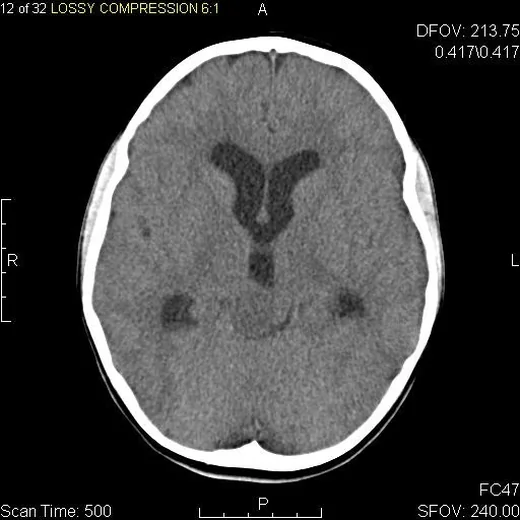
- BT'de lateral ve üçüncü ventriküllerin belirgin genişlemesi, dördüncü ventrikül görece korunuyorsa non-komünikan örüntüyü düşündürebilir.
Önerilen pencereler: Beyin (G 80 / M 40), Kemik (G 1800 / M 400).
BT bulguları
- Foramen Monro tıkanmasında tek taraflı lateral ventrikül genişlemesi; iki foramen etkilenmişse iki lateral ventrikülde genişleme.
- Akuadukt düzeyindeki tıkanıklıkta lateral ve üçüncü ventriküller geniş, dördüncü ventrikül görece küçük kalır.
- Dördüncü ventrikül çıkışındaki tıkanıklık tüm ventriküllerin genişlemesine yol açabilir.
- Lateral ve üçüncü ventrikül genişlemesi, dördüncü ventrikül görece korunuyorsa obstrüktif örüntüyü destekler.
- Periventriküler transependimal BOS geçişi, frontal ve oksipital boynuz çevresinde silik düşük atenüasyon oluşturabilir.
- Üçüncü ventrikül tabanında kitle, akuadukt çevresinde kalsifikasyon/kitle veya posterior fossada dördüncü ventrikül çıkışını daraltan oluşum araştırılır.
- Sulkal silinme, bazal sistern daralması, orta hat kayması veya herniasyon basınç etkisinin ileri bulgularıdır.
- Üçüncü ventrikül tabanında balonlaşma hidrosefali bağlamında görülebilir; bu bulgu tek başına tıkanıklık düzeyini göstermez.
Ölçütler ve sınıflamalar
- Tıkanıklık düzeyine göre
- Lateral ve üçüncü ventriküllerin geniş, dördüncü ventrikülün görece korunmuş olması nonkomünikan hidrosefali örüntüsünü düşündürebilir; bu bulgu tek başına tanısal değildir.
Normalde
Normal inceleme ile karşılaştırmada ventrikül genişliği tek başına gerçek BOS çıkış tıkanıklığını kanıtlamaz; ventrikülomegali, BOS çıkışında gerçek tıkanıklık olmadan da görülebilir. Kıyaslamada genişlemenin foramen Monro, akuadukt veya dördüncü ventrikül çıkışına göre proksimalde kalıp kalmadığını ve komşu sulkusların bası ile silinmesini izleyin.
Normal BT ile kıyasla
Aynı bölgenin, kaynak veri setinde patoloji içermediği belirtilen bir BT incelemesini kesit kesit kaydırın; organ sınırlarını açarak anatomiyi hasta görüntüsüyle karşılaştırın. Küçük rastlantısal bulgular tümüyle dışlanmamıştır.
Kaynak: TotalSegmentator v2.01 veri seti (Wasserthal ve ark., Radiology: Artificial Intelligence 2023), CC BY 4.0, vaka s0103; organ sınırları veri setinin otomatik segmentasyonundan, birleştirilerek sadeleştirildi. Görüntüler 2,5 mm kesit aralığına yeniden örneklendi.
Ayırıcı tanı
- Komünikan hidrosefalide ventriküler sistemde belirgin bir tıkanıklık görülmeyebilir.
- Ventrikülomegali ex vacuo
- kortikal sulkuslar da geniştir; transependimal ödem ve bası bulgusu beklenmez.
- İntraventriküler kitle
- ventrikül konturunda fokal dolum etkisi ya da kalsifikasyon, obstrüksiyon seviyesini gösterebilir.
- Koroid pleksus ksantogranülomu, çocuklarda supratentoryal intraventriküler kitlelerin ayırıcı tanısında yer alan lezyonlardan biridir.
Tuzaklar
- Akut obstrüksiyonda ventriküller henüz belirgin büyümemiş olabilir; sulkal ve sisternal bası ile klinik kötüleşme yine önemlidir.
- Periventriküler transependimal BOS geçişi obstrüktif hidrosefaliye eşlik edebilir.
- Kontrastsız BT küçük akuaduktal web veya ince tümörü göstermeyebilir; tıkanma örüntüsü varsa nedeni BT'de seçilemedi diye dışlamayın.
- Dördüncü ventrikül çıkış obstrüksiyonu tüm ventriküllerin genişlemesine yol açabilir; bu nedenle BOS yolunu bir bütün olarak değerlendirin.
Kendini dene
Non-komünikan (obstrüktif) hidrosefaliyi tanımlayan temel özellik hangisidir?
Cevabı göster
İntraventriküler BOS akımının tıkanması. Non-komünikan hidrosefali, tanım gereği intraventriküler BOS akımındaki bir tıkanıklıktan kaynaklanır.
Tek lateral ventrikül belirgin geniş ve karşı ventrikül ile üçüncü ventrikül normal. Hangi yapı öncelikle incelenmelidir?
Cevabı göster
Foramen Monro. Tek taraflı lateral ventrikül genişlemesi ipsilateral foramen Monro tıkanmasını lokalize eder. Tek taraflı lateral ventrikül genişlemesi, serebrospinal sıvı akışının Foramen Monro düzeyindeki tıkanıklığa bağlı olduğunu düşündürür.
İlgili konular
- Komünikan hidrosefali
- Ventrikülomegali ve ex-vacuo genişleme ayrımı
- İdiyopatik normal basınçlı hidrosefali örüntüsü
Kaynaklar
Bu sayfadaki 36 cümle ve 2 quiz sorusu aşağıdaki kaynaklardan alıntılarla otomatik olarak karşılaştırıldı; 13 cümle bu karşılaştırmada düzeltildi (2026-10-09).
- Burr hole monoportal endoscopic resection of a large choroid plexus cyst causing obstructive hydrocephalus: diagnosis, management and literature reviewpmc.ncbi.nlm.nih.gov
- External Ventricular Drainage for Hydrocephalus Following Cerebellar Infarction: A Scoping Reviewpmc.ncbi.nlm.nih.gov
- Infectious meningitis and encephalitis: A primer for acute care practitionerspmc.ncbi.nlm.nih.gov
- Endoscopic third ventriculostomy for diencephalosynapsis-related hydrocephalus in MPDZ gene syndrome: a case report and review of the literaturepmc.ncbi.nlm.nih.gov
- Neuroendoscopic management of a third ventricle hydatid cyst presenting with obstructive hydrocephalus in a 4-year-old female: a case report and review of the literaturepmc.ncbi.nlm.nih.gov
- Noncommunicating Hydrocephalus.pubmed.ncbi.nlm.nih.gov
- Hydrocephalus in children.pubmed.ncbi.nlm.nih.gov
- Diagnosis and Therapeutic Management of Ventricular Gangliogliomas: An Illustrated Review.pubmed.ncbi.nlm.nih.gov
- Endoscopic Third Ventriculostomy - A Review.pubmed.ncbi.nlm.nih.gov
- Management of primary intracranial germ cell tumors.pubmed.ncbi.nlm.nih.gov
- Role of Secondary Endoscopic Third Ventriculostomy in Children: Review of an Institutional Experience.pubmed.ncbi.nlm.nih.gov
- Masses of the pineal region: clinical presentation and radiographic features.pubmed.ncbi.nlm.nih.gov
- What is the utility of postoperative antihelminthic therapy after resection for intraventricular neurocysticercosis?pubmed.ncbi.nlm.nih.gov
- Spontaneous resolution of obstructive hydrocephalus from blood in the cerebral aqueduct.pubmed.ncbi.nlm.nih.gov
- Too Much on Your "Plate"? Spectrum of Pathologies Involving the Tectal Plate.pubmed.ncbi.nlm.nih.gov
- Cranial ultrasonographic findings in healthy full-term neonates: a retrospective review.pubmed.ncbi.nlm.nih.gov
- Diagnosis and Surgical Management of Neonatal Hydrocephalus.pubmed.ncbi.nlm.nih.gov
- PITCH (pediatric infratentorial tumors - hydrocephalus-related complications) registry study design: observational, prospective, multicenter study evaluating the number of surgeries associated with the treatment of hydrocephalus secondary to infratentorial tumors in childhood and adolescence.pubmed.ncbi.nlm.nih.gov
- Hyponatremia Following Endoscopic Third Ventriculostomy in an Adolescent with an Aqueductal Web: A Case Report.pubmed.ncbi.nlm.nih.gov
- Risk factor analysis of long-term outcomes in patients with large intracerebral and intraventricular hemorrhage treated primarily with combined external ventricular drainage and intraventricular thrombolysis.pubmed.ncbi.nlm.nih.gov
- Progress in the diagnosis and treatment of post-traumatic hydrocephalus.pubmed.ncbi.nlm.nih.gov
- Application of deep neural networks in automatized ventriculometry and segmentation of the aqueduct in pediatric hydrocephalus patients.pubmed.ncbi.nlm.nih.gov
- Case Report: Ultralow-field portable MRI improves the diagnosis of congenital hydrocephalus.pubmed.ncbi.nlm.nih.gov
- From Balloon to Brain Ballooning: A Case of Obstructive Hydrocephalus in a Child.pubmed.ncbi.nlm.nih.gov
- Burr hole monoportal endoscopic resection of a large choroid plexus cyst causing obstructive hydrocephalus: diagnosis, management and literature review.pubmed.ncbi.nlm.nih.gov
- Variability in the circulation of cerebrospinal fluid: causes and clinical implications for intraventricular drug delivery.pubmed.ncbi.nlm.nih.gov
- Development and validation of a prediction model for postoperative cerebral edema progression in emergency traumatic brain injury patients.pubmed.ncbi.nlm.nih.gov
- Anatomy-Guided Microsurgical Resection of a Dominant Frontal Lobe Tumor Without Intraoperative Adjuncts: A Case Report from a Resource-Limited Context.pubmed.ncbi.nlm.nih.gov
- Fixed, Dilated, and Cannulated - Medical Management of Elevated Intracranial Pressures due to a Large Intracranial Hemorrhage in a Patient on Veno-Venous Extracorporeal Membrane Oxygenation: Case Report.pubmed.ncbi.nlm.nih.gov
- Imaging Characteristics of Colloid Cysts: A Case Series Correlating Cyst Size and Location With Associated Acute Hydrocephalus.pubmed.ncbi.nlm.nih.gov
- Magnetic resonance imaging of primary central nervous system neoplasms of dogs and cats: Basic concepts for diagnostic pathologists.pubmed.ncbi.nlm.nih.gov
- Non-Oncological Neuroradiological Manifestations in NF1 and Their Clinical Implications.pubmed.ncbi.nlm.nih.gov
- Imaging of supratentorial intraventricular masses in children:a pictorial review- part 1.pubmed.ncbi.nlm.nih.gov
- Imaging of supratentorial intraventricular masses in children: a pictorial review-part 2.pubmed.ncbi.nlm.nih.gov
- Shunt dependency in supratentorial intraventricular tumors depends on the extent of tumor resection.pubmed.ncbi.nlm.nih.gov
- Continuum of Irreversible and Potentially Reversible Traumatic Brain Injury Sequelae: Axonal Injury and Hydrocephalus.pubmed.ncbi.nlm.nih.gov
- Redefining Idiopathic Normal Pressure Hydrocephalus Using AI-Driven Brain Volumetry.pubmed.ncbi.nlm.nih.gov
- From the past to the present: evolving theories in the pathophysiology of normal pressure hydrocephalus.pubmed.ncbi.nlm.nih.gov
- Artificial intelligence in paediatric neuroradiology: current landscape, challenges, and future directions.pubmed.ncbi.nlm.nih.gov
- Serial failure of the brain clearance continuum in Alzheimer's disease: mechanisms and therapeutic perspectives.pubmed.ncbi.nlm.nih.gov
- Age-Related Alterations of Cerebral Autoregulation.pubmed.ncbi.nlm.nih.gov
- Spontaneous resolution of cerebrospinal fluid obstruction due to intraventricular hemorrhage: A case report.pubmed.ncbi.nlm.nih.gov
- Isolated Aphasia as an Epileptic Manifestation of Neurosarcoidosis: A Case Report.pubmed.ncbi.nlm.nih.gov
- Coexistence of Fahr-Type Intracranial Calcification and a Presumed Cerebellar Pilocytic Astrocytoma With Obstructive Hydrocephalus: A Rare Case Report.pubmed.ncbi.nlm.nih.gov
- Coexistence of histologically distinct intracranial tumors: Case series, literature review, and meta-analysis.pubmed.ncbi.nlm.nih.gov
- Fourth Ventricular Rosai-Dorfman Disease Mimicking Intraventricular Tumor in Young Adult: A Rare Case Report.pubmed.ncbi.nlm.nih.gov
- Case Report: Primary Fourth Ventricle Outlet Obstruction in Childhood - New Clinical Insights and Long-Term Outcome.pubmed.ncbi.nlm.nih.gov
- Comprehensive review of the cerebral aqueduct: anatomy, embryology, imaging, genetics, molecular, and pathology.pubmed.ncbi.nlm.nih.gov
- Cerebrospinal Fluid Flow and Vorticity in Hydrocephalus on 4-Dimensional Flow MRI.pubmed.ncbi.nlm.nih.gov
- Delayed symptomatic TFV in neonatal posthemorrhagic hydrocephalus-pathophysiology and therapeutic strategy: A case report and review of the literature.pubmed.ncbi.nlm.nih.gov
- Fourth ventricular stenting in foramen magnum decompression for type 1 Chiari malformations with syringomyelia.pubmed.ncbi.nlm.nih.gov
- Short- and Long-Term Outcomes of Prenatally Identified Congenital Aqueductal Stenosis by Fetal MRI.pubmed.ncbi.nlm.nih.gov
- When Stroke Leads to Hydrocephalus: A Case of Unilateral Ventricular Enlargement.pubmed.ncbi.nlm.nih.gov
- Surgical management of biventricular hydrocephalus caused by tuberculosis-induced bilateral obstruction of the foramen of Monro: illustrative case.pubmed.ncbi.nlm.nih.gov
- Neuroendoscopic management of a third ventricle hydatid cyst presenting with obstructive hydrocephalus in a 4-year-old female: a case report and review of the literature.pubmed.ncbi.nlm.nih.gov
- From shunt dependency to shunt freedom: Endoscopic third ventriculostomy in ventriculoperitoneal shunt-dependent communicating tetraventricular hydrocephalus: A case report.pubmed.ncbi.nlm.nih.gov
- Third-ventricle cholesterol granuloma: An exceptional intraventricular localization.pubmed.ncbi.nlm.nih.gov
- Age-related Vascular Alterations in the Choroid Plexus: Novel Insights from Pathophysiology and Imaging Studies.pubmed.ncbi.nlm.nih.gov
- Functional outcomes and anatomy-based surgical strategy in 57 pineal region tumors.pubmed.ncbi.nlm.nih.gov
- Diffuse glioma manifesting as normal pressure hydrocephalus: A potential pitfall in diagnosis-a case report.pubmed.ncbi.nlm.nih.gov
- A Review of Common Endoscopic Intracranial Approaches.pubmed.ncbi.nlm.nih.gov
- Endoscopic third ventriculostomy for diencephalosynapsis-related hydrocephalus in MPDZ gene syndrome: a case report and review of the literature.pubmed.ncbi.nlm.nih.gov
- Basilar artery dolichoectasia presenting as obstructive hydrocephalus mimicking normal pressure hydrocephalus.pubmed.ncbi.nlm.nih.gov
- Post-Hemorrhagic Hydrocephalus with Secondary Cerebrospinal Fluid Pathway Obstruction in an Extremely Premature Infant: A Case Report.pubmed.ncbi.nlm.nih.gov
- Persistent refractory hypercapnia following tracheostomy decannulation in a patient with brainstem hemorrhage: a case report.pubmed.ncbi.nlm.nih.gov
- Case Report: 3D-CISS and PC-MRI in the diagnosis and surgical planning of hydrocephalus secondary to presumptive lateral aperture obstruction in a dog.pubmed.ncbi.nlm.nih.gov
- Review of treatment modalities and clinical outcome of giant saccular posterior cerebral artery aneurysms.pubmed.ncbi.nlm.nih.gov
- Novel homozygous SPAG17 variants cause human male infertility through multiple morphological abnormalities of spermatozoal flagella related to axonemal microtubule doublets.pubmed.ncbi.nlm.nih.gov
- <i>Streptococcus suis</i> meningitis complicated with communicating hydrocephalus: complete clinical and radiological resolution with non-neurosurgical management-A case report.pubmed.ncbi.nlm.nih.gov
- Tetraventricular Hydrocephalus Due to Idiopathic Fourth Ventricle Outlet Obstruction: A Case Report and Literature Review.pubmed.ncbi.nlm.nih.gov
- Lumbar puncture-induced negative-pressure hydrocephalus in a child with a ventriculoperitoneal shunt and ventricular obstruction: illustrative case.pubmed.ncbi.nlm.nih.gov
- Posthydrocephalus corpus callosum damage and its mimics: A case report.pubmed.ncbi.nlm.nih.gov
- Extensive Cerebral Venous Sinus Thrombosis With Obstructive Hydrocephalus in a Young Female With Underlying Essential Thrombocythemia: A Case Report.pubmed.ncbi.nlm.nih.gov
- Case Report: Giant acute hemorrhagic colloid cyst in the septum pellucidum-foramen of Monro region with obstructive hydrocephalus in an 8-month-old infant.pubmed.ncbi.nlm.nih.gov
- Clinical and imaging findings after antiviral treatment in cats with presumptive neurologic feline infectious peritonitis: 9 cases (2020-2024).pubmed.ncbi.nlm.nih.gov
- Acute fulminant cerebellitis in children: a case series and literature review on diagnostic challenges and management strategies.pubmed.ncbi.nlm.nih.gov
- Neuroimaging outcomes in suspected papilledema.pubmed.ncbi.nlm.nih.gov
- Fetal mri of obstructive hydrocephalus: a review proposing a surgical etiology-based approach.pubmed.ncbi.nlm.nih.gov
- Magnetic resonance imaging characteristics of ependymal tuberculosis in patients with intracranial tuberculosis.pubmed.ncbi.nlm.nih.gov
- Post-traumatic hydrocephalus in adults: the mechanisms of development, predictors of progression and management strategies. A narrative review and case series analysis.pubmed.ncbi.nlm.nih.gov
- TachoSil<sup>®</sup> as a ventricular sealant after glioma resection: A single-center retrospective cohort study.pubmed.ncbi.nlm.nih.gov
- Encephalitis in Patients with COVID-19: A Systematic Evidence-Based Analysis.pubmed.ncbi.nlm.nih.gov
- Neurological manifestations and neuroimaging findings in patients with SARS-CoV2-a systematic review.pubmed.ncbi.nlm.nih.gov
- Subarachnoid Hemorrhage Causing Hydrocephalus: Narrative Review of a Neurosurgical Emergency.pubmed.ncbi.nlm.nih.gov
- Neuroimaging in inborn errors of immunity: More than infections.pubmed.ncbi.nlm.nih.gov
- Hydrocephalus: Molecular and Neuroimaging Biomarkers in Diagnosis and Management.pubmed.ncbi.nlm.nih.gov
- A rare case of racemose neurocysticercosis and its complications. Case report.pubmed.ncbi.nlm.nih.gov
- Novel compound heterozygous FAM20C variants cause Raine syndrome - retrospective prenatal diagnosis and literature review.pubmed.ncbi.nlm.nih.gov
- Comparative CT Ventricular Morphometrics in Hydrocephalus, Stroke, and Traumatic Brain Injury: A Distortion-Controlled Analysis.pubmed.ncbi.nlm.nih.gov
- Ventricular Anatomy Across CT and MRI in Hydrocephalus: A Retrospective Study.pubmed.ncbi.nlm.nih.gov
- Frontal Paraventricular Cysts: Refined Definitions and Outcomes.pubmed.ncbi.nlm.nih.gov
- Grey matter hypertropia in a child with recurrent seizure: A case report.pubmed.ncbi.nlm.nih.gov
- Functional and Hemodynamic Restoration After Microsurgical Resection of Compact High-Flow Temporo-Parieto-Occipital Arteriovenous Malformation.pubmed.ncbi.nlm.nih.gov
- Morphological and Advanced Imaging of Epilepsy: Beyond the Basics.pubmed.ncbi.nlm.nih.gov
- Fluid transport in the brain.pubmed.ncbi.nlm.nih.gov
Eğitim amaçlıdır; hasta başında tanı ve tedavi kararının yerine geçmez, tıbbi tavsiye değildir. Metinler yapay zekâ desteğiyle yazıldı ve otomatik bir adımda kaynak alıntılarıyla karşılaştırıldı; bu bir tıbbi doğrulama değildir ve içerik uzman radyolog incelemesinden geçmedi. Klinik kararlarda güncel kılavuzları, kurum protokollerini ve radyoloji raporunu esas alın.