Özet
Komünikan hidrosefali, ventriküller ile subaraknoid aralık arasındaki geçiş korunurken BOS dolaşımının veya emiliminin bozulduğu ventrikülomegali örüntüsüdür. Akut dönemde kontrastsız BT ventrikül genişlemesini, transependimal BOS geçişini ve sık nedenlerden olan intraventriküler ya da subaraknoid kanı gösterir. Tüm ventriküller genellikle birlikte etkilenir; ancak tek bir boyut ölçümü etiyolojiyi veya basınç durumunu tek başına belirlemez. Kanama sonrası gelişen genişlemenin gözden kaçması uygun değerlendirme ve müdahaleyi geciktirerek ikincil beyin hasarına veya klinik kötüleşmeye yol açabilir.
Faz ve pencere
- Kontrastsız tanısal
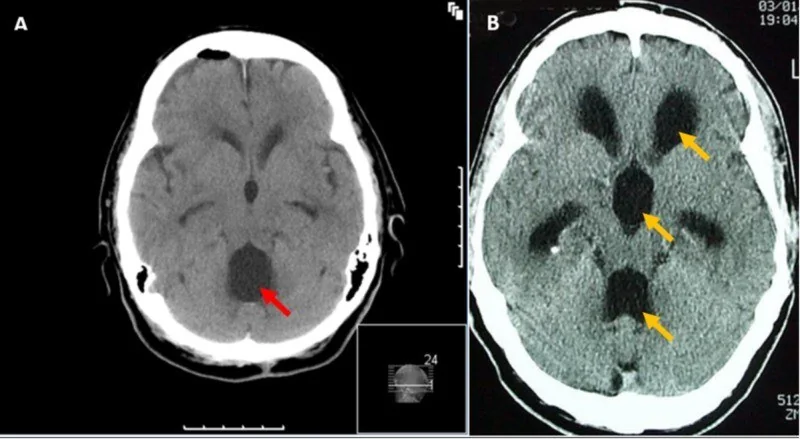
- Lateral, üçüncü ve dördüncü ventriküllerde birlikte genişleme; periventriküler beyaz cevherde transependimal düşük atenüasyon ve olası subaraknoid/intraventriküler kan yüksek atenüasyonla değerlendirilir.
Önerilen pencereler G genişlik, M merkez; değerler Hounsfield birimi (HU)
- BeyinG 80 / M +40
BT bulguları
- Ventrikülomegalinin dağılımını ve olası tıkanıklık düzeyini değerlendirin; komünikan hidrosefalide tıkanıklık subaraknoid aralıkta olabilir ve tüm ventriküller genişleyebilir.
- Lateral ventriküllerin temporal boynuzlarında ve üçüncü ventrikülde sistemin geri kalanıyla orantılı genişleme hidrosefali lehinedir.
- Periventriküler beyaz cevherde ventrikül duvarından dışarı uzanan düşük atenüasyon, transependimal BOS geçişini düşündürür.
- Akut subaraknoid kanamada sulkus ve sisternlerde hiperdens kan görülür; kan ventrikül içine de uzanabilir.
- İleri basınçta kortikal sulkusların silinmesi ve bazal sisternlerin daralması görülebilir.
- Atrofiye bağlı ventrikülomegalide parenkim kaybına eşlik eden sulkus ve ventrikül genişlemesi görülebilir; hidrosefali lehine temporal boynuz ve üçüncü ventrikül genişlemesi, interstisyel ödem ve kortikal sulkus silinmesi birlikte değerlendirilebilir.
- Normal basınçlı hidrosefali değerlendirmesinde Evans indeksi >0,3, atrofiyle orantısız ventrikül genişlemesi ve eşlik eden görüntüleme bulgularıyla birlikte kullanılır.
Ölçütler ve sınıflamalar
- Edinsel hidrosefali etiyolojisi
- Edinsel komünikan hidrosefali subaraknoid kanama veya menenjit sonrasında gelişebilir. BT veya MR, tüm ventrikül sistemini değerlendirmek ve hidrosefalinin altta yatan nedenini araştırmak için kullanılır.
Normalde
Ventrikül boyutlarını yaşla birlikte değerlendirin; mutlak ölçümler tek başına hidrosefaliyi ayırt ettirmez. Normal basınçlı hidrosefali değerlendirmesinde Evans indeksi >0,3, atrofiyle orantısız ventrikül genişlemesi ve eşlik eden görüntüleme bulgularıyla birlikte kullanılır.
Normal BT ile kıyasla
Aynı bölgenin, kaynak veri setinde patoloji içermediği belirtilen bir BT incelemesini kesit kesit kaydırın; organ sınırlarını açarak anatomiyi hasta görüntüsüyle karşılaştırın. Küçük rastlantısal bulgular tümüyle dışlanmamıştır.
Kaynak: TotalSegmentator v2.01 veri seti (Wasserthal ve ark., Radiology: Artificial Intelligence 2023), CC BY 4.0, vaka s0103; organ sınırları veri setinin otomatik segmentasyonundan, birleştirilerek sadeleştirildi. Görüntüler 2,5 mm kesit aralığına yeniden örneklendi.
Ayırıcı tanı
- Obstrüktif hidrosefali
- ventrikül kalibreleri tıkanma düzeyinde ayrışır; akuadukt düzeyindeki obstrüksiyonda lateral ve üçüncü ventriküller genişlerken dördüncü ventrikül genişlemez.
- Hidrosefali ex vacuo
- ventriküllerle birlikte kortikal sulkuslar ve fissürler de hacim kaybına paralel genişler.
- İdiyopatik normal basınçlı hidrosefali
- kronik klinik bağlamda MR'da tanımlanan DESH paterninde yüksek konveksitede sulkus daralması ve Sylvian fissürlerde genişleme eşlik edebilir.
- Atrofiye bağlı ventrikülomegalide parenkim kaybına eşlik eden sulkus ve ventrikül genişlemesi görülebilir; hidrosefali lehine interstisyel ödem ve kortikal sulkus silinmesi değerlendirilir.
- Komünikan hidrosefalide dördüncü ventrikül dahil tüm ventriküller genişleyebilir.
Tuzaklar
- Subaraknoid kanama kontrastsız BT'de sistern ve sulkuslarda kanın yüksek atenüasyonu ile aranmalı; sistern silinmesinin ağır beyin ödemi veya herniasyonda da görülebileceği göz önünde tutulmalıdır.
- Ventrikül duvarına bitişik periventriküler düşük atenüasyon, basınç altındaki ventriküllerde transependimal BOS geçişini gösterebilir ve en sık frontal, oksipital ve temporal boynuz uçlarında görülür; görüntüleme tek başına diğer periventriküler hipodensite nedenlerinden ayırt ettirmez.
- Tüm ventriküllerin birlikte genişlemesi komünikan hidrosefaliyi düşündürse de kesinleştirmez; komünikan tip subaraknoid alandaki dolaşım bozukluğu veya araknoid villuslardaki emilim bozukluğuna bağlıdır ve görüntülemede ventrikül kalibreleri ile sisternlerin durumu ayrıca değerlendirilir.
Kendini dene
Belirgin fokal BOS yolu tıkanıklığı olmayan hastada lateral, üçüncü ve dördüncü ventriküller geniş ve çevre beyaz cevherde yeni düşük atenüasyon var. Bu örüntü neyi destekler?
Cevabı göster
Komünikan hidrosefali. Belirgin fokal tıkanıklık yokluğunda tüm ventriküllerin genişlemesi ve transependimal geçiş komünikan hidrosefaliyle uyumludur; akuadukt stenozunda dördüncü ventrikül genellikle korunur.
Bazal sisternlerde yaygın subaraknoid kanı olan hastada tüm ventriküller geniş ve belirgin fokal BOS yolu tıkanıklığı yok. Komünikan hidrosefali en çok hangi mekanizmayla açıklanır?
Cevabı göster
Subaraknoid aralıkta BOS dolaşımının veya emiliminin bozulması. Subaraknoid kan, subaraknoid aralıkta BOS dolaşımını veya emilimini bozarak komünikan hidrosefaliye yol açabilir.
İlgili konular
- Obstrüktif hidrosefali
- İdiyopatik normal basınçlı hidrosefali örüntüsü
- Ventrikülomegali ve ex-vacuo genişleme ayrımı
Kaynaklar
Bu sayfadaki 37 cümle ve 2 quiz sorusu aşağıdaki kaynaklardan alıntılarla otomatik olarak karşılaştırıldı; 15 cümle bu karşılaştırmada düzeltildi (2026-10-12).
- Hydrocephalus Indian scenario – A reviewpmc.ncbi.nlm.nih.gov
- An ABC for decision making *pmc.ncbi.nlm.nih.gov
- Don't drink in the valley.pubmed.ncbi.nlm.nih.gov
- Imaging of Communicating Hydrocephalus.pubmed.ncbi.nlm.nih.gov
- Endoscopic Third Ventriculostomy - A Review.pubmed.ncbi.nlm.nih.gov
- Cerebrospinal fluid flow imaging by using phase-contrast MR technique.pubmed.ncbi.nlm.nih.gov
- Magnetic Resonance Imaging of Normal Pressure Hydrocephalus.pubmed.ncbi.nlm.nih.gov
- Third ventriculostomy in normal pressure hydrocephalus.pubmed.ncbi.nlm.nih.gov
- Tetraventricular noncommunicating hydrocephalus: Case report and literature review.pubmed.ncbi.nlm.nih.gov
- [Headache from increased cerebrospinal fluid pressure].pubmed.ncbi.nlm.nih.gov
- Cerebral and occipito-atlanto-axial involvement in mucopolysaccharidosis patients: clinical, radiological, and neurosurgical features.pubmed.ncbi.nlm.nih.gov
- Fungal infection of a ventriculoperitoneal shunt: histoplasmosis diagnosis and treatment.pubmed.ncbi.nlm.nih.gov
- Diffuse leptomeningeal glioneuronal tumour (DLGNT) with hydrocephalus as an initial symptom: a case-based update.pubmed.ncbi.nlm.nih.gov
- Cerebrospinal fluid dysregulation and post-traumatic hydrocephalus after paediatric traumatic brain injury.pubmed.ncbi.nlm.nih.gov
- Endoscopic third ventriculostomy for diencephalosynapsis-related hydrocephalus in MPDZ gene syndrome: a case report and review of the literature.pubmed.ncbi.nlm.nih.gov
- Continuum of Irreversible and Potentially Reversible Traumatic Brain Injury Sequelae: Axonal Injury and Hydrocephalus.pubmed.ncbi.nlm.nih.gov
- Spontaneous Recovery From Post-hemorrhagic Obstructive Hydrocephalus: A Rare Case in an Elderly Patient.pubmed.ncbi.nlm.nih.gov
- When Stroke Leads to Hydrocephalus: A Case of Unilateral Ventricular Enlargement.pubmed.ncbi.nlm.nih.gov
- Diagnostic approach to fetal ventriculomegaly.pubmed.ncbi.nlm.nih.gov
- Normal Pressure Hydrocephalus.pubmed.ncbi.nlm.nih.gov
- Mild fetal ventriculomegaly: diagnosis, evaluation, and management.pubmed.ncbi.nlm.nih.gov
- Advances in temporizing treatment strategies and associated complications for posthemorrhagic hydrocephalus in preterm infants.pubmed.ncbi.nlm.nih.gov
- Case Report: Endoscopic-assisted cistern ostomy with Ommaya reservoir insertion for trapped temporal horn: surgical technique and case illustration.pubmed.ncbi.nlm.nih.gov
- Neuroprotection After Intracerebral Hemorrhage: Apoptosis, Neurogenesis, and Prospects of Stem Cell Therapy.pubmed.ncbi.nlm.nih.gov
- <i>Cryptococcus gattii</i> CNS infection presenting as a periaqueductal "soap-bubble" lesion causing obstructive hydrocephalus with refractory CSF diversion.pubmed.ncbi.nlm.nih.gov
- Fetal mri of obstructive hydrocephalus: a review proposing a surgical etiology-based approach.pubmed.ncbi.nlm.nih.gov
- <i>Spp1</i> Appears to Be a Key Gene for Sporadic Obstructive Hydrocephalus in the Absence of AQP4.pubmed.ncbi.nlm.nih.gov
- Imaging Characteristics of Colloid Cysts: A Case Series Correlating Cyst Size and Location With Associated Acute Hydrocephalus.pubmed.ncbi.nlm.nih.gov
- Magnetic resonance imaging of primary central nervous system neoplasms of dogs and cats: Basic concepts for diagnostic pathologists.pubmed.ncbi.nlm.nih.gov
- Lipomatous Dural Metaplasia Associated With Chronic Ventricular Shunting: A Report of Two Cases.pubmed.ncbi.nlm.nih.gov
- Diagnostic Accuracy and Time Efficiency of Artificial Intelligence for Intracranial Hemorrhage Detection on Emergency Brain CT.pubmed.ncbi.nlm.nih.gov
- Co-administration of Four-Factor Prothrombin Complex Concentrate With Andexanet alfa for Reversal of Nontraumatic Intracranial Hemorrhage.pubmed.ncbi.nlm.nih.gov
- Endoscopic resection of a giant colloid cyst in the velum interpositum: illustrative case.pubmed.ncbi.nlm.nih.gov
- From Sound to Silence: Cerebellar Abscesses and Herniation Due to Cochlear Implant Infection With <i>Escherichia coli</i> and <i>Bacteroides fragilis</i>.pubmed.ncbi.nlm.nih.gov
- A Case of Multiple Dural Arteriovenous Fistula-Like Findings Following Aneurysmal Subarachnoid Hemorrhage.pubmed.ncbi.nlm.nih.gov
- Anatomy-Guided Microsurgical Resection of a Dominant Frontal Lobe Tumor Without Intraoperative Adjuncts: A Case Report from a Resource-Limited Context.pubmed.ncbi.nlm.nih.gov
- Comparative CT Ventricular Morphometrics in Hydrocephalus, Stroke, and Traumatic Brain Injury: A Distortion-Controlled Analysis.pubmed.ncbi.nlm.nih.gov
- Prognostic predictors in HIV-negative neurosyphilis: a retrospective cohort study with prospective follow-up.pubmed.ncbi.nlm.nih.gov
- Atrial volume reduction correlates with early improvement in hemorrhage-associated normal pressure hydrocephalus-a 3D computed tomography volumetric study.pubmed.ncbi.nlm.nih.gov
- Association Between Frontotemporal Atrophy and Cognitive Impairment in Patients with Schizophrenia Based on Computed Tomography Imaging.pubmed.ncbi.nlm.nih.gov
- Ventricular CSF-to-blood water transport kinetics in adult hydrocephalus.pubmed.ncbi.nlm.nih.gov
- Redefining Idiopathic Normal Pressure Hydrocephalus Using AI-Driven Brain Volumetry.pubmed.ncbi.nlm.nih.gov
- Magnetic Resonance Imaging of the Neonatal Brain: Modalities, Scoring Systems, and Clinical Applications.pubmed.ncbi.nlm.nih.gov
- Variability in the circulation of cerebrospinal fluid: causes and clinical implications for intraventricular drug delivery.pubmed.ncbi.nlm.nih.gov
- Bilateral Lateral Ventricle Cerebrospinal Fluid Diversion in a Rare Case of Foramen of Monro Occlusion: A Case Report.pubmed.ncbi.nlm.nih.gov
- A Comprehensive Review of Arachnoid Cysts.pubmed.ncbi.nlm.nih.gov
- Hyponatremia Following Endoscopic Third Ventriculostomy in an Adolescent with an Aqueductal Web: A Case Report.pubmed.ncbi.nlm.nih.gov
- Individualized retrograde endoscopic transoccipital-fourth ventricular-midbrain aqueduct to third and lateral ventriculoperitoneal shunt for complex multilocular hydrocephalus with isolated fourth ventricle: a case report.pubmed.ncbi.nlm.nih.gov
- Tectal gliomas as a rare finding in presumed idiopathic congenital aqueductal stenosis: patient series.pubmed.ncbi.nlm.nih.gov
- Alzheimer's disease and related dementia: evaluation, diagnosis and acute care management.pubmed.ncbi.nlm.nih.gov
- Paediatric cranial ultrasound: abnormalities of the brain in term neonates and young infants.pubmed.ncbi.nlm.nih.gov
- Cerebrospinal fluid dynamics disorders: Relationship to Alzheimer biomarkers and cognition.pubmed.ncbi.nlm.nih.gov
- Autopsy Confirmed Normal Pressure Hydrocephalus (NPH) Presenting With Corticobasal Syndrome.pubmed.ncbi.nlm.nih.gov
- Catastrophic Hypoxic-Ischemic Brain Injury Following Influenza A Illness in a Young Woman: A Case Report.pubmed.ncbi.nlm.nih.gov
- Miliary Tuberculosis: A Comprehensive Review of Epidemiology, Clinical Manifestations, Diagnosis, Treatment, and Complications.pubmed.ncbi.nlm.nih.gov
- ESMO/ASCO Recommendations for a Global Curriculum in Medical Oncology Edition 2023.pubmed.ncbi.nlm.nih.gov
- ESMO/ASCO Recommendations for a Global Curriculum in Medical Oncology Edition 2023.pubmed.ncbi.nlm.nih.gov
- From Balloon to Brain Ballooning: A Case of Obstructive Hydrocephalus in a Child.pubmed.ncbi.nlm.nih.gov
- Subarachnoid cisterns as surgical corridors: Integrating microsurgical anatomy and neuroimaging for intracranial navigation.pubmed.ncbi.nlm.nih.gov
- A Colloid Cyst Masquerading As Idiopathic Intracranial Hypertension in a Young Woman: A Diagnostic Pitfall.pubmed.ncbi.nlm.nih.gov
- Clinical manifestations, progression and treatment of post-traumatic hydrocephalus accompanied by contralateral subdural effusion after decompressive craniectomy: a single-center retrospective study.pubmed.ncbi.nlm.nih.gov
- Treatment strategies and prognostic outcomes in craniosynostosis with concurrent hydrocephalus: a case series.pubmed.ncbi.nlm.nih.gov
- Phakomatoses: A pictorial review.pubmed.ncbi.nlm.nih.gov
- Gold nanoparticle-enhanced X-ray microtomography of the rodent reveals region-specific cerebrospinal fluid circulation in the brain.pubmed.ncbi.nlm.nih.gov
- Beyond Vasospasm: Dual Milrinone and Balloon Angioplasty in Refractory Delayed Cerebral Ischemia Post-Subarachnoid Hemorrhage.pubmed.ncbi.nlm.nih.gov
- Intraventricular Hemorrhage Burden and Treatment-Specific Symptomatic Vasospasm After Aneurysmal Subarachnoid Hemorrhage.pubmed.ncbi.nlm.nih.gov
- Beyond the Typical Atypical Imaging Features of Leptomeningeal Enhancement: A Case Series.pubmed.ncbi.nlm.nih.gov
- Post-Hemorrhagic Hydrocephalus with Secondary Cerebrospinal Fluid Pathway Obstruction in an Extremely Premature Infant: A Case Report.pubmed.ncbi.nlm.nih.gov
- Basilar artery dolichoectasia presenting as obstructive hydrocephalus mimicking normal pressure hydrocephalus.pubmed.ncbi.nlm.nih.gov
- Irreversible blindness from hydrocephalus in recurrent pediatric pilocytic astrocytoma: a case report.pubmed.ncbi.nlm.nih.gov
- From the past to the present: evolving theories in the pathophysiology of normal pressure hydrocephalus.pubmed.ncbi.nlm.nih.gov
- Beyond the triad: akinetic mutism in idiopathic normal pressure hydrocephalus, with response to shunt placement. Illustrative case.pubmed.ncbi.nlm.nih.gov
- Endovascular Treatment of Hydrocephalus: A Systematic Literature Review.pubmed.ncbi.nlm.nih.gov
- Surgery for post-traumatic hydrocephalus: lessons, challenges and future directions.pubmed.ncbi.nlm.nih.gov
- <i>Streptococcus suis</i> meningitis complicated with communicating hydrocephalus: complete clinical and radiological resolution with non-neurosurgical management-A case report.pubmed.ncbi.nlm.nih.gov
- PTEN mutations impair CSF dynamics and cortical networks by dysregulating periventricular neural progenitors.pubmed.ncbi.nlm.nih.gov
- Three-Dimensional Constructive Interference in Steady State (3D CISS) Imaging and Clinical Applications in Brain Pathology.pubmed.ncbi.nlm.nih.gov
- Impaired neurogenesis alters brain biomechanics in a neuroprogenitor-based genetic subtype of congenital hydrocephalus.pubmed.ncbi.nlm.nih.gov
- Radiological assessment of dementia: the Italian inter-society consensus for a practical and clinically oriented guide to image acquisition, evaluation, and reporting.pubmed.ncbi.nlm.nih.gov
- Neuroimaging in normal pressure hydrocephalus.pubmed.ncbi.nlm.nih.gov
- Spontaneous rupture of a clinically recurrent intracranial dermoid cyst: a case report and narrative review.pubmed.ncbi.nlm.nih.gov
- Non-contrast computed tomography at the end of the acute care phase as an additional prognostic tool after aneurysmal subarachnoid hemorrhage.pubmed.ncbi.nlm.nih.gov
- Canine Cognitive Dysfunction and Alzheimer's Disease: Pathophysiological Relationships and the Impact of Glymphatic System Impairment on Neurodegeneration.pubmed.ncbi.nlm.nih.gov
- An ABC for decision making.pubmed.ncbi.nlm.nih.gov
- Neuroradiology in women of childbearing age.pubmed.ncbi.nlm.nih.gov
- Clinical effect of radical debris evacuation with a flexible neuroendoscope on patients with ventriculitis: a case series.pubmed.ncbi.nlm.nih.gov
- A review of applications of automated ventricular parcellation from magnetic resonance imaging of the brain.pubmed.ncbi.nlm.nih.gov
- Fetal intracranial hemorrhage and infarct: Main sonographic and MRI characteristics: A review article.pubmed.ncbi.nlm.nih.gov
- Regulation of brain fluid volumes and pressures: basic principles, intracranial hypertension, ventriculomegaly and hydrocephalus.pubmed.ncbi.nlm.nih.gov
- Contrast-induced encephalopathy presenting with refractory status epilepticus following endovascular coiling of an intracranial aneurysm: A case report and literature review.pubmed.ncbi.nlm.nih.gov
- Neurological complications following cerebral angiography: a case of contrast-induced encephalopathy.pubmed.ncbi.nlm.nih.gov
- Contrast-Induced Encephalopathy After Simultaneous Embolization of Multiple Intracranial Aneurysms: A Case Report and Management.pubmed.ncbi.nlm.nih.gov
- An Unusual Case of Spontaneous Intracranial Hypotension Presenting as Meningoencephalitis.pubmed.ncbi.nlm.nih.gov
- The laminar subarachnoid hemorrhage of infant venous stroke: Evidence of a 4<sup>th</sup> meningeal layer?pubmed.ncbi.nlm.nih.gov
- Postmortem CT: Applications in Clinical and Forensic Medicine.pubmed.ncbi.nlm.nih.gov
- An Integrated Approach on the Diagnosis of Cerebral Veins and Dural Sinuses Thrombosis (a Narrative Review).pubmed.ncbi.nlm.nih.gov
- Reversal of cerebral pseudoatrophy in normal pressure hydrocephalus after ventriculoatrial shunt placement.pubmed.ncbi.nlm.nih.gov
- Jugular Venous Compression via Soft Cervical Collar in Shunt-Refractory Low-Pressure Hydrocephalus: A Report of Two Cases.pubmed.ncbi.nlm.nih.gov
- Subarachnoid Hemorrhage Causing Hydrocephalus: Narrative Review of a Neurosurgical Emergency.pubmed.ncbi.nlm.nih.gov
- From shunt dependency to shunt freedom: Endoscopic third ventriculostomy in ventriculoperitoneal shunt-dependent communicating tetraventricular hydrocephalus: A case report.pubmed.ncbi.nlm.nih.gov
- Post-traumatic hydrocephalus in adults: the mechanisms of development, predictors of progression and management strategies. A narrative review and case series analysis.pubmed.ncbi.nlm.nih.gov
- Application of LRG mechanism in normal pressure hydrocephalus.pubmed.ncbi.nlm.nih.gov
- ETV in infancy and childhood below 2 years of age for treatment of hydrocephalus.pubmed.ncbi.nlm.nih.gov
- Inflammation in acquired hydrocephalus: pathogenic mechanisms and therapeutic targets.pubmed.ncbi.nlm.nih.gov
- Volumetric blood cutoff for outcome prediction in aneurysmal subarachnoid hemorrhage using semiautomated quantification.pubmed.ncbi.nlm.nih.gov
- Role of serum magnesium in post-aneurysmal subarachnoid hemorrhagic hydrocephalus.pubmed.ncbi.nlm.nih.gov
- Effects of cranioplasty with customized 3D titanium mesh plates on postoperative complications and neurological outcomes following traumatic brain injury or stroke: a single-center retrospective study.pubmed.ncbi.nlm.nih.gov
- Distinctive hydrocephalus-like phenotype in NOTCH2NLC-related neuronal intranuclear inclusion disease: clinicopathological features and therapeutic implications.pubmed.ncbi.nlm.nih.gov
- Development and external validation of a machine learning model based on multimodal dynamic data for predicting shunt-dependent hydrocephalus after aneurysmal subarachnoid hemorrhage: a dual-center retrospective cohort study.pubmed.ncbi.nlm.nih.gov
- Acute Neurological Deterioration in a Child with Shunt-Dependent Post-Hemorrhagic Hydrocephalus: A Case Report.pubmed.ncbi.nlm.nih.gov
- Dandy-Walker Syndrome and Congenital Heart Defects in a Child: A Case Report.pubmed.ncbi.nlm.nih.gov
- Role of choroid plexus cauterization in augmenting the success rate of endoscopic third ventriculostomy in Chiari II-associated hydrocephalus.pubmed.ncbi.nlm.nih.gov
Eğitim amaçlıdır; hasta başında tanı ve tedavi kararının yerine geçmez, tıbbi tavsiye değildir. Metinler yapay zekâ desteğiyle yazıldı ve otomatik bir adımda kaynak alıntılarıyla karşılaştırıldı; bu bir tıbbi doğrulama değildir ve içerik uzman radyolog incelemesinden geçmedi. Klinik kararlarda güncel kılavuzları, kurum protokollerini ve radyoloji raporunu esas alın.