Özet
BOS şantı olan hastada yeni subdural koleksiyon, aşırı drenajla ilişkili higroma, kanama veya bu süreçlerin birlikte bulunması açısından dikkatle incelenmelidir. Akut kafa travması bağlamında BT, subdural hematom gibi acil nöroşirürjik tedavi gerektirebilecek intrakraniyal lezyonların saptanmasında temel görüntüleme yöntemidir. Aynı BT incelemesinde ventrikül boyutu ve kateter ucunun yeri şant değerlendirmesine katkı sağlar; tek başına koleksiyonun nedenini göstermez. Orta hat kayması veya bazal sistern basısı artmış intrakraniyal basınçla ilişkili olabilir ve klinik bağlamda acil değerlendirme gerektirir.
Faz ve pencere
- Kontrastsız tanısal
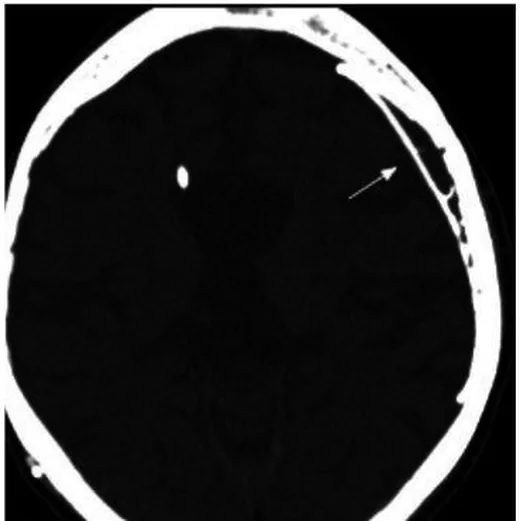
- Subdural koleksiyon serebral konveksite üzerinde yayılan hilal biçimli ekstraaksiyel alandır; subdural hematom BT'de hiperdens, izodens, hipodens veya karışık yoğunlukta görülebilir. Kontrastlı incelemeden sonra subdural sıvı hiperdens görünüp akut hematomu taklit edebilir; önceki kontrast uygulaması göz önünde bulundurulmalı, rutin kontrastlı faz gerekmez.
Önerilen pencereler G genişlik, M merkez; değerler Hounsfield birimi (HU)
- SubduralG 200 / M +75
- BeyinG 80 / M +40
BT bulguları
- Subdural hematom genellikle serebral konveksiteye yayılan hilal biçimli lezyon olarak görülür.
- Subdural higroma konveksite üzerinde septasız ve hemorajik bileşen içermeyen BOS yoğunluklu ekstraaksiyel koleksiyondur; subdural hematom hiperdens, izodens, hipodens veya karışık yoğunlukta görülebilir.
- Membran veya septa içeren çok septalı ya da çok katmanlı görünüm septalı kronik subdural hematomu düşündürür; tek başına kesin yaş tayini sağlamaz.
- Bilateral konveksite subdural higromaları görulebilir ve orta hat kaymasına yol açabilir.
- Tek taraflı ya da kalın koleksiyonda komşu ventrikül basısı, herniasyon ve orta hat kayması gibi kitle etkisi bulguları BT'de değerlendirilip tarif edilir.
- Aynı BT incelemesinde ventrikül boyutu, kateter ucunun yeri ve bazal sisternler ayrıca değerlendirilir.
Normalde
Fizyolojik durumda gerçek bir subdural boşluk bulunmadığı bildirilmiştir; normal incelemede hilal biçimli ekstraaksiyel koleksiyon ve kortikal bası beklenmez. Subdural koleksiyonun kitle etkisi, orta hat yer değiştirmesi, ventrikül basısı ve bazal sistern basısı gibi BT bulgularıyla değerlendirilir.
Normal BT ile kıyasla
Aynı bölgenin, kaynak veri setinde patoloji içermediği belirtilen bir BT incelemesini kesit kesit kaydırın; organ sınırlarını açarak anatomiyi hasta görüntüsüyle karşılaştırın. Küçük rastlantısal bulgular tümüyle dışlanmamıştır.
Kaynak: TotalSegmentator v2.01 veri seti (Wasserthal ve ark., Radiology: Artificial Intelligence 2023), CC BY 4.0, vaka s0103; organ sınırları veri setinin otomatik segmentasyonundan, birleştirilerek sadeleştirildi. Görüntüler 2,5 mm kesit aralığına yeniden örneklendi.
Ayırıcı tanı
- Subdural koleksiyon ayırıcı tanısında subdural higroma, serebral konveksiteler üzerinde septa veya hemorajik bileşen içermeyen BOS yoğunluklu ekstraaksiyel koleksiyon olarak düşünülür.
- Subaraknoid kanama ayırıcı tanıda yer alır ve bazal sisternlerde görülebilir.
- Subdural ampiyem ayırıcı tanıda yer alabilir; merkezi sinir sistemi tutulumu beyin apsesi, meningoensefalit, subdural ampiyem ve epidural apse biçiminde görülebilir.
Tuzaklar
- Bilateral subdural koleksiyonlarda orta hat kayması görülebilir; kitle etkisini orta hat ve bazal sistern bulgularıyla değerlendirin.
- Subdural hematom izodens görülebilir; koleksiyonda membran veya septa varlığı organize septalı koleksiyonu düşündürür.
- Subdural higroma BOS yoğunluklu ekstraaksiyel koleksiyon olarak tanımlanır; koleksiyonun septa ve hemorajik bileşen içermemesi bu ayrımda ayırt edici özelliklerdir.
- Şantlı hastada subdural higroma veya hematom aşırı drenajda görulebilir; ancak kafa travması da subdural hematom riskini artırdığı için travma ve eşlik eden kanama nedenleri de aranmalıdır.
- Özellikle bebeklerde, subdural higromayı diğer patolojilerden ayırmak için başlangıç BT'sinden sonra baş MR'ı gerekebilir.
Kendini dene
Konveksite boyunca BOS benzeri yoğunlukta, septasız ve hemorajik bileşen seçilmeyen ekstraaksiyel koleksiyon en çok hangisiyle uyumludur?
Cevabı göster
Subdural higroma. Subdural higroma, konveksite üzerinde ekstraaksiyel koleksiyon olarak görülür ve kaynaklarda şant/dekompresyon sonrası bildirilmiştir; subdural ve epidural hematom kanamaya bağlı olarak genellikle hiperdens görülür, bu nedenle BOS benzeri septasız koleksiyon higroma ile uyumludur.
Serebral konveksiteler üzerinde septa ve hemorajik bileşen içermeyen, BOS yoğunluklu ekstraaksiyel koleksiyon hangisidir?
Cevabı göster
Subdural higroma. Subdural higroma, konveksite üzerinde ekstraaksiyel koleksiyon biçiminde görülür; kaynaklarda dekompresyon/şant sonrası subdural higroma bildirilmiş, subdural ve epidural hematom ise kanamaya bağlı kitle etkisi gösteren ayrı durumlardır.
İlgili konular
- Şant aşırı drenajı ve intrakraniyal hipotansiyon bulguları
- Slit ventrikül örüntüsü ve şant komplikasyonu
- Şant yetersiz drenajı ve yeniden hidrosefali
Kaynaklar
Bu sayfadaki 31 cümle ve 2 quiz sorusu aşağıdaki kaynaklardan alıntılarla otomatik olarak karşılaştırıldı; 26 cümle bu karşılaştırmada düzeltildi (2026-10-11).
- Role of the “In-Window” Craniectomy in the Management of Serious Head Trauma: 12 Case Series, Technical Note, Literature Review, and Comparison With Other Surgical Managementspmc.ncbi.nlm.nih.gov
- Post-traumatic hydrocephalus in adults: the mechanisms of development, predictors of progression and management strategies. A narrative review and case series analysispmc.ncbi.nlm.nih.gov
- Intracranial hemorrhagic risk after cortical brain biopsy during shunt surgery for idiopathic normal pressure hydrocephalus: a prospective comparative studypmc.ncbi.nlm.nih.gov
- The role of age and Galassi type in management and surgical outcomes of pediatric middle fossa arachnoid cysts: a systematic review and meta-analysispmc.ncbi.nlm.nih.gov
- The paradox of relief: how decompression sets the stage for hydrocephalus—a retrospective inquiry into its clinical determinantspmc.ncbi.nlm.nih.gov
- Intracerebral haemorrhage expansion: definitions, predictors, and prevention.pubmed.ncbi.nlm.nih.gov
- Current diagnosis and treatment of chronic subdural haematomas.pubmed.ncbi.nlm.nih.gov
- Epidural hematoma.pubmed.ncbi.nlm.nih.gov
- Double-locus lymphoplasmacytic aortitis.pubmed.ncbi.nlm.nih.gov
- The conservative and pharmacological management of chronic subdural haematoma.pubmed.ncbi.nlm.nih.gov
- Spontaneous soft tissue hematomas.pubmed.ncbi.nlm.nih.gov
- Deep learning for automatically predicting early haematoma expansion in Chinese patients.pubmed.ncbi.nlm.nih.gov
- Splenic rupture presenting with marked scrotal ecchymosis in a 2-day-old newborn.pubmed.ncbi.nlm.nih.gov
- Apixaban-induced haematoma causing small bowel intussusception.pubmed.ncbi.nlm.nih.gov
- Lactococcus garvieae endocarditis presenting with subdural haematoma.pubmed.ncbi.nlm.nih.gov
- Radiomics for intracerebral hemorrhage: are all small hematomas benign?pubmed.ncbi.nlm.nih.gov
- Subdural Hematoma Mimickers: A Systematic Review.pubmed.ncbi.nlm.nih.gov
- Risk factors for early hemorrhagic complications after endovascular coiling of ruptured intracranial aneurysms.pubmed.ncbi.nlm.nih.gov
- Clinical evolutional aspects of chronic subdural haematomas - literature review.pubmed.ncbi.nlm.nih.gov
- Effect of Anti-Siphon Devices on Postoperative Outcomes in Idiopathic Normal Pressure Hydrocephalus.pubmed.ncbi.nlm.nih.gov
- Ventriculoperitoneal shunt management in patients with normal pressure hydrocephalus and cerebral atrophy: A retrospective chart review.pubmed.ncbi.nlm.nih.gov
- Incidence and management of overdrainage in pediatric hydrocephalus patients exclusively treated with modern gravitational VP shunt valves.pubmed.ncbi.nlm.nih.gov
- Chronic Subdural Hematoma: Pathophysiology, Diagnosis, and the Emerging Role of Middle Meningeal Artery Embolization.pubmed.ncbi.nlm.nih.gov
- Significance of upper cervical epidural venous engorgement on head computed tomography in the initial diagnosis of spontaneous intracranial hypotension: patient series.pubmed.ncbi.nlm.nih.gov
- Incorporating algorithmic uncertainty into a clinical machine deep learning algorithm for urgent head CTs.pubmed.ncbi.nlm.nih.gov
- Cerebrospinal Fluid Shunts: An Updated Radiologic Review of Devices, Malfunctions, and Complications.pubmed.ncbi.nlm.nih.gov
- A modified surgical technique for ventriculoperitoneal shunt placement using a non-burr hole valve in a pediatric population.pubmed.ncbi.nlm.nih.gov
- Dynamic optic nerve sheath diameter monitoring for intracranial pressure assessment in TBI patients.pubmed.ncbi.nlm.nih.gov
- Prognostic value of CT scoring systems and a simplified prediction model for pediatric moderate-to-severe traumatic brain injury.pubmed.ncbi.nlm.nih.gov
- Revisiting traumatic intracerebral hemorrhage in the context of ENRICH: illustrative cases.pubmed.ncbi.nlm.nih.gov
- Symptomatic Postoperative Pneumocephalus: A Case Series and Review of Management Strategies.pubmed.ncbi.nlm.nih.gov
- Subdural hygromas in abusive head trauma: pathogenesis, diagnosis, and forensic implications.pubmed.ncbi.nlm.nih.gov
- MDCT imaging of traumatic brain injury.pubmed.ncbi.nlm.nih.gov
- Imaging for the diagnosis and management of traumatic brain injury.pubmed.ncbi.nlm.nih.gov
- Dual-Energy CT in Enhancing Subdural Effusions that Masquerade as Subdural Hematomas: Diagnosis with Virtual High-Monochromatic (190-keV) Images.pubmed.ncbi.nlm.nih.gov
- Analysis of risk factors for recurrence in septated chronic subdural hematoma.pubmed.ncbi.nlm.nih.gov
- Consensus Statement on Middle Meningeal Artery Embolization in Chronic Subdural Hematoma Treatment: A Guideline from the Society of Vascular and Interventional Neurology Guidelines and Practice Standards Committee.pubmed.ncbi.nlm.nih.gov
- Reversible hemi-parkinsonism syndrome secondary to bilateral subdural hematomas: case report and literature review.pubmed.ncbi.nlm.nih.gov
- Bilateral Subdural Hygromas Following Rupture of a Temporal Arachnoid Cyst in a 16-Year-Old Boy: A Case Report.pubmed.ncbi.nlm.nih.gov
- Surgical management of complicated arachnoid cysts: A case series.pubmed.ncbi.nlm.nih.gov
- Intracranial pressure changes in traumatic brain injury patients undergoing unilateral decompressive craniectomy with dural expansion.pubmed.ncbi.nlm.nih.gov
- Variability in the circulation of cerebrospinal fluid: causes and clinical implications for intraventricular drug delivery.pubmed.ncbi.nlm.nih.gov
- The Effects of Endoscopic Third Ventriculostomy Versus Ventriculoperitoneal Shunt on Neuropsychological and Motor Performance in Patients with Idiopathic Normal Pressure Hydrocephalus-ENVENTOR-iNPH: Study Protocol.pubmed.ncbi.nlm.nih.gov
- Imaging Evaluation of Acute Traumatic Brain Injury.pubmed.ncbi.nlm.nih.gov
- Magnetic resonance imaging of primary central nervous system neoplasms of dogs and cats: Basic concepts for diagnostic pathologists.pubmed.ncbi.nlm.nih.gov
- Advances and controversies in meningeal biology.pubmed.ncbi.nlm.nih.gov
- Imaging of Skull Base Tumors.pubmed.ncbi.nlm.nih.gov
- Adaptive deep brain stimulation for dynamic gait control in Parkinson's disease: a randomized feasibility trial.pubmed.ncbi.nlm.nih.gov
- Case Report: Imaging and pathological features of compartmentalized subdural empyema and pachymeningitis within pre-existing porencephaly in a dog.pubmed.ncbi.nlm.nih.gov
- Evaluation of intraoperative color Doppler ultrasonography in the surgical evacuation of acute intracranial hematoma: a single-center study from Botswana.pubmed.ncbi.nlm.nih.gov
- Do Serum Brain Biomarkers Differentiate the Hemorrhagic Head Injury Lesion Phenotypes? An Interim Analysis of an On-Going Randomized Clinical Trial.pubmed.ncbi.nlm.nih.gov
- A challenging presentation of central nervous system involvement in disseminated coccidioidomycosis: Insights from cases.pubmed.ncbi.nlm.nih.gov
- Postoperative Subdural Empyema Caused by Staphylococcus pseudintermedius: A Case Report.pubmed.ncbi.nlm.nih.gov
- Subdural Empyema in a Dog Originating From the Oral Cavity.pubmed.ncbi.nlm.nih.gov
- Imaging of Abusive Head Trauma : A Radiologists' Perspective.pubmed.ncbi.nlm.nih.gov
- Diagnostic Approach to Macrocephaly in Children.pubmed.ncbi.nlm.nih.gov
- Cerebral Venous Outflow Implications in Idiopathic Intracranial Hypertension-From Physiopathology to Treatment.pubmed.ncbi.nlm.nih.gov
- Classification of recurrence status after surgical treatment of chronic subdural hemorrhage - A machine learning approach.pubmed.ncbi.nlm.nih.gov
- Extensive actinomycosis with intracranial and mediastinal involvement: a therapeutic challenge.pubmed.ncbi.nlm.nih.gov
- MRI appearance of chronic subdural hematoma.pubmed.ncbi.nlm.nih.gov
- An Integrated Approach on the Diagnosis of Cerebral Veins and Dural Sinuses Thrombosis (a Narrative Review).pubmed.ncbi.nlm.nih.gov
- Traumatic shaking: The role of the triad in medical investigations of suspected traumatic shaking.pubmed.ncbi.nlm.nih.gov
- Simultaneous Cranioplasty and Ventriculoperitoneal Shunt Placement After Decompressive Craniectomy in Children: A Single-Center Experience.pubmed.ncbi.nlm.nih.gov
- Low-Pressure Hydrocephalus After Traumatic Brain Injury: A Case Series and Scoping Review.pubmed.ncbi.nlm.nih.gov
- Paediatric hydrocephalus.pubmed.ncbi.nlm.nih.gov
- Impact of an antimicrobial stewardship-based infection prevention bundle on postoperative central nervous system infection in a tertiary neurosurgery department: a quasi-experimental study.pubmed.ncbi.nlm.nih.gov
- Association between neutrophil percentage-to-albumin ratio and chronic subdural hematoma: a retrospective case-control study.pubmed.ncbi.nlm.nih.gov
- Mechanisms of Dural Involvement in Cerebral Amyloid Angiopathy.pubmed.ncbi.nlm.nih.gov
- Pre-existing statin use and recurrence in relation to hematoma architecture of chronic subdural hematomas - A propensity score-matched analysis.pubmed.ncbi.nlm.nih.gov
- Post-traumatic hydrocephalus in adults: the mechanisms of development, predictors of progression and management strategies. A narrative review and case series analysis.pubmed.ncbi.nlm.nih.gov
- Leptomeninges: Anatomy, Mechanisms of Disease and Neuroimaging.pubmed.ncbi.nlm.nih.gov
- Effects of cranioplasty with customized 3D titanium mesh plates on postoperative complications and neurological outcomes following traumatic brain injury or stroke: a single-center retrospective study.pubmed.ncbi.nlm.nih.gov
- Machine learning in developing a predictive model for chronic hydrocephalus following aneurysmal subarachnoid hemorrhage.pubmed.ncbi.nlm.nih.gov
- Ultrasonography for Serial Monitoring and Management of Cerebrospinal Fluid Dynamic Disorders After Decompressive Craniectomy.pubmed.ncbi.nlm.nih.gov
- Optimal Timing of Cranioplasty After Decompressive Craniectomy: Timing or Collapse Ratio.pubmed.ncbi.nlm.nih.gov
- Role of the "In-Window" Craniectomy in the Management of Serious Head Trauma: 12 Case Series, Technical Note, Literature Review, and Comparison With Other Surgical Managements.pubmed.ncbi.nlm.nih.gov
- The paradox of relief: how decompression sets the stage for hydrocephalus-a retrospective inquiry into its clinical determinants.pubmed.ncbi.nlm.nih.gov
- BRIDGE: Burr hole vs. craniotomy - radiomic indicators determining the chronification grid in acute subdural hematoma evaluation.pubmed.ncbi.nlm.nih.gov
- AI-Based Approaches for the Identification and Quantification of Traumatic Brain Injury in Computed Tomography Imaging: Systematic Review.pubmed.ncbi.nlm.nih.gov
- Impact of Premorbid Function and Comorbidities in Geriatric Traumatic Brain Injury Patients: A Systematic Review.pubmed.ncbi.nlm.nih.gov
- Spontaneous Acute Subdural Hematoma Associated with Arachnoid Cyst and Intra-cystic Hemorrhage.pubmed.ncbi.nlm.nih.gov
- Primary and Secondary Optic Nerve Sheath Meningioma.pubmed.ncbi.nlm.nih.gov
- Malignant Cerebral Edema After Cranioplasty: A Case Report and Literature Insights.pubmed.ncbi.nlm.nih.gov
- Intentional Self-Inflicted Transcranial Screwdriver Injury: A Case Report.pubmed.ncbi.nlm.nih.gov
- Intracranial multiple myeloma masquerading as subdural hematoma: illustrative cases.pubmed.ncbi.nlm.nih.gov
- Case Report: Endoscopic evacuation of acute subdural hematoma in selected young patients: a report of two cases.pubmed.ncbi.nlm.nih.gov
- Spectrum of Magnetic Resonance Imaging Findings in Acute Pediatric Traumatic Brain Injury - A Pictorial Essay.pubmed.ncbi.nlm.nih.gov
- The interdural hematoma: A subtype of convexity subdural/dural hematoma with specific radioanatomical characteristics.pubmed.ncbi.nlm.nih.gov
- Radiological predictors of shunt response in the diagnosis and treatment of idiopathic normal pressure hydrocephalus: a systematic review and meta-analysis.pubmed.ncbi.nlm.nih.gov
- Middle meningeal artery embolization of meningioma en plaque misdiagnosed as subdural hematoma: illustrative cases.pubmed.ncbi.nlm.nih.gov
- Bilateral subdural empyema diagnosed after middle meningeal artery embolization: illustrative case.pubmed.ncbi.nlm.nih.gov
- Subarachnoid space in infancy and early childhood: a systematic review of measurements.pubmed.ncbi.nlm.nih.gov
- The laminar subarachnoid hemorrhage of infant venous stroke: Evidence of a 4<sup>th</sup> meningeal layer?pubmed.ncbi.nlm.nih.gov
- Anatomy of the Middle Meningeal Artery: Implications for Middle Meningeal Artery Embolization in Chronic Subdural Hematoma.pubmed.ncbi.nlm.nih.gov
- Herpes simplex virus encephalitis following acute brain injury: illustrative cases.pubmed.ncbi.nlm.nih.gov
- The role of endoscope-assisted septectomy and membranectomy for complex chronic subdural hematomas: safety, efficacy, technical feasibility. Patient series.pubmed.ncbi.nlm.nih.gov
- Ultrasound-guided needle technique as a relaxation strategy for early cranioplasty: illustrative case.pubmed.ncbi.nlm.nih.gov
- Dual Impact: Coup-Contrecoup Brain Injury in a Young Cyclist-A Case Report.pubmed.ncbi.nlm.nih.gov
- Simultaneous Burr hole drainage and middle meningeal artery occlusion through a single incision for chronic subdural hematoma guided by 3D reconstruction.pubmed.ncbi.nlm.nih.gov
- Chronic Subdural Hematoma Is Not Subdural: Anatomical, Biological, and Therapeutic Implications of a Misleading Definition.pubmed.ncbi.nlm.nih.gov
- Benign enlargement of the subarachnoid spaces and subdural collections-when to evaluate for abuse.pubmed.ncbi.nlm.nih.gov
- Flexible thecoscopy for extensive spinal arachnoiditis.pubmed.ncbi.nlm.nih.gov
- Chronic Subdural Hematoma (cSDH): A review of the current state of the art.pubmed.ncbi.nlm.nih.gov
- Ventriculoperitoneal (VP) Shunt-Associated Calcified Chronic Subdural Hematoma: Armored Brain Management With Shunt Revision.pubmed.ncbi.nlm.nih.gov
- Giant calcified chronic subdural hematoma adherent to the sagittal sinus: A case report and surgical considerations.pubmed.ncbi.nlm.nih.gov
- Ventricular volumetry in relation to clinical response and overdrainage after shunt surgery in idiopathic normal-pressure hydrocephalus: a three-year prospective study.pubmed.ncbi.nlm.nih.gov
- Case Report: <b>"</b>Damage control" in obstetric neurosurgery: staged management of ruptured arteriovenous malformation with herniation.pubmed.ncbi.nlm.nih.gov
- Global prevalence and incidence of chronic subdural hematoma: A systematic review.pubmed.ncbi.nlm.nih.gov
- Intracranial arachnoid cysts: Pediatric neurosurgery update.pubmed.ncbi.nlm.nih.gov
- Comparison of image quality between a novel mobile CT scanner and current generation stationary CT scanners.pubmed.ncbi.nlm.nih.gov
- Basal Cisternostomy for Severe TBI: Surgical Technique and Cadaveric Dissection.pubmed.ncbi.nlm.nih.gov
- Giant unusual shaped chronic subdural hematoma in a patient with untreated congenital hydrocephalus.pubmed.ncbi.nlm.nih.gov
- Mycotic aneurysm presenting in a patient with a ventriculoatrial shunt with positive CSF cultures for Cutibacterium acnes: illustrative case.pubmed.ncbi.nlm.nih.gov
- Long-term safety and effectiveness of the "OptEase" vena cava filter.pubmed.ncbi.nlm.nih.gov
- The management of space-occupying cyst in the tumor bed after brain tumor surgery: a case series integrated with literature synthesis.pubmed.ncbi.nlm.nih.gov
Eğitim amaçlıdır; hasta başında tanı ve tedavi kararının yerine geçmez, tıbbi tavsiye değildir. Metinler yapay zekâ desteğiyle yazıldı ve otomatik bir adımda kaynak alıntılarıyla karşılaştırıldı; bu bir tıbbi doğrulama değildir ve içerik uzman radyolog incelemesinden geçmedi. Klinik kararlarda güncel kılavuzları, kurum protokollerini ve radyoloji raporunu esas alın.