Özet
Kardiyak arrest, hipovolemik şok veya ağır hipotansiyon gibi durumlarda serebral perfüzyonun yaygın azalmasına bağlı hipoksik-iskemik beyin hasarı gelişebilir. Kontrastsız BT, yaygın serebral ödemi ve sulkuslarla ventriküllerde silinmeyi değerlendirmede kullanılabilir; erken incelemede şiddetli ödem henüz görülmeyebilir. Global hasarda bilateral simetrik nörolojik tutulum görülebilir; bu dağılım tek bir damar alanındaki fokal infarktla karşılaştırmada ipucu sağlar. Yaygın ödem ve sistern basısı atlanırsa herniasyon riski ve ağır beyin hasarı gözden kaçabilir.
Faz ve pencere
- Kontrastsız tanısal
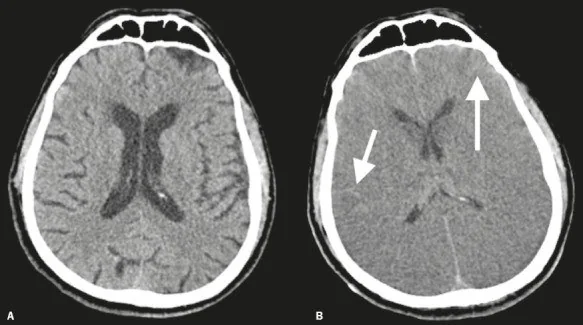
- Korteks ve bazal gangliyon düzeyinde gri-beyaz cevher ayrımında yaygın silinme aranır; ödemde gri cevherde düşük atenuasyon ve sulkuslarda düzleşme görülebilir. İleri ödemde ventriküller ve bazal sisternler daralabilir; bazen ödemli supratentoryal parankime göre serebellum görece yoğun görünür. Kontrastsız BT'de bazal gangliyon düzeyindeki gri-beyaz cevher oranı ile sulkus ve sisternlerdeki silinme değerlendirilerek yaygın ödem bulguları araştırılabilir.
Önerilen pencereler G genişlik, M merkez; değerler Hounsfield birimi (HU)
- BeyinG 80 / M +40
- SubduralG 200 / M +75
BT bulguları
- Yaygın gri-beyaz cevher ayrım kaybı — korteks ile subkortikal beyaz cevher sınırı silikleşir.
- Derin gri cevherde hipodansite ve bazal gangliyon düzeyinde gri-beyaz kontrast kaybı görülebilir.
- Global hipoksik-iskemik hasarda BT’de yaygın gri-beyaz cevher ayrım kaybı ve ödem aranır.
- Yaygın serebral ödem — hemisfer sulkusları daralır, lateral ventriküller basıklaşır.
- Yaygın serebral ödemde sulkuslar ve ventriküller silikleşebilir; ağır olgularda herniasyon görülebilir.
- Beyaz serebellum işareti — hipodens ödemli serebruma karşı serebellum görece yüksek atenüasyonlu kalır.
- Psödo-SAH görünümü — yaygın ödem zemininde bazal sisternlerdeki hiperdens görünüm gerçek subaraknoid kanamayı taklit edebilir.
Normalde
Postmortem BT incelemesinde santral sulkus genişliği, bazal gangliyon düzeyindeki atenüasyon farkı ve serebral gri-beyaz cevher atenüasyon farkı açısından HIE grubu ile kontrol grubu arasında anlamlı fark bildirilmiştir. Bazal gangliyon düzeyinde iki tarafın gri cevher atenüasyonunu ve gri-beyaz sınırını kıyaslayın; PMCT'de serebellar gri cevher ile serebral gri cevher atenüasyon farkı da değerlendirilen parametrelerdendir.
Normal BT ile kıyasla
Aynı bölgenin, kaynak veri setinde patoloji içermediği belirtilen bir BT incelemesini kesit kesit kaydırın; organ sınırlarını açarak anatomiyi hasta görüntüsüyle karşılaştırın. Küçük rastlantısal bulgular tümüyle dışlanmamıştır.
Kaynak: TotalSegmentator v2.01 veri seti (Wasserthal ve ark., Radiology: Artificial Intelligence 2023), CC BY 4.0, vaka s0103; organ sınırları veri setinin otomatik segmentasyonundan, birleştirilerek sadeleştirildi. Görüntüler 2,5 mm kesit aralığına yeniden örneklendi.
Ayırıcı tanı
- Global hipoksik-iskemik hasarda yaygın kortikal şişme ve gri-beyaz cevher ayrım kaybı görülebilir; kardiyak arrest sonrası fokal infarkt da eşlik edebileceğinden BT'deki fokal lezyon ayrıca değerlendirilmelidir.
- Hipoglisemik ensefalopatide MR, bilateral bazal gangliyon, korteks, periventriküler bölge, centrum semiovale ve korpus kallozumda yaygın yüksek sinyal gösterebilir; BT'de benzer bölgelerde hipodansite düşünülüyorsa MR tamamlayıcı görüntüleme yöntemidir.
- Karbonmonoksit toksisitesinde bilateral globus pallidus lezyonları BT'de görülebilir.
- Metanol toksisitesinde metabolit formik asit şiddetli metabolik asidoz ve nörotoksisiteye yol açabilir; bilateral putaminal nekroz BT'de görülebilir.
- Psödo-SAH görünümünde yaygın beyin ödemiyle birlikte bazal sisternlerde hiperdens görünüm gerçek subaraknoid kanamayı taklit edebilir. Hipoksik ensefalopatide psödo-SAH, BT’de gerçek SAH’yi taklit edebilir.
Tuzaklar
- Arrest sonrası erken BT nöroprognostik değerlendirme için yeterli olmayabilir; BT/MR bulguları uygun zamanlama ve multimodal değerlendirme içinde yorumlanmalıdır.
- Yaygın serebral ödemde sulkus ve sistern hiperdansitesi psödo-subaraknoid kanamayı taklit edebilir; bu görünümü otomatik olarak gerçek kanama kabul etmeyin.
- Beyaz serebellum işaretini serebellar kanama veya kalsifikasyon sanma; yoğunluk farkının yaygın supratentoryal ödem zemininde oluştuğunu doğrula.
- Kontrastsız BT’de gri-beyaz cevher oranı ve yaygın ödem bulguları nörolojik prognozu tek başına belirlememeli; görüntüleme uygun zamanlama ve multimodal değerlendirme içinde yorumlanmalıdır.
Kendini dene
Kardiyak arrest sonrası global hipoksik-iskemik beyin hasarında yaygın serebral ödemi destekleyen görüntüleme bulgusu hangisidir?
Cevabı göster
Yaygın ödemle birlikte sulkusların silinmesi ve ventriküllerin basıklaşması. Yaygın serebral ödemde sulkusların silinmesi ve ventriküllerin basılaşması görülebilir; bu bulgular global hipoksik-iskemik hasarlı olgularda bildirilmiştir ve herniasyon bulgularıyla birlikte ağır hasarı gösterir.
Yaygın serebral ödem sırasında serebellar hemisferlerin görece normal görünmesi hangi işaret olarak adlandırılır?
Cevabı göster
Beyaz serebellum işareti. Beyaz serebellum işareti, yaygın serebral ödem zemininde serebellumun görece korunmasıdır ve ağır beyin hasarı için kötü prognostik bir bulgu olarak bildirilmiştir.
İlgili konular
Kaynaklar
Bu sayfadaki 35 cümle ve 2 quiz sorusu aşağıdaki kaynaklardan alıntılarla otomatik olarak karşılaştırıldı; 16 cümle bu karşılaştırmada düzeltildi (2026-10-12).
- Presumptive Acute Post‐Hypoxic Myoclonus Following Return of Spontaneous Circulation in a Cat and a Dogpmc.ncbi.nlm.nih.gov
- Cerebellar Infarction Following Pulseless Electrical Activity Arrest in Advanced Heart Failure With Reduced Ejection Fraction: A Post-resuscitation Diagnostic Pitfallpmc.ncbi.nlm.nih.gov
- Clinical presentation, diagnosis, treatment, and outcome in 8 dogs and 2 cats with global hypoxic‐ischemic brain injury (2010‐2022)pmc.ncbi.nlm.nih.gov
- The role of sex as a biological variable in neurocritical care: Fundamentals of cerebrovascular physiology with clinical implicationspmc.ncbi.nlm.nih.gov
- Robotic-Assisted Navigational Bronchoscopy Complicated by Systemic Air Embolismpmc.ncbi.nlm.nih.gov
- Alterations in motor functional connectivity in Neonatal Hypoxic Ischemic Encephalopathy.pubmed.ncbi.nlm.nih.gov
- Effect of Inhaled Xenon on Cerebral White Matter Damage in Comatose Survivors of Out-of-Hospital Cardiac Arrest: A Randomized Clinical Trial.pubmed.ncbi.nlm.nih.gov
- Disorder of consciousness related pattern could distinguish minimally conscious state from unresponsive wakefulness syndrome: A F-18-FDG-PET study.pubmed.ncbi.nlm.nih.gov
- Clinical presentation, diagnosis, treatment, and outcome in 8 dogs and 2 cats with global hypoxic-ischemic brain injury (2010-2022).pubmed.ncbi.nlm.nih.gov
- The 'FLAIR Motor Sign': FLAIR Signal Abnormality in Precentral Cortex is Useful to Diagnose Adult Global Hypoxic-Ischemic Brain Injury Following Cardiac Arrest.pubmed.ncbi.nlm.nih.gov
- Cerebellar Infarction Following Pulseless Electrical Activity Arrest in Advanced Heart Failure With Reduced Ejection Fraction: A Post-resuscitation Diagnostic Pitfall.pubmed.ncbi.nlm.nih.gov
- Neuroimaging in Cardiac Arrest Prognostication.pubmed.ncbi.nlm.nih.gov
- The role of neuroimaging in the determination of brain death.pubmed.ncbi.nlm.nih.gov
- 36th International Symposium on Intensive Care and Emergency Medicine : Brussels, Belgium. 15-18 March 2016.pubmed.ncbi.nlm.nih.gov
- Dynamic TSPO-PET for assessing early effects of cerebral hypoxia and resuscitation in new born pigs.pubmed.ncbi.nlm.nih.gov
- Can postmortem computed tomography detect antemortem hypoxic-ischemic encephalopathy?pubmed.ncbi.nlm.nih.gov
- [Neurological prognosis after cardiac arrest and resuscitation].pubmed.ncbi.nlm.nih.gov
- Atypical Postpartum Psychosis and Neuropsychiatric Manifestations Coexisting With Global Cortical Atrophy.pubmed.ncbi.nlm.nih.gov
- Choking leading to cardiac arrest and subsequent atypical radiological features of brain damage: A case report.pubmed.ncbi.nlm.nih.gov
- Robotic-Assisted Navigational Bronchoscopy Complicated by Systemic Air Embolism.pubmed.ncbi.nlm.nih.gov
- 18F-FDG PET/CT for post-cardiac-arrest brain injury: current evidence and future directions.pubmed.ncbi.nlm.nih.gov
- Neurological prognostication after cardiac arrest: evidence review and institutional protocol proposal.pubmed.ncbi.nlm.nih.gov
- Guidelines for Neuroprognostication in Comatose Adult Survivors of Cardiac Arrest.pubmed.ncbi.nlm.nih.gov
- Delayed brain injury post carbon monoxide poisoning.pubmed.ncbi.nlm.nih.gov
- Brain growth until adolescence after a neonatal focal injury: sex related differences beyond lesion effect.pubmed.ncbi.nlm.nih.gov
- Clinical Characteristics and Multisystem Imaging Findings of COVID-19: An Overview for Orthopedic Surgeons.pubmed.ncbi.nlm.nih.gov
- Neuroimaging Correlates of Periodic Discharges.pubmed.ncbi.nlm.nih.gov
- Non-invasive intracranial pressure estimation in the intensive care unit: narrative review of methods and clinical applications.pubmed.ncbi.nlm.nih.gov
- Anatomy-Guided Microsurgical Resection of a Dominant Frontal Lobe Tumor Without Intraoperative Adjuncts: A Case Report from a Resource-Limited Context.pubmed.ncbi.nlm.nih.gov
- Neurological manifestations and neuroimaging findings in patients with SARS-CoV2-a systematic review.pubmed.ncbi.nlm.nih.gov
- Stepwise clinical and diagnostic strategy for coma of unknown origin.pubmed.ncbi.nlm.nih.gov
- Is gray-white matter ratio in out-of-hospital cardiac arrest patients' really early predictor of neurological outcome?pubmed.ncbi.nlm.nih.gov
- WHITE CEREBELLUM SIGN AS A DARK PROGNOSTIC INDICATOR OF CEREBRAL INJURY: A CASE REPORT.pubmed.ncbi.nlm.nih.gov
- Remote cerebellar hemorrhage as a complication of lumbar spine surgery.pubmed.ncbi.nlm.nih.gov
- Encephalitis in Patients with COVID-19: A Systematic Evidence-Based Analysis.pubmed.ncbi.nlm.nih.gov
- Pseudo-SAH in a patient with methanol poisoning: a case report.pubmed.ncbi.nlm.nih.gov
- Catastrophic Hypoxic-Ischemic Brain Injury Following Influenza A Illness in a Young Woman: A Case Report.pubmed.ncbi.nlm.nih.gov
- Pseudo-Subarachnoid Hemorrhage After Spinal Myelography Mimicking Acute Subarachnoid Hemorrhage.pubmed.ncbi.nlm.nih.gov
- Hypoglycemic Encephalopathy in a Patient With Diabetes Mellitus: A Case Report.pubmed.ncbi.nlm.nih.gov
- Pathophysiology-driven neuroimaging: decoding brain injury in sepsis.pubmed.ncbi.nlm.nih.gov
- Brain lesions in pediatric abusive head trauma: prevalence, pathophysiology, patterns, and a classification system.pubmed.ncbi.nlm.nih.gov
- Hippocampi and midbrain lesions in carbon monoxide intoxication: a rare case report.pubmed.ncbi.nlm.nih.gov
- Optimizing hyperbaric oxygen initiation time in carbon monoxide poisoning: a 3-hour window enhances neurological recovery via lactate clearance.pubmed.ncbi.nlm.nih.gov
- Beta-ketothiolase deficiency with progressive basal ganglia and extra basal ganglia involvement: CT-MRI correlation in a pediatric metabolic encephalopathy: A case report.pubmed.ncbi.nlm.nih.gov
- Advanced Imaging in Methanol Toxicity: Bilateral Putaminal Necrosis and Frontal-Occipital Ischemia-A Case Report.pubmed.ncbi.nlm.nih.gov
- Case Report: Methanol poisoning mimicking acute coronary syndrome-a fatal case of massive intracranial hemorrhage on dual antiplatelet therapy.pubmed.ncbi.nlm.nih.gov
- Contrast-induced encephalopathy presenting with refractory status epilepticus following endovascular coiling of an intracranial aneurysm: A case report and literature review.pubmed.ncbi.nlm.nih.gov
- Fatal Expanded Dengue Syndrome Mimicking Heat Stroke With Hyperpyrexia, Subarachnoid Hemorrhage, and Refractory Multiorgan Dysfunction: A Case Report.pubmed.ncbi.nlm.nih.gov
- Hypoglycemic Encephalopathy Caused by Insulinoma With Reversible High Signals in the White Matter on Diffusion-Weighted MRI: A Case Report.pubmed.ncbi.nlm.nih.gov
- Hypoglycemic Encephalopathy.pubmed.ncbi.nlm.nih.gov
- A case of metformin-associated encephalopathy in a patient undergoing maintenance hemodialysis.pubmed.ncbi.nlm.nih.gov
- Progressive Neurodegeneration From Anoxic Injury Following Perioperative Cardiac Arrest.pubmed.ncbi.nlm.nih.gov
- Venous-significant intracranial hemorrhage in neonatal HIE treated with therapeutic hypothermia: imaging phenotypes, diagnostic pitfalls, and prognostic implications.pubmed.ncbi.nlm.nih.gov
- Peri-ictal magnetic resonance imaging findings in pediatric seizures: a scoping review on pearls and pitfalls from a heterogeneous population.pubmed.ncbi.nlm.nih.gov
- Recurrent Transient Cortical Blindness After Bilateral Carotid Artery Stenting.pubmed.ncbi.nlm.nih.gov
- Update on hypoxic-ischemic brain injury: Prognosis and management.pubmed.ncbi.nlm.nih.gov
- MASLD-Induced Hyperammonemia With Atypical, Restricted Diffusion Pattern Suggesting Mixed Metabolic and Hypoxic-Anoxic Injury.pubmed.ncbi.nlm.nih.gov
- Magnetic Resonance Imaging of the Neonatal Brain: Modalities, Scoring Systems, and Clinical Applications.pubmed.ncbi.nlm.nih.gov
- Seizure as the clinical presentation of massive pulmonary embolism: Case report and literature review.pubmed.ncbi.nlm.nih.gov
- Severe intracranial hemorrhage or ischemia associated with unfavorable outcomes after pediatric in-hospital cardiac arrest.pubmed.ncbi.nlm.nih.gov
- Brain computed tomography after resuscitation from in-hospital cardiac arrest.pubmed.ncbi.nlm.nih.gov
- Clinical challenges and individualized management of hypertensive emergency complicated by acute ischemic stroke: A case report and literature review.pubmed.ncbi.nlm.nih.gov
- The Hypoxia Trap: Worsening Sickle Cell Disease in the Setting of Tetralogy of Fallot.pubmed.ncbi.nlm.nih.gov
- Diffuse Cortical, Basal Ganglia, and Bilateral Middle Cerebellar Peduncle Diffusion Restriction in Severe Alcohol-Related Hypoglycemic Encephalopathy: A Case Report.pubmed.ncbi.nlm.nih.gov
- Experience of carbon monoxide poisoning treated with hyperbaric oxygen therapy and steroid pulse therapy: a case report.pubmed.ncbi.nlm.nih.gov
- Diabetic striatopathy presenting as stroke-mimicking hemiparesis without involuntary movements: A case report.pubmed.ncbi.nlm.nih.gov
- Intracranial hemorrhage identified after initiating therapeutic hypothermia: two case reports of neonatal hypoxic-ischemic encephalopathy due to hypovolemic shock with anemia: a case report.pubmed.ncbi.nlm.nih.gov
- Neurological complications following cerebral angiography: a case of contrast-induced encephalopathy.pubmed.ncbi.nlm.nih.gov
- Neurofunctional and Clinical Effects of Intranasal Human Recombinant Nerve Growth Factor in Children with Acquired Brain Injury.pubmed.ncbi.nlm.nih.gov
- Mesenchymal stem cell therapy as adjunctive treatment in pediatric patients with severe acquired brain injury: a single-center retrospective case series.pubmed.ncbi.nlm.nih.gov
- Neonatal Thromboembolic Disease: Clinical Spectrum and Emerging Evidence for Diagnostic and Therapeutic Strategies Addressing Unmet Needs.pubmed.ncbi.nlm.nih.gov
- Microcirculation and Cerebrovascular Autoregulation in Patients With Mechanical Circulatory Support Devices.pubmed.ncbi.nlm.nih.gov
- Reviving the Standstill Heart: Multimodal Management of Refractory Cardiac Arrest due to Massive Pulmonary Embolism.pubmed.ncbi.nlm.nih.gov
- Hypoxic-Ischemic Encephalopathy and Beyond: A Pictorial Review of Neuroimaging Findings in Neonatal Encephalopathy.pubmed.ncbi.nlm.nih.gov
- Magnetic Resonance Imaging-Based Cortical and Subcortical Volumetric Changes in Alzheimer's Disease: Association with Clinical Severity.pubmed.ncbi.nlm.nih.gov
- Hounsfield unit and gray-white matter ratio estimates in pediatric normal controls used in studies evaluating head computed tomography.pubmed.ncbi.nlm.nih.gov
- Neuroimaging of Disorder of Consciousness: From Brain Network Mechanisms to Clinical Translation.pubmed.ncbi.nlm.nih.gov
- "The First Thousand Days" Define a Fetal/Neonatal Neurology Program.pubmed.ncbi.nlm.nih.gov
- Brain Magnetic Resonance Imaging of Children With Molybdenum Cofactor Deficiency.pubmed.ncbi.nlm.nih.gov
- Multiscale photoacoustic imaging of stroke in preclinical models and future directions toward clinical translation [Invited].pubmed.ncbi.nlm.nih.gov
- Stroke risk following bee and wasp stings: a systematic review of ischemic and hemorrhagic events.pubmed.ncbi.nlm.nih.gov
- 소아 신경영상에서 보이는 비선천성 원인의 영상 소견: 임상 화보.pubmed.ncbi.nlm.nih.gov
- Neonatal spinal muscular atrophy with brain magnetic resonance imaging hypersignal: a case report.pubmed.ncbi.nlm.nih.gov
- Duodenal Lymphocytosis and B1 Deficiency: Unveiling the Overlap Between Gut and Brain.pubmed.ncbi.nlm.nih.gov
- Diagnostic Challenges of Methanol Poisoning in Resource-Limited Settings: A Case Series.pubmed.ncbi.nlm.nih.gov
- Time-specific comparison of gray-white matter ratio models for predicting outcomes after cardiac arrest: basal ganglia as the leading model.pubmed.ncbi.nlm.nih.gov
- Subarachnoid Hemorrhage Confirmed by Magnetic Resonance Imaging in a Patient with Brain Death owing to Hypoxic Encephalopathy Following Suicide by Hanging.pubmed.ncbi.nlm.nih.gov
- Imaging of Abusive Head Trauma : A Radiologists' Perspective.pubmed.ncbi.nlm.nih.gov
- Regional cerebral FDG-PET metabolic patterns across severity of extracranial internal carotid artery stenosis.pubmed.ncbi.nlm.nih.gov
- Co-ultramicronized Palmitoylethanolamide/Luteolin in the Treatment of Cerebral Ischemia: from Rodent to Man.pubmed.ncbi.nlm.nih.gov
- Variable Refocusing Flip Angle Single-Shot Imaging for Sedation-Free Fast Brain MRI.pubmed.ncbi.nlm.nih.gov
- Optimizing contrast-enhanced cone-beam CT protocol to facilitate simultaneous visualization of neurovascular pathologies and surrounding structures of interest.pubmed.ncbi.nlm.nih.gov
- Metastasis in Adult Brain Tumors.pubmed.ncbi.nlm.nih.gov
- Cyclic Alternating Patterns of Encephalopathy (CAPE) in Acute Brain Injury Through a Quantitative Electroencephalogram (QEEG) Perspective: A Case Series.pubmed.ncbi.nlm.nih.gov
- Spadmiss with basal ganglia calcification and multilocus genetic disease: a novel phenotypic expansion.pubmed.ncbi.nlm.nih.gov
- Magnetic resonance imaging of primary central nervous system neoplasms of dogs and cats: Basic concepts for diagnostic pathologists.pubmed.ncbi.nlm.nih.gov
- CT Imaging in Neurocritical Care.pubmed.ncbi.nlm.nih.gov
- Distinct neuroanatomical and neuropsychological features of Down syndrome compared to related neurodevelopmental disorders: a systematic review.pubmed.ncbi.nlm.nih.gov
- Cadaveric White Matter Dissection Study of the Telencephalic Flexure: Surgical Implications.pubmed.ncbi.nlm.nih.gov
- Neuroimaging of neonatal brain post therapeutic hypothermia: a practical guide to the non-pediatric neuroradiologist.pubmed.ncbi.nlm.nih.gov
- Severe Diabetic Ketoacidosis With Fatal Cerebral Edema in an Adult.pubmed.ncbi.nlm.nih.gov
- Meningococcal Meningitis Complicated by Cerebral Venous Sinus Thrombosis Presenting as Pseudo-Subarachnoid Hemorrhage in a Toddler: A Case Report.pubmed.ncbi.nlm.nih.gov
- Postmortem CT: Applications in Clinical and Forensic Medicine.pubmed.ncbi.nlm.nih.gov
- Neuroprognostication After Extracorporeal Cardiopulmonary Resuscitation: ECMO-Specific Challenges and a Multimodal Time-Sensitive Framework.pubmed.ncbi.nlm.nih.gov
- Multimodal Prediction of Progression Toward Brain Death After Out-of-Hospital Cardiac Arrest.pubmed.ncbi.nlm.nih.gov
- Prognosis and recovery trajectories in prolonged disorders of consciousness: protocol for the PDOCC 5-year prospective cohort study.pubmed.ncbi.nlm.nih.gov
- Quantitative assessment of apparent diffusion coefficient for neurological outcome prediction in status epilepticus: a pilot study.pubmed.ncbi.nlm.nih.gov
- Imaging Evaluation of Acute Traumatic Brain Injury.pubmed.ncbi.nlm.nih.gov
- Marine-derived n-3 fatty acids therapy for stroke.pubmed.ncbi.nlm.nih.gov
- 2022 Guidelines of the Taiwan Society of Cardiology and the Taiwan Hypertension Society for the Management of Hypertension.pubmed.ncbi.nlm.nih.gov
- Remote diffusion-weighted imaging lesions in spontaneous intracerebral hemorrhage: research progress and new perspectives.pubmed.ncbi.nlm.nih.gov
- Vigabatrin-related MRI changes and tapering strategy in hemispherotomy for infantile spasms: illustrative case.pubmed.ncbi.nlm.nih.gov
- A Case of Isolated Cervicomedullary Injury With Extensive Wallerian Degeneration: The Multifactorial Nature in Making Decisions to Withdraw Life Support From a Pathology Perspective.pubmed.ncbi.nlm.nih.gov
- New-Onset Psychotic Episode as the Primary Manifestation One Week After Liver Transplantation: A Case Report and Comprehensive Review About the Risk Factors.pubmed.ncbi.nlm.nih.gov
- Suspected Pregabalin Overdose Presenting With Out-of-Hospital Asystolic Cardiac Arrest and Fatal Multiorgan Failure: A Case Report.pubmed.ncbi.nlm.nih.gov
- pubmed.ncbi.nlm.nih.govpubmed.ncbi.nlm.nih.gov
- pubmed.ncbi.nlm.nih.govpubmed.ncbi.nlm.nih.gov
Eğitim amaçlıdır; hasta başında tanı ve tedavi kararının yerine geçmez, tıbbi tavsiye değildir. Metinler yapay zekâ desteğiyle yazıldı ve otomatik bir adımda kaynak alıntılarıyla karşılaştırıldı; bu bir tıbbi doğrulama değildir ve içerik uzman radyolog incelemesinden geçmedi. Klinik kararlarda güncel kılavuzları, kurum protokollerini ve radyoloji raporunu esas alın.