Özet
Kardiyak arrest veya ağır hipoksi sonrası yaygın hipoksik-iskemik beyin hasarında BT, gelişen ödemin yapısal izlerini ve olası başka nedenleri gösterir. Kontrastsız BT'de gri-beyaz ayrım kaybı, sulkus ve bazal sisterna silinmesi, ventrikül basısı ve bazen yalancı subaraknoid kan görünümü ortaya çıkabilir. Bu bulgular ağır beyin hasarını destekler ancak beyin ölümü/nörolojik ölüm ölçütleri tanısını BT tek başına koyamaz; belirleme klinik süreç ve uygun yardımcı testlerle yapılır. BT'yi ölüm tanısı yerine koymak ya da yalancı SAH'ı gerçek kanama sanmak geri döndürülemez klinik kararları ve acil yönetimi yanlış yönlendirebilir.
Faz ve pencere
- Kontrastsız tanısal
- BT, yaygın hipoksik-iskemik hasarda gri-beyaz ayrım kaybı, sulkus effasmanı ve ventrikül basısı gibi yapısal bulguları gösterebilir. BD/DNC belirlemesi güncel kılavuzdaki klinik değerlendirme ve kabul edilen yardımcı test ölçütlerine dayanır.
Önerilen pencereler G genişlik, M merkez; değerler Hounsfield birimi (HU)
- BeyinG 80 / M +40
BT bulguları
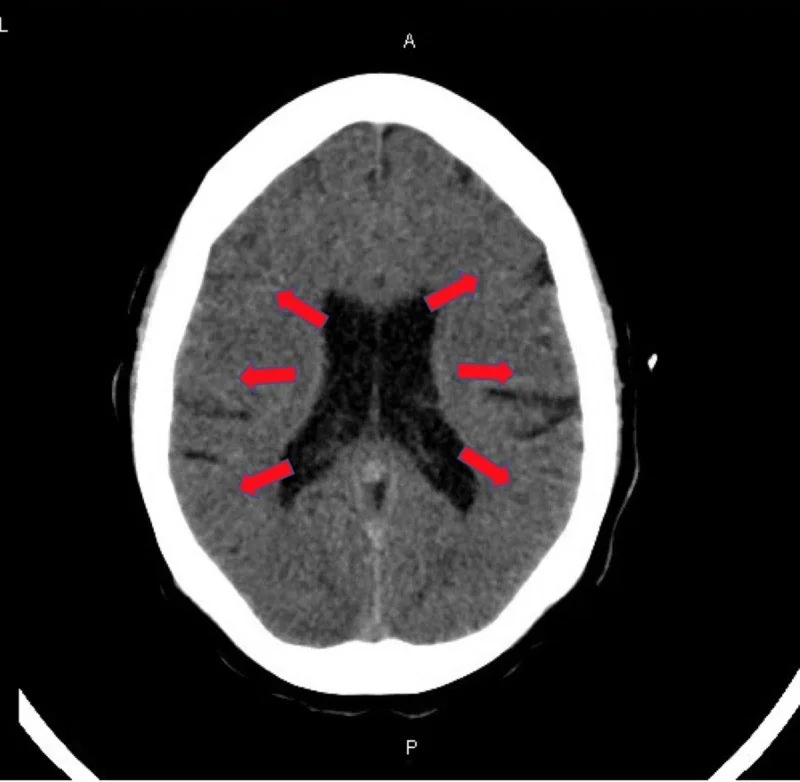
- Yaygın gri-beyaz ayrım kaybı — kortikal gri cevher ile subkortikal beyaz cevher sınırları silikleşir.
- Sulkus effasmanı — hemisferik konveksite sulkusları yaygın biçimde daralır veya kaybolur.
- Bazal sisterna silinmesi — suprasellar, ambient ve perimezensefalik BOS alanları ödemle kapanır.
- Ventriküler kompresyon — yaygın serebral ödemde ventriküller basılı görünebilir.
- Yalancı SAH görünümü — hipodens ödemli parankim arasında bazal sisterna ve Sylvian fissür damarları görece yüksek dansiteli izlenebilir.
- Ağır yaygın hipoksik-iskemik ödemde BT'de diffüz serebral ödem giderek belirginleşebilir ve masif transtentoryal ile tonsiller herniasyon gibi kitle etkisi eşlik edebilir.
- Yaygın ödemde parankim yaygın hipodens görünür; sulkus, sisterna ve ventriküllerde effasman ve bası ile global kitle etkisi oluşabilir.
- BD/DNC belirlemesi klinik parametrelere dayanır; klinik değerlendirmenin sınırlı kaldığı durumlarda elektroensefalografi, serebral anjiyografi, transkranial Doppler veya sintigrafi gibi yardımcı testler kullanılabilir.
Normalde
Normal beyin BT'sinde kortikal gri cevher beyaz cevherden ayırt edilir; konveksite sulkusları, bazal sisternalar ve ventrikül boşlukları açıktır. Aynı seviyelerde gri-beyaz sınırın keskinliğini, sulkusların görünürlüğünü ve sisterna/ventrikül BOS alanlarının hacmini iki hemisfer ve posterior fossa boyunca kıyaslayın.
Normal BT ile kıyasla
Aynı bölgenin, kaynak veri setinde patoloji içermediği belirtilen bir BT incelemesini kesit kesit kaydırın; organ sınırlarını açarak anatomiyi hasta görüntüsüyle karşılaştırın. Küçük rastlantısal bulgular tümüyle dışlanmamıştır.
Kaynak: TotalSegmentator v2.01 veri seti (Wasserthal ve ark., Radiology: Artificial Intelligence 2023), CC BY 4.0, vaka s0103; organ sınırları veri setinin otomatik segmentasyonundan, birleştirilerek sadeleştirildi. Görüntüler 2,5 mm kesit aralığına yeniden örneklendi.
Ayırıcı tanı
- Gerçek subaraknoid kanama ile karışabilen yalancı SAH görünümü, yaygın hipodens parankim zemininde bazal sisterna ve kortikal sulkuslarda görece yüksek atenüasyon olarak izlenir.
- İyotlu kontrast sonrası kontrast boyanması veya ekstravazasyonu kanama ile karışabilir; kontrast uygulama öyküsü dikkate alınmalıdır.
- Metabolik ve toksik hastalıklar dahil çeşitli patolojiler bazal ganglion ve talamusta simetrik veya asimetrik bilateral lezyonlar oluşturabilir. Yaygın hipodens parankim üzerinde bazal sisterna ve kortikal sulkusların yüksek atenüasyonu yalancı SAH görünümü oluşturup akut SAH'ı taklit edebilir.
- Serebral enfarkt odaksal damar alanı veya sınır bölge dağılımı gösterebilir ve yaygın simetrik ödem paterninden ayrışır.
- Subdural hematomalar, BT'de yalancı SAH görünümüyle birlikte bulunabilir.
Tuzaklar
- Sulkus ve bazal sisterna hiperdensitesini gerçek SAH diye etiketlemeden önce diffüz serebral ödem, ventrikül ve sulkus effasmanı ile gri-beyaz ayrım kaybı gibi yaygın hipoksik-iskemik hasar bulgularını araştırın.
- BT'deki yaygın ödemi beyin ölümü tanısı olarak sunma; BD/DNC belirlemesi klinik ölçütlere dayanır ve klinik değerlendirmenin sınırlı kaldığı durumlarda kabul edilen yardımcı testler kullanılır.
- Erken hipoksik-iskemik hasarda ilk BT'de bulgular belirgin olmayabilir; bu nedenle normal ya da sınırlı bulgu veren erken BT klinik şüpheyi tek başına dışlamaz.
- Yalancı subaraknoid kan görünümü hipoksik-iskemik hasara özgü değildir; spontan intrakraniyal hipotansiyonda da BT'de görülebilir.
Kendini dene
Kardiyak arrest sonrası BT'de yaygın hipodens parankim zemininde gri-beyaz kayıp, silik sulkuslar ve bazal sisterna ile sulkuslarda görece hiperdensite var. En uygun yorum nedir?
Cevabı göster
Yaygın ödemle yalancı SAH görünümü. Yaygın hipodens parankim zemininde sisterna ve sulkuslarda görece hiperdensite yalancı SAH görünümünü destekler.
BT'de yaygın serebral ödem görüldüğünde, görüntü öncelikle hangi yapısal özelliğin değerlendirilmesine yardımcı olur?
Cevabı göster
Beyin hasarının yapısal yaygınlığını. BT, beyin hasarının yapısal yaygınlığını değerlendirmeye yardımcı olur; BD/DNC tanısı öykü, muayene ve uygun ölçütlere dayanır.
İlgili konular
Kaynaklar
Bu sayfadaki 36 cümle ve 2 quiz sorusu aşağıdaki kaynaklardan alıntılarla otomatik olarak karşılaştırıldı; 12 cümle bu karşılaştırmada düzeltildi (2026-10-12).
- 18F-FDG PET/CT for post-cardiac-arrest brain injury: current evidence and future directionspmc.ncbi.nlm.nih.gov
- Blunt Cerebrovascular Injury: A Visual Case Report with Computed Tomography Angiography Findings Revealing Carotid and Vertebral Artery Dissectionpmc.ncbi.nlm.nih.gov
- Update on hypoxic-ischemic brain injury: Prognosis and managementpmc.ncbi.nlm.nih.gov
- An unusual case of burst suppression electrographic pattern following intrathecal baclofen overdose in critical care: a case reportpmc.ncbi.nlm.nih.gov
- Neurological prognostication after cardiac arrest: evidence review and institutional protocol proposalpmc.ncbi.nlm.nih.gov
- Neurological prognostication after cardiac arrest: evidence review and institutional protocol proposal.pubmed.ncbi.nlm.nih.gov
- 18F-FDG PET/CT for post-cardiac-arrest brain injury: current evidence and future directions.pubmed.ncbi.nlm.nih.gov
- Robotic-Assisted Navigational Bronchoscopy Complicated by Systemic Air Embolism.pubmed.ncbi.nlm.nih.gov
- Determination of Death by Neurological Criteria in Children and Its Concordance With Ancillary Testing, Primarily With CT Angiography: Single-Center Experience in Türkiye, 2012-2025.pubmed.ncbi.nlm.nih.gov
- Determination of brain death in potential donors on ECMO support : A retrospective analysis highlights the need for evidence-based recommendations.pubmed.ncbi.nlm.nih.gov
- Etiology- and age-specific timing of death by neurologic criteria evaluation and declaration in clinical practice.pubmed.ncbi.nlm.nih.gov
- The Underutilized Ocular Fundus in Emergency Departments: Current Progress and Future Prospect of Imaging and Artificial Intelligence for Patient Care.pubmed.ncbi.nlm.nih.gov
- Neuroimaging of Disorder of Consciousness: From Brain Network Mechanisms to Clinical Translation.pubmed.ncbi.nlm.nih.gov
- Artificial Intelligence-Enhanced Neurocritical Care for Traumatic Brain Injury : Past, Present and Future.pubmed.ncbi.nlm.nih.gov
- Severe Diabetic Ketoacidosis With Fatal Cerebral Edema in an Adult.pubmed.ncbi.nlm.nih.gov
- Isolated brainstem death: case presentation demonstrating preserved supratentorial perfusion on <sup>99m</sup>Tc-bicisate brain scintigraphy.pubmed.ncbi.nlm.nih.gov
- Prevalence, semiology and neuroimaging of movements in comatose adults at risk of death by neurologic criteria: a prospective cohort study.pubmed.ncbi.nlm.nih.gov
- Case Report: Electroencephalography in a neonate with isolated sulfite oxidase deficiency - a case report and literature review.pubmed.ncbi.nlm.nih.gov
- An Imaging Overview of COVID-19 ARDS in ICU Patients and Its Complications: A Pictorial Review.pubmed.ncbi.nlm.nih.gov
- Imaging of Coronavirus Disease 2019 Infection From Head to Toe: A Primer for the Radiologist.pubmed.ncbi.nlm.nih.gov
- Catastrophic Hypoxic-Ischemic Brain Injury Following Influenza A Illness in a Young Woman: A Case Report.pubmed.ncbi.nlm.nih.gov
- In-hospital unexpected cerebral herniation-New neurosurgical quality control standards: A case report.pubmed.ncbi.nlm.nih.gov
- Trapped Fourth Ventricle in a Pediatric Patient With a History of Post-Traumatic Hydrocephalus and Ventriculoperitoneal Shunt: A Case Report and Literature Review.pubmed.ncbi.nlm.nih.gov
- Atrial volume reduction correlates with early improvement in hemorrhage-associated normal pressure hydrocephalus-a 3D computed tomography volumetric study.pubmed.ncbi.nlm.nih.gov
- Pediatric endocrine disorders: a review of intracranial findings and appropriate imaging.pubmed.ncbi.nlm.nih.gov
- Anoxic Brain Injury Presenting as Pseudosubarachnoid Hemorrhage in the Medical Intensive Care Unit.pubmed.ncbi.nlm.nih.gov
- Imaging Evaluation of Acute Traumatic Brain Injury.pubmed.ncbi.nlm.nih.gov
- Cerebellar Infarction Following Pulseless Electrical Activity Arrest in Advanced Heart Failure With Reduced Ejection Fraction: A Post-resuscitation Diagnostic Pitfall.pubmed.ncbi.nlm.nih.gov
- Pulseless Electrical Activity Arrest in End-Stage Heart Failure Complicated by Cocaine-Associated Cardiotoxicity and Cerebellar Infarction: A Post-resuscitation Diagnostic Pitfall.pubmed.ncbi.nlm.nih.gov
- Beyond the Typical Atypical Imaging Features of Leptomeningeal Enhancement: A Case Series.pubmed.ncbi.nlm.nih.gov
- Malignant Posterior Reversible Encephalopathy Syndrome (PRES) After Allogeneic Hematopoietic Stem Cell Transplantation Requiring Emergency Decompressive Craniectomy: A Case Report.pubmed.ncbi.nlm.nih.gov
- Triad of Cerebellar Hematoma, Obstructive Hydrocephalus and Non-Traumatic Subarachnoid Hemorrhage in a Hypertensive Patient: A Case Report and Literature Review.pubmed.ncbi.nlm.nih.gov
- Disseminated Neurocysticercosis With Intraventricular and Cisternal Extension Without Hydrocephalus: A Case Report.pubmed.ncbi.nlm.nih.gov
- Subarachnoid cisterns as surgical corridors: Integrating microsurgical anatomy and neuroimaging for intracranial navigation.pubmed.ncbi.nlm.nih.gov
- Individualized treatment for pediatric intracranial aneurysms in China: case series and literature review.pubmed.ncbi.nlm.nih.gov
- A systematic approach to detection of epileptogenic foci on imaging: protocols, entities, search pattern, and reporting tools.pubmed.ncbi.nlm.nih.gov
- Charting the Normal Development of Structural Brain Connectivity in Utero Using Diffusion MRI.pubmed.ncbi.nlm.nih.gov
- Stroke recovery beyond initial severity: the complementary roles of brain structure and brain function in acute stroke.pubmed.ncbi.nlm.nih.gov
- Acute-Phase Plasma Pigment Epithelium-Derived Factor Predicting Outcomes after Aneurysmal Subarachnoid Hemorrhage in the Elderly.pubmed.ncbi.nlm.nih.gov
- Prognostic accuracy of head computed tomography for prediction of functional outcome after out-of-hospital cardiac arrest: Rationale and design of the prospective TTM2-CT-substudy.pubmed.ncbi.nlm.nih.gov
- Remote cerebellar hemorrhage as a complication of lumbar spine surgery.pubmed.ncbi.nlm.nih.gov
- Contrast-Induced Encephalopathy Due to Contrast Extravasation From a Chronic Post-hemorrhagic Encephalomalacic Region: Prior Hemorrhage as a Potential Risk Factor.pubmed.ncbi.nlm.nih.gov
- Clinical utility of consecutive volume scanning dual-energy CT in differentiating hemorrhage from contrast staining in ischemic stroke patients.pubmed.ncbi.nlm.nih.gov
- Neuroimaging for neurovascular complications of traumatic brain injury.pubmed.ncbi.nlm.nih.gov
- A case of metformin-associated encephalopathy in a patient undergoing maintenance hemodialysis.pubmed.ncbi.nlm.nih.gov
- A Case of Suspected Multiple Acyl-CoA Dehydrogenase Deficiency-Induced Encephalopathy.pubmed.ncbi.nlm.nih.gov
- Stepwise clinical and diagnostic strategy for coma of unknown origin.pubmed.ncbi.nlm.nih.gov
- Spontaneous Coronary Artery Dissection and Takotsubo Syndrome: Converging Mechanisms, Diagnostic Pitfalls, and a Unified Clinical Algorithm.pubmed.ncbi.nlm.nih.gov
- Trousseau syndrome presenting with recurrent multi-territory infarctions: a case report of two patients highlighting divergent outcomes and dynamic hypercoagulability under direct oral anticoagulants and low-molecular-weight heparin.pubmed.ncbi.nlm.nih.gov
- Ictal laughter induced by repetitive transcranial magnetic stimulation in stroke patients: a case series.pubmed.ncbi.nlm.nih.gov
- Multimodality Imaging of Moyamoya Disease: A Practical Guide for Neuroradiologists Based on a Case Report.pubmed.ncbi.nlm.nih.gov
- Pharmacologic and toxicologic confounders in brain death determination: a multidisciplinary guide.pubmed.ncbi.nlm.nih.gov
- Orbital Doppler Ultrasonography and Optic Nerve Sheath Diameter in Pediatric Brain Death Evaluation.pubmed.ncbi.nlm.nih.gov
- Role of Clinical and Multimodality Neuroimaging in the Evaluation of Brain Death/Death by Neurologic Criteria and Recent Highlights from 2023 Updated Guidelines.pubmed.ncbi.nlm.nih.gov
- Venous-significant intracranial hemorrhage in neonatal HIE treated with therapeutic hypothermia: imaging phenotypes, diagnostic pitfalls, and prognostic implications.pubmed.ncbi.nlm.nih.gov
- Pediatric and Adult Brain Death/Death by Neurologic Criteria Consensus Guideline.pubmed.ncbi.nlm.nih.gov
- Management of Potential Organ Donor: Indian Society of Critical Care Medicine-Position Statement.pubmed.ncbi.nlm.nih.gov
- Brain Magnetic Resonance Imaging of Children With Molybdenum Cofactor Deficiency.pubmed.ncbi.nlm.nih.gov
- Neuroimaging of Basal Ganglia in Neurometabolic Diseases in Children.pubmed.ncbi.nlm.nih.gov
- Bilateral lesions of the basal ganglia and thalami (central grey matter)-pictorial review.pubmed.ncbi.nlm.nih.gov
- Chronic Subdural Hematoma: Pathophysiology, Diagnosis, and the Emerging Role of Middle Meningeal Artery Embolization.pubmed.ncbi.nlm.nih.gov
- Middle cerebral artery dissection: pathophysiology, diagnosis, and therapeutic options.pubmed.ncbi.nlm.nih.gov
- An Integrated Approach on the Diagnosis of Cerebral Veins and Dural Sinuses Thrombosis (a Narrative Review).pubmed.ncbi.nlm.nih.gov
- Electroencephalographic Aspects in a Sheep with Coenurosis.pubmed.ncbi.nlm.nih.gov
- Spadmiss with basal ganglia calcification and multilocus genetic disease: a novel phenotypic expansion.pubmed.ncbi.nlm.nih.gov
- Fatal ornithine transcarbamylase deficiency presentation postresection of fourth ventricle ependymoma: illustrative case.pubmed.ncbi.nlm.nih.gov
- Imaging-Based Pulmonary Hypertension Phenotypes in Connective Tissue Disease-Related Interstitial Lung Disease.pubmed.ncbi.nlm.nih.gov
- Combining Machine Learning With Real-World Data to Identify Gaps in Clinical Practice Guidelines: Feasibility Study Using the Prospective German Stroke Registry and the National Acute Ischemic Stroke Guidelines.pubmed.ncbi.nlm.nih.gov
- Use of artificial intelligence in the management of stroke: scoping review.pubmed.ncbi.nlm.nih.gov
- Ancillary tests for brain death.pubmed.ncbi.nlm.nih.gov
- Opioid neurotoxicity: A case series and review from members of the Child Neurology Society Neurocritical Care Special Interest Group.pubmed.ncbi.nlm.nih.gov
- Massive brain swelling after cranioplasty in the setting of severe sunken flap syndrome: illustrative case.pubmed.ncbi.nlm.nih.gov
- Fluid transport in the brain.pubmed.ncbi.nlm.nih.gov
- Disorders of organic acid metabolism and epilepsy.pubmed.ncbi.nlm.nih.gov
- Hypoglycemia-Induced Basal Ganglia Infarct: A Rare Case of Metformin Toxicity in a Hemodialysis Patient.pubmed.ncbi.nlm.nih.gov
- Movement Disorders and Renal Diseases.pubmed.ncbi.nlm.nih.gov
- Neonatal cerebral ultrasound: anatomical variants and age-related diseases.pubmed.ncbi.nlm.nih.gov
- Neurological manifestations and neuroimaging findings in patients with SARS-CoV2-a systematic review.pubmed.ncbi.nlm.nih.gov
- Expanding the genotype-phenotype correlation of childhood sensory polyneuropathy of genetic origin.pubmed.ncbi.nlm.nih.gov
- Neglected and (re-)emergent infections of the CNS i n low-/middle-income countries.pubmed.ncbi.nlm.nih.gov
- Update on hypoxic-ischemic brain injury: Prognosis and management.pubmed.ncbi.nlm.nih.gov
- Spontaneous Intracranial Hypotension with a Reversible Splenial Lesion after Swimming.pubmed.ncbi.nlm.nih.gov
- Abusive head trauma: experience improves diagnosis.pubmed.ncbi.nlm.nih.gov
- Neurological complications after COVID-19: A narrative review.pubmed.ncbi.nlm.nih.gov
- The neurological phoenix: multimodal strategies for brain recovery and prognostication in post-cardiac arrest syndrome-a 2025 clinical framework.pubmed.ncbi.nlm.nih.gov
- A Forensic Approach to Perioperative Deaths After Non-Cardiac Surgery: A Narrative Review.pubmed.ncbi.nlm.nih.gov
- Cognition in Cardiovascular Disease.pubmed.ncbi.nlm.nih.gov
- The Differential Diagnosis of Coma in the ICU: Hyperacute Postoperative Guillain-Barré Syndrome-A Case Report.pubmed.ncbi.nlm.nih.gov
- Neurological Complications in Intensive Care Units: From Delirium to Long-Term Cognitive Dysfunction-A Narrative Review.pubmed.ncbi.nlm.nih.gov
- Delayed Posthypoxic Leukoencephalopathy in a Catatonic-Appearing Patient: A Case Report.pubmed.ncbi.nlm.nih.gov
- Brain Dead and Pregnant.pubmed.ncbi.nlm.nih.gov
- Incoherence in the Brain Death Guideline Regarding Brain Blood Flow Testing: Lessons from the Much-Publicized Case of Zack Dunlap.pubmed.ncbi.nlm.nih.gov
- Implementation of locally processed neuron-specific enolase is associated with improved guideline-concordant neuroprognostication after out-of-hospital cardiac arrest: a retrospective before-and-after study.pubmed.ncbi.nlm.nih.gov
- Diagnostic yield and spectrum of head CT findings after return of spontaneous circulation in non-traumatic in-hospital cardiac arrest: a retrospective cohort study.pubmed.ncbi.nlm.nih.gov
- Pseudosubarachnoid hemorrhage.pubmed.ncbi.nlm.nih.gov
- The role of neuroimaging in the determination of brain death.pubmed.ncbi.nlm.nih.gov
- A Novel Screen-Based Virtual Reality Tool for Teaching Brain Death Determination: A Pilot Study of the Virtual Reality Brain Death Determination Tool.pubmed.ncbi.nlm.nih.gov
- Non-ST elevation myocardial infarction with multivessel disease and anoxic brain injury: a case report.pubmed.ncbi.nlm.nih.gov
- Curriculum Innovation: A Multicenter Feasibility Study of a Consensus-Based Brain Death Simulation Curriculum.pubmed.ncbi.nlm.nih.gov
- Brain Death Determination During VA-ECMO After Pediatric Cardiac Surgery: A Case-Based Analysis of the 2023 Unified Consensus.pubmed.ncbi.nlm.nih.gov
- Neutrophil Extracellular Traps in Atherosclerosis and Cardiovascular Disease.pubmed.ncbi.nlm.nih.gov
- An unusual case of burst suppression electrographic pattern following intrathecal baclofen overdose in critical care: a case report.pubmed.ncbi.nlm.nih.gov
- Hypoglycemic Encephalopathy With Multisystem Organ Dysfunction in an Infant With MEGD(H)EL Syndrome.pubmed.ncbi.nlm.nih.gov
- Mesenchymal stem cell therapy as adjunctive treatment in pediatric patients with severe acquired brain injury: a single-center retrospective case series.pubmed.ncbi.nlm.nih.gov
- Post-cardiac arrest imaging: Unraveling etiology and predicting neurological outcome.pubmed.ncbi.nlm.nih.gov
- Apnea Testing for Brain Death/Death by Neurologic Criteria in Adults: A Prospective Multicenter Observational Study Assessing the Relationship Between Methodology, Safety, and Duration.pubmed.ncbi.nlm.nih.gov
- Pseudo-SAH in a patient with methanol poisoning: a case report.pubmed.ncbi.nlm.nih.gov
- Different diseases, same circuits: lessons from rare and overlooked causes of disorders of consciousness.pubmed.ncbi.nlm.nih.gov
- Hypoxic Brain Injury Mimicking a Spinal Cord Disease: An Unusual Neurological Consequence of Cardiac Arrest.pubmed.ncbi.nlm.nih.gov
- Prognostic value of arterial spin-labeling perfusion in anoxic brain injury: A retrospective cohort study.pubmed.ncbi.nlm.nih.gov
- AI-Based Approaches for the Identification and Quantification of Traumatic Brain Injury in Computed Tomography Imaging: Systematic Review.pubmed.ncbi.nlm.nih.gov
- Elderly at a Crossroads: Rehabilitation and Hospice Outcomes in Small Traumatic Brain Injuries.pubmed.ncbi.nlm.nih.gov
- "Talk and die" syndrome, a tragedy in traumatic brain injury: a cohort study.pubmed.ncbi.nlm.nih.gov
- Is a Second Transcranial Doppler Study Needed to Confirm Neurocirculatory Arrest?pubmed.ncbi.nlm.nih.gov
- Neurohospitalist Core Competencies.pubmed.ncbi.nlm.nih.gov
- pubmed.ncbi.nlm.nih.govpubmed.ncbi.nlm.nih.gov
Eğitim amaçlıdır; hasta başında tanı ve tedavi kararının yerine geçmez, tıbbi tavsiye değildir. Metinler yapay zekâ desteğiyle yazıldı ve otomatik bir adımda kaynak alıntılarıyla karşılaştırıldı; bu bir tıbbi doğrulama değildir ve içerik uzman radyolog incelemesinden geçmedi. Klinik kararlarda güncel kılavuzları, kurum protokollerini ve radyoloji raporunu esas alın.