Özet
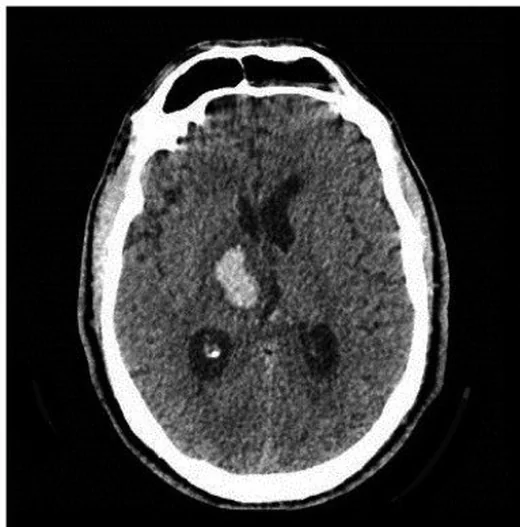
Kafa travması, intraparenkimal kanama veya damar kaynaklı kanama sonrası bilinç değişikliği olan hastada ventrikül içi kan aranır. Kontrastsız beyin BT'si akut kanı hızlıca gösterir ve kanın hangi ventriküllere yayıldığını, BOS yollarını tıkayıp tıkamadığını ortaya koyar. Üçüncü ya da dördüncü ventrikülün pıhtıyla dolması ve ventriküllerin genişlemesi akut obstrüktif hidrosefaliyi düşündürür. Kanın kaynağı ve hidrosefali atlanırsa hızla kötüleşen kafa içi basınç artışı gözden kaçabilir.
Faz ve pencere
- Kontrastsız tanısal
- Akut intraventriküler kan, özellikle üçüncü ve dördüncü ventrikülleri doldurarak döküm benzeri (casting) bir görünüm oluşturabilir ve bu durum akut hidrosefaliye yol açabilir. Kan, foramen Monro, sylvius akuaduktü veya dördüncü ventrikül çıkışlarını tıkayarak obstrüktif hidrosefaliye neden olabilir; nonkontrast BT'de ventriküllerdeki kan pıhtıları ve hidrosefali izlenir.
Önerilen pencereler G genişlik, M merkez; değerler Hounsfield birimi (HU)
- BeyinG 80 / M +40
- SubduralG 200 / M +75
BT bulguları
- İntraventriküler kan, lateral ventriküllerin gövdelerinde, oksipital boynuzlarında veya üçüncü ve dördüncü ventriküllerde yaygın olarak izlenebilir ve ventrikülleri doldurarak döküm benzeri bir görünüm verebilir.
- İntraventriküler kan, ventrikül boşluğunu kalıp gibi dolduran pıhtı görünümü oluşturabilir ve BOS akımını tıkayarak obstrüktif hidrosefaliye yol açabilir.
- Ventrikül genişlemesi — kanla dolu bölmenin beklenenden geniş olması, temporal boynuzların belirginleşmesi ve periventriküler transependimal BOS geçişi.
- Eşlik eden parankimal kaynak — talamus, bazal gangliyon, kaudat başı veya lobar hematomdan ventriküle uzanan devamlılık.
- Travmatik intraventriküler kanama değerlendirilirken eşlik eden diğer travmatik beyin yaralanmaları da BT'de aranmalıdır.
- Subaraknoid kanla iletişim — sisternal veya sulkal kanın ventriküler pıhtıdan ayrı dağılımı; tek başına ventriküler kan görünümü kaynağı belirlemez.
- Parankimal hematomla açıklanamayan spontan IVH'nin nadir bir nedeni, ventrikül içine uzanan anterior kommunikan arter anevrizması olabilir.
Ölçütler ve sınıflamalar
- Klasik Graeb skoru
- Klasik Graeb skoru 0–12 aralığındadır. Graeb skoru IVH’yi 0–12 aralığında derecelendirir.
- Modifiye Graeb skoru (mGS)
- Modifiye Graeb skoru, IVH için kullanılan skorlama sistemlerinden biridir.
Normalde
Sağ-sol ventrikül boyutlarını, temporal boynuzları ve üçüncü ventrikül genişliğini aynı kesitte kıyaslayın; yeni genişleme, periventriküler düşük dansite ve çıkış yolundaki pıhtı birlikteyse hidrosefali lehinedir.
Normal BT ile kıyasla
Aynı bölgenin, kaynak veri setinde patoloji içermediği belirtilen bir BT incelemesini kesit kesit kaydırın; organ sınırlarını açarak anatomiyi hasta görüntüsüyle karşılaştırın. Küçük rastlantısal bulgular tümüyle dışlanmamıştır.
Kaynak: TotalSegmentator v2.01 veri seti (Wasserthal ve ark., Radiology: Artificial Intelligence 2023), CC BY 4.0, vaka s0103; organ sınırları veri setinin otomatik segmentasyonundan, birleştirilerek sadeleştirildi. Görüntüler 2,5 mm kesit aralığına yeniden örneklendi.
Ayırıcı tanı
- Koroid pleksus ksantogranülomu, supratentoryal intraventriküler kitlelerin ayırıcı tanısında yer alır.
- Ventrikül içi tümör
- foramen Monro veya koroid pleksus düzeyinde doku kitlesi, kitle etkisi ve bazen kalsifikasyon yapar; kan gibi bağımlı tabakalaşmaz.
- Ventriküle komşu parankimal hematom
- kan ventriküle açılmış olabilir; parankim içindeki kaynak hematomun devamlılığını takip edin.
Tuzaklar
- Travmatik intraventriküler kanama değerlendirilirken eşlik eden diğer travmatik beyin yaralanmaları da gözden geçirilmelidir.
- Ventriküler asimetriyi tek başına hidrosefali saymayın; eski incelemeyle karşılaştırıp temporal boynuzlar, üçüncü ventrikül ve periventriküler BOS geçişini birlikte değerlendirin.
- Ventrikül içi kanın görülmesi travmatik ya da spontan kaynağı tek başına kanıtlamaz; eşlik eden parankimal hematom, damar çevresi dağılımı ve travma izlerini arayın.
- Travma sonrası kalıcı ventrikül genişlemesi serebral atrofi olarak yorumlanabilir; bu nedenle hidrosefali olasılığı görüntüleme bulgularıyla birlikte değerlendirilmelidir.
Kendini dene
Üçüncü ve dördüncü ventriküllere uzanan kalıp benzeri intraventriküler kanamada hangi komplikasyon bildirilmiştir?
Cevabı göster
Akut hidrosefali. Kalıp benzeri intraventriküler kanama üçüncü ve dördüncü ventriküllere uzanabilir ve akut hidrosefaliyle birlikte görülebilir.
Üçüncü ventrikülde kan pıhtısı ve BOS yollarındaki tıkanıklık söz konusu olduğunda, gelişen ventriküler genişlemenin nedeni nedir?
Cevabı göster
BOS akımının engellenmesine bağlı obstrüktif hidrosefali. Kaynaklar, ventriküler sistemdeki pıhtılaşmış kanın BOS akımını tıkayarak obstrüktif hidrosefaliye neden olduğunu açıklamaktadır.
İlgili konular
Kaynaklar
Bu sayfadaki 34 cümle ve 2 quiz sorusu aşağıdaki kaynaklardan alıntılarla otomatik olarak karşılaştırıldı; 14 cümle bu karşılaştırmada düzeltildi (2026-10-09).
- Continuous Ventricular Irrigation for Intraventricular Hemorrhagepmc.ncbi.nlm.nih.gov
- Current approaches to predicting intraventricular hemorrhage in preterm neonates using blood biomarkerspmc.ncbi.nlm.nih.gov
- Advances in temporizing treatment strategies and associated complications for posthemorrhagic hydrocephalus in preterm infantspmc.ncbi.nlm.nih.gov
- Neurodevelopmental impairment in infants with necrotizing enterocolitis: a comprehensive review of mechanisms, outcomes, and emerging strategiespmc.ncbi.nlm.nih.gov
- Neonatal Listeriosis with Central Nervous System Involvement: A Case Series and Review of the Literaturepmc.ncbi.nlm.nih.gov
- Hemorrhagic cerebrovascular disease.pubmed.ncbi.nlm.nih.gov
- Diffusion tensor imaging in hemorrhagic stroke.pubmed.ncbi.nlm.nih.gov
- Ruptured aneurysm of the PICA communicating artery: a case report.pubmed.ncbi.nlm.nih.gov
- Diagnosis and Surgical Management of Neonatal Hydrocephalus.pubmed.ncbi.nlm.nih.gov
- Traumatic brain injury and intracranial hemorrhage-induced cerebral vasospasm: a systematic review.pubmed.ncbi.nlm.nih.gov
- Routine imaging of the preterm neonatal brain.pubmed.ncbi.nlm.nih.gov
- Perinatal Brain Injury: Mechanisms, Prevention, and Outcomes.pubmed.ncbi.nlm.nih.gov
- Cranial ultrasonographic findings in healthy full-term neonates: a retrospective review.pubmed.ncbi.nlm.nih.gov
- Raised intracranial pressure and brain edema.pubmed.ncbi.nlm.nih.gov
- Primary Decompressive Craniectomy After Traumatic Brain Injury: A Literature Review.pubmed.ncbi.nlm.nih.gov
- The Vulnerable Newborn Brain: Imaging Patterns of Acquired Perinatal Injury.pubmed.ncbi.nlm.nih.gov
- Antenatal and postnatal radiologic diagnosis of holocarboxylase synthetase deficiency: a systematic review.pubmed.ncbi.nlm.nih.gov
- A review of penetrating brain trauma: epidemiology, pathophysiology, imaging assessment, complications, and treatment.pubmed.ncbi.nlm.nih.gov
- Neuroimaging of white matter injury, intraventricular and cerebellar hemorrhage.pubmed.ncbi.nlm.nih.gov
- Posterior Reversible Encephalopathy Syndrome (PRES) and intraventricular hemorrhage in a patient with untreated hypertension: a case report.pubmed.ncbi.nlm.nih.gov
- Delayed Expanding Intracerebral Pneumatocele Following Severe Craniofacial Trauma: A Case Report With Serial Imaging Correlation.pubmed.ncbi.nlm.nih.gov
- Early multimodal neuromonitoring is associated with outcomes in critically ill patients with hemorrhagic stroke.pubmed.ncbi.nlm.nih.gov
- Machine learning in neuroradiology: Recent developments and applications.pubmed.ncbi.nlm.nih.gov
- From Vitreous to Ventricles: Serial Imaging of Intracranial Silicone Oil Migration.pubmed.ncbi.nlm.nih.gov
- Terson's syndrome leading to fatal outcome in a 36-year-old woman: A case report.pubmed.ncbi.nlm.nih.gov
- Spontaneous resolution of cerebrospinal fluid obstruction due to intraventricular hemorrhage: A case report.pubmed.ncbi.nlm.nih.gov
- Minimal-access exoscopic approach for caudate hemorrhage with intraventricular extension using the ViewSite Brain Access System.pubmed.ncbi.nlm.nih.gov
- Emergency neuroendoscopic evacuation of traumatic intraventricular hemorrhage: A case report.pubmed.ncbi.nlm.nih.gov
- Coexistence of Intracranial Aneurysm and Pituitary Adenoma: A Case Report and Literature Review.pubmed.ncbi.nlm.nih.gov
- A Rare Case of Non-traumatic Tension Pneumocephalus Following a Lumbar Puncture: Unusual Complications of a Common Procedure.pubmed.ncbi.nlm.nih.gov
- Critical Care Monitoring in Comatose Patients Receiving ECMO: A Cohort Study of Machine Learning on Quantitative EEG for Diagnosing Acute Brain Injury and Prognosticating Mortality.pubmed.ncbi.nlm.nih.gov
- Paediatric cranial ultrasound: assessment of the preterm brain.pubmed.ncbi.nlm.nih.gov
- Structural neuroimaging markers of normal pressure hydrocephalus versus Alzheimer's dementia and Parkinson's disease, and hydrocephalus versus atrophy in chronic TBI-a narrative review.pubmed.ncbi.nlm.nih.gov
- Radiological predictors of shunt response in the diagnosis and treatment of idiopathic normal pressure hydrocephalus: a systematic review and meta-analysis.pubmed.ncbi.nlm.nih.gov
- Intraventricular hemorrhage, suspected EBV reactivation, and TBA-positive epilepsy after deep cervical lymphovenous anastomosis in Alzheimer's disease: a case report.pubmed.ncbi.nlm.nih.gov
- Treatment of brain abscess rupturing into ventricle: a case report and literature review.pubmed.ncbi.nlm.nih.gov
- Spinal solitary fibrous tumor metastatic to the fourth ventricle: illustrative case.pubmed.ncbi.nlm.nih.gov
- Atrial volume reduction correlates with early improvement in hemorrhage-associated normal pressure hydrocephalus-a 3D computed tomography volumetric study.pubmed.ncbi.nlm.nih.gov
- Continuous Ventricular Irrigation for Intraventricular Hemorrhage.pubmed.ncbi.nlm.nih.gov
- Continuum of Irreversible and Potentially Reversible Traumatic Brain Injury Sequelae: Axonal Injury and Hydrocephalus.pubmed.ncbi.nlm.nih.gov
- Comparative CT Ventricular Morphometrics in Hydrocephalus, Stroke, and Traumatic Brain Injury: A Distortion-Controlled Analysis.pubmed.ncbi.nlm.nih.gov
- Ventricular Anatomy Across CT and MRI in Hydrocephalus: A Retrospective Study.pubmed.ncbi.nlm.nih.gov
- Characteristics of head injuries in children at King Abdullah Specialized Children's Hospital, Jeddah: a cross-sectional study.pubmed.ncbi.nlm.nih.gov
- Seizure and aspiration complicating acute expanding epidural hematoma in a tuberous sclerosis adolescent: a case report of clinical and surgical emergency.pubmed.ncbi.nlm.nih.gov
- Pathway-level proteomics identifies subcellular trafficking dysregulation as a molecular signature in severe traumatic brain injury.pubmed.ncbi.nlm.nih.gov
- Severe Recurrent Hemorrhage of an Oncogenic Vertebrobasilar Junction Aneurysm Following Stent-Assisted Coil Embolization in Metastatic Testicular Choriocarcinoma.pubmed.ncbi.nlm.nih.gov
- Case Report: Primary choriocarcinoma of the pineal region.pubmed.ncbi.nlm.nih.gov
- Reporting Clinically Actionable Imaging Features of Intracerebral Hemorrhage: A Survey of Neuroradiologist Practice.pubmed.ncbi.nlm.nih.gov
- Topographical Patterns of Intraventricular Hemorrhage as a Novel Prognostic Imaging Biomarker in Intracerebral Hemorrhage.pubmed.ncbi.nlm.nih.gov
- Intraventricular Hemorrhage Burden and Treatment-Specific Symptomatic Vasospasm After Aneurysmal Subarachnoid Hemorrhage.pubmed.ncbi.nlm.nih.gov
- Imaging Scores in Subarachnoid Hemorrhage: Performance on Prediction of Functional Outcome, Mortality, and Complications.pubmed.ncbi.nlm.nih.gov
- Magnetic resonance imaging of primary central nervous system neoplasms of dogs and cats: Basic concepts for diagnostic pathologists.pubmed.ncbi.nlm.nih.gov
- Canine brain imaging with a new low-field portable (0.05 T) MRI scanner: a pilot <i>in vivo</i> comparison to conventional 1.5 T.pubmed.ncbi.nlm.nih.gov
- Trapped Fourth Ventricle in a Pediatric Patient With a History of Post-Traumatic Hydrocephalus and Ventriculoperitoneal Shunt: A Case Report and Literature Review.pubmed.ncbi.nlm.nih.gov
- Periventricular hyperintensity in children with hydrocephalus.pubmed.ncbi.nlm.nih.gov
- Cytotoxic Lesions of the Corpus Callosum after Aneurysmal Subarachnoid Hemorrhage and Risk of Shunt-Dependent Chronic Hydrocephalus.pubmed.ncbi.nlm.nih.gov
- "Rogue" [DEspR+CD11b+] neutrophil subset correlates with severity in spontaneous intracerebral hemorrhage.pubmed.ncbi.nlm.nih.gov
- The short- and long-term efficacy analysis of stereotactic surgery combined external ventricular drainage in the treatment of the secondary intraventricular hemorrhage.pubmed.ncbi.nlm.nih.gov
- First reported case in Brazil of intraventricular pilocytic astrocytoma in an adult patient with literature review.pubmed.ncbi.nlm.nih.gov
- Obstructive hydrocephalus due to choroid plexus carcinoma of third ventricle in pediatric: A rare case report.pubmed.ncbi.nlm.nih.gov
- Imaging of supratentorial intraventricular masses in children:a pictorial review- part 1.pubmed.ncbi.nlm.nih.gov
- Fourth Ventricular Rosai-Dorfman Disease Mimicking Intraventricular Tumor in Young Adult: A Rare Case Report.pubmed.ncbi.nlm.nih.gov
- Pediatric Meningeal Diseases: What Radiologists Need to Know.pubmed.ncbi.nlm.nih.gov
- Case Report: Giant acute hemorrhagic colloid cyst in the septum pellucidum-foramen of Monro region with obstructive hydrocephalus in an 8-month-old infant.pubmed.ncbi.nlm.nih.gov
- Choroid Plexus Cyst with Parenchymal Localization in a Symptomatic 50-year-old Male: A Case Report.pubmed.ncbi.nlm.nih.gov
- Neuroendoscopic management of a third ventricle hydatid cyst presenting with obstructive hydrocephalus in a 4-year-old female: a case report and review of the literature.pubmed.ncbi.nlm.nih.gov
- Rapid spontaneous regression of a massive post-thrombolysis intracerebral hemorrhage: A case report.pubmed.ncbi.nlm.nih.gov
- Trans-sylvian hematoma evacuation combined with lamina terminalis ventriculostomy for hypertensive basal ganglia hemorrhage: a retrospective cohort study.pubmed.ncbi.nlm.nih.gov
- Sex differences in imaging features including cerebral amyloid angiopathy markers in intracerebral hemorrhage.pubmed.ncbi.nlm.nih.gov
- Low-Pressure Hydrocephalus After Traumatic Brain Injury: A Case Series and Scoping Review.pubmed.ncbi.nlm.nih.gov
- Early Metabolomic Changes During Extracorporeal Membrane Oxygenation Are Associated with Subsequent Acute Brain Injury.pubmed.ncbi.nlm.nih.gov
- Extensive Intracerebral Hemorrhage Involving Basal Ganglia and Frontal Lobe With Intraventricular and Subarachnoid Extension in a Triplet Pregnancy Following In Vitro Fertilization: A Case Report and Review.pubmed.ncbi.nlm.nih.gov
- A systematic approach to detection of epileptogenic foci on imaging: protocols, entities, search pattern, and reporting tools.pubmed.ncbi.nlm.nih.gov
- Radiogenomics of congenital brain malformations: Linking embryology, genetics, and imaging.pubmed.ncbi.nlm.nih.gov
- Parenchymal Insults in Abuse-A Potential Key to Diagnosis.pubmed.ncbi.nlm.nih.gov
- Brain morphometry and cognition in late-onset glutaric aciduria type 1: scoping review and novel insights from a case report.pubmed.ncbi.nlm.nih.gov
- The effect of pituitary neuroendocrine tumors on the volumes of intracranial structures.pubmed.ncbi.nlm.nih.gov
- Primary Central Nervous System Lymphoma Presenting as a Solitary Fourth Ventricular Mass: A Case Report.pubmed.ncbi.nlm.nih.gov
- Calcified intracranial lipoma in the temporal lobe convexity - A report of unusual manifestations of a rare disease with a brief review of literature.pubmed.ncbi.nlm.nih.gov
- Fetal intracranial hemorrhage and infarct: Main sonographic and MRI characteristics: A review article.pubmed.ncbi.nlm.nih.gov
- A Standardized Anatomical Classification of Intracranial Hemorrhage.pubmed.ncbi.nlm.nih.gov
- Portable Bedside Low-Field MRI for Assessment of Ventricular Size.pubmed.ncbi.nlm.nih.gov
- Hydrocephalus: Molecular and Neuroimaging Biomarkers in Diagnosis and Management.pubmed.ncbi.nlm.nih.gov
- Minimally invasive interventions for intracranial pathologies using tubular retractors in the pediatric population: Safety, efficacy, technical aspects and outcomes.pubmed.ncbi.nlm.nih.gov
- AI Models for Surgical Decision Support in Spontaneous Intracerebral Hemorrhage: A Systematic Review in Relation to Trials and Guidelines.pubmed.ncbi.nlm.nih.gov
- Imaging and Clinical Prognostic Features in Lobar Versus Deep Intracerebral Hemorrhage in an Unselected Swedish Population.pubmed.ncbi.nlm.nih.gov
- Evaluation of Risk Factors and Prognostic Outcomes in Patients With Intracerebral Hemorrhage: A Clinical Study From a Tertiary Care Hospital in South India.pubmed.ncbi.nlm.nih.gov
- Occipital Pial AVM Rupture in a Young Adult: Dual Intranidal Aneurysms, Solitary Parasagittal SSS Drainage, and Hematoma-Corridor Microsurgical Cure.pubmed.ncbi.nlm.nih.gov
- Continuum topological derivative - A novel application tool for segmentation of CT and MRI images.pubmed.ncbi.nlm.nih.gov
- Posterior Fossa Hemorrhage Following the Use of Low-Molecular-Weight Heparin: Lessons Learned and Recommendations for the Treatment and Prophylaxis of Postoperative Venous Thromboembolism.pubmed.ncbi.nlm.nih.gov
- Association of Same-Session Neuroendoscopic Lavage With Ventriculoperitoneal Shunting and Outcomes in Post-hemorrhagic Hydrocephalus: A Retrospective Cohort Study.pubmed.ncbi.nlm.nih.gov
- Cranial Ultrasonography-Standards in Diagnosis of Intraventricular Hemorrhage and Ventricular Dilatation in Premature Neonates.pubmed.ncbi.nlm.nih.gov
- Risk factor analysis of long-term outcomes in patients with large intracerebral and intraventricular hemorrhage treated primarily with combined external ventricular drainage and intraventricular thrombolysis.pubmed.ncbi.nlm.nih.gov
- From shunt dependency to shunt freedom: Endoscopic third ventriculostomy in ventriculoperitoneal shunt-dependent communicating tetraventricular hydrocephalus: A case report.pubmed.ncbi.nlm.nih.gov
- Advances in temporizing treatment strategies and associated complications for posthemorrhagic hydrocephalus in preterm infants.pubmed.ncbi.nlm.nih.gov
- Predictors of pre-resection hydrocephalus in posterior cranial fossa tumors: development of a predictive scoring model.pubmed.ncbi.nlm.nih.gov
- Isolated intraventricular hemorrhage from an anterior communicating artery aneurysm via the lamina terminalis: illustrative case.pubmed.ncbi.nlm.nih.gov
- Fulminant Amyloid-β-Related Angiitis after Tenecteplase: A Biopsy-Confirmed Cause of Post-Thrombolysis Neurologic Deterioration.pubmed.ncbi.nlm.nih.gov
- Likelihood and Predictors of Acute Findings on CTA Head and Neck for Neurologic Presentations to the Emergency Department.pubmed.ncbi.nlm.nih.gov
- Venous-significant intracranial hemorrhage in neonatal HIE treated with therapeutic hypothermia: imaging phenotypes, diagnostic pitfalls, and prognostic implications.pubmed.ncbi.nlm.nih.gov
- Intraventricular neurocytoma presenting as Kleine-Levin syndrome: resolution after resection and review of neurosurgical conditions associated with hypersexuality. Illustrative case.pubmed.ncbi.nlm.nih.gov
- Post-traumatic hydrocephalus in adults: the mechanisms of development, predictors of progression and management strategies. A narrative review and case series analysis.pubmed.ncbi.nlm.nih.gov
- Ruptured artery of Percheron aneurysm in moyamoya disease with thalamic hemorrhage and acute hydrocephalus: illustrative case.pubmed.ncbi.nlm.nih.gov
- From Benign Symptoms to Subarachnoid Hemorrhage: A Pediatric Case.pubmed.ncbi.nlm.nih.gov
- Routine versus clinically indicated cerebrospinal fluid sampling for infection in external ventricular drains: a systematic review.pubmed.ncbi.nlm.nih.gov
- Posttraumatic intracranial migration of silicone oil after treatment of retinal detachment, a rare complication.pubmed.ncbi.nlm.nih.gov
- An Atlas of Neonatal Neurovascular Imaging Anatomy as Depicted with Microvascular Imaging: The Intracranial Arteries.pubmed.ncbi.nlm.nih.gov
- Encephalitis in Patients with COVID-19: A Systematic Evidence-Based Analysis.pubmed.ncbi.nlm.nih.gov
- Imaging Evaluation of Acute Traumatic Brain Injury.pubmed.ncbi.nlm.nih.gov
- Delayed identification and treatment of a cervicomedullary spinal vascular lesion following angiogram-negative, high-grade subarachnoid hemorrhage: illustrative case.pubmed.ncbi.nlm.nih.gov
- Spontaneous Right Thalamic Hemorrhage With Intraventricular Extension in a Two-Month-Old Preterm Infant Initially Suspected of Having Cow's Milk Protein Allergy.pubmed.ncbi.nlm.nih.gov
- When Stroke Leads to Hydrocephalus: A Case of Unilateral Ventricular Enlargement.pubmed.ncbi.nlm.nih.gov
- Risk stratification for significant acute traumatic intracranial hemorrhage in older adults after a ground-level fall: A prospective multicentre cohort study.pubmed.ncbi.nlm.nih.gov
- Assessment of Brain-Specific and Neuroendocrine Biomarkers for Intracerebral Hemorrhage Diagnosis: A Prospective Cohort Study.pubmed.ncbi.nlm.nih.gov
- Dramatic Reanimation and Spontaneous Re-Canalization of a Fourth Ventricular Hemorrhage: "REVIVE" Phenomenon.pubmed.ncbi.nlm.nih.gov
Eğitim amaçlıdır; hasta başında tanı ve tedavi kararının yerine geçmez, tıbbi tavsiye değildir. Metinler yapay zekâ desteğiyle yazıldı ve otomatik bir adımda kaynak alıntılarıyla karşılaştırıldı; bu bir tıbbi doğrulama değildir ve içerik uzman radyolog incelemesinden geçmedi. Klinik kararlarda güncel kılavuzları, kurum protokollerini ve radyoloji raporunu esas alın.