Özet
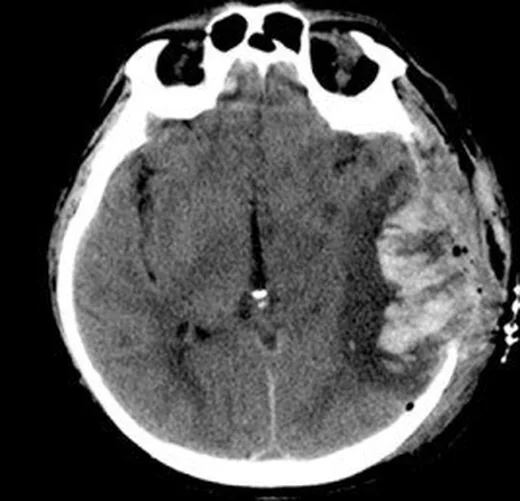
Künt kafa travması sonrası korteks ve yüzeyel beyaz cevherde kanama ile doku ezilmesi gelişen hastalarda hemorajik kontüzyon aranır. Kontrastsız BT akut kanı, çevresindeki ödemi, kitle etkisini ve takipte büyümeyi hızlıca gösterir; en sık frontal ve temporal lobların kemik çıkıntılarına komşu yüzeylerinde görülür. İlk çekim çok erken yapılmışsa kontüzyonun kanama bileşeni henüz belirgin olmayabilir ve seri incelemede yeni odaklar çıkabilir. Büyüyen kanama veya ödem atlanırsa orta hat kayması ve herniasyon riski küçümsenebilir.
Faz ve pencere
- Kontrastsız tanısal
- Akut kan, kortikal/subkortikal dokuyla iç içe düzensiz hiperdens odaklar veya küçük birleşen kan adacıkları şeklindedir; çevre ödemi daha düşük dansitelidir. Kontrasız BT, travmatik beyin yaralanmalarında parankimal kontüzyonları, kitle etkisini ve orta hat kaymasını değerlendirmek için birincil görüntüleme yöntemi olarak kullanılır.
Önerilen pencereler: Beyin (G 80 / M 40), Subdural (G 200 / M 75), Kemik (G 1800 / M 400).
BT bulguları
- Kortikal/subkortikal kontüzyon kanı — hasarlı girus ve yüzeyel beyaz cevher içine karışan, düzensiz hiperdens odaklar.
- Tuz-biber paterni — erken dönemde ödemli veya izodens dokuda dağınık küçük kan noktaları; sonraki BT'de daha belirgin hiperdens hale gelebilir.
- Perikontüzyonel ödem — kan odaklarının çevresinde gri-beyaz ayrımını bulanıklaştıran ve sulkusları daraltan düşük dansiteli halka.
- Coup-contrecoup dağılımı — darbe bölgesinde ve kafatası iç yüzeyinin karşısındaki frontal ya da temporal kortekste ayrı kontüzyonlar.
- Kontüzyon kümelenmesi — orbitofrontal giruslar, frontal kutup ve anterior-inferior temporal loblarda düzensiz çok odaklı hasar.
- Kitle etkisi — komşu sulkusların silinmesi, ventrikül basısı, orta hat yapılarında yer değiştirme veya bazal sisternaların daralması.
- Hemorajik progresyon — takip BT'de mevcut odakların genişlemesi, yoğunlaşması veya önceden görünmeyen komşu/uzak kan odaklarının belirmesi.
Normalde
Kontrasız BT, travmatik kontüzyon odaklarının boyutunu, konumunu ve çevresindeki kitle etkisini değerlendirmek için kullanılır.
Normal BT ile kıyasla
Aynı bölgenin, kaynak veri setinde patoloji içermediği belirtilen bir BT incelemesini kesit kesit kaydırın; organ sınırlarını açarak anatomiyi hasta görüntüsüyle karşılaştırın. Küçük rastlantısal bulgular tümüyle dışlanmamıştır.
Kaynak: TotalSegmentator v2.01 veri seti (Wasserthal ve ark., Radiology: Artificial Intelligence 2023), CC BY 4.0, vaka s0103; organ sınırları veri setinin otomatik segmentasyonundan, birleştirilerek sadeleştirildi. Görüntüler 2,5 mm kesit aralığına yeniden örneklendi.
Ayırıcı tanı
- Travmatik intraparenkimal hematom, beyin parankimi içinde yer alan ve genellikle kontüzyonlara bağlı oluşan kanamadır.
- Travmatik subaraknoid kanama
- hiperdenslik kortikal sulkus ve sisternlerin içinde çizgisel seyreder, parankim içine giral odaklar halinde uzanmaz.
- Travmaya bağlı sekonder beyin hasarı arasında iskemik değişiklikler yer alır ve bunlar primer travmanın ardından gelişerek periferal perfüzyon bozukluklarına yol açabilir.
- Kontrastsız BT, travmatik kanama, kontüzyon, fraktür ve kitle etkisi gibi akut lezyonları saptamak için birincil görüntüleme yöntemi olarak kullanılır.
- Travmatik beyin yaralanmaları, primer ve sekonder hasar patternleri açısından heterojen yapıdadır ve doğrudan mekanik kuvvetlerle ilişkilendirilir.
Tuzaklar
- İlk saatlerde ödemli kontüzyon izodens kalabilir; BT'de yalnızca hafif gri-beyaz silinme varsa küçük hemorajik odak yokluğunu doku hasarı yokluğu olarak yorumlamayın.
- Kontüzyon içindeki dağınık kanı tek parankimal hematom gibi ölçüp tanımlamayın; kanın kortikal dokuya karışmış, giral ve düzensiz dağılımı kontüzyonu destekler.
- Orta kafa çukuru tabanı yakınındaki lezyonlar, özellikle orta meningeal arter yaralanmalarına bağlı epidural hematomlar açısından koronal görüntülerde dikkatlice taranmalıdır.
- Kontüzyonun ilk BT'de küçük olması stabil kalacağını göstermez; yeni nörolojik kötüleşme veya izlem gerekliliğinde önceki incelemeyle aynı düzeyleri karşılaştırın.
Kendini dene
Kontrastsız BT'de travmatik intraparenkimal kanama ve kontüzyon görülebilir; ancak erken dönemde parankimal kontüzyonlar yetersiz değerlendirilebilir. Görüntüdeki bulgular en çok aşağıdakilerden hangisini düşündürür?
Cevabı göster
Hemorajik kontüzyon. Travmatik intraparenkimal kanamalar sıklıkla kontüzyona bağlıdır ve parankim içine karışık görünür. Epidural hematom ekstraaksiyel ve bikonveks seyreder; bu nedenle bulgular kontüzyonu destekler.
BT taramalarında travmatik intraparenkimal kanamanın hacminde zamanla artış gözlenirse bu durum literatürde nasıl tanımlanır?
Cevabı göster
Progresyon. S12, travmatik intraserebral kanamanın hacmindeki artışın prognostik açıdan önemli bir fenomen olduğunu belirtmektedir.
Bu konunun yer aldığı turlar
İlgili konular
Kaynaklar
Bu sayfadaki 34 cümle ve 2 quiz sorusu aşağıdaki kaynaklardan alıntılarla tek tek karşılaştırıldı; 9 cümle bu karşılaştırmada düzeltildi (2026-10-09).
- Neuroimaging of Traumatic Brain Injurypmc.ncbi.nlm.nih.gov
- Isolated hemorrhagic contusion of an incidental meningioma.pubmed.ncbi.nlm.nih.gov
- The Monocyte-to-Lymphocyte Ratio at Hospital Admission Is a Novel Predictor for Acute Traumatic Intraparenchymal Hemorrhage Expansion after Cerebral Contusion.pubmed.ncbi.nlm.nih.gov
- Recovery of Consciousness and Functional Outcome in Moderate and Severe Traumatic Brain Injury.pubmed.ncbi.nlm.nih.gov
- Traumatic brain injury in Indian children.pubmed.ncbi.nlm.nih.gov
- Behavioral and Structural Effects of Single and Repeat Closed-Head Injury.pubmed.ncbi.nlm.nih.gov
- Primary Decompressive Craniectomy After Traumatic Brain Injury: A Literature Review.pubmed.ncbi.nlm.nih.gov
- Intravenous Tranexamic Acid for Brain Contusion with Intraparenchymal Hemorrhage: Randomized, Double-Blind, Placebo-Controlled Trial.pubmed.ncbi.nlm.nih.gov
- Use of Magnetic Resonance in the Evaluation of Cranial Trauma.pubmed.ncbi.nlm.nih.gov
- Epidemiology of traumatic brain injury-associated epilepsy in western China: An analysis of multicenter data.pubmed.ncbi.nlm.nih.gov
- Predictive Value of Leakage Signs for Pure Brain Contusional Hematoma Expansion.pubmed.ncbi.nlm.nih.gov
- Traumatic Intracerebral Hemorrhage: Risk Factors Associated with Progression.pubmed.ncbi.nlm.nih.gov
- Progressive hemorrhagic injury after severe traumatic brain injury: effect of hemoglobin transfusion thresholds.pubmed.ncbi.nlm.nih.gov
- Parenchymal brain injuries in abusive head trauma.pubmed.ncbi.nlm.nih.gov
- Epidemiological and Clinico-radiological Evaluation of Head Injury in Pediatric Population.pubmed.ncbi.nlm.nih.gov
- Chronic traumatic encephalopathy neuropathologic change in the Late Effects of Traumatic Brain Injury project: Findings in a community autopsy cohort.pubmed.ncbi.nlm.nih.gov
- Evidence-Based Interventions for Functional Restoration and Pain Management following Traumatic Brain Injury.pubmed.ncbi.nlm.nih.gov
- Updates in Management of Acute Disorders of Consciousness After Traumatic Injury.pubmed.ncbi.nlm.nih.gov
- Delayed Traumatic Subarachnoid Hemorrhage Following Initially Negative Computed Tomography (CT) Imaging in a Patient With a Mechanical Mitral Valve and Markedly Elevated International Normalized Ratio (INR).pubmed.ncbi.nlm.nih.gov
- Incorporating algorithmic uncertainty into a clinical machine deep learning algorithm for urgent head CTs.pubmed.ncbi.nlm.nih.gov
- Parenchymal Insults in Abuse-A Potential Key to Diagnosis.pubmed.ncbi.nlm.nih.gov
- Correlation of Contusion Morphology and Volume With Functional Recovery and in Hospital Mortality in Traumatic Brain Injury.pubmed.ncbi.nlm.nih.gov
- Post-Traumatic Middle Cerebral Artery Pseudoaneurysm Following Depressed Skull Fracture: Case Report and PRISMA-Guided Literature Review.pubmed.ncbi.nlm.nih.gov
- Role of the "In-Window" Craniectomy in the Management of Serious Head Trauma: 12 Case Series, Technical Note, Literature Review, and Comparison With Other Surgical Managements.pubmed.ncbi.nlm.nih.gov
- Trauma-induced coagulopathy in pediatric traumatic brain injury: incidence, risk factors, and outcomes in a retrospective cohort study.pubmed.ncbi.nlm.nih.gov
- Revisiting traumatic intracerebral hemorrhage in the context of ENRICH: illustrative cases.pubmed.ncbi.nlm.nih.gov
- Acute Computer Tomography Findings in Pediatric Accidental Head Trauma-Review.pubmed.ncbi.nlm.nih.gov
- Cerebral contusions - Pathomechanism, predictive factors for progression and historical and current management.pubmed.ncbi.nlm.nih.gov
- Traumatic Brain Injury and Chronic Traumatic Encephalopathy: Not Only Trigger for Neurodegeneration but Also for Cerebral Amyloid Angiopathy?pubmed.ncbi.nlm.nih.gov
- Journey to the other side of the brain: asymmetry in patients with chronic mild or moderate traumatic brain injury.pubmed.ncbi.nlm.nih.gov
- International consensus statement on allergy and rhinology: Olfaction.pubmed.ncbi.nlm.nih.gov
- A study of the response of the human cadaver head to impact.pubmed.ncbi.nlm.nih.gov
- Changes in brain morphology over the first year in adult mixed-mechanism mild traumatic brain injury: the role of injury severity factors.pubmed.ncbi.nlm.nih.gov
- Iatrogenic cerebral amyloid angiopathy 30 years after childhood cadaveric dura mater transplantation: a case report.pubmed.ncbi.nlm.nih.gov
- Eligibility for Anti-Amyloid Therapies in Patients With Biomarker-Confirmed Atypical Alzheimer Disease Phenotypes.pubmed.ncbi.nlm.nih.gov
- Neuroimaging Patterns of Intracranial Infections: Meningitis, Cerebritis, and Their Complications.pubmed.ncbi.nlm.nih.gov
- Decreased DNA Methylation of RGMA is Associated with Intracranial Hypertension After Severe Traumatic Brain Injury: An Exploratory Epigenome-Wide Association Study.pubmed.ncbi.nlm.nih.gov
- Different dynamics of aquaporin 4 and glutamate transporter-1 distribution in the perineuronal and perivascular compartments during ischemic stroke.pubmed.ncbi.nlm.nih.gov
- CT-based radiomic markers to predict late-onset seizures after traumatic brain injury.pubmed.ncbi.nlm.nih.gov
- Outcome and Management of Occipitofrontal Contrecoup Head Injury.pubmed.ncbi.nlm.nih.gov
- Forensic neuropathology: 2026 update.pubmed.ncbi.nlm.nih.gov
- Mild and repetitive mild traumatic brain injury: Changes in microglial cells and synapses.pubmed.ncbi.nlm.nih.gov
- Obsessive-compulsive disorder after traumatic injury to the right frontal and left temporal lobes: A case report.pubmed.ncbi.nlm.nih.gov
- Post-traumatic hydrocephalus in adults: the mechanisms of development, predictors of progression and management strategies. A narrative review and case series analysis.pubmed.ncbi.nlm.nih.gov
- Development and validation of a prediction model for postoperative cerebral edema progression in emergency traumatic brain injury patients.pubmed.ncbi.nlm.nih.gov
- Posterior fossa hematoma: CT perfusion as a tool to reveal occult intracranial hypertension and support surgical decision-making - a case report.pubmed.ncbi.nlm.nih.gov
- Successful endoscopic evacuation of traumatic intracerebral hemorrhage: A report of two cases.pubmed.ncbi.nlm.nih.gov
- Stroke-Mimic: An Intracranial Dural Arteriovenous Fistula Revealed by New-Onset Seizures and Post-Ictal Deficit.pubmed.ncbi.nlm.nih.gov
- Brain morphological changes in acquired hearing loss: A surface-based morphometry study.pubmed.ncbi.nlm.nih.gov
- A systematic approach to detection of epileptogenic foci on imaging: protocols, entities, search pattern, and reporting tools.pubmed.ncbi.nlm.nih.gov
- Pathway-level proteomics identifies subcellular trafficking dysregulation as a molecular signature in severe traumatic brain injury.pubmed.ncbi.nlm.nih.gov
- Retrospective Review of Head Injury: Are Pre-Injury Anticoagulant and Antiplatelet Therapy Associated with Acute Traumatic Intracranial Hemorrhage?pubmed.ncbi.nlm.nih.gov
- Intraparenchymal B cell therapy protects neurological function and modulates local neuroinflammation in experimental hemorrhagic stroke.pubmed.ncbi.nlm.nih.gov
- Risk factors and development of a predictive model for post-traumatic cognitive impairment in patients with frontal lobe cerebral contusion.pubmed.ncbi.nlm.nih.gov
- Herpes simplex virus encephalitis following acute brain injury: illustrative cases.pubmed.ncbi.nlm.nih.gov
- Comparison of the Safety and Efficacy between Endovascular Coiling and Surgical Clipping of Posterior Communicating Artery Aneurysms: A 10-year Retrospective Analysis of 851 Aneurysms.pubmed.ncbi.nlm.nih.gov
- Salvaging the No-Reflow Zone: Intra-arterial Cranial Bone-Derived MSCs Restore Neurovascular Integrity After Stroke.pubmed.ncbi.nlm.nih.gov
- Early Anticoagulation After Large Ischemic Stroke in the Initiation of Anticoagulation After Cardioembolic Stroke Study.pubmed.ncbi.nlm.nih.gov
- Spectral CT and Photon-counting Detector CT: Principles and Applications in Neuroradiology.pubmed.ncbi.nlm.nih.gov
- Multimodal profiling of atherosclerosis: Protocol and pilot data for the AtherOMICS biobank.pubmed.ncbi.nlm.nih.gov
- A case of carotid web with thrombosis causing stroke in a young adult.pubmed.ncbi.nlm.nih.gov
- Osteopontin in the Central Nervous System: Roles in Development, Injury, Neurodegeneration, and Neuro-Oncology.pubmed.ncbi.nlm.nih.gov
- Prognostic models for seizures and epilepsy after stroke, tumors and traumatic brain injury.pubmed.ncbi.nlm.nih.gov
- Minimally invasive interventions for intracranial pathologies using tubular retractors in the pediatric population: Safety, efficacy, technical aspects and outcomes.pubmed.ncbi.nlm.nih.gov
- Guidance for a clinical and forensic diagnosis of pediatric abusive head trauma: a narrative review.pubmed.ncbi.nlm.nih.gov
- Mapping the Landscape of Diaschisis in Traumatic Brain Injury: A Scoping Review.pubmed.ncbi.nlm.nih.gov
- Spinal Cord Infarction: Clinical and Neuroradiological Clues of a Rare Stroke Subtype.pubmed.ncbi.nlm.nih.gov
- Intramyelinic edema manifesting as central white matter diffusion restriction associated with brain contusion in pediatric patients.pubmed.ncbi.nlm.nih.gov
- Mechanisms of Traumatic Spinal Cord Injury AIS Grade Conversion.pubmed.ncbi.nlm.nih.gov
- Validation of Highly Accelerated Wave-CAIPI SWI Compared with Conventional SWI and T2*-Weighted Gradient Recalled-Echo for Routine Clinical Brain MRI at 3T.pubmed.ncbi.nlm.nih.gov
- Comparison of complete resection rate and endocrine function improvement between neuronavigation-assisted neuroendoscopic transnasal transsphenoidal approach and microscopic transcranial approach for giant pituitary adenoma.pubmed.ncbi.nlm.nih.gov
- Imaging of Neurotrauma in Acute and Chronic Settings.pubmed.ncbi.nlm.nih.gov
- Expert-level detection of acute intracranial hemorrhage on head computed tomography using deep learning.pubmed.ncbi.nlm.nih.gov
- Serial Magnetic Resonance Imaging Leading to the Diagnosis of a Growing Skull Fracture in an Infant Without an Apparent Fracture Widening on Follow-Up Computed Tomography.pubmed.ncbi.nlm.nih.gov
- Posterior fossa extradural haematoma with cerebral venous sinus thrombosis precipitates haemophilia a diagnosis: a paediatric case report and literature review.pubmed.ncbi.nlm.nih.gov
- An iPSC-derived neural progenitor cell therapy for subacute spinal cord injury: a phase 1 trial with long-term follow-up.pubmed.ncbi.nlm.nih.gov
- Traumatic Brain Injury as a Public Health Issue: Epidemiology, Prognostic Factors and Useful Data from Forensic Practice.pubmed.ncbi.nlm.nih.gov
- Traumatic Brain Injury: A Forensic Approach: A Literature Review.pubmed.ncbi.nlm.nih.gov
- Systems Biology, Neuroimaging, Neuropsychology, Neuroconnectivity and Traumatic Brain Injury.pubmed.ncbi.nlm.nih.gov
- The neuropathological basis of elevated serum neurofilament light following experimental concussion.pubmed.ncbi.nlm.nih.gov
- Advances and Challenges in Traumatic Brain Injury from a Forensic Perspective.pubmed.ncbi.nlm.nih.gov
- Traumatic posterior fossa extradural hematoma in children: a meta-analysis and institutional experience of its clinical course, treatment and outcomes.pubmed.ncbi.nlm.nih.gov
- Recent Advances in Pathophysiology of Traumatic Brain Injury.pubmed.ncbi.nlm.nih.gov
- The Anticoagulation Dilemma: Concurrent Traumatic Brain Hemorrhage and Cerebral Venous Thrombosis in a Blast Injury Patient.pubmed.ncbi.nlm.nih.gov
- Role of Magnetic Resonance Imaging in Acute Head Injury Patients with Normal Computed Tomography Brain Findings.pubmed.ncbi.nlm.nih.gov
- Biphasic growth and subsequent spontaneous regression of posterior fossa meningioma with progressive calcification: illustrative case.pubmed.ncbi.nlm.nih.gov
- Rapid enlargement of a cervicomedullary junction neurenteric cyst with <i>de novo</i> fluid-fluid level formation.pubmed.ncbi.nlm.nih.gov
- Late-onset atypical pseudohypoparathyroidism type 1A with intracranial calcification and epilepsy associated with a novel <i>GNAS</i> variant: a case report.pubmed.ncbi.nlm.nih.gov
- Delayed intracranial lesions following cardiac myxoma resection in a patient with concurrent cerebral embolism: a diagnostic challenge in the absence of pathological evidence.pubmed.ncbi.nlm.nih.gov
- Delayed multiple hemorrhagic brain metastases from atrial myxoma: a case report and literature review.pubmed.ncbi.nlm.nih.gov
- Spatial distribution and prognostic significance of hemorrhagic imaging features in brain metastases from metastatic renal cell carcinoma.pubmed.ncbi.nlm.nih.gov
- Case Report: Myelin oligodendrocyte glycoprotein antibody-associated cortical encephalitis masked by peri-ictal magnetic resonance imaging abnormalities.pubmed.ncbi.nlm.nih.gov
- Stroke or Seizure? Diagnostic Role of Neuroimaging in Acute Neurologic Mimics.pubmed.ncbi.nlm.nih.gov
- Neuroprognostication After Extracorporeal Cardiopulmonary Resuscitation: ECMO-Specific Challenges and a Multimodal Time-Sensitive Framework.pubmed.ncbi.nlm.nih.gov
- AI-Based Approaches for the Identification and Quantification of Traumatic Brain Injury in Computed Tomography Imaging: Systematic Review.pubmed.ncbi.nlm.nih.gov
- Cerebral Vasospasm After Traumatic Subarachnoid Hemorrhage: A Narrative Review.pubmed.ncbi.nlm.nih.gov
- Comparative Study of Antemortem Computed Tomography (CT) Findings With Autopsy Findings in Head Injury Cases.pubmed.ncbi.nlm.nih.gov
- Pediatric Mild Traumatic Brain Injury and Concussion: Modern Pathophysiological Insights, Diagnostic Advances, and Active Management Protocols.pubmed.ncbi.nlm.nih.gov
- Acupuncture regulates mitochondrial homeostasis in traumatic brain injury: current evidence, mechanistic hypotheses, and translational challenges.pubmed.ncbi.nlm.nih.gov
- From Recognition Lag to the Treatment Gap in Intimate Partner Violence-Related Brain Injury: The Cognitive Entrapment Prospective Framework.pubmed.ncbi.nlm.nih.gov
- Imaging Evaluation of Acute Traumatic Brain Injury.pubmed.ncbi.nlm.nih.gov
- Diminished neural network dynamics after moderate and severe traumatic brain injury.pubmed.ncbi.nlm.nih.gov
- Clinical Outcomes of Hinged Craniotomy as an Alternative Surgery Technique Compared to Conventional Decompressive Craniectomy for Traumatic Brain Injury: A Systematic Review.pubmed.ncbi.nlm.nih.gov
- Electroencephalography for monitoring cortical electrical activity related to intracranial pressure in patients with traumatic brain injury: a systematic review.pubmed.ncbi.nlm.nih.gov
- Subarachnoid cisterns as surgical corridors: Integrating microsurgical anatomy and neuroimaging for intracranial navigation.pubmed.ncbi.nlm.nih.gov
- Congenital central nervous system malformations in piedmontese calves-part 1. structural brain disorders.pubmed.ncbi.nlm.nih.gov
- Individualized treatment for pediatric intracranial aneurysms in China: case series and literature review.pubmed.ncbi.nlm.nih.gov
- Clinical and Pathological Features of CSF1R-Related Disorder Associated With the p.R777Q Pathogenic Variant.pubmed.ncbi.nlm.nih.gov
- Imaging of Skull Base Tumors.pubmed.ncbi.nlm.nih.gov
- Intracranial intricacies: Comprehensive analysis of rare skull base meningiomas-A single-center case series.pubmed.ncbi.nlm.nih.gov
- A systematic review of brain structural and functional alterations in pediatric mild traumatic brain injury.pubmed.ncbi.nlm.nih.gov
Eğitim amaçlıdır; hasta başında tanı ve tedavi kararının yerine geçmez. İçerik yapay zekâ destekli bir süreçle güncel literatüre göre cümle cümle kaynaklarla karşılaştırıldı, ancak uzman radyolog incelemesinden geçmedi. Klinik kararlarda güncel kılavuzları, kurum protokollerini ve radyoloji raporunu esas alın.