Özet
Künt kafa travması sonucu subaraknoid aralıkta kan birikir ve bu durum travmatik beyin yaralanmalarının sık görülen bileşenidir. Kontrastsız beyin BT'si akut kanı hızlı gösterir ve eşlik eden kontüzyon, ekstraaksiyel hematom, kırık, ventrikül kanı ile kitle etkisini aynı incelemede ortaya koyar. Kanın konveksite ağırlıklı olması travmayı destekler; bazal sisternlerde yoğun kan varsa eşzamanlı anevrizmal kaynak veya ağır damar yaralanması olasılığı gözden geçirilmelidir. Travmatik subaraknoid kanama, progresif nörolojik kötüleşme ve morbiditede artış ile ilişkili önemli bir prognoz faktörüdür.
Faz ve pencere
- Kontrastsız tanısal
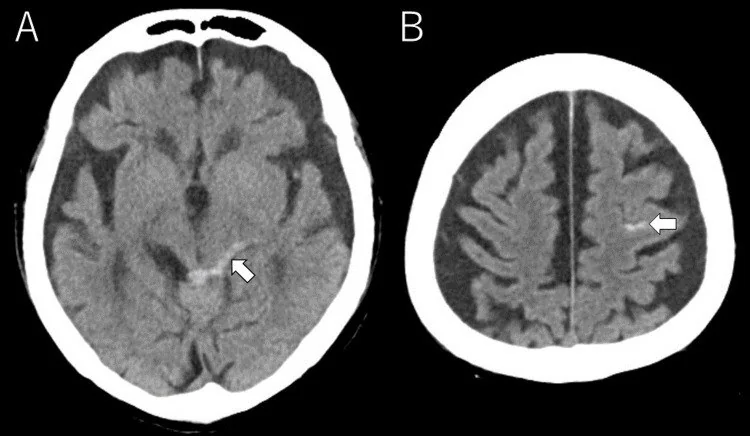
- Travmatik subaraknoid kanama, akut BT'de en sık görülen intrakranial bulgulardan biridir ve sıklıkla beyin konveksiteleri ile Sylvian fissür gibi yüzeyel aralıklarda lokalizedir. Akut kan BT'de sulkuslarda hiperdens olarak izlenir; ince veya hafif kanamaların tanısında ek dizilim desteği gerekebilir. İntravenöz kontrast tanı için gerekmez.
Önerilen pencereler: Beyin (G 80 / M 40), Subdural (G 200 / M 75), Kemik (G 1800 / M 400).
BT bulguları
- Konveksite sulkuslarında kan — frontal veya parietal girusları çevreleyen BOS aralığında çizgisel hiperdensite.
- Travmatik subaraknoid kanama, Sylvian fissür ve diğer yüzeyel sulkuslar gibi kortikal aralıklarda hiperdensite olarak izlenebilir ve genellikle primer travma odaklarıyla ilişkilidir.
- Travma odağıyla komşuluk — kanın skalp hematomu, kırık veya parankimal kontüzyon tarafında yoğunlaşması.
- Yoğun kan birikimi veya eşlik eden parankimal ödem, sulkusların effasmanına (silinmesine) ve komşu girusların seçilememesine neden olabilir.
- Kortikal ve subkortikal kontüzyonlar, travmatik beyin yaralanmalarında sık görülen (yaklaşık %31) yamalı hemorajik lezyonlardır ve BT/MRI ile tespit edilebilir.
- Yaygın travmatik kanamalar bazal sisternleri, interhemisferik fissürü veya ventrikülleri tutabilir ve bu durum basal sistern effasmanı ile birlikte kütle etkisine yol açabilir.
- Kitle etkisi — sulkus ve bazal sistern basısı, ventrikül sıkışması ya da orta hat yapılarında yer değiştirme.
Normalde
Travmatik SAK sıklıkla konveksitelere yayılır; sınırlı kortikal sulkus kanamasını göstermede FLAIR, BT'den daha duyarlıdır. Kontrastsız BT ile alt kesitlerdeki Sylvian fissür ve bazal sisternlerin incelenmesi, patolojik hiperdensite aranarak travmatik subaraknoid kanamanın ekarte edilmesi açısından önemlidir. Sağ-sol karşılaştırmada, travma tarafında sulkuslarda yeni hiperdensite ve komşu parankimal kontüzyon veya skalp lezyonları gibi eşlikçi bulguların varlığı travmanın yerini belirlemede yardımcı olur.
Normal BT ile kıyasla
Aynı bölgenin, kaynak veri setinde patoloji içermediği belirtilen bir BT incelemesini kesit kesit kaydırın; organ sınırlarını açarak anatomiyi hasta görüntüsüyle karşılaştırın. Küçük rastlantısal bulgular tümüyle dışlanmamıştır.
Kaynak: TotalSegmentator v2.01 veri seti (Wasserthal ve ark., Radiology: Artificial Intelligence 2023), CC BY 4.0, vaka s0103; organ sınırları veri setinin otomatik segmentasyonundan, birleştirilerek sadeleştirildi. Görüntüler 2,5 mm kesit aralığına yeniden örneklendi.
Ayırıcı tanı
- Anevrizmal subaraknoid kanama
- suprasellar ve bazal sisternlerde merkezlenen, Sylvian veya interhemisferik fissüre yayılan kan paterni.
- Kortikal ven trombozu, sulkus kanaması ile karışabilen venöz infarkt ve çevresel ödem oluşturabilir ve tanı için venografik görüntüleme gerekebilir.
- Hemorajik kortikal kontüzyonlar, subaraknoid kanamadan farklı olarak korteks ve parankim içinde lokalize yamalı hemorajik odaklardır ve travmatik beyin yaralanmalarında yaygın bulunur.
- Psödo-SAK görünümü
- yaygın ödemde silik sisternler ve sulkuslar yüksek yoğunluk izlenimi verebilir; belirgin gerçek sulkus içi kan dağılımı yoktur.
Tuzaklar
- Bazal sisternlerde baskın kanı sıradan travmatik konveksite kanaması olarak etiketlemeyin; anevrizmal kaynak ve damar yaralanması için dağılımı yeniden değerlendirin.
- Polikitemi (yüksek hematokrit) veya yaygın beyin ödemi kaynaklı pseudosubaraknoid kanama görünümü, gerçek travmatik kanamayı taklit edebilir ve ayırıcı tanıda dikkatli değerlendirme gerektirir.
- İnce kanamalar veya ödem kaynaklı artmış dansite yanlış pozitif/negatif verebilir; dikkatli kesit geçişleri ve gerekirse MR desteği önerilir.
Kendini dene
Kafa travması sonrası verteks sulkuslarında çizgisel hiperdensite ve komşu skalp hematomu var; en olası kanama bölgesi hangisidir?
Cevabı göster
Subaraknoid aralık. Sulkusların anatomik şeklini izleyen kan subaraknoid aralıktadır. Subdural ve epidural hematomlar ekstraaksiyel, intraparenkimal kanama ise intraaksiyel kanama grubundadır.
Künt kafa travması sonrası en belirgin kan suprasellar sistern ve her iki Sylvian fissürde; hangi yorum daha uygundur?
Cevabı göster
Bu dağılım tipik konveksite travmatik SAK paterni değildir; anevrizmal veya travmatik damar kaynağı da araştırılmalıdır. Suprasellar sistern ve iki Sylvian fissürde baskın kan, tipik konveksite travmatik SAK dağılımı değildir; travma öyküsü anevrizmal veya travmatik damar kaynağını dışlamaz. Travmatik SAK kanı sıklıkla konveksitelerde yaygın dağılır; subdural hematom ekstraaksiyel, intraparenkimal kanama ise intraaksiyel kanama grubundadır.
Bu konunun yer aldığı turlar
İlgili konular
Kaynaklar
Bu sayfadaki 35 cümle ve 2 quiz sorusu aşağıdaki kaynaklardan alıntılarla tek tek karşılaştırıldı; 22 cümle bu karşılaştırmada düzeltildi (2026-10-08).
- Cerebral Vasospasm After Traumatic Subarachnoid Hemorrhage: A Narrative Reviewpmc.ncbi.nlm.nih.gov
- The Role of Nursing Care in the Management of Patients with Traumatic Subarachnoid Hemorrhagepmc.ncbi.nlm.nih.gov
- Similarities in the Electrographic Patterns of Delayed Cerebral Infarction and Brain Death After Aneurysmal and Traumatic Subarachnoid Hemorrhagepmc.ncbi.nlm.nih.gov
- Traumatic Subarachnoid Hemorrhage: A Scoping Reviewpmc.ncbi.nlm.nih.gov
- Initial CT Imaging Predicts Mortality in Severe Traumatic Brain Injuries in Pediatric Population—A Systematic Review and Meta-Analysispmc.ncbi.nlm.nih.gov
- Traumatic Subarachnoid Hemorrhage: A Scoping Review.pubmed.ncbi.nlm.nih.gov
- Surgical Management of Trauma-Related Intracranial Hemorrhage-a Review.pubmed.ncbi.nlm.nih.gov
- Subarachnoid hemorrhage in ten questions.pubmed.ncbi.nlm.nih.gov
- Hemorrhagic stroke: aneurysmal subarachnoid hemorrhage.pubmed.ncbi.nlm.nih.gov
- Non-contrast computed tomography for the diagnosis of non-traumatic subarachnoid hemorrhage.pubmed.ncbi.nlm.nih.gov
- Post-traumatic subarachnoid hemorrhage: A review.pubmed.ncbi.nlm.nih.gov
- Early computed tomography for acute post-traumatic diffuse axonal injury: a systematic review.pubmed.ncbi.nlm.nih.gov
- Initial CT Imaging Predicts Mortality in Severe Traumatic Brain Injuries in Pediatric Population-A Systematic Review and Meta-Analysis.pubmed.ncbi.nlm.nih.gov
- The role of imaging in the management of non-traumatic subarachnoid hemorrhage: a practical review.pubmed.ncbi.nlm.nih.gov
- A tangential gunshot wound to the head: case report and review of the literature.pubmed.ncbi.nlm.nih.gov
- Motion preserving management of unstable traumatic clivus fracture extending through bilateral occipital condyles.pubmed.ncbi.nlm.nih.gov
- Emergent surgical evacuation of traumatic intracranial hematoma in patients with preoperative thrombocytopenia: surgical risk and early outcome.pubmed.ncbi.nlm.nih.gov
- Imaging Findings in Acute Traumatic Brain Injury: a National Institute of Neurological Disorders and Stroke Common Data Element-Based Pictorial Review and Analysis of Over 4000 Admission Brain Computed Tomography Scans from the Collaborative European NeuroTrauma Effectiveness Research in Traumatic Brain Injury (CENTER-TBI) Study.pubmed.ncbi.nlm.nih.gov
- Radiographic Evaluation of a Patient with Subarachnoid Hemorrhage.pubmed.ncbi.nlm.nih.gov
- Neuroimaging for neurovascular complications of traumatic brain injury.pubmed.ncbi.nlm.nih.gov
- Middle cerebral artery dissection: pathophysiology, diagnosis, and therapeutic options.pubmed.ncbi.nlm.nih.gov
- Extracellular Vesicle-Derived microRNAs as Fluid Biomarkers in Neurodegenerative Diseases: A Systematic Review.pubmed.ncbi.nlm.nih.gov
- Role of Magnetic Resonance Imaging in Acute Head Injury Patients with Normal Computed Tomography Brain Findings.pubmed.ncbi.nlm.nih.gov
- AI-Based Approaches for the Identification and Quantification of Traumatic Brain Injury in Computed Tomography Imaging: Systematic Review.pubmed.ncbi.nlm.nih.gov
- Endovascular treatment for symptomatic vasospasm following traumatic brain injury: illustrative case.pubmed.ncbi.nlm.nih.gov
- Post-traumatic hydrocephalus in adults: the mechanisms of development, predictors of progression and management strategies. A narrative review and case series analysis.pubmed.ncbi.nlm.nih.gov
- Non-contrast computed tomography at the end of the acute care phase as an additional prognostic tool after aneurysmal subarachnoid hemorrhage.pubmed.ncbi.nlm.nih.gov
- Leptomeninges: Anatomy, Mechanisms of Disease and Neuroimaging.pubmed.ncbi.nlm.nih.gov
- Single-Center Investigation of Brain Injury Guidelines (BIG)-3 Classification in Traumatic Brain Injury: A Retrospective Analysis of the Role of Pre-injury Antithrombotic Therapy.pubmed.ncbi.nlm.nih.gov
- Syndrome of the trephined: from pathophysiology to cranioplasty - an updated narrative review.pubmed.ncbi.nlm.nih.gov
- Continuum of Irreversible and Potentially Reversible Traumatic Brain Injury Sequelae: Axonal Injury and Hydrocephalus.pubmed.ncbi.nlm.nih.gov
- Neurological complications following cerebral angiography: a case of contrast-induced encephalopathy.pubmed.ncbi.nlm.nih.gov
- Cerebral Amyloid Angiopathy With Progressive Cortical Superficial Siderosis and Convexity Subarachnoid Hemorrhage in an Apolipoprotein E (APOE) ε2/ε2 Homozygous Patient: A Case Report and Literature Review.pubmed.ncbi.nlm.nih.gov
- Current state and advancements of imaging in acute ischemic stroke: a practical review.pubmed.ncbi.nlm.nih.gov
- Polycythemia, a radiologic mimic in plain CT head: A case report.pubmed.ncbi.nlm.nih.gov
- Machine Learning-Based Prediction of Delayed Cerebral Ischemia and Functional Outcome in Aneurysmal Subarachnoid Hemorrhage: The Role of CNS Infection-Related Parameters.pubmed.ncbi.nlm.nih.gov
- Diagnostic Accuracy of Hounsfield Unit Value and Hounsfield Unit to Hematocrit Ratio in Predicting Cerebral Venous Sinus Thrombosis: A Retrospective Case-Control Study.pubmed.ncbi.nlm.nih.gov
- Fulminant Amyloid-β-Related Angiitis after Tenecteplase: A Biopsy-Confirmed Cause of Post-Thrombolysis Neurologic Deterioration.pubmed.ncbi.nlm.nih.gov
- Hypothalamic adipsia presenting as persistent hypernatremia after aneurysmal subarachnoid hemorrhage.pubmed.ncbi.nlm.nih.gov
- A Case of Isolated Abnormal Behavior Associated With Vitamin B12 Deficiency.pubmed.ncbi.nlm.nih.gov
- 'Carotid spells' - transient focal neurological episodes associated with convexity subarachnoid haemorrhage in severe ipsilateral extracranial internal carotid artery stenosis: a case report and concise literature review.pubmed.ncbi.nlm.nih.gov
- Fatal Outcome of Intravenous Thrombolysis With an Unexpected Finding of Amyloid-β-Related Angiitis-A Case Report Highlighting a Relevant Scenario With Acute Focal Neurological Deficits and Minimal Radiological Presentation.pubmed.ncbi.nlm.nih.gov
- The Heart-Brain Axis: Key Concepts in Neurocardiology.pubmed.ncbi.nlm.nih.gov
- A myriad spectrum of seizures on magnetic resonance imaging - A pictorial essay.pubmed.ncbi.nlm.nih.gov
- Hearing impairment after subarachnoid hemorrhage.pubmed.ncbi.nlm.nih.gov
- Predictors of Intracranial Hemorrhage on Initial Head Computed Tomography After Mild Traumatic Brain Injury.pubmed.ncbi.nlm.nih.gov
- Serial Magnetic Resonance Imaging Leading to the Diagnosis of a Growing Skull Fracture in an Infant Without an Apparent Fracture Widening on Follow-Up Computed Tomography.pubmed.ncbi.nlm.nih.gov
- Characteristics of head injuries in children at King Abdullah Specialized Children's Hospital, Jeddah: a cross-sectional study.pubmed.ncbi.nlm.nih.gov
- Wide Dissection Trans-Sulcal Approach for Resection of Deep Intra-Axial Lesions in Eloquent Brain Areas.pubmed.ncbi.nlm.nih.gov
- Primary central nervous system vasculitis and headache: Ten themes.pubmed.ncbi.nlm.nih.gov
- Using non-invasive neuroimaging to enhance the care, well-being and experimental outcomes of laboratory non-human primates (monkeys).pubmed.ncbi.nlm.nih.gov
- Fatal Injuries Caused by Falling Trees: Correlation Between Postmortem Computed Tomography and Forensic Autopsy Findings in Eight Cases.pubmed.ncbi.nlm.nih.gov
- Interhemispheric Acute Subdural Hematoma Secondary to Falx Meningioma: A Case Report.pubmed.ncbi.nlm.nih.gov
- Navigating the Role of Surgery in Optimizing Patient Outcomes in Traumatic Brain Injuries (TBIs): A Comprehensive Review.pubmed.ncbi.nlm.nih.gov
- Stretching the Limits: A Rare Case Report of Perimesencephalic Subarachnoid Hemorrhage During Yoga.pubmed.ncbi.nlm.nih.gov
- From Benign Symptoms to Subarachnoid Hemorrhage: A Pediatric Case.pubmed.ncbi.nlm.nih.gov
- Ruptured Vertebral-Anterior Spinal Artery Junction Aneurysm Presenting With Diffuse Subarachnoid Hemorrhage: Diagnostic Limitations of CT Angiography (CTA) and the Role of Digital Subtraction Angiography (DSA) in Management-Related Decision-Making.pubmed.ncbi.nlm.nih.gov
- A Prospective Comparative Study of Optic Nerve Sheath Diameter Measurement by Ultrasonography vs Computed Tomography Scan for the Detection of Elevated Intracranial Pressure in Patients with Acute Neurological Emergencies.pubmed.ncbi.nlm.nih.gov
- Integrating Brain Imaging Volumetrics and Quantitative Pupillometry for Predicting Neurologic Deterioration after Large Hemispheric Stroke.pubmed.ncbi.nlm.nih.gov
- Parasagittal subdural space: a novel quantitative marker of spontaneous intracranial hypotension syndrome-induced chronic subdural hematoma.pubmed.ncbi.nlm.nih.gov
- Contrast-induced encephalopathy presenting with refractory status epilepticus following endovascular coiling of an intracranial aneurysm: A case report and literature review.pubmed.ncbi.nlm.nih.gov
- Bilateral subdural hematomas complicating intracranial hypotension following lumbar spine procedures: two case reports.pubmed.ncbi.nlm.nih.gov
- Rapidly Progressive Multiple Ischemic Lesions Caused by <i>Cryptococcus neoformans</i> Infection Presenting with Meningoencephalitis and Cerebral Infarction as the Initial Manifestations: A Case Report.pubmed.ncbi.nlm.nih.gov
- Basal cisternostomy for severe traumatic brain injury: illustrative case.pubmed.ncbi.nlm.nih.gov
- Missing A1 Unmasked During Surgery for Ruptured Anterior Communicating Artery (ACoA) Aneurysm: Navigating the Unexpected.pubmed.ncbi.nlm.nih.gov
- Clinical and epidemiological comparison between perimesencephalic and non-perimesencephalic, non-aneurysmal subarachnoid hemorrhage: a single-center cohort study from a referral center in a developing country.pubmed.ncbi.nlm.nih.gov
- Non-Aneurysmal Subarachnoid Hemorrhage in a Patient With Type 1 Diabetes Mellitus: A Case Report.pubmed.ncbi.nlm.nih.gov
- Intracranial venous thrombosis imaging by anatomical location: an educational review with mimics and diagnostic pitfalls.pubmed.ncbi.nlm.nih.gov
- Intracerebral Hemorrhage in Aging: Pathophysiology, Clinical Challenges, and Future Directions.pubmed.ncbi.nlm.nih.gov
- Neuroimaging of neonatal brain post therapeutic hypothermia: a practical guide to the non-pediatric neuroradiologist.pubmed.ncbi.nlm.nih.gov
- Early (<24 hours) venous thromboembolism prophylaxis in traumatic brain injury: development of the EViTBI algorithm using a national cohort.pubmed.ncbi.nlm.nih.gov
- Retrospective Review of Head Injury: Are Pre-Injury Anticoagulant and Antiplatelet Therapy Associated with Acute Traumatic Intracranial Hemorrhage?pubmed.ncbi.nlm.nih.gov
- Neuroendoscopy for acute severe neurological conditions: high hematoma clearance and rapid recovery in 815 patients - cohort study.pubmed.ncbi.nlm.nih.gov
- Anoxic Brain Injury Presenting as Pseudosubarachnoid Hemorrhage in the Medical Intensive Care Unit.pubmed.ncbi.nlm.nih.gov
- Does the Integration of Inflammatory Markers with Clinical Scoring Systems Improve the Prediction of Neurosurgical Intervention in Emergency Department Patients Diagnosed with Traumatic Subarachnoid Hemorrhage?pubmed.ncbi.nlm.nih.gov
- Survival of a 2-month-old infant after clipping of ruptured middle cerebral artery aneurysm: A case report and review of the literature.pubmed.ncbi.nlm.nih.gov
- Ruptured distal anterior cerebral artery (A2) aneurysm presenting with simultaneous bilateral intraparenchymal hemorrhage and acute subdural hematoma: A case report and literature review.pubmed.ncbi.nlm.nih.gov
- Venous-significant intracranial hemorrhage in neonatal HIE treated with therapeutic hypothermia: imaging phenotypes, diagnostic pitfalls, and prognostic implications.pubmed.ncbi.nlm.nih.gov
- An Integrated Approach on the Diagnosis of Cerebral Veins and Dural Sinuses Thrombosis (a Narrative Review).pubmed.ncbi.nlm.nih.gov
- Patterns of injury and violence in Yaoundé Cameroon: an analysis of hospital data.pubmed.ncbi.nlm.nih.gov
- A Review on Computer Aided Diagnosis of Acute Brain Stroke.pubmed.ncbi.nlm.nih.gov
- Imaging for the diagnosis and management of traumatic brain injury.pubmed.ncbi.nlm.nih.gov
- Role of neuroimaging in multidisciplinary approach towards Non-Alzheimer's dementia.pubmed.ncbi.nlm.nih.gov
- Cerebral amyloid angiopathy: an underdiagnosed cause of recurrent neurological symptoms.pubmed.ncbi.nlm.nih.gov
- Decision-making for emergency craniotomy in traumatic intracranial hemorrhage with severe thrombocytopenia and coagulopathy in a patient with suspected acute leukemia: A case-based review.pubmed.ncbi.nlm.nih.gov
- Diagnostic evaluation of suspected aneurysmal subarachnoid hemorrhage after negative CT: risk-stratified use of lumbar puncture and CT angiography.pubmed.ncbi.nlm.nih.gov
- Radiological evaluation in patients with clinical suspicion of cerebral venous sinus thrombosis presenting with nontraumatic headache - a retrospective observational study with a validation cohort.pubmed.ncbi.nlm.nih.gov
- Molecular, Pathological, Clinical, and Therapeutic Aspects of Perihematomal Edema in Different Stages of Intracerebral Hemorrhage.pubmed.ncbi.nlm.nih.gov
- Imaging Evaluation of Acute Traumatic Brain Injury.pubmed.ncbi.nlm.nih.gov
- Commentary: an eye on PET quantification.pubmed.ncbi.nlm.nih.gov
- Catastrophic Hypoxic-Ischemic Brain Injury Following Influenza A Illness in a Young Woman: A Case Report.pubmed.ncbi.nlm.nih.gov
- Localized Subarachnoid Purulence Mimicking Aneurysmal Subarachnoid Hemorrhage: A Case Report.pubmed.ncbi.nlm.nih.gov
- Pilocytic astrocytoma: A rare case report.pubmed.ncbi.nlm.nih.gov
- An Atlas of Neonatal Neurovascular Imaging Anatomy as Depicted with Microvascular Imaging: The Intracranial Arteries.pubmed.ncbi.nlm.nih.gov
- Use of magnetic source imaging to assess recovery after severe traumatic brain injury-an MEG pilot study.pubmed.ncbi.nlm.nih.gov
- Multimodal monitoring: practical recommendations (dos and don'ts) in challenging situations and uncertainty.pubmed.ncbi.nlm.nih.gov
- Clinical application of near-infrared spectroscopy in patients with traumatic brain injury: a review of the progress of the field.pubmed.ncbi.nlm.nih.gov
- Utility of dual energy CT in differentiating clot in acute ischemic stroke.pubmed.ncbi.nlm.nih.gov
- Metastatic choriocarcinoma with hemorrhagic complications and spontaneous ovarian hyperstimulation syndrome: A case report.pubmed.ncbi.nlm.nih.gov
- Diagnostic yield and spectrum of head CT findings after return of spontaneous circulation in non-traumatic in-hospital cardiac arrest: a retrospective cohort study.pubmed.ncbi.nlm.nih.gov
- Subarachnoid cisterns as surgical corridors: Integrating microsurgical anatomy and neuroimaging for intracranial navigation.pubmed.ncbi.nlm.nih.gov
- Inter-Rater Reliability of Subarachnoid Hemorrhage Radiological Grading Scales: A Systematic Review and Meta-Analysis.pubmed.ncbi.nlm.nih.gov
- Extensive peritruncal subarachnoid hemorrhage: a risk factor for the development of spinal arachnoid cysts. Illustrative cases.pubmed.ncbi.nlm.nih.gov
- CT-based automatic segmentation of key CSF regions for detecting disproportionately enlarged subarachnoid space hydrocephalus.pubmed.ncbi.nlm.nih.gov
- Diffuse leptomeningeal glioneuronal tumor mimicking chronic inflammatory and tuberculous meningitis.pubmed.ncbi.nlm.nih.gov
- Role of the "In-Window" Craniectomy in the Management of Serious Head Trauma: 12 Case Series, Technical Note, Literature Review, and Comparison With Other Surgical Managements.pubmed.ncbi.nlm.nih.gov
- Disruption of white matter integrity and its relationship with cognitive function in non-severe traumatic brain injury.pubmed.ncbi.nlm.nih.gov
- Delayed identification and treatment of a cervicomedullary spinal vascular lesion following angiogram-negative, high-grade subarachnoid hemorrhage: illustrative case.pubmed.ncbi.nlm.nih.gov
- Real-world performance evaluation of a commercial deep learning model for intracranial hemorrhage detection.pubmed.ncbi.nlm.nih.gov
- Regional and Global Changes in Brain Structure 1-Year Post Pediatric "Mild" Traumatic Brain Injury.pubmed.ncbi.nlm.nih.gov
- Radiological assessment of dementia: the Italian inter-society consensus for a practical and clinically oriented guide to image acquisition, evaluation, and reporting.pubmed.ncbi.nlm.nih.gov
- Radiological predictors of shunt response in the diagnosis and treatment of idiopathic normal pressure hydrocephalus: a systematic review and meta-analysis.pubmed.ncbi.nlm.nih.gov
- Optic nerve sheath diameter for prediction of intracranial hypertension after ischemic sTrokE - The ONSITE study.pubmed.ncbi.nlm.nih.gov
- Optic nerve sheath diameter for prediction of intracranial hypertension after ischemic sTrokE - The ONSITE study.pubmed.ncbi.nlm.nih.gov
- Association of the C-reactive protein-albumin-lymphocyte index with clinical outcomes after mechanical thrombectomy for acute ischemic stroke.pubmed.ncbi.nlm.nih.gov
Eğitim amaçlıdır; hasta başında tanı ve tedavi kararının yerine geçmez. İçerik yapay zekâ destekli bir süreçle güncel literatüre göre cümle cümle kaynaklarla karşılaştırıldı, ancak uzman radyolog incelemesinden geçmedi. Klinik kararlarda güncel kılavuzları, kurum protokollerini ve radyoloji raporunu esas alın.