Özet
Primer santral sinir sistemi lenfoması (PCNSL), beyin parankimi, göz, leptomeninks veya omurilikte ortaya çıkabilen agresif bir lenfomadır; bağışıklığı normal kişilerde de görülür. Kontrastsız BT’de derin veya periventriküler hiperdens kitle PCNSL’yi düşündürebilir; ancak tanısal inceleme olarak kontrastlı MRG tercih edilir. Kontrastlı MRG tanısal incelemede tercih edilir; BT’deki görünüm lenfomayı gliom, metastaz veya enfeksiyondan tek başına ayıramaz. PCNSL’de kitle infiltrasyonu ve kompresyon nörolojik belirtilere yol açabilir; ventriküler yerleşimli lezyonlarda obstrüksiyon ve hidrosefali gelişebilir.
Faz ve pencere
- Kontrastsız tanısal
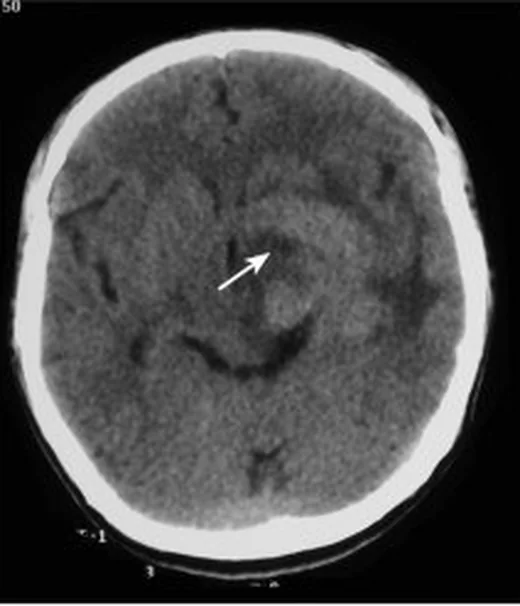
- Periventriküler beyaz cevher, korpus kallozum veya bazal gangliyonda kortekse göre izo-hiperdens solid kitle görülebilir; çevresinde değişen ölçüde hipodens ödem bulunabilir. Kontrastsız BT kontrastlanma örüntüsünü göstermez ve normal BT PCNSL’yi dışlamaz.
Önerilen pencereler: Beyin (G 80 / M 40).
BT bulguları
- Periventriküler odak — lateral ventrikül duvarına bitişik beyaz cevher veya subependimal yüzey boyunca yerleşir.
- Derin gri cevher tutulumu — bazal gangliyon veya talamusta kitle ve çevresel ödem oluşturabilir.
- Korpus kallozum uzanımı — orta hatta geçerek iki hemisfer derin beyaz cevherini tutabilir.
- Kontrastsız BT’de göreli hiperdensite — hücresel yoğunlukla ilişkili olabilir; bulgu tanıya özgü değildir.
- Ödem ve kitle etkisi — değişen derecelerde eşlik edebilir; tek başına miktarı ayırıcı tanı koydurmaz.
- Kontrastlı incelemede belirgin solid kontrastlanma — sıklıkla homojen örüntüdedir; bu özellik kontrastsız görüntüden çıkarılamaz.
- Nekroz, kanama veya kalsifikasyon — bağışıklığı normal hastada tipik değildir; varlığı atipik sunum veya alternatif tanıyı gündeme getirir.
Normalde
Periventriküler alanı, korpus kallozumu ve bazal gangliyonları lezyon açısından incele; PCNSL bu bölgelerde sık yerleşebilir.
Normal BT ile kıyasla
Aynı bölgenin, kaynak veri setinde patoloji içermediği belirtilen bir BT incelemesini kesit kesit kaydırın; organ sınırlarını açarak anatomiyi hasta görüntüsüyle karşılaştırın. Küçük rastlantısal bulgular tümüyle dışlanmamıştır.
Kaynak: TotalSegmentator v2.01 veri seti (Wasserthal ve ark., Radiology: Artificial Intelligence 2023), CC BY 4.0, vaka s0103; organ sınırları veri setinin otomatik segmentasyonundan, birleştirilerek sadeleştirildi. Görüntüler 2,5 mm kesit aralığına yeniden örneklendi.
Ayırıcı tanı
- Glioblastom
- PCNSL’ye göre genellikle daha yüksek rCBV, heterojen yapı ve nekroz ile karakterize iken; PCNSL sıklıkla homojen kontrastlanma, düşük ADC ve periventriküler yerleşim gösterir.
- Beyin metastazı PCNSL’nin ayırıcı tanıları arasındadır; klinik ve görüntüleme bulguları ayırıcı tanıyı daraltmaya yardımcı olabilir.
- Nörotoksoplazmoz
- bağışıklığı baskılanmış hastada çoğunlukla çoklu halka biçimli lezyonlar ve bazal gangliyon tutulumu görülür; lezyonlarda eksantrik hedef işareti toksoplazmozu destekler.
- Beyin apsesi
- kaynaklar apseyi yalnızca ayırıcı tanı olarak listeler, apsenin halka biçimli kontrastlanma veya difüzyon kısıtlanması gibi ayırıcı özelliklerini bu metinlerde detaylandırmaz.
- Akut enfarkt ve intravasküler lenfoma
- kaynaklar intravasküler lenfomanın kortikal-subkortikal enfarkt benzeri lezyonlar oluşturduğunu belirtir; akut enfarktın arteriyel dağılım özelliği kaynaklarda yer almamaktadır.
Tuzaklar
- Kontrastsız BT'de görülen hiperdensite yüksek hücrellikle ilişkilidir; tanının kesinleşmesi için kontrastlı MRG ve histolojik doğrulama gereklidir.
- Bağışıklığı baskılanmış hastadaki çoklu halka biçimli odakları tipik PCNSL sayma: toksoplazmoz ve başka enfeksiyonlar güçlü taklitçilerdir.
- Kontrastsız BT’yi normal bulup lenfomayı dışlama: küçük veya izodens lezyonlar görünmeyebilir; klinik şüphede MRG gerekir.
- Tümöre bağlı ödemi kitle sınırı olarak kabul etme: PCNSL lezyonlarına değişen derecelerde vazojenik ödem eşlik edebilir.
Kendini dene
Derin periventriküler alanda kortekse göre hiperdens solid kitle görülüyor. Hangi tanı özellikle akla gelmelidir?
Cevabı göster
Primer SSS lenfoması. Periventriküler yerleşim ve kontrastsız BT'de hiperdensite PCNSL'yi düşündürür; kesin tanı için stereotaktik biyopsi veya CSF analizleri gereklidir. Menenjiyom ekstraaksiyel, apse sıklıkla halka biçimli, ensefalomalazi ise hacim kayıplı parankim değişikliğidir.
Bağışıklığı baskılanmış hastada çoklu halka biçimli bazal gangliyon lezyonları var. En önemli ayırıcı tanı hangisidir?
Cevabı göster
Nörotoksoplazmoz. Bağışıklığı baskılanmış kişide çoklu halka biçimli bazal gangliyon odakları nörotoksoplazmozu güçlü biçimde düşündürür. Menenjiyom ekstraaksiyel kitle yapar; diffüz gliom ve kavernom bu çoklu enfeksiyöz örüntüyü açıklamaz.
İlgili konular
Kaynaklar
Bu sayfadaki 36 cümle ve 2 quiz sorusu aşağıdaki kaynaklardan alıntılarla tek tek karşılaştırıldı; 11 cümle bu karşılaştırmada düzeltildi (2026-10-08).
- Primary central nervous system lymphoma in the molecular era: genomic drivers, liquid biopsy, and targeted therapeutic strategiespmc.ncbi.nlm.nih.gov
- Primary central nervous system lymphoma—current standards and recent developmentspmc.ncbi.nlm.nih.gov
- The Landscape of Primary Central Nervous System Lymphoma (PCNSL): Clinicopathologic and Genomic Characteristics and Therapeutic Perspectivespmc.ncbi.nlm.nih.gov
- Advances in molecular pathobiology of PCNSL – towards clinical implementation of novel diagnostics and therapeuticspmc.ncbi.nlm.nih.gov
- Diagnostic imaging and emerging image-guided neurointervention in brain tumors: a narrative reviewpmc.ncbi.nlm.nih.gov
- Primary central nervous system lymphoma: Imaging features and differential diagnosis.pubmed.ncbi.nlm.nih.gov
- Approach to an Intracranial Mass in Patients With HIV.pubmed.ncbi.nlm.nih.gov
- [Malignant Lymphoma of the Brain, and Dementia].pubmed.ncbi.nlm.nih.gov
- Diagnostic Performance of Pretreatment 18F-Fluorodeoxyglucose Positron Emission Tomography With or Without Computed Tomography in Patients With Primary Central Nervous System Lymphoma: Updated Systematic Review and Diagnostic Test Accuracy Meta-analyses.pubmed.ncbi.nlm.nih.gov
- Consensus recommendations for MRI and PET imaging of primary central nervous system lymphoma: guideline statement from the International Primary CNS Lymphoma Collaborative Group (IPCG).pubmed.ncbi.nlm.nih.gov
- Primary CNS lymphoma in HIV infection.pubmed.ncbi.nlm.nih.gov
- Primary central nervous system lymphoma in immunocompetent patients: a retrospective review of MRI features.pubmed.ncbi.nlm.nih.gov
- Differential diagnosis for bilateral abnormalities of the basal ganglia and thalamus.pubmed.ncbi.nlm.nih.gov
- Neuroimaging in Central Nervous System Lymphoma.pubmed.ncbi.nlm.nih.gov
- Primary CNS Lymphomas: Challenges in Diagnosis and Monitoring.pubmed.ncbi.nlm.nih.gov
- PET imaging for brain tumor diagnostics.pubmed.ncbi.nlm.nih.gov
- Advances in Primary Central Nervous System Lymphoma.pubmed.ncbi.nlm.nih.gov
- Extranodal Lymphoma of the Central Nervous System and Spine.pubmed.ncbi.nlm.nih.gov
- Delivery of chemotherapeutics across the blood-brain barrier: challenges and advances.pubmed.ncbi.nlm.nih.gov
- Primary central nervous system lymphoma in the molecular era: genomic drivers, liquid biopsy, and targeted therapeutic strategies.pubmed.ncbi.nlm.nih.gov
- [Toxoplasmosis].pubmed.ncbi.nlm.nih.gov
- Spectrum of Neuroimaging Findings in CNS Lymphoproliferative Disorders.pubmed.ncbi.nlm.nih.gov
- Delayed Uptake on <sup>123</sup>I-IMP SPECT as a Diagnostic Clue in Cranial Vault Lymphoma in a 25-Year-Old Man: A Case Report.pubmed.ncbi.nlm.nih.gov
- Whole-body magnetic resonance imaging vs. positron emission tomography-computed tomography in pediatric oncology: enhancing diagnostic precision for solid tumors.pubmed.ncbi.nlm.nih.gov
- CXCR4-targeted PET/CT with [¹⁸F]AlF-NOTA-QHY-04 in primary central nervous system lymphoma: a prospective comparison with MRI and [¹⁸F]FDG PET/CT.pubmed.ncbi.nlm.nih.gov
- Diagnostic imaging and emerging image-guided neurointervention in brain tumors: a narrative review.pubmed.ncbi.nlm.nih.gov
- Imaging Features of Pediatric Primary Orbital Lymphomas: A Rare Case With Histopathological Correlation and Systematic Literature Review.pubmed.ncbi.nlm.nih.gov
- Primary central nervous system lymphoma of the third ventricle: Diagnostic pitfalls, the "Ghost Tumor" phenomenon, and steroid-induced complications.pubmed.ncbi.nlm.nih.gov
- Case Report: Suspected low-pressure hydrocephalus following surgical treatment of traumatic brain injury in a patient with subsequently diagnosed glioblastoma.pubmed.ncbi.nlm.nih.gov
- Case Report: Rare presentations of glioblastoma: three multifocal and one cerebellar cases highlighting the value of shared clinical experience.pubmed.ncbi.nlm.nih.gov
- Predictors for the Differentiation between Glioblastoma, Primary Central Nervous System Lymphoma, and Metastasis in Patients with a Solitary Enhancing Intracranial Mass.pubmed.ncbi.nlm.nih.gov
- Electron Density and Effective Atomic Number as Quantitative Biomarkers for Differentiating Malignant Brain Tumors: An Exploratory Study with Machine Learning.pubmed.ncbi.nlm.nih.gov
- Multiple myeloma presenting as dural plasmacytoma.pubmed.ncbi.nlm.nih.gov
- Magnetic resonance imaging of the orbit, Part 2: Characterization of orbital pathologies.pubmed.ncbi.nlm.nih.gov
- Magnetic resonance imaging of primary central nervous system neoplasms of dogs and cats: Basic concepts for diagnostic pathologists.pubmed.ncbi.nlm.nih.gov
- Lymphoma Related to the Ventricular System: A Rare Case Report and Systematic Review of Intraventricular Lymphomas.pubmed.ncbi.nlm.nih.gov
- Left Pulvinar Thalamic Tumor with Ventricular Atrial Extension Presenting as Network-Level Cognitive and Gait Dysfunction.pubmed.ncbi.nlm.nih.gov
- The Dual Role of Connexins in Stroke, Neurotrauma, Neurodegenerative and Psychiatric Disorders: A Global Systematic Review.pubmed.ncbi.nlm.nih.gov
- Primary central nervous system diffuse large B-cell lymphoma in fourth ventricle: Case report and literature review.pubmed.ncbi.nlm.nih.gov
- Radiologic features of primary intracranial ectopic germinomas: Case reports and literature review.pubmed.ncbi.nlm.nih.gov
- Butterfly Glioma of the Corpus Callosum Mimicking Rapidly Progressive Dementia.pubmed.ncbi.nlm.nih.gov
- Third ventricle non-Hodgkin lymphoma: An unusual presentation of primary central nervous system lymphoma.pubmed.ncbi.nlm.nih.gov
- Understanding a mass in the paraspinal region: an anatomical approach.pubmed.ncbi.nlm.nih.gov
- Bilateral lesions of the basal ganglia and thalami (central grey matter)-pictorial review.pubmed.ncbi.nlm.nih.gov
- Neurolymphomatosis: A Comprehensive Review of Clinical and Imaging Features.pubmed.ncbi.nlm.nih.gov
- Preoperative assessment of recurrence-prone subregions within the peritumoral region of glioblastoma: a comparison between diffusion kurtosis and diffusion tensor imaging.pubmed.ncbi.nlm.nih.gov
- Primary Intramedullary Histiocytic Sarcoma with Leptomeningeal Dissemination: Imaging, Pathologic, and Molecular Correlation.pubmed.ncbi.nlm.nih.gov
- Radiological and FDG-PET imaging features of Epstein-Barr virus-positive primary central nervous system lymphomas.pubmed.ncbi.nlm.nih.gov
- Management of pneumonia by the emergency radiologist.pubmed.ncbi.nlm.nih.gov
- Myxoid glioneuronal tumor of the septum pellucidum with concurrent dual <i>PDGFRA</i> and <i>FGFR3</i> gene mutations: a case report and literature review.pubmed.ncbi.nlm.nih.gov
- Case Report: Giant acute hemorrhagic colloid cyst in the septum pellucidum-foramen of Monro region with obstructive hydrocephalus in an 8-month-old infant.pubmed.ncbi.nlm.nih.gov
- Brain morphometry and cognition in late-onset glutaric aciduria type 1: scoping review and novel insights from a case report.pubmed.ncbi.nlm.nih.gov
- Analysis of Upper Facial Weakness in Central Facial Palsy Following Acute Ischemic Stroke.pubmed.ncbi.nlm.nih.gov
- Distinct neuroanatomical and neuropsychological features of Down syndrome compared to related neurodevelopmental disorders: a systematic review.pubmed.ncbi.nlm.nih.gov
- Tumor apparent diffusion coefficient combined with the lipid-to-creatine ratio for preoperative differentiation of primary central nervous system lymphoma from high-grade glioma: a single-center diagnostic model development and internal validation study.pubmed.ncbi.nlm.nih.gov
- Intraoperative Flow Cytometry for the Differentiation of Glioblastomas from Metastatic Brain Tumours: A Preliminary Prospective Study.pubmed.ncbi.nlm.nih.gov
- Targeting Classical <i>EGFR</i> Mutations in Lung Cancer: Twenty Years of Progress and Beyond.pubmed.ncbi.nlm.nih.gov
- Cosmic Signs in Radiology: A Pictorial Review.pubmed.ncbi.nlm.nih.gov
- Spinal Cord Toxoplasmosis: Mapping the Journey of a Rare Entity Through a Case Report and Review of the Literature.pubmed.ncbi.nlm.nih.gov
- Tumor-like Lesions in Primary Angiitis of the Central Nervous System: The Role of Magnetic Resonance Imaging in Differential Diagnosis.pubmed.ncbi.nlm.nih.gov
- Evaluation of imaging methods in cerebral toxoplasmosis.pubmed.ncbi.nlm.nih.gov
- Receptor-Assisted Nanotherapeutics for Overcoming the Blood-Brain Barrier.pubmed.ncbi.nlm.nih.gov
- Shining New Light on Biological Systems: Luminescent Transition Metal Complexes for Bioimaging and Biosensing Applications.pubmed.ncbi.nlm.nih.gov
- EACR 2025 Congress: Innovative Cancer Science, 16-19 June 2025.pubmed.ncbi.nlm.nih.gov
- Complex vasculitic overlap: temporal arteritis complicating suspected neuro-behçet disease with recurrent ischemic injury.pubmed.ncbi.nlm.nih.gov
- Post-therapy imaging of adult brain tumours: patterns, pitfalls, and practical framework.pubmed.ncbi.nlm.nih.gov
- Primary central nervous system vasculitis and headache: Ten themes.pubmed.ncbi.nlm.nih.gov
- Spontaneous Renal Hemorrhage Secondary to Acute Pyelonephritis: An Unusual Presentation of Wunderlich Syndrome.pubmed.ncbi.nlm.nih.gov
- Cerebral Venous Sinus Thrombosis Mimicking Tumor Hemorrhage: Successful Anticoagulation in a Resource-Limited Setting.pubmed.ncbi.nlm.nih.gov
- Chromosomal 1p Duplication in a Pediatric Patient: A Case Report.pubmed.ncbi.nlm.nih.gov
- CNS involvement by EBV-positive extranodal T-cell lymphoma harboring STAT3 Y640F mutation following allogeneic hematopoietic stem cell transplantation: A case report.pubmed.ncbi.nlm.nih.gov
- Cerebral toxoplasmosis: Parasitology, diagnosis, treatment, and prevention - a narrative review.pubmed.ncbi.nlm.nih.gov
- Blastomycosis of the Central Nervous System.pubmed.ncbi.nlm.nih.gov
- Nonbrain metastases seen on magnetic resonance imaging during metastatic brain tumor screening.pubmed.ncbi.nlm.nih.gov
- Adrenal Incidentaloma.pubmed.ncbi.nlm.nih.gov
- Treating the invisible target: treatment planning targeting the microscopic tumor spread in gliomas.pubmed.ncbi.nlm.nih.gov
- Spectral CT and Photon-counting Detector CT: Principles and Applications in Neuroradiology.pubmed.ncbi.nlm.nih.gov
- CT-based radiomics and ablation margin quantification for predicting local tumor progression in Stage I NSCLC after radiofrequency ablation.pubmed.ncbi.nlm.nih.gov
- Severe Central Nervous System Fungal Infection Following Tirabrutinib Administration in a Patient with Refractory Primary Central Nervous System Lymphoma: A Case Report.pubmed.ncbi.nlm.nih.gov
- Primary breast diffuse large B-cell lymphoma mimicking breast carcinoma: A case report and literature review.pubmed.ncbi.nlm.nih.gov
- Paraneoplastic Myopathy as a Possible Initial Presentation of Sporadic Burkitt Lymphoma in an Immunocompetent Adult: A Case Report.pubmed.ncbi.nlm.nih.gov
- Multiterritory Acute Ischemic Stroke with Bilateral Middle Cerebellar Peduncle T2/FLAIR Hyperintensities in the Setting of a Fatal Systemic Arterial Thrombotic Process: A Case Report.pubmed.ncbi.nlm.nih.gov
- Electroencephalographic Aspects in a Sheep with Coenurosis.pubmed.ncbi.nlm.nih.gov
- Bi-allelic loss-of-function variants in TMEM63B cause syndromic surfactant dysfunction disorder.pubmed.ncbi.nlm.nih.gov
- Structural MRI Differences in the Thalamus, Caudate Nucleus, and Interthalamic Adhesion in Dogs With Idiopathic Epilepsy.pubmed.ncbi.nlm.nih.gov
- Interpretable multimodal learning for integrating neuroimaging and genetic data in Alzheimer's disease.pubmed.ncbi.nlm.nih.gov
- Multimodal imaging analysis of autosomal recessive Parkinson's disease.pubmed.ncbi.nlm.nih.gov
- Severe Recurrent Hemorrhage of an Oncogenic Vertebrobasilar Junction Aneurysm Following Stent-Assisted Coil Embolization in Metastatic Testicular Choriocarcinoma.pubmed.ncbi.nlm.nih.gov
- Central Nervous System Tuberculoma in Qatar: Clinical, Radiological, and Pathological Insights From a Rare Case With Literature Review.pubmed.ncbi.nlm.nih.gov
- Pediatric CLIPPERS: Expanding the Neuroimaging Spectrum of a Rare Steroid-Responsive Neuroinflammatory Syndrome-A Systematic Review.pubmed.ncbi.nlm.nih.gov
- Cerebrovascular Manifestations of Neurosarcoidosis - An Overview.pubmed.ncbi.nlm.nih.gov
- Case Report: Cerebrospinal fluid cytology as a diagnostic clue in hemorrhagic glioblastoma mimicking hypertensive intracranial hemorrhage.pubmed.ncbi.nlm.nih.gov
- Neuroimaging in inborn errors of immunity: More than infections.pubmed.ncbi.nlm.nih.gov
- Clinical Approach to Myelopathy Diagnosis.pubmed.ncbi.nlm.nih.gov
- A systematic approach to detection of epileptogenic foci on imaging: protocols, entities, search pattern, and reporting tools.pubmed.ncbi.nlm.nih.gov
- Clinical applications of diffusion-weighted sequence in brain imaging: beyond stroke.pubmed.ncbi.nlm.nih.gov
- Diffusion-weighted MRI in neuro-oncology.pubmed.ncbi.nlm.nih.gov
- Neurological complications of transplantation: part I: hematopoietic cell transplantation.pubmed.ncbi.nlm.nih.gov
- Perilesional Diffusion Tensor Imaging for Differentiating Malignant and Benign Causes of Intracerebral Hemorrhage.pubmed.ncbi.nlm.nih.gov
- Diagnostic accuracy of dynamic contrast-enhanced CT for meningioma subclassification and its role in evaluating tumor vascularity.pubmed.ncbi.nlm.nih.gov
- Quantitative magnetic resonance imaging for accurate delineation of radiotherapy: a narrative review.pubmed.ncbi.nlm.nih.gov
- The Lupus Damage Index Revision Program: Results From the Item Generation and Reduction Phases.pubmed.ncbi.nlm.nih.gov
- A comparative study of large-vessel and small-vessel primary angiitis of the central nervous system: insights from a Chinese single-center retrospective cohort.pubmed.ncbi.nlm.nih.gov
- The lupus damage index revision program: Results from the item generation and reduction phases.pubmed.ncbi.nlm.nih.gov
- Neuroradiology of acute pathologies in adults with hematologic malignancies: a pictorial review.pubmed.ncbi.nlm.nih.gov
- Pathophysiology, clinical manifestations, and prognostic insights of cerebral fat embolism: a literature review.pubmed.ncbi.nlm.nih.gov
- Microstructure mapping with time-dependent diffusion MRI differentiates primary central nervous system lymphoma from glioblastoma.pubmed.ncbi.nlm.nih.gov
- Primary CNS Lymphoma Presenting With Seizures in a Virologically Suppressed HIV Patient With Near-Normal CD4: A Case Report From Uganda.pubmed.ncbi.nlm.nih.gov
- The first reported case of <i>Balamuthia</i> amoebic encephalitis initially presenting as anti-NMDAR encephalitis.pubmed.ncbi.nlm.nih.gov
- Case Report: Probable CLIPPERS in a patient with cutaneous T-cell lymphoma in remission: 5-year follow-up.pubmed.ncbi.nlm.nih.gov
- Case report: Intravascular large B cell lymphoma mimicking acute demyelinating encephalomyelitis after SARS-CoV-2 reinfection: diagnostic value of advanced MRI techniques and the literature review with the assistance of ChatGPT.pubmed.ncbi.nlm.nih.gov
- Unusual primary central nervous system lymphoma location involving the fourth ventricle and hypothalamus.pubmed.ncbi.nlm.nih.gov
- Modern techniques of magnetic resonance in the evaluation of primary central nervous system lymphoma: contributions to the diagnosis and differential diagnosis.pubmed.ncbi.nlm.nih.gov
Eğitim amaçlıdır; hasta başında tanı ve tedavi kararının yerine geçmez. İçerik yapay zekâ destekli bir süreçle güncel literatüre göre cümle cümle kaynaklarla karşılaştırıldı, ancak uzman radyolog incelemesinden geçmedi. Klinik kararlarda güncel kılavuzları, kurum protokollerini ve radyoloji raporunu esas alın.