Özet
Çocuklarda künt toraks travması en sık akciğer kontüzyonu ve kaburga kırığına yol açar; travma yönetimi genellikle konservatif olup, radyasyon riski nedeniyle ileri görüntüleme seçici kullanılmalıdır. Çok kesitli BT; kaburga kırıkları, pnömotoraks, hemotoraks, akciğer kontüzyonu ve laserasyonları, diyafram yırtığını ve aort yaralanmalarını değerlendirebilir; kanama kuşkusunda kontrastlı BT yalancı anevrizma veya aktif kontrast ekstravazasyonunu gösterebilir. İlk tarama görüntülemesinde travmatik bulgusu olmayan ya da yalnızca hafif bulguları olan çocuklarda, girişim ya da ameliyat gerektirecek veya mortaliteye yol açacak toraks yaralanmalarını saptamak için BT rutin kullanılmamalı; ileri görüntüleme kararı travmanın niteliğine, çocuğun klinik durumuna ve ilk radyografi bulgularına göre verilmelidir. Kanıt sınırlı olmakla birlikte, başlangıç görüntülemesinde travmatik bulgusu olmayan ya da hafif bulguları olan çocuklarda rutin BT yapılmaması koşullu olarak önerilir.
Faz ve pencere
- Venöz tanısal
- Çok kesitli BT ve çok düzlemli rekonstrüksiyonlar; kaburga kırıkları, pnömotoraks, hemotoraks, akciğer kontüzyonu ve laserasyonları, diyafram yırtığı ve aort yaralanmalarını değerlendirmede idealdir. BT, aort yaralanmaları dâhil göğüs yaralanmalarını değerlendirebilir; çocukta BT kararı travmanın niteliğine, klinik duruma ve ilk radyografi bulgularına göre verilmelidir.
- BTA tanısal
- Kanama kuşkusunda kontrastlı BT; yalancı anevrizma ya da aktif kontrast ekstravazasyonunu gösterebilir.
- Kemik algoritması tanısal
- Çok kesitli BT ve çok düzlemli rekonstrüksiyonlar, kaburga kırıklarının saptanmasında idealdir.
Önerilen pencereler G genişlik, M merkez; değerler Hounsfield birimi (HU)
- AkciğerG 1500 / M −600
- MediastenG 350 / M +50
- KemikG 1800 / M +400
- AnjiyoG 600 / M +150
BT bulguları
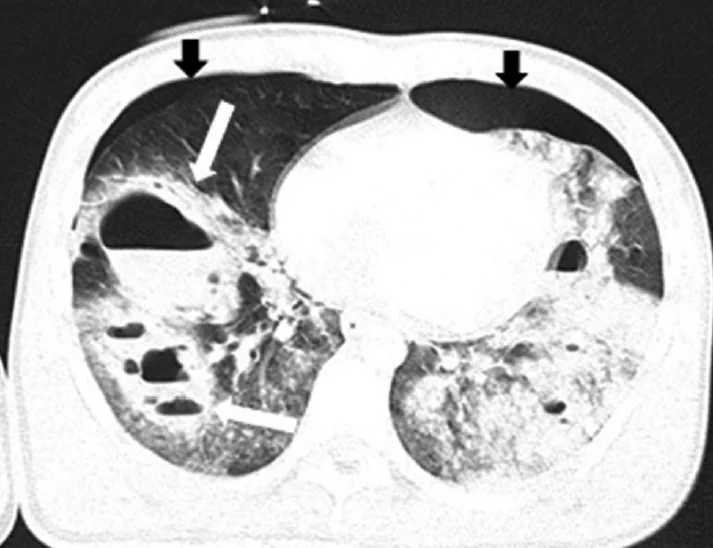
- Akciğer kontüzyonu, künt toraks travması sonrası en sık görülen yaralanmadır ve BT ile net olarak tanımlanabilir.
- BT, akciğer laserasyonlarını tanımada ideal yöntemlerden biridir; çocuklarda travmatik pnömatozellerin saptanmasında en duyarlı yöntemdir ve bu lezyonlar genellikle konservatif tedavi edilir.
- BT'de saptanan okült pnömotoraks genellikle gözlemle yönetilir; stabil hastalarda yönetim, pnömotoraksın boyutuna göre de değişebilir.
- Hemotoraks künt toraks travmasında görülebilir ve BT ile değerlendirilebilir.
- Hemopnömotoraks, plevral boşlukta hem hava hem sıvı bulunmasıdır.
- Kaburga kırıkları, BT ve çok düzlemli rekonstrüksiyonlarla değerlendirilebilir.
- Aktif damar kaçağı ve yalancı anevrizma, kanama kuşkusunda kontrastlı BT ile saptanabilir.
Normalde
Akciğer kontüzyonları çocuklarda sık görülen toraks yaralanmalarındandır ve BT ile değerlendirilebilir. Akciğer laserasyonları, BT ile saptanabilen toraks yaralanmaları arasındadır. Kaburga kırıkları ince kesit ve çok düzlemli rekonstrüksiyonlarda izlenir.
Normal BT ile kıyasla
Aynı bölgenin, kaynak veri setinde patoloji içermediği belirtilen bir BT incelemesini kesit kesit kaydırın; organ sınırlarını açarak anatomiyi hasta görüntüsüyle karşılaştırın. Küçük rastlantısal bulgular tümüyle dışlanmamıştır.
Kaynak: TotalSegmentator v2.01 veri seti (Wasserthal ve ark., Radiology: Artificial Intelligence 2023), CC BY 4.0, vaka s1278; organ sınırları veri setinin otomatik segmentasyonundan, birleştirilerek sadeleştirildi. Görüntüler 2,5 mm kesit aralığına yeniden örneklendi.
Ayırıcı tanı
- Travmaya bağlı akciğer opasitelerinin değerlendirilmesinde travmanın niteliği, çocuğun klinik durumu ve ilk radyografi bulguları dikkate alınır.
- Akciğer laserasyonu ve kontüzyon, travmatik akciğer yaralanmalarının ayrı bileşenleridir ve BT ile birlikte değerlendirilmelidir.
- Travma sonrası plevral sıvı birikiminde hemotoraks ayırıcı tanıda yer alır ve BT ile değerlendirilebilir.
Tuzaklar
- Akciğer kontüzyonu çocuklarda sık görülen toraks yaralanmalarındandır ve BT toraks boşluğu yaralanmalarının tanısında yüksek duyarlılıklı bir araçtır.
- Gizli (okült) pnömotoraks ve hemotoraks BT ile saptanabilir ve genellikle yalnızca gözlemle yönetilir.
- BT ile saptanan ek travma bulgularının yalnızca küçük bir bölümü girişim, ameliyat ya da klinik yönetim değişikliğine yol açar.
- Aktif damar kaçağı ve yalancı anevrizma, kontrastlı BT ile saptanabilen ciddi travma bulgularıdır ve doğru yorumlanmalıdır.
Kendini dene
Çocuklarda künt toraks travmasında bildirilen en sık toraks yaralanması hangisidir?
Cevabı göster
Akciğer kontüzyonu. Çocuklarda bildirilen en sık toraks yaralanması akciğer kontüzyonudur.
Stabil çocuk hastada BT'de saptanan okült pnömotoraksta genellikle tercih edilen yönetim nedir?
Cevabı göster
Gözlem (analjezi ve izlem). BT'de saptanan okült pnömotoraks ve hemotoraks genellikle yalnızca gözlemle yönetilir; stabil hastada drenaj kararı pnömotoraksın boyutuna göre değişebilir.
Bu konunun yer aldığı turlar
İlgili konular
Kaynaklar
Bu sayfadaki 34 cümle ve 2 quiz sorusu aşağıdaki kaynaklardan alıntılarla otomatik olarak karşılaştırıldı; 20 cümle bu karşılaştırmada düzeltildi (2026-10-12).
- Emergency Department Imaging of Pediatric Patients with Blunt Thoracic Trauma: A Systematic Review, Meta-Analysis, and Practice Management Guidelinepmc.ncbi.nlm.nih.gov
- Chest trauma in children: current imaging guidelines and techniques.pubmed.ncbi.nlm.nih.gov
- Use of Chest Computed Tomography for Blunt Pediatric Chest Trauma: Does It Change Clinical Course?pubmed.ncbi.nlm.nih.gov
- Thoracic Ultrasound in Pediatric Chest Trauma: Beyond the Basics.pubmed.ncbi.nlm.nih.gov
- Review, monitor, educate: A quality improvement initiative for sustained chest radiation reduction in pediatric trauma patients.pubmed.ncbi.nlm.nih.gov
- Management of Children and Adolescents with Chest Trauma in Pediatric and Non-Pediatric Departments-A Claims Data Analysis.pubmed.ncbi.nlm.nih.gov
- Use of extracorporeal membrane oxygenation for pediatric post-traumatic pulmonary hemorrhage: A Case report and literature review.pubmed.ncbi.nlm.nih.gov
- Diagnosis and management of Aspergillus diseases: executive summary of the 2017 ESCMID-ECMM-ERS guideline.pubmed.ncbi.nlm.nih.gov
- Consensus statement on abusive head trauma in infants and young children.pubmed.ncbi.nlm.nih.gov
- Tracheal damage.pubmed.ncbi.nlm.nih.gov
- Diagnostic Imaging in pediatric thoracic trauma.pubmed.ncbi.nlm.nih.gov
- Pediatric tracheal trauma.pubmed.ncbi.nlm.nih.gov
- Blunt Traumatic Diaphragmatic Hernia in Children: A Systematic Review.pubmed.ncbi.nlm.nih.gov
- Imaging features and differential diagnoses of non-neoplastic diffuse mediastinal diseases.pubmed.ncbi.nlm.nih.gov
- ACR Appropriateness Criteria® Major Blunt Trauma.pubmed.ncbi.nlm.nih.gov
- Pneumothorax and Hemothorax: Practical Approaches for Radiologists.pubmed.ncbi.nlm.nih.gov
- Relation Between Injury Severity and Fractures of the First and/or Second Ribs in Blunt Chest Trauma at a Community-Based Hospital: A Retrospective Study.pubmed.ncbi.nlm.nih.gov
- Comparative clinical study of total thoracoscopic surgery and thoracoscopy-assisted small-incision surgery for multiple rib fractures.pubmed.ncbi.nlm.nih.gov
- Computed Tomography-Verified Deep Learning Model for Rib Fracture Prediction and Complication Association from Chest Radiographs.pubmed.ncbi.nlm.nih.gov
- Point-of-care ultrasound in trauma: a systematic review of recent literature.pubmed.ncbi.nlm.nih.gov
- Beyond the Usual Course: A Rare Case of Persistent Traumatic Pulmonary Pneumatoceles With 8-Year Favorable Evolution.pubmed.ncbi.nlm.nih.gov
- Size-specific dose estimation in pediatric computed tomography: From dose characterization to individualized optimization.pubmed.ncbi.nlm.nih.gov
- Imaging Pathways in Pediatric Thoracic Trauma: FAST-First Triage and Selective CT Escalation in Clinical Practice.pubmed.ncbi.nlm.nih.gov
- Lung biopsy strategies for childhood interstitial lung disease: Indications and techniques.pubmed.ncbi.nlm.nih.gov
- Bilateral Ultrasound-Guided Transversus Thoracic Plane Block as Part of a Multimodal Analgesic Plan in Two Rabbits Undergoing Median Sternotomy.pubmed.ncbi.nlm.nih.gov
- Advances and Challenges in Obstetric Intensive Care Medicine.pubmed.ncbi.nlm.nih.gov
- Postmortem CT: Applications in Clinical and Forensic Medicine.pubmed.ncbi.nlm.nih.gov
- The Interface of Trauma Surgery and Interventional Radiology: The Trauma Surgeon's Perspective.pubmed.ncbi.nlm.nih.gov
- Guidelines for Enhanced Recovery After Trauma and Intensive Care (ERATIC): Enhanced Recovery After Surgery (ERAS) Society and International Association of Trauma Surgery and Intensive Care (IATSIC) Recommendations: Paper 1: Initial Care-Pre and Intraoperative Care Until ICU, Including Non-Operative Management.pubmed.ncbi.nlm.nih.gov
- A pictorial essay of thoracic wall diseases: multiple pathologies in the same anatomical site.pubmed.ncbi.nlm.nih.gov
- CPR related injuries of the chest wall: direct and indirect fractures.pubmed.ncbi.nlm.nih.gov
- Traumatic Pulmonary Pseudocysts in a Young Dog Following Non-penetrating Blunt Thoracic Trauma.pubmed.ncbi.nlm.nih.gov
- Traumatic pneumatocele in an 11-year-old boy - report of a rare case and review of the literature.pubmed.ncbi.nlm.nih.gov
- Solitary round pulmonary lesions in the pediatric population: a pictorial review.pubmed.ncbi.nlm.nih.gov
- Spinnaker-sail sign in full-term neonates with spontaneous pneumomediastinum: a case study and scoping literature review.pubmed.ncbi.nlm.nih.gov
- Thoracic trauma WSES-AAST guidelines.pubmed.ncbi.nlm.nih.gov
- The Incremental Role of Multiorgan Point-of-Care Ultrasounds in the Emergency Setting.pubmed.ncbi.nlm.nih.gov
- Emergency Department Imaging of Pediatric Patients with Blunt Thoracic Trauma: A Systematic Review, Meta-Analysis, and Practice Management Guideline.pubmed.ncbi.nlm.nih.gov
- An Unanticipated Diagnosis in a Child with Blunt Chest Trauma.pubmed.ncbi.nlm.nih.gov
- Esophageal Perforation and Fistulization After Ingestion of Multiple Foreign Bodies: A Case Report.pubmed.ncbi.nlm.nih.gov
- Acute management of spinal fractures: What you need to know.pubmed.ncbi.nlm.nih.gov
- Computed tomography of renal emergencies: A comprehensive diagnostic guide for radiology residents.pubmed.ncbi.nlm.nih.gov
- Computed tomography of pediatric abdominal trauma: optimizing utilization and enhancing diagnostic interpretation.pubmed.ncbi.nlm.nih.gov
- Esophageal Perforation During Dilation in a Patient With Hypopharyngeal Metastatic Squamous Cell Carcinoma.pubmed.ncbi.nlm.nih.gov
- Case Report: Quantitative multimodal imaging for surgical planning in isolated pulmonary artery sling.pubmed.ncbi.nlm.nih.gov
- Lung ultrasound for the diagnosis of subpleural consolidations - a review of the veterinary and human literature.pubmed.ncbi.nlm.nih.gov
- Thoracic Inlet in Cervical Spine CT of Blunt Trauma Patients: Prevalence of Pathologies and Importance of CT Interpretation.pubmed.ncbi.nlm.nih.gov
- Surgical stabilization of rib fractures (SSRF): the WSES and CWIS position paper.pubmed.ncbi.nlm.nih.gov
- Diagnostic challenges of a giant cerebral cavernous malformation mimicking a glioma in a 16-year-old male.pubmed.ncbi.nlm.nih.gov
- Conservative Treatment of Pediatric Fractures-Narrative Review of Acceptable Deformity and Remodeling Potential.pubmed.ncbi.nlm.nih.gov
- Optimizing transducer choice for the detection of alveolar-interstitial syndrome in dogs and cats: an evidence-based review.pubmed.ncbi.nlm.nih.gov
- Current Insights into Clinical, Molecular, and Therapeutic Approaches to Acute Respiratory Distress Syndrome.pubmed.ncbi.nlm.nih.gov
- ARDS and corticosteroids: beyond COVID-19.pubmed.ncbi.nlm.nih.gov
- Imaging techniques in veterinary medicine . Part II: Computed tomography, magnetic resonance imaging, nuclear medicine.pubmed.ncbi.nlm.nih.gov
- Nosocomial Pneumonia in the Era of Multidrug-Resistance: Updates in Diagnosis and Management.pubmed.ncbi.nlm.nih.gov
- Prognostic Factors of Mortality and Clinical Characteristics of Patients Surgically Treated for Blunt Liver Injury-A Single-Center Experience.pubmed.ncbi.nlm.nih.gov
- Point-of-Care Ultrasound in Blunt Chest Trauma: Diagnostic Performance and Clinical Relevance.pubmed.ncbi.nlm.nih.gov
- The 2023 WSES guidelines on the management of trauma in elderly and frail patients.pubmed.ncbi.nlm.nih.gov
- SPOT THE BOT: A comparative quality assessment of AI-generated written instructions for lung ultrasound training.pubmed.ncbi.nlm.nih.gov
- A Narrative Review of Biomarkers and Imaging in the Diagnosis of Acute Aortic Syndrome.pubmed.ncbi.nlm.nih.gov
- Tips and Tricks in Thoracic Radiology for Beginners: A Findings-Based Approach.pubmed.ncbi.nlm.nih.gov
- Commentary: an eye on PET quantification.pubmed.ncbi.nlm.nih.gov
- Preliminary investigation of the clinical value of thoracic ultrasound in pediatric pleuropulmonary blastoma: a comparative analysis with computed tomography and pathology.pubmed.ncbi.nlm.nih.gov
- Can lung ultrasound replace chest computed tomography in pediatric patients with complicated community-acquired pneumonia?pubmed.ncbi.nlm.nih.gov
- Medial Clavicle Physeal Fracture in a 15-Year-Old Male: A Case Report.pubmed.ncbi.nlm.nih.gov
- Contrast-enhanced ultrasound (CEUS) in urgent and emergent pediatric conditions: a comprehensive review.pubmed.ncbi.nlm.nih.gov
- Dual-Network Protein Hydrogels Promote Rapid Hemostasis and Immune-Regulated Scarless Tissue Regeneration.pubmed.ncbi.nlm.nih.gov
- High-affinity alphavbeta3 integrin targeted optical probe as a new imaging biomarker for early atherosclerosis: initial studies in Watanabe rabbits.pubmed.ncbi.nlm.nih.gov
- Nontrombotic Pulmonary Embolism: Different Etiology, Same Significant Consequences.pubmed.ncbi.nlm.nih.gov
- Current Diagnostic Techniques for Pneumonia: A Scoping Review.pubmed.ncbi.nlm.nih.gov
- Bioengineering and Clinical Translation of Human Lung and its Components.pubmed.ncbi.nlm.nih.gov
- Diagnostic accuracy of transthoracic ultrasound for detection of pneumothorax, hemothorax, and lung contusion in trauma patients: comparison with chest radiography.pubmed.ncbi.nlm.nih.gov
- Intralobar Pulmonary Sequestration Presenting as Hemothorax Secondary to Spontaneous Pneumothorax: Case Report and Literature Review.pubmed.ncbi.nlm.nih.gov
- Blunt trauma related chest wall and pulmonary injuries: An overview.pubmed.ncbi.nlm.nih.gov
- Pictorial essay of radiological features of benign intrathoracic masses.pubmed.ncbi.nlm.nih.gov
- Severe trauma care: advances and future directions in diagnostic and therapeutic techniques and information technology support.pubmed.ncbi.nlm.nih.gov
- A Systematic Literature Review of You Only Look Once Architectures (v1-v12) in Healthcare Systems.pubmed.ncbi.nlm.nih.gov
- Emergency repair of complete right main bronchial transection after blunt chest trauma: a case report.pubmed.ncbi.nlm.nih.gov
- Lung parenchymal trauma biomechanics, mechanisms, and classification: a narrative review of the current knowledge.pubmed.ncbi.nlm.nih.gov
- Bronchial Dieulafoy disease: A case report and literature review.pubmed.ncbi.nlm.nih.gov
- The Diagnosis and Management of Pediatric Blunt Abdominal Trauma-A Comprehensive Review.pubmed.ncbi.nlm.nih.gov
- Extensive cervicofacial-to-scrotal subcutaneous emphysema without pneumothorax following pediatric blunt thoracic trauma: a case report.pubmed.ncbi.nlm.nih.gov
- Hospital Disaster Preparedness and Response to a Pediatric Mass Casualty Incident in Central India: A Retrospective Quality Improvement Analysis.pubmed.ncbi.nlm.nih.gov
- 2025 Practice-changing articles in trauma, emergency general surgery, pediatric trauma, and surgical critical care: an EAST narrative review.pubmed.ncbi.nlm.nih.gov
- Development of a novel clinical decision support tool for determining the need for whole-body computed tomography in pediatric trauma patients: the WHOLE score.pubmed.ncbi.nlm.nih.gov
- Applications of deep learning in trauma radiology: A narrative review.pubmed.ncbi.nlm.nih.gov
- Radiology and A Radiologist: A Keystone in the Turmoil of Trauma Setting.pubmed.ncbi.nlm.nih.gov
- Computed Tomography of the Chest in Younger Pediatric Patients with Thoracic Blunt Trauma Rarely Changes Surgical Management.pubmed.ncbi.nlm.nih.gov
- Impact of early arterial-phase multidetector CT in blunt spleen injury: a clinical outcomes-oriented study.pubmed.ncbi.nlm.nih.gov
- Blunt Traumatic Tracheobronchial Injury: a Clinical Pathway.pubmed.ncbi.nlm.nih.gov
- Spontaneous pseudoaneurysm of a profunda femoris artery perforator in a pediatric patient.pubmed.ncbi.nlm.nih.gov
- Successful Endovascular Treatment of Traumatic Renal Artery Thrombosis and Dissection Associated with Liver Injury: A Case Report.pubmed.ncbi.nlm.nih.gov
- Management and outcomes of congenital pulmonary airway malformations and bronchopulmonary sequestrations diagnosed in the fetal period.pubmed.ncbi.nlm.nih.gov
- Towards a more realistic anthropomorphic chest phantom using 3D-printed and cork-integrated components.pubmed.ncbi.nlm.nih.gov
- The utility of three-dimensional computed tomography bronchography and angiography technology in pulmonary sequestration surgery.pubmed.ncbi.nlm.nih.gov
- Tension Gastrothorax in a Child With Undiagnosed Congenital Diaphragmatic Hernia: A Case Report and Proposed Emergency Management Algorithm.pubmed.ncbi.nlm.nih.gov
- CT-guided Preoperative Localization of Impalpable Pulmonary Nodules: Comparison Between Two Devices.pubmed.ncbi.nlm.nih.gov
- Clinical comparison of radiofrequency ablation and surgical resection in treating pulmonar metastasis of hepatoblastoma.pubmed.ncbi.nlm.nih.gov
- Imaging of pediatric musculoskeletal trauma: Age-specific considerations and challenges.pubmed.ncbi.nlm.nih.gov
- Three-year emergency department analysis of clavicle fractures: Age- and sex-dependent patterns and associated injuries.pubmed.ncbi.nlm.nih.gov
- Deep learning and hybrid architectures for atypical and complex bone fracture diagnosis: a systematic review of performance and clinical validity.pubmed.ncbi.nlm.nih.gov
- Millimeters from catastrophe: The pericardium as a lifesaving shield.pubmed.ncbi.nlm.nih.gov
- Traumatic aortic isthmus transection with pseudoaneurysm formation and massive mediastinal hematoma: management challenges in resource-limited countries: case report.pubmed.ncbi.nlm.nih.gov
- Massive Bochdalek Hernia in an Adult Presenting With Cardiac Arrhythmias: A Case Report.pubmed.ncbi.nlm.nih.gov
- Prevalence of Central Airway Anatomical Variations and Structural Abnormalities Using Virtual Bronchoscopy: A Retrospective Study From a Tertiary Care Center.pubmed.ncbi.nlm.nih.gov
- Case Report: MRSA sepsis after pediatric traumatic pseudoaneurysm.pubmed.ncbi.nlm.nih.gov
- Unveiling Rare Pulmonary Complications in Infective Endocarditis: Pneumatoceles and Pneumothorax in a Case Series With Contextual Literature Review.pubmed.ncbi.nlm.nih.gov
- Perioperative POCUS: Technical Considerations and Applications for the Pediatric Anesthesiologist.pubmed.ncbi.nlm.nih.gov
- Cervical spine clearance in pediatric trauma patients - Consensus algorithm of the Pediatric Spinal Trauma Group of the Spine Section of the German Society for Orthopedic and Trauma Surgery (DGOU).pubmed.ncbi.nlm.nih.gov
- Biomechanics of chest wall injury: implications for surgical stabilization and failure prevention.pubmed.ncbi.nlm.nih.gov
- <i>Streptococcus intermedius</i> lung abscess in children: a case report and literature review.pubmed.ncbi.nlm.nih.gov
Eğitim amaçlıdır; hasta başında tanı ve tedavi kararının yerine geçmez, tıbbi tavsiye değildir. Metinler yapay zekâ desteğiyle yazıldı ve otomatik bir adımda kaynak alıntılarıyla karşılaştırıldı; bu bir tıbbi doğrulama değildir ve içerik uzman radyolog incelemesinden geçmedi. Klinik kararlarda güncel kılavuzları, kurum protokollerini ve radyoloji raporunu esas alın.