Özet
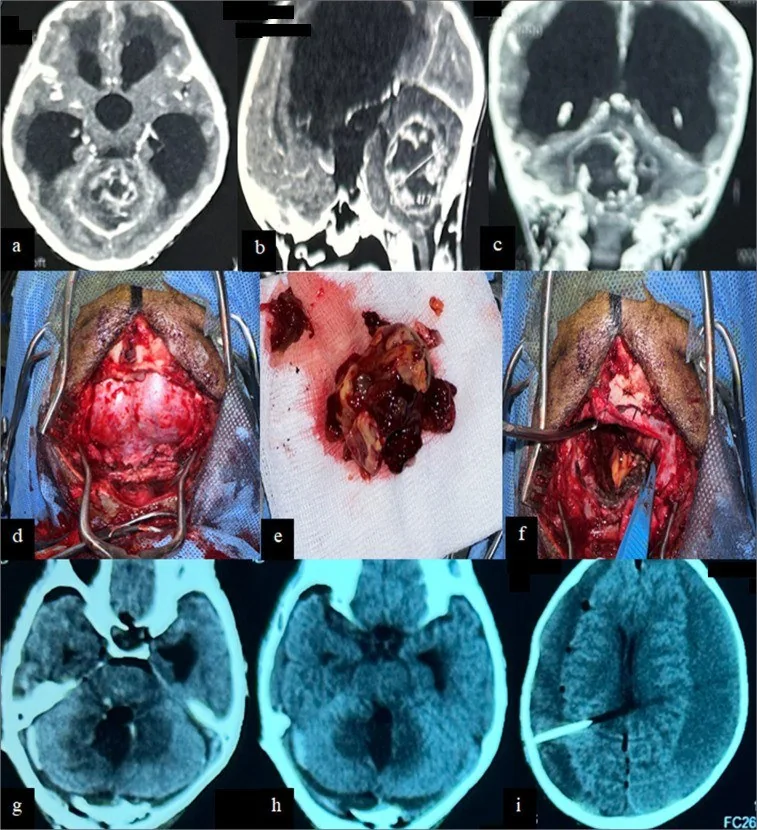
Çocukluk çağında posterior fossa kitleleri dördüncü ventrikülü veya BOS çıkış yollarını daraltarak obstrüktif hidrosefaliyle ortaya çıkabilir. BT, pediatrik beyin tümörlerinin ön tanı ve karakterizasyonunda kitle yerleşimi, yoğunluk özellikleri ve çevre yapılar üzerine etkileri açısından değerli bir yöntemdir. Medulloblastom, ependimom ve pilositik astrositomun BT görünümleri örtüşür; tümör tipini belirlemek için MR ve doku tanısı gerekir. Dördüncü ventrikül basısı BOS akımını bozarak obstrüktif hidrosefaliye yol açabilir.
Faz ve pencere
- Kontrastsız tanısal
- Posterior fossa kitle atenüasyonu, kaba kalsifikasyon veya kanama, dördüncü ventrikülün yer değiştirmesi/dolması ve supratentoryal ventrikül genişlemesi incelenir. Posterior fossa artefaktları, özellikle beyin sapı ve derin serebellar lezyonların BT’de saptanmasını güçleştirebilir.
Önerilen pencereler: Beyin (G 80 / M 40), Kemik (G 1800 / M 400).
BT bulguları
- Serebellar vermis, hemisfer, dördüncü ventrikül veya beyin sapı merkezli kitle odağını belirle.
- Dördüncü ventrikülün öne itilmesi, genişlemesi ya da tümörle dolması kitle komşuluğunu gösterir.
- Akuadukt ve sisterna magna çevresindeki BOS boşluklarında silinme veya daralma ara.
- Medulloblastom, yüksek hücre yoğunluğuna bağlı olarak BT’de hiperdens görünebilir.
- Ependimom dördüncü ventrikül içinde şekillenen ve çıkış açıklıklarına uzanabilen heterojen bir kitle olabilir.
- Pilositik astrositom serebellar hemisferde kistik bileşen ve mural solid odakla görülebilir.
- Ventrikülomegali, transependimal ödem ve bazal sistern basısı obstrüktif hidrosefalinin eşlikçileri olabilir.
Normalde
Kitle tarafında dördüncü ventrikülün biçim ve konum değişikliği, çevre sisternlerin silinmesi ve lateral ventrikül genişlemesiyle kıyasla.
Normal BT ile kıyasla
Aynı bölgenin, kaynak veri setinde patoloji içermediği belirtilen bir BT incelemesini kesit kesit kaydırın; organ sınırlarını açarak anatomiyi hasta görüntüsüyle karşılaştırın. Küçük rastlantısal bulgular tümüyle dışlanmamıştır.
Kaynak: TotalSegmentator v2.01 veri seti (Wasserthal ve ark., Radiology: Artificial Intelligence 2023), CC BY 4.0, vaka s0103; organ sınırları veri setinin otomatik segmentasyonundan, birleştirilerek sadeleştirildi. Görüntüler 2,5 mm kesit aralığına yeniden örneklendi.
Ayırıcı tanı
- Beyin sapı gliomu
- ekspansil kitle pons merkezindedir; dördüncü ventrikül arkaya (posteriora) itilmiş veya basılanmış olabilir.
- Atipik teratoid/rabdoid tümör
- küçük çocukta heterojen posterior fossa kitlesi olarak medulloblastomu taklit edebilir.
- Kontrastlı görüntülemede halka şeklinde kontrastlanma ve çevresinde ödem oluşturabilen enfeksiyonel bir lezyondur.
- Serebellar hemoraji
- akut kan yoğunluğu ve çevresinde ödem ile dördüncü ventrikülü basabilir.
Tuzaklar
- Posterior fossa artefaktları lezyon saptanmasını güçleştirebilir; beyin sapı ve derin serebellar bölgeleri dikkatle gözden geçir.
- Dördüncü ventrikül basısı tek başına tümör tipini ayırt ettirmez; kitle merkezi ve iç yapısı birlikte okunur.
- Kistik bileşen ve mural solid nodül pilositik astrositomu destekleyebilir ama özgül değildir; nodülün kontrastlanması kontrastlı MR'da değerlendirilir. Kontrastsız BT bulguları tümör tipine ilişkin ipuçları sağlar; farklı histolojik tümör tiplerini ayırt etmede MR ek bilgi ve tanısal güven sağlayabilir.
Kendini dene
Posterior fossa kitlesi ve ventriküler genişleme birlikte görüldüğünde hangi komplikasyon öncelikle düşünülmelidir?
Cevabı göster
Obstrüktif hidrosefali. Posterior fossa kitleleri obstrüktif hidrosefaliye yol açabilir. İleri görüntüleme teknikleri histolojik ve moleküler alt grubu tahmin etmede yardımcı olur, ancak kesin tanı dokusal ve genetik analize dayanır.
Dördüncü ventrikül çevresinden başlayıp Luschka açıklıklarından komşu sisternalara uzanan kitle hangi tümörle daha uyumludur?
Cevabı göster
Ependimom. Ependimomlar çoğunlukla dördüncü ventrikül içinde veya yakınında gelişir ve Luschka açıklıklarından komşu sisternalara uzanabilir. Bu yerleşim tanısal ipucudur; tümör tipini belirlemek için MR değerlendirmesi önemlidir.
İlgili konular
Kaynaklar
Bu sayfadaki 33 cümle ve 2 quiz sorusu aşağıdaki kaynaklardan alıntılarla otomatik olarak karşılaştırıldı; 11 cümle bu karşılaştırmada düzeltildi (2026-10-09).
- Posterior fossa tumors in children: An update and new conceptspmc.ncbi.nlm.nih.gov
- Infratentorielle Hirntumoren bei Kindernpmc.ncbi.nlm.nih.gov
- Imaging of brain tumors in children: the basics—a narrative reviewpmc.ncbi.nlm.nih.gov
- Posterior Fossa Tumors.pubmed.ncbi.nlm.nih.gov
- Role of computed tomography in the evaluation of pediatric brain tumor.pubmed.ncbi.nlm.nih.gov
- Giant Posterior Fossa Tuberculoma Mimicking Atypical Teratoid/Rhabdoid Tumor in a Child: Illustrative Case.pubmed.ncbi.nlm.nih.gov
- Acute fulminant cerebellitis in children: a case series and literature review on diagnostic challenges and management strategies.pubmed.ncbi.nlm.nih.gov
- Surgical resection of a solid posterior cranial fossa hemangioblastoma causing obstructive hydrocephalus in a pediatric patient.pubmed.ncbi.nlm.nih.gov
- Incidentally Discovered Cerebellar Ganglioglioma in an Adult Following a Motor Vehicle Accident: A Case Report and Literature Review.pubmed.ncbi.nlm.nih.gov
- Giant Craniopharyngioma Complicated by Cerebrospinal Fluid Ascites in a 7-Year-Old Boy: A Case Report and Review of Literature.pubmed.ncbi.nlm.nih.gov
- Insights into Accelerated MRI Protocols for Pediatric Brain Assessment in Emergency Cases.pubmed.ncbi.nlm.nih.gov
- Pilocytic Astrocytoma Causing Brainstem Compression in Pregnancy: Case Report with Literature Review.pubmed.ncbi.nlm.nih.gov
- PLAG1 fusions define a third subtype of CNS embryonal tumor with PLAG family gene alteration.pubmed.ncbi.nlm.nih.gov
- Advancing Brain Tumor Diagnosis Using Deep Learning: A Systematic and Critical Review on Methodological Approaches to Glioma Segmentation and Classification Through Multiparametric MRI.pubmed.ncbi.nlm.nih.gov
- Outcomes of endoscopic third ventriculostomy in comparison to ventriculoperitoneal shunt in obstructive hydrocephalus - A randomized controlled trial.pubmed.ncbi.nlm.nih.gov
- The Collapse of Brain Clearance: Glymphatic-Venous Failure, Aquaporin-4 Breakdown, and AI-Empowered Precision Neurotherapeutics in Intracranial Hypertension.pubmed.ncbi.nlm.nih.gov
- When Pediatric Headaches Are Not Benign-Eye Findings.pubmed.ncbi.nlm.nih.gov
- Imaging of supratentorial intraventricular masses in children:a pictorial review- part 1.pubmed.ncbi.nlm.nih.gov
- Pediatric Meningeal Diseases: What Radiologists Need to Know.pubmed.ncbi.nlm.nih.gov
- Where Does the Signal Go? Technical Challenges of CT Perfusion in Lacunar and Infratentorial Stroke.pubmed.ncbi.nlm.nih.gov
- Understanding Photon-Counting CT: Physics, Detector Technology, and Image Reconstructions.pubmed.ncbi.nlm.nih.gov
- Multimodal imaging in neuro-ophthalmology.pubmed.ncbi.nlm.nih.gov
- Microsurgical outcomes and prognostic analysis of cerebellar gliomas; pathology, molecular biomarkers, and novel clinical insights: a retrospective study.pubmed.ncbi.nlm.nih.gov
- Preoperative Cerebellar Mutism Syndrome in an Adult Female With a Fourth Ventricle Epidermoid Cyst: A Case Report and Review of the Literature.pubmed.ncbi.nlm.nih.gov
- Intraoperative seizure in the setting of tumor resection: illustrative cases.pubmed.ncbi.nlm.nih.gov
- Fourth Ventricle Epidermoid Cyst: Case Report of Precision Telovelar Microsurgery, Functional Preservation, and Lifelong Surveillance.pubmed.ncbi.nlm.nih.gov
- Transcatheter Edge-to-Edge Repair in Adult Congenital Heart Disease: Anatomic Challenges, Device Adaptations, and Emerging Evidence.pubmed.ncbi.nlm.nih.gov
- Anatomically Precise Microsurgical Resection of a Posterior Fossa Cerebellar Metastasis in an Elderly Patient with Preservation of Venous Outflow, Dentate Nucleus, and Cerebrospinal Fluid Pathways.pubmed.ncbi.nlm.nih.gov
- Clinical Applications of Fetal MRI in the Brain.pubmed.ncbi.nlm.nih.gov
- The value of CSF flow studies in the management of CSF disorders in children: a pictorial review.pubmed.ncbi.nlm.nih.gov
- Cerebellar Tuberculoma as a Rare Manifestation of Central Nervous System Tuberculosis: Literature Review and Clinical Case.pubmed.ncbi.nlm.nih.gov
- Extra axial medulloblastoma of the cerebellopontine angle: A rare case report.pubmed.ncbi.nlm.nih.gov
- Treatment strategies for relapsed medulloblastoma in the pediatric population: illustrative case.pubmed.ncbi.nlm.nih.gov
- MRI Differentiation of Anaplastic Ependymoma and Medulloblastoma with Fourth Ventricular Outlet Extension in Children.pubmed.ncbi.nlm.nih.gov
- An Illustrated Scoping Review of the Magnetic Resonance Imaging Characteristics of Canine and Feline Brain Tumors.pubmed.ncbi.nlm.nih.gov
- Cerebellopontine angle tumors in infants and children.pubmed.ncbi.nlm.nih.gov
- Comparative study on imaging characteristics of pilocytic astrocytomas in children and adolescents.pubmed.ncbi.nlm.nih.gov
- Case Report: A case series of Lhermitte-Duclos disease with surgical intervention.pubmed.ncbi.nlm.nih.gov
- Cranial ultrasound for beginners.pubmed.ncbi.nlm.nih.gov
- The spectrum of brain malformations and disruptions in twins.pubmed.ncbi.nlm.nih.gov
- Mesenchymal tumors of the central nervous system: illustrative case.pubmed.ncbi.nlm.nih.gov
- Diagnostic Approach to Macrocephaly in Children.pubmed.ncbi.nlm.nih.gov
- Infantile brainstem tumors presenting with recurrent pneumonia and dysphagia: a report of two cases and literature review.pubmed.ncbi.nlm.nih.gov
- Benign brainstem tumors in children: a retrospective series of 42 patients treated in Lyon.pubmed.ncbi.nlm.nih.gov
- Cerebello-Pontine Angle Tumors in Children: An Update on Challenging Neoplasms.pubmed.ncbi.nlm.nih.gov
- Atypical Teratoid/Rhabdoid Tumor of the Posterior Fossa Mimicking Medulloblastoma in an Infant: A Case Report.pubmed.ncbi.nlm.nih.gov
- Advances in the Repurposing and Blood-Brain Barrier Penetrance of Drugs in Pediatric Brain Tumors.pubmed.ncbi.nlm.nih.gov
- Pediatric CNS tumors and 2021 WHO classification: what do oncologists need from pathologists?pubmed.ncbi.nlm.nih.gov
- Central Nervous System Tuberculoma in Qatar: Clinical, Radiological, and Pathological Insights From a Rare Case With Literature Review.pubmed.ncbi.nlm.nih.gov
- Imaging diagnosis of cystic intraparenchymal brain neoplasms.pubmed.ncbi.nlm.nih.gov
- An unusual case of invasive rhino-cerebral aspergillosis in a pediatric patient: A case report with diagnostic approach and imaging review.pubmed.ncbi.nlm.nih.gov
- The retrosigmoid trans-middle cerebellar peduncle approach for pontine cavernous malformations: multicenter experience.pubmed.ncbi.nlm.nih.gov
- Multifocal intracranial hemorrhage on emergency brain CT in a child with end-stage nephrotic syndrome.pubmed.ncbi.nlm.nih.gov
- Posterior fossa dynamic craniotomy utilizing NuCrani reversibly expandable bone flap fixation plates: patient series.pubmed.ncbi.nlm.nih.gov
- Suprasellar Desmoplastic Infantile Ganglioglioma in a 7-Month-Old Infant: A Rare Diagnostic Consideration in Infant Suprasellar Masses.pubmed.ncbi.nlm.nih.gov
- Thoracic metastasis of a pediatric posterior fossa group A ependymoma: a rare case and literature review.pubmed.ncbi.nlm.nih.gov
- A concise history of skull base surgery: what is its contribution to neurosurgery?pubmed.ncbi.nlm.nih.gov
- First reported case in Brazil of intraventricular pilocytic astrocytoma in an adult patient with literature review.pubmed.ncbi.nlm.nih.gov
- Polymorphous low-grade neuroepithelial tumor of the young: case report and literature review.pubmed.ncbi.nlm.nih.gov
- Adenoid cystic carcinoma of the external auditory canal with metastasis to the cerebellopontine angle mimicking vestibular schwannoma: a case report and literature review.pubmed.ncbi.nlm.nih.gov
- A Radiologist's Guide to IDH-Wildtype Glioblastoma for Efficient Communication With Clinicians: Part I-Essential Information on Preoperative and Immediate Postoperative Imaging.pubmed.ncbi.nlm.nih.gov
- Clival and Paraclival Lesions: A Pictorial Review.pubmed.ncbi.nlm.nih.gov
- Blind spots in brain imaging: a pictorial essay.pubmed.ncbi.nlm.nih.gov
- Society for Cardiovascular Magnetic Resonance/European Society of Cardiovascular Imaging/American Society of Echocardiography/Society for Pediatric Radiology/North American Society for Cardiovascular Imaging Guidelines for the Use of Cardiac Magnetic Resonance in Pediatric Congenital and Acquired Heart Disease: Endorsed by The American Heart Association.pubmed.ncbi.nlm.nih.gov
- Society for Cardiovascular Magnetic Resonance/European Society of Cardiovascular Imaging/American Society of Echocardiography/Society for Pediatric Radiology/North American Society for Cardiovascular Imaging Guidelines for the use of cardiovascular magnetic resonance in pediatric congenital and acquired heart disease : Endorsed by The American Heart Association.pubmed.ncbi.nlm.nih.gov
- An Integrated Approach on the Diagnosis of Cerebral Veins and Dural Sinuses Thrombosis (a Narrative Review).pubmed.ncbi.nlm.nih.gov
- Imaging of cranial nerves: a pictorial overview.pubmed.ncbi.nlm.nih.gov
- The Role of the Craniocervical Junction in Craniospinal Hydrodynamics and Neurodegenerative Conditions.pubmed.ncbi.nlm.nih.gov
- Neuroimaging in inborn errors of immunity: More than infections.pubmed.ncbi.nlm.nih.gov
- Cryptococcal Meningitis in an Immunocompetent Patient With an Initially False-Negative Cerebrospinal Fluid Analysis: A Case Report.pubmed.ncbi.nlm.nih.gov
- The value of cerebrospinal fluid cytology in the diagnosis of atypical medulloblastoma: a case report and review of the literature.pubmed.ncbi.nlm.nih.gov
- Acute management of spontaneous intracerebral hemorrhage (ICH) in the emergency department.pubmed.ncbi.nlm.nih.gov
- Lumbar puncture-induced negative-pressure hydrocephalus in a child with a ventriculoperitoneal shunt and ventricular obstruction: illustrative case.pubmed.ncbi.nlm.nih.gov
- Telovelar Approach for Fourth-Ventricular Epidermoid Cyst: Anatomical Respect, Functional Recovery, and Long-Term Stability.pubmed.ncbi.nlm.nih.gov
- Early post-operative hydrocephalus following retrosigmoid vestibular schwannoma resection: Incidence, clinical patterns, and outcomes.pubmed.ncbi.nlm.nih.gov
- Beyond anatomy: deciphering metastasis to enhance diagnosis and treatment in head and neck carcinoma of unknown primary.pubmed.ncbi.nlm.nih.gov
- Diagnostic Performance of Neural Network-Based Artificial Intelligence in the Detection and Classification of Pediatric Astrocytoma: A Systematic Review.pubmed.ncbi.nlm.nih.gov
- Diagnostic Limitations, Patient Characteristics, and Confounding Factors Impacting Neurotologic Lesion Imaging: A Systematic Review.pubmed.ncbi.nlm.nih.gov
- A rare trifocal presentation of a choroid plexus papilloma: Case report and review of the literature.pubmed.ncbi.nlm.nih.gov
- Anatomic Neuroimaging Characteristics of Posterior Fossa Type A Ependymoma Subgroups.pubmed.ncbi.nlm.nih.gov
- Case Report: Arthroscopic management of a giant Baker cyst containing numerous rice body-like loose bodies in a patient with rheumatoid arthritis.pubmed.ncbi.nlm.nih.gov
- Presumed Hippocampal Endometriosis Presenting as Catamenial Epilepsy: Diagnostic Challenges, MRI Follow-Up, and Comparative Review of Reported Cerebral Endometriosis Case.pubmed.ncbi.nlm.nih.gov
- Case Report: Rare presentations of glioblastoma: three multifocal and one cerebellar cases highlighting the value of shared clinical experience.pubmed.ncbi.nlm.nih.gov
- Association of Recorded Cerebrospinal Fluid Diversion with Registry Outcome Status in Pediatric Medulloblastoma: An Exploratory 10-Year Single-Centre Cohort Study.pubmed.ncbi.nlm.nih.gov
- Society for Cardiovascular Magnetic Resonance 2024 Cases of SCMR case series.pubmed.ncbi.nlm.nih.gov
- Surgical outcomes and clinical profile of pediatric brain tumors: A 3-year retrospective analysis.pubmed.ncbi.nlm.nih.gov
- Report from the National Pediatric Cancer Foundation - infantile glioma and other non-embryonal central nervous system tumors: evolving molecular advances and current treatment landscape.pubmed.ncbi.nlm.nih.gov
- Predictors of pre-resection hydrocephalus in posterior cranial fossa tumors: development of a predictive scoring model.pubmed.ncbi.nlm.nih.gov
- Posterior fossa ependymoma: a comprehensive review of molecular classification, management guidelines, and clinical outcomes (Part I of ependymomas across compartments).pubmed.ncbi.nlm.nih.gov
- Noise-optimized virtual monoenergetic imaging technology of the third-generation dual-source computed tomography and its clinical applications.pubmed.ncbi.nlm.nih.gov
- Diagnostic challenges in an adult patient with Fanconi Anemia: Neuroinflammatory Syndrome (FANS) intertwined with infectious processes.pubmed.ncbi.nlm.nih.gov
- Vascular Malformations and Tumors: A Review of Classification and Imaging Features for Cardiothoracic Radiologists.pubmed.ncbi.nlm.nih.gov
- Mega Cisterna Magna: Current Perspectives and Future Directions-A Literature Review.pubmed.ncbi.nlm.nih.gov
- Trapped Fourth Ventricle in a Pediatric Patient With a History of Post-Traumatic Hydrocephalus and Ventriculoperitoneal Shunt: A Case Report and Literature Review.pubmed.ncbi.nlm.nih.gov
- Conventional imaging-derived phenotypes of brain abscess and short-term clinical outcomes: a comparative study in children and adults.pubmed.ncbi.nlm.nih.gov
- Applications and prospects of artificial intelligence and digital medicine in pediatric nasal skull base tumors.pubmed.ncbi.nlm.nih.gov
- Clinical application of <sup>1</sup>H MRS in the human brain at 7T.pubmed.ncbi.nlm.nih.gov
- Kidneys in Children with Tuberous Sclerosis Complex-An Up-to-Date Review.pubmed.ncbi.nlm.nih.gov
- "Genetic tumor syndromes of the head and neck: Update in the genomic era".pubmed.ncbi.nlm.nih.gov
- Neuroangiography: Review of Anatomy, Periprocedural Management, Technique, and Tips.pubmed.ncbi.nlm.nih.gov
- Early Recurrence of an Adult Desmoplastic Medulloblastoma With Intramedullary Spinal and Suprasellar Metastases.pubmed.ncbi.nlm.nih.gov
- The prepontine block and its relevance for the development and treatment of hydrocephalus.pubmed.ncbi.nlm.nih.gov
- Arachnoid cyst in the pediatric patient: What the radiologist needs to know.pubmed.ncbi.nlm.nih.gov
- Hemorrhagic brain abscess mimicking an intracranial neoplasm in invasive Klebsiella pneumoniae syndrome: illustrative case.pubmed.ncbi.nlm.nih.gov
- Early secondary brain abscess formation caused by <i>Bacteroides fragilis</i> at the intracerebral hemorrhage site: A case report.pubmed.ncbi.nlm.nih.gov
- Navigating Diagnostic Ambiguity in Palliative Pediatric Neuro-Oncology: A Conceptual Framework for Suspected Shunt Malfunction and Refractory Hyponatremia.pubmed.ncbi.nlm.nih.gov
- PITCH (pediatric infratentorial tumors - hydrocephalus-related complications) registry study design: observational, prospective, multicenter study evaluating the number of surgeries associated with the treatment of hydrocephalus secondary to infratentorial tumors in childhood and adolescence.pubmed.ncbi.nlm.nih.gov
- Posterior fossa extra-axial variations of medulloblastoma: a pictorial review as a primer for radiologists.pubmed.ncbi.nlm.nih.gov
- Diffuse Leptomeningeal Glioneuronal Tumour with 9-Year Follow-Up: Case Report and Review of the Literature.pubmed.ncbi.nlm.nih.gov
- Imaging of brain tumors in children: the basics-a narrative review.pubmed.ncbi.nlm.nih.gov
- Pediatric Trapped Fourth Ventricle: The Need for Objective Surgical-Selection Criteria and Long-Term Surveillance After Open Fenestration.pubmed.ncbi.nlm.nih.gov
- Novel endoscopic posterior fossa cyst fenestration via an occipital meningocele defect in neonatal Dandy-Walker malformation: illustrative case.pubmed.ncbi.nlm.nih.gov
- Diagnostic Accuracy of MRI and CT Scan Features in Differentiation of Pediatric Ependymoma from Medulloblastoma.pubmed.ncbi.nlm.nih.gov
Eğitim amaçlıdır; hasta başında tanı ve tedavi kararının yerine geçmez, tıbbi tavsiye değildir. Metinler yapay zekâ desteğiyle yazıldı ve otomatik bir adımda kaynak alıntılarıyla karşılaştırıldı; bu bir tıbbi doğrulama değildir ve içerik uzman radyolog incelemesinden geçmedi. Klinik kararlarda güncel kılavuzları, kurum protokollerini ve radyoloji raporunu esas alın.