Özet
Delici veya kesici gövde yaralanmasında BT'nin temel görevi cilt girişini ve yara yolunu belirleyip yolun periton, retroperitoneum, diyafram, barsak, damar ya da solid organla kesişip kesişmediğini göstermektir. Kontrastlı portal faz doku ve organ hasarını, arteriyel faz ise damar yaralanması ve aktif ekstravazasyonu ortaya koyar; gaz, kan, yabancı cisim ve kemik parçaları yolun izlenmesine yardım eder. Giriş yarası ile tahmini çizginin dışında kalan organları da taramak gerekir; enerji iletimi ve sekonder parçalanma doğrudan hattın ötesinde hasar bırakabilir. Torakoabdominal yara yolunun diyaframı veya barsağı geçmesinin atlanması başlangıçta gizli perforasyon, kanama ya da diyafram yaralanmasının tanısını geciktirebilir.
Faz ve pencere
- Portal tanısal
- Cilt defektinden deri altı ve kas planlarına uzanan lineer/tübüler yara yolu; yol boyunca kan, hava, yabancı cisim, kemik parçası ve yağ kirlenmesi ile komşu organ yaralanmaları izlenir.
- Arteriyel tanısal
- Kontrastlı BT veya BT anjiografi ile yara yolu boyunca veya komşu hematomda damar yaralanması, psödoanevrizma ve aktif kanama aranır.
Önerilen pencereler: Batın (G 400 / M 50), Yumuşak doku (G 400 / M 40), Anjiyo (G 600 / M 150), Akciğer (G 1500 / M -600).
BT bulguları
- Cilt giriş defekti — fokal cilt kesintisi ve çevresindeki yumuşak doku hasarı, yara yolunun başlangıcını gösterir; metal işaretleyici kullanılmışsa başlangıç noktası daha iyi konumlanır.
- Yara yolu — subkutan yağ ve kas içinden ilerleyen lineer/tübüler hava, kan, yabancı cisim ya da stranding hattı; aksiyel kesitler kadar koronal-sagittal rekonstrüksiyonlarda izlenir.
- Peritoneal veya retroperitoneal penetrasyon — yolun fasya ve periton sınırını geçerek boşluk içindeki hava, kan veya organ hasarına ulaşması penetrasyon düzlemini tanımlar.
- Barsak yaralanması — yol ile kesişen segmentte duvar kesintisi, duvar hematomu, ekstraluminal hava/içerik veya anormal kontrastlanma araştırılır.
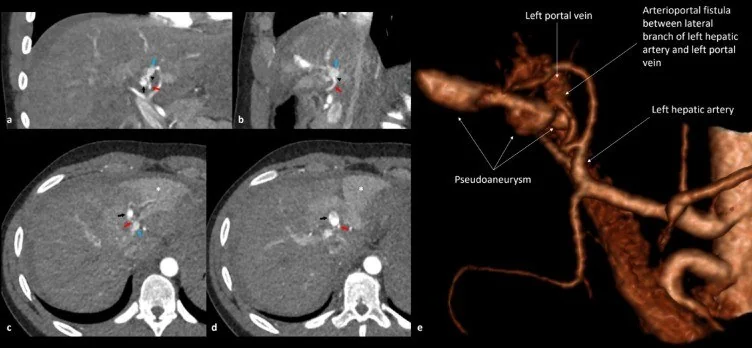
- Damar yaralanması — yolun büyük damar veya dallarla kesiştiği düzeyde kesinti, trombüs, psödoanevrizma ya da aktif kontrast ekstravazasyonu görülür.
- Alt toraks-yara yolu diyaframı kesiştiğinde, plevral ve peritoneal boşlukların tutulması, diyafram defektinin ve komşu organ herniasyonunun değerlendirilmesi gerekir.
- Uzak eşlik eden hasar — giriş-çıkış çizgisi üzerindeki organlar dışında hematom, serbest sıvı, ekstraluminal hava veya kemik fragmanı ile ilişkili hasar da bulunabilir.
- Retine edilen yabancı cisimler veya kırık kemik fragmanları traktografi ile lokalize edilir; metal saçılma artefaktı nedeniyle komşu yapılar dikkatle incelenir.
Normalde
Normal gövde duvarında cilt, subkutan yağ, kas tabakaları ve fasya kesintisizdir; bu planlardan peritoneal ya da retroperitoneal boşluğa uzanan lineer hava, kan veya yabancı cisim hattı bulunmaz. Karşı vücut duvarı ve yara yolunun beklenen anatomik komşuluklarını kıyaslayın; yolun diyafram, plevra, periton, barsak ansı ve damarlarla gerçek kesişimini çok düzlemli görüntülerde doğrulayın.
Normal BT ile kıyasla
Aynı bölgenin, kaynak veri setinde patoloji içermediği belirtilen bir BT incelemesini kesit kesit kaydırın; organ sınırlarını açarak anatomiyi hasta görüntüsüyle karşılaştırın. Küçük rastlantısal bulgular tümüyle dışlanmamıştır.
Kaynak: TotalSegmentator v2.01 veri seti (Wasserthal ve ark., Radiology: Artificial Intelligence 2023), CC BY 4.0, vaka s0546; organ sınırları veri setinin otomatik segmentasyonundan, birleştirilerek sadeleştirildi. Görüntüler 2,5 mm kesit aralığına yeniden örneklendi.
Ayırıcı tanı
- İyatrojenik kateterler vücutta kalabilir veya kırılarak embolize olabilir; cihazın konumu ve işlem öyküsü penetrant travma ile karışmamalıdır.
- Postoperatif cerrahi kesilerde cilt ve fasya planları düzenlidir; penetrant yaralanmada görülen keskin sınırlı tek hatlı yara traktı ve yaygın yağ kirlenmesi gözlenmez.
- Yumuşak doku enfeksiyonları ve apse oluşumları lokalize veya yaygın yumuşak doku ödemi ve gaz oluşturabilir; penetrant travmada görülen ciltten başlayıp derin dokulara uzanan lineer yara traktından farklıdır.
- Diyafram fıtığı
- toraks ve abdomen arasında organ geçişi vardır; akut yara yolu veya duvar defekti olmadan yapısal açıklık ve herniye organ görülür.
- Kemik fragmanı kaynaklı ikincil hasar
- cilt girişinden uzakta fragmanın komşu organı delmesi mümkündür; fragmanın konumu ve kırık hattı izlenerek ana yara yolundan ayrılır.
Tuzaklar
- Yara yolunu ciltteki en belirgin girişten düz bir çizgi varsayma; cilt, kas ve periton düzeyindeki yön değişimini çok düzlemli görüntülerde takip et.
- Yalnız tahmini yol üzerindeki organları inceleme; sekonder fragmanlar, enerji aktarımı ve birden fazla yaralanma hattı uzak organ hasarı bırakabilir.
- Alt toraks yarasını yalnız göğüs ya da yalnız batın incelemesi olarak ele alma; diyafram kubbesini ve komşu plevral/peritoneal boşlukları kesintisiz tara.
- Metal saçılma artefaktı doğrudan görüntüyü bozabilir; bu durumda dolaylı bulgular (hematom, serbest hava) ve çok düzlemli rekonstrüksiyonlar değerlendirmede kullanılır.
Kendini dene
Sol alt toraks cilt girişinden başlayan hat diyaframı geçiyor; dalak yanında hematom ve sol plevrada kan var. Yol için en doğru yorum nedir?
Cevabı göster
Torakoabdominal penetrasyon. Cilt girişinden diyaframı aşarak hem plevral hem peritoneal komşuluğa uzanan hat torakoabdominal penetrasyonu gösterir. İzole duvar yarası boşluklara geçmez; fıtıkta akut yara yolu yoktur; enfeksiyon bu anatomik travma hattını açıklamaz.
Giriş yarasından izlenen hat peritonu geçiyor, fakat kesiştiği barsak duvarı ve damarlar normal. En doğru sonraki inceleme yaklaşımı nedir?
Cevabı göster
Uzak organ ve boşlukları taramak. Yara hattı dışındaki organlar sekonder fragman veya enerji aktarımıyla yaralanabilir; tüm batın ve ilgili alt toraks taranmalıdır. Peritoneal geçiş zaten gösterilmiştir; cilt defekti ölçüsü organ hasarını dışlamaz; torakoabdominal yol varsa diyafram değerlendirmesi sürer.
İlgili konular
- Künt barsak yaralanması
- Mezenter yaralanması
- Hemoperitoneum ve retroperitoneal kanama
- Duodenal ve retroperitoneal yaralanma
Kaynaklar
Bu sayfadaki 39 cümle ve 2 quiz sorusu aşağıdaki kaynaklardan alıntılarla tek tek karşılaştırıldı; 7 cümle bu karşılaştırmada düzeltildi (2026-10-08).
- Penetrating stab injury extending from the temporal region to the orbital apex and ethmoidal cells – A unique case report and review of the literaturepmc.ncbi.nlm.nih.gov
- Delayed Presentation of a Retained Knife Fragment Following Penetrating Abdominal Trauma and Exploratory Laparotomypmc.ncbi.nlm.nih.gov
- Proper Management for Massive Penetrating Chest Trauma Narrowly Missing Major Organs: A Case Reportpmc.ncbi.nlm.nih.gov
- Successful lung-preserving tractotomy to treat intrathoracic wood impalement after high-fall trauma: a case reportpmc.ncbi.nlm.nih.gov
- Cinematic rendering of penetrating cardiac injurypmc.ncbi.nlm.nih.gov
- Penetrating Thoracic Injury.pubmed.ncbi.nlm.nih.gov
- Transmediastinal penetrating trauma.pubmed.ncbi.nlm.nih.gov
- Transnasal Penetration of a Ballpoint Pen: Case Report and Review of Literature.pubmed.ncbi.nlm.nih.gov
- Cerebrovascular Complications in Early Survivors of Civilian Penetrating Brain Injury.pubmed.ncbi.nlm.nih.gov
- Childhood Transorbital Skull Base Penetrating Injury: Report of 2 Cases and Review of Literature.pubmed.ncbi.nlm.nih.gov
- Brown-Séquard-plus syndrome after a stab injury.pubmed.ncbi.nlm.nih.gov
- Determining injuries from posterior and flank stab wounds using computed tomography tractography.pubmed.ncbi.nlm.nih.gov
- [S2 iliosacral screw insertion technique].pubmed.ncbi.nlm.nih.gov
- Accuracy of CT Scan for Detecting Hollow Viscus Injury in Penetrating Abdominal Trauma.pubmed.ncbi.nlm.nih.gov
- Through-and-through stab wound of the cervical spinal canal with retained weapon but no neurological repercussions: an exceptionally rare injury and the case for direct withdrawal. Illustrative case.pubmed.ncbi.nlm.nih.gov
- Breaking the Mold: Surgical Exploration for Spinal Impalement Injury Without Neurological Deficit.pubmed.ncbi.nlm.nih.gov
- An unusual homicidal stab wound of the cervical spinal cord: A single case examined by post-mortem computed tomography angiography (PMCTA).pubmed.ncbi.nlm.nih.gov
- Forensic application of micro-radiological analysis and 3D-printed vertebrae in a stab wound homicide case.pubmed.ncbi.nlm.nih.gov
- Accuracy of posterosuperior iliac spine reference array placement in robot-navigated spine surgery.pubmed.ncbi.nlm.nih.gov
- Surgical decision-making in paediatric penetrating trauma: case report from two paediatric tertiary centres.pubmed.ncbi.nlm.nih.gov
- Craniofacial speargun injuries: report of three cases, literature review and proposed management guidelines for maxillo-facial surgeons.pubmed.ncbi.nlm.nih.gov
- Triple impalement by fishing spears ('teta'): Surgical decision-making and multisite management in a resource-limited setting - A case report.pubmed.ncbi.nlm.nih.gov
- Hidden Inferior Vena Cava Injury: A Case of Missed Diagnosis after Preoperative CT and Laparotomy.pubmed.ncbi.nlm.nih.gov
- Radiologic Imaging of Traumatic Bowel and Mesenteric Injuries: A Comprehensive Up-to-Date Review.pubmed.ncbi.nlm.nih.gov
- Imaging of penetrating vascular trauma of the body and extremities secondary to ballistic and stab wounds.pubmed.ncbi.nlm.nih.gov
- CT of Penetrating Abdominopelvic Trauma.pubmed.ncbi.nlm.nih.gov
- Historical and current trends in colon trauma.pubmed.ncbi.nlm.nih.gov
- Intracellular Delivery by Membrane Disruption: Mechanisms, Strategies, and Concepts.pubmed.ncbi.nlm.nih.gov
- Delayed presentation of left-sided penetrating diaphragmatic injury with multivisceral herniation, gastric fundal perforation, and splenic laceration leading to fatal septic shock: a case report from Ethiopia.pubmed.ncbi.nlm.nih.gov
- Tension Viscerothorax with Concomitant Pneumothorax and Associated Intrathoracic Gastric Perforation after Thoracoabdominal Stab Wound in a Resource-Limited Setting: A Case Report.pubmed.ncbi.nlm.nih.gov
- Delayed Traumatic Diaphragmatic Hernia Presenting With Gastric Volvulus and Necrosis: A Case Report and Literature Review.pubmed.ncbi.nlm.nih.gov
- Submucosal laryngeal lesions: A puzzling diagnostic conundrum.pubmed.ncbi.nlm.nih.gov
- Gastrointestinal Fistulas-What Gastroenterologists Need to Know in 2025.pubmed.ncbi.nlm.nih.gov
- Multimodal Imaging of a Post-Traumatic Cervical Arteriovenous Fistula with Concomitant Pseudoaneurysm After a Gunshot Wound Treated with a Covered Stent-Graft.pubmed.ncbi.nlm.nih.gov
- Delayed hepatic artery pseudoaneurysm with arterioportal fistula after penetrating liver trauma successfully treated with coil embolization: a case report and focused literature review.pubmed.ncbi.nlm.nih.gov
- Proximal and distal endovascular embolization of a penetrating V3 vertebral artery transection with adjunctive surgical ligation: A case report.pubmed.ncbi.nlm.nih.gov
- Forensic Pathologist Testimony, Part 1: Common Questions and Considerations.pubmed.ncbi.nlm.nih.gov
- External mandibular fixation for gunshot fractures: report of 2 cases.pubmed.ncbi.nlm.nih.gov
- Combined Use of Endoscopic Techniques and Virtual Surgical Planning for Intraoral Approach for Hemi-mandibular Resection and Reconstruction.pubmed.ncbi.nlm.nih.gov
- Computed tomography angiography-guided conservative management of a penetrating ballistic neck injury involving the carotid sheath: A case report.pubmed.ncbi.nlm.nih.gov
- Practical guidelines for the prevention and management of diabetic foot disease in China.pubmed.ncbi.nlm.nih.gov
- Duodenal Trauma: Mechanisms of Injury, Diagnosis, and Management.pubmed.ncbi.nlm.nih.gov
- Firearm injury to the left buttock with uterus penetrating trauma.pubmed.ncbi.nlm.nih.gov
- Penetrating Neck Injury With Common Carotid Artery Involvement: A Case Report.pubmed.ncbi.nlm.nih.gov
- Penetrating extremity injuries in a large Scandinavian Level-1 trauma center: a 4-year analysis of imaging methods, mechanisms of injury and clinical outcome.pubmed.ncbi.nlm.nih.gov
- Single-Incision Laparoscopy in Abdominal Trauma: Current Evidence, Clinical Applications, and Evolving Role-A Narrative Review.pubmed.ncbi.nlm.nih.gov
- Post-Traumatic Diaphragmatic Hernia Presenting as Bowel Obstruction 12 Years After a Chest Gunshot Wound: A Rare Delayed Diagnosis.pubmed.ncbi.nlm.nih.gov
- Retained Central Venous Catheters in Pediatric Patients: Challenges, Mechanisms, and Surgical Strategies-A Narrative Review.pubmed.ncbi.nlm.nih.gov
- Successful mechanical thrombectomy for terminal ICA bullet embolism: A case report.pubmed.ncbi.nlm.nih.gov
- State of the art of 18 F-FDG PET/CT application in inflammation and infection: a guide for image acquisition and interpretation.pubmed.ncbi.nlm.nih.gov
- Spontaneous uterine rupture with primary epigastric pain in the second trimester: a case report on diagnostic challenges and multidisciplinary management.pubmed.ncbi.nlm.nih.gov
- Open Cholecystectomy in a Patient With Situs Inversus Totalis and Symptomatic Cholelithiasis: A Case Report.pubmed.ncbi.nlm.nih.gov
- Intraluminal Contrast-Enhanced Ultrasonography Application in Dogs and Cats.pubmed.ncbi.nlm.nih.gov
- Contemporary Pleural Drainage in Adult Practice: Image-Guided Techniques, Procedural Safety, Training Standards, and Malignant Pleural Effusion Management.pubmed.ncbi.nlm.nih.gov
- Nursing care for a patient with multiple organ fistulas and severe malnutrition-sarcopenia syndrome following surgery for irradiated rectal cancer: a case report.pubmed.ncbi.nlm.nih.gov
- Therapeutics in hepatobronchial fistula caused by microwave ablation for the treatment of recurrent hepatic carcinoma: A case report.pubmed.ncbi.nlm.nih.gov
- Biportal Endoscopic Transforaminal Lumbar Interbody Fusion for Two-Level Fusion: Hemodynamic Profiles and Early Clinical Outcomes Compared with Tubular MIS and Open Approaches.pubmed.ncbi.nlm.nih.gov
- Outcomes of the Herringbone Suturing Technique for the Closure of Anterior Abdominal Wall Surgeries: A Prospective Study.pubmed.ncbi.nlm.nih.gov
- Trajectory Matters: A Case of Bullet Extraction From the Heart via a Median Sternotomy.pubmed.ncbi.nlm.nih.gov
- CT of Soft Tissue Infections: Current and Future Perspectives from Diagnosis to Treatment.pubmed.ncbi.nlm.nih.gov
- Imaging of acute musculoskeletal infections in children and their differential diagnoses.pubmed.ncbi.nlm.nih.gov
- Recognizing Descending Necrotizing Mediastinitis in Adults: A Narrative Review of Diagnostic Dilemmas and Barriers.pubmed.ncbi.nlm.nih.gov
- Efficacy and Safety of Wound Catheter Infusion with Ropivacaine After Abdominal Surgery in Children Aged < 1 Year: A Randomized Controlled Trial.pubmed.ncbi.nlm.nih.gov
- Cesena guidelines: WSES consensus statement on laparoscopic-first approach to general surgery emergencies and abdominal trauma.pubmed.ncbi.nlm.nih.gov
- let-7c-5p promotes fracture healing by downregulating CDK8.pubmed.ncbi.nlm.nih.gov
- Cellular senescence in musculoskeletal diseases: biological mechanisms and clinical implications.pubmed.ncbi.nlm.nih.gov
- Human biomarker navigator.pubmed.ncbi.nlm.nih.gov
- Long-term safety and effectiveness of the "OptEase" vena cava filter.pubmed.ncbi.nlm.nih.gov
- Obstructive Sleep Apnea: Epidemiology, Pathophysiology, Complications, Diagnosis, Management, and Emerging Fibrosis-Linked Remodeling.pubmed.ncbi.nlm.nih.gov
- Severe trauma care: advances and future directions in diagnostic and therapeutic techniques and information technology support.pubmed.ncbi.nlm.nih.gov
- Machine Learning for Wound Management: A Structured Narrative Review of Applications, Challenges, and Prospects.pubmed.ncbi.nlm.nih.gov
- High-Grade Chondrosarcoma Involving the Xiphoid Process and Lower Sternum-The Continuing Role of Extended Open Chest Wall Surgery in the Era of Minimally Invasive Thoracic Surgery: A Case Report.pubmed.ncbi.nlm.nih.gov
- An exploratory radiologic index for evaluating diaphragmatic injury risk in left thoracoabdominal penetrating stab wounds: the diaphragmatic penetration index.pubmed.ncbi.nlm.nih.gov
- Commentary: an eye on PET quantification.pubmed.ncbi.nlm.nih.gov
- Combined Open Reduction and Transantral Endoscopic Approach for Internal Fixation of Orbital Floor Fractures: A Tertiary Care Center Experience with Decision-Making Algorithm.pubmed.ncbi.nlm.nih.gov
- Lrrn-mediated retinal ganglion cell targeting drives visual circuit assembly for brightness and contrast detection.pubmed.ncbi.nlm.nih.gov
- A Novel Virtual Planned-Orthodontic-Surgical Approach for Proportional Condylectomy in Condylar Hyperplasia.pubmed.ncbi.nlm.nih.gov
- FocusedON-BC: A Robust Deep Learning Framework for Automated Body Composition Assessment.pubmed.ncbi.nlm.nih.gov
- 2015 American Thyroid Association Management Guidelines for Adult Patients with Thyroid Nodules and Differentiated Thyroid Cancer: The American Thyroid Association Guidelines Task Force on Thyroid Nodules and Differentiated Thyroid Cancer.pubmed.ncbi.nlm.nih.gov
- The AGCES Classification System for Endometriosis: Integrating Adenomyosis with Genital and Extragenital Staging-An Expert Consensus Framework from the American & Global College of Endometriosis Specialists (AGCES).pubmed.ncbi.nlm.nih.gov
- Current Approaches and Emerging Strategies in the Treatment of Peritoneal Carcinomatosis.pubmed.ncbi.nlm.nih.gov
- Pediatric Perineal Impalement Injuries: A Case Series on Surgical Management and Outcomes.pubmed.ncbi.nlm.nih.gov
- Computed tomography of pediatric abdominal trauma: optimizing utilization and enhancing diagnostic interpretation.pubmed.ncbi.nlm.nih.gov
- Utility of point-of-care ultrasound of the liver in the neonatal intensive care unit: experience from a case series.pubmed.ncbi.nlm.nih.gov
- The Diagnosis and Management of Pediatric Blunt Abdominal Trauma-A Comprehensive Review.pubmed.ncbi.nlm.nih.gov
- Management Protocol for Ballistic and Other High-Energy Avulsive Facial Injuries-An Update for the 21st Century.pubmed.ncbi.nlm.nih.gov
- Pediatric Craniofacial Ballistic Injuries.pubmed.ncbi.nlm.nih.gov
- Peripheral Extracellular Vesicles for Diagnosis and Prognosis of Resectable Lung Cancer: The LUCEx Study Protocol.pubmed.ncbi.nlm.nih.gov
- Laparoscopic approach to the management of penetrating traumatic diaphragmatic injury.pubmed.ncbi.nlm.nih.gov
- Imaging of penetrating thoracic trauma in a large Nordic trauma center.pubmed.ncbi.nlm.nih.gov
- Trends in nonoperative management of traumatic injuries - A synopsis.pubmed.ncbi.nlm.nih.gov
- Enhancing dromedary camel (<i>Camelus dromedarius</i>) healthcare: ultrasound-guided diagnostic and therapeutic interventions in the thoracic and abdominal cavities.pubmed.ncbi.nlm.nih.gov
- Task-Oriented Biomedical Microrobots: Access, Working Environment, Actuation, Body Design, Detection and Control.pubmed.ncbi.nlm.nih.gov
- Resveratrol Nanoformulations for Cancer Management: A Comprehensive Review of Disease-Specific Strategies and Clinical Translational Barriers.pubmed.ncbi.nlm.nih.gov
- Selective nonoperative management of penetrating abdominal trauma at a level 1 Canadian trauma centre: a quest for perfectionpubmed.ncbi.nlm.nih.gov
- Does laparoscopic surgery decrease the risk of atrial fibrillation after foregut surgery?pubmed.ncbi.nlm.nih.gov
- Patterns of injury and violence in Yaoundé Cameroon: an analysis of hospital data.pubmed.ncbi.nlm.nih.gov
- Penetrating stab injury extending from the temporal region to the orbital apex and ethmoidal cells - A unique case report and review of the literature.pubmed.ncbi.nlm.nih.gov
- Delayed Presentation of a Retained Knife Fragment Following Penetrating Abdominal Trauma and Exploratory Laparotomy.pubmed.ncbi.nlm.nih.gov
- Diagnostic tips for multi-phase post-mortem computed tomography angiography interpretation in upper gastro-intestinal bleeding.pubmed.ncbi.nlm.nih.gov
- Renal embolization for trauma: a narrative review.pubmed.ncbi.nlm.nih.gov
- CTA Imaging of Peripheral Arterial Injuries.pubmed.ncbi.nlm.nih.gov
- Pneumatosis intestinalis revisited: associated imaging findings, clinical correlation, management, risk stratification and future perspectives.pubmed.ncbi.nlm.nih.gov
- Emphysematous conditions of the abdomen and pelvis: pearls and pitfalls.pubmed.ncbi.nlm.nih.gov
- Complications and expected imaging findings after endoscopic retrograde cholangiopancreatography.pubmed.ncbi.nlm.nih.gov
- Mechanical Small Bowel Obstruction Secondary to Low-Grade Appendiceal Mucinous Neoplasm: A Case Report.pubmed.ncbi.nlm.nih.gov
- Retroperitoneal glass foreign body with renal parenchymal involvement after 25 years of silent retention: a case report.pubmed.ncbi.nlm.nih.gov
- Robot-assisted radical resection for choledochal cysts in infants under three months of age: a multicenter retrospective study.pubmed.ncbi.nlm.nih.gov
- From Fragile Lives to Forensic Truth: Multimodal Forensic Approaches to Pediatric Homicide and Suspect Death.pubmed.ncbi.nlm.nih.gov
- Lung parenchymal trauma biomechanics, mechanisms, and classification: a narrative review of the current knowledge.pubmed.ncbi.nlm.nih.gov
- Antimicrobial prescribing guidelines for horses in Australia.pubmed.ncbi.nlm.nih.gov
- Isolated Urethral Injury Without Penile Fracture: A Case Report.pubmed.ncbi.nlm.nih.gov
- Successful management of 72-h delay-detected blunt esophageal injury with trans-gastric primary repair; a case report and literature review.pubmed.ncbi.nlm.nih.gov
- Bone tunnel repair of traumatic lumbar hernias without mesh: A multidisciplinary case series and literature review.pubmed.ncbi.nlm.nih.gov
- Pediatric Surgeon-led Management of Abdominal Trauma: An Audit from an African Nation.pubmed.ncbi.nlm.nih.gov
Eğitim amaçlıdır; hasta başında tanı ve tedavi kararının yerine geçmez. İçerik yapay zekâ destekli bir süreçle güncel literatüre göre cümle cümle kaynaklarla karşılaştırıldı, ancak uzman radyolog incelemesinden geçmedi. Klinik kararlarda güncel kılavuzları, kurum protokollerini ve radyoloji raporunu esas alın.