Özet
Yüksek enerjili künt travmada pelvik halka kırığı; büyük hacimli kanama, mekanik instabilite ve mesane ya da üretra yaralanmasıyla birlikte olabilir. BT, ön ve arka halka hasarını, asetabulum eklem yüzüne uzanımı ve sakral kanal-foramen ilişkisini çok düzlemli gösterir; kontrastlı seriler hematom içindeki aktif damar kanamasını aramaya yarar. Arka halka lezyonu yalnızca ön halka kırığı görüldüğü için dışlanamaz; sakral foraminal veya kanal uzanımı nörolojik açıdan kritik olabilir. Bu bileşenler gözden kaçarsa kanama kaynağı ve kırığın kapsamı eksik raporlanabilir.
Faz ve pencere
- Kemik algoritması tanısal
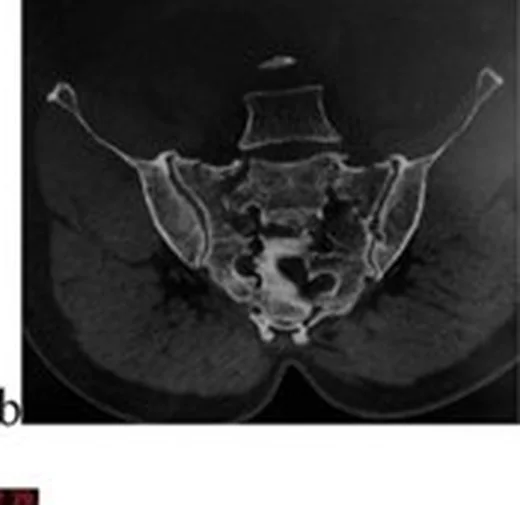
- Aksiyel ince kesitler ile koronal ve sagittal kemik rekonstrüksiyonlarında pubik ramus, simfiz, iliak kemik, sakrum ve asetabulum korteksinde kırık hattı, impaksiyon, basamaklanma ve fragman deplasmanı seçilir; sakral hattın foramen veya kanala uzanımı bu serilerde haritalanır.
- Arteriyel tanısal
- İntravenöz kontrast sonrası arteriyel seride pelvik hematom içinde aort yoğunluğunda damar dışı kontrast odağı aktif arteriyel kanamayı düşündürür; iyi sınırlı, yuvarlak bir damar kesesi psödoanevrizma olabilir. Odağın damar kesiti ya da kemik fragmanı olmadığını komşu kesitlerle doğrulayın.
- Portal tanısal
- Portal venöz/geç seri, hematom içindeki kontrast odağının büyüyüp çevreye yayılıp yayılmadığını ve pelvisteki eşlik eden yumuşak doku yaralanmalarını gösterir; fazlar arası artan göllenme aktif ekstravazasyon lehinedir.
Önerilen pencereler: Kemik (G 1800 / M 400), Yumuşak doku (G 400 / M 40), Anjiyo (G 600 / M 150).
BT bulguları
- Pubik ramus veya simfiz hasarı — kortikal süreksizlik, ramuslarda yer değiştirme ya da simfiz ekleminde travmatik genişleme.
- Arka halka kesintisi — sakral ala/korpus kırığı, sakroiliak eklem ayrışması veya posterior iliak kemik kırığı; ön halka bulgusuyla aynı tarafta olup olmadığını izleyin.
- Hemipelvis seviye farkı — koronal planda bir tarafın kraniokaudal yer değiştirmesi dikey kayma bileşenini gösterir.
- Asetabular eklem uzanımı — kırık hattı tavan, kolon ya da duvardan eklem yüzüne ulaşır; eklem içi fragman ve yüzey basamağı ayrıca vurgulanır.
- Sakral foraminal uzanım — kırık hattı nöral foramenle kesişir veya fragman foramen konturunu daraltır.
- Sakral kanal daralması — santral fragman ya da deplasman kanal lümenine taşar; transvers bileşen eşlik ediyorsa spinopelvik ayrışma paterni araştırılır.
- Pelvik hematom — prevezikal, presakral veya yan pelvik duvarda kanama yumuşak doku penceresinde belirir; yayılımı kırık tarafı ve kompartımanla eşleştirilir.
- Damar odağı — hematom içindeki arteriyel kontrast odağı, sonraki serideki boyut ve biçim değişimiyle birlikte aktif kaçak veya psödoanevrizma yönünden sınıflanır.
Ölçütler ve sınıflamalar
- Young–Burgess pelvik halka sınıflaması
- Young–Burgess sınıflaması, mekanizma ve posterior halka/bağ hasarına göre ilerler; APC I'de anterior halka yırtılması ve kısmi posterior tutulum, APC III'te ise anterior ve posterior kompleksteki tam kopukluk tanımlanır. Bu 2,5 cm sınırı tek başına sınıf belirlemez: posterior halka/bağ bulguları da değerlendirilmelidir; pelvik binder ayrışmayı gizleyebilir. LC I–III lateral kompresyonun halka ve bağ hasar paternlerini, VS dikey kaymayı, kombine tip birden fazla kuvvet yönünü tanımlar.
- Denis sakral kırık zonları
- U veya H biçimli transvers bileşenli kırıklar, spinopelvik ayrışma ile seyreden yüksek riskli instabilite paternlerini işaret eder.
Normalde
Normal BT'de pubik simfiz ile bilateral sakroiliak eklem aralıkları uyumludur; sakrum ve asetabulum korteksleri kesintisiz, sakral foramenler ve kanal açık konturludur. Aynı düzeyde sağ ve sol hemipelvisin hizasını, eklem yüzlerinin düzgünlüğünü ve hematom bulunmayan pelvik yağ planlarını karşılaştırın.
Normal BT ile kıyasla
Aynı bölgenin, kaynak veri setinde patoloji içermediği belirtilen bir BT incelemesini kesit kesit kaydırın; organ sınırlarını açarak anatomiyi hasta görüntüsüyle karşılaştırın. Küçük rastlantısal bulgular tümüyle dışlanmamıştır.
Kaynak: TotalSegmentator v2.01 veri seti (Wasserthal ve ark., Radiology: Artificial Intelligence 2023), CC BY 4.0, vaka s1256; organ sınırları veri setinin otomatik segmentasyonundan, birleştirilerek sadeleştirildi. Görüntüler 2,5 mm kesit aralığına yeniden örneklendi.
Ayırıcı tanı
- Sakral insüfisiyans kırığı
- çoğunlukla osteoporotik zeminde alar skleroz ve ince kırık hattı oluşturur; eşlik eden yüksek enerjili halka deplasmanı beklenmez.
- Eklem yüzüne uzanan kırık hatları, asetabular tavan veya kolonlarda basamaklanma ve fragmentasyon oluşturarak normal anatomik yapıdan ayrılır.
- Pelvik yumuşak doku hematomu
- kanamayı gösterir, fakat arteriyel seride damar dışı kontrast odağı yoksa tek başına aktif arteriyel kaynak anlamına gelmez.
- Kemik fragmanının damar odağı taklidi
- kemik penceresinde kortikal yoğunluk taşır ve kontrastlı seriler arasında damar gibi biçim değiştirmez.
Tuzaklar
- İzole pubik ramus kırığı görüntüsü arka halka bütünlüğünü kanıtlamaz; sakrum, SI eklemleri ve posterior iliak kanadı ayrı ayrı tarayın.
- Sakral kırık, aksiyel kesitte foramenle sınırlı sanılabilir; koronal ve sagittal planda kanal içi uzanım ile transvers bileşeni arayın.
- Hematoma bitişik damar kesiti veya kemik parçası kontrast odağına benzeyebilir; damar devamlılığını ve ardışık fazlardaki görünümünü kontrol edin.
- Mesane rüptürü rutin intravenöz kontrastlı pelvis BT'sinde dışlanamaz; pubik fragman ve perivezikal bulgular varsa retrograd BT sistografi gereksinimini belirtin.
Kendini dene
Pelvik travmada arteriyel seride hematom içinde kontrast odağı görülüyor ve geç seride bu alan büyüyor. Bu dinamik bulgu en çok aşağıdakilerden hangisini destekler?
Cevabı göster
Aktif arteriyel kanama. Kontrast odağının fazlar arasında büyümesi aktif damar dışı kaçağı gösterir; kas/yumuşak doku yaralanmaları bu fazlar arası kontrast davranışını oluşturmaz.
U veya H biçimli transvers bileşenli sakral kırıklar, hangi klinik durum ve prognostik risk ile güçlü şekilde ilişkilendirilir?
Cevabı göster
Spinopelvik ayrışma ve yüksek instabilite riski. U veya H biçimli transvers bileşenli kırıklar, spinopelvik ayrışma ile seyreden yüksek riskli instabilite paternlerini işaret eder.
Bu konunun yer aldığı turlar
İlgili konular
Kaynaklar
Bu sayfadaki 43 cümle ve 2 quiz sorusu aşağıdaki kaynaklardan alıntılarla tek tek karşılaştırıldı; 6 cümle bu karşılaştırmada düzeltildi (2026-10-08).
- Iliosacral Screw Fixation for Treating Sacral Fractures: A Modified Pedicle‐Guided Fixation Technique in Prone Positionpmc.ncbi.nlm.nih.gov
- Robot-assisted closed reduction and navigated fixation for pelvic ring injuries: a focused narrative review of a reduction-fixation-audit frameworkpmc.ncbi.nlm.nih.gov
- Surgical Management of a Lateral Compression (LC)III Pelvic Ring Fracture With Type I Crescent Fracture-Dislocation: A Case Reportpmc.ncbi.nlm.nih.gov
- Clinical Outcomes of Sacral Alar-Iliac Screw Fixation for Pelvic Ring Fractures: A Retrospective Case Seriespmc.ncbi.nlm.nih.gov
- Traumatic Uterine Rupture in a Nonpregnant Patient: A Case Reportpmc.ncbi.nlm.nih.gov
- Sacral fractures: issues, challenges, solutions.pubmed.ncbi.nlm.nih.gov
- Sacral fractures: classification and management.pubmed.ncbi.nlm.nih.gov
- Open reduction and navigated Iliosacral screws for vertically unstable pelvic fractures.pubmed.ncbi.nlm.nih.gov
- [Osteoporotic fractures of the proximal femur. What's new?].pubmed.ncbi.nlm.nih.gov
- Applicable safety analysis and biomechanical study of iliosacral triangular osteosynthesis.pubmed.ncbi.nlm.nih.gov
- [Osteoporotic fractures of the pelvis].pubmed.ncbi.nlm.nih.gov
- Iliosacral screw insertion using CT-3D-fluoroscopy matching navigation.pubmed.ncbi.nlm.nih.gov
- Factors influencing the accuracy of iliosacral screw insertion using 3D fluoroscopic navigation.pubmed.ncbi.nlm.nih.gov
- Spinopelvic Fixation of Sacroiliac Joint Fractures and Fracture-Dislocations: A Clinical 8 Years Follow-Up Study.pubmed.ncbi.nlm.nih.gov
- Current concepts in spondylopelvic dissociation.pubmed.ncbi.nlm.nih.gov
- Minimal Invasive Surgical Treatment of Fragility Fractures of the Pelvis.pubmed.ncbi.nlm.nih.gov
- Urological injuries associated with pelvic fractures: A case report of a detached bone segment inside the bladder.pubmed.ncbi.nlm.nih.gov
- Posterior pelvic ring bone density with implications for percutaneous screw fixation.pubmed.ncbi.nlm.nih.gov
- Three-dimensional kinematic corridors of the head, spine, and pelvis for small female driver seat occupants in near- and far-side oblique frontal impacts.pubmed.ncbi.nlm.nih.gov
- Surgical Management of a Lateral Compression (LC)III Pelvic Ring Fracture With Type I Crescent Fracture-Dislocation: A Case Report.pubmed.ncbi.nlm.nih.gov
- Bilateral traumatic testicular dislocation associated with an unstable pelvic ring injury: a rare case report and literature review.pubmed.ncbi.nlm.nih.gov
- Ballistic injuries of the pelvis and acetabulum: a narrative review.pubmed.ncbi.nlm.nih.gov
- Emergency radiology of severe acute injury in extreme alpine summer sports: a pictorial essay.pubmed.ncbi.nlm.nih.gov
- Denis pattern-dependent biomechanical behavior of posterior trans-iliac plate fixation compared with bilateral triangular osteosynthesis in unilateral sacral fractures: a finite element study.pubmed.ncbi.nlm.nih.gov
- Traumatic lumbosacral instability: part 1 - proposing a definition and identifying underlying injury patterns.pubmed.ncbi.nlm.nih.gov
- Robot-assisted closed reduction and navigated fixation for pelvic ring injuries: a focused narrative review of a reduction-fixation-audit framework.pubmed.ncbi.nlm.nih.gov
- Management of C0 Sacral Fractures Based on the AO Spine Sacral Injury Classification: A Narrative Review.pubmed.ncbi.nlm.nih.gov
- A Guide to Improving the Care of Patients with Fragility Fractures, Edition 2.pubmed.ncbi.nlm.nih.gov
- Limitations of CT-based planning in anterior pelvic ring fixation: a study of fluoroscopy-guided pubic ramus screws.pubmed.ncbi.nlm.nih.gov
- Iliosacral Screw Fixation for Treating Sacral Fractures: A Modified Pedicle-Guided Fixation Technique in Prone Position.pubmed.ncbi.nlm.nih.gov
- Combined Post-traumatic Pseudoaneurysms of the Superior Gluteal and Aberrant Obturator Arteries: A Case Report.pubmed.ncbi.nlm.nih.gov
- Collateral-pathway-oriented clinico-angiographic framework for inferior epigastric artery-related hemorrhage: embolization planning and clinical outcomes.pubmed.ncbi.nlm.nih.gov
- Transarterial embolization in musculoskeletal care: an indication-stratified narrative review.pubmed.ncbi.nlm.nih.gov
- Spontaneous Rectus Sheath Hematoma Mimicking Bladder Tamponade: A Case Report.pubmed.ncbi.nlm.nih.gov
- Blunt Traumatic Isolated Left External Iliac Vein Injury Without Pelvic Fracture.pubmed.ncbi.nlm.nih.gov
- Pneumothorax and Hemothorax: Practical Approaches for Radiologists.pubmed.ncbi.nlm.nih.gov
- W-shaped double plating for symphyseal diastasis in vertical shear pelvic ring injury: 12-month radiographic stability - a case report.pubmed.ncbi.nlm.nih.gov
- Clinical Outcomes of Straddle Fracture Patterns: A Retrospective Multicenter Analysis Based on a New Descriptive Classification Framework.pubmed.ncbi.nlm.nih.gov
- Delayed migration of orthopedic screw into the bladder following pelvic fracture fixation.pubmed.ncbi.nlm.nih.gov
- Safe definitive surgery in unstable pelvic ring injuries - a retrospective cohort study.pubmed.ncbi.nlm.nih.gov
- Clinical study on the treatment of pubic symphysis diastasis with modified internal fixation.pubmed.ncbi.nlm.nih.gov
- Staged management of a Tile C3 pelvic ring injury with bilateral sacroiliac disruption and T-shaped sacral fracture.pubmed.ncbi.nlm.nih.gov
- Isolated Unilateral Posterior Sacroiliac Dislocation With an Intact Anterior Pelvic Ring: Case Report of an Unusual Injury Pattern.pubmed.ncbi.nlm.nih.gov
- Knowledge gaps in high-energy sacral fracture treatment and management.pubmed.ncbi.nlm.nih.gov
- Management and outcome of displaced acetabular fractures in the oldest-old: a retrospective analysis of orif and acute total hip arthroplasty.pubmed.ncbi.nlm.nih.gov
- The Predictive Factors for Post-Traumatic Hip Osteoarthritis After Surgical Treatment of Acetabular Fractures: A Retrospective Cohort of 130 Patients.pubmed.ncbi.nlm.nih.gov
- Factors Associated with Functional Outcomes Following Combined Pelvic Ring and Acetabular Fractures: A 2-Year Retrospective Analysis.pubmed.ncbi.nlm.nih.gov
- Radiculopathy due to cement extravasation after sacroplasty: A case report.pubmed.ncbi.nlm.nih.gov
- Sacral Insufficiency Fracture Following L4-S1 Circumferential Fusion in Corticosteroid-associated Bone Fragility: A Case Report and Biomechanical Considerations.pubmed.ncbi.nlm.nih.gov
- Open and Percutaneous Fixation of Traumatic Sacral Fracture-Dislocation with Spinopelvic Dissociation: Two Adolescent Cases and a Systematic Literature Review.pubmed.ncbi.nlm.nih.gov
- Recognizing Sacral Insufficiency Fractures Hidden in Plain Sight: An Illustrative Case Report.pubmed.ncbi.nlm.nih.gov
- L5 osteotomy combined with adjuvant romosozumab therapy for L5 osteoporotic vertebral fracture-induced spinal deformity: illustrative case.pubmed.ncbi.nlm.nih.gov
- Percutaneous lumbopelvic fixation for pathologic sacral fractures and spinopelvic dissociation: patient series.pubmed.ncbi.nlm.nih.gov
- Time Is Kidney: A Case Study and Literature Review of Bilateral Renal Compartment Syndrome After Blunt Trauma, a Rare Complication.pubmed.ncbi.nlm.nih.gov
- Understanding Air in the Body: A Radiologic Perspective on Emphysematous and Traumatic Conditions.pubmed.ncbi.nlm.nih.gov
- Comparison between lumbar plexus block and fascia iliaca block in hip surgery: A systematic review and meta-analysis.pubmed.ncbi.nlm.nih.gov
- Simultaneous Cesarean Delivery and Pelvic Stabilization for Open-Book Pelvic Injury in Late Pregnancy: A Case Report.pubmed.ncbi.nlm.nih.gov
- Selective Anterior Fixation for Rami Fractures in Anteroposterior Compression-Type Pelvic Ring Injuries: Impact of Posterior Stability.pubmed.ncbi.nlm.nih.gov
- Functional status and health-related quality of life following Young and Burgess classified pelvic ring injuries.pubmed.ncbi.nlm.nih.gov
- Minimally invasive stabilisation of anterior pelvic ring injuries through anterior infix versus percutaneous anterior retrograde pubic screw: a prospective comparative cohort study.pubmed.ncbi.nlm.nih.gov
- Neuronavigated placement of iliosacral screws in sacral fractures: an additional tool in the spine surgeon's arsenal.pubmed.ncbi.nlm.nih.gov
- Sacral and Pelvic Fractures: Historical Systems and Advancements with the AO Spine Classification.pubmed.ncbi.nlm.nih.gov
- New Minimally Invasive Method for Treating Posterior Pelvic Ring Fractures: Biomechanical Validation and Clinical Application of Sacroiliac Joint Locking Plate.pubmed.ncbi.nlm.nih.gov
- A Case of U-shaped Sacral Fracture After Longstanding Spinopelvic Fixation Treated With Percutaneous Sacroiliac Joint Fusion and Iliosacral Osteosynthesis.pubmed.ncbi.nlm.nih.gov
- Analysis of Fracture Patterns and Characteristics in Sacral Insufficiency Fracture: Do Sacral Fractures Occur in Patients Who Had Previous Lumbosacral Fusion Insufficiency Fractures or Stress Fractures?pubmed.ncbi.nlm.nih.gov
- Modified unilateral iliac screw fixation with partial reduction in the treatment of high-grade spondylolisthesis at L5/S1 in adult patients: introduction of key technique, report of clinical outcomes and analysis of spinopelvic parameters.pubmed.ncbi.nlm.nih.gov
- Fragility fractures of the pelvis.pubmed.ncbi.nlm.nih.gov
- Congenital and Breed-Associated Vertebral Anomalies in Dogs and Cats: Developmental Anatomy, Genetic Determinants, and Biological Significance.pubmed.ncbi.nlm.nih.gov
- The value of magnetic resonance imaging and computed tomography in the study of spinal disorders.pubmed.ncbi.nlm.nih.gov
- Malformed vertebrae: a clinical and imaging review.pubmed.ncbi.nlm.nih.gov
- Toward next-generation hip implants: From failure mechanisms to translational design.pubmed.ncbi.nlm.nih.gov
- Advancements in 3D printing technologies for personalized treatment of osteonecrosis of the femoral head.pubmed.ncbi.nlm.nih.gov
- Hip preservation surgery and the acetabular fossa.pubmed.ncbi.nlm.nih.gov
- Imaging in the postpartum period.pubmed.ncbi.nlm.nih.gov
- Diagnostic Value of the Split-Bolus CT Protocol in Blunt Abdominal Trauma: Comparison With Standard Portal Venous Phase Imaging.pubmed.ncbi.nlm.nih.gov
- Intraosseous tumours of the knee.pubmed.ncbi.nlm.nih.gov
- CT Angiography of the Upper Extremities: Review of Acute Arterial Entities.pubmed.ncbi.nlm.nih.gov
- The multilayer coatings on polylactic acid implants spatiotemporally regulates the microenvironment to enhance antibacterial and osseointegration capacity.pubmed.ncbi.nlm.nih.gov
- Biomechanical stability evaluation of isolated straddle fracture using finite element analysis.pubmed.ncbi.nlm.nih.gov
- Parasymphyseal fracture location in lateral compression pelvic ring injuries: an assessment of reoperation and radiographic displacement in an international multicenter study.pubmed.ncbi.nlm.nih.gov
- Radiographic Changes After Pubic Symphysis Plating and Their Clinical Relevance: An Exploratory Longitudinal Cohort Study.pubmed.ncbi.nlm.nih.gov
- Neurolymphomatosis: A Comprehensive Review of Clinical and Imaging Features.pubmed.ncbi.nlm.nih.gov
- Role of 3D Printing in Preoperative Planning for Spine Surgery: A Scoping Review.pubmed.ncbi.nlm.nih.gov
- A Primer on Anatomy, Biophysics, Pathology, Imaging and Treatment of the Intervertebral Disc and the Anterior Spinal Column: The Discogenic, Intervertebral, Spinal Column (DISC) ASPN Workgroup.pubmed.ncbi.nlm.nih.gov
- Multiple organ dysfunction syndrome: molecular mechanisms and therapeutic strategies.pubmed.ncbi.nlm.nih.gov
- Mineralized Cryogel/Hydrogel Constructs to Recapitulate Early Breast Cancer Bone Metastasis In Vitro.pubmed.ncbi.nlm.nih.gov
- Bladder Traumapubmed.ncbi.nlm.nih.gov
- Clinical Characteristics and In-Hospital Outcomes of Traumatic Bladder Rupture: An 11-Year Retrospective Cohort Study at a Single Regional Trauma Center.pubmed.ncbi.nlm.nih.gov
- Early versus delayed urethroplasty for pediatric pelvic fracture-related urethral injury in boys: a retrospective comparative cohort study of complications and surgical success rates from a single center.pubmed.ncbi.nlm.nih.gov
- Clinical Outcomes of Sacral Alar-Iliac Screw Fixation for Pelvic Ring Fractures: A Retrospective Case Series.pubmed.ncbi.nlm.nih.gov
- CT-based three-dimensional fracture mapping reveals characteristic patterns in pelvic insufficiency fractures.pubmed.ncbi.nlm.nih.gov
- Minimally invasive circumferential fixation using TIFI and INFIX for unstable pelvic ring injuries: a prospective evaluation of clinical and radiological outcomes.pubmed.ncbi.nlm.nih.gov
- Examination under anesthesia in anterior posterior compression pelvic ring injuries; additional assessment of the posterior pelvic ring reveals occult sacroiliac joint instability.pubmed.ncbi.nlm.nih.gov
- Surgical management and long-term functional outcomes of traumatic pubic symphysis diastasis: a retrospective cohort study.pubmed.ncbi.nlm.nih.gov
- Occult bladder wall injury with pelvic binder.pubmed.ncbi.nlm.nih.gov
- Spinal lesions: a comprehensive radiologic overview.pubmed.ncbi.nlm.nih.gov
- Chronic Noninfectious Osteomyelitis: A Review of Imaging Findings.pubmed.ncbi.nlm.nih.gov
- Association of Chiropractic Colleges Educational Conference and Research Agenda Conference 2025: Transformative Trends in Healthcare.pubmed.ncbi.nlm.nih.gov
- Molecular mechanisms and genetic factors contributing to the developmental dysplasia of the hip.pubmed.ncbi.nlm.nih.gov
- SSR white paper: guidelines for utilization and performance of direct MR arthrography.pubmed.ncbi.nlm.nih.gov
- Open reduction and internal fixation versus percutaneous multiple-trajectory screw fixation for unstable pelvic fractures with severe polytrauma: a prospective study.pubmed.ncbi.nlm.nih.gov
- Single-Segment Spinal Decompression and Fusion With Selective Nerve Root Block in Adult Degenerative Scoliosis: A Retrospective Comparative Study.pubmed.ncbi.nlm.nih.gov
- A positioning method for the transiliac-transsacral screw bone channel based on a manual tracing of a transparent overlay of preoperative computed tomography images in patients with pelvic fracture and a unilateral trans-sacroiliac corridor.pubmed.ncbi.nlm.nih.gov
- Perfecting the pour: A novel co-axial technique with sequential injections for optimising cement delivery during sacroplasty.pubmed.ncbi.nlm.nih.gov
- We Tabulated and Organized American Board of Neurological Surgeons Primary Exam Keywords (2015-2023) so You Don't Have to.pubmed.ncbi.nlm.nih.gov
- Imaging of presacral masses--a multidisciplinary approach.pubmed.ncbi.nlm.nih.gov
- Preoperative 3D-Planned S1 Corridors Transferred into 2D Fluoroscopy Allow for Safe Intraoperative Large-Diameter Implant Placement: Description of a Novel Sacroiliac Fixation Technique and Proof of Concept in 137 Implantations.pubmed.ncbi.nlm.nih.gov
- Relationship of posterior superior iliac spine morphology and ideal S1 pedicle screw trajectory: A cross-sectional study of closed versus open posterior superior iliac spine morphology.pubmed.ncbi.nlm.nih.gov
- Minimally Invasive Lumbopelvic and Transiliac-Transsacral Fixation for a Pathological Sacral Fracture Due to Metastatic Breast Cancer: A Case Report.pubmed.ncbi.nlm.nih.gov
- Deep learning and hybrid architectures for atypical and complex bone fracture diagnosis: a systematic review of performance and clinical validity.pubmed.ncbi.nlm.nih.gov
- Artificial Intelligence in Pelvic Fracture Diagnosis and Outcome Prediction: A Systematic Review and Meta-analysis.pubmed.ncbi.nlm.nih.gov
- Effectiveness of a Teaching Session on Interpreting Common Orthopaedic Radiographs at a Major Trauma Centre.pubmed.ncbi.nlm.nih.gov
- Acetabular superior wall fractures: a distinct acetabular fracture entity.pubmed.ncbi.nlm.nih.gov
- Quantitative three-dimensional fracture mapping reveals subtype-specific morphology of acetabular roof column and wall fractures.pubmed.ncbi.nlm.nih.gov
- A Case Report of Pipkin Type II Femoral Head Fracture Managed by Ganz Safe Surgical Dislocation and Headless Compression Screw (Herbert Screw) Fixation: A Stepwise Technical Description and Clinical Outcome.pubmed.ncbi.nlm.nih.gov
Eğitim amaçlıdır; hasta başında tanı ve tedavi kararının yerine geçmez. İçerik yapay zekâ destekli bir süreçle güncel literatüre göre cümle cümle kaynaklarla karşılaştırıldı, ancak uzman radyolog incelemesinden geçmedi. Klinik kararlarda güncel kılavuzları, kurum protokollerini ve radyoloji raporunu esas alın.