Özet
Nazal septumun vomer ve kıkırdak bileşenlerinin toplam septal hacme oranı yaşla değişebilir. Yüz travması BT'si, septal kırıkların yanı sıra sıklıkla eşlik eden nazal kemik ve orta yüz kırıklarını da belirgin şekilde gösterir. BT, nazal travmada kemik yapının detaylı değerlendirilmesi için tercih edilir; kartilajın incelenmesinde klinik muayene ve ultrasonografi de değerlidir. Septal hematom, acil drenaj gerektirdiği için travmatik burun değerlendirmelerinde mutlaka aranmalıdır.
Faz ve pencere
- Kontrastsız tanısal
- Kontrastsız aksiyel ve koronal kemik algoritması rekonstrüksiyonlarında vomer veya etmoid dikey plakta kortikal kesinti, açılanma ya da ayrışma izlenir; kemik septumun orta hat devamlılığı ve nazal kemiklerle ilişkisi değerlendirilir. BT, kemik kırıklarını ve displasmanı belirgin şekilde gösterirken; kartilaj yaralanmaları septal bölgedeki yumuşak doku ödem veya hematom gibi dolaylı bulgularla desteklenerek değerlendirilir. Kontrast gerekmez.
Önerilen pencereler: Kemik (G 1800 / M 400), Yumuşak doku (G 400 / M 40).
BT bulguları
- Etmoid kemiğin dikey plağı veya vomerde keskin kortikal süreksizlik kırık lehinedir.
- Kemik septumdaki kayma ve fragmentasyon, nazal kavite yapısını ve işlevini bozabilir.
- Septal deviasyon konka bülloza ile birlikte görülebilir; bir pediatrik BT çalışmasında deviasyon konka büllozaya göre daha sık karşı taraftaydı.
- Nazal travmada septal yaralanmalar, nazal kemikler ve orbita tabanı gibi komşu yapılarla birlikte görülme sıklığı yüksektir.
- Nazal hematomlar travma sonrası görülebilir ve en sık septumu etkiler.
- Eşlik eden nazal kemik, spina nazalis anterior veya NOE kırığı travmanın yaygınlığını gösterir.
Normalde
Normal BT görüntülerinde septal yapılar ortada konumlanmış olup, yaşla birlikte vomer hacminin toplam septal hacme oranı artmaktadır. Septal deviasyon değerlendirmesinde kraniyofasiyal BT ve nazal endoskopi kullanılabilir.
Normal BT ile kıyasla
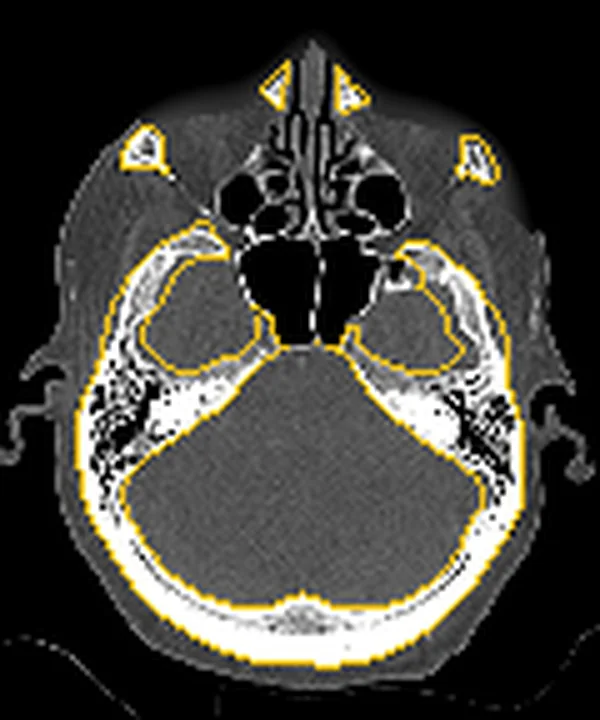
Aynı bölgenin, kaynak veri setinde patoloji içermediği belirtilen bir BT incelemesini kesit kesit kaydırın; organ sınırlarını açarak anatomiyi hasta görüntüsüyle karşılaştırın. Küçük rastlantısal bulgular tümüyle dışlanmamıştır.
Kaynak: TotalSegmentator v2.01 veri seti (Wasserthal ve ark., Radiology: Artificial Intelligence 2023), CC BY 4.0, vaka s0849; organ sınırları veri setinin otomatik segmentasyonundan, birleştirilerek sadeleştirildi. Görüntüler 2,5 mm kesit aralığına yeniden örneklendi.
Ayırıcı tanı
- Septal deviasyon değerlendirmesinde kraniyofasiyal BT ve nazal endoskopi kullanılabilir.
- Nazal hematomlar travma sonrası septumda görülebilir.
- Septal hematomlar travma sonrası görülür ve acil cerrahi boşaltım gerektirir.
- Nazal septum ve konkalar bölgesinde anatomik varyantlar görülebilir.
Tuzaklar
- Nazal septumun değerlendirilmesinde nazal endoskopi ve kraniyofasiyal BT, bu çalışmada spekulum muayenesi ve 3B rekonstrüksiyondan daha doğru ve hassas bulunmuştur.
- Septal deviasyon yaygın bir varyant olduğu için, tanı koyarken keskin kortikal süreksizlik ve yeni travmatik bulguların varlığına dikkat edilmelidir.
- Travma sonrası septal bölgede görülen yumuşak doku kalınlaşması hematom gibi koleksiyonları düşündürebilir ve ayrı ayrı incelenmelidir.
Kendini dene
Travmatik burun yaralanmasında septal hematomun dışlanması neden önemlidir?
Cevabı göster
Kaçırılması, acil boşaltım gerektiren bir yaralanmanın gözden kaçmasına yol açabilir.. Septal hematomun dışlanması önemlidir; travmatik burun yaralanmasında acil drenaj gerektirir.
S6 kohortunda nazal septum hematomu hangi kırık grubu için yüksek pozitif prediktif değer göstermiştir?
Cevabı göster
Orta yüz kırıkları. S6 çalışmasında nazal septum hematomu, orta yüz kırıkları için yüksek pozitif prediktif değer ve pozitif olabilirlik oranı gösteren muayene bulguları arasında yer almıştır.
İlgili konular
Kaynaklar
Bu sayfadaki 31 cümle ve 2 quiz sorusu aşağıdaki kaynaklardan alıntılarla otomatik olarak karşılaştırıldı; 24 cümle bu karşılaştırmada düzeltildi (2026-10-09).
- Facial fractures: classification and highlights for a useful reportpmc.ncbi.nlm.nih.gov
- Clinical Analysis of Nasal Bone Fracture in Patients Who Have Previously Undergone Dorsal Augmentation Using Silicone Implants: A Pilot Study.pubmed.ncbi.nlm.nih.gov
- The accuracy of different methods for diagnosing septal deviation in patients undergoing septorhinoplasty: A prospective study.pubmed.ncbi.nlm.nih.gov
- Facial trauma.pubmed.ncbi.nlm.nih.gov
- Head trauma and olfactory function.pubmed.ncbi.nlm.nih.gov
- Diagnostic accuracy of physical examination findings for midfacial and mandibular fractures.pubmed.ncbi.nlm.nih.gov
- Repair of bone defects in vivo using tissue engineered hypertrophic cartilage grafts produced from nasal chondrocytes.pubmed.ncbi.nlm.nih.gov
- Black bone and CT-like MRI-based delineation of fracture-prone regions in oral and maxillofacial trauma.pubmed.ncbi.nlm.nih.gov
- [Endoscopy-assisted surgery for deviated nose with the preoperative 3-D CT reconstruction].pubmed.ncbi.nlm.nih.gov
- Similar Fracture Patterns in Human Nose and Gothic Cathedral.pubmed.ncbi.nlm.nih.gov
- Prevalence of concha bullosa in a pediatric population.pubmed.ncbi.nlm.nih.gov
- [Clinical study on efficacy of nasal surgical expansion as a basic operation in treatment of patients with OSAHS].pubmed.ncbi.nlm.nih.gov
- The Retrospective Study of Closed Reduction of Nasal Bone Fracture.pubmed.ncbi.nlm.nih.gov
- Alar Cartilage Hematoma: Case Report and Literature Review.pubmed.ncbi.nlm.nih.gov
- Traumatic nasal injuries in general practice.pubmed.ncbi.nlm.nih.gov
- Structural Aesthetic Septorhinoplasty Using the RAGO Strut: A Combined Septal Cartilage and Ethmoid-Vomer Plate Complex Technique to Address Nasal Tip Projection Challenges in Northeast Indian Ethnicities.pubmed.ncbi.nlm.nih.gov
- The State of the Art in Septoplasty: A Review of the Latest Achievements.pubmed.ncbi.nlm.nih.gov
- Computed Tomography of the Nasal Cavities and Paranasal Sinuses of Cattle at Different Ages.pubmed.ncbi.nlm.nih.gov
- Novel compound heterozygous FAM20C variants cause Raine syndrome - retrospective prenatal diagnosis and literature review.pubmed.ncbi.nlm.nih.gov
- ESR Essentials: imaging in nasal obstruction and epistaxis-practice recommendations by the European Society of Head and Neck Radiology.pubmed.ncbi.nlm.nih.gov
- Comparative evaluation of MRI-based bone-targeted sequences and computed tomography for preoperative assessment of midfacial trauma.pubmed.ncbi.nlm.nih.gov
- Modern management of maxillofacial trauma in the emergency department.pubmed.ncbi.nlm.nih.gov
- Efficacy of multi-slice spiral computed tomography-based curved planar reformation combined with nasal endoscopy in the treatment of nasal bone fractures with deformities.pubmed.ncbi.nlm.nih.gov
- Guided Limited Maxillectomy and Staged Septal-Palatal Reconstruction for Low-Grade Chondrosarcoma of the Hard Palate: A Case Report and Literature Review.pubmed.ncbi.nlm.nih.gov
- Pediatric Facial Fractures.pubmed.ncbi.nlm.nih.gov
- Intraosseous tumours of the knee.pubmed.ncbi.nlm.nih.gov
- Experimental comparative study of Two-dimensional and Three-dimensional CT reconstruction in detecting maxillofacial fractures at Mzuzu Central Hospital, Malawi.pubmed.ncbi.nlm.nih.gov
- Surgical excision of an infraorbital nerve schwannoma via a transconjunctival approach with lateral canthotomy: a case report.pubmed.ncbi.nlm.nih.gov
- Musculoskeletal Manifestations of T-Cell Lymphomas: Clinical Presentation, Imaging Features, Pathobiology, and Orthopedic Considerations-A Narrative Review.pubmed.ncbi.nlm.nih.gov
- Deep learning and hybrid architectures for atypical and complex bone fracture diagnosis: a systematic review of performance and clinical validity.pubmed.ncbi.nlm.nih.gov
- Cranial anatomy, palaeoneurology, palaeobiology and stratigraphic age of the large-bodied ornithopod, <i>Muttaburrasaurus langdoni</i> Bartholomai and Molnar, 1981, from the mid-Cretaceous of Australia.pubmed.ncbi.nlm.nih.gov
- Cheek tooth repulsion aided by computer-assisted surgery in 16 equids.pubmed.ncbi.nlm.nih.gov
- Cranial Osteology of Fona herzogae (Dinosauria: Thescelosaurinae) from the Mussentuchit Member of the Cedar Mountain Formation.pubmed.ncbi.nlm.nih.gov
- Ectopic nasal tooth: A clinical case report.pubmed.ncbi.nlm.nih.gov
- Assessment of the Relationship Between Haller Cells, Accessory Maxillary Ostium, and Maxillary Sinus Pathologies: A Cross-Sectional CBCT Study.pubmed.ncbi.nlm.nih.gov
- Integrative Migraine Therapy: From Current Concepts to Future Directions-A Plastic Surgeon's Perspective.pubmed.ncbi.nlm.nih.gov
- Morphological and Epidemiological Analysis of the Sphenoid Sinus Based on Computed Tomography and Magnetic Resonance Imaging: A Narrative Review.pubmed.ncbi.nlm.nih.gov
- Innovative septum suspension technique with a cantilever graft for effective keystone region reconstruction.pubmed.ncbi.nlm.nih.gov
- Exploring the correlation of epidemiological and clinical factors with facial injury severity scores in maxillofacial trauma: a comprehensive analysis.pubmed.ncbi.nlm.nih.gov
- Comparison of 3D-printed and laboratory-fabricated Hyrax on stress distribution and displacement of the maxillary complex: a 3D finite element study.pubmed.ncbi.nlm.nih.gov
- Management of Hypertelorism.pubmed.ncbi.nlm.nih.gov
- Systematic anatomical validation of the endoscopic mononostril transethmoid-paraseptal approach to the central skull base.pubmed.ncbi.nlm.nih.gov
- Vomeric Chondrosarcoma: A Case Report of a Rare Entity With CT and MRI Findings.pubmed.ncbi.nlm.nih.gov
- Bilateral Choanal Atresia in a Newborn With Trisomy of Chromosome 21: A Case Report.pubmed.ncbi.nlm.nih.gov
- Applications of the Novel Midpalatal Piezocorticotomy Guide for MARPE Midfacial Skeletal Expansion.pubmed.ncbi.nlm.nih.gov
- CT comparison of the nasal airway anterior and posterior to the piriform aperture in patients with and without nasal obstruction.pubmed.ncbi.nlm.nih.gov
- Use of an Orthodontic and Otolaryngological Approach in an Infant with Holoprosencephaly.pubmed.ncbi.nlm.nih.gov
- Sudden sensorineural olfactory loss: a structured narrative review and proposal for a standardised terminological framework.pubmed.ncbi.nlm.nih.gov
- 2022 ACC/AHA guideline for the diagnosis and management of aortic disease: A report of the American Heart Association/American College of Cardiology Joint Committee on Clinical Practice Guidelines.pubmed.ncbi.nlm.nih.gov
- International Consensus Statement on Obstructive Sleep Apnea.pubmed.ncbi.nlm.nih.gov
- Ophthalmic Complications After Dental Procedures: Scoping Review.pubmed.ncbi.nlm.nih.gov
- Postmortem CT: Applications in Clinical and Forensic Medicine.pubmed.ncbi.nlm.nih.gov
- Spontaneous bacteremia and spontaneous bacterial peritonitis share similar prognosis in patients with cirrhosis: a cohort study.pubmed.ncbi.nlm.nih.gov
- Imaging for Pediatric Head and Neck Emergencies: Critical Insights.pubmed.ncbi.nlm.nih.gov
- Review of imaging modalities and radiological findings of calvarial lesions.pubmed.ncbi.nlm.nih.gov
- Clinical Application of FDM 3D Printing in Surgery and Traumatology: A Systematic Review.pubmed.ncbi.nlm.nih.gov
- Assessing Nasal Soft-Tissue Envelope Thickness for Rhinoplasty: Normative Data and a Predictive Algorithm.pubmed.ncbi.nlm.nih.gov
- Position paper of the German Society of Oto-Rhino-Laryngology, Head and Neck Surgery and the German Society of Phoniatrics and Pediatric Audiology - Current state of clinical and endoscopic diagnostics, evaluation, and therapy of swallowing disorders in children.pubmed.ncbi.nlm.nih.gov
- Multimodal imaging in neuro-ophthalmology.pubmed.ncbi.nlm.nih.gov
- Computational Mapping of Hedgehog Pathway Kinase Module Predicts Node-Specific Craniofacial Phenotypes.pubmed.ncbi.nlm.nih.gov
- The Exchange Breathing Method for Seizure Intervention: A Historical and Scientific Review of Epilepsy and Its Evolving Therapeutic Paradigms.pubmed.ncbi.nlm.nih.gov
- The vomeronasal system of the wolf (Canis lupus signatus): The singularities of a wild canid.pubmed.ncbi.nlm.nih.gov
- Nasal Cavity Dimensions and Pharyngeal Airway Space in Simple Snoring: A Cross-Sectional CT-Based Study.pubmed.ncbi.nlm.nih.gov
- Asymmetric Puzzle Spreader Graft: A Systematic Approach for Correction of Crooked Nose Deformity.pubmed.ncbi.nlm.nih.gov
- Evaluation of the impacted upper canine and maxillary sinus dimensions using cone beam computed tomography.pubmed.ncbi.nlm.nih.gov
- Malpositioned orbital implants: indications for implant removal and secondary reconstructive techniques.pubmed.ncbi.nlm.nih.gov
- Novel approach to a severe craniomaxillofacial trauma in a military working dog using a customized 3D-printed mold for printed polymethylmethacrylate (PMMA) plate-a case report.pubmed.ncbi.nlm.nih.gov
- Intraoperative CT evaluation of repositioning accuracy in zygomaticomaxillary complex fractures: 1-point versus multiple-point fixation.pubmed.ncbi.nlm.nih.gov
- Mechanical birth-related trauma to the neonate: An imaging perspective.pubmed.ncbi.nlm.nih.gov
- Epiphora: A Structured Diagnostic Approach for the Otolaryngologist.pubmed.ncbi.nlm.nih.gov
- Non-thrombotic pulmonary emboli: imaging findings and differential diagnoses.pubmed.ncbi.nlm.nih.gov
- Case Report: Neurological examination, computed tomography, and magnetic resonance imaging in South American camelids and a dromedary.pubmed.ncbi.nlm.nih.gov
- Orbital Compression Syndrome Mimicking Severe Malaria in a Child with Sickle Cell Disease in a Ugandan Refugee Settlement: A Case Report.pubmed.ncbi.nlm.nih.gov
- Severe Periocular Inflammatory Reaction Mimicking Necrotizing Fasciitis following Hyaluronic Acid Microinjections: A Case Report and Literature Review.pubmed.ncbi.nlm.nih.gov
- Orbital tuberculosis mimicking a vascular emergency: A case report of superior ophthalmic vein engorgement.pubmed.ncbi.nlm.nih.gov
- The current regenerative medicine approaches of craniofacial diseases: A narrative review.pubmed.ncbi.nlm.nih.gov
- International Harmonization of Nomenclature and Diagnostic Criteria (INHAND): Nonproliferative and Proliferative Lesions of the Rabbit.pubmed.ncbi.nlm.nih.gov
- A pneumatized inferior turbinate (inferior concha bullosa): a case report.pubmed.ncbi.nlm.nih.gov
- Clinical feasibility of wireless handheld ultrasound in closed reduction of nasal bone fractures: a comparative study with high-end probes.pubmed.ncbi.nlm.nih.gov
- Computed Tomography Based Classification of Nasal Bone Shape and Thickness for Osteoplasty: The Avellaneda System.pubmed.ncbi.nlm.nih.gov
- The Creation of an Average 3D Model of the Human Cartilaginous Nasal Septum and Its Biomimetic Applications.pubmed.ncbi.nlm.nih.gov
- A Contemporary Review of Trachea, Nose, and Ear Cartilage Bioengineering and Additive Manufacturing.pubmed.ncbi.nlm.nih.gov
- Nasal cavities and the nasal septum: Anatomical variants and assessment of features with computed tomography.pubmed.ncbi.nlm.nih.gov
- A review of Hallermann-Streiff syndrome demonstrates clinical overlap with other conditions.pubmed.ncbi.nlm.nih.gov
- Ultrasonographic Evaluation of Nasal Tip Anatomy for Rhinoplasty Planning.pubmed.ncbi.nlm.nih.gov
- Diagnostic Approaches and Surgical Outcomes in Nasal Valve Dysfunction: A Systematic Review.pubmed.ncbi.nlm.nih.gov
- Application of [<sup>18</sup>F]NaF and [<sup>18</sup>F]FDG PET/CT to Assess Molecular Calcification and Glucose Metabolism in Thyroid Cartilage.pubmed.ncbi.nlm.nih.gov
- Chinese expert consensus on imaging examination and diagnosis of nasal cavity and paranasal sinus tumors.pubmed.ncbi.nlm.nih.gov
- Critical infections in the head and neck: A pictorial review of acute presentations and complications.pubmed.ncbi.nlm.nih.gov
- The Frontal Sinus and Frontal Recess: Anatomical, Radiological and Surgical Concepts.pubmed.ncbi.nlm.nih.gov
- Sinonasal Anatomical Variations and Primary Acquired Nasolacrimal Duct Obstruction: A Single Centre, Case-Control Investigation.pubmed.ncbi.nlm.nih.gov
- Aggressive Treatment Including Endonasal Surgical Sequestrectomy with Vascularized Nasoseptal Flap Can Improve Outcomes of Skull Base Osteoradionecrosis.pubmed.ncbi.nlm.nih.gov
- Histologic atlas of the Egyptian rousette (Rousettus aegyptiacus) with an integrated review of macroscopic anatomy.pubmed.ncbi.nlm.nih.gov
- Antimicrobial prescribing guidelines for horses in Australia.pubmed.ncbi.nlm.nih.gov
- Best Practice Recommendations for Infertility Management.pubmed.ncbi.nlm.nih.gov
- Comprehensive review on endonasal endoscopic sinus surgery.pubmed.ncbi.nlm.nih.gov
- The Application of Cone Beam Computed Tomography (CBCT) on the Diagnosis and Management of Maxillofacial Trauma.pubmed.ncbi.nlm.nih.gov
- The State of Craniomaxillofacial Trauma Care in Low- and Middle-Income Countries: A Scoping Review.pubmed.ncbi.nlm.nih.gov
- Functional Rhinoplasty.pubmed.ncbi.nlm.nih.gov
- Morphometric analysis of the nasal septum in normal Chinese individuals using a three-dimensional model of the nasal septum with facial CT scanning.pubmed.ncbi.nlm.nih.gov
- Improvements in airflow characteristics and effect on the NOSE score after septoturbinoplasty: A computational fluid dynamics analysis.pubmed.ncbi.nlm.nih.gov
- Septal deviation in the nose of the longest faced crocodylian: A description of nasal anatomy and airflow in the Indian gharial (Gavialis gangeticus) with comments on acoustics.pubmed.ncbi.nlm.nih.gov
- Virtual septoplasty: a method to predict surgical outcomes for patients with nasal airway obstruction.pubmed.ncbi.nlm.nih.gov
- Bioprinting for craniofacial reconstruction: A review of advancements, clinical use, and challenges.pubmed.ncbi.nlm.nih.gov
- The current techniques in dorsal augmentation rhinoplasty: a comprehensive review.pubmed.ncbi.nlm.nih.gov
- Managing Surgical Risks in Hemophilic Elbow Arthropathy: An In-Depth Case Study and Literature Review.pubmed.ncbi.nlm.nih.gov
- Unusual Manifestations of Sinonasal Osteomas: A Narrative Review.pubmed.ncbi.nlm.nih.gov
- Lipoid Pneumonia: HRCT and MRI Spectrum, Diagnostic Pitfalls, and Imaging-Based Diagnostic Workflow.pubmed.ncbi.nlm.nih.gov
- Epistaxis and Destructive Computed Tomographic Features in Canine Nasal Transitional Carcinoma: Frequent Cribriform Plate Destruction but Uncommon CT-Detected Brain Parenchymal Involvement.pubmed.ncbi.nlm.nih.gov
- International consensus statement on allergy and rhinology: Olfaction.pubmed.ncbi.nlm.nih.gov
- Emerging and re-emerging infectious disease in otorhinolaryngology.pubmed.ncbi.nlm.nih.gov
Eğitim amaçlıdır; hasta başında tanı ve tedavi kararının yerine geçmez, tıbbi tavsiye değildir. Metinler yapay zekâ desteğiyle yazıldı ve otomatik bir adımda kaynak alıntılarıyla karşılaştırıldı; bu bir tıbbi doğrulama değildir ve içerik uzman radyolog incelemesinden geçmedi. Klinik kararlarda güncel kılavuzları, kurum protokollerini ve radyoloji raporunu esas alın.