Özet
Polispleni ve konjenital aspleni, heterotaksi spektrumunda tanımlanan doğumsal dalak anomalileridir. Portal faz BT, ektopik yerleşimli dalak dokularını ve karın organları ile büyük damarların ilişkisini tek incelemede gösterir. Dalak sayısını tek başına situs tipine eşitlemek güvenilir değildir; organ dizilimi, vena kava ve azygos sistemi ayrıca haritalanmalıdır. Eşlik eden kardiyak, vasküler veya bağırsak rotasyon anomalilerinin atlanması anatomik değerlendirmeyi eksik bırakabilir.
Faz ve pencere
- Portal tanısal
- Portal venöz faz, dalak yatağındaki dokunun varlığını, birden çok düzgün sınırlı ve dalakla benzer atenüasyonlu odağı, karaciğer-mide-bağırsak yerleşimini ve vena kava/azygos devamlılığını değerlendirmek için uygundur.
- Kontrastsız
- Kontrastsız BT organların ve olası dalak dokusu odaklarının konumunu gösterebilir; vasküler devamlılık ve splenik dokuyla eş kontrastlanma daha sınırlı değerlendirilir.
Önerilen pencereler: Batın (G 400 / M 50), Yumuşak doku (G 400 / M 40).
BT bulguları
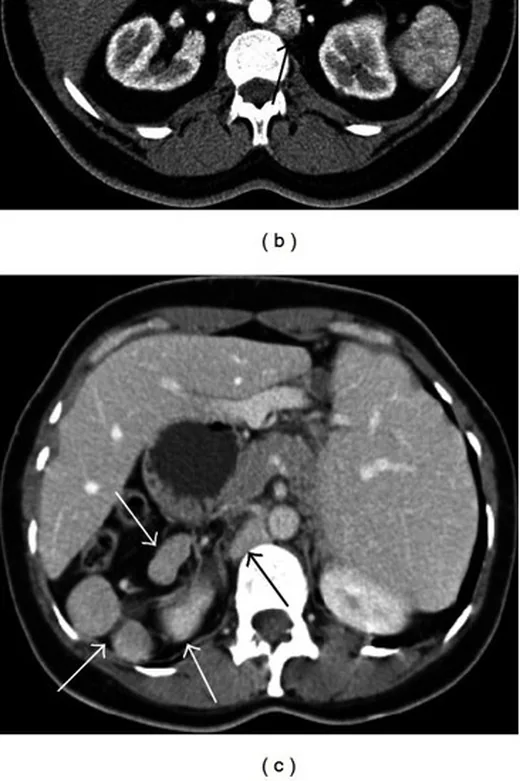
- Birden çok, düzgün sınırlı, dalak parankimine benzer atenüasyon ve portal faz kontrastlanması gösteren dalak dokusu adacığı
- Sol üst kadranda ortotopik dalağın görülmemesi; ektopik dokunun sağ üst kadran veya başka abdominal bölgede aranması
- Karaciğerin orta hatta veya karşı tarafta yerleşmesi ve mide-bağırsak situsunun olağandışı düzeni
- İntrahepatik vena kava kesintisi ve azygos/hemiazygos devamlılığı gibi büyük damar seyir anomalileri
- İnce bağırsak ve kolon yerleşiminde rotasyon veya situs değişikliği
- Dalak anatomisine eşlik edebilen pankreas, safra yolları ve diğer viseral varyantlar
Ölçütler ve sınıflamalar
- Heterotaksi ve dalak anatomisi
- Polispleni veya aspleni, heterotaksiyle ilişkili fenotipleri tanımlamakta kullanılır; dalak bulgusu tek başına diğer organların situsunu ya da fonksiyonel dalak durumunu kesinleştirmez. Eşlik eden torasik ve abdominal anatomi ayrı ayrı tarif edilir.
Normalde
Situs solitus düzeninde dalak sol üst kadranda, karaciğer çoğunlukla sağda, mide solda ve vena kava aortanın sağında izlenir; bağırsak yerleşimi bu düzenle uyumludur. Portal fazda saptanan her dalak benzeri odağı ortotopik dalakla karşılaştır ve karaciğer, mide, ince/kalın bağırsak, aorta, vena kava ile azygos sisteminin yönünü aynı inceleme boyunca izle.
Normal BT ile kıyasla
Aynı bölgenin, kaynak veri setinde patoloji içermediği belirtilen bir BT incelemesini kesit kesit kaydırın; organ sınırlarını açarak anatomiyi hasta görüntüsüyle karşılaştırın. Küçük rastlantısal bulgular tümüyle dışlanmamıştır.
Kaynak: TotalSegmentator v2.01 veri seti (Wasserthal ve ark., Radiology: Artificial Intelligence 2023), CC BY 4.0, vaka s0541; organ sınırları veri setinin otomatik segmentasyonundan, birleştirilerek sadeleştirildi. Görüntüler 2,5 mm kesit aralığına yeniden örneklendi.
Ayırıcı tanı
- Cerrahi splenektomi
- klipsler veya ameliyat yatağı değişiklikleri ve operasyon öyküsü konjenital yokluktan ayırır.
- Splenozis, dalak kapsülünün travma veya splenektomi sonrası rüptürüyle başka bölgelere ototransplante olan kazanılmış splenik doku odaklarıdır.
- Tek aksesuar dalak
- ana dalağın yanında sınırlı bir odaktır; birden çok benzer dokuyu ve situs-vasküler anomalileri tek başına açıklamaz.
- Wandering spleen
- dalak dokusu vardır fakat anormal derecede hareketli ve pedikül etrafında yer değiştirmiştir; çok sayıda odak oluşturmaz.
Tuzaklar
- BT'de dalak görünmemesi cerrahi veya işlevsel aspleniyi dışlamaz; öykü, ektopik doku ve gerektiğinde fonksiyonel değerlendirme birbirinden ayrılmalıdır.
- Birden fazla splenik nodül polispleniyle uyumlu olabilir; ancak travma veya splenektomi sonrası gelişen kazanılmış splenozis de ektopik splenik doku odakları oluşturabilir.
- Karaciğerin veya midenin yer değiştirmesi tek başına tam situs tipini belirlemez; bağırsak ve sistemik venöz anatomi de görüntüler boyunca izlenmelidir.
- Polispleni/aspleni ile kalp anomalileri arasında değişken birliktelik vardır; abdominal BT kalp anatomisini bütünüyle dışlamaz.
Kendini dene
Önceden travma veya splenektomi öyküsü olmayan hastada sol dalak yatağı boş; sağ üst kadranda dalakla eş kontrastlanan birden çok splenik doku ve eşlik eden situs/venöz anatomi anomalisi var. En olası değerlendirme hangisidir?
Cevabı göster
Heterotaksiyle ilişkili polispleni. Çoklu splenik odaklarla birlikte viseral ve venöz situs değişiklikleri heterotaksiyle ilişkili polispleni olasılığını artırır. Splenozis, travma veya iatrojenik splenektomi sonrası splenik doku implantasyonu ile oluşan kazanılmış bir durumdur; genellikle peritoneal yüzeylerde ve pelviste çoklu nodüller şeklinde izlenir. Splenektomi için ameliyat öyküsü aranır, wandering spleen ise tek yer değiştirmiş organdır.
Dalak dokusu görülmeyen bir hastada karaciğer-situs ve vena kava düzeni de konjenital varyant gösteriyor. Hangi yorum en temkinlidir?
Cevabı göster
Konjenital aspleni olasılığını araştırmak. Situs ve damar anomalileri konjenital heterotaksi/aspleni olasılığını gündeme getirir; yalnız BT görünümü önceki cerrahi öyküsünü kanıtlamaz. Normal situs tanımı anormal anatomiyi yok sayar, splenozis ise implant dokularının gösterilmesini ve genellikle kazanılmış öyküyü gerektirir.
İlgili konular
Kaynaklar
Bu sayfadaki 39 cümle ve 2 quiz sorusu aşağıdaki kaynaklardan alıntılarla tek tek karşılaştırıldı; 6 cümle bu karşılaştırmada düzeltildi (2026-10-09).
- Situs Ambiguous With Polysplenia With Azygos Continuation of the Inferior Vena Cava (IVC): A Case Reportpmc.ncbi.nlm.nih.gov
- From multiple spleens to absence: Insights from two cases of heterotaxy syndromespmc.ncbi.nlm.nih.gov
- Polysplenia syndrome complicated by multiple intrahepatic bile duct stones in an adult: a case reportpmc.ncbi.nlm.nih.gov
- Heterotaxy syndrome with complex single-ventricle physiology and left-sided Bochdalek hernia: Multisystem characterization by cardiothoracic CTpmc.ncbi.nlm.nih.gov
- Dextrocardia in Heterotaxy Syndrome (Polysplenia Variant) in a 36‐Year‐Old Ethiopian Woman: A Case Report and Literature Reviewpmc.ncbi.nlm.nih.gov
- Characterisation of computed tomography angiography findings in paediatric patients with heterotaxy.pubmed.ncbi.nlm.nih.gov
- Heterotaxy polysplenia syndrome in an adult female with complete endocardial cushion defect.pubmed.ncbi.nlm.nih.gov
- Disharmonious Patterns of Heterotaxy and Isomerism: How Often Are the Classic Patterns Breached?pubmed.ncbi.nlm.nih.gov
- Polysplenia syndrome with duodenal and pancreatic dysplasia in a Holstein calf: a case report.pubmed.ncbi.nlm.nih.gov
- The Spectrum of Cardiac Anomalies Associated with Heterotaxy: A Single-Center Study of a Large Series Based on Computed Tomography.pubmed.ncbi.nlm.nih.gov
- Complex venous malformation in an elderly female: A case report.pubmed.ncbi.nlm.nih.gov
- Pheochromocytoma in a patient with heterotaxy syndrome: a case report.pubmed.ncbi.nlm.nih.gov
- Isomeric Bodily Situs in the Era of Universal Prenatal Detection: Highlighting Computed Tomographic Findings in Those with Complex Cardiovascular Malformations.pubmed.ncbi.nlm.nih.gov
- Genetics in Heterotaxy: A Case Series and Literature Review on DNAH9, PKD1L1, MMP21, and GDF1.pubmed.ncbi.nlm.nih.gov
- Situs Ambiguous With Polysplenia With Azygos Continuation of the Inferior Vena Cava (IVC): A Case Report.pubmed.ncbi.nlm.nih.gov
- Living Donor Liver Transplantation in Pediatric Situs Inversus: A Case Series and Systematic Review.pubmed.ncbi.nlm.nih.gov
- The Many Faces of the Angry Peritoneum.pubmed.ncbi.nlm.nih.gov
- China Liver Cancer Guidelines for the Diagnosis and Treatment of Hepatocellular Carcinoma (2024 Edition).pubmed.ncbi.nlm.nih.gov
- Pancreatic Morphology, Immunology, and the Pathogenesis of Acute Pancreatitis.pubmed.ncbi.nlm.nih.gov
- Global research trends in heterotaxy syndrome with congenital heart defects: a 20-year bibliometric analysis (2006-2025).pubmed.ncbi.nlm.nih.gov
- The phenotypic spectrum of ZIC3 mutations includes isolated d-transposition of the great arteries and double outlet right ventricle.pubmed.ncbi.nlm.nih.gov
- Laparoscopic Repair of Duodenal Atresia with Concurrent Situs Anomaly: A Case Series and Technical Considerations.pubmed.ncbi.nlm.nih.gov
- From multiple spleens to absence: Insights from two cases of heterotaxy syndromes.pubmed.ncbi.nlm.nih.gov
- Polysplenia syndrome with semi-annular pancreas, midgut malrotation and interrupted inferior vena cava: A rare adult case report.pubmed.ncbi.nlm.nih.gov
- Guidelines for endoscopic treatment of postinflammatory pancreatic and peripancreatic fluid collections. Recommendations of the Endoscopic Surgery Section of the Association of Polish Surgeons, the Endoscopy Section of the Polish Society of Gastroenterology, the Polish Pancreatic Club, the Laparoscopic and Robotic Surgery Section of the Association of Polish Surgeons, and the Pancreatic Surgery Section of the Association of Polish Surgeons; formulated by an expert panel led by Prof. Mateusz Jagielski, MD, PhD.pubmed.ncbi.nlm.nih.gov
- Automated Segmentation of Tissues Using CT and MRI: A Systematic Review.pubmed.ncbi.nlm.nih.gov
- Diagnosis and management of hemorrhagic complications of interventional radiology procedures.pubmed.ncbi.nlm.nih.gov
- Common and Uncommon Splenic Lesions: A Review.pubmed.ncbi.nlm.nih.gov
- Primary splenic angiosarcoma presenting with multiple bone destruction as the initial manifestation: a case report and narrative review.pubmed.ncbi.nlm.nih.gov
- Multimodal imaging features to diagnose abdominal complications of sickle cell disease.pubmed.ncbi.nlm.nih.gov
- Patterns of injury and violence in Yaoundé Cameroon: an analysis of hospital data.pubmed.ncbi.nlm.nih.gov
- Spontaneous bacteremia and spontaneous bacterial peritonitis share similar prognosis in patients with cirrhosis: a cohort study.pubmed.ncbi.nlm.nih.gov
- High-affinity alphavbeta3 integrin targeted optical probe as a new imaging biomarker for early atherosclerosis: initial studies in Watanabe rabbits.pubmed.ncbi.nlm.nih.gov
- Diagnosis of Dextrocardia with a Pictorial Rendition of Terminology and Diagnosis.pubmed.ncbi.nlm.nih.gov
- Pancreaticoduodenectomy for pancreatic adenocarcinoma in a patient with situs inversus abdomenalis, a case report.pubmed.ncbi.nlm.nih.gov
- Prenatal ultrasound findings of the IVC takeoff appearance: Teaching cases highlighting IVC interruption and double vessel sign.pubmed.ncbi.nlm.nih.gov
- Transhepatic Access for Transcatheter ASD Closure in Patients With Interrupted IVC.pubmed.ncbi.nlm.nih.gov
- Incidental Heterotaxy Syndrome With Polysplenia and Inferior Vena Cava Agenesis Identified During Trauma Evaluation.pubmed.ncbi.nlm.nih.gov
- Extraordinary rare type of rotational abnormality of the gut revealed in a 6-month-old infant presented with intussusception: a case report.pubmed.ncbi.nlm.nih.gov
- A Case of Congenital Peritoneal Encapsulation Complicated with Left Paraduodenal Hernia Presenting as Recurrent Small Bowel Obstruction.pubmed.ncbi.nlm.nih.gov
- Heterotaxy Syndrome Diagnosed in an Adult.pubmed.ncbi.nlm.nih.gov
- Situs Inversus Partialis: An Incidental Discovery in a Young Patient with Obstructed Left Inguinal Hernia.pubmed.ncbi.nlm.nih.gov
- A Rare Presentation of Hepatolithiasis and Acute Cholangitis: A Case Report Highlighting Heterotaxy Syndrome With Left Isomerism.pubmed.ncbi.nlm.nih.gov
- Heterotaxy syndrome - An unusual cause for bowel obstruction in an adult.pubmed.ncbi.nlm.nih.gov
- Long-term safety and effectiveness of the "OptEase" vena cava filter.pubmed.ncbi.nlm.nih.gov
- Dextrocardia in Heterotaxy Syndrome (Polysplenia Variant) in a 36-Year-Old Ethiopian Woman: A Case Report and Literature Review.pubmed.ncbi.nlm.nih.gov
- Splenic Torsion in a Patient With Situs Inversus Totalis and Polysplenia: Challenging Diagnosis and Treatment of a Rare Case.pubmed.ncbi.nlm.nih.gov
- Novel MYO1D Missense Variant Identified Through Whole Exome Sequencing and Computational Biology Analysis Expands the Spectrum of Causal Genes of Laterality Defects.pubmed.ncbi.nlm.nih.gov
- Laterality defects in the national birth defects prevention study (1998-2007): birth prevalence and descriptive epidemiology.pubmed.ncbi.nlm.nih.gov
- Nonproliferative and Proliferative Lesions of the Rat and Mouse Hematolymphoid System.pubmed.ncbi.nlm.nih.gov
- Coexistence of Autoantibodies against the Golgi Complex and Ro52 Antigen in a Patient with Nonspecific Interstitial Pneumonia.pubmed.ncbi.nlm.nih.gov
- Elective Robotic Splenectomy for Wandering Spleen-Associated Pancreatitis: A Novel Case Report.pubmed.ncbi.nlm.nih.gov
- Wandering spleen presenting as a pelvic mass: A rare case report and literature review.pubmed.ncbi.nlm.nih.gov
- Splenic Torsion Following Blunt Abdominal Trauma.pubmed.ncbi.nlm.nih.gov
- PET/CT of the Spleen with Gallium-Oxine-Labeled, Heat-Damaged Red Blood Cells: Clinical Experience and Technical Aspects.pubmed.ncbi.nlm.nih.gov
- The North American Neuroendocrine Tumor Society Consensus Paper on the Surgical Management of Pancreatic Neuroendocrine Tumors.pubmed.ncbi.nlm.nih.gov
- Standards of the Polish Ultrasound Society - update. Spleen examination.pubmed.ncbi.nlm.nih.gov
- Multimodal study of pelvic splenosis: a rare cause of abdominal pain.pubmed.ncbi.nlm.nih.gov
- Pelvic splenosis-a very unusual location.pubmed.ncbi.nlm.nih.gov
- Imaging of the spleen: what the clinician needs to know.pubmed.ncbi.nlm.nih.gov
- Seventeen years of prenatal magnetic resonance imaging at the Institute of Mother and Child in Warsaw.pubmed.ncbi.nlm.nih.gov
- Does laparoscopic surgery decrease the risk of atrial fibrillation after foregut surgery?pubmed.ncbi.nlm.nih.gov
- Unilateral Lung Agenesis: A Systematic Review of Prevalence, Anatomical Variants, and Clinical Implications.pubmed.ncbi.nlm.nih.gov
- Ventricular Topology in Congenital Heart Defects Associated with Heterotaxy: Can We Find Patterns Reflecting the Syndrome-Specific Tendency for Visceral Symmetry?pubmed.ncbi.nlm.nih.gov
- Splenic Torsion in Heterotaxy Syndrome with Left Isomerism: A Case Report and Literature Review.pubmed.ncbi.nlm.nih.gov
- Dual Role of Alchemilla vulgaris L. Extract in Breast Cancer Regression: Reestablishment of Effective Immune Response.pubmed.ncbi.nlm.nih.gov
- Special Issue: EACR 2026 Congress: Innovative Cancer Science, 8-11 June 2026.pubmed.ncbi.nlm.nih.gov
- Update of the risk assessment of polybrominated diphenyl ethers (PBDEs) in food.pubmed.ncbi.nlm.nih.gov
- MDCT Findings of Splenic Pathology.pubmed.ncbi.nlm.nih.gov
- Refractory Immune Thrombocytopenic Purpura with Abdominal Splenosis: A Complex Case.pubmed.ncbi.nlm.nih.gov
- Splenic pathologies: A pictorial review of common, wandering, twisting and rare presentations.pubmed.ncbi.nlm.nih.gov
- Splenoses and Other Ectopic and Heterotopic Splenic Tissue: The Use of Long-Lasting Enhancement in Contrast-Enhanced Ultrasound to Avoid Unnecessary Intervention.pubmed.ncbi.nlm.nih.gov
- Acute splenic torsion in an adolescent with polysplenia syndrome: case report.pubmed.ncbi.nlm.nih.gov
Eğitim amaçlıdır; hasta başında tanı ve tedavi kararının yerine geçmez. İçerik yapay zekâ destekli bir süreçle güncel literatüre göre cümle cümle kaynaklarla karşılaştırıldı, ancak uzman radyolog incelemesinden geçmedi. Klinik kararlarda güncel kılavuzları, kurum protokollerini ve radyoloji raporunu esas alın.