Özet
Birincil postpartum kanama doğumdan sonraki ilk 24 saatte, ikincil postpartum kanama ise 24 saatten sonra ve 6 haftaya kadar ortaya çıkar; semptomatik postpartum hastalarda ultrasonografi ilk değerlendirmede önemli bir görüntüleme yöntemidir. Doğumdan sonra devam eden veya yineleyen kanamada, kontrastlı BT kanama odağını belirlemeye ve uterus dışındaki kanama bulgularını göstermeye yardımcı olabilir. Kontrastlı BT aktif kontrast ekstravazasyonunu ve uterin arter psödoanevrizmasını gösterebilir; bu bulgular kanama odağının değerlendirilmesine yardımcı olur. Hematomun ekstraperitoneal, intraperitoneal veya karın duvarındaki uzanımı kanamanın görünür vajinal kanamayla sınırlı olmadığını gösterebilir. Damar odağının ya da uzak hematomun gözden kaçması kanama kaynağının tanınmasını geciktirebilir.
Faz ve pencere
- Kontrastsız
- Acil kanama değerlendirmesinde kontrastsız BT'yi arteriyel ve portal venöz kontrastlı fazlar izleyebilir; aktif ekstravazasyon kontrastlı görüntülerde damar dışına çıkan kontrast olarak aranır.
- Arteriyel tanısal
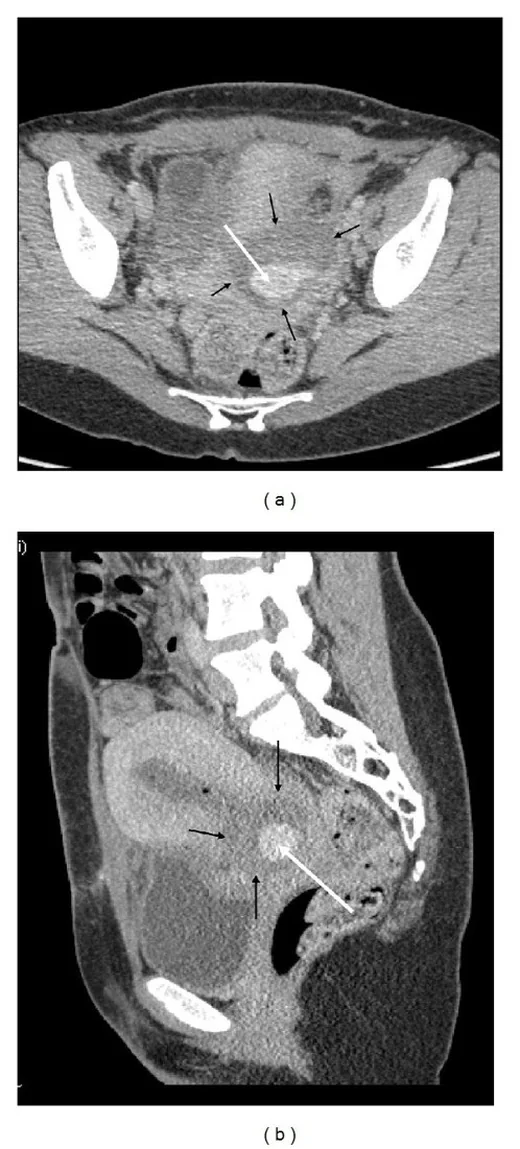
- Kontrastlı BT'de uterin arter psödoanevrizması kontrastla dolan fokal bir çıkıntı olarak, vajinal arter dalı kanaması ise damar dışına aktif ekstravazasyon olarak görülebilir.
- Portal tanısal
- Çok fazlı BT'de arteriyel, geç arteriyel ve venöz serilerde ekstravaze kontrast aktif kanama açısından değerlendirilir; ek olarak rektus kılıfı ve ekstraperitoneal hematomlar ile hemoperitoneum saptanabilir.
Önerilen pencereler G genişlik, M merkez; değerler Hounsfield birimi (HU)
- AnjiyoG 600 / M +150
- Yumuşak dokuG 400 / M +40
- BatınG 400 / M +50
BT bulguları
- Aktif kontrast ekstravazasyonu — kontrastlı BT'de damar dışına çıkan kontrast materyali.
- Uterin arter psödoanevrizması — uterin arter dalıyla bağlantılı, arteriyel fazda damar lümeni gibi dolan sınırlı kese.
- Mesane-flebi hematomu — sezaryen sonrası alt uterin segment ile mesane arasında görülen pelvik hematom.
- Paravajinal hematom — vajen kanalı ve paravajinal bölgede kan dansitesinde koleksiyon; supralevator uzanım gösterebilir ve posteriorunda rektuma komşu olabilir.
- Paravajinal hematom — vajen çevresindeki yumuşak dokuda gelişen kan koleksiyonu.
- Hemoperitoneum — peritoneal boşlukta kan birikimidir ve postpartum kanamada görülebilir; retroperitoneal kanama ise periton arkasındaki ayrı bir anatomik kompartımanda hematom oluşturabilir.
- Karın duvarı kanaması — sezaryen insizyonu yakınında rektus kılıfı içinde hematom; inferior epigastrik damar dalı kaynak olabilir.
- Postpartum uterin kavite içeriği — BT'de endometriyal kavitede debris veya küçük hematom görülebilir.
Normalde
Sezaryen sonrası beklenen BT bulguları arasında endometriyal kavite debrisi ve küçük hematom bulunabilir. Kıyaslamada kavite içeriğinin yanı sıra psödoanevrizma veya aktif ekstravazasyon varlığını ve mesane-flebi, rektus kılıfı ya da ekstraperitoneal hematomları değerlendirin.
Normal BT ile kıyasla
Aynı bölgenin, kaynak veri setinde patoloji içermediği belirtilen bir BT incelemesini kesit kesit kaydırın; organ sınırlarını açarak anatomiyi hasta görüntüsüyle karşılaştırın. Küçük rastlantısal bulgular tümüyle dışlanmamıştır.
Kaynak: TotalSegmentator v2.01 veri seti (Wasserthal ve ark., Radiology: Artificial Intelligence 2023), CC BY 4.0, vaka s0119; organ sınırları veri setinin otomatik segmentasyonundan, birleştirilerek sadeleştirildi. Görüntüler 2,5 mm kesit aralığına yeniden örneklendi.
Ayırıcı tanı
- Uterin atoni
- postpartum kanamada sık bir nedenidir; görüntülemenin atoni yönetimindeki yararı sınırlıdır.
- Plasental doku retansiyonu
- sekonder postpartum kanamanın sık nedenidir; BT'de kavite içi odakta izlenebilirken aktif ekstravazasyon dinamik BT'de aktif kanamayı temsil eden ekstravaze kontrast olarak değerlendirilir.
- Uterin arteriovenöz malformasyon
- gebelikle ilişkili olaylar veya uterin enstrümantasyonla ilişkili edinilmiş vasküler lezyonlardan ayırt edilmelidir; psödoanevrizma ayrı bir vasküler ayırıcı tanıdır.
- Vajinal veya pudendal arter yaralanması
- ekstravazasyon ilgili damar seyri boyunca, vajen çevresi hematom içinde izlenebilir.
- Normal postpartum kavite içeriği
- endometriyal kavitede debris veya küçük hematom görülebilir.
Tuzaklar
- Aktif kanamayı değerlendirmek için kontrastlı BT'nin arteriyel ve venöz serilerinde ekstravaze kontrastı inceleyin.
- Puerperiumdaki fizyolojik uterin değişiklikler komplikasyonlarla örtüşebileceğinden, şüpheli vasküler odağı BT'de tek başına görünümüne göre yorumlamayın.
- Psödoanevrizma BT'de kontrastla dolu görülebilir; psödoanevrizma saptanması tek başına aktif ekstravazasyon bulunduğunu göstermez.
- Vajinal kanama görülmemesi kan kaybını dışlamaz; sezaryen sonrası rektus kılıfı, prevezikal alan ve peritoneal boşlukta saklı hematom arayın.
Kendini dene
Kontrastlı BT'de uterin arterle ilişkili, kontrastla dolan fokal çıkıntı görülüyor. En olası tanı nedir?
Cevabı göster
Uterin arter psödoanevrizması. Kontrastlı BT'de uterin arterle ilişkili fokal vasküler çıkıntı psödoanevrizma lehinedir.
Doğum sonrası kanamada arteriyel seride damar dışı opak odak görülüyor ve sonraki fazda büyüyerek yayılıyor. Bu görünüm en iyi neyi düşündürür?
Cevabı göster
Sürmekte olan kanama. Dinamik BT'de kontrastlı fazlarda damar dışına çıkan kontrast aktif kanamayı gösterir.
İlgili konular
- Postpartum pelvik komplikasyonlar ve normal postpartum görünüm
- Retained products of conception ve postpartum endometrit
- Uterin arteriovenöz malformasyon ve psödoanevrizma
Kaynaklar
Bu sayfadaki 38 cümle ve 2 quiz sorusu aşağıdaki kaynaklardan alıntılarla otomatik olarak karşılaştırıldı; 18 cümle bu karşılaştırmada düzeltildi (2026-10-10).
- Postcaesarean Pseudoaneurysm of Uterine Artery Causing Secondary Postpartum Hemorrhage Managed With Embolization: A Case Reportpmc.ncbi.nlm.nih.gov
- Rupture of the Uterine Artery Pseudoaneurysm Causing Late Postpartum Hemorrhage: Case Report and Literature Reviewpmc.ncbi.nlm.nih.gov
- Collateral-pathway–oriented clinico-angiographic framework for inferior epigastric artery–related hemorrhage: embolization planning and clinical outcomespmc.ncbi.nlm.nih.gov
- Postpartum retroperitoneal hematoma secondary to ovarian artery rupture: A case presentationpmc.ncbi.nlm.nih.gov
- Pseudoaneurysm of the Internal Pudendal Artery Causing Delayed Vaginal Hemorrhage After Robotic-Assisted Total Hysterectomy: A Case Reportpmc.ncbi.nlm.nih.gov
- Embolization of iatrogenic uterine pseudoaneurysm.pubmed.ncbi.nlm.nih.gov
- Post-partum hemoperitoneum: Do not miss false aneurysm as a cause of bleeding.pubmed.ncbi.nlm.nih.gov
- Extravasating uterine pseudoaneurysm: A rare cause of postpartum haemorrhage.pubmed.ncbi.nlm.nih.gov
- Primary and secondary postpartum haemorrhage: a review for a rationale endovascular approach.pubmed.ncbi.nlm.nih.gov
- Management of Hypervascular Retained Products of Conception With Massive Bleeding.pubmed.ncbi.nlm.nih.gov
- Embolization of a postcesarean pseudo-aneurysm of a uterine artery: A case report.pubmed.ncbi.nlm.nih.gov
- Uterine artery pseudoaneurysm bleeding one decade after caesarean section: A case report.pubmed.ncbi.nlm.nih.gov
- Transcatheter Embolization of Ruptured Uterine Artery Pseudoaneurysm: A Case Report.pubmed.ncbi.nlm.nih.gov
- Spontaneous Rupture of an Ovarian Artery Aneurysm in the Early Postpartum Period: A Case Report.pubmed.ncbi.nlm.nih.gov
- Efficacy of computed tomography for the diagnosis of postpartum hemorrhage.pubmed.ncbi.nlm.nih.gov
- Delayed postpartum hemorrhage resulting from uterine artery pseudoaneurysm rupture.pubmed.ncbi.nlm.nih.gov
- Uterine artery pseudoaneurysm presenting with subcutaneous hematoma and vaginal bleeding following cesarean delivery.pubmed.ncbi.nlm.nih.gov
- Uterine artery pseudoaneurysm hidden behind septic abortion: pseudoaneurysm without preceding procedure.pubmed.ncbi.nlm.nih.gov
- Post-cesarean section pseudoaneurysm of uterine artery: A case report.pubmed.ncbi.nlm.nih.gov
- Uterine necrosis following pelvic arterial embolization for post-partum hemorrhage: review of the literature.pubmed.ncbi.nlm.nih.gov
- The accuracy of contrast-enhanced computed tomography scans to detect postpartum haemorrhage: an observational study.pubmed.ncbi.nlm.nih.gov
- Identification of bleeding sites in patients with postpartum hemorrhage: MDCT compared with angiography.pubmed.ncbi.nlm.nih.gov
- The successful detection of postpartum unruptured vaginal pseudoaneurysm using ultrasonography: a case report.pubmed.ncbi.nlm.nih.gov
- Imaging in extremity vascular trauma: can MDCT angiography predict the nature of injury?pubmed.ncbi.nlm.nih.gov
- Pulmonary artery pseudoaneurysm causing massive hemoptysis in hyperimmunoglobulin E syndrome: a case report.pubmed.ncbi.nlm.nih.gov
- Management of immediate and delayed postpartum hemorrhage with cesarean delivery.pubmed.ncbi.nlm.nih.gov
- Circumferential Vault Excision and Reconstruction: Technical Description of Management of Intractable Secondary Vault Hemorrhage after Hysterectomy in Resource-Limited Settings.pubmed.ncbi.nlm.nih.gov
- Arterial embolization for primary postpartum hemorrhage.pubmed.ncbi.nlm.nih.gov
- Endovascular management of acquired uterine vascular anomalies.pubmed.ncbi.nlm.nih.gov
- Adenomyomectomy, curettage, and then uterine artery pseudoaneurysm occupying the entire uterine cavity.pubmed.ncbi.nlm.nih.gov
- Three-dimensional computerized tomographic angiography for diagnosis and management of intractable postpartum hemorrhage.pubmed.ncbi.nlm.nih.gov
- Report of a Rare Case of Acute Abdominal Pain Post-partum: Spontaneous Ureteral Rupture.pubmed.ncbi.nlm.nih.gov
- A Pictorial Review of Postpartum Complications.pubmed.ncbi.nlm.nih.gov
- Multidetector CT appearance of the pelvis after cesarean delivery: normal and abnormal acute findings.pubmed.ncbi.nlm.nih.gov
- Diagnostic imaging in uterine incisional necrosis/dehiscence complicating cesarean section.pubmed.ncbi.nlm.nih.gov
- Early and delayed post-cesarean complications: an imaging review.pubmed.ncbi.nlm.nih.gov
- Uterine artery projection relative to anatomical bony landmarks in CT-angiographies.pubmed.ncbi.nlm.nih.gov
- Intracervical lakes as sonographic marker of placenta accreta spectrum disorder in patients with placenta previa or low-lying placenta.pubmed.ncbi.nlm.nih.gov
- Complete Laparoscopic Type C2 Radical Surgery for Cervical Stump Cancer: No-Look and No-Touch Techniques.pubmed.ncbi.nlm.nih.gov
- Large supralevator haematoma: a dilemma in diagnosis and management.pubmed.ncbi.nlm.nih.gov
- Laparoscopic hemostasis and drainage for postpartum retroperitoneal hematoma complicated with an infection: A case report and surgical video.pubmed.ncbi.nlm.nih.gov
- Idiopathic spontaneous intraperitoneal haemorrhage: A near fatal presentation of acute abdomen requiring prompt diagnosis.pubmed.ncbi.nlm.nih.gov
- Uterocutaneous fistula following B-Lynch suture for primary postpartum haemorrhage.pubmed.ncbi.nlm.nih.gov
- The clinical characteristics and surgical approach of scar endometriosis: A case series of 14 women.pubmed.ncbi.nlm.nih.gov
- Resuscitation of traumatic maternal cardiac arrest: A case report and summary of recommendations from Obstetric Life Support™.pubmed.ncbi.nlm.nih.gov
- Imaging and Pitfalls of Early Postpartum Complications after Vaginal and Cesarean Section.pubmed.ncbi.nlm.nih.gov
- A Rare Delayed Presentation of Uterine Rupture Following Vaginal Birth After Caesarean (VBAC): A Case Report and Literature Review.pubmed.ncbi.nlm.nih.gov
- True pelvic congenital arteriovenous malformation in a patient seeking pregnancy.pubmed.ncbi.nlm.nih.gov
- Treatment decision-making for post-partum hemorrhage using dynamic contrast-enhanced computed tomography.pubmed.ncbi.nlm.nih.gov
- Unscarred uterine rupture with catastrophic hemorrhage immediately after vaginal delivery: diagnosis and management of six consecutive cases.pubmed.ncbi.nlm.nih.gov
- Rapid, moderate, or slow bleeding? CT analysis of abdominopelvic active vascular contrast extravasation classes and mortality outcomes.pubmed.ncbi.nlm.nih.gov
- Utility of pelvic CT angiography in blunt pelvic trauma.pubmed.ncbi.nlm.nih.gov
- Quantitative assessment of active bleeding on contrast-enhanced computed tomography in primary postpartum hemorrhage.pubmed.ncbi.nlm.nih.gov
- Crucial factors for implementing treatment strategies in intractable atonic postpartum haemorrhage: early phase contrast medium extravasation on dynamic CT.pubmed.ncbi.nlm.nih.gov
- CT angiography for the management of postpartum hemorrhage refractory to conservative treatment.pubmed.ncbi.nlm.nih.gov
- Uterine artery pseudoaneurysm: a rare cause of secondary postpartum haemorrhage following caesarean section.pubmed.ncbi.nlm.nih.gov
- Pseudoaneurysm of uterine artery complicating caesarean section: a rare cause of intractable secondary postpartum haemorrhage managed with uterine artery embolisation.pubmed.ncbi.nlm.nih.gov
- Collateral-pathway-oriented clinico-angiographic framework for inferior epigastric artery-related hemorrhage: embolization planning and clinical outcomes.pubmed.ncbi.nlm.nih.gov
- Emergency surgical management of acute Stanford type A aortic dissection in a primigravida at 29 weeks gestation: A case report.pubmed.ncbi.nlm.nih.gov
- A rare case report of vascular Ehlers-Danlos syndrome as a pulsatile neck mass with an internal carotid artery aneurysm.pubmed.ncbi.nlm.nih.gov
- Uterine artery pseudoaneurysm: Rare cause of delayed postpartum hemorrhage.pubmed.ncbi.nlm.nih.gov
- Postcaesarean Pseudoaneurysm of Uterine Artery Causing Secondary Postpartum Hemorrhage Managed With Embolization: A Case Report.pubmed.ncbi.nlm.nih.gov
- Uterus-preserving management of a high-flow uterine artery pseudoaneurysm with arteriovenous fistula following cesarean section: a case report.pubmed.ncbi.nlm.nih.gov
- Upper-Limb Ischemia Due to Distal Embolization from a Dissecting Axillary Artery Pseudoaneurysm in an Elite Overhead Athlete: A Case Report.pubmed.ncbi.nlm.nih.gov
- Acute Limb Ischemia Caused by Distal Embolization from an External Iliac Artery Pseudoaneurysm Associated with a Protruding Acetabular Screw: A Case Report.pubmed.ncbi.nlm.nih.gov
- Delayed hepatic artery pseudoaneurysm with arterioportal fistula after penetrating liver trauma successfully treated with coil embolization: a case report and focused literature review.pubmed.ncbi.nlm.nih.gov
- Rupture of the Uterine Artery Pseudoaneurysm Causing Late Postpartum Hemorrhage: Case Report and Literature Review.pubmed.ncbi.nlm.nih.gov
- Postpartum retroperitoneal hematoma secondary to ovarian artery rupture: A case presentation.pubmed.ncbi.nlm.nih.gov
- Idiopathic retroperitoneal hematoma after normal vaginal delivery: a case report and literature review.pubmed.ncbi.nlm.nih.gov
- Ruptured postpartum ovarian artery aneurysm, endovascular limitations and the value of open vascular control.pubmed.ncbi.nlm.nih.gov
- Postpartum hemorrhage - what the interventional radiologist should know.pubmed.ncbi.nlm.nih.gov
- Long-term safety and effectiveness of the "OptEase" vena cava filter.pubmed.ncbi.nlm.nih.gov
- Extraperitoneal vs. Transperitoneal Cesarean Section: A Systematic Literature Review of Safety and Outcomes.pubmed.ncbi.nlm.nih.gov
- Spectrum of Multidetector Computed Tomography Imaging Findings in Iatrogenic Abdominopelvic Injuries: A Comprehensive Pictorial Review.pubmed.ncbi.nlm.nih.gov
- Large Vaginal Hematoma in a Puerperium Patient: Treating a Delayed Diagnosis & Management Caused by an Incomplete Clinical Examination.pubmed.ncbi.nlm.nih.gov
- A Case of Concomitant Inferior Epigastric Artery Injury and Superior Vesical Artery Pseudoaneurysm after Cesarean Section Treated with Transarterial and Transvaginal Embolization.pubmed.ncbi.nlm.nih.gov
- Retroperitoneal hematoma secondary to rupture of uterine artery pseudoaneurysm after cesarean section, managed by selective embolization: A case report.pubmed.ncbi.nlm.nih.gov
- Spontaneous subcapsular hepatic hematoma with hepatic rupture and hemorrhage in the postpartum period: a case report and literature review.pubmed.ncbi.nlm.nih.gov
- Massive Hemoperitoneum Caused by Spontaneous Rupture of a Superficial Uterine Fundal Vein During Preterm Labor: A Case Report.pubmed.ncbi.nlm.nih.gov
- Surgical Treatment of a Large Post-cesarean Hematoma in the Retzius Space Accompanied by a Blood Coagulation Disorder: A Rare Case Report.pubmed.ncbi.nlm.nih.gov
- Pelvic ultrasonography of the postpartum uterus in patients presenting to the emergency room with vaginal bleeding and pelvic pain.pubmed.ncbi.nlm.nih.gov
- Post caesarean section complications conundrum: Role of imaging.pubmed.ncbi.nlm.nih.gov
- Clinical predictors of postpartum vaginal and vulvar hematomas and the need for surgical treatment.pubmed.ncbi.nlm.nih.gov
- Massive Retroperitoneal Hematoma Following Vaginal Delivery: A Case Report and Review of Literature.pubmed.ncbi.nlm.nih.gov
- Application of T-Type Drainage Tube in Treating Large Deep Vaginal Hematoma Postpartum: A Technical Note.pubmed.ncbi.nlm.nih.gov
- Imaging in the postpartum period.pubmed.ncbi.nlm.nih.gov
- Postpartum Uterine Dehiscence and Rupture Following Successful Vaginal Birth After Cesarean: A Case Series.pubmed.ncbi.nlm.nih.gov
- Contemporary Approach to Postpartum Hemorrhage: Early Diagnosis and Evidence-Based Therapeutic Management.pubmed.ncbi.nlm.nih.gov
- Impact of Contrast-Enhanced Computed Tomography on the Management of Postpartum Hemorrhage with Extravasation.pubmed.ncbi.nlm.nih.gov
- Cervical ectopic pregnancy at 22 weeks: A case with subsequent pregnancy outcome.pubmed.ncbi.nlm.nih.gov
- A Case of Uterine Arteriovenous Fistula Associated With Adenomyosis and Pregnancy.pubmed.ncbi.nlm.nih.gov
- Intra-uterine use of a Foley balloon catheter to tamponade an actively bleeding post-traumatic uterine arteriovenous shunt.pubmed.ncbi.nlm.nih.gov
- An Injectable, Self-Expanding Hemostatic Foam for Field-Compatible Postpartum Hemorrhage Management.pubmed.ncbi.nlm.nih.gov
- Necrotizing Uterine Infection After Dilation and Evacuation: A Case Report.pubmed.ncbi.nlm.nih.gov
- Abdominal vascular emergencies: US and CT assessment.pubmed.ncbi.nlm.nih.gov
- New approaches in the haemostatic management of postpartum haemorrhage.pubmed.ncbi.nlm.nih.gov
- Imaging of Acute Abdominopelvic Pain in Pregnancy and Puerperium-Part I: Obstetric (Non-Fetal) Complications.pubmed.ncbi.nlm.nih.gov
- Successfully conservative management of the uterus in acute pulmonary embolism during cesarean section for placenta previa: a case report from Tu Du Hospital, Vietnam and literature review.pubmed.ncbi.nlm.nih.gov
- Rectus Sheath Hematoma Following Cesarean Section: A Concealed Extrauterine Cause of Postpartum Hemorrhage.pubmed.ncbi.nlm.nih.gov
- Internal iliac artery balloon occlusion for placenta accreta spectrum disorder: outcomes and factors influencing efficacy.pubmed.ncbi.nlm.nih.gov
- The Role of Platelet Dysfunctions in the Pathogenesis of the Hemostatic-Coagulant System Imbalances.pubmed.ncbi.nlm.nih.gov
- 2025 American Thyroid Association Management Guidelines for Adult Patients with Differentiated Thyroid Cancer.pubmed.ncbi.nlm.nih.gov
- Uterine Perforation as a Complication of the Intrauterine Procedures Causing Omentum Incarceration: A Review.pubmed.ncbi.nlm.nih.gov
- Early and late onset complications of gynaecologic surgery: a multimodality imaging approach.pubmed.ncbi.nlm.nih.gov
- Bladder flap creation during cesarean delivery. A systematic review and meta-analysis of randomized controlled trials.pubmed.ncbi.nlm.nih.gov
- A novel 'wrap-and-patch' omental flap technique for the repair of uretero-uterine fistula: A case report.pubmed.ncbi.nlm.nih.gov
- MRI visualization of maternal pelvic and perineal anatomical changes during the second stage of labor: a feasibility study.pubmed.ncbi.nlm.nih.gov
- Spontaneous Perforation of Pyometra in a Postmenopausal Woman with Intrauterine Device Presenting with Septic Shock: A Case Report and Review of Published Cases.pubmed.ncbi.nlm.nih.gov
- Aortic aneurysm rupture in a postpartum patient with antiphospholipid syndrome: a case report.pubmed.ncbi.nlm.nih.gov
- Severe Postpartum Hemorrhage After Vaginal Delivery in an Osteogenesis Imperfecta Type I Patient: A Case Report.pubmed.ncbi.nlm.nih.gov
- Presumed Amniotic Fluid Embolism Complicated by Disseminated Intravascular Coagulation and Refractory Postpartum Hemorrhage: A Case Report and Narrative Review.pubmed.ncbi.nlm.nih.gov
- Case report on resistant postpartum hemorrhage during cesarean section treated with a modified quadruple uterine belt suture technique for uterus preservation.pubmed.ncbi.nlm.nih.gov
- Delayed Vaginal Cuff Ectopic Pregnancy Following Hysterectomy: A Case Report.pubmed.ncbi.nlm.nih.gov
- An International Continence Society (ICS)/ International Urogynecological Association (IUGA) joint report on the terminology for the assessment and management of obstetric pelvic floor disorders.pubmed.ncbi.nlm.nih.gov
- Autologous cell therapy with CD133+ bone marrow-derived stem cells for Asherman Syndrome: a phase 1/2 trial.pubmed.ncbi.nlm.nih.gov
Eğitim amaçlıdır; hasta başında tanı ve tedavi kararının yerine geçmez, tıbbi tavsiye değildir. Metinler yapay zekâ desteğiyle yazıldı ve otomatik bir adımda kaynak alıntılarıyla karşılaştırıldı; bu bir tıbbi doğrulama değildir ve içerik uzman radyolog incelemesinden geçmedi. Klinik kararlarda güncel kılavuzları, kurum protokollerini ve radyoloji raporunu esas alın.