Özet
Anteromedial faset kırığı, koronoidin medial eklem kenarını ve varus yüküne karşı kemik desteği taşıyan yüzünü ilgilendirir. Kontrastsız ince kesit BT, eklem uyumunu ve kırık morfolojisini değerlendirmek için önerilir; radyografide AMF kırıkları genellikle çift kontür belirtisi gösterirken, uç kırıkları süperiyor dislokasyonla seyreder. Lateral kollateral bağ yetmezliğiyle birliktelik, posteromedial rotatuvar instabilite örüntüsünü düşündürür; radial baş kırığı veya lateral kolon hasarı ayrıca aranır. Medial faset basamağının atlanması eklem yüzü uyumsuzluğu ve instabiliteyi eksik değerlendirmeye neden olabilir.
Okuma sırası
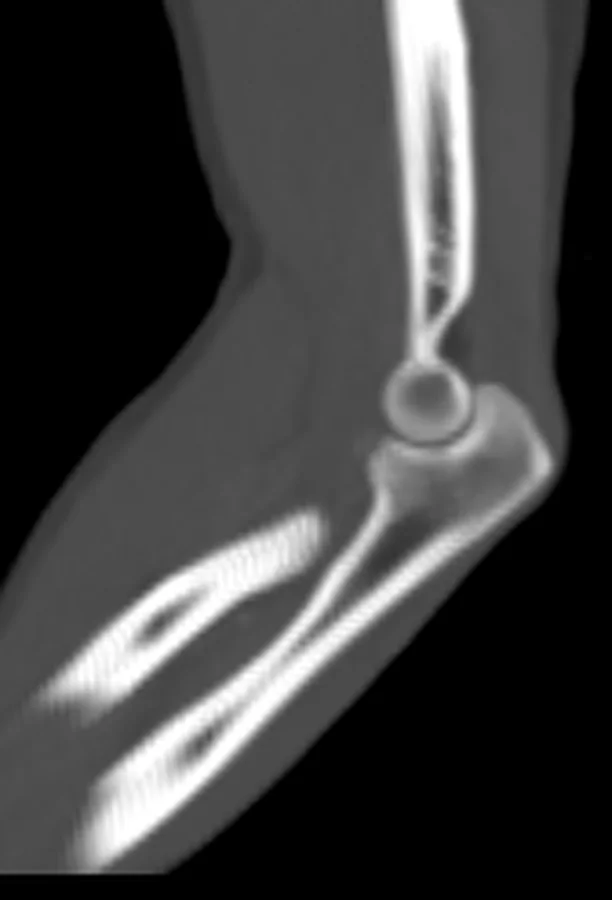
- Koronoid anteromedial faset. Koronal kemik kesitte distal humerus trokleasının medialinde uzanan koronoid eklem kenarını bul ve fasetin üst-alt sınırını belirle.
- Anteromedial kırık düzlemi. Aksiyel planda medial kenardan içeri ilerleyen kırık düzlemini ara; uzanımını uçtan ve koronoid gövdesinden ayır.
- Medial ulnohumeral yüz. Koronal rekonstrüksiyonda karşılıklı troklear yüzlerle aynı çizgiyi izle; fasetin hangi bölümünde basamak kaldığını göster.
- Sublime tüberkül. Kırık hattını distale doğru takip edip sublime tüberkülün bütünlüğünü değerlendir; yapışma alanına uzanımı ayrıca kaydet.
- Radial baş ve lateral kolon. Son olarak radial baş ile kapitellum yüzlerini tara; karşı lateral kolonda eşlik eden kırık veya çökme örüntüsünü dışla.
Faz ve pencere
- Kontrastsız tanısal
- Koronal ve aksiyel kemik rekonstrüksiyonlarda koronoid medial eklem kenarından oblik uzanan kırık düzlemi, anteromedial faset basamağı, fragman rotasyonu ve ulnohumeral temas izlenir; sagittal kesit kırığın uca veya sublime tüberküle uzanımını gösterir. Eklem uyumu ve kırık morfolojisini değerlendirmek amacıyla iki boyutlu ve üç boyutlu BT rekonstrüksiyonları önerilir.
Önerilen pencereler: Kemik (G 1800 / M 400), Yumuşak doku (G 400 / M 40).
BT bulguları
- Anteromedial faset kırıkları, medial eklem kenarından başlayarak oblik ilerleyen ve sublime tüberküle uzanabilen kırık düzlemi ile karakterizedir.
- Medial fasetteki kortikal basamak ya da impaksiyon troklear çentik eklem hattının düzgünlüğünü bozar.
- Fragmanın rotasyonu, medial eklem kenarının ana ulna konturuna göre aşağı ya da mediale yer değiştirmesiyle multiplanar kesitlerde görülür.
- Kırık hattının sublime tüberküle ulaşması ön medial kollateral bağın ulnar yapışma bölgesinin kemik desteğini etkiler.
- Koronoid tepesi ile anteromedial yüzün birlikte ayrılması, faset kırığının tip ve alt tipini tanımlamada önemlidir.
- Ulnohumeral eklemin posteromedial ya da varus yönde eksantrikliği, faset yüzü kırığıyla ilişkili instabilite morfolojisini destekler.
- Radial baş, kapitellum ve lateral kolon konturları; eşlik eden kırıklı çıkık veya karşı kolon yaralanması için gözden geçirilir.
Ölçütler ve sınıflamalar
- O’Driscoll koronoid sınıflaması, tip 2 (anteromedial faset)
- Alt tip 1 anteromedial rim/faset kırığını; alt tip 2 fasetle birlikte ucu; alt tip 3 fasetle sublime tüberkülü, uç eşlik edebilsin ya da etmesin, içerir. Bu morfoloji posteromedial rotatuvar instabilite örüntüsüyle ilişkilidir.
- Wrightington örüntü sınıflaması
- A örüntüsü anteromedial koronoid kırığının lateral kollateral bağ ve/veya posterior medial kollateral bağ yaralanmasıyla birlikteliğini tanımlar; sınıflama eşlik eden yumuşak doku ve kemik yaralanmalarını da dikkate alır.
Normalde
Normal anteromedial faset, koronoid çıkıntının medialinde troklea ile karşılıklı eklemleşen kesintisiz bir yüzeydir; sublime tüberkül bu yüzün medial kenarında seçilir. Aynı koronal seviyede sağlam karşı ulna ve ipsilateral troklear çentik konturunu kıyasla; kırıkta oblik çizgi, faset kenarında basamak veya yüzey çökmesi bulunur.
Ayırıcı tanı
- Koronoid uç avulsiyonu
- kemik parçası apeksle sınırlıdır ve medial eklem kenarında uzun oblik yarılma oluşturmaz.
- Koronoid baz kırığı
- çizgi koronoid kökünü geçerek proksimal ulna metafizine veya şaftına devam eder.
- Troklea osteokondral kırığı
- lezyon distal humerus eklem yüzündedir; koronoid medial faset korteksi korunabilir.
- Ulnohumeral çıkık sonrası kontur düzensizliği
- eklem yer değiştirmesi olabilir ancak koronoid fasetten çıkan sürekli bir kemik hattı görülmez.
- Sublime tüberkül avulsiyonu
- küçük kemik parçası fasetin daha distal-medial yapışma bölgesinde sınırlıdır; geniş oblik faset basamağı olmayabilir.
Tuzaklar
- Anteromedial faset kırıklarının morfolojisi ve uzanımı, doğru tanı ve tedavi planlaması için koronal ve aksiyel kemik rekonstrüksiyonlar ile üç boyutlu BT değerlendirmesi gerektirir.
- Kırık fragmanlarının eklem uyumu ve morfolojisi üzerindeki etkisini değerlendirmek için iki boyutlu ve üç boyutlu BT rekonstrüksiyonları ile distal humerusun dijital olarak çıkarılması (subtraction) kullanılmalıdır.
- BT kemik morfolojisini gösterir, bağ yırtığını doğrudan kanıtlamaz; bağ yapışma yerindeki kemik fragmanı ile bağın kendisini eş anlamlı raporlama.
Kendini dene
Aksiyel ve koronal BT'de koronoidin anteromedial eklem kenarından oblik bir parça ayrıldığı ve fasette basamak oluştuğu görülüyor. En uygun tanım hangisidir?
Cevabı göster
Anteromedial faset kırığı. Oblik kırık düzlemi ve medial eklem kenarındaki faset basamağı anteromedial faset yaralanmasını tanımlar. Diğer seçenekler radius başı, humerus kapitellumu veya olekranon apofizine ait farklı bölgelerdir.
Anteromedial faset fragmanı sublime tüberküle kadar uzanıyor. O'Driscoll tip 2 içinde hangi alt tip düşünülür?
Cevabı göster
Alt tip 3. Tip 2 alt tip 3, anteromedial faset ile sublime tüberkülün birlikte tutulduğu morfolojidir; koronoid uç kırığı eşlik edebilir. Alt tip 1 yalnızca faseti, alt tip 2 ise fasetle birlikte koronoid ucu tutar. Tip 3 baz örüntüsüdür.
İlgili konular
Kaynaklar
Bu sayfadaki 43 cümle ve 2 quiz sorusu aşağıdaki kaynaklardan alıntılarla tek tek karşılaştırıldı; 7 cümle bu karşılaştırmada düzeltildi (2026-10-08).
- Fractures of the coronoid process: state of the artpmc.ncbi.nlm.nih.gov
- Coronoid fractures and traumatic elbow instabilitypmc.ncbi.nlm.nih.gov
- Anteromedial coronoid facet fractures.pubmed.ncbi.nlm.nih.gov
- Isolated coronoid fracture: Assessment by magnetic resonance imaging for concomitant injuries.pubmed.ncbi.nlm.nih.gov
- Management of fractures of the proximal ulna.pubmed.ncbi.nlm.nih.gov
- Coronoid fractures and traumatic elbow instability.pubmed.ncbi.nlm.nih.gov
- Quantitative 3-dimensional computed tomography measurements of coronoid fractures.pubmed.ncbi.nlm.nih.gov
- Anteromedial coronoid facet fractures and associated ligament lesions: A case series.pubmed.ncbi.nlm.nih.gov
- Strategic approach to O'Driscoll type 2 anteromedial coronoid facet fracture.pubmed.ncbi.nlm.nih.gov
- Three-dimensional cortical and trabecular bone microstructure of the proximal ulna.pubmed.ncbi.nlm.nih.gov
- Understanding Varus Posteromedial Instability: Biomechanics, Injury Patterns, and Achieving Successful Stability.pubmed.ncbi.nlm.nih.gov
- Three-dimensional suitability assessment of three types of osteochondral autograft for ulnar coronoid process reconstruction.pubmed.ncbi.nlm.nih.gov
- Coronoid height index: a reliable and reproducible technique for quantifying coronoid bone loss in elbow instability.pubmed.ncbi.nlm.nih.gov
- Morphological characteristics of fractures of the anteromedial facet of the coronoid in posteromedial rotatory instability of the elbow: a three-dimensional CT remodeling study.pubmed.ncbi.nlm.nih.gov
- Fracture of the Anteromedial Facet of the Coronoid is More Common Than Previously Thought in Combined Fractures of the Coronoid and Radial Head.pubmed.ncbi.nlm.nih.gov
- The shape match of the olecranon tip for reconstruction of the coronoid process: influence of side and osteotomy angle.pubmed.ncbi.nlm.nih.gov
- Medial elbow approach via a medial epicondyle osteotomy.pubmed.ncbi.nlm.nih.gov
- Three-Dimensional Fracture Mapping of the Terrible Triad of the Elbow: Morphological Characteristics and Clinical Implications.pubmed.ncbi.nlm.nih.gov
- Fractures of the coronoid process: state of the art.pubmed.ncbi.nlm.nih.gov
- Postoperative Outcomes of Anteromedial Approach in Patients with Elbow Varus Posteromedial Rotatory Instability: A Retrospective Study.pubmed.ncbi.nlm.nih.gov
- The posterior ulna medial approach to the elbow: a cadaveric anatomical study of exposure of the coronoid and posteromedial collateral ligament.pubmed.ncbi.nlm.nih.gov
- Research status of diagnosis and treatment of varus-posteromedial rotatory instability of the elbow joint.pubmed.ncbi.nlm.nih.gov
- Articular varus angles of the elbow are not associated with coronoid fracture type.pubmed.ncbi.nlm.nih.gov
- Anteromedial facet coronoid fractures: an algorithmic approach for assessment and management based on 3 dimensional computed tomography humeral subtraction.pubmed.ncbi.nlm.nih.gov
- Variations on a Theme: Morphological Variability and Insular Adaptations in the Pleistocene Hippopotamuses of the Siculo-Maltese Archipelago.pubmed.ncbi.nlm.nih.gov
- Navicular and fifth metatarsal base stress fractures: An illustrated anatomical review.pubmed.ncbi.nlm.nih.gov
- How do forelimb long bones adapt in rhinoceroses? An in-depth examination of their microanatomy.pubmed.ncbi.nlm.nih.gov
- Cranial anatomy, palaeoneurology, palaeobiology and stratigraphic age of the large-bodied ornithopod, <i>Muttaburrasaurus langdoni</i> Bartholomai and Molnar, 1981, from the mid-Cretaceous of Australia.pubmed.ncbi.nlm.nih.gov
- The extraordinary osteology and functional morphology of the limbs in Palorchestidae, a family of strange extinct marsupial giants.pubmed.ncbi.nlm.nih.gov
- Overcoming the absence of pre-traumatic imaging: a multiplanar three-dimensional virtual reduction workflow for mandibular condylar fractures.pubmed.ncbi.nlm.nih.gov
- Clinical and functional outcomes of open reduction and internal fixation for scapular fractures using the modified Judet approach.pubmed.ncbi.nlm.nih.gov
- Valgus mechanism inducing a unique "terrible triad injury" pattern in the elbow: a detailed clinical and surgical analysis.pubmed.ncbi.nlm.nih.gov
- The effects of coronoid fracture fixation on functional outcomes and complication rates following terrible triad injuries of the elbow.pubmed.ncbi.nlm.nih.gov
- Anterolateral rotatory instability of the elbow: a possible etiology of primary osteoarthritis.pubmed.ncbi.nlm.nih.gov
- Proximal ulna fracture dislocation: Review of current concepts and surgical management.pubmed.ncbi.nlm.nih.gov
- "How the Wrightington classification of traumatic elbow instability can simplify the algorithm for treatment".pubmed.ncbi.nlm.nih.gov
- Elbow Varus posteromedial rotatory instability: Reflections from a multidimensional perspective.pubmed.ncbi.nlm.nih.gov
- Novel Coronoid Reconstruction Using a Patient-Specific 3-Dimensional Metal-Printed Prosthesis and Guide for Comminuted Coronoid Process Fractures.pubmed.ncbi.nlm.nih.gov
- Suture Button Fixation for Regan-Morrey Type II Coronoid Fracture of Anterior and Posterior Monteggia Fracture: A Report of Two Cases.pubmed.ncbi.nlm.nih.gov
- Clinical and research applications of synthetic bone substitutes in equine veterinary medicine: A systematic review.pubmed.ncbi.nlm.nih.gov
- Medial Femoral Trochlea Graft for Scaphoid Waist Nonunion: A Case Report and Review of the Literature.pubmed.ncbi.nlm.nih.gov
- News in paediatric orthopaedic surgery: an overview of the latest advances in paediatric orthopaedics and traumatology (2020-2023).pubmed.ncbi.nlm.nih.gov
- Coronoid fractures and complex elbow instability: current concepts.pubmed.ncbi.nlm.nih.gov
- Magnetic resonance imaging of the elbow.pubmed.ncbi.nlm.nih.gov
- New Skull Material of Taeniolabis taoensis (Multituberculata, Taeniolabididae) from the Early Paleocene (Danian) of the Denver Basin, Colorado.pubmed.ncbi.nlm.nih.gov
- Cranial osteology of Hypoptophis (Aparallactinae: Atractaspididae: Caenophidia), with a discussion on the evolution of its fossorial adaptations.pubmed.ncbi.nlm.nih.gov
- A review of the surgical management of distal humerus fractures and nonunions: From fixation to arthroplasty.pubmed.ncbi.nlm.nih.gov
- 오버헤드 투구 선수에서의 팔꿈치 외반-신전 과부하 증후군.pubmed.ncbi.nlm.nih.gov
- Preoperative and operative risk factors for failed lateral collateral ligament reconstruction.pubmed.ncbi.nlm.nih.gov
- Ulnar Collateral Ligament Reconstruction Through a Mini-Invasive Approach and Suture Anchor Fixation.pubmed.ncbi.nlm.nih.gov
- Surgical outcomes of coronal shear fractures of the capitellum and trochlea: a retrospective study of Dubberley classification-guided treatment.pubmed.ncbi.nlm.nih.gov
- Analysis of characteristics and therapeutic outcomes in children with Dubberley type IIA capitellar fractures.pubmed.ncbi.nlm.nih.gov
- Proximal lateral entry technique for the treatment of supracondylar humeral fractures in children and intraoperative nerve protection: a novel technique.pubmed.ncbi.nlm.nih.gov
- A new eusauropod (Dinosauria, Sauropodomorpha) from the Middle Jurassic of Gansu, China.pubmed.ncbi.nlm.nih.gov
- Computed Tomography for Calcaneal Fractures: Adding Value to the Radiology Report.pubmed.ncbi.nlm.nih.gov
- New fossil remains of Homo naledi from the Lesedi Chamber, South Africa.pubmed.ncbi.nlm.nih.gov
- Radial Head Fractures Cluster in the Anterolateral and Anteromedial Quadrants and Do Not Correlate With Coronoid Fracture Types.pubmed.ncbi.nlm.nih.gov
- Management of Pediatric Elbow Fractures and Dislocations.pubmed.ncbi.nlm.nih.gov
- Elbow arthroplasty in trauma-current concepts review.pubmed.ncbi.nlm.nih.gov
- Diagnosis and Management of Nerve Injuries Caused by Pediatric Upper Extremity Fractures.pubmed.ncbi.nlm.nih.gov
- Imaging of pediatric musculoskeletal trauma: Age-specific considerations and challenges.pubmed.ncbi.nlm.nih.gov
- Osteochondritis Dissecans of the Elbow in Overhead Athletes: A Comprehensive Narrative Review.pubmed.ncbi.nlm.nih.gov
- Osteochondrosis in the feline stifle: a case series and literature review.pubmed.ncbi.nlm.nih.gov
- Cranial and mandibular anatomy of Plastomenus thomasii and a new time-tree of trionychid evolution.pubmed.ncbi.nlm.nih.gov
- Mandible Biomechanics and Continuously Erupting Teeth: A New Defect Model for Studying Load-Bearing Biomaterials.pubmed.ncbi.nlm.nih.gov
- Imaging of the temporomandibular joint: An update.pubmed.ncbi.nlm.nih.gov
- A review of the oral health of individuals with disabilities in Puerto Rico and among U.S. Hispanics.pubmed.ncbi.nlm.nih.gov
- Total elbow arthroplasty for distal humeral fractures in the elderly population: good functional outcomes and a high implant survival rate can be expected after surgery.pubmed.ncbi.nlm.nih.gov
- CT-based morphometric analysis of the zygomatic region: infraorbital foramen localization, bone thickness, and sutural relationships.pubmed.ncbi.nlm.nih.gov
- Arthroscopic reduction with non-fixation for Broberg & Morrey type II radial head fracture with mechanical rotation block: a propensity score-matched case-control study.pubmed.ncbi.nlm.nih.gov
- Extra-Articular Corrective Osteotomy for Malunion of Intra-Articular Fracture of the Elbow in a Child: A Case Report.pubmed.ncbi.nlm.nih.gov
- Elbow arthroscopy - Indications and technique.pubmed.ncbi.nlm.nih.gov
- Chaos theory modeling improves olecranodiaphyseal angle prediction from proximal ulnar dorsal angulation in healthy elbows.pubmed.ncbi.nlm.nih.gov
- Musculoskeletal CT Imaging: State-of-the-Art Advancements and Future Directions.pubmed.ncbi.nlm.nih.gov
- Glossary of terms for musculoskeletal radiology.pubmed.ncbi.nlm.nih.gov
- Lesions involving the outer surface of the bone in children: a pictorial review.pubmed.ncbi.nlm.nih.gov
- Osteochondral Autograft Options for Reconstruction of Intra-articular Distal Humerus and Proximal Ulna Injuries in Physiologically Young Patients.pubmed.ncbi.nlm.nih.gov
- Isolated trochlea osteochondral fracture of the distal humerus in a 6-year-old patient surgically fixed using biodegradable pins: A case study with over 3 years of follow-up.pubmed.ncbi.nlm.nih.gov
- Surgical Management of Pediatric Coronoid Process Fractures: A Report of Two Cases.pubmed.ncbi.nlm.nih.gov
- Shear fractures of the capitellum in children: a case report and narrative review.pubmed.ncbi.nlm.nih.gov
- Role of diagnostic ultrasound in the assessment of musculoskeletal diseases.pubmed.ncbi.nlm.nih.gov
- Clinical Feasibility Studies and Potential Applications of Cone-Beam Computed Tomography Integrated in Multimodality X-Ray System for Small Animals.pubmed.ncbi.nlm.nih.gov
- Diagnostic value of contrast-enhanced CT for elbow joint disorders in dogs.pubmed.ncbi.nlm.nih.gov
- Comparison of parallel and orthogonal plating techniques and the predictive role of Hounsfield unit values in AO/OTA type 13-C distal humerus fractures in patients over 50.pubmed.ncbi.nlm.nih.gov
- Rugby Injury Imaging.pubmed.ncbi.nlm.nih.gov
Eğitim amaçlıdır; hasta başında tanı ve tedavi kararının yerine geçmez. İçerik yapay zekâ destekli bir süreçle güncel literatüre göre cümle cümle kaynaklarla karşılaştırıldı, ancak uzman radyolog incelemesinden geçmedi. Klinik kararlarda güncel kılavuzları, kurum protokollerini ve radyoloji raporunu esas alın.