
Özet
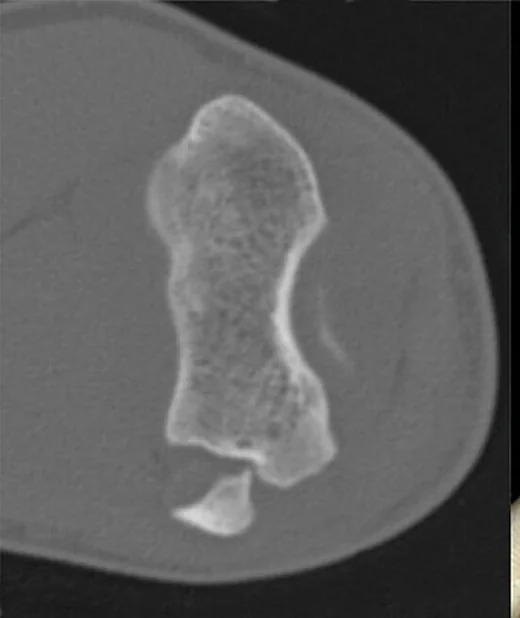
Medial epikondil avulsiyonunda fleksör-pronator kasların ani çekişi ve valgus stresi rol oynayabilir; dirsek çıkığı da olası mekanizmalardandır. İlk değerlendirmede radyografiler kullanılır; medial epikondil avulsiyonlarında BT ve MR deplasman ölçümünde genellikle yardımcı değildir, 45° iç oblik ve distal humerus aksiyel grafileri maksimal deplasman ölçümünü iyileştirebilir. Medial epikondil kırıklarında fragman olguların %15-25’inde eklem içinde hapsolabilir. Eklem içine hapsolan fragmanların tespit edilmesi, cerrahi giriş endikasyonları açısından kritik önem taşımaktadır.
Faz ve pencere
- Kontrastsız tanısal
- Medial epikondil fragmanı ulnohumeral eklem içinde hapsolabilir.
- Kemik algoritması tanısal
- Radyografiler temel incelemedir; medial epikondil avulsiyonlarında BT ve MR deplasman değerlendirmesinde genellikle yardımcı değildir. 45° iç oblik grafi maksimal yer değiştirmenin ölçümünü iyileştirebilir.
Önerilen pencereler G genişlik, M merkez; değerler Hounsfield birimi (HU)
- KemikG 1800 / M +400
- Yumuşak dokuG 400 / M +40
BT bulguları
- Medial epikondil fizisinde genişleme ve olası parçalanma ya da düzensiz görünüm izlenebilir.
- Fragman deplasmanı — medial epikondilin beklenen yatağından uzaklığı ve yer değiştirme yönü çok düzlemli olarak tarif edilir.
- Fragman konumu — yer değiştirme tipik olarak anterior ve distal yöndedir ve izole anteroposterior grafide olduğundan küçük görünebilir; maksimal yer değiştirme, 45° internal oblik grafilerle daha doğru değerlendirilir.
- Eklem içi interpozisyon — epikondil fragmanı dirsek eklemi içinde hapsolabilir.
- Beklenen apofiz yatağının boşluğu — medial epikondil olağan konumunda seçilmiyorsa intraartiküler göçü özellikle araştırın.
- Eşlik eden dirsek çıkığı — BT'de ulnohumeral eklemin redüksiyonu ve uyumu değerlendirilir.
- Dirsek çıkığına eşlik eden medial humerus kondil ve troklea kırıkları istisnai derecede nadir bildirilmiştir.
Ölçütler ve sınıflamalar
- Papavasiliou
- Medial epikondil kırıklarında Papavasiliou ve Crawford sınıflamaları kullanılmıştır; kırıkların %30-60’ına dirsek çıkığı eşlik eder ve eklem içine hapsolmuş fragman mutlak cerrahi endikasyon kabul edilir. Fragmanın eklem içinde hapsolup hapsolmadığının ayrıca belirtilmesi gerekir; çünkü hapsolmuş epikondil fragmanı açık redüksiyon ve internal fiksasyon endikasyonları arasındadır.
Normalde
Normal dirsekte medial epikondil ossifikasyon merkezinin kaynaşma yaşı değişkendir. Akut avulsiyonu anatomik varyasyondan ayırmak için karşı dirsek radyografileri yararlı olabilir.
Ayırıcı tanı
- Kontralateral dirsek radyografisi ile karşılaştırarak akut avulsiyonu anatomik varyasyondan ayırt edin. Ossifikasyon merkezinin kaynaşma yaşı değişken olduğundan akut avulsiyon ile anatomik varyasyon ayrımında karşı dirsek radyografileri yararlı olabilir.
- Pediatrik troklea kırığı
- humeral trokleanın yapısal bütünlüğünü bozan nadir bir yaralanmadır; bildirilen olguların çoğunda cerrahi tedavi gerekmiştir.
- Ulnohumeral çıkık
- eklem yüzleri yer değiştirmiştir; medial epikondil avulsiyonu ise valgus zorlanmasıyla dirsek çıkığı eşlik etmeksizin de gelişebilir.
- Lateral kondil kırığı distal humerusun lateral kondilini tutar.
- Fleksör-pronator apofiziti
- tekrarlayan valgus stresi ve medial epikondilde traksiyonla ilişkili aşırı kullanım yaralanmasıdır.
Tuzaklar
- Çıkık redüksiyonundan sonra medial epikondilin yerinde görünmemesi yalnız deplasman sayılmamalı; eklem aralığı içinde kaybolmuş fragman arayın.
- BT'de kıkırdak doğrudan iyi görüntülenmeyebilir; kemik fragmanı görülmemesi tek başına kıkırdak yaralanmasını dışlamaz.
- Apofiz parçalanmasını fizyolojik varyanttan ayırırken karşı dirsek, fragman kenarlarının kortikasyonu ve akut çıkık bağlamını birlikte kullanın.
- BT'nin dirsek tuzak nöropatilerinin değerlendirilmesindeki rolü sınırlıdır; sinir yapısı ve hareketi için ultrasonografi, dirsek yumuşak dokuları için MR daha uygundur.
- Medial epikondil kırıkları apofizisi tutan yaralanmalardır; ancak ayrılan fragman ulnohumeral eklem içine hapsolarak eklem içi interpozisyon yapabilir ve bu durum cerrahi endikasyon açısından önemlidir.
Kendini dene
Medial epikondil avulsiyon kırığında, cerrahi tedavi için genel kabul görmüş mutlak endikasyonlardan biri aşağıdakilerden hangisidir?
Cevabı göster
Eklem içinde hapsolmuş kırık fragmanı. Eklem içinde hapsolmuş fragman, açık kırık ve ulnar sinir sıkışması operatif müdahale için genel kabul görmüş mutlak endikasyonlardır.
Ergen hastada medial epikondilde tek, düzgün sınırlı ve beklenen yerinde bir ossifikasyon merkezi görülüyor; akut travma bulgusu yok. En olası açıklama nedir?
Cevabı göster
Normal gelişimsel ossifikasyon merkezi. Medial epikondil ossifikasyon merkezi normal apofiz gelişiminin bir parçasıdır ve kaynaşma yaşı değişkendir. Kaynaşma yaşı değişken olduğu için, tek ve yerinde görünen bir ossifikasyon merkezi akut avulsiyon yerine normal gelişimsel varyantı düşündürür; karşı dirsek radyografisiyle kıyaslama bu ayrımda yararlı olabilir.
İlgili konular
Kaynaklar
Bu sayfadaki 41 cümle ve 2 quiz sorusu aşağıdaki kaynaklardan alıntılarla otomatik olarak karşılaştırıldı; 24 cümle bu karşılaştırmada düzeltildi (2026-10-12).
- Common Upper Extremity Injuries in Pediatric Athletespmc.ncbi.nlm.nih.gov
- A rare traumatic triad: Open bicondylar non-conjoint Hoffa fracture with partial tibial tubercle and medial epicondyle avulsions – A case report and biomechanical analysispmc.ncbi.nlm.nih.gov
- The arrow and the target—description of the “Robin Hood” technique for fixation of tibial spine avulsion fractures: a technical notepmc.ncbi.nlm.nih.gov
- Pediatric Elbow Dislocation With Comminuted Fractures of the Medial Humeral Epicondyle and Trochleapmc.ncbi.nlm.nih.gov
- Osteochondral Autograft Options for Reconstruction of Intra-articular Distal Humerus and Proximal Ulna Injuries in Physiologically Young Patientspmc.ncbi.nlm.nih.gov
- Classification of Olecranon Stress Fractures in Baseball Players.pubmed.ncbi.nlm.nih.gov
- Open Reduction Internal Fixation of a Medial Epicondyle Avulsion Fracture With Incarcerated Fragment.pubmed.ncbi.nlm.nih.gov
- Diagnosis and management of medial epicondyle avulsion fracture in a 27-year-old female: A case report.pubmed.ncbi.nlm.nih.gov
- [Pale and pulseless hand after luxation of the left elbow in a 9‑year-old boy].pubmed.ncbi.nlm.nih.gov
- CT is a feasible imaging technique for detecting lesions in horses with elbow lameness: A study of 139 elbows in 99 horses.pubmed.ncbi.nlm.nih.gov
- A rare traumatic triad: Open bicondylar non-conjoint Hoffa fracture with partial tibial tubercle and medial epicondyle avulsions - A case report and biomechanical analysis.pubmed.ncbi.nlm.nih.gov
- Medial Epicondyle Fractures Treated with Diverse Fixation Techniques: A Case Series.pubmed.ncbi.nlm.nih.gov
- Type III intra-articular entrapment of the median nerve following elbow dislocation in an adult patient: A case report.pubmed.ncbi.nlm.nih.gov
- Return-to-Play Protocols for Various Injuries in Skeletally Immature Athletes: A Systematic Review.pubmed.ncbi.nlm.nih.gov
- Management of Pediatric Elbow Fractures and Dislocations.pubmed.ncbi.nlm.nih.gov
- Top 15 musculoskeletal lesions in the aging recreational sporter: a pictorial review.pubmed.ncbi.nlm.nih.gov
- Magnetic resonance imaging of the elbow.pubmed.ncbi.nlm.nih.gov
- Coronoid fractures and complex elbow instability: current concepts.pubmed.ncbi.nlm.nih.gov
- Management and outcomes of capitellum fractures in adolescents: A case series and review of the literature.pubmed.ncbi.nlm.nih.gov
- Coronoid fractures and traumatic elbow instability.pubmed.ncbi.nlm.nih.gov
- Pediatric musculoskeletal ultrasound of the elbow: a pictorial review.pubmed.ncbi.nlm.nih.gov
- 오버헤드 투구 선수에서의 팔꿈치 외반-신전 과부하 증후군.pubmed.ncbi.nlm.nih.gov
- Imaging of pediatric musculoskeletal trauma: Age-specific considerations and challenges.pubmed.ncbi.nlm.nih.gov
- Current concepts in the management of high-energy tibial plateau fractures: a narrative review.pubmed.ncbi.nlm.nih.gov
- A Systematic Approach to the Evaluation of Acute Musculoskeletal Injuries in the Emergency Department.pubmed.ncbi.nlm.nih.gov
- Anterior Elbow Dislocation Associated With Medial Epicondyle and Humeral Condyle Fractures in a Pediatric Patient: A Report of a Rare Case.pubmed.ncbi.nlm.nih.gov
- The anconeus approach is safe and effective for lateral elbow trauma: a consecutive case series of clinical and functional outcomes.pubmed.ncbi.nlm.nih.gov
- The Stiff Elbow Revisited: How Much Motion Can Surgery Really Restore?pubmed.ncbi.nlm.nih.gov
- Biomechanical investigation of elbow dislocation: comparative analysis using <i>Papio anubis</i> baboon and human cadaver models.pubmed.ncbi.nlm.nih.gov
- Pediatric Supracondylar Humerus Fractures: Evaluation and Management Approach in Resource-limited Settings.pubmed.ncbi.nlm.nih.gov
- Medial to lateral diagonal injury of the elbow without elbow dislocation in children.pubmed.ncbi.nlm.nih.gov
- Trash Lesions Around the Elbow: A Review of Approach to Diagnosis and Management.pubmed.ncbi.nlm.nih.gov
- Operative versus non-operative management of pediatric medial epicondyle fractures: a systematic review.pubmed.ncbi.nlm.nih.gov
- Application of biodegradable implants in pediatric orthopedics: shifting from absorbable polymers to biodegradable metals.pubmed.ncbi.nlm.nih.gov
- Interhospital Variability in Treatment of Pediatric Medial Epicondyle Fractures of the Humerus.pubmed.ncbi.nlm.nih.gov
- Proximal ulna fracture dislocation: Review of current concepts and surgical management.pubmed.ncbi.nlm.nih.gov
- The Presence of Associated Injuries in Pediatric Radial Neck Fractures: A Systematic Review of the Literature and Meta-Analysis of Pooled Individual Patient Data.pubmed.ncbi.nlm.nih.gov
- Open Reduction and Pinning of Lateral Condyle Fractures.pubmed.ncbi.nlm.nih.gov
- Repair Versus Non-Repair of Lateral Ulnar Collateral Ligament in Elbow Varus Posteromedial Rotatory Instability Treatment: A Comparative Study.pubmed.ncbi.nlm.nih.gov
- Common Upper Extremity Injuries in Pediatric Athletes.pubmed.ncbi.nlm.nih.gov
- Evaluation and management of elbow injuries in the adolescent overhead athlete.pubmed.ncbi.nlm.nih.gov
- Medial elbow pain.pubmed.ncbi.nlm.nih.gov
- Pediatric Elbow Dislocation With Comminuted Fractures of the Medial Humeral Epicondyle and Trochlea.pubmed.ncbi.nlm.nih.gov
- Conservative Treatment of Pediatric Fractures-Narrative Review of Acceptable Deformity and Remodeling Potential.pubmed.ncbi.nlm.nih.gov
- Non-traumatic Medial-Sided Elbow Pain: A Comprehensive Review of Etiologies, Diagnostic Strategies, and Treatment Approaches.pubmed.ncbi.nlm.nih.gov
- Postoperative Outcomes of Anteromedial Approach in Patients with Elbow Varus Posteromedial Rotatory Instability: A Retrospective Study.pubmed.ncbi.nlm.nih.gov
- Radiocapitellar Alignment in Suspected Pediatric Monteggia Lesions: Narrative Review and Imaging Interpretation Framework.pubmed.ncbi.nlm.nih.gov
- Treatment of Pediatric Displaced Intraarticular Olecranon Fractures with Resorbable Poly-L-Lactic-Co-Glycolic Acid (PLGA) Pins and Polydioxanone (PDS) Loops.pubmed.ncbi.nlm.nih.gov
- Challenges in Diagnosing Pediatric Monteggia Fractures: Role of Clinical Experience and Imaging.pubmed.ncbi.nlm.nih.gov
- The arrow and the target-description of the "Robin Hood" technique for fixation of tibial spine avulsion fractures: a technical note.pubmed.ncbi.nlm.nih.gov
- Traumatic bony avulsion of the lateral collateral ligament of the knee in a pediatric patient.pubmed.ncbi.nlm.nih.gov
- Osteochondral Autograft Options for Reconstruction of Intra-articular Distal Humerus and Proximal Ulna Injuries in Physiologically Young Patients.pubmed.ncbi.nlm.nih.gov
- Fracture mapping of coronal shear fractures of the distal humerus: morphological analysis and fixation efficacy.pubmed.ncbi.nlm.nih.gov
- The necessity of ulnar nerve exploration and translocation in open reduction of medial humeral epicondyle fractures in children.pubmed.ncbi.nlm.nih.gov
- Diagnosis and treatment of "medial to lateral diagonal injury of the elbow" in children: Concomitant medial epicondylar and radial neck fractures.pubmed.ncbi.nlm.nih.gov
- Diagnosis and Treatment of Concomitant Lateral Condyle and Medial Epicondyle Fractures With Elbow Dislocation in Children.pubmed.ncbi.nlm.nih.gov
- Pediatric Type II Tibial Spine Fractures: Addressing the Treatment Controversy With a Mixed-Effects Model.pubmed.ncbi.nlm.nih.gov
- A Journey into Animal Models of Human Osteomyelitis: A Review.pubmed.ncbi.nlm.nih.gov
- Multiligament-injured knee: what the general orthopedic surgeon should know.pubmed.ncbi.nlm.nih.gov
- Patellar Instability: A Narrative Review with an Integrated Treatment Algorithm.pubmed.ncbi.nlm.nih.gov
- Arthroscopy-assisted reduction for Jacob type II pediatric humeral lateral condyle fractures: a clinical efficacy study.pubmed.ncbi.nlm.nih.gov
- Fracture of the Anteromedial Facet of the Coronoid is More Common Than Previously Thought in Combined Fractures of the Coronoid and Radial Head.pubmed.ncbi.nlm.nih.gov
- Distal humerus physeal fractures in children under 3 years: a systematic review and quantitative descriptive analysis.pubmed.ncbi.nlm.nih.gov
- Patterns of Avulsion and Osteochondral Fractures Associated with Patellar Dislocations: A Descriptive Study Using 3-Dimensional Computed Tomography.pubmed.ncbi.nlm.nih.gov
- Internal Brace Augmentation Following Ulnar Collateral Ligament Release for Elbow Stiffness: A Case Series.pubmed.ncbi.nlm.nih.gov
- Loose Fit Monobloc Versus Cemented Bipolar Radial Head Prosthesis in the Treatment of Radial Head Fractures: A Comparative Study.pubmed.ncbi.nlm.nih.gov
- Elbow Varus posteromedial rotatory instability: Reflections from a multidimensional perspective.pubmed.ncbi.nlm.nih.gov
- Morphological and postoperative functional comparison of patellar dislocation with or without avulsion fracture of the medial inferior border of the patella.pubmed.ncbi.nlm.nih.gov
- Radiographic imaging of the entheses of the equine thoracic foot.pubmed.ncbi.nlm.nih.gov
- Ossification of the Pediatric Elbow with a Focus on Radial Head Ossification Patterns.pubmed.ncbi.nlm.nih.gov
- Elbow Fractures Overviewpubmed.ncbi.nlm.nih.gov
- Femoral insertion osteotomy of the lateral collateral ligament for expanding lateral knee space in meniscus repair.pubmed.ncbi.nlm.nih.gov
- Guide to lower extremity radiologic measurements: part 2 knee.pubmed.ncbi.nlm.nih.gov
- A Corresponding Point Measurement System Provides Reliable Measurement of Displacement for Medial Epicondyle Fractures.pubmed.ncbi.nlm.nih.gov
- Radiographic Evaluation of Common Pediatric Elbow Injuries.pubmed.ncbi.nlm.nih.gov
- Irreducible Lateral Patellar Dislocation: A Case Report and Literature Review.pubmed.ncbi.nlm.nih.gov
- Calcified or ossified benign soft tissue lesions that may simulate malignancy.pubmed.ncbi.nlm.nih.gov
- The posterior ulna medial approach to the elbow: a cadaveric anatomical study of exposure of the coronoid and posteromedial collateral ligament.pubmed.ncbi.nlm.nih.gov
- Irreducible extremity fractures in pediatric and adolescent rodeo-related trauma: A retrospective case series.pubmed.ncbi.nlm.nih.gov
- Management of Pediatric Medial Epicondyle Fractures: Results of a Survey of the Pediatric Orthopaedic Society of North America (POSNA).pubmed.ncbi.nlm.nih.gov
- Persistent elbow dislocation.pubmed.ncbi.nlm.nih.gov
- Radial head fractures.pubmed.ncbi.nlm.nih.gov
- Elbow dislocations: a review ranging from soft tissue injuries to complex elbow fracture dislocations.pubmed.ncbi.nlm.nih.gov
- Magnetic Resonance Imaging Patterns of Common Injuries in Pediatric and Adolescent Athletes.pubmed.ncbi.nlm.nih.gov
- Pediatric Coronoid-Deficient Elbow Reconstruction with Iliac Crest Allograft: A Case Report.pubmed.ncbi.nlm.nih.gov
- Pure elbow dislocation in a 6-year-old child: A case report and review of the literature.pubmed.ncbi.nlm.nih.gov
- A Rare Pediatric Cause of Lateral Foot Pain: Symptomatic Os Vesalianum Pedis Requiring Excision and Peroneus Brevis Repair.pubmed.ncbi.nlm.nih.gov
- Clinical application of unilateral intramedullary K-wire occupying technique for flexible reduction in pediatric supracondylar humeral fractures.pubmed.ncbi.nlm.nih.gov
- WHICH FACTORS CAN DEFINE THE PROGNOSIS OF ARTICULAR FRACTURES OF THE CAPITELLUM AND TROCHLEA?pubmed.ncbi.nlm.nih.gov
- Influence of medial epicondyle morphology on the contribution of flexor-pronator muscle contractions to dynamic elbow stability.pubmed.ncbi.nlm.nih.gov
- Use of a Modified All-Epiphyseal Technique for Anterior Cruciate Ligament Reconstruction in the Skeletally Immature Patient.pubmed.ncbi.nlm.nih.gov
- Medial elbow approach via a medial epicondyle osteotomy.pubmed.ncbi.nlm.nih.gov
- Development of an automated machine learning-based risk prediction and decision support system for postoperative cubitus varus complicating pediatric lateral humeral condyle fracture.pubmed.ncbi.nlm.nih.gov
- Pediatric Capitellum Fracture Fixation with Bio-absorbable K-wire.pubmed.ncbi.nlm.nih.gov
- Fractures of the coronoid process: state of the art.pubmed.ncbi.nlm.nih.gov
- Os Vesalianum Pedis in a Professional Badminton Player: A Case Report.pubmed.ncbi.nlm.nih.gov
- "How the Wrightington classification of traumatic elbow instability can simplify the algorithm for treatment".pubmed.ncbi.nlm.nih.gov
- Current concepts in distal humeral hemiarthroplasty.pubmed.ncbi.nlm.nih.gov
- Imaging of elbow entrapment neuropathies.pubmed.ncbi.nlm.nih.gov
- Modified screw fixation technique for medial epicondyle fractures to reduce complications and improve stability of fixation.pubmed.ncbi.nlm.nih.gov
- Fracture morphological characteristics and associated soft-tissue injuries in flexion varus tibial plateau fractures.pubmed.ncbi.nlm.nih.gov
- Value of MR arthrography for evaluation of children and adolescents with clinically suspected intraarticular cause of hip pain.pubmed.ncbi.nlm.nih.gov
- Chronic hip pain in adults: Current knowledge and future prospective.pubmed.ncbi.nlm.nih.gov
- Differential Diagnosis of Elbow Pain.pubmed.ncbi.nlm.nih.gov
- Treatment of medial epicondyle fracture without associated elbow dislocation in older children and adolescents.pubmed.ncbi.nlm.nih.gov
- Common elbow injuries in children.pubmed.ncbi.nlm.nih.gov
- Medial Epicondylar Apophyseal Avulsion Fractures in Youth Throwers: A Severe Variant of Little League Elbow.pubmed.ncbi.nlm.nih.gov
- Resorbable magnesium screws for fixation of medial epicondyle avulsion fractures in skeletally immature patients: A comparison with Kirschner wires.pubmed.ncbi.nlm.nih.gov
- Pediatric anterior elbow dislocation due to a rare mechanism of injury: A case report.pubmed.ncbi.nlm.nih.gov
- Let them move: Early range of motion and rehabilitation after fixation of medial epicondyle fractures in adolescent athletes.pubmed.ncbi.nlm.nih.gov
- Double Adjustable-Loop Cortical Buttons for Minimally Invasive Anatomic Double-Bundle Medial Patellofemoral Ligament Reconstruction.pubmed.ncbi.nlm.nih.gov
- Long-Term Patient Reported Outcomes of Surgical Versus Nonsurgical Management of Pediatric Medial Epicondyle Fractures.pubmed.ncbi.nlm.nih.gov
- Severe medial tibial plateau fractures: feasibility and functional and radiographic results of an extended approach with medial femoral epicondyle osteotomy.pubmed.ncbi.nlm.nih.gov
- Good functional recovery after bilateral elbow dislocation associated with bilateral distal radius and ulna fractures.pubmed.ncbi.nlm.nih.gov
- Medial Patellofemoral Ligament Reconstruction Using Gracilis With Pes Anserinus Preservation and Adductor Magnus Pulley.pubmed.ncbi.nlm.nih.gov
Eğitim amaçlıdır; hasta başında tanı ve tedavi kararının yerine geçmez, tıbbi tavsiye değildir. Metinler yapay zekâ desteğiyle yazıldı ve otomatik bir adımda kaynak alıntılarıyla karşılaştırıldı; bu bir tıbbi doğrulama değildir ve içerik uzman radyolog incelemesinden geçmedi. Klinik kararlarda güncel kılavuzları, kurum protokollerini ve radyoloji raporunu esas alın.