
Özet
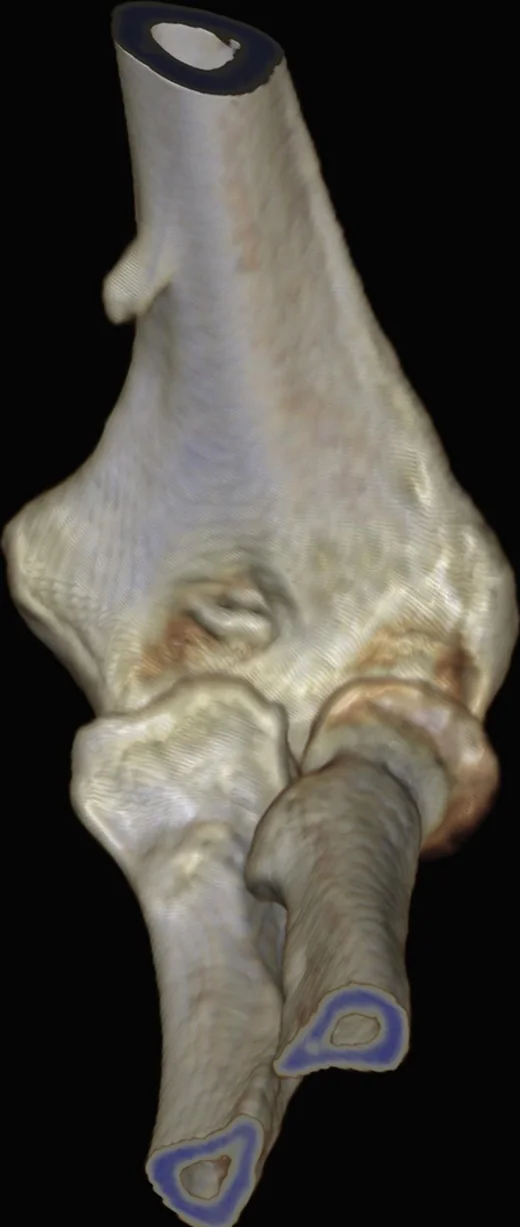
Suprakondiler proses, distal humerusun anteromedialinde bulunan nadir embriyonik kemik varyantıdır; kendi tabanından kırılabilir ve travma değerlendirmesinde yanlış tanınabilir. Suprakondiler proses, distal humerusun anteromedialinde yer alan ve dirsek eklemine yönelen kemik çıkıntısıdır; osteokondromlardan eklem çizgilerinden uzağa değil dirsek eklemine yönelmesiyle ayrılır. Proses ucundan medial epikondile uzanan Struthers ligamanı eşlik edebilir; ligaman median sinir ve brakiyal arterle ilişkili olası bir bası alanı oluşturur, ancak bu sinir ve yumuşak doku yapıları BT’de güvenilir biçimde değerlendirilmez. Proses tabanındaki lucency düşme sonrası kırıkla ilişkili olabilir; suprakondiler proses ve Struthers ligamanı median sinir veya brakiyal damar basısıyla ilişkili nörovasküler belirtilere yol açabilir.
Faz ve pencere
- Kontrastsız tanısal
- Kemik penceresinde distal humerusun anteromedial korteksinden distale uzanan, korteksi humerusla devamlı bir kemik çıkıntısı izlenir; medüller kanal spur içine devam etmez ve bu kemik varyantını değerlendirmek için kontrast gerekmez.
- Kemik algoritması tanısal
- BT'de üst kolda suprakondiler proses görülebilir ve BT görüntüleri 3B rekonstrüksiyon yöntemiyle değerlendirilebilir.
Önerilen pencereler G genişlik, M merkez; değerler Hounsfield birimi (HU)
- KemikG 1800 / M +400
- Yumuşak dokuG 400 / M +40
BT bulguları
- Anteromedial suprakondiler çıkıntı — distal humerusun ön-iç korteksinden çıkan kemik çıkıntısı, medial epikondilin proksimalinde yer alır.
- Kortikal devamlılık, medüller kanal devamlılığı olmaksızın — proses humerus korteksiyle kesintisiz görünür; medüller kanalın devam etmemesi osteokondromdan ayrımda önemlidir.
- Distale yönelim — çıkıntı anteromedial humerustan aşağıya doğru uzanır ve dirsek eklemine yönelir.
- Düzgün kortikal kontur — sağlam varyantta spur tabanında humerus korteksi devam eder; kırıkta tabanda yeni lucency veya ayrışma görülebilir.
- Struthers ligamanı olasılığı — proses ucunu medial epikondile bağlayan fibröz bant eşlik edebilir, fakat rutin BT’de güvenilir biçimde görünmeyebilir.
- Nörovasküler komşuluk — olası geçit median sinir ve brakiyal arterle ilişkilidir; BT’de doğrudan bası gösterilemiyorsa anatomik olasılık olarak ifade edilir.
- Proses tabanında yeni lucency veya ayrışma travmatik kırık olasılığını artırır; suprakondiler proses kırığı nadir de olsa bildirilmiştir.
Normalde
Suprakondiler proses bulunmayan distal humerusta anteromedial konturda bu düzeyde ayrı bir spur görülmez; varyantta korteksle devamlı distal yönelimli çıkıntı izlenir. Aynı seviyede karşı taraf mevcutsa çıkıntının varlığını ve yönünü kıyaslayın; etkilenen tarafta kortikal devamlılığı ve medüller kanalın spur içine devam etmediğini, medial epikondil ve çevre yumuşak dokularla ilişkisini inceleyin.
Ayırıcı tanı
- Suprakondiler proses kırığı
- önceden var olan çıkıntıda taban lucency veya ayrışma görülmesi travmatik kırığı destekler.
- Travmatik miyozit ossifikans ve osteokondrom ayırıcı tanıda düşünülmelidir; osteokondrom eklem hattından uzağa yönelirken suprakondiler proses dirsek eklemine doğru uzanır.
- Osteokondrom
- osteokondromlar eklem çizgisinden uzağa yönelirken suprakondiler proses dirsek eklemine doğru yönelir.
- Heterotopik ossifikasyon
- suprakondiler proses kırığının ayırıcı tanısında posttravmatik miyozit ossifikans da düşünülmelidir.
Tuzaklar
- Aksiyel tek kesitteki kemik çıkıntısı kortikal kırık parçası gibi görünebilir; koronal ve sagittal düzlemlerde tabanın humerusla sürekliliğini izleyin.
- Suprakondiler proses kırılabilir; bilinen ya da olası varyantta yeni travma sonrası tabanda lucency veya ayrışma arayın ve yalnız dış konturun düzgün olmasına dayanarak kırığı dışlamayın.
- Struthers ligamanı ile ulnar sinirin geçtiği arcade of Struthers farklı yapılardır; prosesle ilişkili olası bası anatomisini ulnar sinir arkı diye adlandırmayın.
- Yumuşak doku penceresinde sinir veya ligaman seçilmemesi, varyantın nörovasküler komşuluğunu dışlamaz; doğrudan gösterilemeyen yapıyı BT bulgusu gibi raporlamayın.
Kendini dene
Suprakondiler proses, yönelimi bakımından osteokondromdan nasıl ayrılır?
Cevabı göster
Dirsek eklemine doğru uzanır. Suprakondiler proses dirsek eklemine doğru uzanırken osteokondrom eklemden uzağa yönelir.
Doğrudan travma sonrası suprakondiler proses tabanında yer değiştirmiş transvers kırık izleniyor. En olası tanı hangisidir?
Cevabı göster
Suprakondiler proses kırığı. Doğrudan travma sonrası suprakondiler prosesin yer değiştirmiş transvers kırığı bildirilmiştir.
İlgili konular
Kaynaklar
Bu sayfadaki 33 cümle ve 2 quiz sorusu aşağıdaki kaynaklardan alıntılarla otomatik olarak karşılaştırıldı; 15 cümle bu karşılaştırmada düzeltildi (2026-10-12).
- Pediatric Supracondylar Process Fracture: Radiographic Distinction, Misdiagnosis, and Conservative Managementpubmed.ncbi.nlm.nih.gov
- Imaging of elbow entrapment neuropathiespubmed.ncbi.nlm.nih.gov
- Struthers’ Ligament and Supracondylar Humeral Process: An Anatomical Study and Clinical Implicationspubmed.ncbi.nlm.nih.gov
- Fracture of the Supracondylar Process in a Child: A Case Report and Review of the Literaturepubmed.ncbi.nlm.nih.gov
- Fracture of supracondylar process of the humeruspubmed.ncbi.nlm.nih.gov
- Fracture of the supracondylar process of the humerus in an adolescent athletepmc.ncbi.nlm.nih.gov
- Lateral Supracondylar Spur Process of the Humeruspmc.ncbi.nlm.nih.gov
- Surgical Management of Exceptionally Severe Cubitus Varus Deformity in Osteogenesis Imperfecta: A Case Reportpmc.ncbi.nlm.nih.gov
- Osteochondral Autograft Options for Reconstruction of Intra-articular Distal Humerus and Proximal Ulna Injuries in Physiologically Young Patientspmc.ncbi.nlm.nih.gov
- Olecranon flip osteotomy for distal humerus fracturespmc.ncbi.nlm.nih.gov
- Osseous variability around the elbow joint.pubmed.ncbi.nlm.nih.gov
- Mismatch analysis of humeral nailing: antegrade versus retrograde insertion.pubmed.ncbi.nlm.nih.gov
- Morphological evaluation and clinical significance of the supracondylar process and supratrochlear foramen: an anatomic and radiological study.pubmed.ncbi.nlm.nih.gov
- Finite element analysis of modified Slongo's external fixation in the treatment of supracondylar humeral fractures in older children.pubmed.ncbi.nlm.nih.gov
- [Rare Compression Syndrome of the Median Nerve due to a Supracondylar Humeral Process and a Ligament of Struthers].pubmed.ncbi.nlm.nih.gov
- Acute Ulnar Neuropathy at the Elbow: Clinical, Electrodiagnostic, and Ultrasonographic Findings.pubmed.ncbi.nlm.nih.gov
- Brachioradialis muscle pain: a common source of underdiagnosed or misdiagnosed forearm pain.pubmed.ncbi.nlm.nih.gov
- The Diagnostic Pitfalls in the Pronator Teres Syndrome-A Case Report.pubmed.ncbi.nlm.nih.gov
- Surgical Management of Exceptionally Severe Cubitus Varus Deformity in Osteogenesis Imperfecta: A Case Report.pubmed.ncbi.nlm.nih.gov
- Osteochondral Autograft Options for Reconstruction of Intra-articular Distal Humerus and Proximal Ulna Injuries in Physiologically Young Patients.pubmed.ncbi.nlm.nih.gov
- Cost-effectiveness of surgical and conservative interventions for orthopaedic injuries in Malawi: a modelling study.pubmed.ncbi.nlm.nih.gov
- Imaging of pediatric musculoskeletal trauma: Age-specific considerations and challenges.pubmed.ncbi.nlm.nih.gov
- Continuous decompression treatment of unicameral bone cyst in a small-breed dog: A case report.pubmed.ncbi.nlm.nih.gov
- Updates in pediatric upper extremity imaging.pubmed.ncbi.nlm.nih.gov
- Application of biodegradable implants in pediatric orthopedics: shifting from absorbable polymers to biodegradable metals.pubmed.ncbi.nlm.nih.gov
- Postmenopausal Osteoporosis: From Molecular Pathways to Therapeutic Targets-A Mechanism-to-Practice Framework Integrating Pharmacotherapy, Fall Prevention, and Adherence into Patient-Centered Care.pubmed.ncbi.nlm.nih.gov
- The Role of 3D Printing in Pediatric Surgical Care: A Narrative Review.pubmed.ncbi.nlm.nih.gov
- Non-union after bisphosphonate-associated atypical femoral fractures: a review of the current literature.pubmed.ncbi.nlm.nih.gov
- Benign incidental do-not-touch bone lesions.pubmed.ncbi.nlm.nih.gov
- Endoscopic Excision of Supracondylar Humeral Spur for Decompression of the Median Nerve and Brachial Artery.pubmed.ncbi.nlm.nih.gov
- Sonographic imaging of the radial nerve proper: Five potential entrapment sites.pubmed.ncbi.nlm.nih.gov
- Clinical outcomes of three treatment methods for humeral shaft fractures: a comparative study.pubmed.ncbi.nlm.nih.gov
- Diagnosis and evolution of the benign tumor osteochondroma.pubmed.ncbi.nlm.nih.gov
- Nerve Injuries Following Pediatric Supracondylar Humerus Fractures-A Systematic Review and Meta-Analysis.pubmed.ncbi.nlm.nih.gov
- Open supracondylar humerus fractures in children: Associated injuries and clinical outcomes.pubmed.ncbi.nlm.nih.gov
- K-Hammer percutaneous fixation: a novel technique for preventing iatrogenic ulnar nerve injury in pediatric supracondylar humeral fractures.pubmed.ncbi.nlm.nih.gov
- Kirschner wire configuration and fixation stability in pediatric supracondylar humerus fractures: a finite element analysis.pubmed.ncbi.nlm.nih.gov
- Common elbow injuries in children.pubmed.ncbi.nlm.nih.gov
- The Challenge of Trans-Ulnar Basal Coronoid Fracture-Dislocations: A Surgical Strategy Based on the Pattern of Coronoid Fracture.pubmed.ncbi.nlm.nih.gov
- Condylar orientation plating in comminuted intraarticular fractures of adult distal humerus.pubmed.ncbi.nlm.nih.gov
- The biology and treatment of acute long-bones diaphyseal fractures: Overview of the current options for bone healing enhancement.pubmed.ncbi.nlm.nih.gov
- Olecranon flip osteotomy for distal humerus fractures.pubmed.ncbi.nlm.nih.gov
- Conservative Treatment of Pediatric Fractures-Narrative Review of Acceptable Deformity and Remodeling Potential.pubmed.ncbi.nlm.nih.gov
- Imaging in the diagnosis of ulnar nerve pathologies-a neoteric approach.pubmed.ncbi.nlm.nih.gov
- Pitfalls in the diagnosis of common benign bone tumours in children.pubmed.ncbi.nlm.nih.gov
- A rare case of anterior inferior iliac spine osteochondroma causing external snapping hip syndrome: a case report.pubmed.ncbi.nlm.nih.gov
- Intraosseous tumours of the knee.pubmed.ncbi.nlm.nih.gov
- Multidisciplinary approach to the accurate diagnosis of parosteal osteosarcoma.pubmed.ncbi.nlm.nih.gov
- Elbow Varus posteromedial rotatory instability: Reflections from a multidimensional perspective.pubmed.ncbi.nlm.nih.gov
- Intraosseous Nontraumatic Median Nerve Entrapment at the Elbow: A Case Report.pubmed.ncbi.nlm.nih.gov
- Revisiting Myositis Ossificans: A Comprehensive Stage-by-Stage Imaging Review.pubmed.ncbi.nlm.nih.gov
- Multifocal Skeletal Muscle Mineralisation Following Severe Trauma and Prolonged Critical Illness: A Case Report.pubmed.ncbi.nlm.nih.gov
- Sacral florid reactive periostitis: a case report.pubmed.ncbi.nlm.nih.gov
- Extraosseous osteochondroma of the hypothenar region: a case report and literature review.pubmed.ncbi.nlm.nih.gov
- Clinical and radiological outcomes of callus preservation versus excision in gunshot-related distal humerus fractures.pubmed.ncbi.nlm.nih.gov
- Modified Medial Para-Olecranon Pinning Versus Conventional Crossed Pinning for Displaced Pediatric Supracondylar Humerus Fractures: A Retrospective Comparative Cohort Study.pubmed.ncbi.nlm.nih.gov
- Immobilisation for Gartland I Supracondylar Humerus Fractures in Children: A Systematic Review.pubmed.ncbi.nlm.nih.gov
- Missing Landmark Estimation Using Reverse Engineering: Challenges and Potential Solutions for the Study of Hominin Long Bones.pubmed.ncbi.nlm.nih.gov
- Elbow Fractures Overviewpubmed.ncbi.nlm.nih.gov
- The Dark Side of Precision: Pin-Related Complications in Computer-Navigated and Robotic-Assisted Knee Arthroplasty.pubmed.ncbi.nlm.nih.gov
- Heterotopic ossification of the elbow joint in a child: Successful surgical resection - A case report.pubmed.ncbi.nlm.nih.gov
- Bridging Myositis Ossificans After Supracondylar Humeral Fracture in a Child: A Case Report.pubmed.ncbi.nlm.nih.gov
- An unprecedented pan-brachial injury: A case report of ipsilateral floating shoulder, floating elbow, and acetabular fracture following a psychosis-induced fall.pubmed.ncbi.nlm.nih.gov
- Does the fracture line position relative to the olecranon fossa affect surgical difficulty and outcomes in pediatric supracondylar humerus fractures?pubmed.ncbi.nlm.nih.gov
- Pediatric Supracondylar Humerus Fractures: Evaluation and Management Approach in Resource-limited Settings.pubmed.ncbi.nlm.nih.gov
- Updating the forelimb anatomy of the domestic cat (Felis catus, Felidae) based on evolutionary inferences of its muscles and nerves I: Shoulder and brachium.pubmed.ncbi.nlm.nih.gov
- External fixators and lengthening systems in pediatric upper limb.pubmed.ncbi.nlm.nih.gov
- Bone tumor mimickers: A pictorial essay.pubmed.ncbi.nlm.nih.gov
- Comparative Evaluation of Two Fluoroscopic Techniques in Pediatric Supracondylar Humerus Fractures: A Retrospective Study on Surgical Efficiency and Early Outcomes.pubmed.ncbi.nlm.nih.gov
- Free Functional Gracilis Muscle Transfer for Severe Pediatric Volkmann Ischemic Contracture After Traditional Splinting of a Supracondylar Humerus Fracture: A Case Report.pubmed.ncbi.nlm.nih.gov
- Rare Mimickers of Exostosis: A Case Series.pubmed.ncbi.nlm.nih.gov
- Artificial intelligence meets pediatric orthopedics: A comparative analysis of ChatGPT-4o, Gemini 2.0, and Claude 3.5 in detecting supracondylar humeral fractures.pubmed.ncbi.nlm.nih.gov
- Parallel vs. Orthogonal dual plating for distal humerus fractures: a systematic review and pooled analysis of functional outcomes and union times.pubmed.ncbi.nlm.nih.gov
- Retrospective and statistical analysis of hand and forearm injuries in the Silesian pediatric population - study of post-traumatic X-rays in 2022.pubmed.ncbi.nlm.nih.gov
- Clinical application of unilateral intramedullary K-wire occupying technique for flexible reduction in pediatric supracondylar humeral fractures.pubmed.ncbi.nlm.nih.gov
Eğitim amaçlıdır; hasta başında tanı ve tedavi kararının yerine geçmez, tıbbi tavsiye değildir. Metinler yapay zekâ desteğiyle yazıldı ve otomatik bir adımda kaynak alıntılarıyla karşılaştırıldı; bu bir tıbbi doğrulama değildir ve içerik uzman radyolog incelemesinden geçmedi. Klinik kararlarda güncel kılavuzları, kurum protokollerini ve radyoloji raporunu esas alın.