Özet
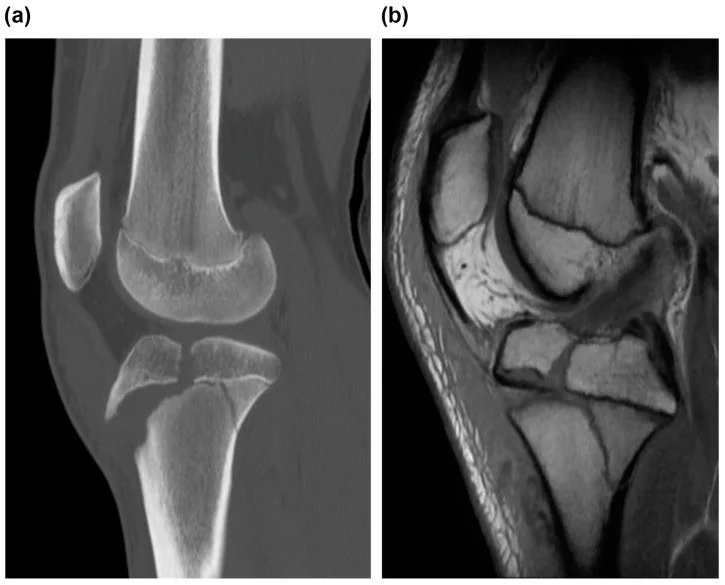
Diz çevresi fizis kırıkları çocuk ve ergenlerde distal femur ya da proksimal tibia büyüme plağını etkiler; yüksek enerjili travma veya spor yaralanması sonrası oluşabilir. Kontrastsız BT, özellikle eklem yüzüne uzanan epifiz kırıklarında kemik parçalarının yerini ve eklem basamağını gösterir; kıkırdak fizis ve kemik iliği hasarı grafide/BT'de belirsiz kalırsa MRG tamamlayıcıdır. Bu bölgedeki fizis hasarı büyüme duraklaması, ekstremite uzunluk farkı veya açısal deformiteyle sonuçlanabilir. Kırık hattının fizis-metafiz-epifiz ilişkisini atlamak, büyüme plağı riskinin ve eklem içi uzanımın eksik tanımlanmasına yol açar.
Faz ve pencere
- Kontrastsız tanısal
- Fizis boyunca genişleme veya basamak, metafizer ya da epifiz uzanımlı kırık çizgisi, kortikal kesinti ve eklem yüzü uyumsuzluğu değerlendirilir; kontrast gerekmez.
- Kemik algoritması tanısal
- Koronal ve sagittal ince kesitler kırık hattının fizisten metafize/epifize geçişini, deplasmanı ve eklem basamağını gösterir; karşı taraf fizisi yaşa uygun kontur ve kapanma görünümü için kıyaslanır.
Önerilen pencereler: Kemik (G 1800 / M 400), Yumuşak doku (G 400 / M 40).
BT bulguları
- Distal femur veya proksimal tibia fizisinde fokal genişleme, düzensizlik ya da kortikal devamlılık kaybı.
- Kırık hattının epifize ve eklem yüzüne geçmesi; eklem basamağı veya kondiler yüz uyumsuzluğu.
- Epifiz-metafiz parçalarının fizis boyunca ayrılması ve deplasman yönü.
- Fizis yaralanması sonrası kemik köprüsü (fizis barı) ve buna bağlı uzuv uzunluğu farkı ya da açısal deformite zamanla gelişebildiğinden uzun dönem takip ve büyüme öngörüsü gerekir.
- Efüzyon ve komşu yumuşak doku şişliği akut diz travmasına eşlik edebilir.
- Açık, kapanmakta olan veya kapanmış fizis görünümü hastanın gelişim evresi ve karşı tarafla birlikte değerlendirilir; normal fizis dar ve düzgün olabilir.
Ölçütler ve sınıflamalar
- Salter–Harris sınıflaması
- Tip I: kırık fizis boyunca; Tip II: fizis ve metafiz; Tip III: fizis ve epifiz/eklem yüzü; Tip IV: metafiz, fizis ve epifiz boyunca; Tip V: fizisin kompresyon ezilmesi. BT özellikle eklem içi Tip III-IV uzanımı ve kemik deplasmanını göstermede yararlıdır.
Normalde
Normal açık fizis, distal femur veya proksimal tibia metafiziyle epifiz arasında düzgün, kesintisiz bir radyolüsent çizgi olarak izlenir; yaş ilerledikçe fizis incelir ve fizyolojik kapanma odakları oluşabilir. Karşı tarafta aynı kemiğin fizis genişliğini ve kapanma şeklini, ayrıca metafizer korteks ile eklem yüzünün kesintisizliğini kıyaslayın.
Normal BT ile kıyasla
Aynı bölgenin, kaynak veri setinde patoloji içermediği belirtilen bir BT incelemesini kesit kesit kaydırın; organ sınırlarını açarak anatomiyi hasta görüntüsüyle karşılaştırın. Küçük rastlantısal bulgular tümüyle dışlanmamıştır.
Kaynak: TotalSegmentator v2.01 veri seti (Wasserthal ve ark., Radiology: Artificial Intelligence 2023), CC BY 4.0, vaka s0685; organ sınırları veri setinin otomatik segmentasyonundan, birleştirilerek sadeleştirildi. Görüntüler 2,5 mm kesit aralığına yeniden örneklendi.
Ayırıcı tanı
- Fizyolojik fizis kapanması
- yaşa uygun, düzgün ve çoğu kez simetrik kemikleşme köprüleri gösterir; komşu akut kortikal kırık hattı yoktur.
- Metafizer kırık, fizis dışı
- kortikal veya trabeküler çizgi metafizde kalır ve fizis/epifiz boyunca uzanmaz.
- Tibial eminens avulsiyonu
- interkondiler eminens merkezinde kemik fragmanı vardır; proksimal tibia fizisi boyunca ayrışma değildir.
- Distal femur kondil osteokondral yaralanması
- eklem yüzü altı fragman ve kıkırdak hasarı ön plandadır; fizis çizgisini takip eden ayrışma görülmez.
- Eski fizis yaralanmasına bağlı bar
- sınırlı kemik köprü ve asimetrik büyüme görünümü kronikliği destekler; akut travmaya ait yeni kırık kenarı olmayabilir.
Tuzaklar
- Kapanmakta olan fizisi kırık hattı sanma; karşı tarafla aynı düzeydeki fizis kalınlığı ve kemikleşme düzenini kıyasla.
- Salter–Harris I yaralanmasında BT'nin normal olmasını fizis yaralanmasını dışlayan kanıt sayma; kıkırdak ve kemik iliği ödemi için MRG daha duyarlıdır.
- Epifiz uzanımını yalnız aksiyel kesitte arama; eklem yüzü basamağı ve kırık hattının fizisle ilişkisi koronal-sagittal rekonstrüksiyonlarda daha iyi haritalanır.
- Fizis barı ve büyüme duraklaması travmayı izleyen aylar ya da yıllar içinde gelişebildiğinden akut BT'de kesinleştirilemez; uzun dönem takip ve büyüme öngörüsü gerekir.
Kendini dene
Epifiz, fizis ve metafizi birlikte tutan Salter-Harris kırık tipi hangisidir?
Cevabı göster
Tip IV. Salter-Harris tip IV kırık; epifiz, fizis ve metafiz bölümlerini birlikte içeren bir büyüme plağı kırığıdır. Tip III ise epifize ve eklem içine uzanır.
Fizis ve epifiz boyunca ilerleyip eklem yüzünde basamak oluşturan kırık için en uygun sınıf hangisidir?
Cevabı göster
Salter–Harris Tip III. Tip III kırık fizis ile epifizi geçerek eklem yüzüne ulaşır. Tip IV ise epifiz, fizis ve metafizi birlikte içeren bir fizis kırığıdır.
Kaynaklar
Bu sayfadaki 37 cümle ve 2 quiz sorusu aşağıdaki kaynaklardan alıntılarla tek tek karşılaştırıldı; 6 cümle bu karşılaştırmada düzeltildi (2026-10-08).
- Intraosseous tumours of the kneepmc.ncbi.nlm.nih.gov
- Knee Pain: The Fine Line Between Malignant and Benignpmc.ncbi.nlm.nih.gov
- Prospective analysis of injury demographics, distribution, severity and risk factors in adolescent climberspmc.ncbi.nlm.nih.gov
- Bone marrow edema in children: chronic nonbacterial osteomyelitis and its mimickerspmc.ncbi.nlm.nih.gov
- Chronic Noninfectious Osteomyelitis: A Review of Imaging Findingspmc.ncbi.nlm.nih.gov
- Conservative Treatment of Pediatric Fractures-Narrative Review of Acceptable Deformity and Remodeling Potential.pubmed.ncbi.nlm.nih.gov
- Physeal-Sparing Medial Femoral Condyle Flap for Treatment of Scaphoid Nonunion With Avascular Necrosis in Skeletally Immature Patients: A Case Series With Long-Term Follow-Up.pubmed.ncbi.nlm.nih.gov
- Pediatric physeal fractures and growth disturbance: current concepts and surgical approaches.pubmed.ncbi.nlm.nih.gov
- Imaging of pediatric musculoskeletal trauma: Age-specific considerations and challenges.pubmed.ncbi.nlm.nih.gov
- A Systematic Approach to the Evaluation of Acute Musculoskeletal Injuries in the Emergency Department.pubmed.ncbi.nlm.nih.gov
- Open Distal Femoral Physeal Fracture in a 6-Year-Old Child Complicated by Growth Arrest and Limb-Length Discrepancy: A Case Report.pubmed.ncbi.nlm.nih.gov
- Oblique Plane Deformity Correction with Ilizarov Fixator in Ipsilateral Proximal Tibia Growth Arrest and Malunited Tibia: A Case Report.pubmed.ncbi.nlm.nih.gov
- Monteggia equivalent fracture associated with Salter-Harris I fracture of the radial head.pubmed.ncbi.nlm.nih.gov
- Osteonecrosis in Youth with Sickle Cell Disease-A Narrative Review.pubmed.ncbi.nlm.nih.gov
- Outcomes of indeterminate fractures identified on skeletal surveys obtained during non-accidental trauma evaluations.pubmed.ncbi.nlm.nih.gov
- Does the mini-open technique still have a role in the modern management of pediatric tibial eminence fractures?pubmed.ncbi.nlm.nih.gov
- Natural reverse shoulder joint following a conservatively treated proximal humeral fracture in adolescence-a 46-year follow-up case report.pubmed.ncbi.nlm.nih.gov
- Isolated fracture of the anterior wall of the acetabulum: A rare fracture, even rarer in the skeletally immature patient. Report of two cases and literature review.pubmed.ncbi.nlm.nih.gov
- Case Report: Distal tibial physeal fracture secondary to septic physitis and osteomyelitis in a Boxer puppy.pubmed.ncbi.nlm.nih.gov
- Orthopaedic diagnostic pitfalls in fibroblast growth factor 23-mediated hypophosphatemic rickets/osteomalacia in fibrous dysplasia/McCune-Albright syndrome: Two burosumab-treated cases.pubmed.ncbi.nlm.nih.gov
- An Anatomic Reduction Technique for Salter-Harris Type III Medial Femoral Condyle Fractures.pubmed.ncbi.nlm.nih.gov
- Emergency Medicine Management of Distal Radius and Ulna Fractures: Narrative Review.pubmed.ncbi.nlm.nih.gov
- Comparison of Arthroscopic Reduction and Percutaneous Fixation Versus Open Reduction for Pediatric Intra-articular Epiphyseal Ankle Fractures.pubmed.ncbi.nlm.nih.gov
- Reliability and clinical utility of paediatric ankle fracture classifications : a systematic review.pubmed.ncbi.nlm.nih.gov
- Surgical management of supracondylar humerus fracture in a child with severe hemophilia A: A case report.pubmed.ncbi.nlm.nih.gov
- Management of a Comminuted Patellar Fracture in a Child Using a Titanium Claw Plate: A Case Report.pubmed.ncbi.nlm.nih.gov
- Challenges in Reconstruction and Limb Lengthening Surgery for Congenital Lower Limb Deficiencies.pubmed.ncbi.nlm.nih.gov
- The iliotibial band revisited: surgical anatomy and imaging-based guidelines for lateral tenodesis in ACL reconstruction.pubmed.ncbi.nlm.nih.gov
- Growth Plate Injury Leading to Madelung-Type Deformity After ESIN in Children: A Case Report and a Narrative Review of the Literature.pubmed.ncbi.nlm.nih.gov
- Normal ossification of the glenoid mimicking a glenoid fracture in an adolescent patient: a case report.pubmed.ncbi.nlm.nih.gov
- Indications and Timing of Guided Growth Techniques for Pediatric Upper Extremity Deformities: A Literature Review.pubmed.ncbi.nlm.nih.gov
- Regenerative Medicine Approaches for the Treatment of Pediatric Physeal Injuries.pubmed.ncbi.nlm.nih.gov
- Distal ulna physeal fracture Salter-Harris type IV versus cleft ulnar epiphysis: Two pediatric case report.pubmed.ncbi.nlm.nih.gov
- Suture Fixation Versus Screw Fixation in Pediatric Tibial Eminence Fractures: A Systematic Review and Meta-Analysis of Clinical Outcomes and Reoperation Rates.pubmed.ncbi.nlm.nih.gov
- Pediatric ACL Injuries: A Current Concepts Review.pubmed.ncbi.nlm.nih.gov
- Is There a Difference Between Medial and Lateral Femoral Condyle Allografts? An Outcome and Survivorship Analysis.pubmed.ncbi.nlm.nih.gov
- Clinical Outcomes Following Anatomic Medial Patellofemoral Ligament Reconstruction With Concomitant Procedures in Skeletally Immature Patients With Patellar Instability.pubmed.ncbi.nlm.nih.gov
- Arthroscopic Management of Patellar Instability in Skeletally Immature Patients: Current Concepts and Future Directions.pubmed.ncbi.nlm.nih.gov
- Physeal Bar Formation After Salter-Harris III and IV Medial Malleolus Fractures in Children Aged ≤10 Years.pubmed.ncbi.nlm.nih.gov
- Post-infection physeal bar resection of the proximal tibia: a case report and narrative review of the literature.pubmed.ncbi.nlm.nih.gov
- Self-Reported 20-Year Outcome of Taylor Spatial Frame Correction for Distal Femoral Physeal Growth Disturbance: A Case Report.pubmed.ncbi.nlm.nih.gov
- Delayed Correction of Intra-articular Lateral Head Fracture of the Proximal Phalanx of the Great Toe in Children.pubmed.ncbi.nlm.nih.gov
- Comparative Outcomes of Treatment Strategies for Traumatic Distal Humerus Physeal Separation in Children: A Systematic Review.pubmed.ncbi.nlm.nih.gov
- Management and subsequent outcomes of patellar sleeve injuries: A retrospective case series of 90 pediatric and adolescent patients.pubmed.ncbi.nlm.nih.gov
- Transphyseal Proximal Humeral Aneurysmal Bone Cyst with Pathologic Fracture in a Child: A Case Report.pubmed.ncbi.nlm.nih.gov
- Risk Factor Analysis for Growth Arrest in Paediatric Physeal Fractures-A Prospective Study.pubmed.ncbi.nlm.nih.gov
- The role of 99m Tc-DPD bone SPECT/CT in the management of growth disturbance of the long bones in pediatric patients: a retrospective observational study.pubmed.ncbi.nlm.nih.gov
- Physeal breach as a potential predictor of pulmonary metastasis in paediatric osteosarcoma.pubmed.ncbi.nlm.nih.gov
- A Comprehensive Guide to Revision Medial Patellofemoral Ligament Reconstruction in Adolescents.pubmed.ncbi.nlm.nih.gov
- ACL injuries in skeletally immature athletes.pubmed.ncbi.nlm.nih.gov
- Therapeutic progress in the management of triplane fractures in adolescents.pubmed.ncbi.nlm.nih.gov
- Robot-assisted percutaneous cannulated screw fixation in the treatment of slipped capital femoral epiphysis.pubmed.ncbi.nlm.nih.gov
- Knee Pain: The Fine Line Between Malignant and Benign.pubmed.ncbi.nlm.nih.gov
- Intraosseous tumours of the knee.pubmed.ncbi.nlm.nih.gov
- Prospective analysis of injury demographics, distribution, severity and risk factors in adolescent climbers.pubmed.ncbi.nlm.nih.gov
- Evaluation and Management of Transitional Fractures of the Distal Radius.pubmed.ncbi.nlm.nih.gov
- Acute medial tibial plateau elevation with gradual metaphyseal correction using an Ilizarov fixator for late-presenting infantile Langenskiold stage V and VI Blount's disease. Short-term results.pubmed.ncbi.nlm.nih.gov
- Avulsion injuries: an update on radiologic findings.pubmed.ncbi.nlm.nih.gov
- When performance declines: culturally mediated delay in pediatric knee fracture following traditional healing and scarification-a case report from rural Cameroon.pubmed.ncbi.nlm.nih.gov
- Outcomes of Surgical Management of Late Presenting Intra-Articular Distal Femoral Physeal Fracture: A Multicentric Retrospective Case Series.pubmed.ncbi.nlm.nih.gov
- Outcomes of Surgical Management of Late Presenting Intra-Articular Distal Femoral Physeal Fracture: A Multicentric Retrospective Case Series.pubmed.ncbi.nlm.nih.gov
- Secondary deformity after treatment of pediatric fragmental distal femoral metaphyseal fracture: a case report and review of the literature.pubmed.ncbi.nlm.nih.gov
- The Unique Features of Pediatric Sports Injuries: The Hip.pubmed.ncbi.nlm.nih.gov
- Management of Physeal Fractures: A Review Article.pubmed.ncbi.nlm.nih.gov
- Penetrating Ballistic Trauma to the Popliteal Fossa Without Neurovascular Injury Despite High-Risk Trajectory: An Unusual Case Report.pubmed.ncbi.nlm.nih.gov
- Bilateral Knee Osteonecrosis in an Adolescent With Leukemia on Prolonged Corticosteroids: Discordant Femoral-Tibial Findings on Bone Scan SPECT-CT.pubmed.ncbi.nlm.nih.gov
- Interventions for treating wrist fractures in children.pubmed.ncbi.nlm.nih.gov
- Application of biodegradable implants in pediatric orthopedics: shifting from absorbable polymers to biodegradable metals.pubmed.ncbi.nlm.nih.gov
- Glossary of terms for musculoskeletal radiology.pubmed.ncbi.nlm.nih.gov
- Nonproliferative and Proliferative Lesions of the Rat and Mouse Skeletal Tissues (Bones, Joints, and Teeth).pubmed.ncbi.nlm.nih.gov
- Coronal plane deformity around the knee in the skeletally immature population: A review of principles of evaluation and treatment.pubmed.ncbi.nlm.nih.gov
- Guided growth in the correction of knee deformity in patients with congenital insensitivity to pain.pubmed.ncbi.nlm.nih.gov
- An update on tibial tubercle avulsion fractures: a narrative review.pubmed.ncbi.nlm.nih.gov
- Long-term safety and effectiveness of the "OptEase" vena cava filter.pubmed.ncbi.nlm.nih.gov
- Imaging of pediatric bone and growth disorders: Of diagnostic workhorses and new horizons.pubmed.ncbi.nlm.nih.gov
- A missed opportunity: A scoping review of the effect of sex and age on osteoarthritis using large animal models.pubmed.ncbi.nlm.nih.gov
- Overuse injuries in sport: a comprehensive overview.pubmed.ncbi.nlm.nih.gov
- Diagnostic Imaging of the Skeletal System: Overview of Applications in Human and Veterinary Medicine.pubmed.ncbi.nlm.nih.gov
- A Review of Pediatric Orthopedic Disorders: Diagnosis and Treatment Updates.pubmed.ncbi.nlm.nih.gov
- Selective Femoral Resurfacing for Bilateral Knee Osteonecrosis: A Bone-Preserving Alternative to Total Knee Arthroplasty.pubmed.ncbi.nlm.nih.gov
- Discovery and Characterization of Intercondylar Transphyseal Complexes and their Oncological Significance in Transphyseal Extension of Pediatric Osteosarcoma.pubmed.ncbi.nlm.nih.gov
- Multimodal Imaging of Osteosarcoma: From First Diagnosis to Radiomics.pubmed.ncbi.nlm.nih.gov
- Fractures of the Proximal Femur in Childhood: A Review.pubmed.ncbi.nlm.nih.gov
- 2.5-mm articulated endoluminal forceps using a compliant mechanism.pubmed.ncbi.nlm.nih.gov
- Short-term whole-body vibration in adolescents: A prospective single-arm study of diffusion tensor imaging-derived changes in the knee physis and postural stability.pubmed.ncbi.nlm.nih.gov
- Chronic Noninfectious Osteomyelitis: A Review of Imaging Findings.pubmed.ncbi.nlm.nih.gov
- Outcome of Open Distal Tibial Physeal Fractures: A Descriptive Report of Two Cases.pubmed.ncbi.nlm.nih.gov
- Surgical Management of a Proximal Tibial Epiphyseal Fracture in a Pediatric Patient with Osteogenesis Imperfecta.pubmed.ncbi.nlm.nih.gov
- Arthroscopic management of pediatric ankle fractures: a systematic review.pubmed.ncbi.nlm.nih.gov
- Deep Learning-Based Multi-Class Pediatric Wrist Fracture Subtype Classification: A Pilot Study Comparing Convolutional Neural Network Architectures.pubmed.ncbi.nlm.nih.gov
- Open Reduction and Internal Fixation of a Comminuted Displaced Radial Head Fracture in a 12-Year-Old Female: A Case Report.pubmed.ncbi.nlm.nih.gov
- Invited Perspective: It is Time to Rename SCFE.pubmed.ncbi.nlm.nih.gov
- Diagnostic Pitfalls and Management of Transphyseal Fractures of the Distal Humerus: A Retrospective Review of 25 Cases.pubmed.ncbi.nlm.nih.gov
- A Novel Model of Hip Femoroacetabular Impingement in Immature Rabbits Reproduces the Distinctive Head-Neck Cam Deformity.pubmed.ncbi.nlm.nih.gov
- Intra-articular Physeal Fractures of the Distal Femur: A Frequently Missed Diagnosis in Adolescent Athletes.pubmed.ncbi.nlm.nih.gov
- Ultrasound Imaging-Based Methods for Assessing Biological Maturity during Adolescence and Possible Application in Youth Sport: A Scoping Review.pubmed.ncbi.nlm.nih.gov
- Imaging of physeal injury: overuse.pubmed.ncbi.nlm.nih.gov
- Recognition and management of traumatic sports injuries in the skeletally immature athlete.pubmed.ncbi.nlm.nih.gov
- Review for the generalist: evaluation of pediatric hip pain.pubmed.ncbi.nlm.nih.gov
- Post-operative imaging in pediatric distal radius fractures: When tradition meets evidence.pubmed.ncbi.nlm.nih.gov
- Pediatric Knee Injury: A Unique Case of Intra-articular Osteochondral Fracture Following Penetrating Trauma.pubmed.ncbi.nlm.nih.gov
- Osteochondritis dissecans of the elbow: recent evolution of pathogenesis, imaging, and treatment modalities.pubmed.ncbi.nlm.nih.gov
- Imaging the Pediatric Athlete: Acute and Stress Skeletal Injuries.pubmed.ncbi.nlm.nih.gov
- Patellofemoral Instability in the Adolescent Age Group.pubmed.ncbi.nlm.nih.gov
- Choosing the right animal model for osteomyelitis research: Considerations and challenges.pubmed.ncbi.nlm.nih.gov
- Management of Acute Lateral Humeral Condyle Fractures in Children.pubmed.ncbi.nlm.nih.gov
- Peri-epiphyseal and Overuse Injuries in Adolescent Athletes.pubmed.ncbi.nlm.nih.gov
- International Harmonization of Nomenclature and Diagnostic Criteria (INHAND): Non-proliferative and Proliferative Lesions of the Non-human Primate ( M. fascicularis ).pubmed.ncbi.nlm.nih.gov
- Calcification of the Lateral Collateral Ligament of the Knee: A Case Series.pubmed.ncbi.nlm.nih.gov
- Interventions for treating ankle fractures in children.pubmed.ncbi.nlm.nih.gov
- MRI of Knee Joint Lesions: An Observational Study of Traumatic, Degenerative, Cystic, and Neoplastic Pathologies.pubmed.ncbi.nlm.nih.gov
- International Harmonization of Nomenclature and Diagnostic Criteria (INHAND): Nonproliferative and Proliferative Lesions of the Rabbit.pubmed.ncbi.nlm.nih.gov
- A nosographic and etiopathogenetic framework for subchondral bone marrow lesions in the knee: A narrative review.pubmed.ncbi.nlm.nih.gov
- Magnetic Resonance Imaging Patterns of Common Injuries in Pediatric and Adolescent Athletes.pubmed.ncbi.nlm.nih.gov
- Arthroscopic Fixation of Knee Femoral Condyle Osteochondritis Dissecans Fragment With Bone Marrow Aspirate Concentrate.pubmed.ncbi.nlm.nih.gov
Eğitim amaçlıdır; hasta başında tanı ve tedavi kararının yerine geçmez. İçerik yapay zekâ destekli bir süreçle güncel literatüre göre cümle cümle kaynaklarla karşılaştırıldı, ancak uzman radyolog incelemesinden geçmedi. Klinik kararlarda güncel kılavuzları, kurum protokollerini ve radyoloji raporunu esas alın.