Özet
Akut lateral patella çıkığı veya subluksasyonu sonrası medial patella fasetinden ya da lateral femoral kondilden osteokondral fragman kopabilir. Patella çıkığı sonrası medial patella fasetinden veya lateral femoral kondilden kopan osteokondral fragman eklem boşluğunda yer değiştirmiş olarak bulunabilir. BT, patella çıkığıyla ilişkili kemik avülsiyonlarını ve osteokondral kırıkları belirleyip fragman yerini tanımlamaya katkı sağlayabilir; kıkırdak ve kapsül-bağ durumu için MRG bilgi verir. Eklem içi serbest fragman veya defekt atlanırsa travmanın eklem yüzüne etkisi eksik kalır.
Faz ve pencere
- Kontrastsız tanısal
- Medial patella ve lateral femoral kondilde osteokondral kırık örüntülerini değerlendirin; eklem boşluğundaki fragmanlar lateral olukta, anterior veya posterior eklem boşluğunda ya da suprapatellar alanda bulunabilir. Patella kırıklarında BT, özellikle alt kutup parçalı kırıklarının değerlendirilmesinde konvansiyonel radyografiden daha doğru olabilir.
- Kemik algoritması tanısal
- BT, kemik ve osteokondral fragmanların karakterizasyonuna katkı sağlar; kıkırdak ve kapsül-bağ yapılarının değerlendirilmesinde MRG bilgi verir.
Önerilen pencereler G genişlik, M merkez; değerler Hounsfield birimi (HU)
- KemikG 1800 / M +400
- Yumuşak dokuG 400 / M +40
BT bulguları
- Patellar tilt, BT'de lateral patellofemoral açı veya patellar tilt ölçümüyle değerlendirilebilir.
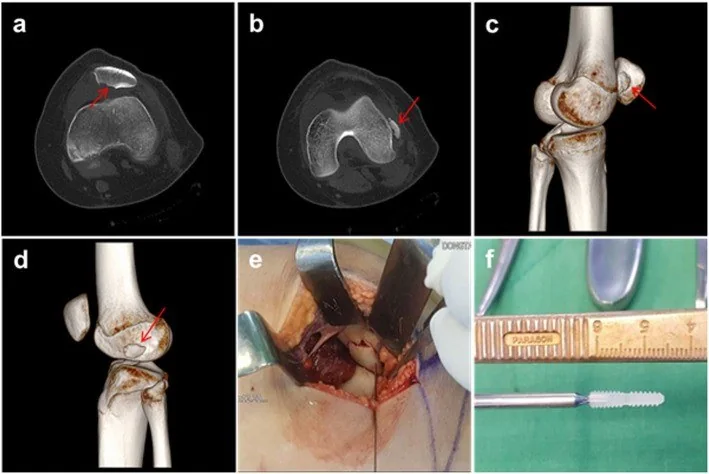
- Medial patella fasetinden osteokondral fragman, patella çıkığı veya subluksasyonu sonrası kopabilir.
- Patella çıkığı veya subluksasyonu sonrası lateral femoral kondilden osteokondral fragman kopabilir.
- İnferomedial patella fragmanı, inferomedial patellar fasetten kopan osteokondral kırık örüntüsüdür ve eklem içinde yer değiştirebilir.
- Eklem içi osteokondral fragmanlar lateral olukta, anterior veya posterior eklem boşluğunda ya da suprapatellar alanda bulunabilir.
- Patella çıkığına medial patellofemoral bağın üst patellar bölümden veya medial patellotibial ve patellomeniskal bağların alt patellar bölümden avülsiyonu eşlik edebilir.
- Akut patella çıkığında medial patellofemoral bağ hemen her zaman yaralanır; kapsül-bağ durumunu değerlendirmede MRG bilgi verir.
- BT'de kortikal defekt ve mineralize osteokondral fragman aranır; kıkırdak hasarı BT'de doğrudan gösterilemez.
Normalde
Patellanın eklem kıkırdağı, medial ve lateral fasetlere ayrılır. Patellofemoral instabilite değerlendirmesinde ipsilateral ve karşı diz ölçümleri karşılaştırılabilir.
Normal BT ile kıyasla
Aynı bölgenin, kaynak veri setinde patoloji içermediği belirtilen bir BT incelemesini kesit kesit kaydırın; organ sınırlarını açarak anatomiyi hasta görüntüsüyle karşılaştırın. Küçük rastlantısal bulgular tümüyle dışlanmamıştır.
Kaynak: TotalSegmentator v2.01 veri seti (Wasserthal ve ark., Radiology: Artificial Intelligence 2023), CC BY 4.0, vaka s0685; organ sınırları veri setinin otomatik segmentasyonundan, birleştirilerek sadeleştirildi. Görüntüler 2,5 mm kesit aralığına yeniden örneklendi.
Ayırıcı tanı
- Patella gövde kırıkları morfolojik paterne göre sınıflanır; çıkık/subluksasyon sonrası medial patellar faset veya lateral femoral kondilden kopan osteokondral fragman örüntüsünden ayrılır.
- Bipartit patella
- superolateral parçanın kenarları düzgün kortikedir ve eklem yüzünde akut defekt oluşturması beklenmez.
- Osteokondritis dissekan subkondral kemik iskemisi ve/veya kırığıyla ilişkili olabilir; patella çıkığı sonrası osteokondral fragmanlar medial patella fasetinden veya lateral femoral kondilden kopabilir.
- Kronik patellar maltracking, patella ile trokleanın dinamik ilişkisindeki dengesizlikten kaynaklanabilir ve altta yatan yapısal anormalliklerle ilişkili olabilir.
Tuzaklar
- Çıkık inceleme sırasında kendiliğinden redükte olmuş olabilir; patellanın merkezde görünmesiyle medial faset ve lateral kondil impaksiyonlarını taramayı bırakmayın.
- Eklem içindeki küçük osteokondral fragmanları lateral oluk, anterior ve posterior eklem boşlukları ile suprapatellar alanda arayın.
- BT'de belirgin kemik parçası görülmemesi saf kıkırdak osteokondral yaralanmasını dışlamaz; klinik kuşku sürüyorsa BT'nin kıkırdak sınırlılığını raporda belirtin.
- Medial yumuşak doku şişliği MPFL bütünlüğünü göstermez; MPFL ve diğer kapsül-ligamentöz yapıların değerlendirilmesinde MR bilgi sağlar.
Kendini dene
Lateral patella çıkığı sonrası medial patella ve lateral femoral kondilde eşzamanlı osteokondral yaralanmalar görülebilir. En olası açıklama nedir?
Cevabı göster
Kendiliğinden redükte lateral patella çıkığı. Medial patella ve lateral femoral kondilde eşzamanlı osteokondral yaralanma lateral patella çıkığıyla ilişkili olabilir; çıkık kendiliğinden redükte olabileceğinden görüntüleme sırasında patella redükte görünse bile çıkık öyküsü önemlidir.
Patella çıkığı sonrası BT'de medial patella fasetinden ayrılmış kemik-kıkırdak parçası suprapatellar alanda görülüyor. Bu bulgu nasıl adlandırılmalıdır?
Cevabı göster
Eklem içine yer değiştirmiş osteokondral parça. Patella fasetinden kopan osteokondral fragman eklem boşluğunda yer değiştirmiş olabilir; suprapatellar alan bu fragmanların görülebildiği yerlerden biridir.
İlgili konular
Kaynaklar
Bu sayfadaki 36 cümle ve 2 quiz sorusu aşağıdaki kaynaklardan alıntılarla otomatik olarak karşılaştırıldı; 21 cümle bu karşılaştırmada düzeltildi (2026-10-12).
- Imaging of patellar fracturespmc.ncbi.nlm.nih.gov
- Acute traumatic patellar dislocation.pubmed.ncbi.nlm.nih.gov
- Lateral Patellar Instability.pubmed.ncbi.nlm.nih.gov
- Pediatric Patellar Injuries.pubmed.ncbi.nlm.nih.gov
- Irreducible, incarcerated vertical dislocation of patella into a Hoffa fracture.pubmed.ncbi.nlm.nih.gov
- A new minimally invasive surgical technique for medial retinaculum repair following traumatic patellar dislocation.pubmed.ncbi.nlm.nih.gov
- Pediatric lateral patellar dislocation: is there a role for plain radiography in the emergency department?pubmed.ncbi.nlm.nih.gov
- An Unexpected Complication after Headless Compression Screw Fixation of an Osteochondral Fracture of Patella.pubmed.ncbi.nlm.nih.gov
- [Patellar osteochondral injury as onset of patellar instability].pubmed.ncbi.nlm.nih.gov
- Osteochondral fracture of the patella without soft tissue injury and with no dislocation: A case report.pubmed.ncbi.nlm.nih.gov
- Late Repair, One Year After a Knee Twisting Injury, of a Missed Femoral Trochlea Osteochondral Fragment, With Bioabsorbable Nails, in a 14-Year-Old Boy.pubmed.ncbi.nlm.nih.gov
- MRI as the optimal imaging modality for assessment and management of osteochondral fractures and loose bodies following traumatic patellar dislocation: a systematic review.pubmed.ncbi.nlm.nih.gov
- A Rare Case of Large Osteochondral Fracture of Patella.pubmed.ncbi.nlm.nih.gov
- Effect of Patellar Morphology on the Risk of Osteochondral Fracture after Patellar Dislocation: A Cross-sectional Study.pubmed.ncbi.nlm.nih.gov
- Suprapatellar pouch effusion is associated with an increased risk of neglected osteochondral fractures in primary acute traumatic patellar dislocation: a consecutive series of 113 children.pubmed.ncbi.nlm.nih.gov
- Combination of Cartiheal and Osteochondral Allograft for the Treatment of Multifocal Cartilage Defects.pubmed.ncbi.nlm.nih.gov
- Prognostic Role of Lesion Morphology in Patellar Osteochondral Fixation: Influence of Localization and Size on Functional and Pain Outcomes.pubmed.ncbi.nlm.nih.gov
- Cartilage restoration procedures in patellofemoral stabilization.pubmed.ncbi.nlm.nih.gov
- Simultaneous Osteochondral Fractures of the Medial Patella and Lateral Femoral Condyle Following Lateral Patellar Dislocation: A Case Report.pubmed.ncbi.nlm.nih.gov
- Recurrence in Adolescents With First-Time Acute Patellar Dislocation: Comparing Outcomes With and Without Osteochondral Fracture.pubmed.ncbi.nlm.nih.gov
- Effectiveness analysis of arthroscopy-assisted medial retinaculum tightening suture with internal fixation for treating adolescent acute patellar dislocation with osteochondral fracture: A retrospective study.pubmed.ncbi.nlm.nih.gov
- Glossary of terms for musculoskeletal radiology.pubmed.ncbi.nlm.nih.gov
- Subject-specific analysis of joint contact mechanics: application to the study of osteoarthritis and surgical planning.pubmed.ncbi.nlm.nih.gov
- Accuracy of Preoperative Magnetic Resonance Imaging in Predicting Intra-articular Pathology Associated With Patellar Instability Diagnosed by Arthroscopy: A High Rate of Discordant Findings Altering Surgical Treatment.pubmed.ncbi.nlm.nih.gov
- A Systematic Approach to the Evaluation of Acute Musculoskeletal Injuries in the Emergency Department.pubmed.ncbi.nlm.nih.gov
- Novel Technique for Closed Reduction of an Irreducible Patella Dislocation in a Degenerative Knee.pubmed.ncbi.nlm.nih.gov
- Locked Lateral Patellar Dislocation Reduced by Arthroscopic Procedure: A Case Report.pubmed.ncbi.nlm.nih.gov
- Patterns of Avulsion and Osteochondral Fractures Associated with Patellar Dislocations: A Descriptive Study Using 3-Dimensional Computed Tomography.pubmed.ncbi.nlm.nih.gov
- In Vivo Classification of Patellar Motion Trajectories in Individuals: A 4D-CT-Based Study with Unsupervised Clustering.pubmed.ncbi.nlm.nih.gov
- Management Options for Shoulder Impingement Syndrome in Athletes: Insights and Future Directions.pubmed.ncbi.nlm.nih.gov
- Patellar maltracking: an update on the diagnosis and treatment strategies.pubmed.ncbi.nlm.nih.gov
- Jumping patella is associated with inferior clinical outcomes after MPFL reconstruction for recurrent patellar dislocation: a retrospective cohort study.pubmed.ncbi.nlm.nih.gov
- Age-Dependent Susceptibility to Mechanical Unloading-Induced Femoral Morphological Changes and Patellar Instability in a Rat Model.pubmed.ncbi.nlm.nih.gov
- Patellar Instability: A Narrative Review with an Integrated Treatment Algorithm.pubmed.ncbi.nlm.nih.gov
- Osteochondral Fragment Repair Using Knotless All-Suture Anchor Technique Within Patellofemoral Joint.pubmed.ncbi.nlm.nih.gov
- Arthroscopic-assisted Suture-based Fixation of Patellar Osteochondral Fractures using the DG-lock Suturing: A Novel Technique.pubmed.ncbi.nlm.nih.gov
- The Irreducible Patella in the Elderly Patient: A Case Report.pubmed.ncbi.nlm.nih.gov
- Establishment and validation of a novel rat model of early-stage patellofemoral osteoarthritis induced by patellar instability.pubmed.ncbi.nlm.nih.gov
- Osteochondral Fragment from the Lateral Femoral Condyle in an Adult after Patellar Dislocation: A Surgical Challenge.pubmed.ncbi.nlm.nih.gov
- Osteochondral flake refixation using the parachute technique yields favourable clinical and radiological outcomes following acute patellar dislocation: A case series at short- to mid-term follow-up.pubmed.ncbi.nlm.nih.gov
- Does Conventional Radiography Overrepresent Joint Space Narrowing in Hallux Rigidus? A Comparative Study With Weightbearing CT Imaging.pubmed.ncbi.nlm.nih.gov
- Assessment and management of torsional malalignment in paediatric patients with patellofemoral joint instability.pubmed.ncbi.nlm.nih.gov
- Morphological and postoperative functional comparison of patellar dislocation with or without avulsion fracture of the medial inferior border of the patella.pubmed.ncbi.nlm.nih.gov
- Patellar fracture mapping: characteristics of fracture line distribution and risk factors for postoperative malposition.pubmed.ncbi.nlm.nih.gov
- Thrombectomy and balloon angioplasty for a traumatic popliteal artery injury: A stent-free approach.pubmed.ncbi.nlm.nih.gov
- A Comprehensive Guide to Revision Medial Patellofemoral Ligament Reconstruction in Adolescents.pubmed.ncbi.nlm.nih.gov
- The apTTTG distance decreases linearly with knee flexion: A dynamic CT-based analysis in patients with patellofemoral instability.pubmed.ncbi.nlm.nih.gov
- Primary Lateral Patellar Dislocation Associated with an Increased Sulcus Angle in an African Child: A Case Report of Synthetic Graft-Assisted Medial Patellofemoral Ligament Reconstruction.pubmed.ncbi.nlm.nih.gov
- Kinematic Alignment in TKA Using the Contralateral Healthy Knee as Reference: A Combined Finite Element and Clinical Analysis.pubmed.ncbi.nlm.nih.gov
- Patellofemoral outcomes after kinematic versus mechanical alignment in primary total knee arthroplasty : a focused scoping review of head-to-head comparative studies.pubmed.ncbi.nlm.nih.gov
- No significant side-to-side differences in retropatellar load distribution using more than 7.5 years after isolated MPFL reconstruction: A CT-osteoabsorptiometry pilot study in nine patients.pubmed.ncbi.nlm.nih.gov
- Conservative versus surgical management of pediatric bipartite patella with patellar dislocation: a single-center retrospective analysis.pubmed.ncbi.nlm.nih.gov
- Trochlear dysplasia is associated with distal patellar fracture.pubmed.ncbi.nlm.nih.gov
- Current concepts review: Fractures of the patella.pubmed.ncbi.nlm.nih.gov
- The state of trial registrations in the field of Orthopaedics in years 2015-2020. A meta-epidemiological study.pubmed.ncbi.nlm.nih.gov
- Review for the generalist: evaluation of anterior knee pain.pubmed.ncbi.nlm.nih.gov
- <i>In Vitro</i> Evaluation of Lateral Femur Condyle Free Chondral Fragment Swelling after Soaking in Normal Saline.pubmed.ncbi.nlm.nih.gov
- A nosographic and etiopathogenetic framework for subchondral bone marrow lesions in the knee: A narrative review.pubmed.ncbi.nlm.nih.gov
- Bone Marrow Edema Injury Patterns in the Pediatric Knee: An MRI Study.pubmed.ncbi.nlm.nih.gov
- Transient lateral patellar dislocation resulting in osteochondral lesion of the lateral femoral condyle: a case series of findings on cone beam CT.pubmed.ncbi.nlm.nih.gov
- Managing patellofemoral instability in in-season athletes: a review.pubmed.ncbi.nlm.nih.gov
- Lateral patellar retinaculum hypertrophy on magnetic resonance imaging predicts patellar subluxation in femoral trochlear dysplasia.pubmed.ncbi.nlm.nih.gov
- Patellar Tracking: An Old Problem with New Insights.pubmed.ncbi.nlm.nih.gov
- Management of Juvenile Osteochondral Fractures Utilising Absorbable PLGA Implants.pubmed.ncbi.nlm.nih.gov
- Bone marrow edema of the knee: a narrative review.pubmed.ncbi.nlm.nih.gov
- Long-term outcomes of arthroscopic single-anchor fixation versus microfracture for osteochondral fractures of the knee weight-bearing area in adolescents and young adults.pubmed.ncbi.nlm.nih.gov
- Imaging of pediatric musculoskeletal trauma: Age-specific considerations and challenges.pubmed.ncbi.nlm.nih.gov
- Double Adjustable-Loop Cortical Buttons for Minimally Invasive Anatomic Double-Bundle Medial Patellofemoral Ligament Reconstruction.pubmed.ncbi.nlm.nih.gov
- Dynamic Ultrasound Assessment of Axial Extensor Mechanism Alignment in Adolescents With and Without Patellofemoral Instability.pubmed.ncbi.nlm.nih.gov
- Reconsideration of radiographic axial imaging techniques for the evaluation of patellofemoral alignment: skyline view vs. merchant view.pubmed.ncbi.nlm.nih.gov
- Weight-bearing computed tomography in knee pathologies: current evidence and future perspectives.pubmed.ncbi.nlm.nih.gov
- Patellar Non-Traumatic Pathologies: A Pictorial Review of Radiologic Findings.pubmed.ncbi.nlm.nih.gov
- Current concepts in the management of high-energy tibial plateau fractures: a narrative review.pubmed.ncbi.nlm.nih.gov
- Primary hypertrophic osteoarthropathy and bilateral transient lateral patellar dislocation in an adolescent.pubmed.ncbi.nlm.nih.gov
- Fixation of an Osteochondral Fracture of the Lateral Femoral Condyle With Knotless Suture Anchors.pubmed.ncbi.nlm.nih.gov
- Management of patellar instability in skeletally immature patients.pubmed.ncbi.nlm.nih.gov
- High prevalence of generalized ligamentous laxity in patellar dislocation with posterior weight-bearing lateral femoral condyle osteochondral fractures: an observational study and treatment outcomes.pubmed.ncbi.nlm.nih.gov
- Computed Tomography-Based Imaging Scores in Basilar Artery Occlusions: A Comparison of Predictive Abilities for Functional Outcomes.pubmed.ncbi.nlm.nih.gov
- Computed Tomography Findings in Pathology-Confirmed Rhino-Orbital Mucormycosis During the COVID-19 Era: A Retrospective Cross-Sectional Study.pubmed.ncbi.nlm.nih.gov
- Volumetric assessment from L2 to L4 improves the reliability and validity of body composition by CT.pubmed.ncbi.nlm.nih.gov
- Comparable clinical outcomes and redislocation rates after isolated medial patellofemoral ligament reconstruction in patients with and without borderline anatomical risk factors for patellar instability.pubmed.ncbi.nlm.nih.gov
- Comparison of Ultrasonographic, Radiographic, Computed Tomographic, and Ex Vivo Measurements of Feline Femoral Trochlear Groove Depth.pubmed.ncbi.nlm.nih.gov
- New variant of bipartite patella with traumatic separation and complete disruption of the extensor mechanism of the knee.pubmed.ncbi.nlm.nih.gov
- [Clinical Features and Radiological Differential Diagnoses of Symptomatic Sesamoid Bones and Accessory Ossicles: A Pictorial Essay].pubmed.ncbi.nlm.nih.gov
- Arthroscopic Fixation of Unstable Adolescent Knee Osteochondritis Dissecans With Structural Tibial Cancellous Bone Autograft.pubmed.ncbi.nlm.nih.gov
- Screw Versus Suture Bridge Fixation for Medial Femoral Condyle Osteochondritis Dissecans Demonstrate Comparable Healing Rates.pubmed.ncbi.nlm.nih.gov
- Femoral Osteochondritis Dissecans and Tibial Osteochondral Defect in an Adult Revealed by Bone SPECT/CT.pubmed.ncbi.nlm.nih.gov
- Complications in anterior cruciate ligament reconstruction Articular cartilage reconstruction: Review of concepts, techniques, complications, risk factors, and Bail out/salvage strategies.pubmed.ncbi.nlm.nih.gov
- Reconstruction of the medial patellofemoral ligament using a double-bundle semitendinosus tendon graft and a single suture anchor.pubmed.ncbi.nlm.nih.gov
- Arthroscopic Management of Patellar Instability in Skeletally Immature Patients: Current Concepts and Future Directions.pubmed.ncbi.nlm.nih.gov
- Image based three-dimensional kinematic mapping to optimize femoral tunnel placement for intra-articular cranial cruciate ligament reconstruction in dogs.pubmed.ncbi.nlm.nih.gov
- Correlation between Patellar Tilt Angle, Femoral Anteversion and Tibial Tubercle Trochlear Groove Distance Measured by Computer Tomography in Patients with non-Traumatic Recurrent Patellar Dislocation.pubmed.ncbi.nlm.nih.gov
- Extensor mechanism realignment procedures in the treatment of patellofemoral instability.pubmed.ncbi.nlm.nih.gov
- Deepening trochleoplasty combined with balanced medial patellofemoral ligament reconstruction for an adequate graft tensioning.pubmed.ncbi.nlm.nih.gov
- Spinal facet joint biomechanics and mechanotransduction in normal, injury and degenerative conditions.pubmed.ncbi.nlm.nih.gov
- Osteochondritis Dissecans of the Knee: Etiology and Pathogenetic Mechanisms. A Systematic Review.pubmed.ncbi.nlm.nih.gov
- Total knee arthroplasty for the treatment of osteoarthritis secondary to bilateral congenital patellar dislocation: A case report and review of the literature.pubmed.ncbi.nlm.nih.gov
- Patellofemoral disorders: role of computed tomography and magnetic resonance imaging in defining abnormal rotational lower limb alignment.pubmed.ncbi.nlm.nih.gov
- Musculoskeletal CT Imaging: State-of-the-Art Advancements and Future Directions.pubmed.ncbi.nlm.nih.gov
- Osteochondritis Dissecans: Current Understanding of Epidemiology, Etiology, Management, and Outcomes.pubmed.ncbi.nlm.nih.gov
- Imaging Evaluation of the Patellofemoral Joint.pubmed.ncbi.nlm.nih.gov
- Guide to lower extremity radiologic measurements: part 1 hip.pubmed.ncbi.nlm.nih.gov
- Complication Rates and Clinical Outcomes of Larger Alignment Corrections Using Inverted V-shaped High Tibial Osteotomy in Severe Varus Knee Osteoarthritis: A Comparison with Smaller Corrections.pubmed.ncbi.nlm.nih.gov
- Impact of femoral mediolateral diameter on femoral component selection during total knee arthroplasty and its effect on postoperative knee function and pain: a retrospective cohort study.pubmed.ncbi.nlm.nih.gov
- Robotic vs. conventional total knee arthroplasty over two decades: Evolving trends toward personalised alignment without significant clinical superiority in predominantly mild varus deformity-A systematic review of RCTs.pubmed.ncbi.nlm.nih.gov
- Femoral and tibial alignments in chihuahuas with patellar luxation by radiograph: Angular values and intra- and inter-observer agreement of measurements.pubmed.ncbi.nlm.nih.gov
- Increased tibiofemoral rotation is associated with anatomical risk factors for lateral patella instability.pubmed.ncbi.nlm.nih.gov
- Bone Marrow Edema and Tyrosine Kinase Inhibitors Treatment in Chronic Myeloid Leukemia.pubmed.ncbi.nlm.nih.gov
- Treatment of Knee Osteochondral Fractures.pubmed.ncbi.nlm.nih.gov
- Ipsilateral Knee Pain After Total Hip Arthroplasty: Pathogenesis and Intervention Strategies-A Narrative Review.pubmed.ncbi.nlm.nih.gov
- The Impact of Axial CT Level Selection on Grading Trochlear Dysplasia Using Dejour Classification.pubmed.ncbi.nlm.nih.gov
Eğitim amaçlıdır; hasta başında tanı ve tedavi kararının yerine geçmez, tıbbi tavsiye değildir. Metinler yapay zekâ desteğiyle yazıldı ve otomatik bir adımda kaynak alıntılarıyla karşılaştırıldı; bu bir tıbbi doğrulama değildir ve içerik uzman radyolog incelemesinden geçmedi. Klinik kararlarda güncel kılavuzları, kurum protokollerini ve radyoloji raporunu esas alın.